Introduction to Linguistics
Part One- Sounds
(Phonetics and Phonology)
Level-3
1- Phonetics
• Phonetics is the branch of Linguistics which comprises the study
of the sounds of human speech and their production. It is the
study of how speech sounds are made or articulated.
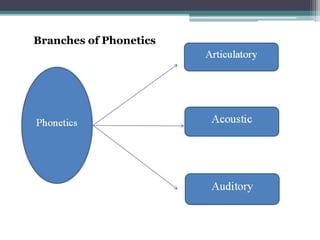
There are three basic areas of study:
• Articulatory phonetics: The study of the production of speech
sounds by the articulatory and vocal organs by the speaker.
• Acoustic phonetics: The study of the physical transmission of
speech sounds from the speaker to the listener.
• Auditory phonetics: The study of the reception and
perception of speech sounds by the listener.
Branches of Phonetics
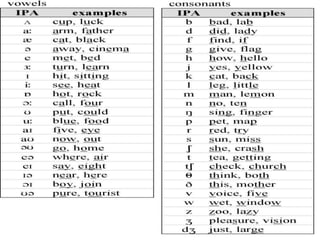
Phonetic Transcription
• Phonetic transcription (also known as phonetic
script or phonetic notation) is the visual
representation of speech sounds.
• The most common type of phonetic
transcription uses a phonetic alphabet, such as
the International Phonetic Alphabet or (IPA)
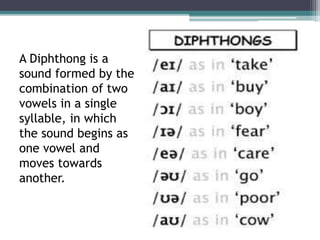
A Diphthong is a
sound formed by the
combination of two
vowels in a single
syllable, in which
the sound begins as
one vowel and
moves towards
another.
A glide from one vowel to another and then to a third one. (Closing diphthong + ǝ)
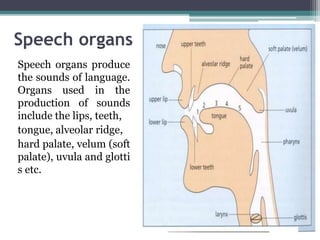
Speech organs
Speech organs produce
the sounds of language.
Organs used in the
production of sounds
include the lips, teeth,
tongue, alveolar ridge,
hard palate, velum (soft
palate), uvula and glotti
s etc.
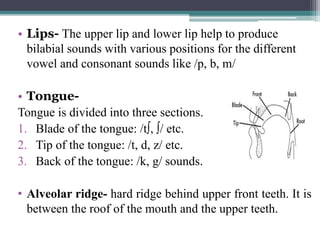
• Lips- The upper lip and lower lip help to produce
bilabial sounds with various positions for the different
vowel and consonant sounds like /p, b, m/
• Tongue-
Tongue is divided into three sections.
1. Blade of the tongue: /t∫, ∫/ etc.
2. Tip of the tongue: /t, d, z/ etc.
3. Back of the tongue: /k, g/ sounds.
• Alveolar ridge- hard ridge behind upper front teeth. It is
between the roof of the mouth and the upper teeth.
• Velum- /k, ɡ, ŋ/ sounds are produced by raising the
back part of the tongue to the soft palate or the velum.
• Uvula- The loose hanging end of the soft palate, [q] [ɣ]
sounds are produced by raising the back of the tongue to
the uvula. The uvular sounds [q] and [ɣ] occur in
languages like Arabic, Persian Urdu etc. These do not
normally occur in English.
• Glottis- It assists in forming or producing the buzzing
sounds like /g, ŋ, ʤ/.
2- Phonology
• Phonology is a branch of linguistics concerned with
the systematic organization of sounds in languages.
• It has traditionally focused largely on the study of
the systems of phonemes in particular languages (and
therefore used to be also called phonemics, or
phonematics)
• Phonology describes the way sounds function within
a given language or across languages to encode
meaning.
Phoneme, Phone and Allophone
• A phoneme is the smallest contrastive linguistic unit
which may bring about a change of meaning. For example
'mat' and 'bat'. Phonemes are based on spoken language
and recorded by IPA (International Phonetic Alphabet).
They are written between slashes. e.g. /p/
• Allophones are variations of phonemes. So, they are set of
possible spoken sounds used to pronounce one single
phoneme. e.g. [pʰ] (as in pin) and [p] (as in spin) are
allophones of the phoneme /p/. This feature (puff of air as
in pʰ) is known as aspiration.
• A Phone is a unit of speech sound. It may refer to any
speech sound or gesture without regard of its place in
phonology of a language. A phoneme is a set of phones or a
set of sound features that are thought of as the same
element within the phonology of a particular language.
Place of Articulation
• In articulatory phonetics, the place of
articulation (also point of articulation) of
a consonant is the point of contact where
an obstruction occurs in the vocal
tract between articulatory gestures.
• Dental- A dental consonant is a consonant articulated
with the tongue against the upper teeth, such
as /t/, /d/, /n/, and /l/ in some languages.
• Alveolar- Alveolar consonants are articulated with
the tongue against or close to the superior alveolar
ridge, such as /t/, /d/, /s/, /z/, /n/ etc.
• Palatal- Consonants which are articulated with
the body of the tongue raised against the hard
palate, such as /ʃ/, /tʃ/, /ʒ/ and /dʒ/ etc.
• Velar- Velars are consonants articulated with the
back part of the tongue against the soft palate,
such as /k/, /g/, /ŋ/ etc.
• Glottal- Glottal consonants are consonants using
the glottis as their primary articulation, such as
/h/ and /?/ etc.
Manner of Articulation
The manner of articulation is the configuration
and interaction of the articulators (speech
organs such as the tongue, lips, and palate) when
making a speech sound.
1. Stops [p, t, k (voiceless) b, d, g (voiced)]
2. Fricatives [f, s (voiceless), and v, z (voiced)]
3. Affricates [tʃ and dʒ]
4. Nasals [m, n and ŋ]
5. Liquids [l and r]
Voiced and voiceless sounds
• Voiceless sounds are those when the vocal cords
are spread apart and the air from the lungs passes
between them unobstructed.
• Examples: p, t, k, s, sh, ch, th (as in thing).
• Voiced sounds are those sounds when the vocal
cords are drawn together, the air from the lungs
repeatedly pushes them apart as it passes through,
creating a vibration effect.
• Examples: b, d, th (as in then), v, l, r, z, j
• All vowel sounds and diphthongs (combination of
two vowel sounds) are voiced.
Manner of Articulation
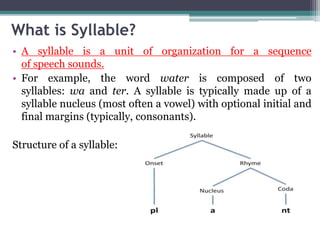
What is Syllable?
• A syllable is a unit of organization for a sequence
of speech sounds.
• For example, the word water is composed of two
syllables: wa and ter. A syllable is typically made up of a
syllable nucleus (most often a vowel) with optional initial and
final margins (typically, consonants).
Structure of a syllable:
There are two types of syllable structures as below;
Closed Syllable: A closed syllable is that syllable where
onset, nucleus and coda all are present, as in mat, plant,
dog etc.
Open syllable: open syllable is that syllable where
either onset or coda is missing in a syllable, as in am, it,
too and see etc.
Phonotactics
• Phonotactics (from Ancient Greek phōnḗ "voice,
sound" and taktikós "having to do with
arranging") is a branch of phonology that deals with
restrictions in a language on the permissible
combinations of phonemes.
• Phonotactics defines permissible syllable
structure, consonant clusters , and vowel sequences
by means of phonotactical constraints.
Consonant Clusters
• In linguistics, a consonant cluster or consonant
sequence is a group of consonants which have no
intervening vowel. In English, for example, the
groups’ /spl/ and /ts/ are consonant clusters in the
word splits.
• Words like black, bread, trick, twin, flat, throw,
splash, strong, square etc. are some examples of
Consonant Clusters in English.
***********

phoneticsandphonology

  • 1.
    Introduction to Linguistics PartOne- Sounds (Phonetics and Phonology) Level-3
  • 2.
    1- Phonetics • Phoneticsis the branch of Linguistics which comprises the study of the sounds of human speech and their production. It is the study of how speech sounds are made or articulated. There are three basic areas of study: • Articulatory phonetics: The study of the production of speech sounds by the articulatory and vocal organs by the speaker. • Acoustic phonetics: The study of the physical transmission of speech sounds from the speaker to the listener. • Auditory phonetics: The study of the reception and perception of speech sounds by the listener.
  • 3.
  • 4.
    Phonetic Transcription • Phonetictranscription (also known as phonetic script or phonetic notation) is the visual representation of speech sounds. • The most common type of phonetic transcription uses a phonetic alphabet, such as the International Phonetic Alphabet or (IPA)
  • 6.
    A Diphthong isa sound formed by the combination of two vowels in a single syllable, in which the sound begins as one vowel and moves towards another.
  • 7.
    A glide fromone vowel to another and then to a third one. (Closing diphthong + ǝ)
  • 8.
    Speech organs Speech organsproduce the sounds of language. Organs used in the production of sounds include the lips, teeth, tongue, alveolar ridge, hard palate, velum (soft palate), uvula and glotti s etc.
  • 9.
    • Lips- Theupper lip and lower lip help to produce bilabial sounds with various positions for the different vowel and consonant sounds like /p, b, m/ • Tongue- Tongue is divided into three sections. 1. Blade of the tongue: /t∫, ∫/ etc. 2. Tip of the tongue: /t, d, z/ etc. 3. Back of the tongue: /k, g/ sounds. • Alveolar ridge- hard ridge behind upper front teeth. It is between the roof of the mouth and the upper teeth.
  • 10.
    • Velum- /k,ɡ, ŋ/ sounds are produced by raising the back part of the tongue to the soft palate or the velum. • Uvula- The loose hanging end of the soft palate, [q] [ɣ] sounds are produced by raising the back of the tongue to the uvula. The uvular sounds [q] and [ɣ] occur in languages like Arabic, Persian Urdu etc. These do not normally occur in English. • Glottis- It assists in forming or producing the buzzing sounds like /g, ŋ, ʤ/.
  • 11.
    2- Phonology • Phonologyis a branch of linguistics concerned with the systematic organization of sounds in languages. • It has traditionally focused largely on the study of the systems of phonemes in particular languages (and therefore used to be also called phonemics, or phonematics) • Phonology describes the way sounds function within a given language or across languages to encode meaning.
  • 12.
    Phoneme, Phone andAllophone • A phoneme is the smallest contrastive linguistic unit which may bring about a change of meaning. For example 'mat' and 'bat'. Phonemes are based on spoken language and recorded by IPA (International Phonetic Alphabet). They are written between slashes. e.g. /p/ • Allophones are variations of phonemes. So, they are set of possible spoken sounds used to pronounce one single phoneme. e.g. [pʰ] (as in pin) and [p] (as in spin) are allophones of the phoneme /p/. This feature (puff of air as in pʰ) is known as aspiration. • A Phone is a unit of speech sound. It may refer to any speech sound or gesture without regard of its place in phonology of a language. A phoneme is a set of phones or a set of sound features that are thought of as the same element within the phonology of a particular language.
  • 13.
    Place of Articulation •In articulatory phonetics, the place of articulation (also point of articulation) of a consonant is the point of contact where an obstruction occurs in the vocal tract between articulatory gestures. • Dental- A dental consonant is a consonant articulated with the tongue against the upper teeth, such as /t/, /d/, /n/, and /l/ in some languages. • Alveolar- Alveolar consonants are articulated with the tongue against or close to the superior alveolar ridge, such as /t/, /d/, /s/, /z/, /n/ etc.
  • 14.
    • Palatal- Consonantswhich are articulated with the body of the tongue raised against the hard palate, such as /ʃ/, /tʃ/, /ʒ/ and /dʒ/ etc. • Velar- Velars are consonants articulated with the back part of the tongue against the soft palate, such as /k/, /g/, /ŋ/ etc. • Glottal- Glottal consonants are consonants using the glottis as their primary articulation, such as /h/ and /?/ etc.
  • 15.
    Manner of Articulation Themanner of articulation is the configuration and interaction of the articulators (speech organs such as the tongue, lips, and palate) when making a speech sound. 1. Stops [p, t, k (voiceless) b, d, g (voiced)] 2. Fricatives [f, s (voiceless), and v, z (voiced)] 3. Affricates [tʃ and dʒ] 4. Nasals [m, n and ŋ] 5. Liquids [l and r]
  • 16.
    Voiced and voicelesssounds • Voiceless sounds are those when the vocal cords are spread apart and the air from the lungs passes between them unobstructed. • Examples: p, t, k, s, sh, ch, th (as in thing). • Voiced sounds are those sounds when the vocal cords are drawn together, the air from the lungs repeatedly pushes them apart as it passes through, creating a vibration effect. • Examples: b, d, th (as in then), v, l, r, z, j • All vowel sounds and diphthongs (combination of two vowel sounds) are voiced.
  • 17.
  • 18.
    What is Syllable? •A syllable is a unit of organization for a sequence of speech sounds. • For example, the word water is composed of two syllables: wa and ter. A syllable is typically made up of a syllable nucleus (most often a vowel) with optional initial and final margins (typically, consonants). Structure of a syllable:
  • 19.
    There are twotypes of syllable structures as below; Closed Syllable: A closed syllable is that syllable where onset, nucleus and coda all are present, as in mat, plant, dog etc. Open syllable: open syllable is that syllable where either onset or coda is missing in a syllable, as in am, it, too and see etc.
  • 20.
    Phonotactics • Phonotactics (fromAncient Greek phōnḗ "voice, sound" and taktikós "having to do with arranging") is a branch of phonology that deals with restrictions in a language on the permissible combinations of phonemes. • Phonotactics defines permissible syllable structure, consonant clusters , and vowel sequences by means of phonotactical constraints.
  • 21.
    Consonant Clusters • Inlinguistics, a consonant cluster or consonant sequence is a group of consonants which have no intervening vowel. In English, for example, the groups’ /spl/ and /ts/ are consonant clusters in the word splits. • Words like black, bread, trick, twin, flat, throw, splash, strong, square etc. are some examples of Consonant Clusters in English. ***********