Morphology & Phonology
BY JOSHUA S. DONALDSON
Morphology in Instruction
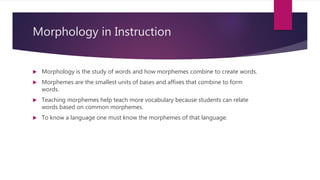
 Morphology is the study of words and how morphemes combine to create words.
 Morphemes are the smallest units of bases and affixes that combine to form
words.
 Teaching morphemes help teach more vocabulary because students can relate
words based on common morphemes.
 To know a language one must know the morphemes of that language.
Morphemes
 Morphemes are grouped into Two Classes
 Closed Classes – Morphemes keep the same form every time used and cannot be changed such as
conjunctions, pronouns, auxiliary verbs, determiners, prepositions, and inflectional suffixes.
 Open Classes – Morphemes change according to the grammar and meaning of a sentence such as
nouns, verbs, adjectives, adverbs, and derivational affixes.
 Free and Bound Morphemes
 Free – One morpheme and can stand alone
 Bound – One morpheme cannot stand alone and must be attached to a free morpheme
 Inflectional Bound – Can change meaning
 Derivational bound – Often changes part of speech
(From Linguistics for Teachers of ELLs)
Morphology Meets Communication Needs
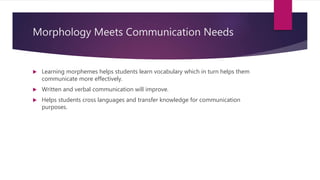
 Learning morphemes helps students learn vocabulary which in turn helps them
communicate more effectively.
 Written and verbal communication will improve.
 Helps students cross languages and transfer knowledge for communication
purposes.
Phonology in Instruction
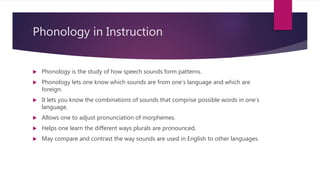
 Phonology is the study of how speech sounds form patterns.
 Phonology lets one know which sounds are from one’s language and which are
foreign.
 It lets you know the combinations of sounds that comprise possible words in one’s
language.
 Allows one to adjust pronunciation of morphemes.
 Helps one learn the different ways plurals are pronounced.
 May compare and contrast the way sounds are used in English to other languages.
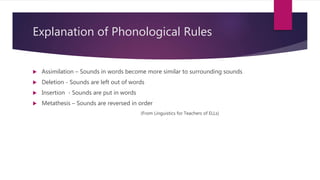
Explanation of Phonological Rules
 Assimilation – Sounds in words become more similar to surrounding sounds
 Deletion - Sounds are left out of words
 Insertion - Sounds are put in words
 Metathesis – Sounds are reversed in order
(From Linguistics for Teachers of ELLs)
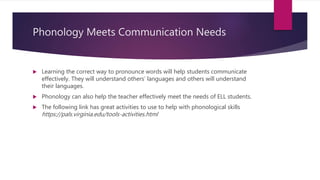
Phonology Meets Communication Needs
 Learning the correct way to pronounce words will help students communicate
effectively. They will understand others’ languages and others will understand
their languages.
 Phonology can also help the teacher effectively meet the needs of ELL students.
 The following link has great activities to use to help with phonological skills
https://pals.virginia.edu/tools-activities.html
References
 Fromkin, V., Rodman, R., & Hyams, N. (2014). An introduction to language
(10th ed.). Boston MA: Cengage Wadsworth.
 Pals activities. (2007). Phonological Awareness Literacy Screening. Retrieved
from https://pals.virginia.edu/tools-activities.html.
 What is morphology? Linguistics for Teachers of ELLS. Retrieved from
http://linguisticsforteachersofells.weebly.com/morphology-in-the-
classroom.html.
 What is phonology? Linguistics for Teachers of ELLS. Retrieved from
http://linguisticsforteachersofells.weebly.com/phonology-in-the-
classroom.html.

Morphology and Phonology

  • 1.
    Morphology & Phonology BYJOSHUA S. DONALDSON
  • 2.
    Morphology in Instruction Morphology is the study of words and how morphemes combine to create words.  Morphemes are the smallest units of bases and affixes that combine to form words.  Teaching morphemes help teach more vocabulary because students can relate words based on common morphemes.  To know a language one must know the morphemes of that language.
  • 3.
    Morphemes  Morphemes aregrouped into Two Classes  Closed Classes – Morphemes keep the same form every time used and cannot be changed such as conjunctions, pronouns, auxiliary verbs, determiners, prepositions, and inflectional suffixes.  Open Classes – Morphemes change according to the grammar and meaning of a sentence such as nouns, verbs, adjectives, adverbs, and derivational affixes.  Free and Bound Morphemes  Free – One morpheme and can stand alone  Bound – One morpheme cannot stand alone and must be attached to a free morpheme  Inflectional Bound – Can change meaning  Derivational bound – Often changes part of speech (From Linguistics for Teachers of ELLs)
  • 4.
    Morphology Meets CommunicationNeeds  Learning morphemes helps students learn vocabulary which in turn helps them communicate more effectively.  Written and verbal communication will improve.  Helps students cross languages and transfer knowledge for communication purposes.
  • 5.
    Phonology in Instruction Phonology is the study of how speech sounds form patterns.  Phonology lets one know which sounds are from one’s language and which are foreign.  It lets you know the combinations of sounds that comprise possible words in one’s language.  Allows one to adjust pronunciation of morphemes.  Helps one learn the different ways plurals are pronounced.  May compare and contrast the way sounds are used in English to other languages.
  • 6.
    Explanation of PhonologicalRules  Assimilation – Sounds in words become more similar to surrounding sounds  Deletion - Sounds are left out of words  Insertion - Sounds are put in words  Metathesis – Sounds are reversed in order (From Linguistics for Teachers of ELLs)
  • 7.
    Phonology Meets CommunicationNeeds  Learning the correct way to pronounce words will help students communicate effectively. They will understand others’ languages and others will understand their languages.  Phonology can also help the teacher effectively meet the needs of ELL students.  The following link has great activities to use to help with phonological skills https://pals.virginia.edu/tools-activities.html
  • 8.
    References  Fromkin, V.,Rodman, R., & Hyams, N. (2014). An introduction to language (10th ed.). Boston MA: Cengage Wadsworth.  Pals activities. (2007). Phonological Awareness Literacy Screening. Retrieved from https://pals.virginia.edu/tools-activities.html.  What is morphology? Linguistics for Teachers of ELLS. Retrieved from http://linguisticsforteachersofells.weebly.com/morphology-in-the- classroom.html.  What is phonology? Linguistics for Teachers of ELLS. Retrieved from http://linguisticsforteachersofells.weebly.com/phonology-in-the- classroom.html.