
Nanolithography
Presented by Preeti Choudhary
MSc Applied Physics
chaudharypreeti1997@gmail.com
Types of Lithography
 A. Photolithography (optical,
UV, EUV)
 B. E-beam/ion-
beam/Neutral atomic beam
lithography
 C. X-ray lithography
 D. Interference lithography
 E. Scanning Probe
Voltage pulse
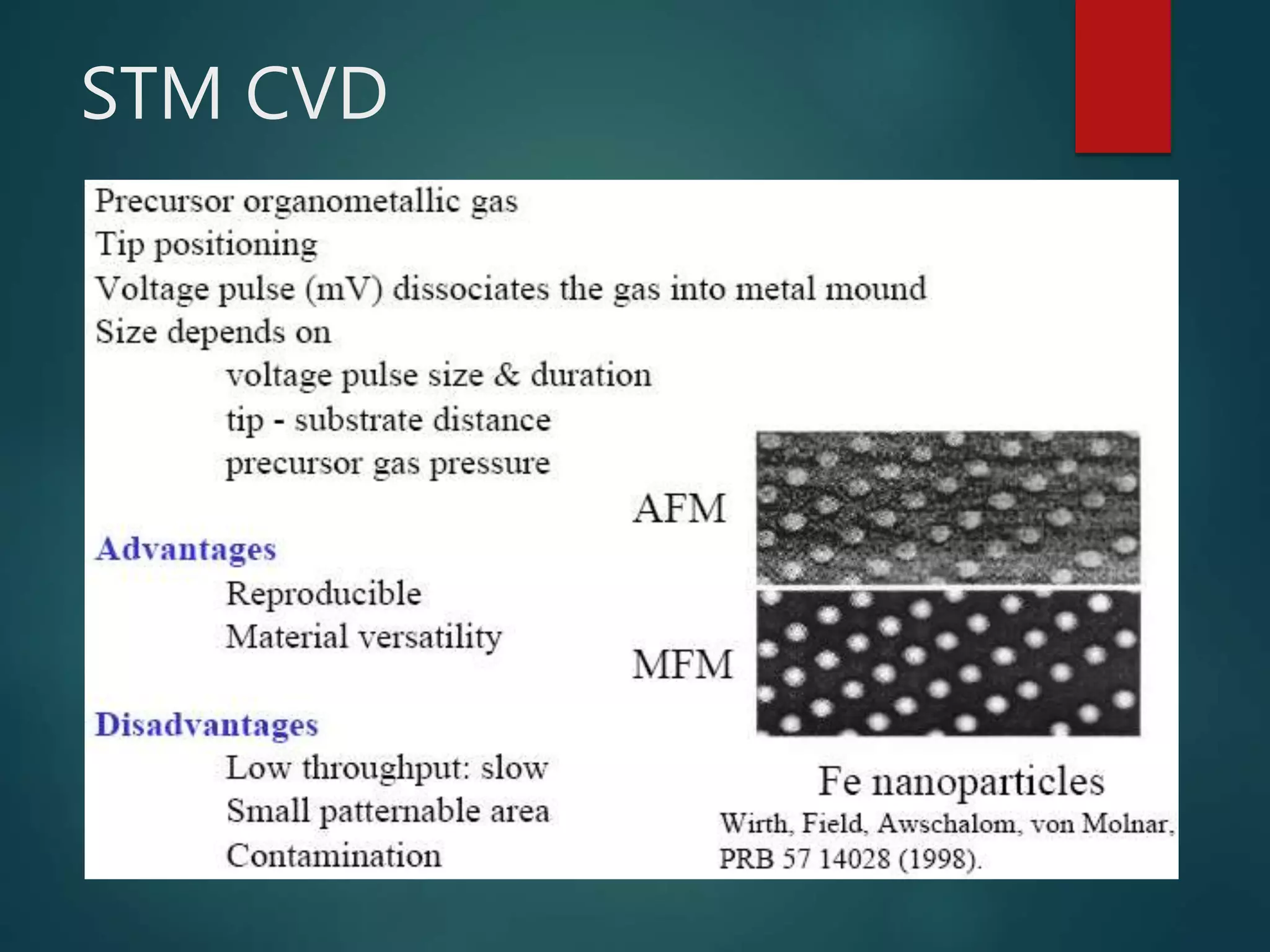
CVD
Local electrodeposition
Dip-pen
F. Step Growth
G. Soft Lithography
H. Nanoimprint
I. Shadow Mask
J. Self-Assembly
K. Nanotemplates
Diblock copolymer
Sphere
Alumina membrane
Nanochannel glass
Nuclear-track etched membrane
Photolithography
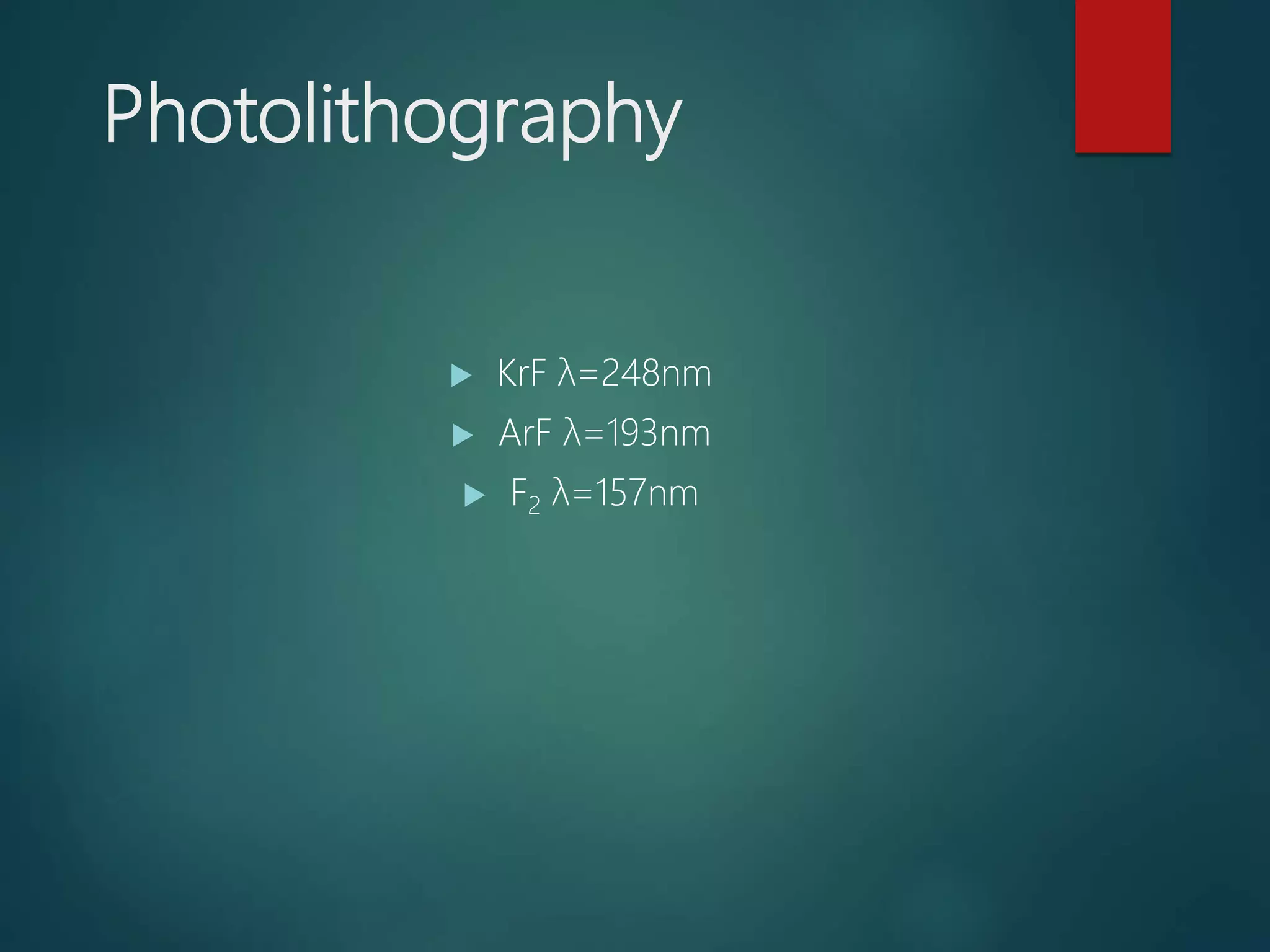
 KrF λ=248nm
 ArF λ=193nm
 F2 λ=157nm
Electron-Beam Lithography
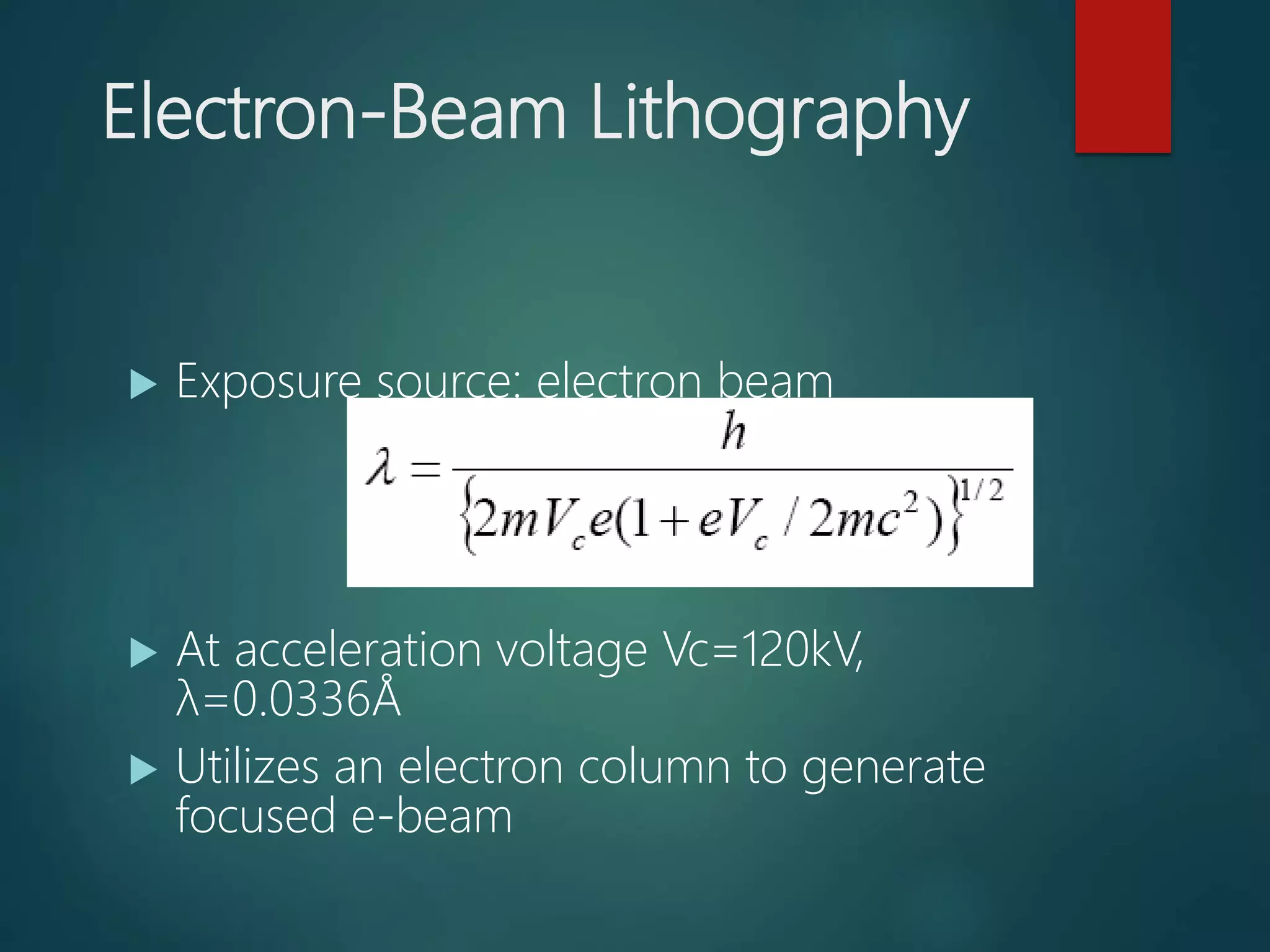
 Exposure source: electron beam
 At acceleration voltage Vc=120kV,
λ=0.0336Å
 Utilizes an electron column to generate
focused e-beam
Electron Column
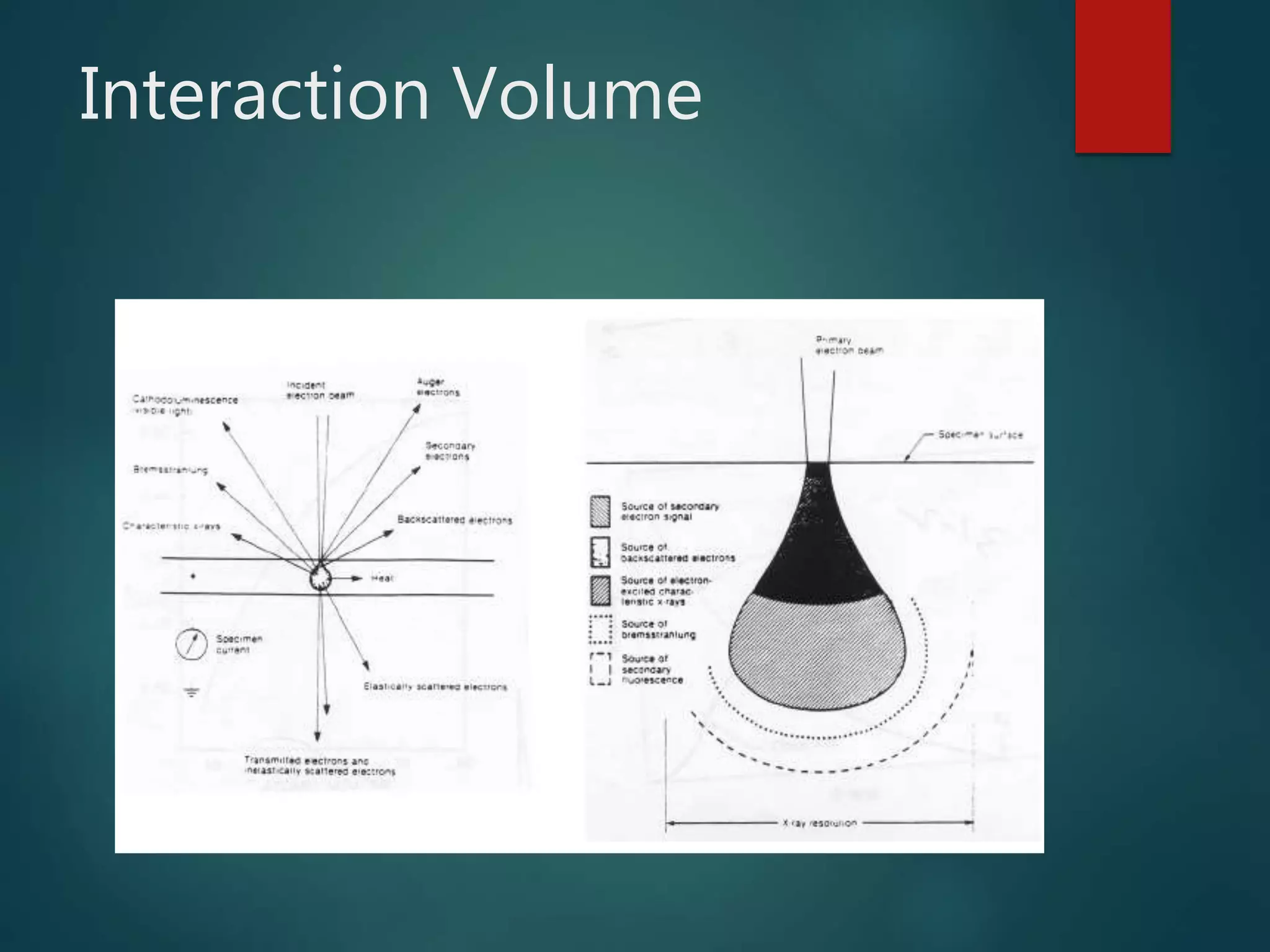
Interaction Volume
SEM Resolution
 Magnification x Resolution in (Å) = 107
for a 1mm feature on the image
 Collimation
 Wavelength
 Charging effect - coating
carbon, metal
thickness
 Escape depth
metal ~40 Å
semiconductor ~100 Å
insulator ~300 Å
SEM Images
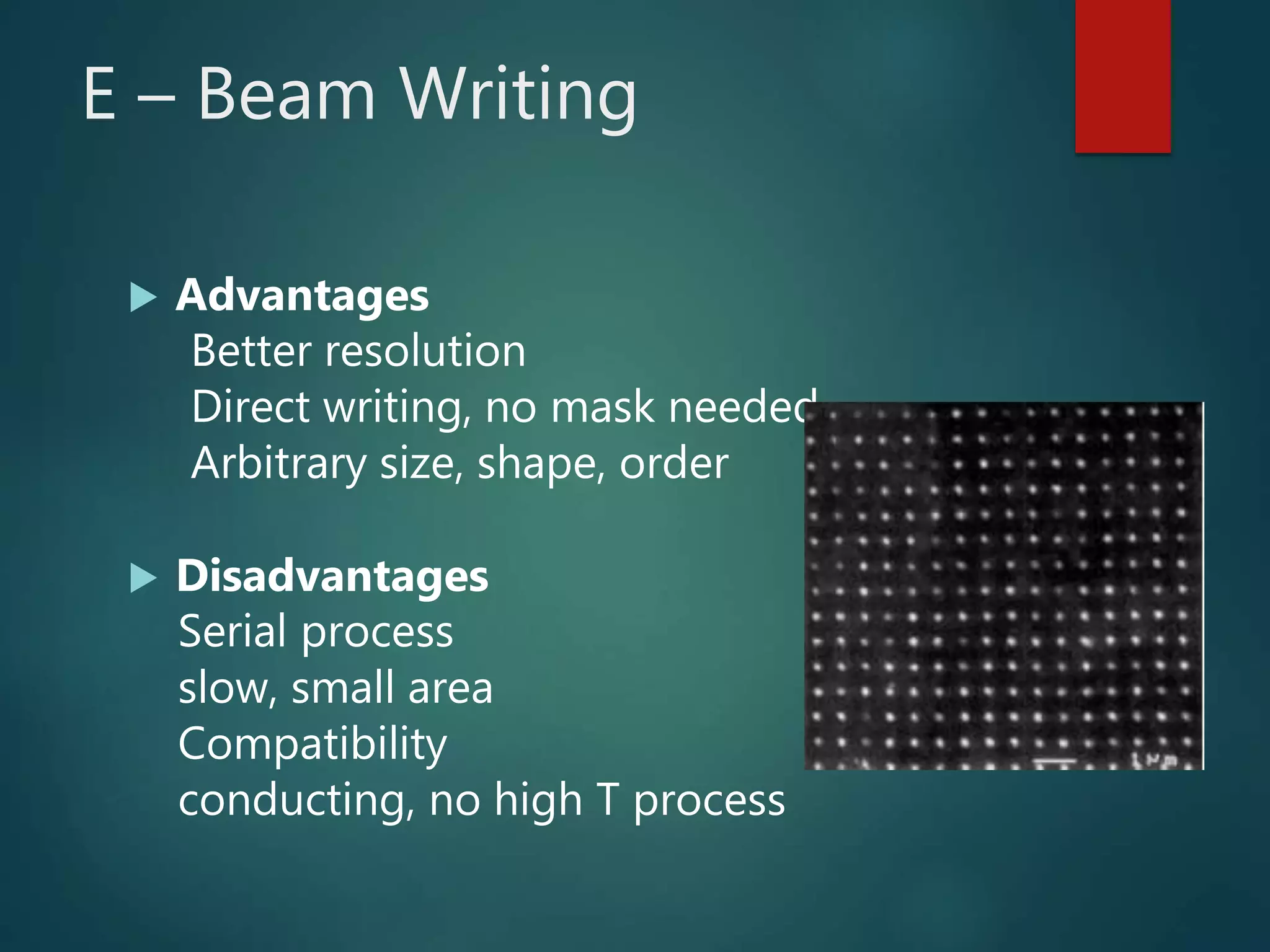
E – Beam Writing
 Advantages
Better resolution
Direct writing, no mask needed
Arbitrary size, shape, order
 Disadvantages
Serial process
slow, small area
Compatibility
conducting, no high T process
Sample E-beam Writing
Procedure
 Application of e-beam resist (PMMA)
 Spin coating & soft bake
 Loading
Ag paint reference, position
 Power on
 Tuning emission current
 Stabilizing filament
 Gun alignment
 Adjust astigmatism
 Referencing
 Focusing
 Writing
 Shutting down SEM
 Developing
 Hard bake
X-ray Lithography
 Exposure source: x-ray (synchrotron)
 Resist: sensitive to x-ray (PMMA)
– IBM used resists developed for DUV and obtained
successful
results
 Mask: SiC membrane covered by high Z metal;
fabricated by e – beam writer
 Advantages: High resolution
 Large area
 Disadvantage: Synchrotron facility necessary
X- Ray Lithography:
Applications
 IC industry
– Proposed for fabricating Gigabit-level
DRAM
– Not a mainstream technique for IC
fabrication
 Nanoelectronics
 MEMS applications
 – LIGA
 – High aspect ratio devices
Conclusions
 Electron-beam lithography is currently the industry
standard for high-resolution, but has limited applications
due to its high cost and time-demanding process.
 X-ray lithography is an up-and-coming technology that
can be used in the same capacities as optical
lithography with better results. However, due to the high
cost of the equipment and supplies, as well as the desire
to push optical lithography to its absolute limit, we can
only say that x-ray lithography has a bright future ahead.
References for E – Beam and
X – Ray Lithography
 C. Ngo and C. Rosilio, "Lithography for semiconductor technology," Nucl. Instr.
and Meth. In Phys. Res. B, vol. 131, pp. 22-29, 1997.
 R. C. Jager, Introduction to Microelectronic Fabrication, vol. 5. Upper Saddle
River, New Jersey: Prentice Hall, 2002.
 J. G. Chase and B. W. Smith, "Overview of Modern Lithography Techniques and
a MEMS Based Approach to High Throughput Rate Electron Beam
Lithography," J. Intell. Mater. Syst. Struct., vol. 12, pp. 807-817, 2002.
 J. N. Helbert, Handbook of VLSI Microlithography. Norwich, NY: Noyes
Publications/William Andrew Publishing, LLC., 2001.
 "Facility Procedures," in http://rlewb.mit.edu/sebl/facility_procedures.htm.
 "Raith Nanolithography Products," in
http://www.raith.com/WWW_RAITH/nanolithography/nano_faqs2.html.
 "Electron Beam Lithography," in http://www.shef.ac.uk/eee/research/ebl.
 K.-S. Chen, I.-K. Lin, and F.-H. Ko, "Fabrication of 3D Polymer Microstructures
Using Electron Beam Lithography and Nanoimprinting Technologies," J.
Micromech. Microeng., vol. 15, 2005.
 • J. P. Silverman, "Challenges and Progress in X-ray Lithography," J. Vac. Sci.
Technol. B, vol. 16, pp. 3137-3140, 1998.
 • S. Ohki and S. Ishihara, "An Overview of X-ray Lithography," Microelectron.
Eng., pp. 171-178, 1996.
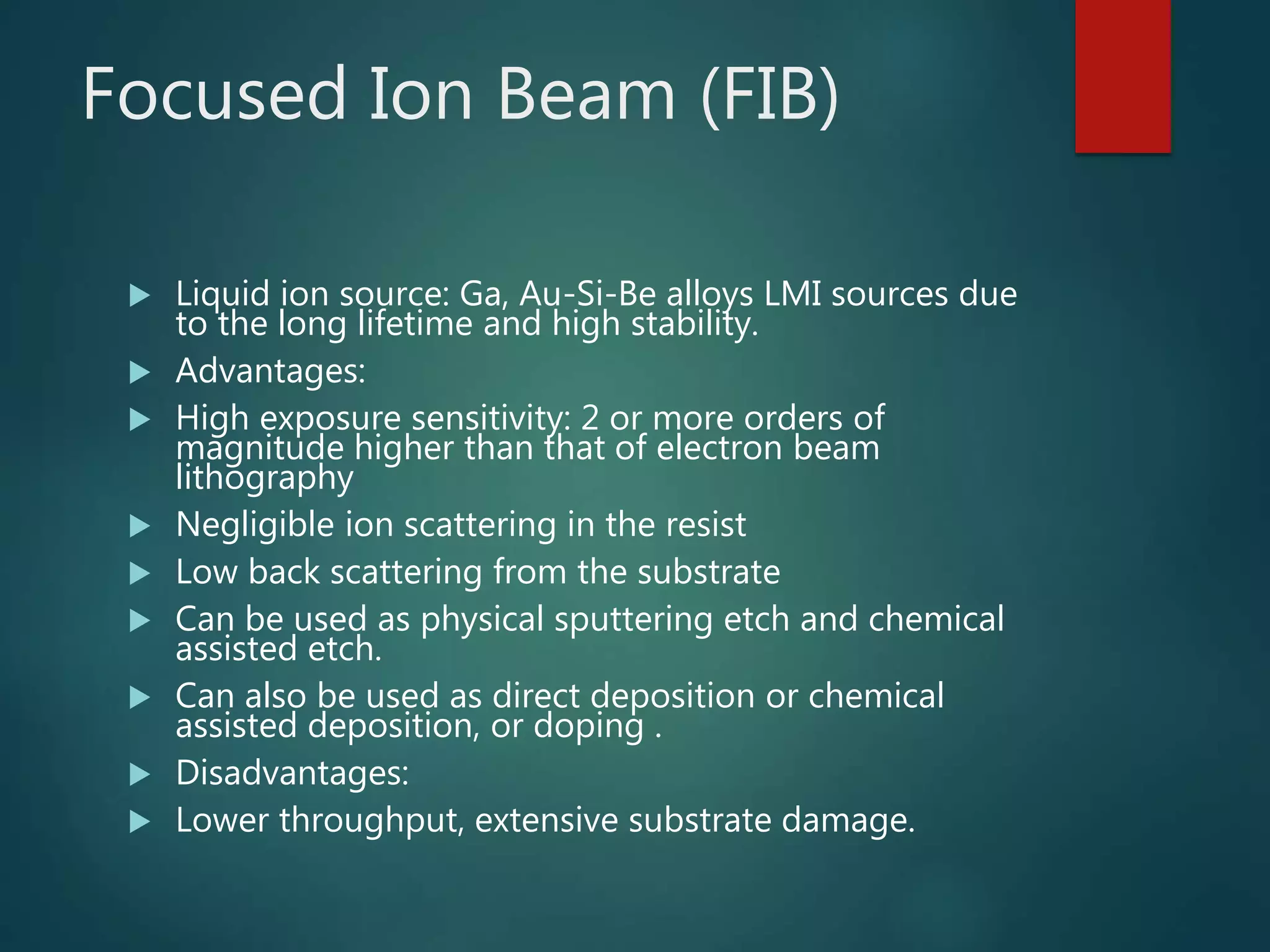
Focused Ion Beam (FIB)
 Liquid ion source: Ga, Au-Si-Be alloys LMI sources due
to the long lifetime and high stability.
 Advantages:
 High exposure sensitivity: 2 or more orders of
magnitude higher than that of electron beam
lithography
 Negligible ion scattering in the resist
 Low back scattering from the substrate
 Can be used as physical sputtering etch and chemical
assisted etch.
 Can also be used as direct deposition or chemical
assisted deposition, or doping .
 Disadvantages:
 Lower throughput, extensive substrate damage.
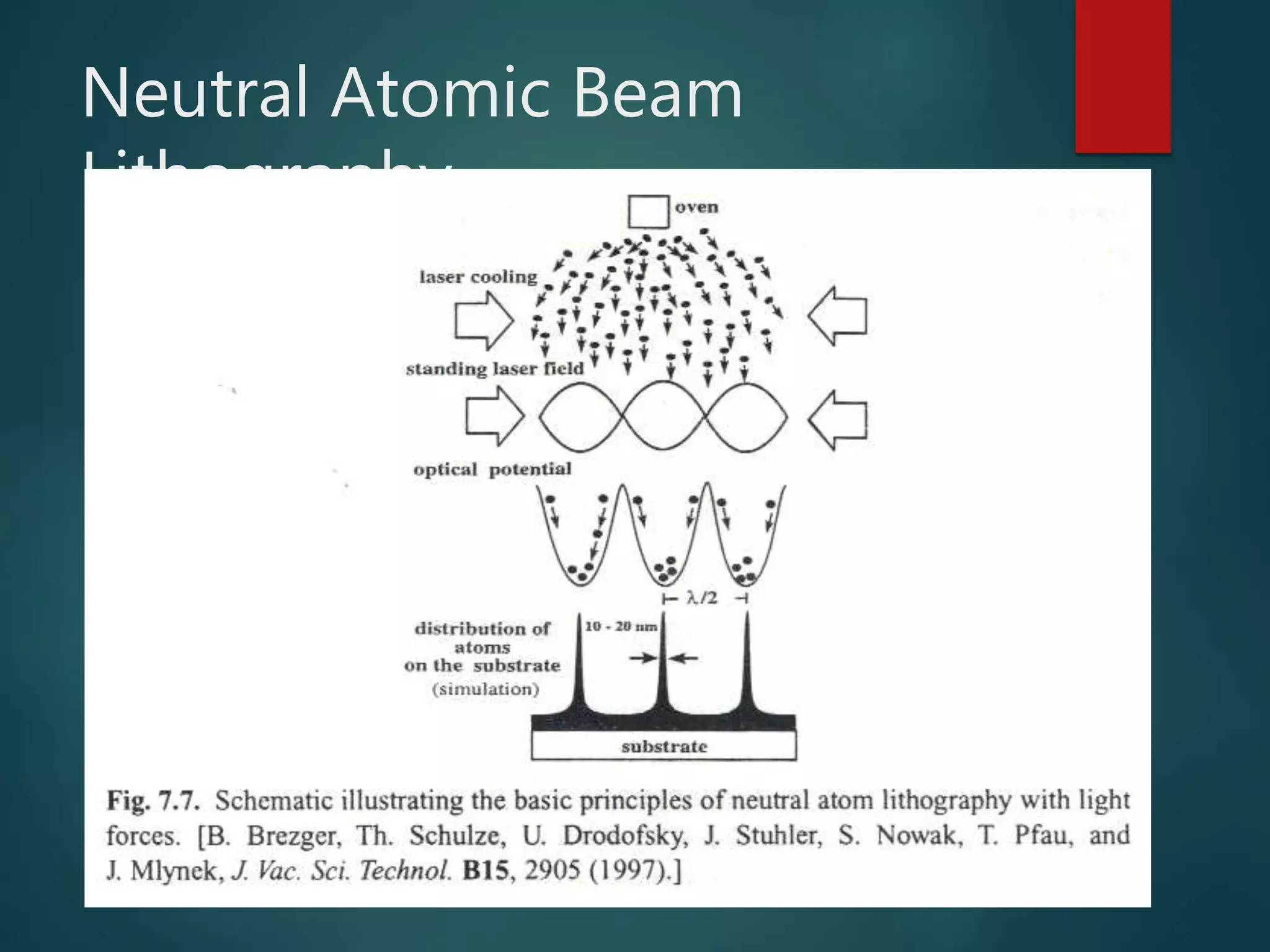
Neutral Atomic Beam
Lithography
Interference Lithography
Experiments
Patterned Nanostructures
Scanning Probe Lithography
 Probe
STM, AFM
 Techniques
Voltage pulse
CVD
Local electrodeposition
Dip-pen
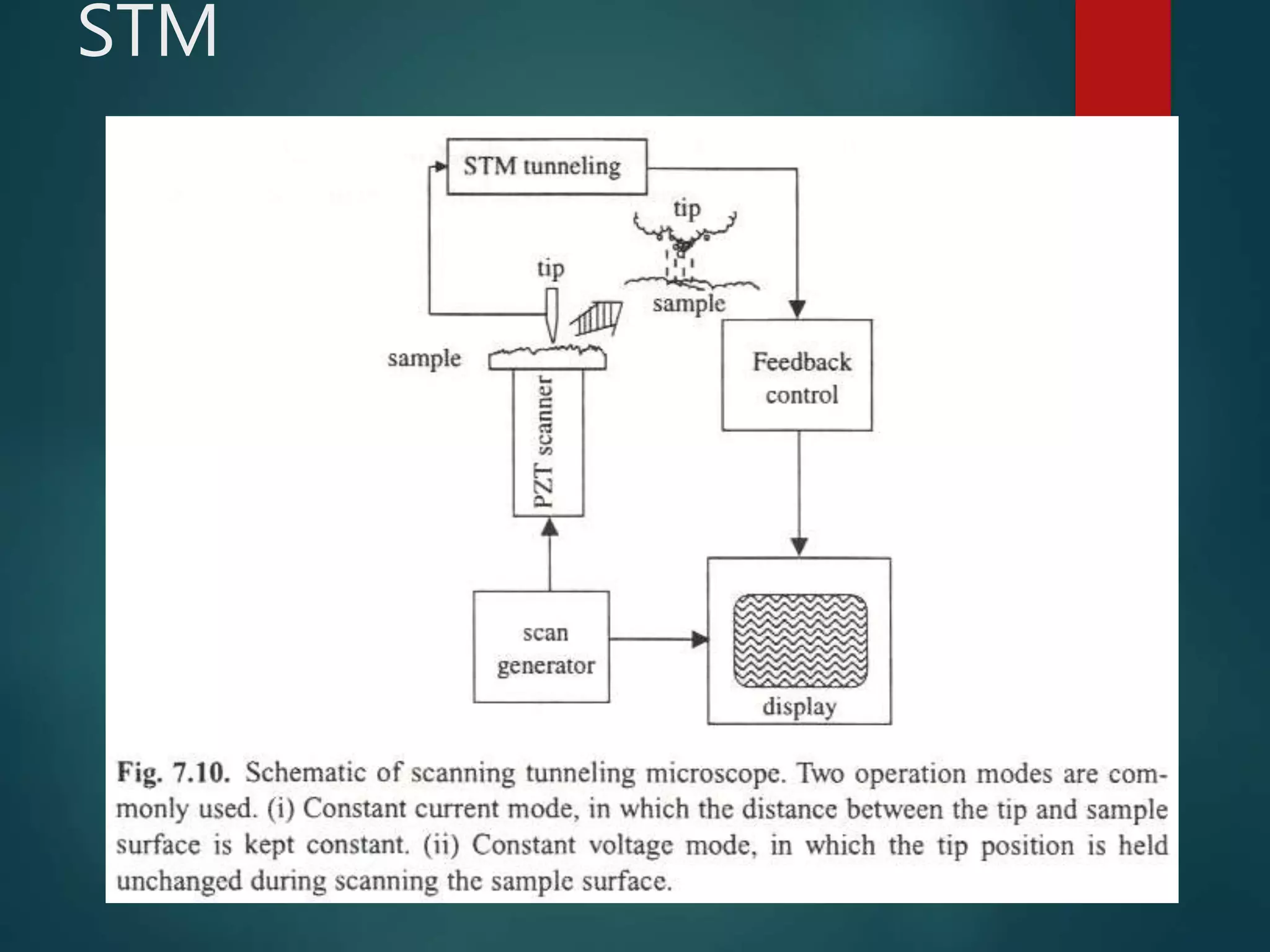
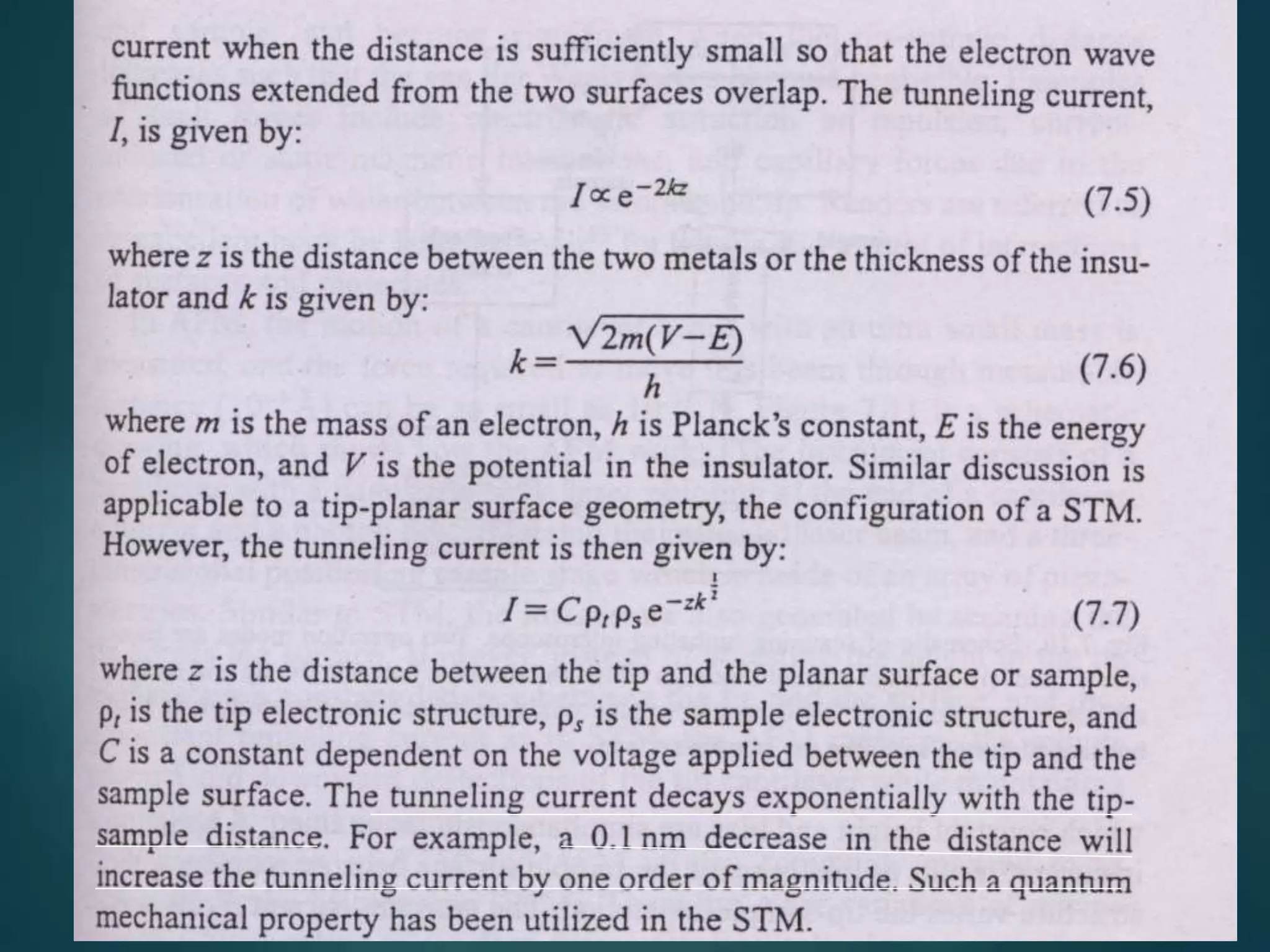
STM
Two Different Modes of STM
 Constant current mode
 Constant height mode
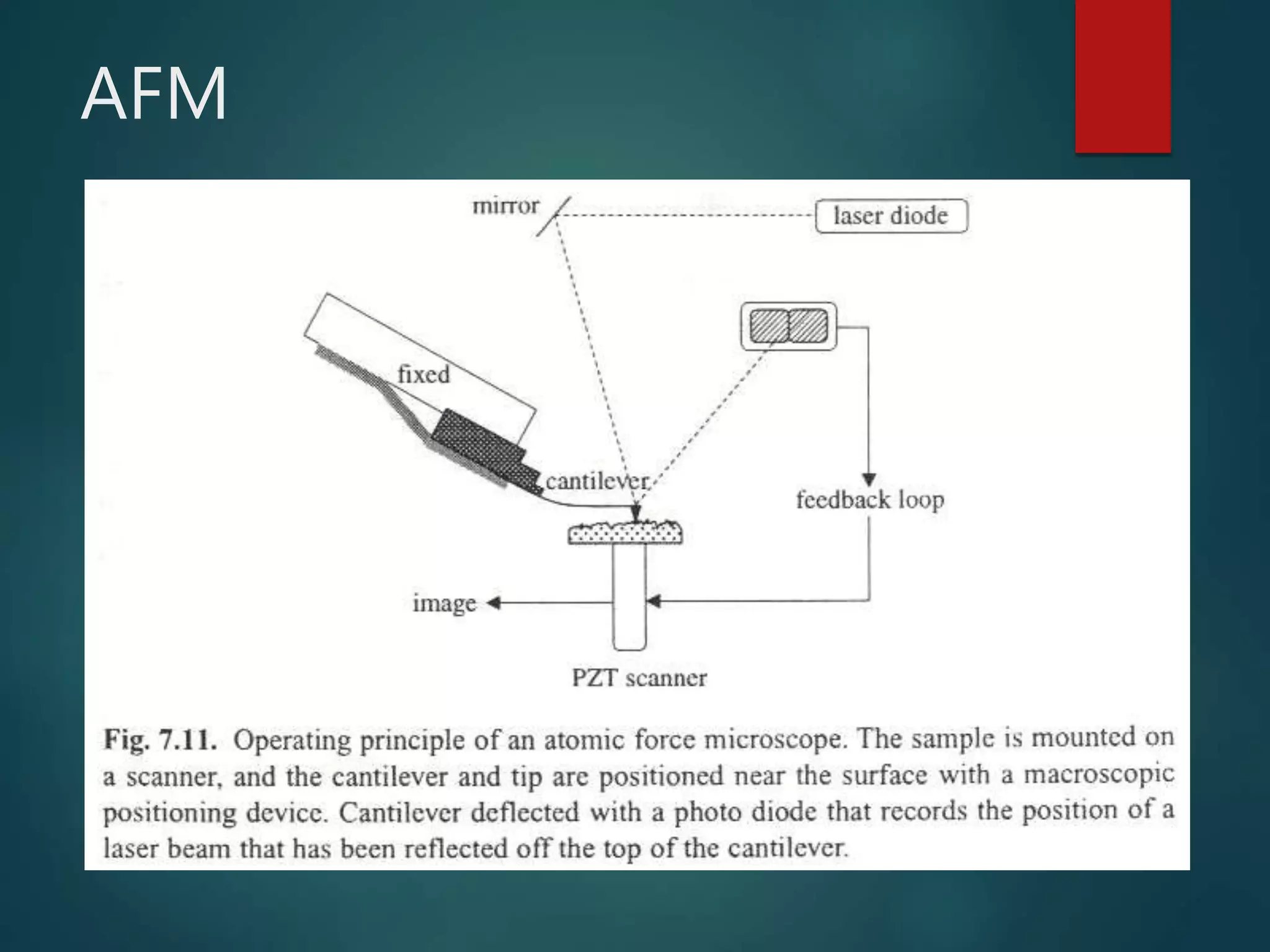
AFM
Manipulation of Atoms
1. Parallel process
2. Perpendicular process
Nanolithography
 Local anodic oxidation, passivation, localized chemical
vapor deposition, electrodeposition, mechanical
contact of the tip with the surface, deformation of the
surface by electrical pulses
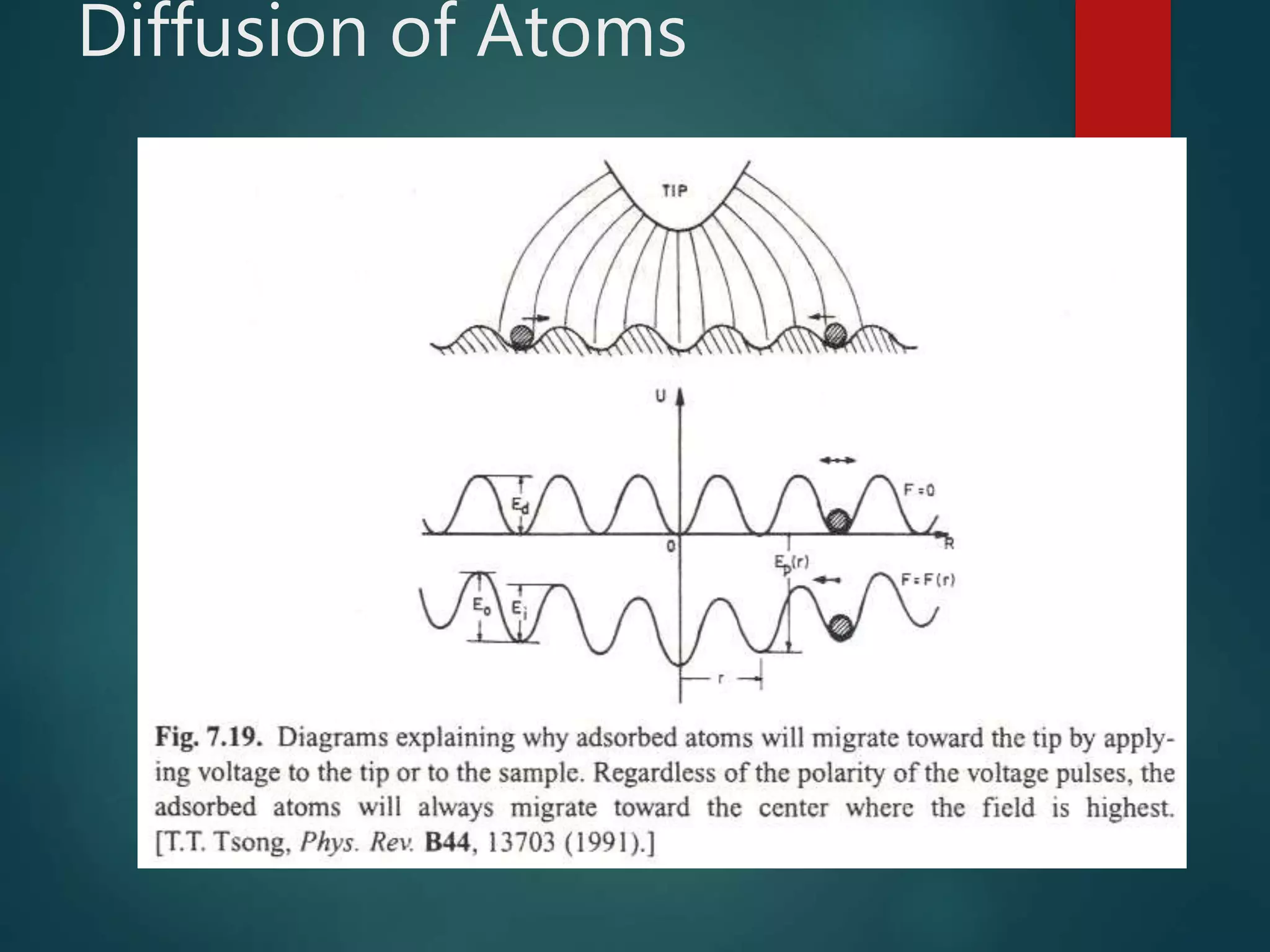
Diffusion of Atoms
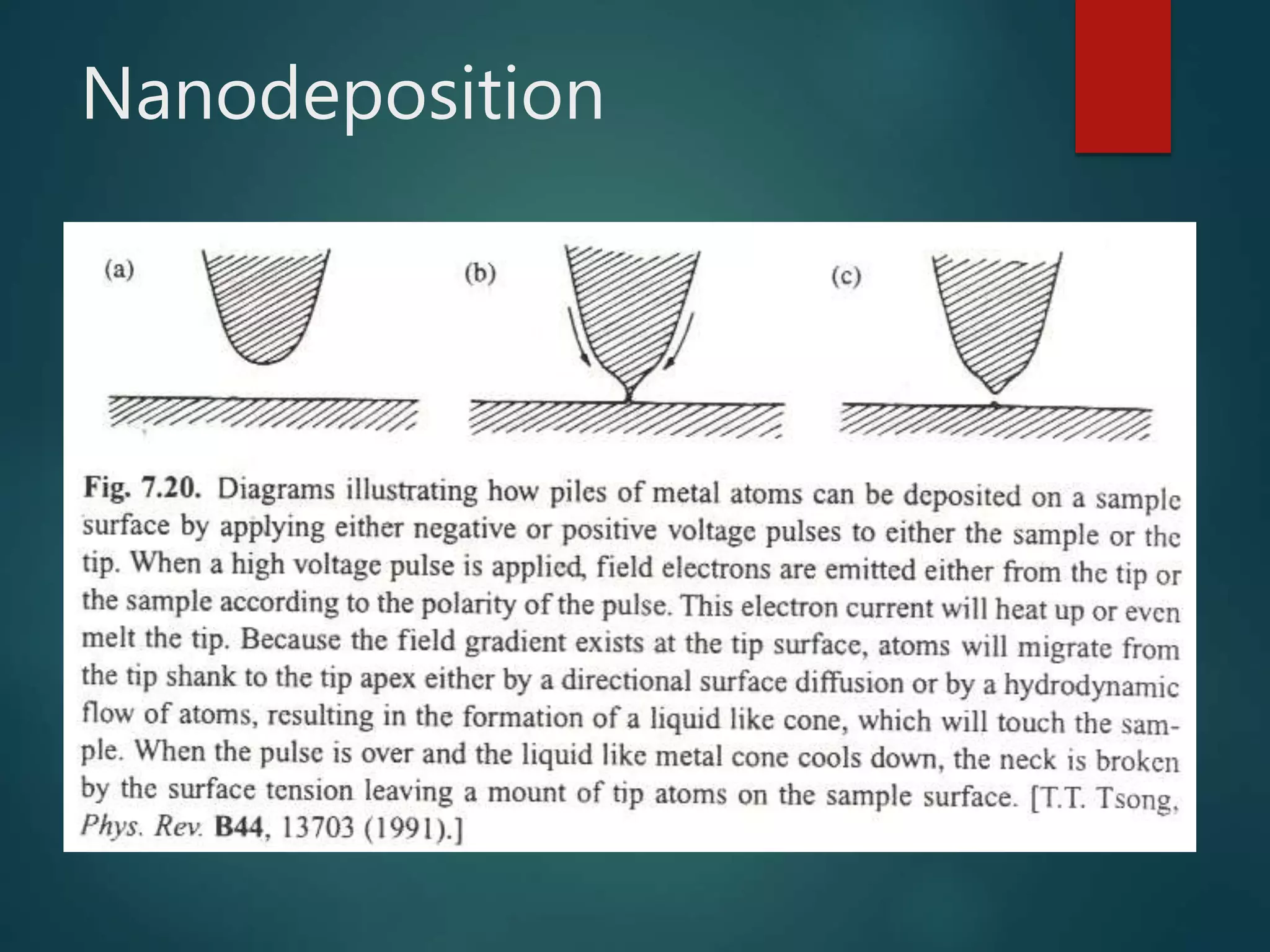
Nanodeposition
Voltage Plus
STM CVD
Local Electrodeposition
AFM
Dip Pen Lithography
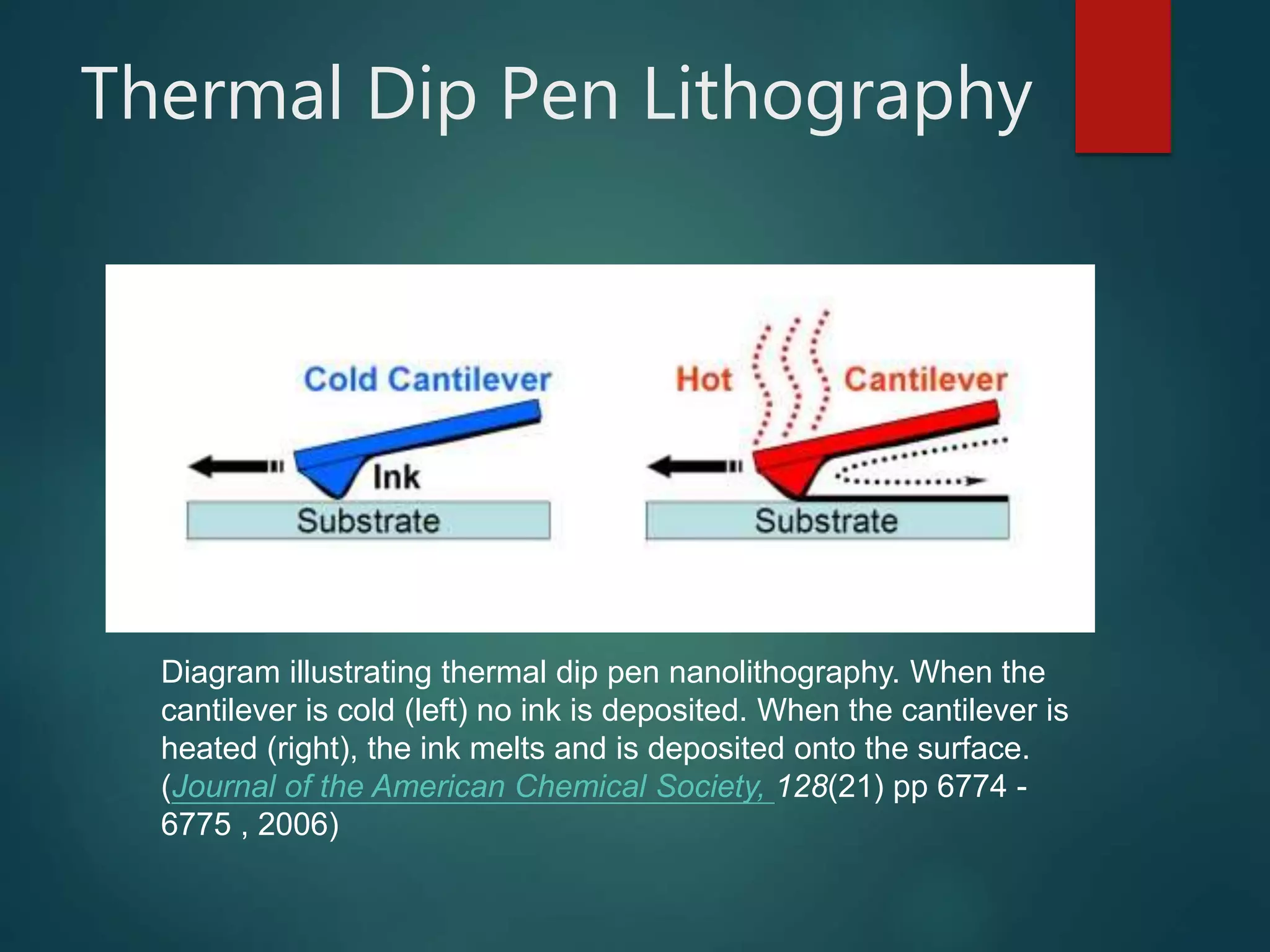
Diagram illustrating thermal dip pen nanolithography. When the
cantilever is cold (left) no ink is deposited. When the cantilever is
heated (right), the ink melts and is deposited onto the surface.
(Journal of the American Chemical Society, 128(21) pp 6774 -
6775 , 2006)
Thermal Dip Pen Lithography
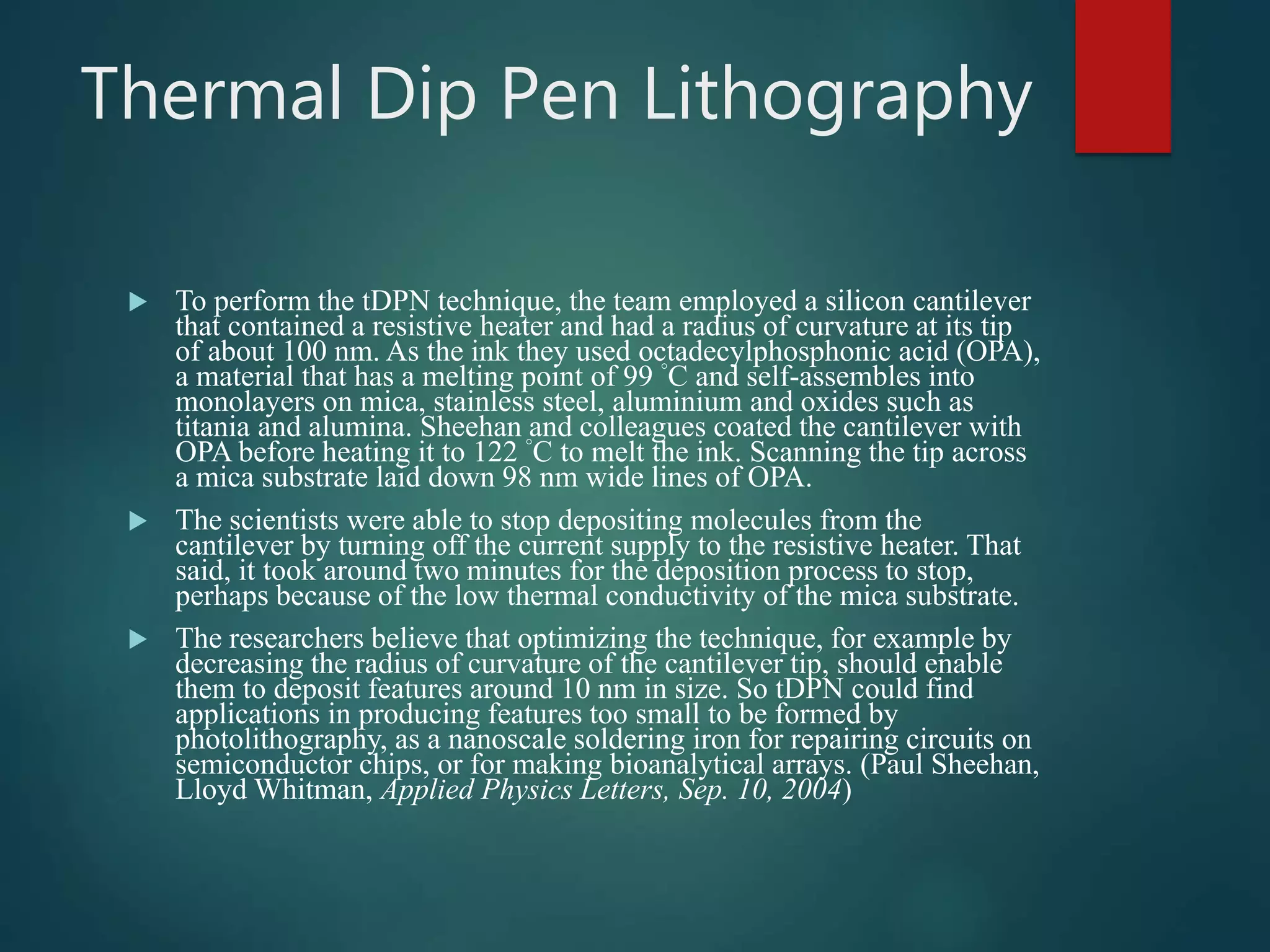
 To perform the tDPN technique, the team employed a silicon cantilever
that contained a resistive heater and had a radius of curvature at its tip
of about 100 nm. As the ink they used octadecylphosphonic acid (OPA),
a material that has a melting point of 99 °C and self-assembles into
monolayers on mica, stainless steel, aluminium and oxides such as
titania and alumina. Sheehan and colleagues coated the cantilever with
OPA before heating it to 122 °C to melt the ink. Scanning the tip across
a mica substrate laid down 98 nm wide lines of OPA.
 The scientists were able to stop depositing molecules from the
cantilever by turning off the current supply to the resistive heater. That
said, it took around two minutes for the deposition process to stop,
perhaps because of the low thermal conductivity of the mica substrate.
 The researchers believe that optimizing the technique, for example by
decreasing the radius of curvature of the cantilever tip, should enable
them to deposit features around 10 nm in size. So tDPN could find
applications in producing features too small to be formed by
photolithography, as a nanoscale soldering iron for repairing circuits on
semiconductor chips, or for making bioanalytical arrays. (Paul Sheehan,
Lloyd Whitman, Applied Physics Letters, Sep. 10, 2004)
Thermal Dip Pen
Lithography – Conducting
Polymer
 Whitman and colleagues Minchul Yang, Paul Sheehan and Bill King deposited
layers of the conducting polymer poly(3-dodecylthiophene) (PDDT) onto
silicon oxide surfaces. They produced nanostructures with lateral dimensions
of less than 80 nm and achieved monolayer-by-monolayer thickness control –
a monolayer of the molecules was around 2.6 nm thick. The researchers were
also able to control the orientation of the polymer chains.
 PDDT has promise in the field of organic electronics and could have
applications in areas such as transistors, photovoltaic devices and video
displays. "The performance of these devices depends critically on the degree
of molecular ordering and orientation within the polymer film, a property that
has been difficult to control," said Whitman. "We have succeeded in directly
writing polymer nanostructures with monolayer-by-monolayer thickness
control using tDPN. The deposition process employs highly local heating to
produce this polymer ordering and orientation."
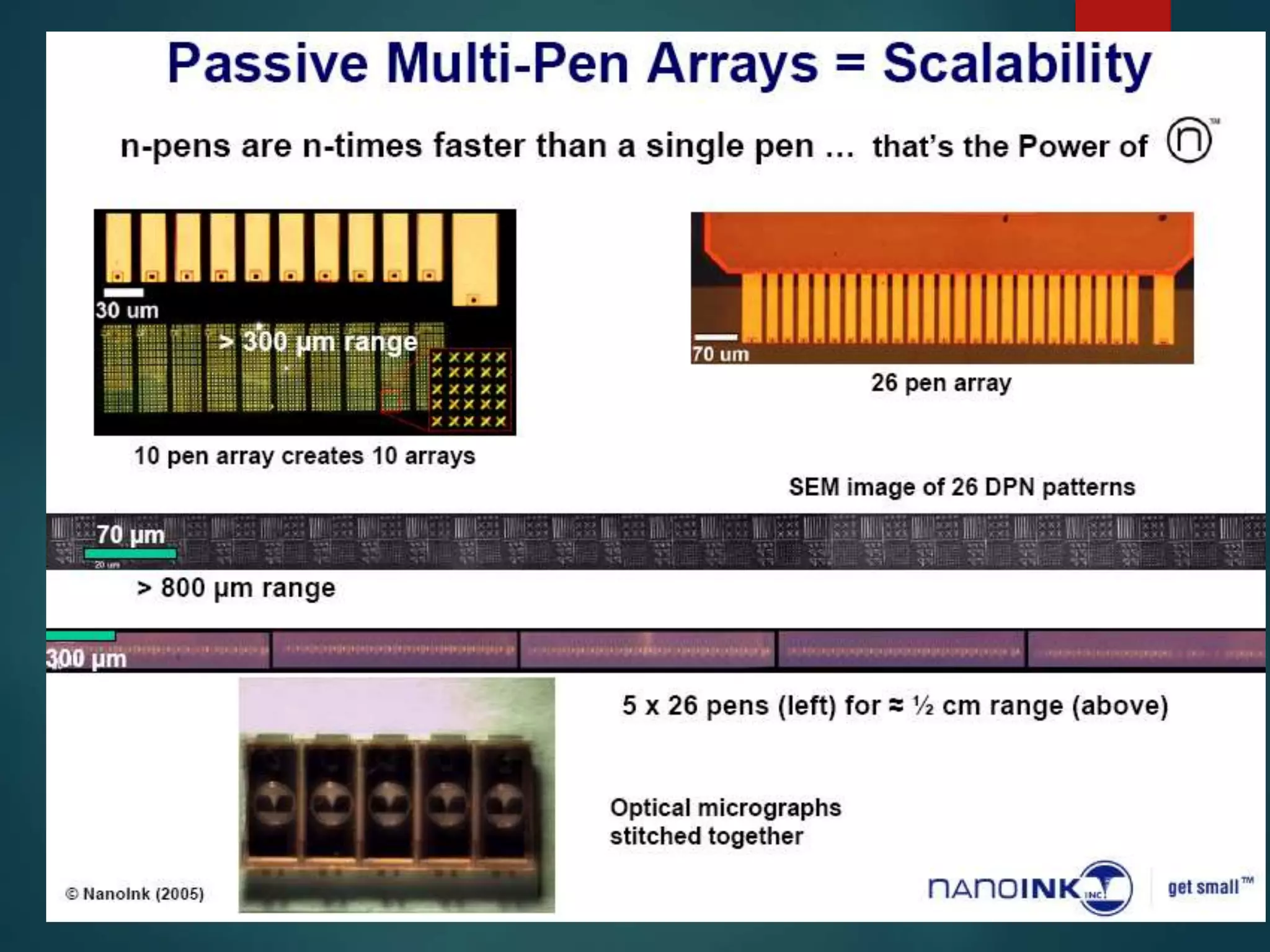
A dip-pen nanolithography that has an array of 55,000
pens that can create 55,000 identical molecular patterns
The background shows some of the 55,000 miniature images of a 2005 US
nickel made with dip-pen lithography. (Each circle is only twice the diameter
of a red blood cell.) Each nickel image with Thomas Jefferson's profile (in
red) is made of a series of 80 nm dots. The inset (right) is an electron
microscope image of a portion of the 55,000-pen array (Angewandte
Chemie 45 1-4, 2006 )
Thank-You

Nanolithography

  • 1.
    Nanolithography Presented by PreetiChoudhary MSc Applied Physics chaudharypreeti1997@gmail.com
  • 2.
    Types of Lithography A. Photolithography (optical, UV, EUV)  B. E-beam/ion- beam/Neutral atomic beam lithography  C. X-ray lithography  D. Interference lithography  E. Scanning Probe Voltage pulse CVD Local electrodeposition Dip-pen F. Step Growth G. Soft Lithography H. Nanoimprint I. Shadow Mask J. Self-Assembly K. Nanotemplates Diblock copolymer Sphere Alumina membrane Nanochannel glass Nuclear-track etched membrane
  • 3.
    Photolithography  KrF λ=248nm ArF λ=193nm  F2 λ=157nm
  • 4.
    Electron-Beam Lithography  Exposuresource: electron beam  At acceleration voltage Vc=120kV, λ=0.0336Å  Utilizes an electron column to generate focused e-beam
  • 5.
  • 6.
  • 7.
    SEM Resolution  Magnificationx Resolution in (Å) = 107 for a 1mm feature on the image  Collimation  Wavelength  Charging effect - coating carbon, metal thickness  Escape depth metal ~40 Å semiconductor ~100 Å insulator ~300 Å
  • 8.
  • 9.
    E – BeamWriting  Advantages Better resolution Direct writing, no mask needed Arbitrary size, shape, order  Disadvantages Serial process slow, small area Compatibility conducting, no high T process
  • 11.
    Sample E-beam Writing Procedure Application of e-beam resist (PMMA)  Spin coating & soft bake  Loading Ag paint reference, position  Power on  Tuning emission current  Stabilizing filament  Gun alignment  Adjust astigmatism  Referencing  Focusing  Writing  Shutting down SEM  Developing  Hard bake
  • 12.
    X-ray Lithography  Exposuresource: x-ray (synchrotron)  Resist: sensitive to x-ray (PMMA) – IBM used resists developed for DUV and obtained successful results  Mask: SiC membrane covered by high Z metal; fabricated by e – beam writer  Advantages: High resolution  Large area  Disadvantage: Synchrotron facility necessary
  • 13.
    X- Ray Lithography: Applications IC industry – Proposed for fabricating Gigabit-level DRAM – Not a mainstream technique for IC fabrication  Nanoelectronics  MEMS applications  – LIGA  – High aspect ratio devices
  • 14.
    Conclusions  Electron-beam lithographyis currently the industry standard for high-resolution, but has limited applications due to its high cost and time-demanding process.  X-ray lithography is an up-and-coming technology that can be used in the same capacities as optical lithography with better results. However, due to the high cost of the equipment and supplies, as well as the desire to push optical lithography to its absolute limit, we can only say that x-ray lithography has a bright future ahead.
  • 15.
    References for E– Beam and X – Ray Lithography  C. Ngo and C. Rosilio, "Lithography for semiconductor technology," Nucl. Instr. and Meth. In Phys. Res. B, vol. 131, pp. 22-29, 1997.  R. C. Jager, Introduction to Microelectronic Fabrication, vol. 5. Upper Saddle River, New Jersey: Prentice Hall, 2002.  J. G. Chase and B. W. Smith, "Overview of Modern Lithography Techniques and a MEMS Based Approach to High Throughput Rate Electron Beam Lithography," J. Intell. Mater. Syst. Struct., vol. 12, pp. 807-817, 2002.  J. N. Helbert, Handbook of VLSI Microlithography. Norwich, NY: Noyes Publications/William Andrew Publishing, LLC., 2001.  "Facility Procedures," in http://rlewb.mit.edu/sebl/facility_procedures.htm.  "Raith Nanolithography Products," in http://www.raith.com/WWW_RAITH/nanolithography/nano_faqs2.html.  "Electron Beam Lithography," in http://www.shef.ac.uk/eee/research/ebl.  K.-S. Chen, I.-K. Lin, and F.-H. Ko, "Fabrication of 3D Polymer Microstructures Using Electron Beam Lithography and Nanoimprinting Technologies," J. Micromech. Microeng., vol. 15, 2005.  • J. P. Silverman, "Challenges and Progress in X-ray Lithography," J. Vac. Sci. Technol. B, vol. 16, pp. 3137-3140, 1998.  • S. Ohki and S. Ishihara, "An Overview of X-ray Lithography," Microelectron. Eng., pp. 171-178, 1996.
  • 16.
    Focused Ion Beam(FIB)  Liquid ion source: Ga, Au-Si-Be alloys LMI sources due to the long lifetime and high stability.  Advantages:  High exposure sensitivity: 2 or more orders of magnitude higher than that of electron beam lithography  Negligible ion scattering in the resist  Low back scattering from the substrate  Can be used as physical sputtering etch and chemical assisted etch.  Can also be used as direct deposition or chemical assisted deposition, or doping .  Disadvantages:  Lower throughput, extensive substrate damage.
  • 17.
  • 18.
  • 19.
  • 20.
  • 21.
    Scanning Probe Lithography Probe STM, AFM  Techniques Voltage pulse CVD Local electrodeposition Dip-pen
  • 22.
  • 24.
    Two Different Modesof STM  Constant current mode  Constant height mode
  • 25.
  • 26.
    Manipulation of Atoms 1.Parallel process 2. Perpendicular process
  • 30.
    Nanolithography  Local anodicoxidation, passivation, localized chemical vapor deposition, electrodeposition, mechanical contact of the tip with the surface, deformation of the surface by electrical pulses
  • 31.
  • 32.
  • 33.
  • 34.
  • 35.
  • 36.
  • 37.
  • 38.
    Diagram illustrating thermaldip pen nanolithography. When the cantilever is cold (left) no ink is deposited. When the cantilever is heated (right), the ink melts and is deposited onto the surface. (Journal of the American Chemical Society, 128(21) pp 6774 - 6775 , 2006) Thermal Dip Pen Lithography
  • 39.
    Thermal Dip PenLithography  To perform the tDPN technique, the team employed a silicon cantilever that contained a resistive heater and had a radius of curvature at its tip of about 100 nm. As the ink they used octadecylphosphonic acid (OPA), a material that has a melting point of 99 °C and self-assembles into monolayers on mica, stainless steel, aluminium and oxides such as titania and alumina. Sheehan and colleagues coated the cantilever with OPA before heating it to 122 °C to melt the ink. Scanning the tip across a mica substrate laid down 98 nm wide lines of OPA.  The scientists were able to stop depositing molecules from the cantilever by turning off the current supply to the resistive heater. That said, it took around two minutes for the deposition process to stop, perhaps because of the low thermal conductivity of the mica substrate.  The researchers believe that optimizing the technique, for example by decreasing the radius of curvature of the cantilever tip, should enable them to deposit features around 10 nm in size. So tDPN could find applications in producing features too small to be formed by photolithography, as a nanoscale soldering iron for repairing circuits on semiconductor chips, or for making bioanalytical arrays. (Paul Sheehan, Lloyd Whitman, Applied Physics Letters, Sep. 10, 2004)
  • 40.
    Thermal Dip Pen Lithography– Conducting Polymer  Whitman and colleagues Minchul Yang, Paul Sheehan and Bill King deposited layers of the conducting polymer poly(3-dodecylthiophene) (PDDT) onto silicon oxide surfaces. They produced nanostructures with lateral dimensions of less than 80 nm and achieved monolayer-by-monolayer thickness control – a monolayer of the molecules was around 2.6 nm thick. The researchers were also able to control the orientation of the polymer chains.  PDDT has promise in the field of organic electronics and could have applications in areas such as transistors, photovoltaic devices and video displays. "The performance of these devices depends critically on the degree of molecular ordering and orientation within the polymer film, a property that has been difficult to control," said Whitman. "We have succeeded in directly writing polymer nanostructures with monolayer-by-monolayer thickness control using tDPN. The deposition process employs highly local heating to produce this polymer ordering and orientation."
  • 42.
    A dip-pen nanolithographythat has an array of 55,000 pens that can create 55,000 identical molecular patterns The background shows some of the 55,000 miniature images of a 2005 US nickel made with dip-pen lithography. (Each circle is only twice the diameter of a red blood cell.) Each nickel image with Thomas Jefferson's profile (in red) is made of a series of 80 nm dots. The inset (right) is an electron microscope image of a portion of the 55,000-pen array (Angewandte Chemie 45 1-4, 2006 )
  • 43.