An Introduction to Infrared and
UV-Visible Spectroscopy
Preeti Choudhary
MSc Applied Physics
LEARNING OBJECTIVES
 Describe the principal regions of the electromagnetic
spectrum.
 Describe the principles of infrared spectroscopy.
 Describe the principles of UV-Vis spectroscopy.
 Describe and explain the principal factors that govern the
vibrational frequencies of bonds.
 Describe and explain the principal factors that govern the
electronic absorption process in UV-Vis spectroscopy.
 Experimental and instrumental
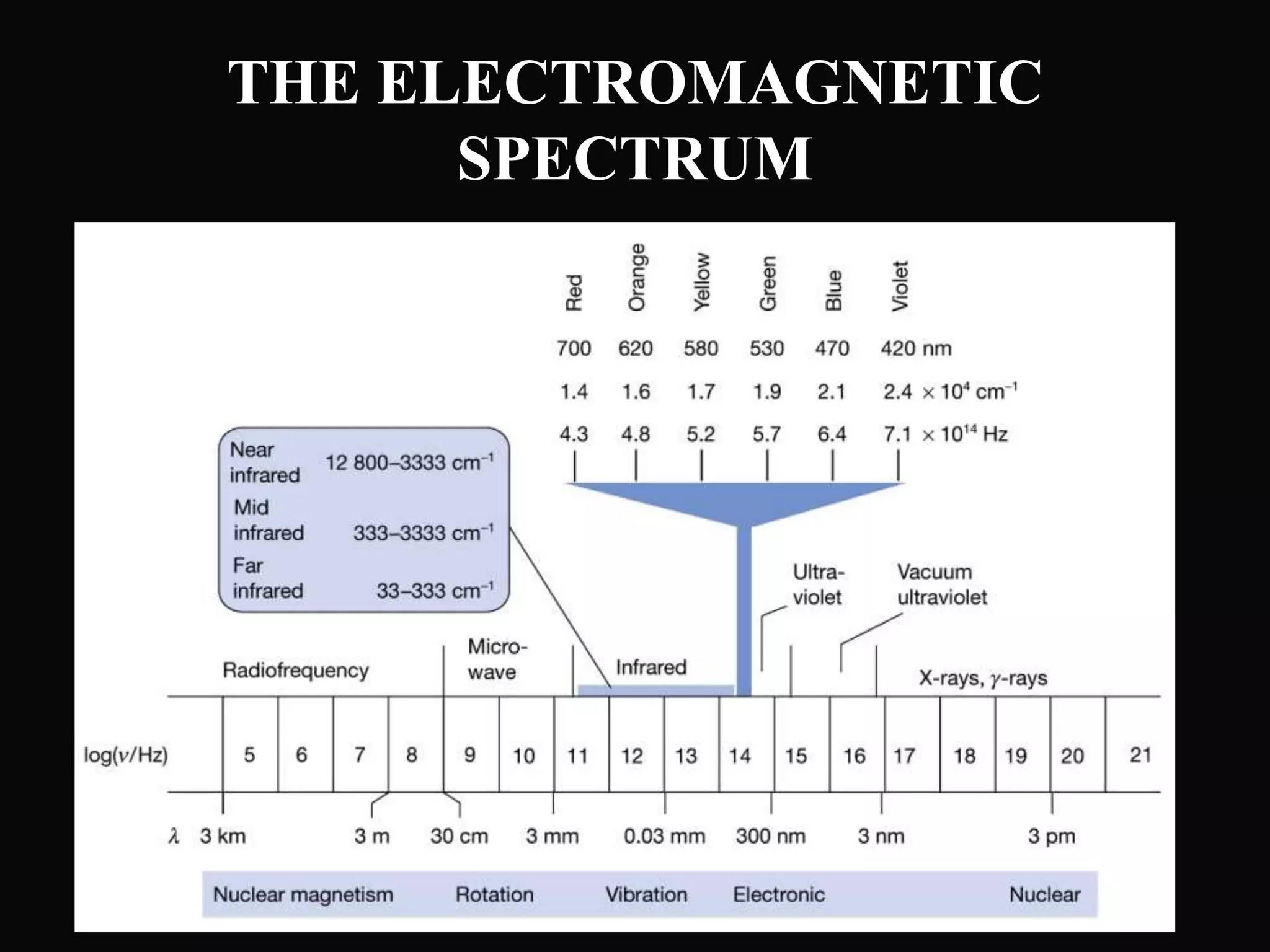
THE ELECTROMAGNETIC
SPECTRUM
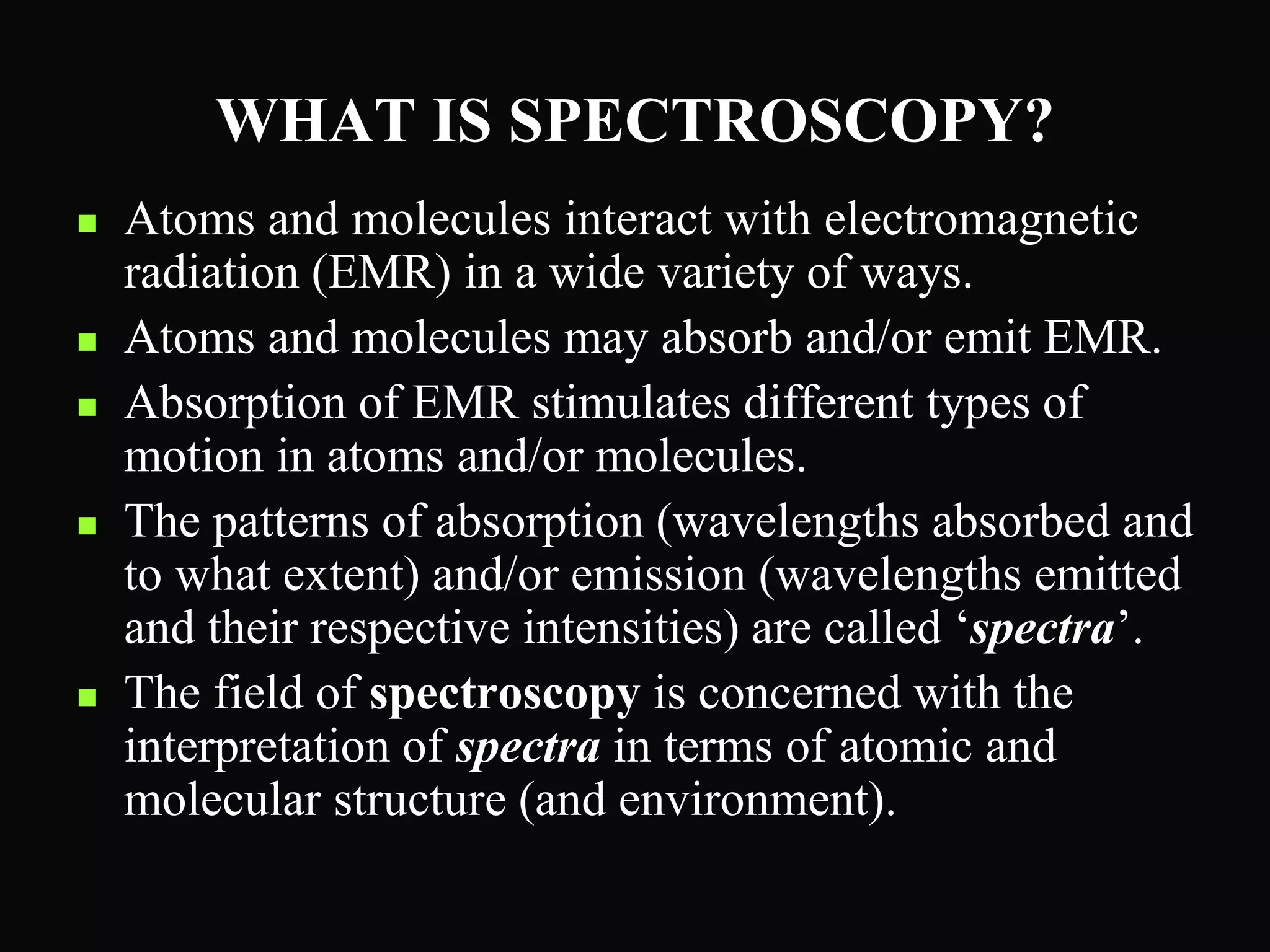
WHAT IS SPECTROSCOPY?
 Atoms and molecules interact with electromagnetic
radiation (EMR) in a wide variety of ways.
 Atoms and molecules may absorb and/or emit EMR.
 Absorption of EMR stimulates different types of
motion in atoms and/or molecules.
 The patterns of absorption (wavelengths absorbed and
to what extent) and/or emission (wavelengths emitted
and their respective intensities) are called ‘spectra’.
 The field of spectroscopy is concerned with the
interpretation of spectra in terms of atomic and
molecular structure (and environment).
INFRARED SPECTROSCOPY
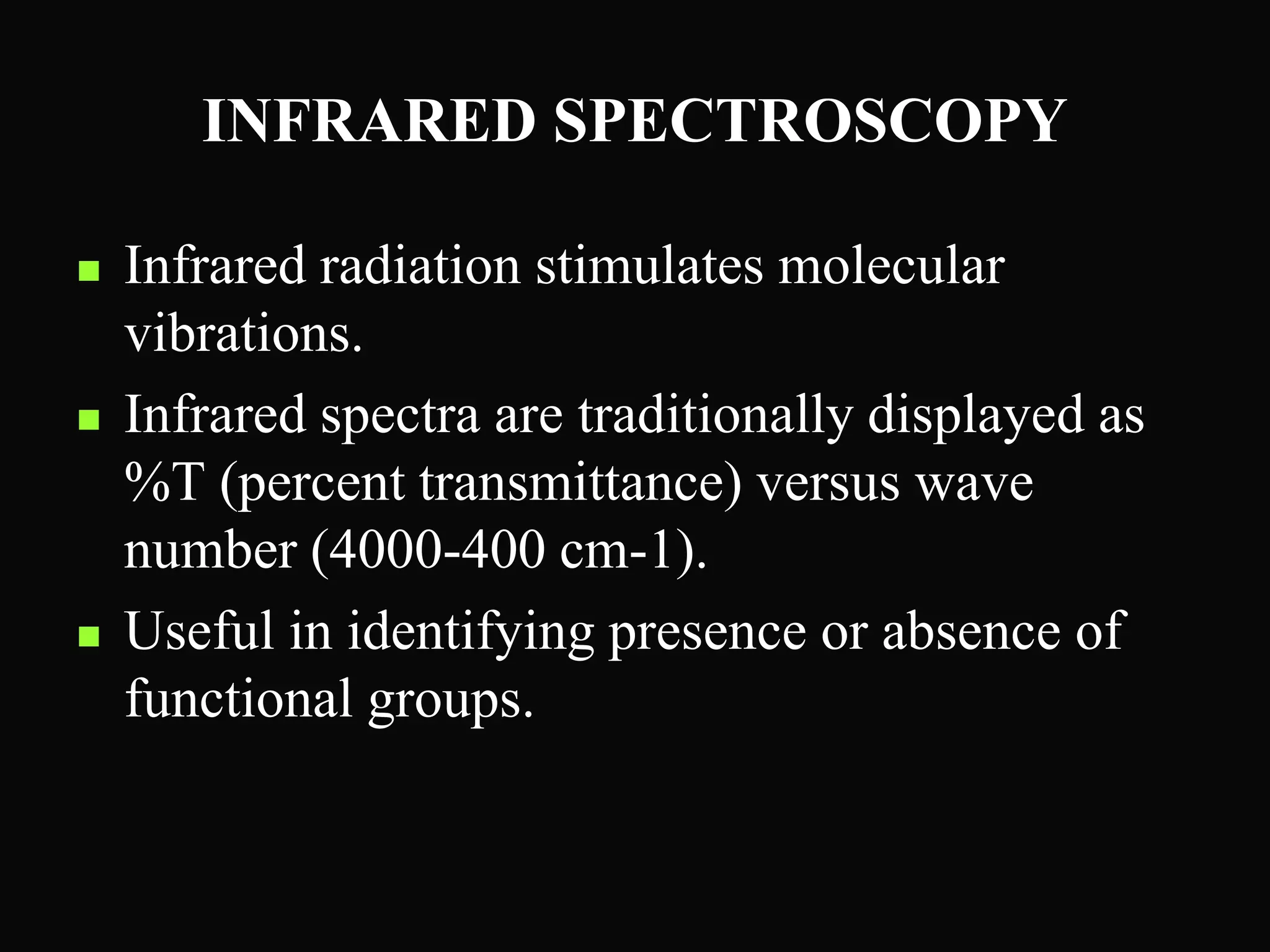
 Infrared radiation stimulates molecular
vibrations.
 Infrared spectra are traditionally displayed as
%T (percent transmittance) versus wave
number (4000-400 cm-1).
 Useful in identifying presence or absence of
functional groups.
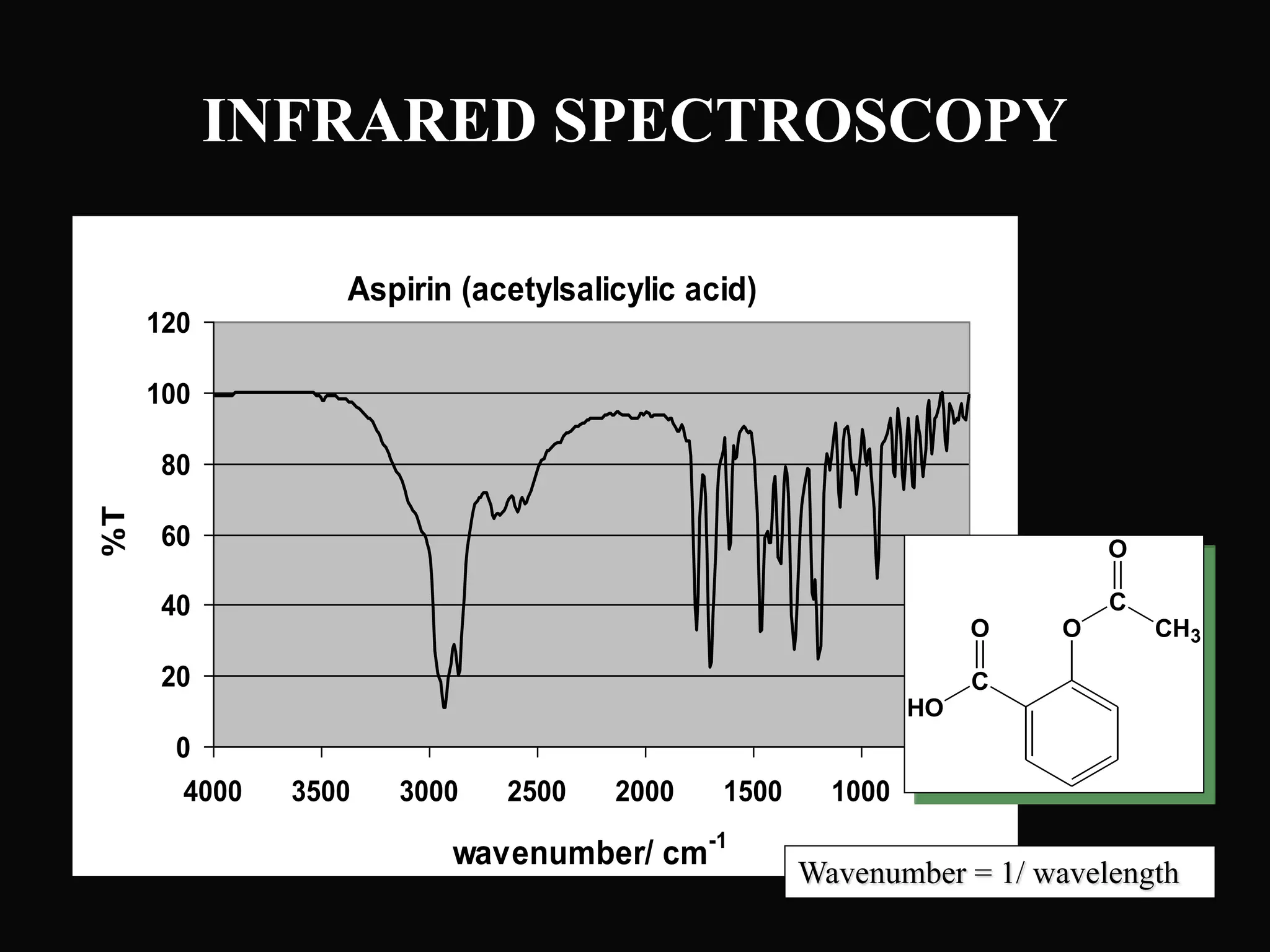
INFRARED SPECTROSCOPY
Aspirin (acetylsalicylic acid)
0
20
40
60
80
100
120
5001000150020002500300035004000
wavenumber/ cm-1
%T
O
C
O
CH3
C
O
HO
Wavenumber = 1/ wavelength
INFRARED SPECTROSCOPY
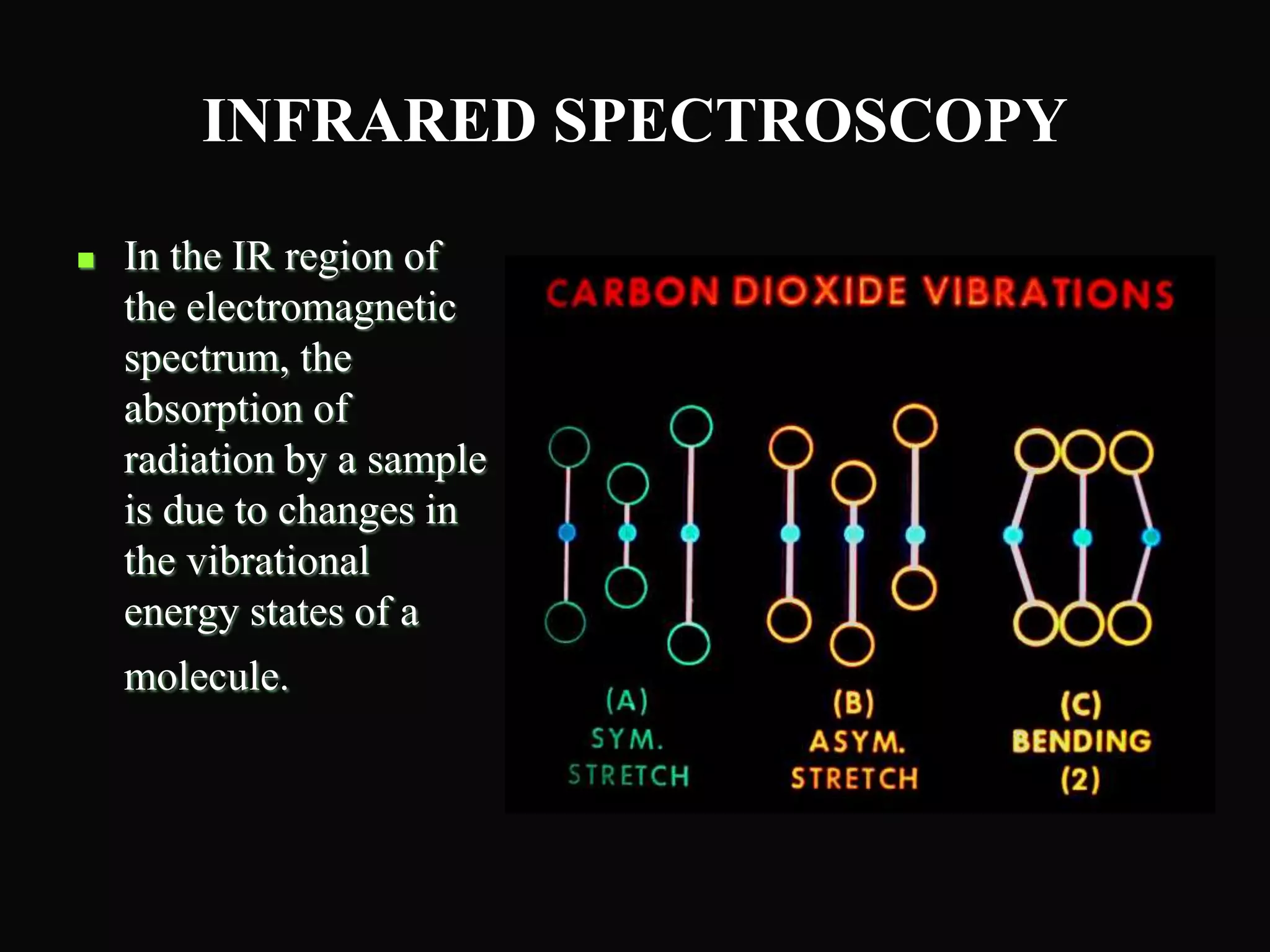
 In the IR region of
the electromagnetic
spectrum, the
absorption of
radiation by a sample
is due to changes in
the vibrational
energy states of a
molecule.
INFRARED SPECTROSCOPY
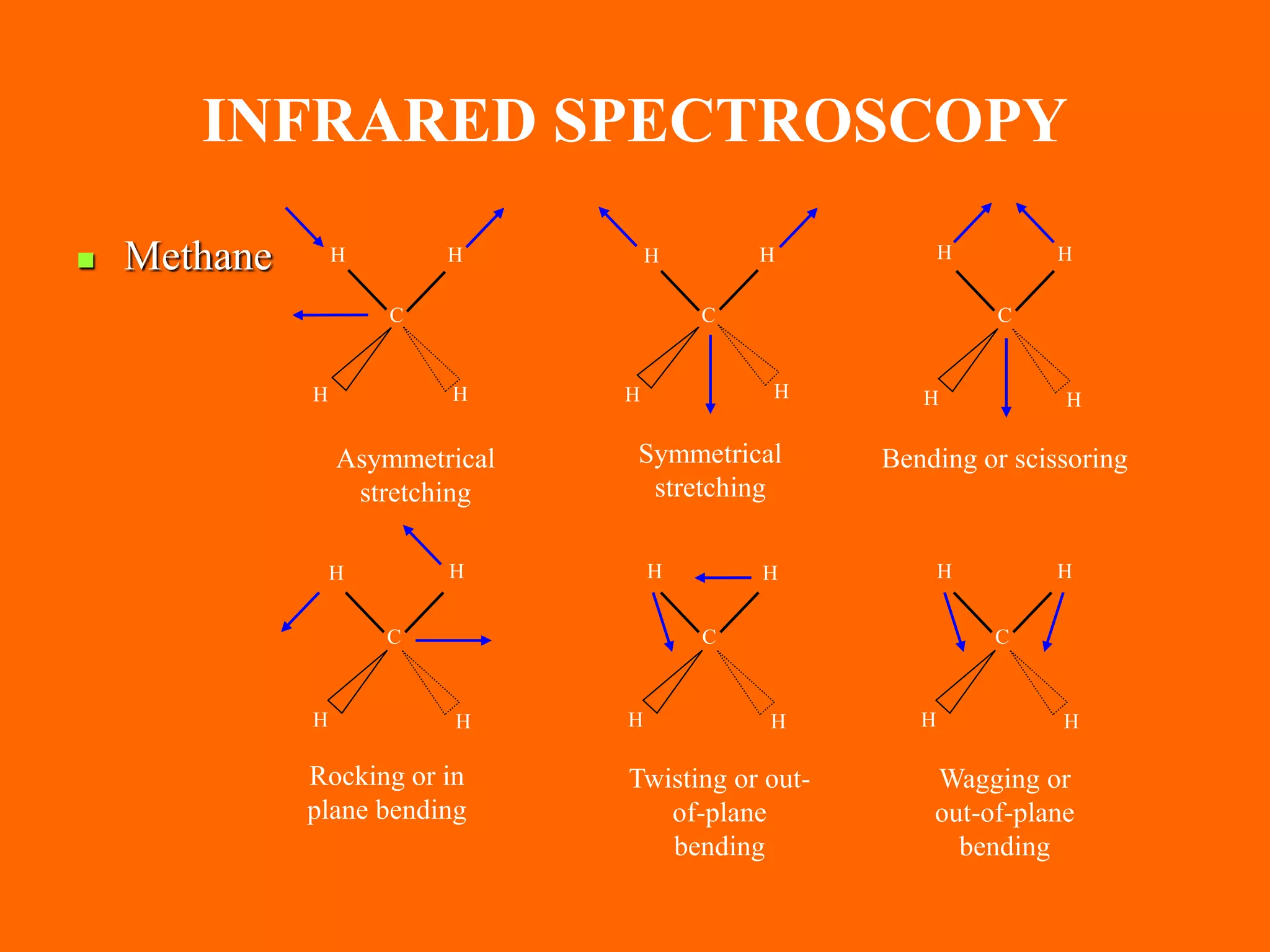
 Methane
Rocking or in
plane bending
HH HH HH
C
HH
H H
H H
H
H H
C
H H
C
H
H
C
HH
C
HH
C
H
Asymmetrical
stretching
Symmetrical
stretching
Bending or scissoring
Twisting or out-
of-plane
bending
Wagging or
out-of-plane
bending
INFRARED SPECTROSCOPY
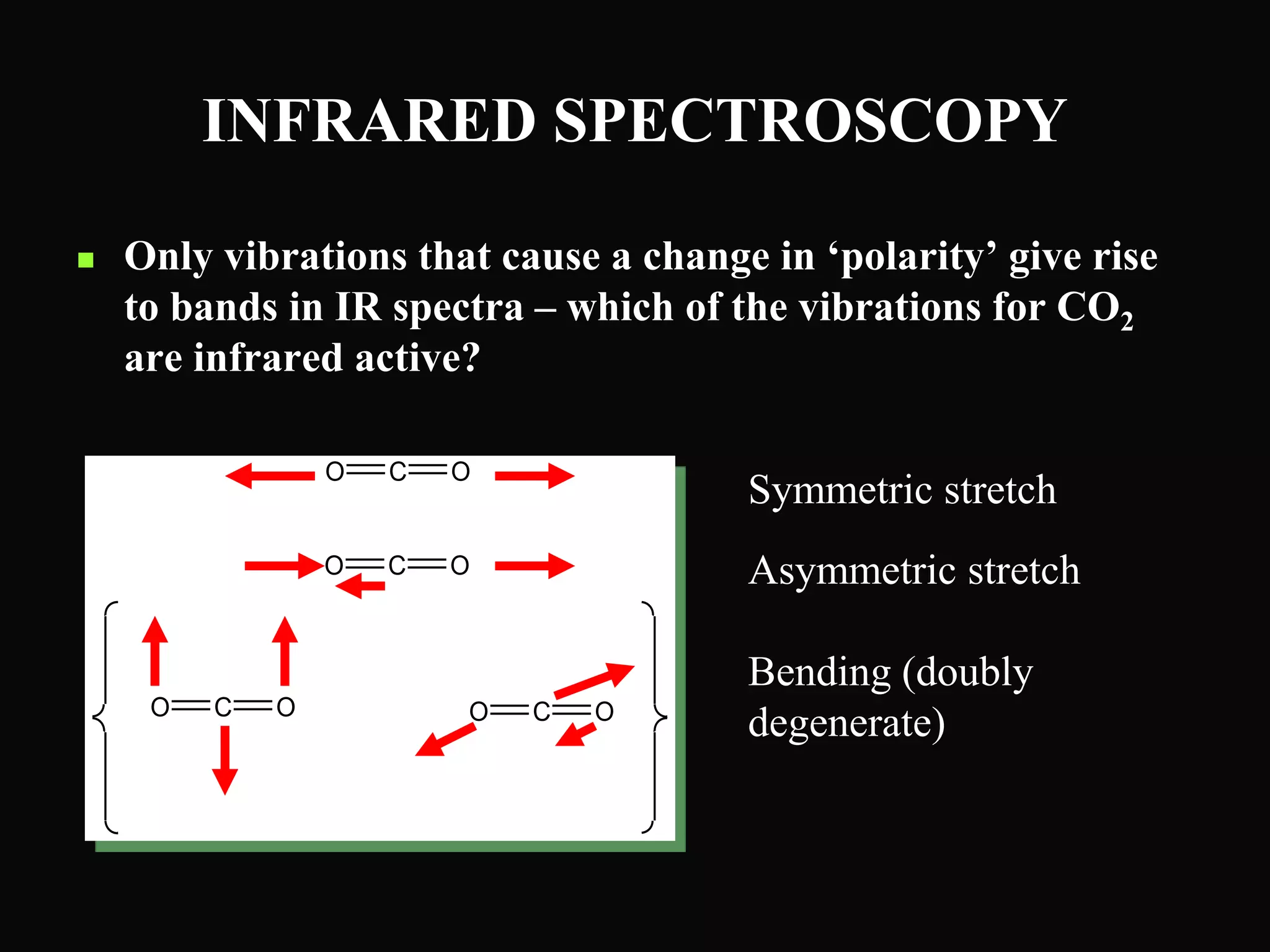
 Only vibrations that cause a change in ‘polarity’ give rise
to bands in IR spectra – which of the vibrations for CO2
are infrared active?
O C O
O C O
O C O O C O
Symmetric stretch
Asymmetric stretch
Bending (doubly
degenerate)
INFRARED SPECTROSCOPY
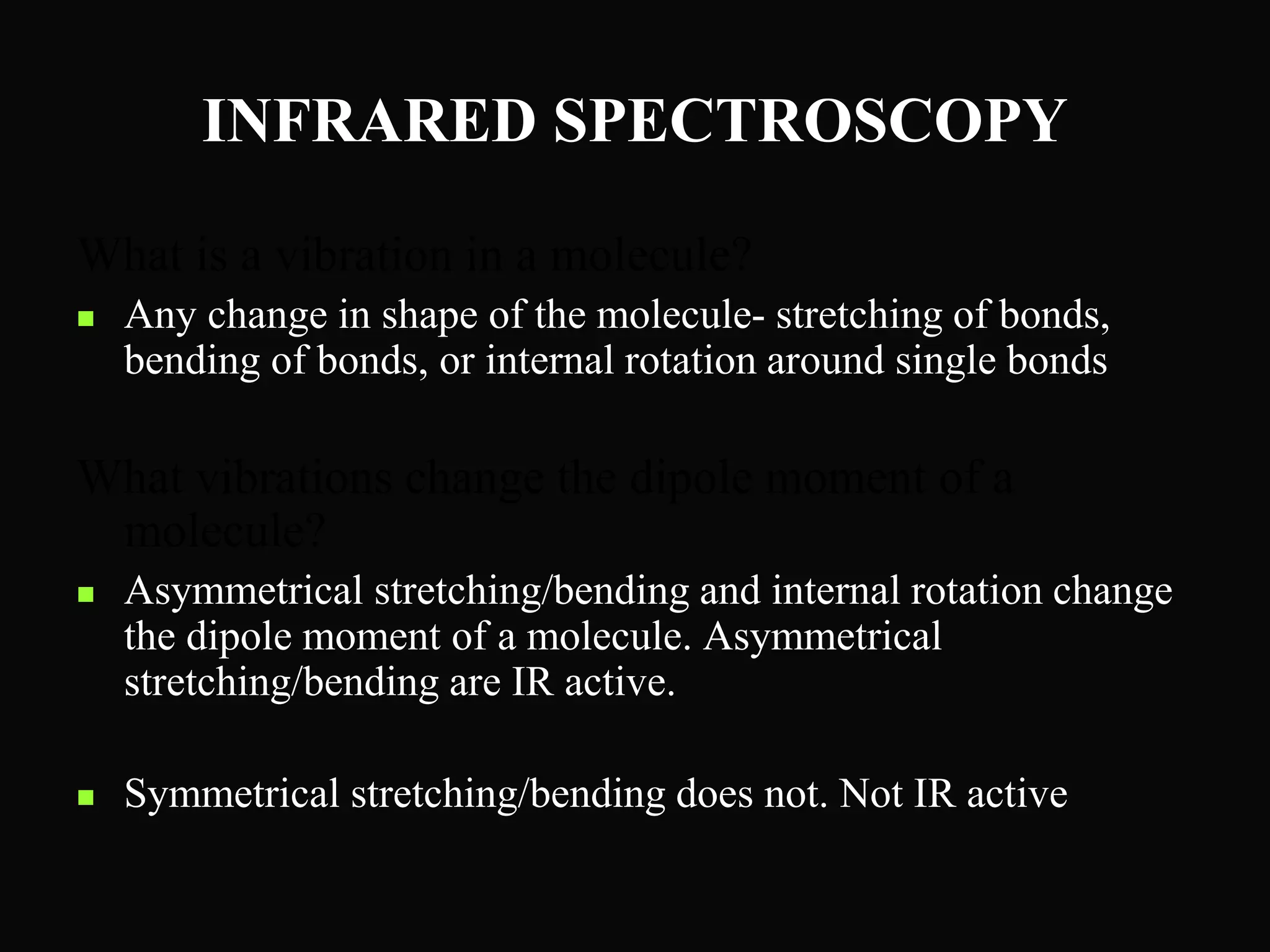
What is a vibration in a molecule?
 Any change in shape of the molecule- stretching of bonds,
bending of bonds, or internal rotation around single bonds
What vibrations change the dipole moment of a
molecule?
 Asymmetrical stretching/bending and internal rotation change
the dipole moment of a molecule. Asymmetrical
stretching/bending are IR active.
 Symmetrical stretching/bending does not. Not IR active
INFRARED SPECTROSCOPY
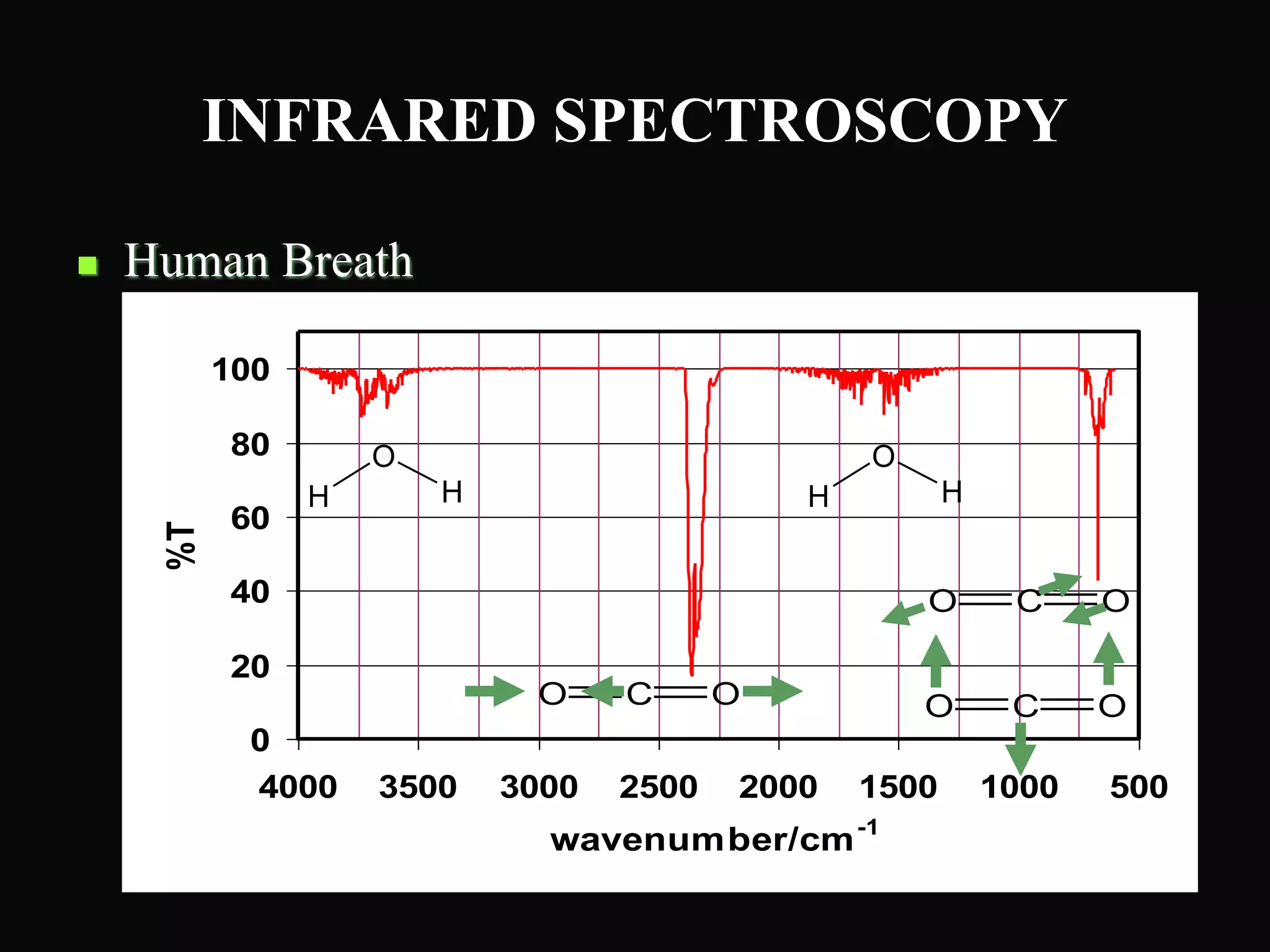
 Human Breath
0
20
40
60
80
100
5001000150020002500300035004000
wavenumber/cm-1
%T
O
H H
O
H H
O C O
O C O
O C O
INFRARED SPECTROSCOPY
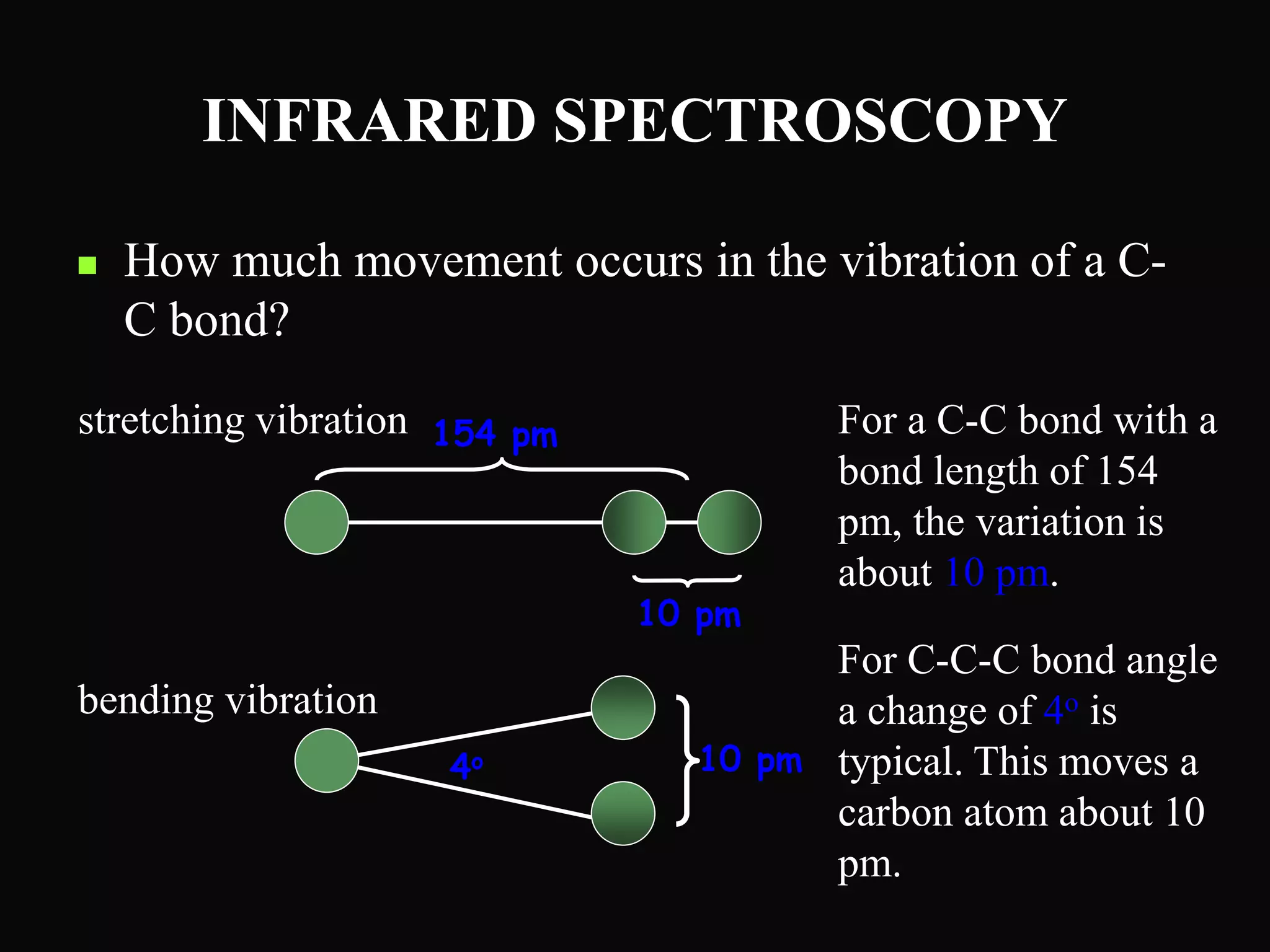
 How much movement occurs in the vibration of a C-
C bond?
10 pm
154 pmstretching vibration For a C-C bond with a
bond length of 154
pm, the variation is
about 10 pm.
bending vibration
4o 10 pm
For C-C-C bond angle
a change of 4o is
typical. This moves a
carbon atom about 10
pm.
INFRARED SPECTROSCOPY
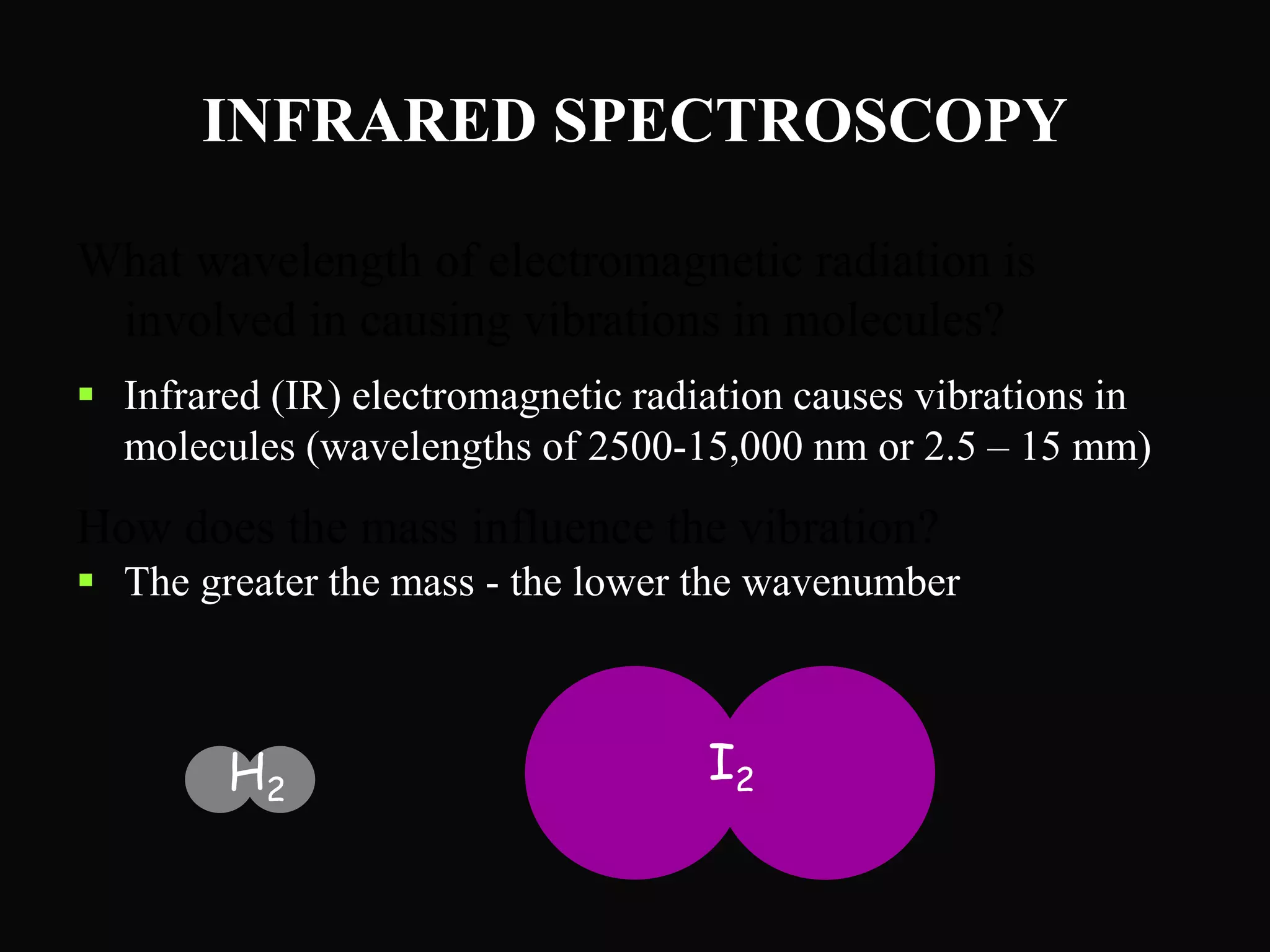
What wavelength of electromagnetic radiation is
involved in causing vibrations in molecules?
 Infrared (IR) electromagnetic radiation causes vibrations in
molecules (wavelengths of 2500-15,000 nm or 2.5 – 15 mm)
How does the mass influence the vibration?
 The greater the mass - the lower the wavenumber
H2
I2
INFRARED SPECTROSCOPY
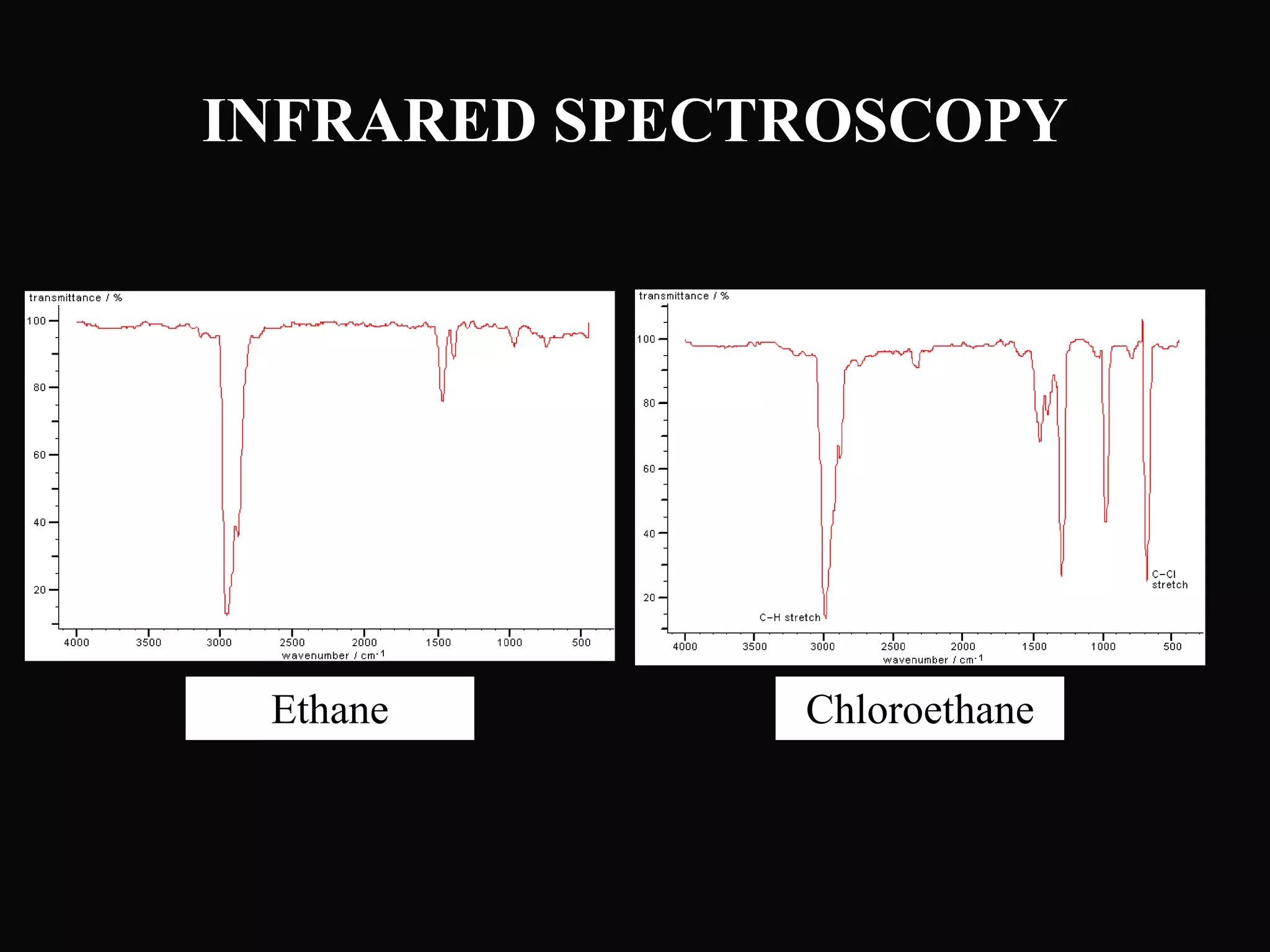
Ethane Chloroethane
INFRARED SPECTROSCOPY
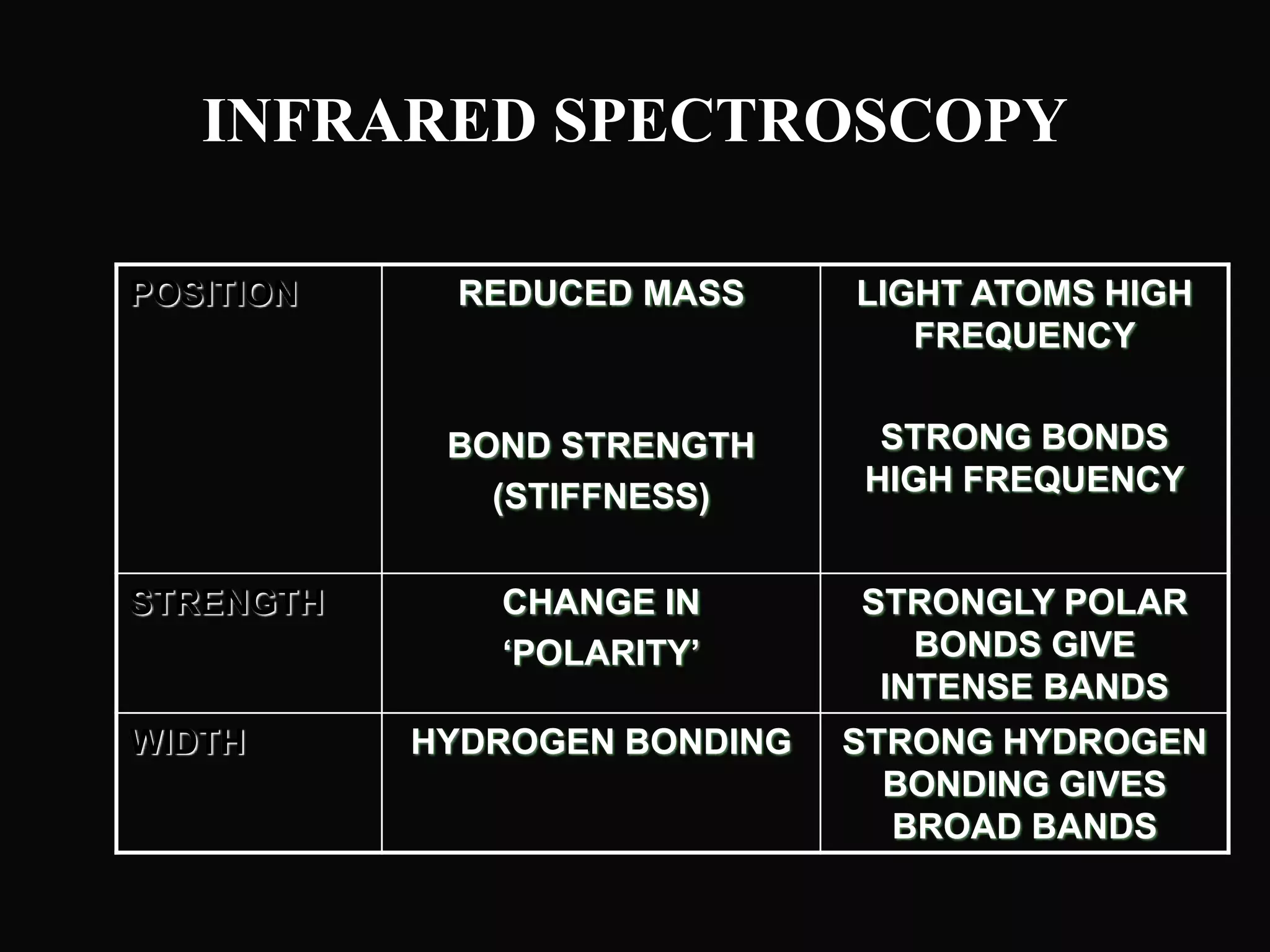
POSITION REDUCED MASS
BOND STRENGTH
(STIFFNESS)
LIGHT ATOMS HIGH
FREQUENCY
STRONG BONDS
HIGH FREQUENCY
STRENGTH CHANGE IN
‘POLARITY’
STRONGLY POLAR
BONDS GIVE
INTENSE BANDS
WIDTH HYDROGEN BONDING STRONG HYDROGEN
BONDING GIVES
BROAD BANDS
INFRARED SPECTROSCOPY
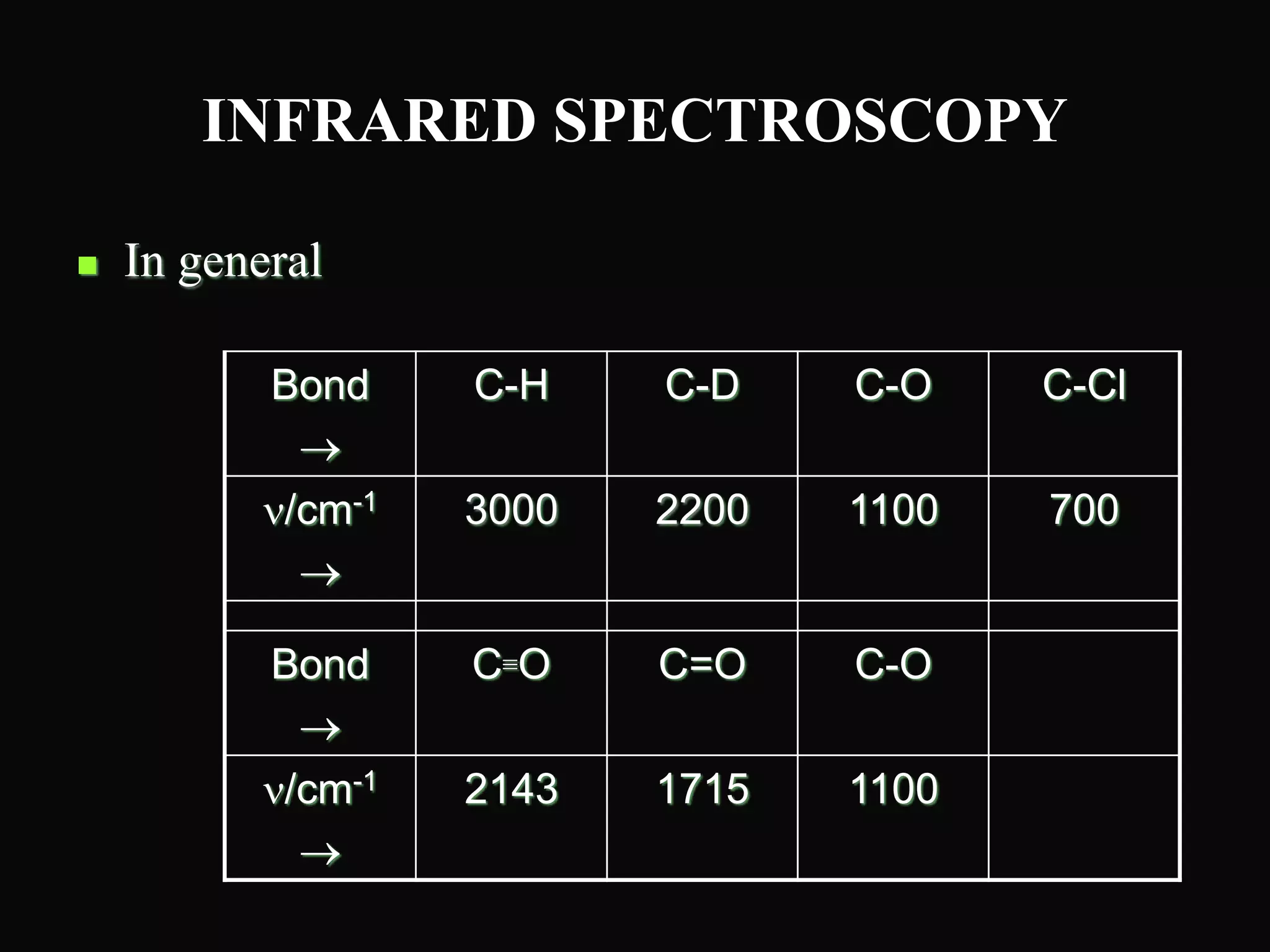
 In general
Bond

C-H C-D C-O C-Cl
/cm-1

3000 2200 1100 700
Bond

CO C=O C-O
/cm-1

2143 1715 1100
INFRARED SPECTROSCOPY
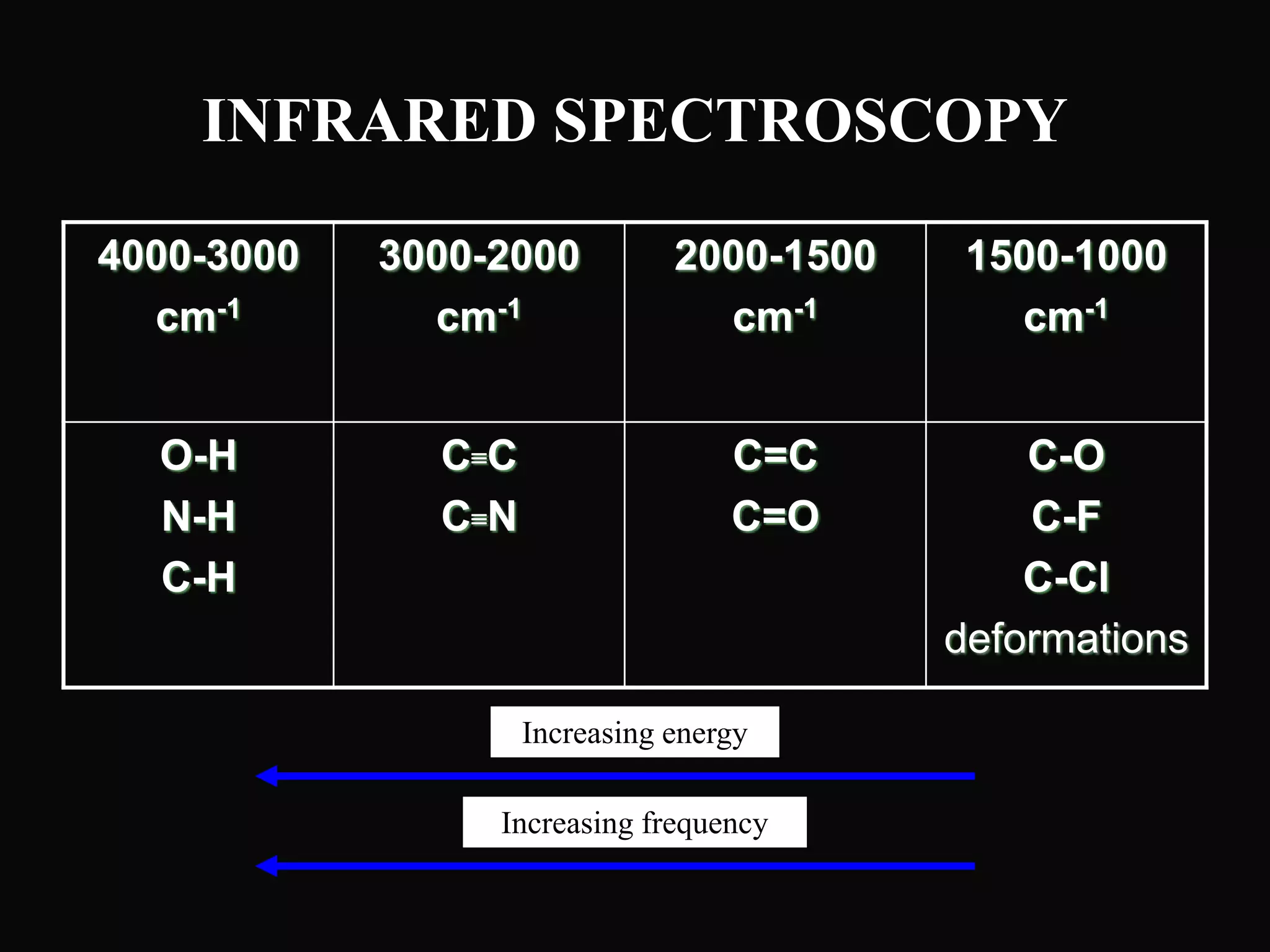
4000-3000
cm-1
3000-2000
cm-1
2000-1500
cm-1
1500-1000
cm-1
O-H
N-H
C-H
CC
CN
C=C
C=O
C-O
C-F
C-Cl
deformations
Increasing energy
Increasing frequency
INTERPRETATION OF INFRARED SPECTRA
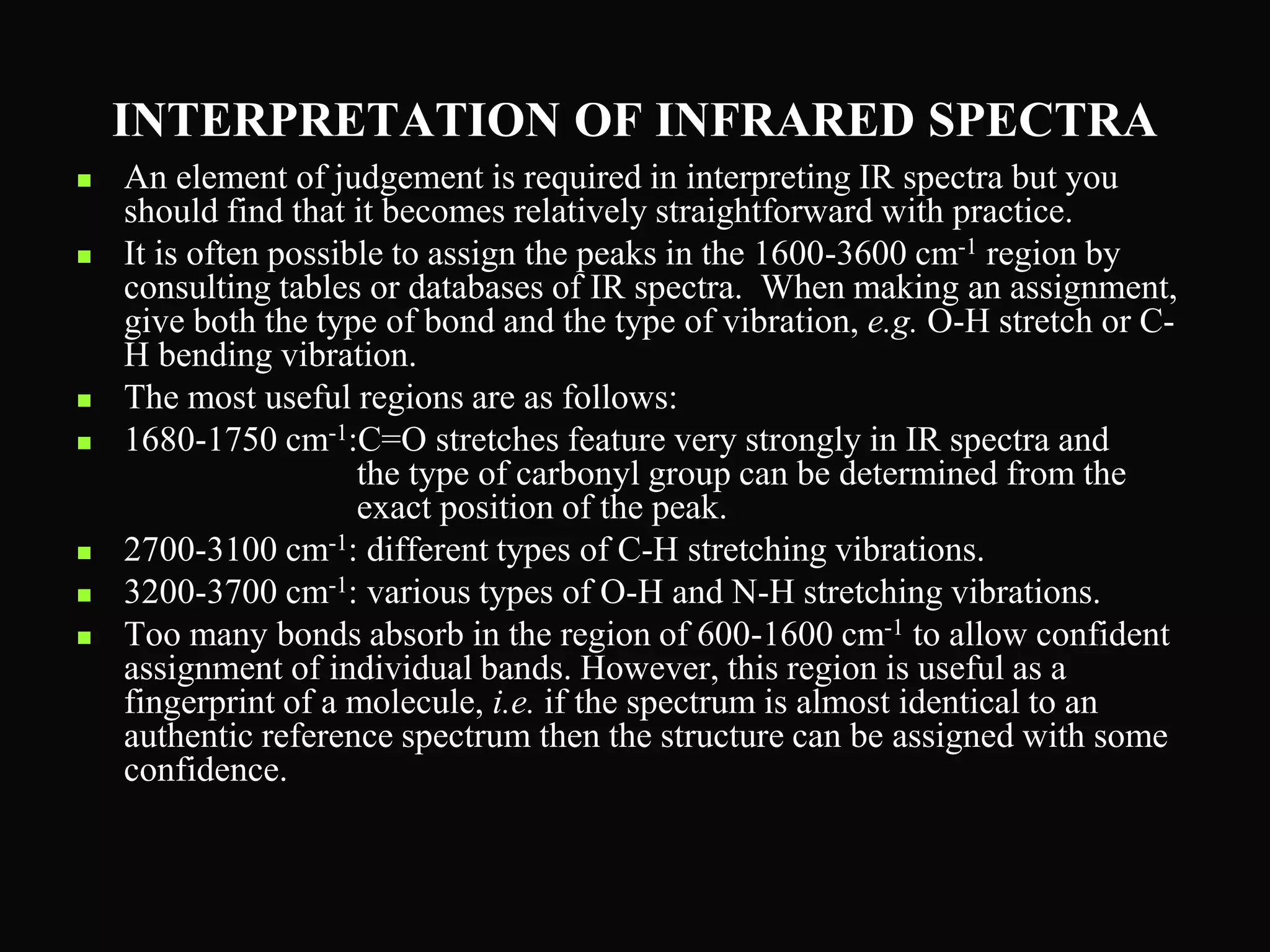
 An element of judgement is required in interpreting IR spectra but you
should find that it becomes relatively straightforward with practice.
 It is often possible to assign the peaks in the 1600-3600 cm-1 region by
consulting tables or databases of IR spectra. When making an assignment,
give both the type of bond and the type of vibration, e.g. O-H stretch or C-
H bending vibration.
 The most useful regions are as follows:
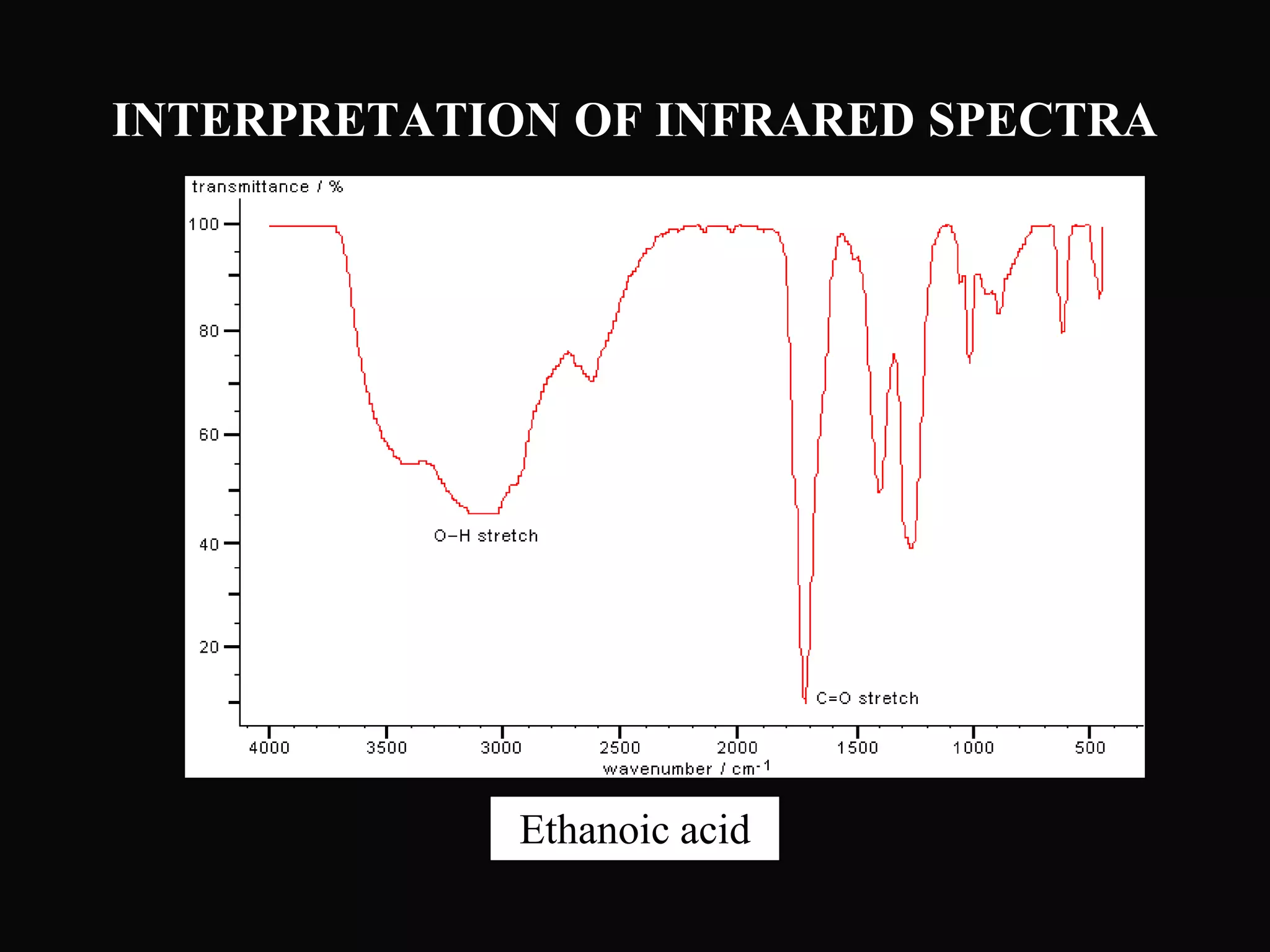
 1680-1750 cm-1:C=O stretches feature very strongly in IR spectra and
the type of carbonyl group can be determined from the
exact position of the peak.
 2700-3100 cm-1: different types of C-H stretching vibrations.
 3200-3700 cm-1: various types of O-H and N-H stretching vibrations.
 Too many bonds absorb in the region of 600-1600 cm-1 to allow confident
assignment of individual bands. However, this region is useful as a
fingerprint of a molecule, i.e. if the spectrum is almost identical to an
authentic reference spectrum then the structure can be assigned with some
confidence.
INTERPRETATION OF INFRARED SPECTRA
Ethanoic acid
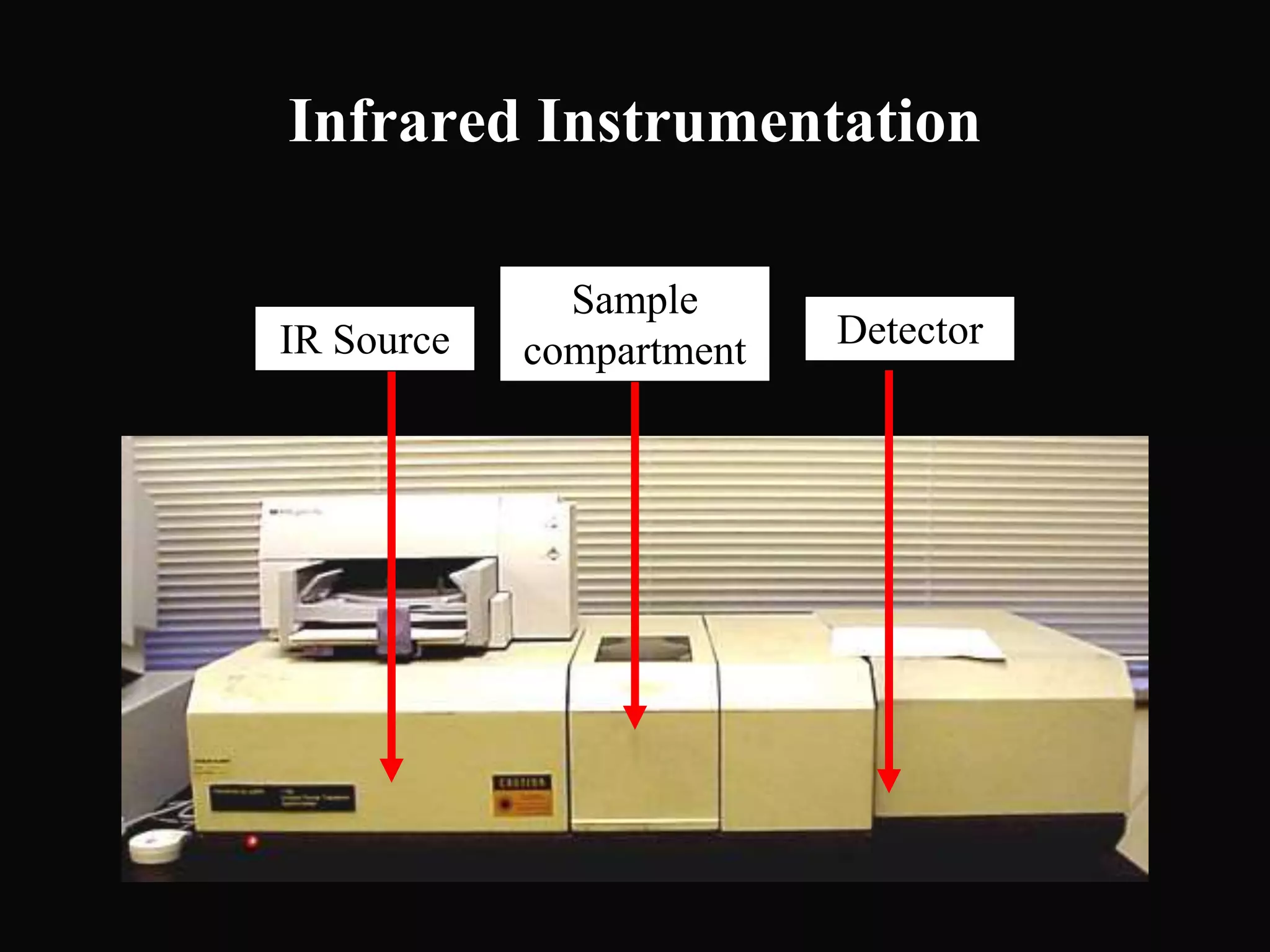
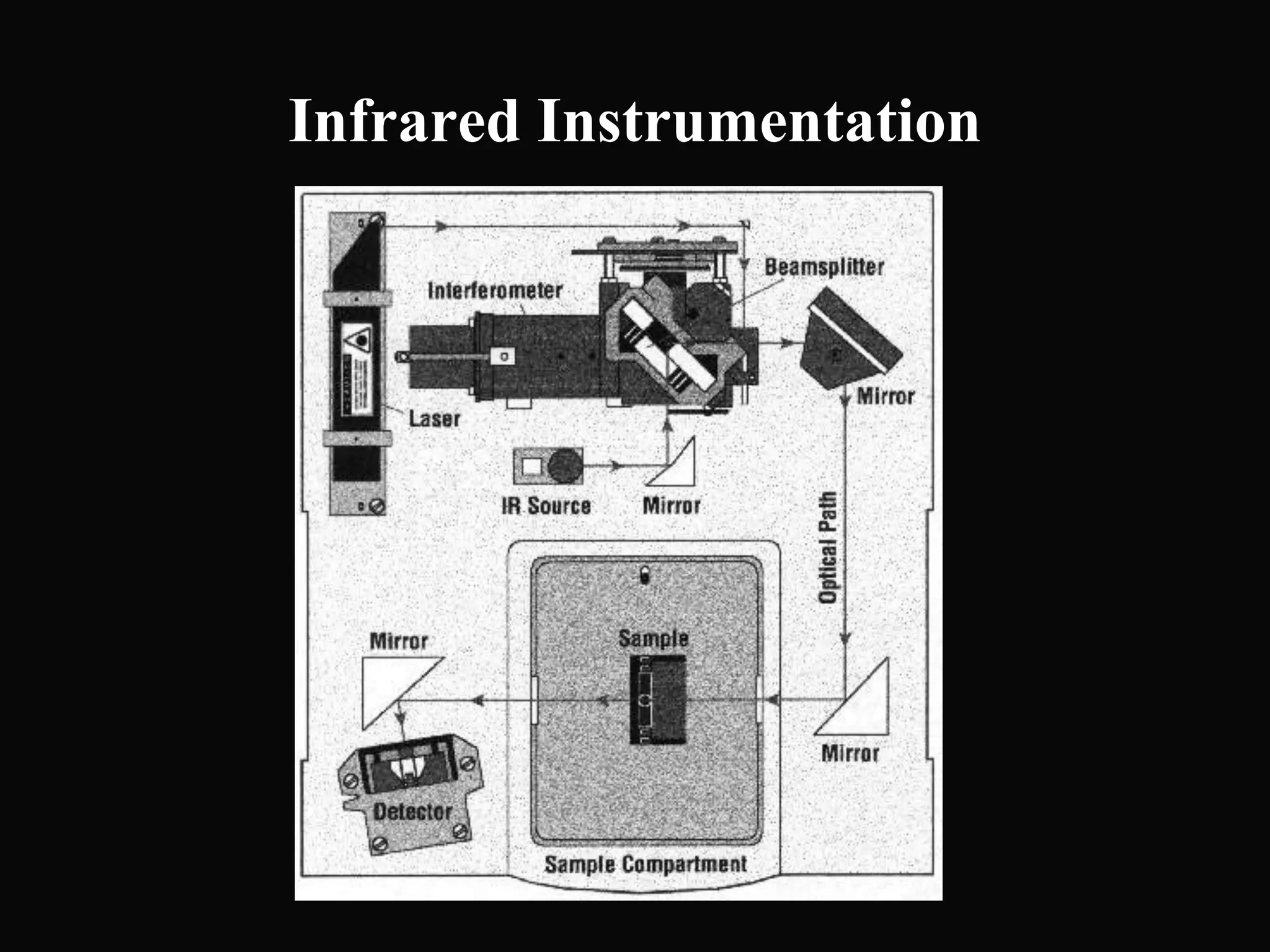
Infrared Instrumentation
Sample
compartmentIR Source Detector
Infrared Instrumentation
 All modern instruments are Fourier Transform
instruments.
 In all transmission experiments radiation from a
source is directed through the sample to a detector.
 The measurement of the type and amount of light
transmitted by the sample gives information about the
structure of the molecules comprising the sample.
Infrared Instrumentation
Infrared Experimental
 To obtain an IR spectrum, the sample must be
placed in a “container” or cell that is transparent
in the IR region of the spectrum.
 Sodium chloride or salt plates are a common
means of placing the sample in the light beam of
the instrument.
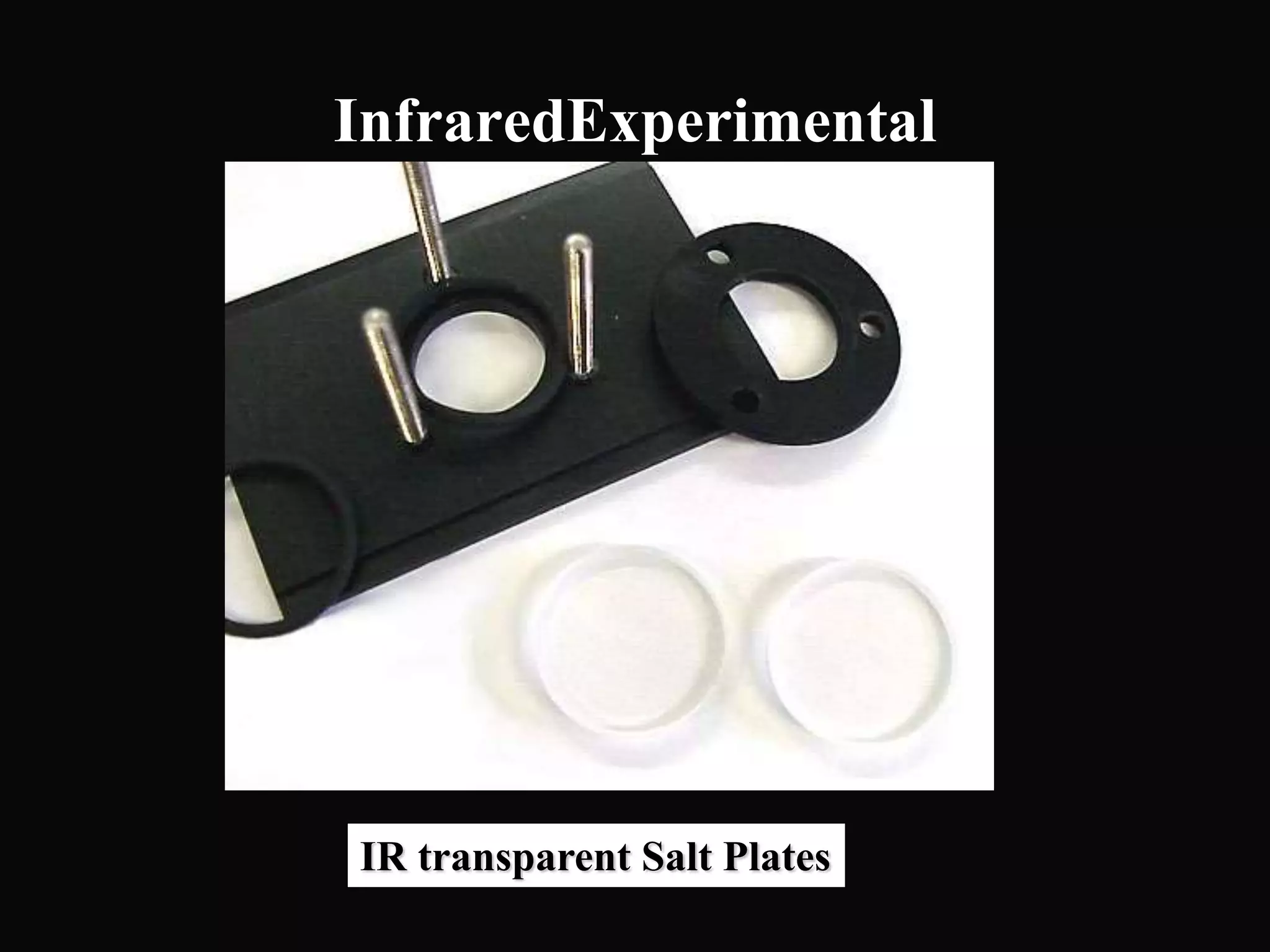
InfraredExperimental
IR transparent Salt Plates
Infrared Experimental
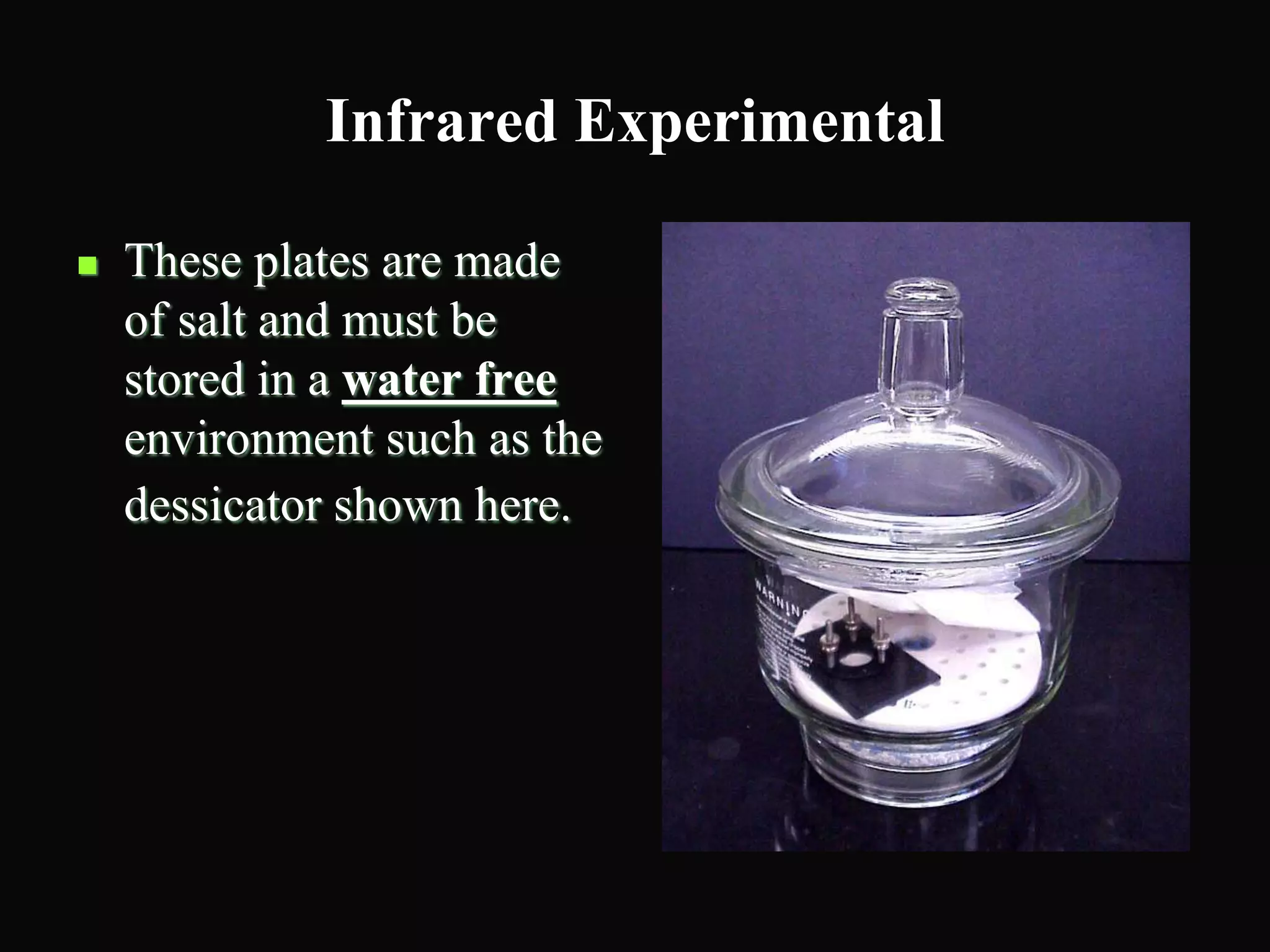
 These plates are made
of salt and must be
stored in a water free
environment such as the
dessicator shown here.
Infrared Experimental
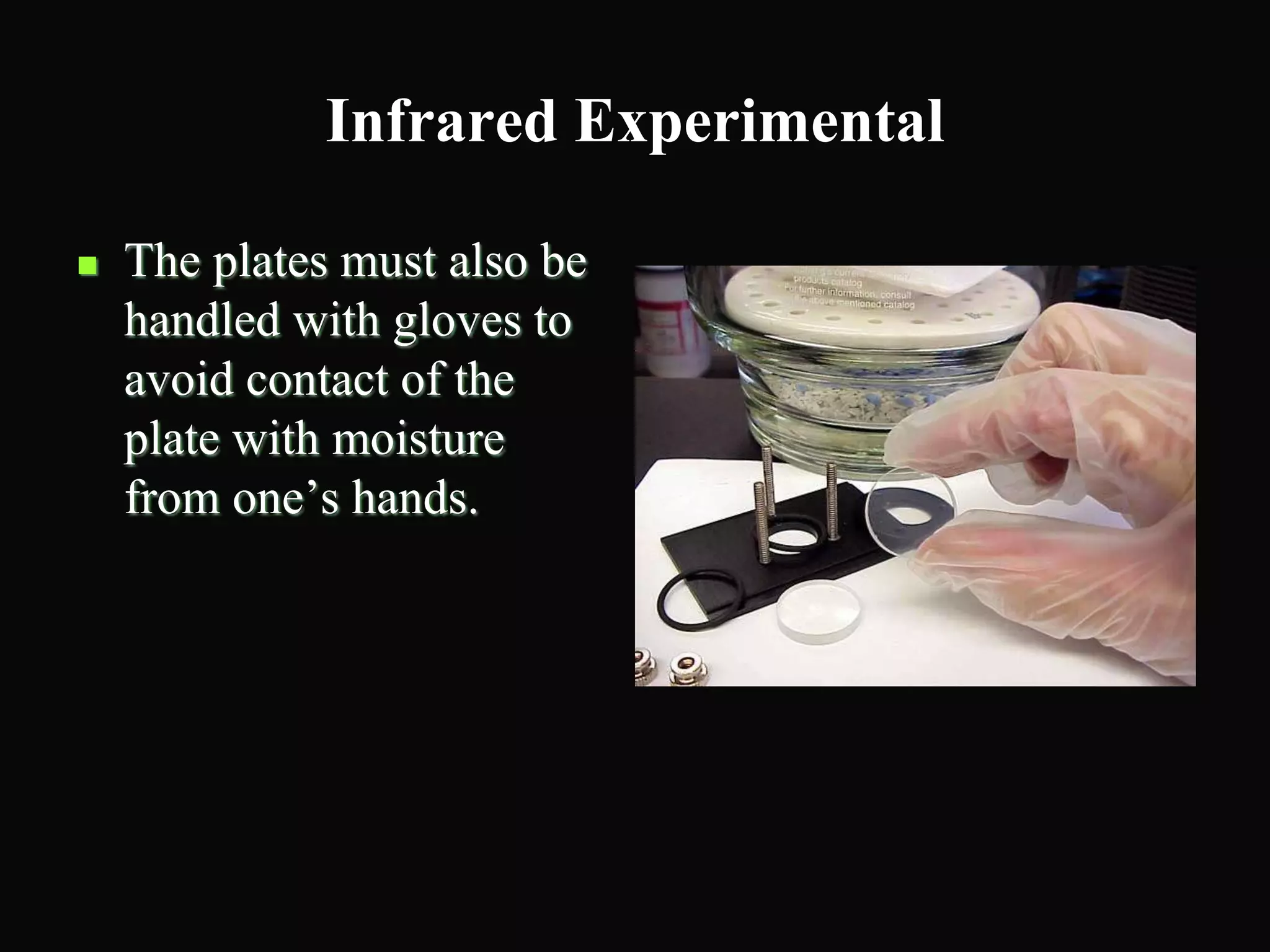
 The plates must also be
handled with gloves to
avoid contact of the
plate with moisture
from one’s hands.
Infrared Experimental
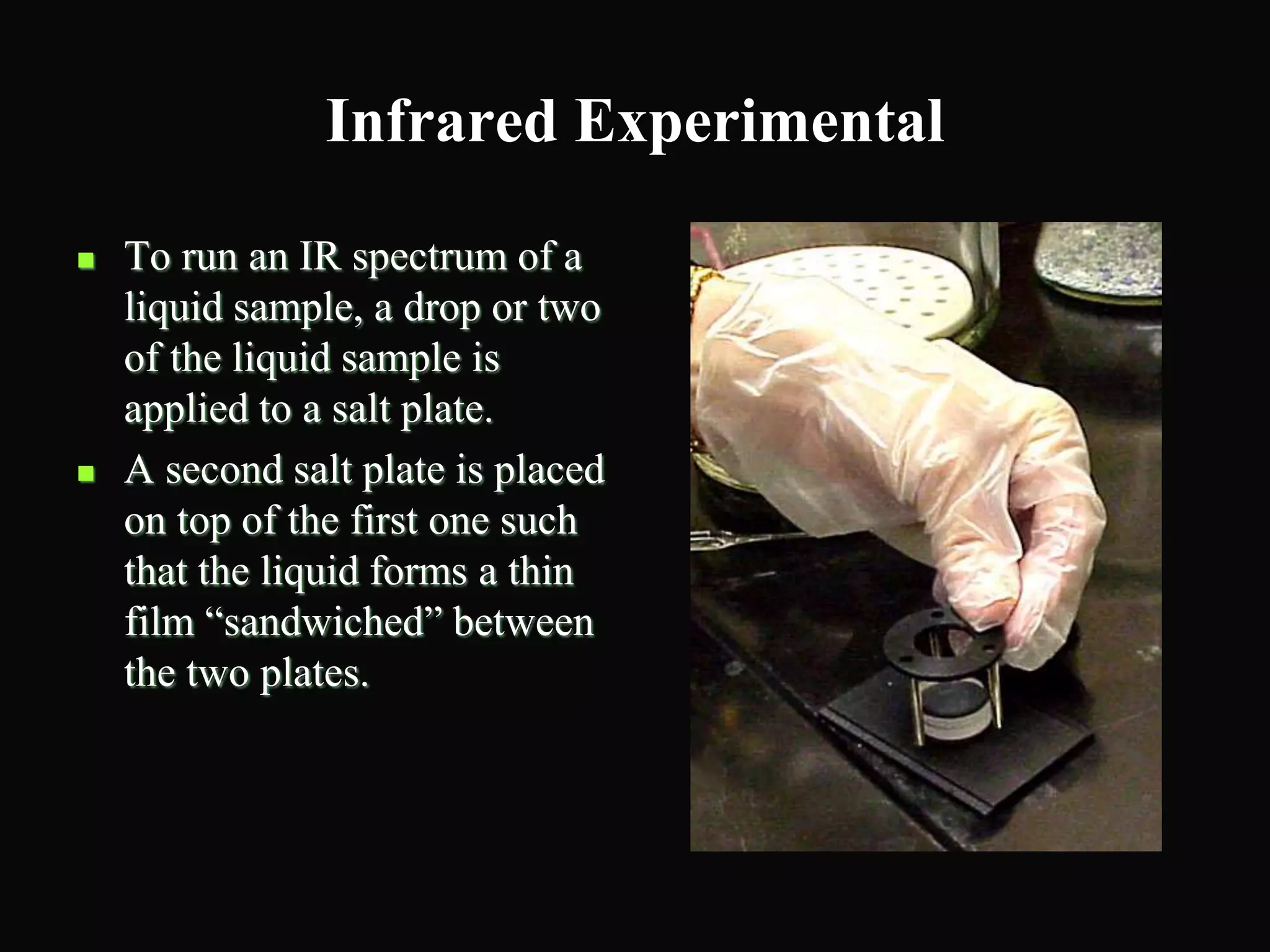
 To run an IR spectrum of a
liquid sample, a drop or two
of the liquid sample is
applied to a salt plate.
 A second salt plate is placed
on top of the first one such
that the liquid forms a thin
film “sandwiched” between
the two plates.
Infrared Experimental
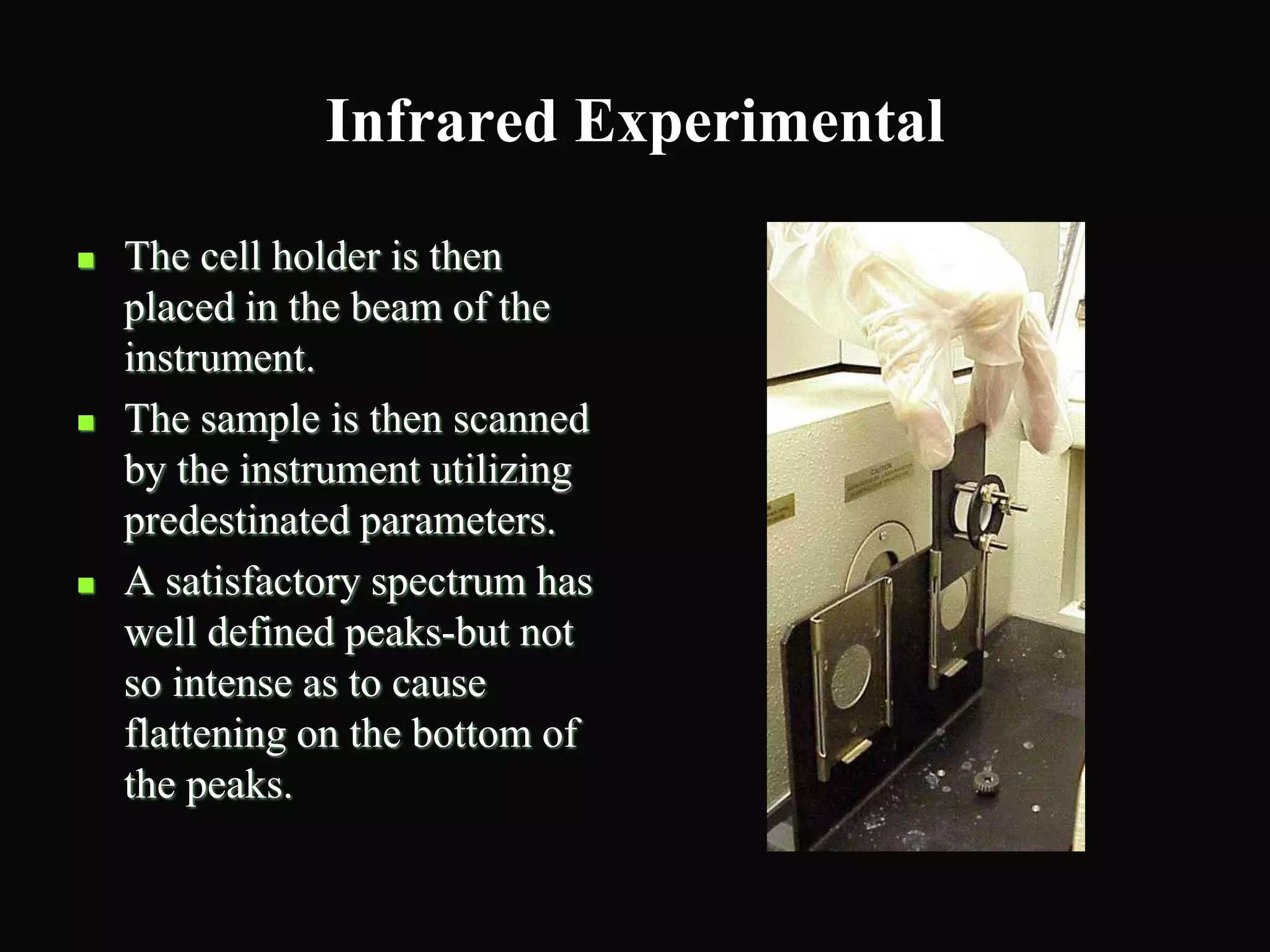
 The cell holder is then
placed in the beam of the
instrument.
 The sample is then scanned
by the instrument utilizing
predestinated parameters.
 A satisfactory spectrum has
well defined peaks-but not
so intense as to cause
flattening on the bottom of
the peaks.
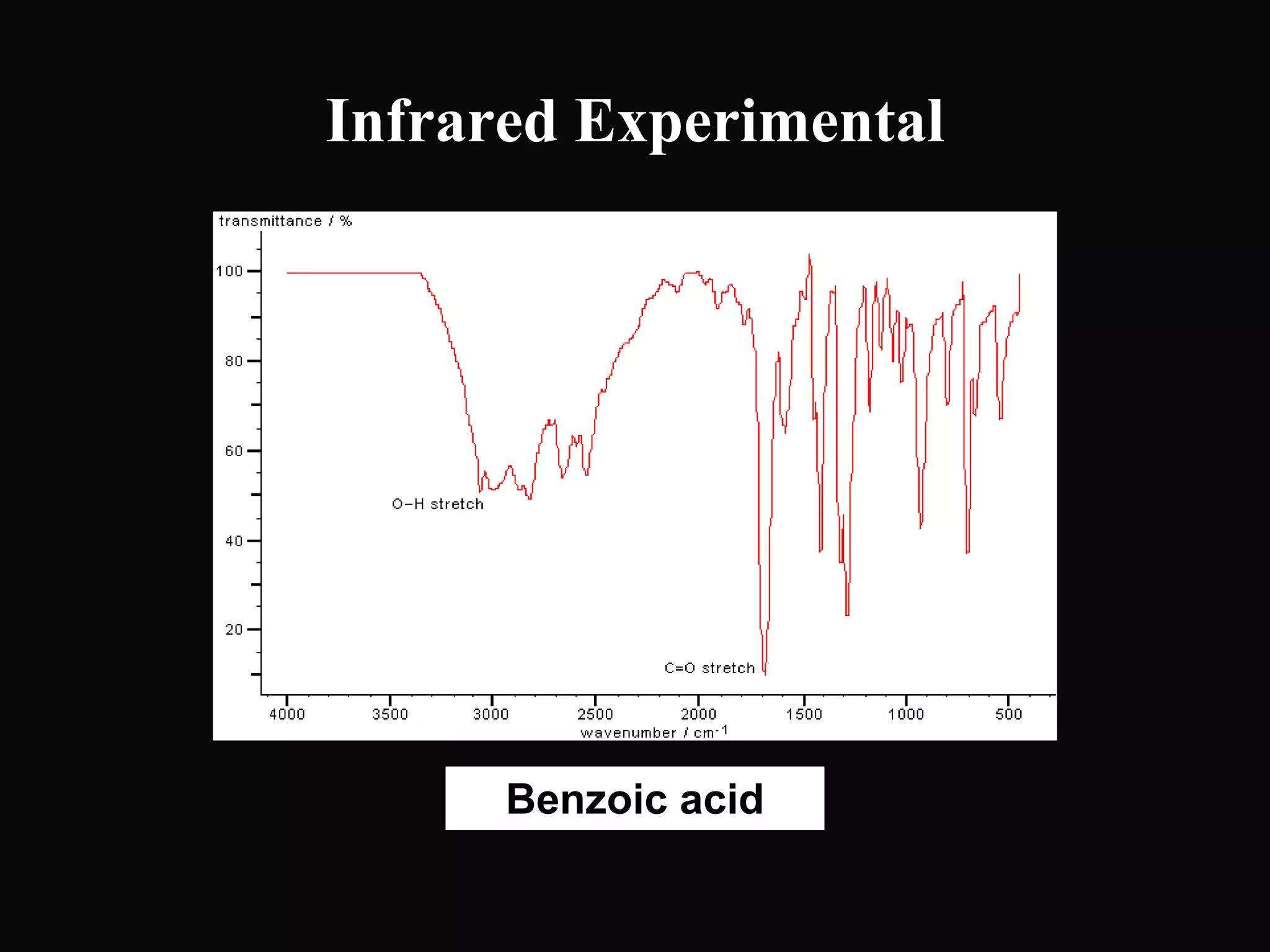
Infrared Experimental
Benzoic acid
Infrared Experimental
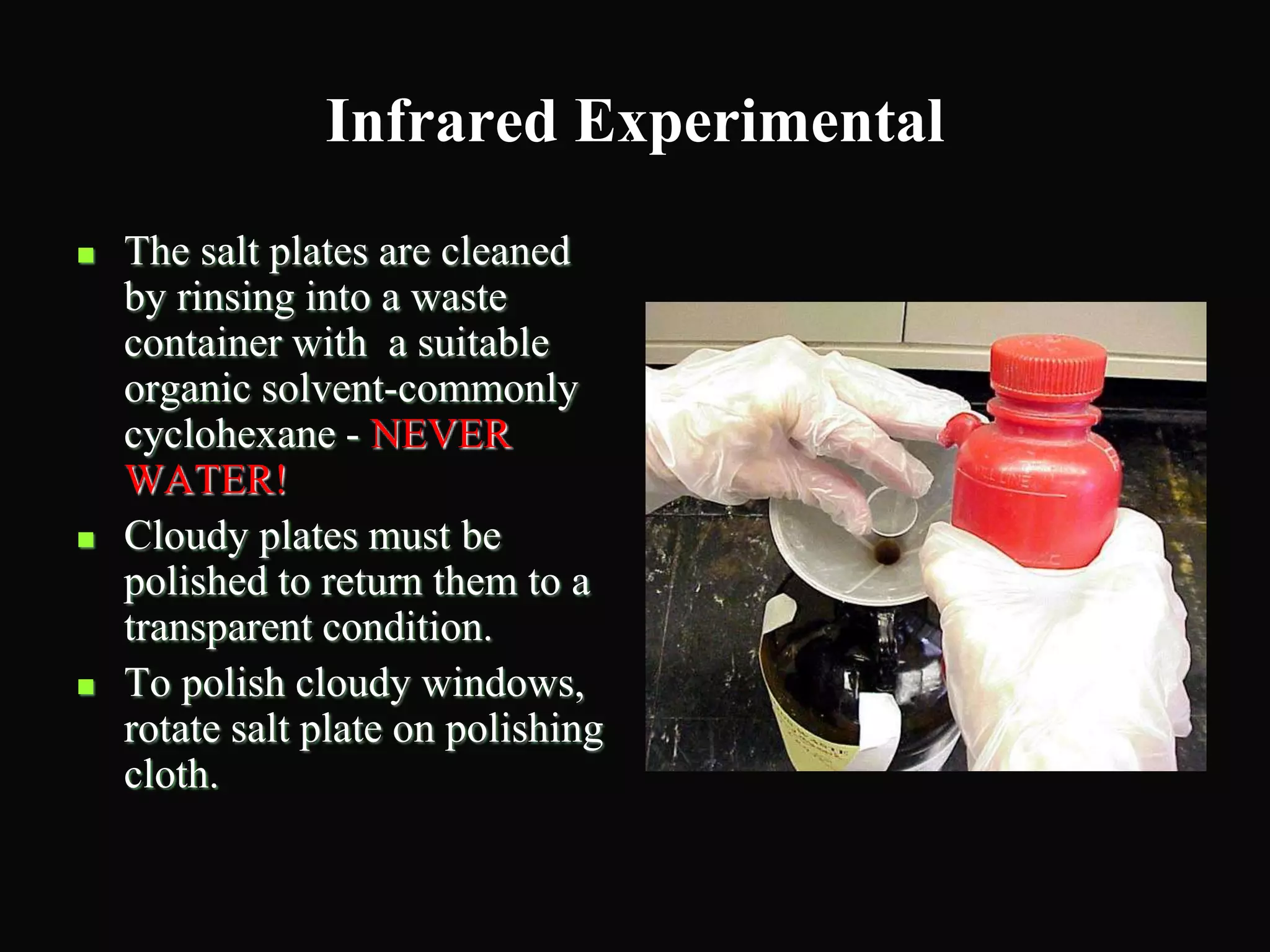
 The salt plates are cleaned
by rinsing into a waste
container with a suitable
organic solvent-commonly
cyclohexane - NEVER
WATER!
 Cloudy plates must be
polished to return them to a
transparent condition.
 To polish cloudy windows,
rotate salt plate on polishing
cloth.
UV-Visible Spectroscopy
 Ultraviolet radiation stimulates molecular
vibrations and electronic transitions.
 Absorption spectroscopy from 160 nm to 780
nm
 Measurement absorption or transmittance
 Identification of inorganic and organic species
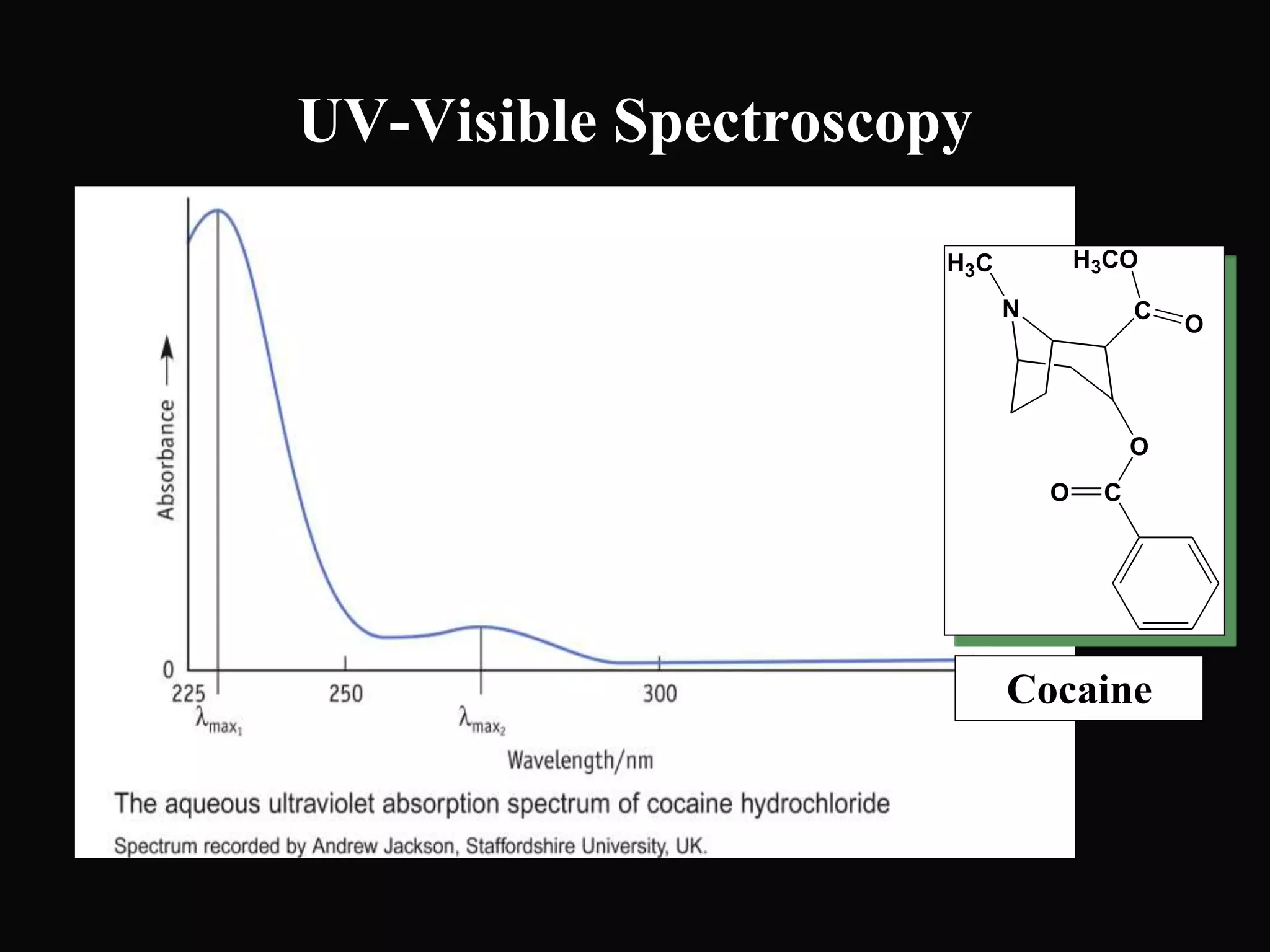
UV-Visible Spectroscopy
CO
O
N C
H3C
O
H3CO
Cocaine
UV-Visible Spectroscopy
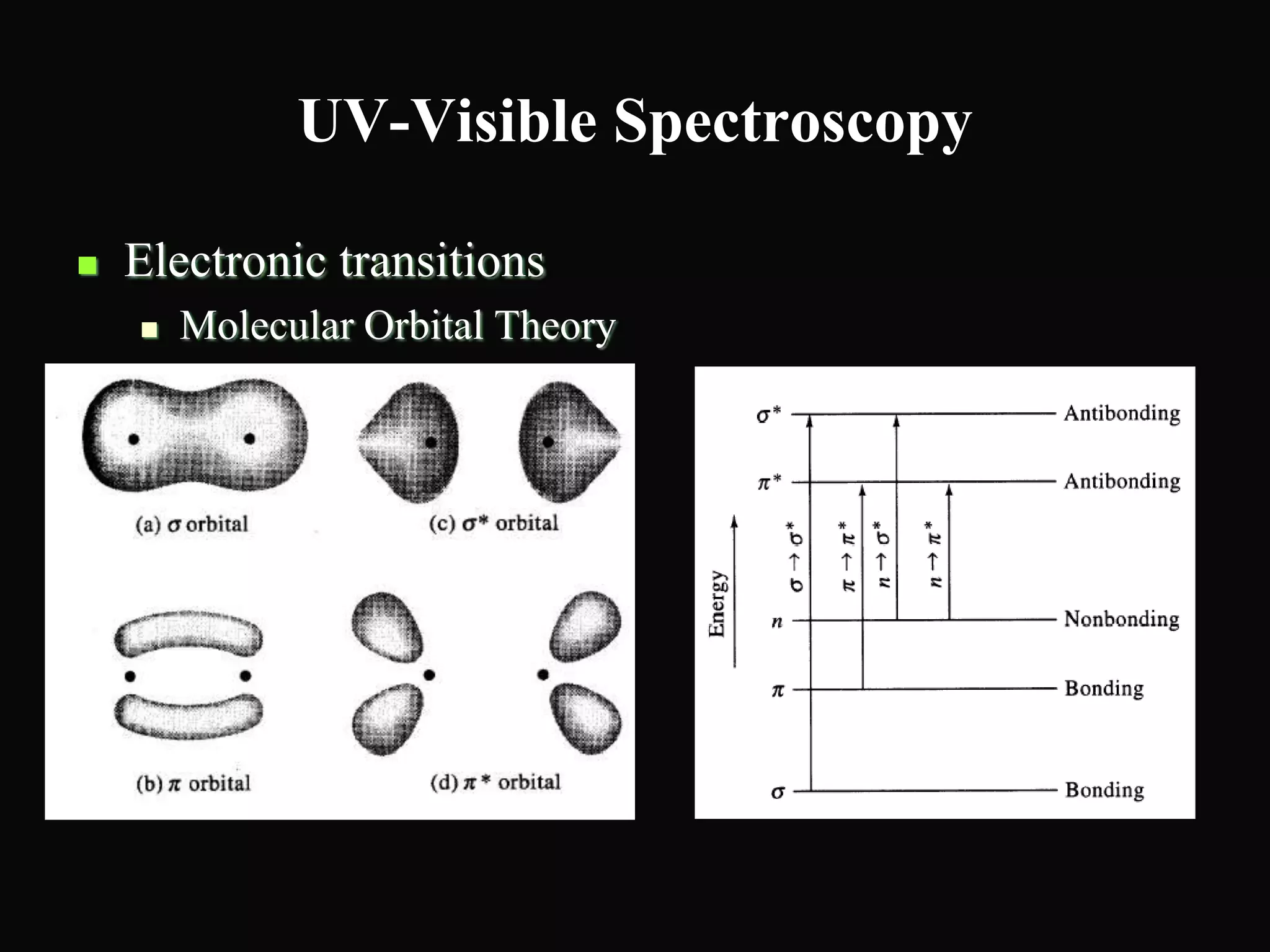
 Electronic transitions
 Molecular Orbital Theory
UV-Visible Spectroscopy
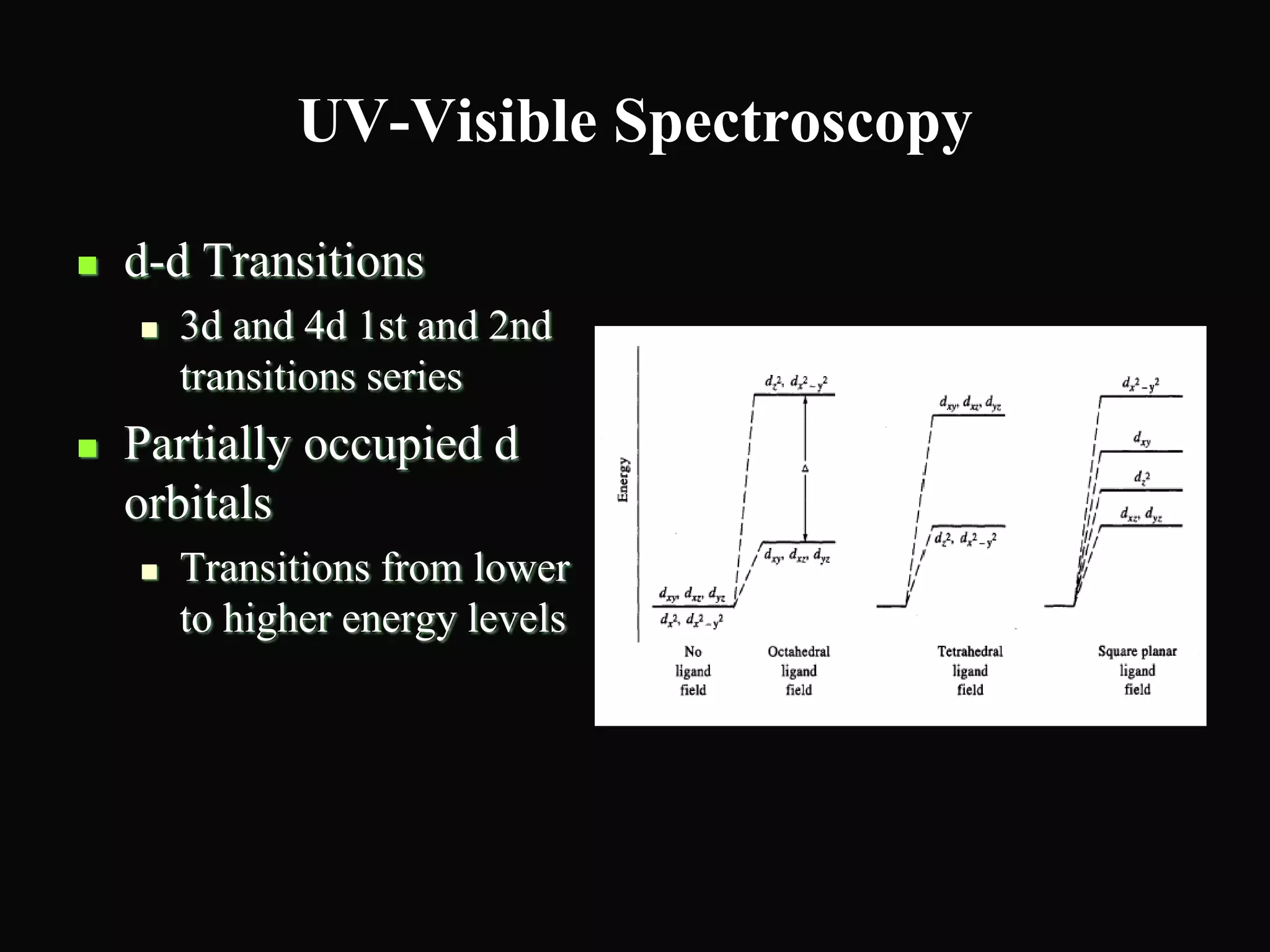
 d-d Transitions
 3d and 4d 1st and 2nd
transitions series
 Partially occupied d
orbitals
 Transitions from lower
to higher energy levels
UV-Visible Spectroscopy
 Charge Transfer
 Electron donor and acceptor characteristics
 Absorption involves e- transitions from donor to acceptor
 SCN- to Fe(III)
 Fe(II) and neutral SCN
 Metal is acceptor
 Reduced metals can be exception
UV-Visible Spectroscopy
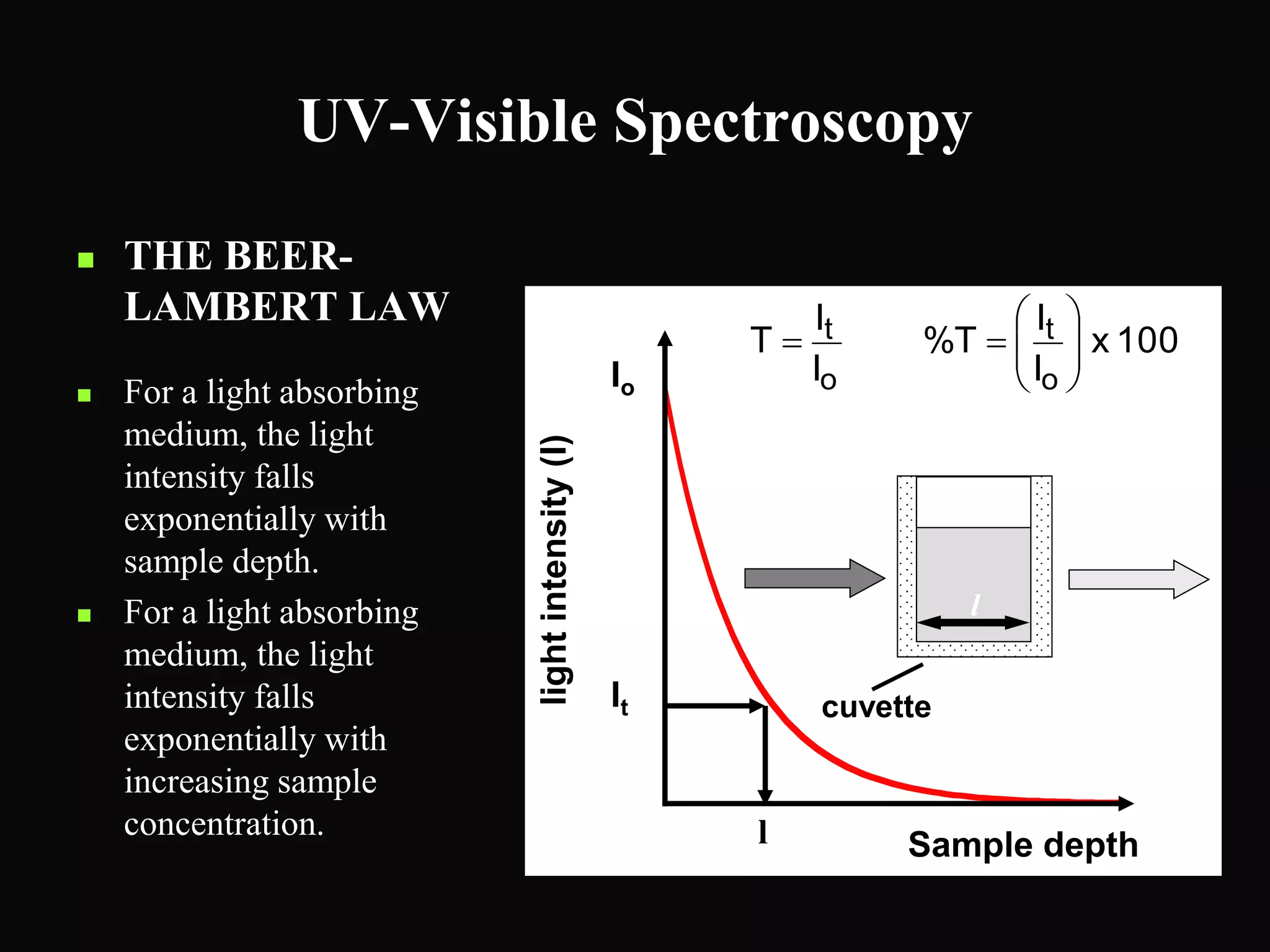
 THE BEER-
LAMBERT LAW
 For a light absorbing
medium, the light
intensity falls
exponentially with
sample depth.
 For a light absorbing
medium, the light
intensity falls
exponentially with
increasing sample
concentration.
100x
I
I
T%
I
I
T
o
t
o
t







Io It
l
cuvette
lightintensity(I)
Sample depth
Io
It
l
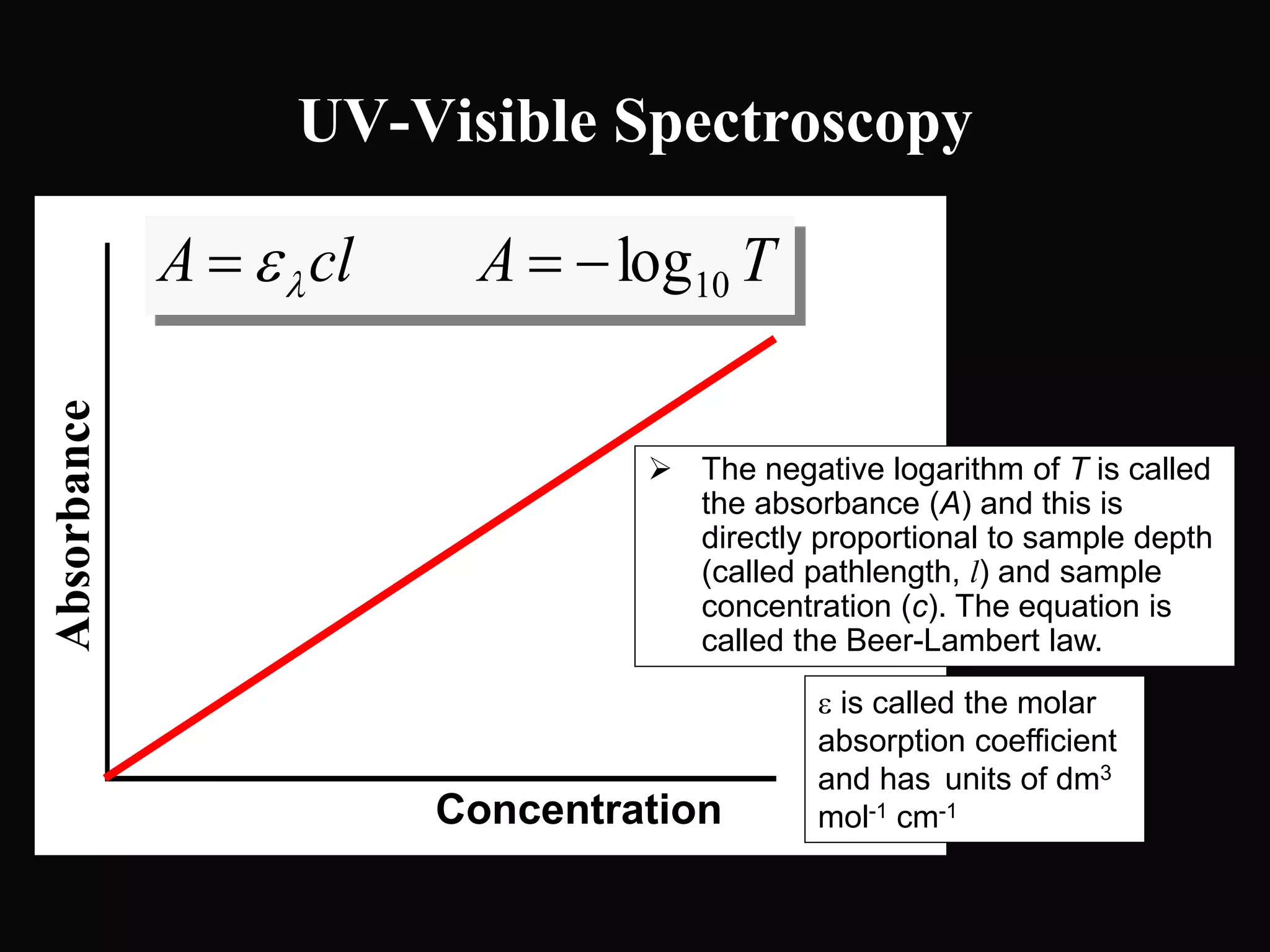
UV-Visible Spectroscopy
Absorbance
Concentration
TAclA 10log 
 The negative logarithm of T is called
the absorbance (A) and this is
directly proportional to sample depth
(called pathlength, l) and sample
concentration (c). The equation is
called the Beer-Lambert law.
 is called the molar
absorption coefficient
and has units of dm3
mol-1 cm-1
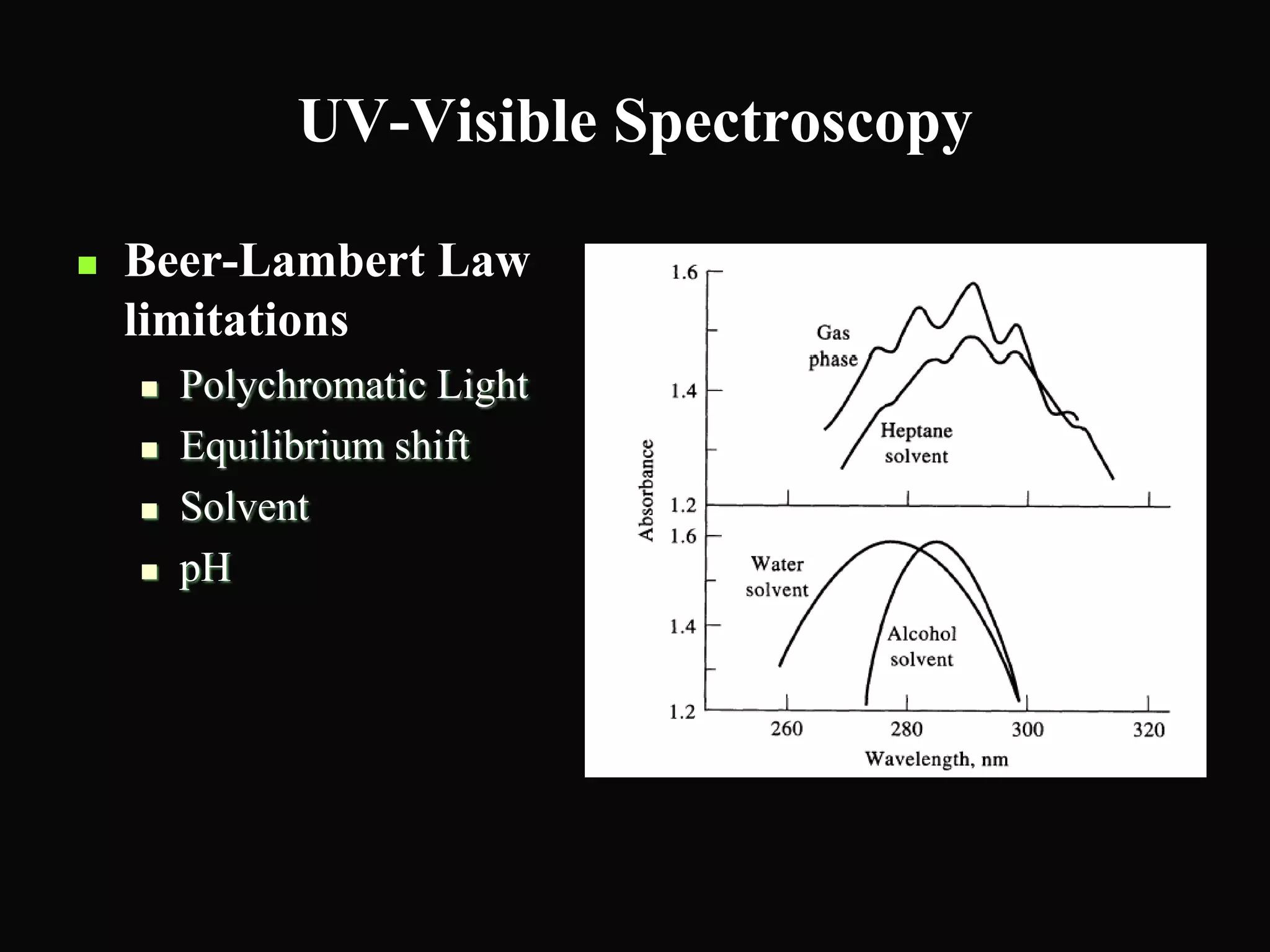
UV-Visible Spectroscopy
 Beer-Lambert Law
limitations
 Polychromatic Light
 Equilibrium shift
 Solvent
 pH
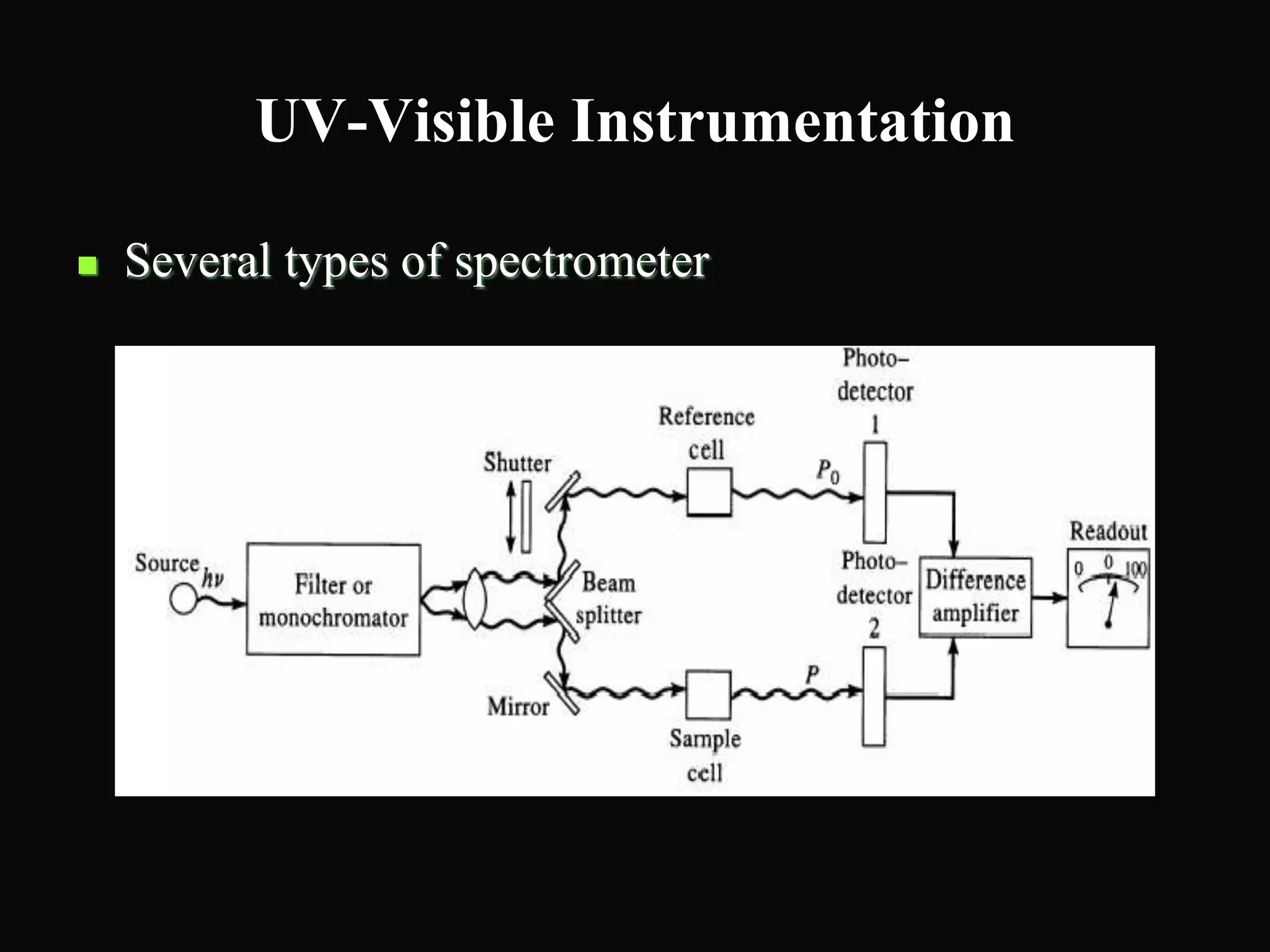
UV-Visible Instrumentation
 Several types of spectrometer
UV-Visible Instrumentation
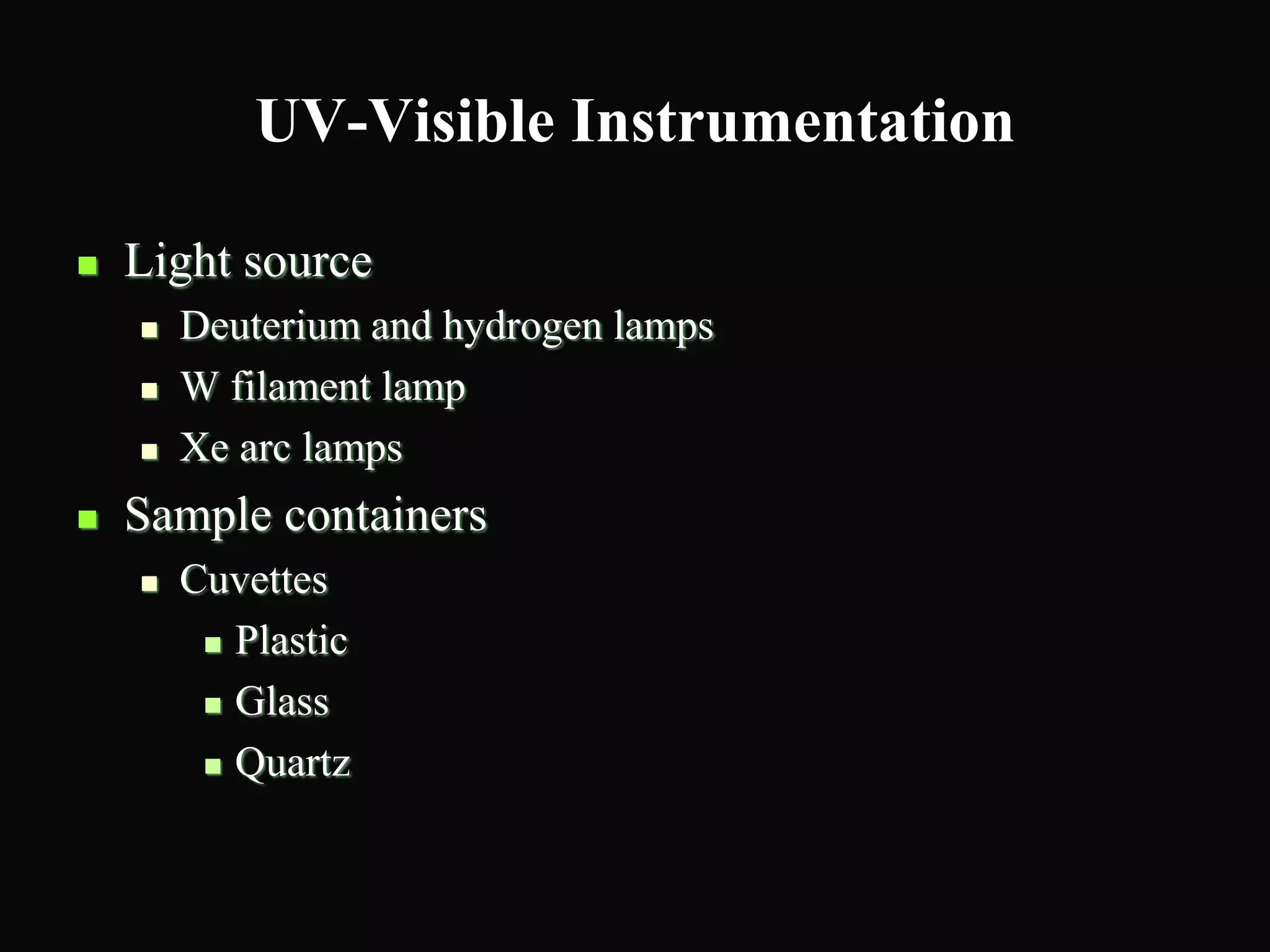
 Light source
 Deuterium and hydrogen lamps
 W filament lamp
 Xe arc lamps
 Sample containers
 Cuvettes
 Plastic
 Glass
 Quartz
Thank you

Have a nice day!!

Infrared Spectroscopy and UV-Visible spectroscopy

  • 1.
    An Introduction toInfrared and UV-Visible Spectroscopy Preeti Choudhary MSc Applied Physics
  • 2.
    LEARNING OBJECTIVES  Describethe principal regions of the electromagnetic spectrum.  Describe the principles of infrared spectroscopy.  Describe the principles of UV-Vis spectroscopy.  Describe and explain the principal factors that govern the vibrational frequencies of bonds.  Describe and explain the principal factors that govern the electronic absorption process in UV-Vis spectroscopy.  Experimental and instrumental
  • 3.
  • 4.
    WHAT IS SPECTROSCOPY? Atoms and molecules interact with electromagnetic radiation (EMR) in a wide variety of ways.  Atoms and molecules may absorb and/or emit EMR.  Absorption of EMR stimulates different types of motion in atoms and/or molecules.  The patterns of absorption (wavelengths absorbed and to what extent) and/or emission (wavelengths emitted and their respective intensities) are called ‘spectra’.  The field of spectroscopy is concerned with the interpretation of spectra in terms of atomic and molecular structure (and environment).
  • 5.
    INFRARED SPECTROSCOPY  Infraredradiation stimulates molecular vibrations.  Infrared spectra are traditionally displayed as %T (percent transmittance) versus wave number (4000-400 cm-1).  Useful in identifying presence or absence of functional groups.
  • 6.
    INFRARED SPECTROSCOPY Aspirin (acetylsalicylicacid) 0 20 40 60 80 100 120 5001000150020002500300035004000 wavenumber/ cm-1 %T O C O CH3 C O HO Wavenumber = 1/ wavelength
  • 7.
    INFRARED SPECTROSCOPY  Inthe IR region of the electromagnetic spectrum, the absorption of radiation by a sample is due to changes in the vibrational energy states of a molecule.
  • 8.
    INFRARED SPECTROSCOPY  Methane Rockingor in plane bending HH HH HH C HH H H H H H H H C H H C H H C HH C HH C H Asymmetrical stretching Symmetrical stretching Bending or scissoring Twisting or out- of-plane bending Wagging or out-of-plane bending
  • 9.
    INFRARED SPECTROSCOPY  Onlyvibrations that cause a change in ‘polarity’ give rise to bands in IR spectra – which of the vibrations for CO2 are infrared active? O C O O C O O C O O C O Symmetric stretch Asymmetric stretch Bending (doubly degenerate)
  • 10.
    INFRARED SPECTROSCOPY What isa vibration in a molecule?  Any change in shape of the molecule- stretching of bonds, bending of bonds, or internal rotation around single bonds What vibrations change the dipole moment of a molecule?  Asymmetrical stretching/bending and internal rotation change the dipole moment of a molecule. Asymmetrical stretching/bending are IR active.  Symmetrical stretching/bending does not. Not IR active
  • 11.
    INFRARED SPECTROSCOPY  HumanBreath 0 20 40 60 80 100 5001000150020002500300035004000 wavenumber/cm-1 %T O H H O H H O C O O C O O C O
  • 12.
    INFRARED SPECTROSCOPY  Howmuch movement occurs in the vibration of a C- C bond? 10 pm 154 pmstretching vibration For a C-C bond with a bond length of 154 pm, the variation is about 10 pm. bending vibration 4o 10 pm For C-C-C bond angle a change of 4o is typical. This moves a carbon atom about 10 pm.
  • 13.
    INFRARED SPECTROSCOPY What wavelengthof electromagnetic radiation is involved in causing vibrations in molecules?  Infrared (IR) electromagnetic radiation causes vibrations in molecules (wavelengths of 2500-15,000 nm or 2.5 – 15 mm) How does the mass influence the vibration?  The greater the mass - the lower the wavenumber H2 I2
  • 14.
  • 15.
    INFRARED SPECTROSCOPY POSITION REDUCEDMASS BOND STRENGTH (STIFFNESS) LIGHT ATOMS HIGH FREQUENCY STRONG BONDS HIGH FREQUENCY STRENGTH CHANGE IN ‘POLARITY’ STRONGLY POLAR BONDS GIVE INTENSE BANDS WIDTH HYDROGEN BONDING STRONG HYDROGEN BONDING GIVES BROAD BANDS
  • 16.
    INFRARED SPECTROSCOPY  Ingeneral Bond  C-H C-D C-O C-Cl /cm-1  3000 2200 1100 700 Bond  CO C=O C-O /cm-1  2143 1715 1100
  • 17.
  • 18.
    INTERPRETATION OF INFRAREDSPECTRA  An element of judgement is required in interpreting IR spectra but you should find that it becomes relatively straightforward with practice.  It is often possible to assign the peaks in the 1600-3600 cm-1 region by consulting tables or databases of IR spectra. When making an assignment, give both the type of bond and the type of vibration, e.g. O-H stretch or C- H bending vibration.  The most useful regions are as follows:  1680-1750 cm-1:C=O stretches feature very strongly in IR spectra and the type of carbonyl group can be determined from the exact position of the peak.  2700-3100 cm-1: different types of C-H stretching vibrations.  3200-3700 cm-1: various types of O-H and N-H stretching vibrations.  Too many bonds absorb in the region of 600-1600 cm-1 to allow confident assignment of individual bands. However, this region is useful as a fingerprint of a molecule, i.e. if the spectrum is almost identical to an authentic reference spectrum then the structure can be assigned with some confidence.
  • 19.
    INTERPRETATION OF INFRAREDSPECTRA Ethanoic acid
  • 20.
  • 21.
    Infrared Instrumentation  Allmodern instruments are Fourier Transform instruments.  In all transmission experiments radiation from a source is directed through the sample to a detector.  The measurement of the type and amount of light transmitted by the sample gives information about the structure of the molecules comprising the sample.
  • 22.
  • 23.
    Infrared Experimental  Toobtain an IR spectrum, the sample must be placed in a “container” or cell that is transparent in the IR region of the spectrum.  Sodium chloride or salt plates are a common means of placing the sample in the light beam of the instrument.
  • 24.
  • 25.
    Infrared Experimental  Theseplates are made of salt and must be stored in a water free environment such as the dessicator shown here.
  • 26.
    Infrared Experimental  Theplates must also be handled with gloves to avoid contact of the plate with moisture from one’s hands.
  • 27.
    Infrared Experimental  Torun an IR spectrum of a liquid sample, a drop or two of the liquid sample is applied to a salt plate.  A second salt plate is placed on top of the first one such that the liquid forms a thin film “sandwiched” between the two plates.
  • 28.
    Infrared Experimental  Thecell holder is then placed in the beam of the instrument.  The sample is then scanned by the instrument utilizing predestinated parameters.  A satisfactory spectrum has well defined peaks-but not so intense as to cause flattening on the bottom of the peaks.
  • 29.
  • 30.
    Infrared Experimental  Thesalt plates are cleaned by rinsing into a waste container with a suitable organic solvent-commonly cyclohexane - NEVER WATER!  Cloudy plates must be polished to return them to a transparent condition.  To polish cloudy windows, rotate salt plate on polishing cloth.
  • 31.
    UV-Visible Spectroscopy  Ultravioletradiation stimulates molecular vibrations and electronic transitions.  Absorption spectroscopy from 160 nm to 780 nm  Measurement absorption or transmittance  Identification of inorganic and organic species
  • 32.
  • 33.
    UV-Visible Spectroscopy  Electronictransitions  Molecular Orbital Theory
  • 34.
    UV-Visible Spectroscopy  d-dTransitions  3d and 4d 1st and 2nd transitions series  Partially occupied d orbitals  Transitions from lower to higher energy levels
  • 35.
    UV-Visible Spectroscopy  ChargeTransfer  Electron donor and acceptor characteristics  Absorption involves e- transitions from donor to acceptor  SCN- to Fe(III)  Fe(II) and neutral SCN  Metal is acceptor  Reduced metals can be exception
  • 36.
    UV-Visible Spectroscopy  THEBEER- LAMBERT LAW  For a light absorbing medium, the light intensity falls exponentially with sample depth.  For a light absorbing medium, the light intensity falls exponentially with increasing sample concentration. 100x I I T% I I T o t o t        Io It l cuvette lightintensity(I) Sample depth Io It l
  • 37.
    UV-Visible Spectroscopy Absorbance Concentration TAclA 10log  The negative logarithm of T is called the absorbance (A) and this is directly proportional to sample depth (called pathlength, l) and sample concentration (c). The equation is called the Beer-Lambert law.  is called the molar absorption coefficient and has units of dm3 mol-1 cm-1
  • 38.
    UV-Visible Spectroscopy  Beer-LambertLaw limitations  Polychromatic Light  Equilibrium shift  Solvent  pH
  • 39.
  • 40.
    UV-Visible Instrumentation  Lightsource  Deuterium and hydrogen lamps  W filament lamp  Xe arc lamps  Sample containers  Cuvettes  Plastic  Glass  Quartz
  • 41.