Submitted by: Preeti choudhary
chaudharypreeti1997@gmail.com
Roll No.: 21700304
Content
 What is a Nanoparticle?
 Nanomaterial Dimension
 Why small is good?
 Surface area to volume ratio
 Top down & Bottom up Approach
 Applications
 Conclusion
Talk given to the American Physical Society, 1959
There’s plenty of Room at the Bottom
Introduction to Nanoscience?
• Nano– Derived from a Greek word “Nanos” meaning
Dwarf or small.
• A nanometer is one billionth of a meter (10ˉ⁹ m).
• Nanometer scale range from approximately 100 nm to
1nm.
• Nanoscience: It is the study of phenomena and
manipulation of materials at atomic, molecular and
macromolecular scales, where properties differ
significantly from those at a larger scale.
•
Ref: Introduction to Nanoscience : S. M. Lindsay, Oxford, 2010.
Ref: Written by lusia filipponi and duncan sutherland interdisplinary nanoscience centre (iNANO) Aarhus university, denmark
september 2010
• Nanomaterial: It could be defined as those
materials which have structured components
with size less than 100nm at least in one
dimension.
• Nanotechnology: It can be define as the
design, characterisation, production and
application of structures, devices and systems
by controlling shape and size at the
nanometer scale.
Fig 1: From macro-materials to atoms. Nanomaterials and nanodevices that
are of interest in nanotechnologies are in the lower end of the scale(1-
100nm)
nanoscale
• Ref: lusia filipponi and duncan sutherland interdisplinary nanoscience centre (iNANO) Aarhus university, denmark september
2010
Ref:Written by lusia filipponi and duncan sutherland interdisplinary nanoscience centre (iNANO) Aarhus university,
denmark september 2010
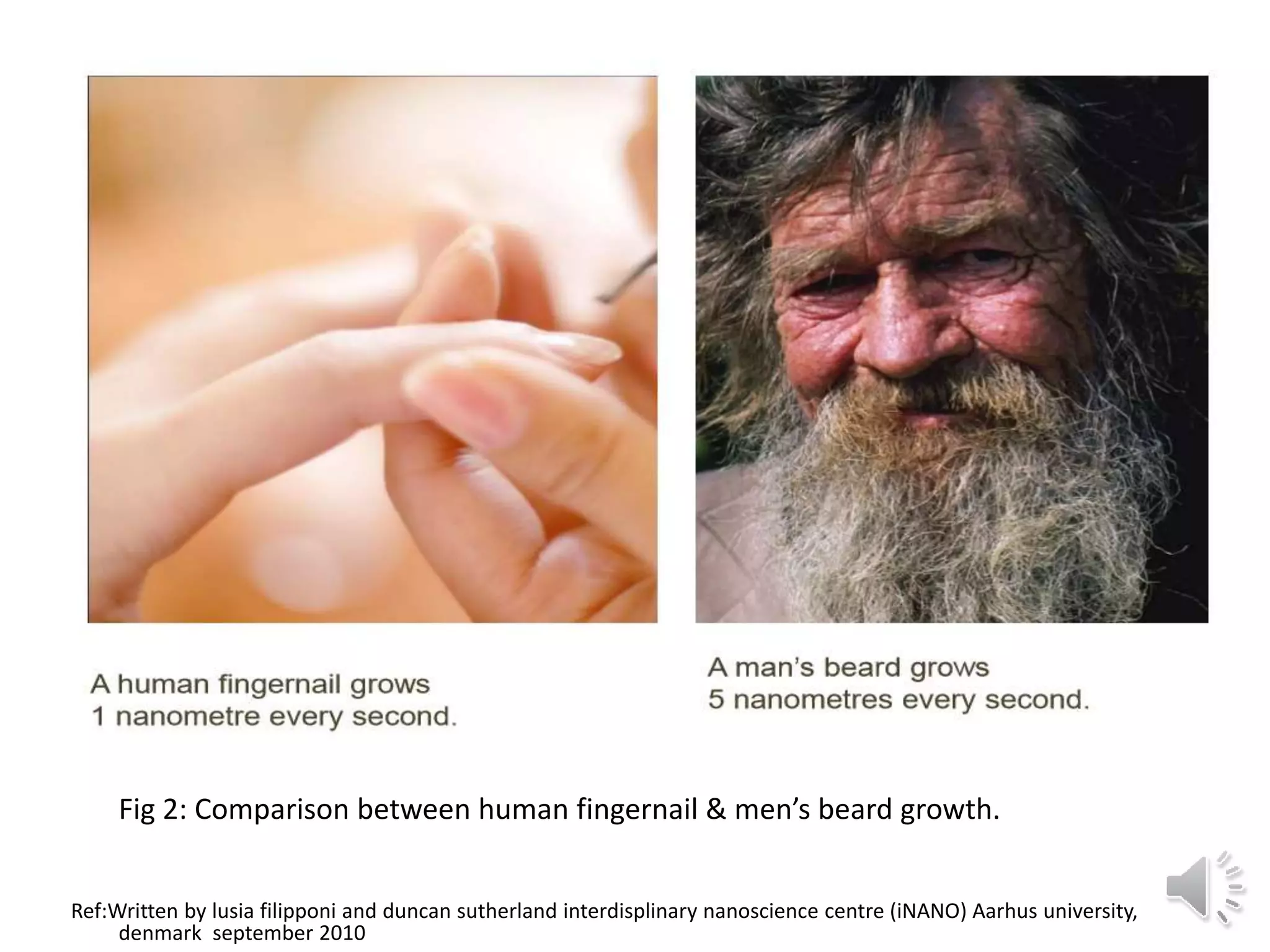
Fig 2: Comparison between human fingernail & men’s beard growth.
Fig 3: Density of states g(E) VS Energy (E) for four quantum structures.
Ref: Source: Introduction to Nanoscience : S. M. Lindsay, Oxford, 2010
. Quantum Mechanics for Nanostructures : Vladimir V. Mitin, Dimitry I. Sementsov & Nizami Z. Vagidov, Cambridge, 2010.
Why small is good?
• Faster
• Lighter
• Can get into small spaces
• Cheaper
• More energy efficient
• Different properties at very small scale
Properties of a Material
• A property describes how a material acts under certain
conditions.
• Types of properties:
 Optical (e.g. color).
 Electrical (e.g. conductivity).
 Physical (e.g. melting point).
 Chemical (e.g. reaction rate).
 Structural (e.g. Surface morphology)
Ref: Written by lusia filipponi and duncan sutherland interdisplinary nanoscience centre (iNANO) Aarhus university, denmark
september 2010
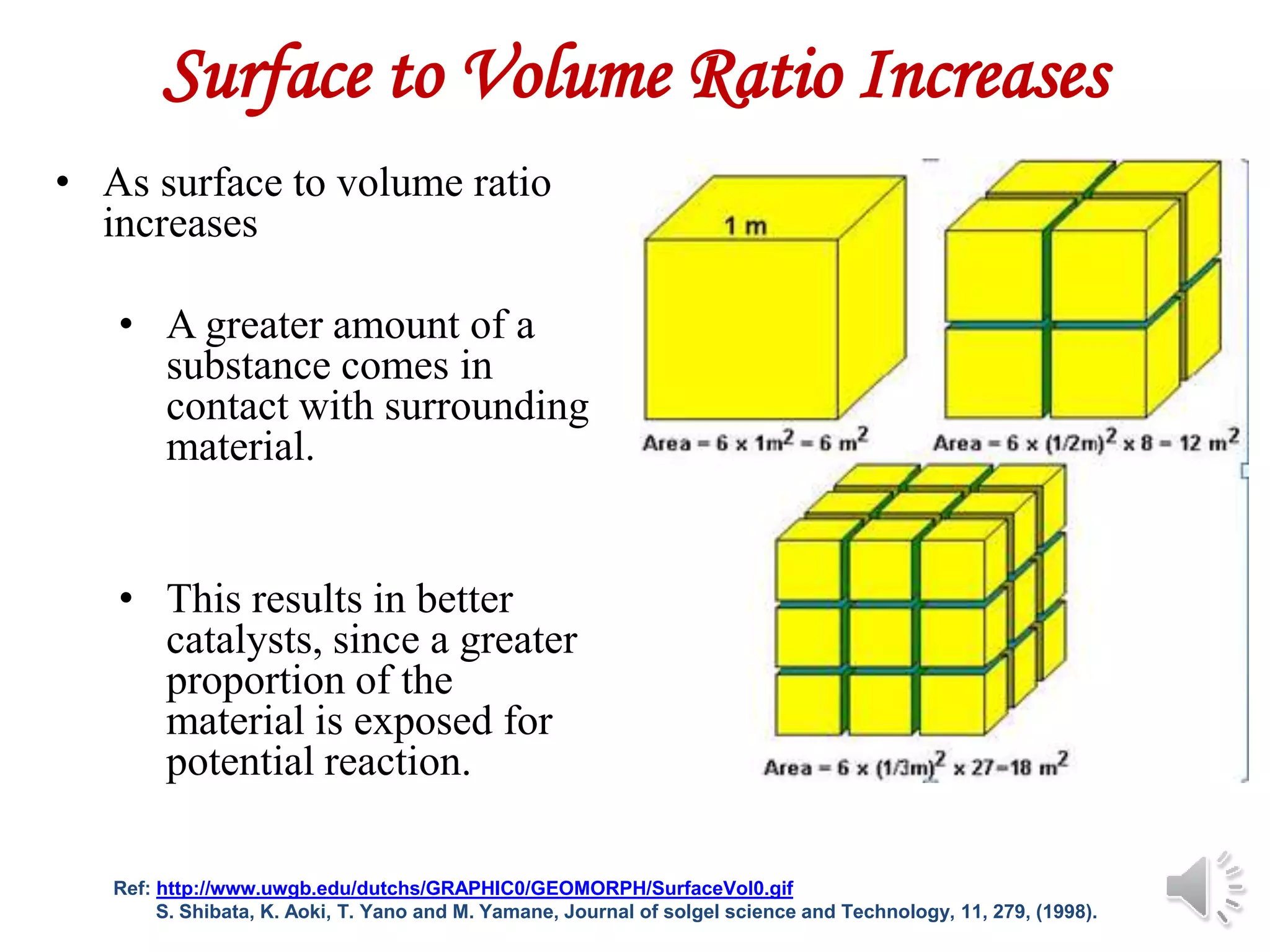
Surface to Volume Ratio Increases
Ref: http://www.uwgb.edu/dutchs/GRAPHIC0/GEOMORPH/SurfaceVol0.gif
S. Shibata, K. Aoki, T. Yano and M. Yamane, Journal of solgel science and Technology, 11, 279, (1998).
• As surface to volume ratio
increases
• A greater amount of a
substance comes in
contact with surrounding
material.
• This results in better
catalysts, since a greater
proportion of the
material is exposed for
potential reaction.
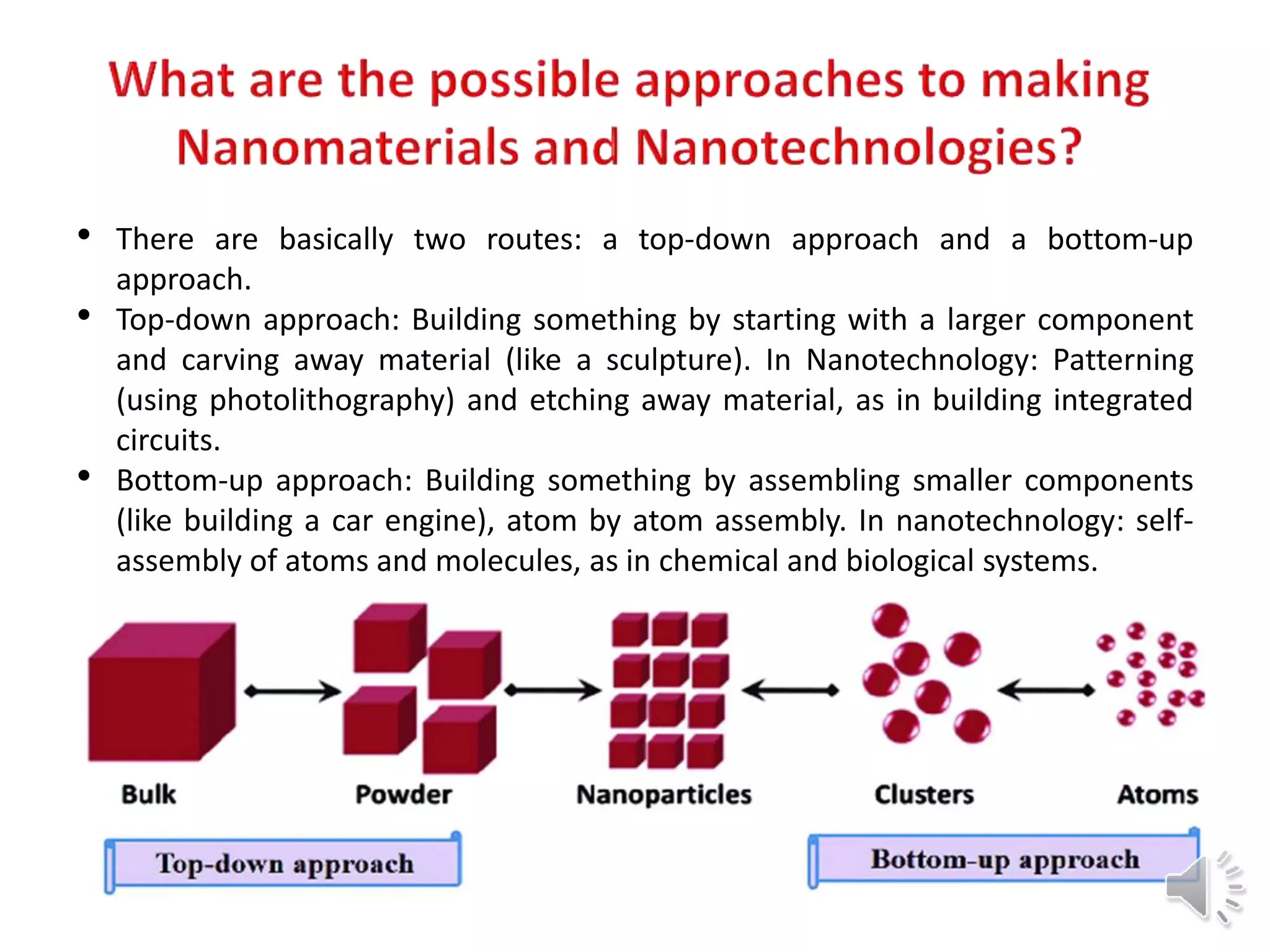
• There are basically two routes: a top-down approach and a bottom-up
approach.
• Top-down approach: Building something by starting with a larger component
and carving away material (like a sculpture). In Nanotechnology: Patterning
(using photolithography) and etching away material, as in building integrated
circuits.
• Bottom-up approach: Building something by assembling smaller components
(like building a car engine), atom by atom assembly. In nanotechnology: self-
assembly of atoms and molecules, as in chemical and biological systems.
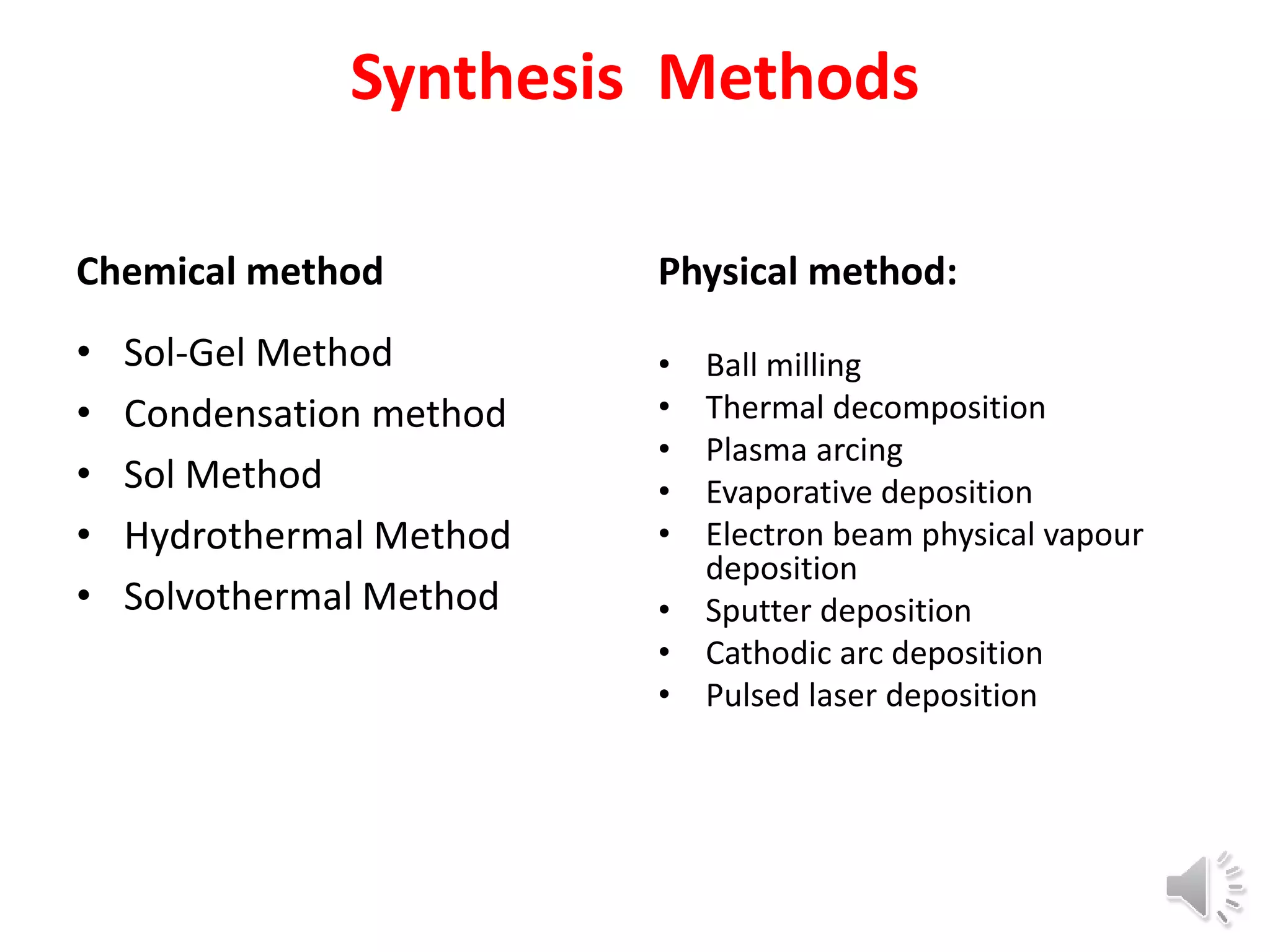
Synthesis Methods
Chemical method
• Sol-Gel Method
• Condensation method
• Sol Method
• Hydrothermal Method
• Solvothermal Method
Physical method:
• Ball milling
• Thermal decomposition
• Plasma arcing
• Evaporative deposition
• Electron beam physical vapour
deposition
• Sputter deposition
• Cathodic arc deposition
• Pulsed laser deposition
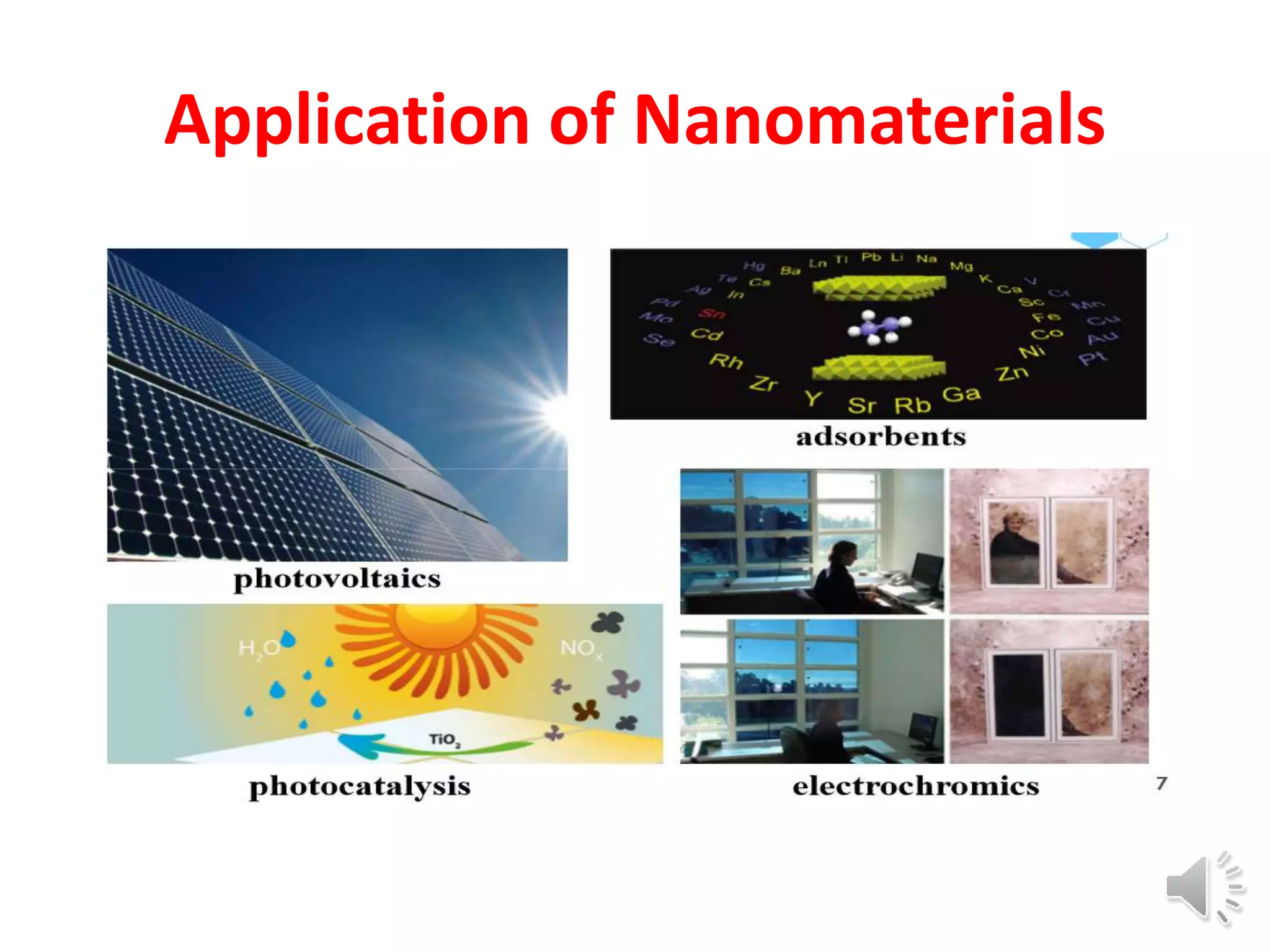
Application of Nanomaterials
Future Applications
Electronics
Coatings
Fuel Cells
Water filters
Composites
Drugs
Cancer Detection & Treatment
• Nanomaterial having enhanced properties as
compared to bulk material.
• Nanomaterial is cost effective and can easily be
implemented in the lab.
• Nanomaterial implemented by several approach
using chemical and physical method.
• The study revealed that the nanoparticle plays an
important role in future research and its
enhanced application gives us new vision to the
see world.
Conclusion
Thank-you

Have a nice day!!

Nanomaterial and their application

  • 1.
    Submitted by: Preetichoudhary chaudharypreeti1997@gmail.com Roll No.: 21700304
  • 2.
    Content  What isa Nanoparticle?  Nanomaterial Dimension  Why small is good?  Surface area to volume ratio  Top down & Bottom up Approach  Applications  Conclusion
  • 3.
    Talk given tothe American Physical Society, 1959 There’s plenty of Room at the Bottom
  • 4.
    Introduction to Nanoscience? •Nano– Derived from a Greek word “Nanos” meaning Dwarf or small. • A nanometer is one billionth of a meter (10ˉ⁹ m). • Nanometer scale range from approximately 100 nm to 1nm. • Nanoscience: It is the study of phenomena and manipulation of materials at atomic, molecular and macromolecular scales, where properties differ significantly from those at a larger scale. • Ref: Introduction to Nanoscience : S. M. Lindsay, Oxford, 2010.
  • 5.
    Ref: Written bylusia filipponi and duncan sutherland interdisplinary nanoscience centre (iNANO) Aarhus university, denmark september 2010 • Nanomaterial: It could be defined as those materials which have structured components with size less than 100nm at least in one dimension. • Nanotechnology: It can be define as the design, characterisation, production and application of structures, devices and systems by controlling shape and size at the nanometer scale.
  • 6.
    Fig 1: Frommacro-materials to atoms. Nanomaterials and nanodevices that are of interest in nanotechnologies are in the lower end of the scale(1- 100nm) nanoscale • Ref: lusia filipponi and duncan sutherland interdisplinary nanoscience centre (iNANO) Aarhus university, denmark september 2010
  • 7.
    Ref:Written by lusiafilipponi and duncan sutherland interdisplinary nanoscience centre (iNANO) Aarhus university, denmark september 2010 Fig 2: Comparison between human fingernail & men’s beard growth.
  • 8.
    Fig 3: Densityof states g(E) VS Energy (E) for four quantum structures. Ref: Source: Introduction to Nanoscience : S. M. Lindsay, Oxford, 2010 . Quantum Mechanics for Nanostructures : Vladimir V. Mitin, Dimitry I. Sementsov & Nizami Z. Vagidov, Cambridge, 2010.
  • 9.
    Why small isgood? • Faster • Lighter • Can get into small spaces • Cheaper • More energy efficient • Different properties at very small scale
  • 10.
    Properties of aMaterial • A property describes how a material acts under certain conditions. • Types of properties:  Optical (e.g. color).  Electrical (e.g. conductivity).  Physical (e.g. melting point).  Chemical (e.g. reaction rate).  Structural (e.g. Surface morphology) Ref: Written by lusia filipponi and duncan sutherland interdisplinary nanoscience centre (iNANO) Aarhus university, denmark september 2010
  • 11.
    Surface to VolumeRatio Increases Ref: http://www.uwgb.edu/dutchs/GRAPHIC0/GEOMORPH/SurfaceVol0.gif S. Shibata, K. Aoki, T. Yano and M. Yamane, Journal of solgel science and Technology, 11, 279, (1998). • As surface to volume ratio increases • A greater amount of a substance comes in contact with surrounding material. • This results in better catalysts, since a greater proportion of the material is exposed for potential reaction.
  • 12.
    • There arebasically two routes: a top-down approach and a bottom-up approach. • Top-down approach: Building something by starting with a larger component and carving away material (like a sculpture). In Nanotechnology: Patterning (using photolithography) and etching away material, as in building integrated circuits. • Bottom-up approach: Building something by assembling smaller components (like building a car engine), atom by atom assembly. In nanotechnology: self- assembly of atoms and molecules, as in chemical and biological systems.
  • 13.
    Synthesis Methods Chemical method •Sol-Gel Method • Condensation method • Sol Method • Hydrothermal Method • Solvothermal Method Physical method: • Ball milling • Thermal decomposition • Plasma arcing • Evaporative deposition • Electron beam physical vapour deposition • Sputter deposition • Cathodic arc deposition • Pulsed laser deposition
  • 14.
  • 15.
    Future Applications Electronics Coatings Fuel Cells Waterfilters Composites Drugs Cancer Detection & Treatment
  • 16.
    • Nanomaterial havingenhanced properties as compared to bulk material. • Nanomaterial is cost effective and can easily be implemented in the lab. • Nanomaterial implemented by several approach using chemical and physical method. • The study revealed that the nanoparticle plays an important role in future research and its enhanced application gives us new vision to the see world. Conclusion
  • 17.