A Seminar On
Synthesis Of Nano Particles By
Solution Combustion
Presented
By

K. GANAPATHI RAO
(13031D6003)
CONTENT
•
•
•
•
•
•
•
•

Introduction.
Preparation Method.
Flowchart.
Procedure.
Calcination.
Advantages.
Precaution.
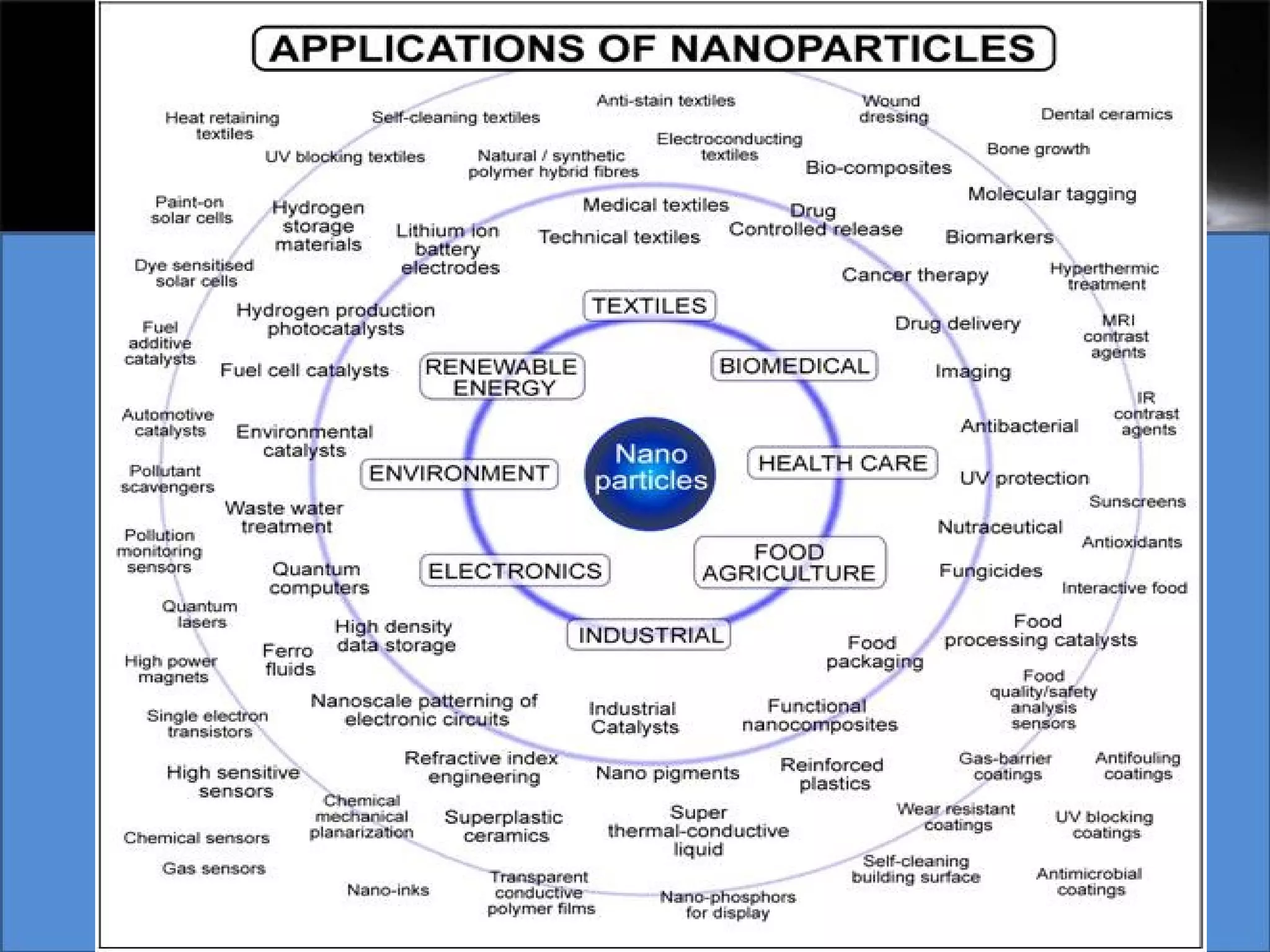
Applications.
Nano particles
• A material or structure has at least one dimension in the
Nano range, which is called as Nanomaterial or
Nanostructure.
• Nano is the scale range between in (1-100)nm.
• cm = 10-2m, mm = 10-3m, μm = 10-6m, nm = 10-9m, pm=10-12m
• Atom ≈ 0.1 nm , DNA (width) 2 nm , Protein 5 –50 nm.
Virus 75 -100nm , Materials internalized by cells < 100 nm
Nano particles
 Nanoparticles of a defined material, e.g. gold or silicon, may
exhibit completely different optical, electronic and chemical
behaviour compared to bulk gold or silicon.
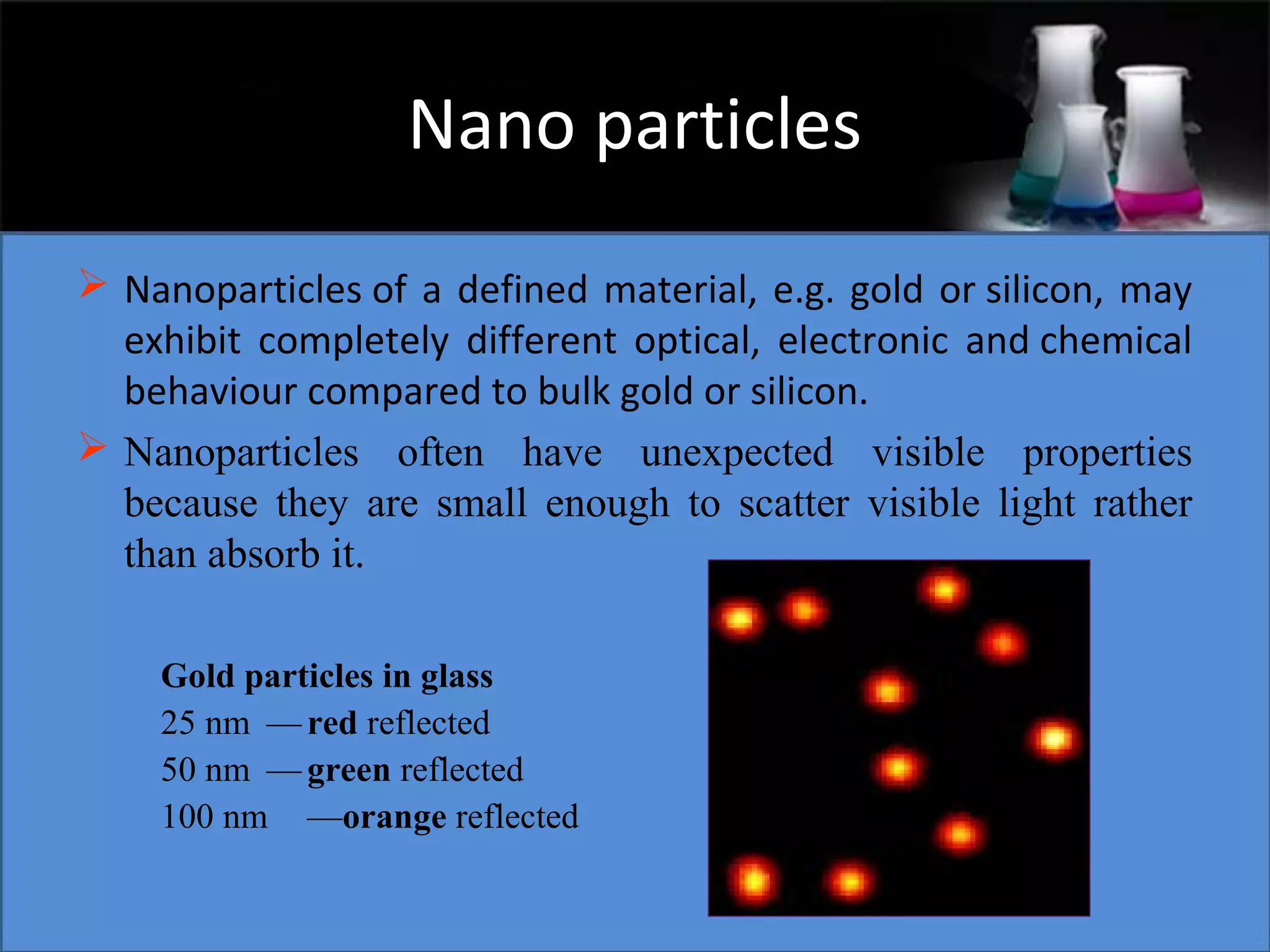
 Nanoparticles often have unexpected visible properties
because they are small enough to scatter visible light rather
than absorb it.
Gold particles in glass
25 nm — red reflected
50 nm — green reflected
100 nm —orange reflected
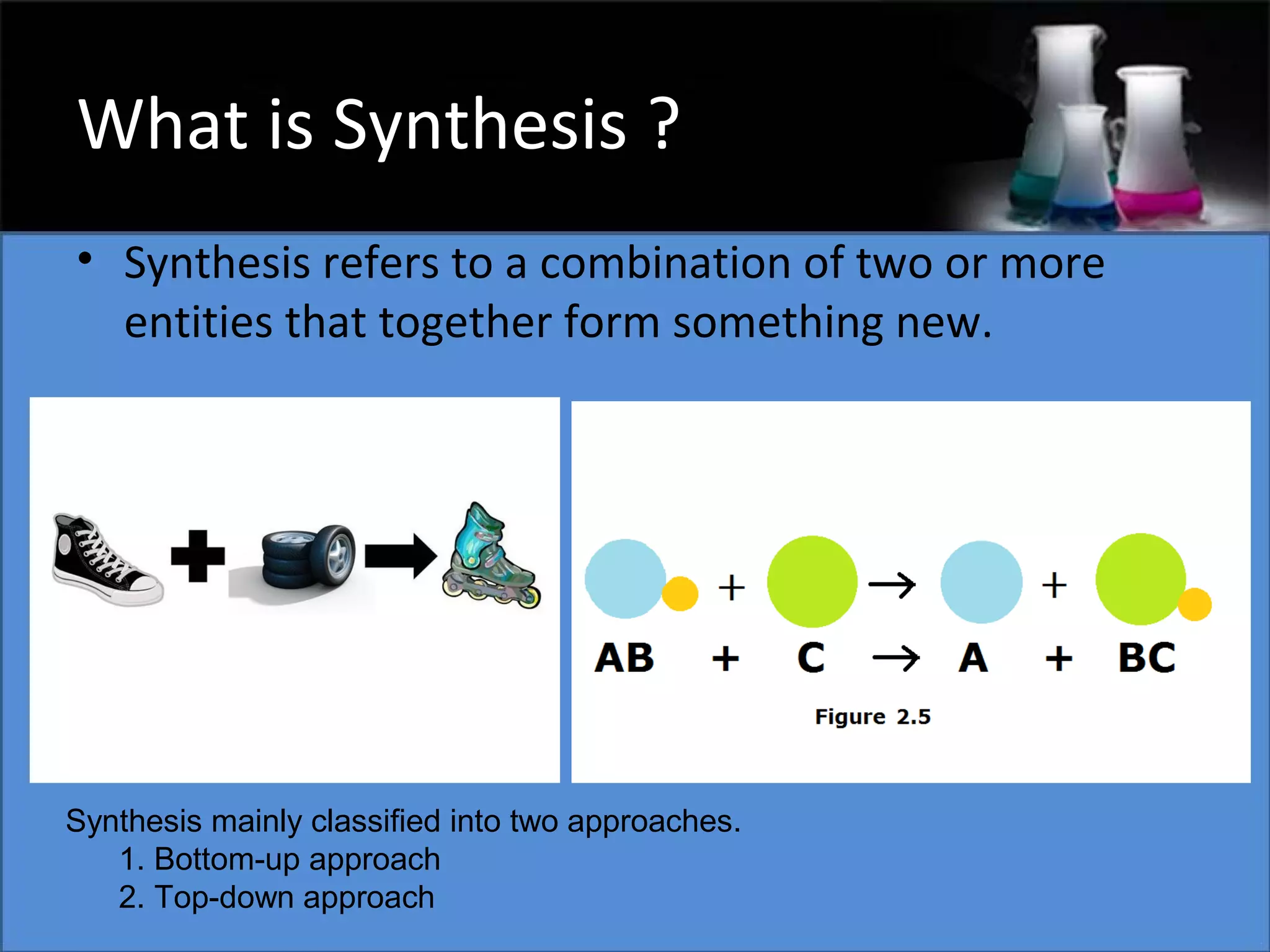
What is Synthesis ?
• Synthesis refers to a combination of two or more
entities that together form something new.

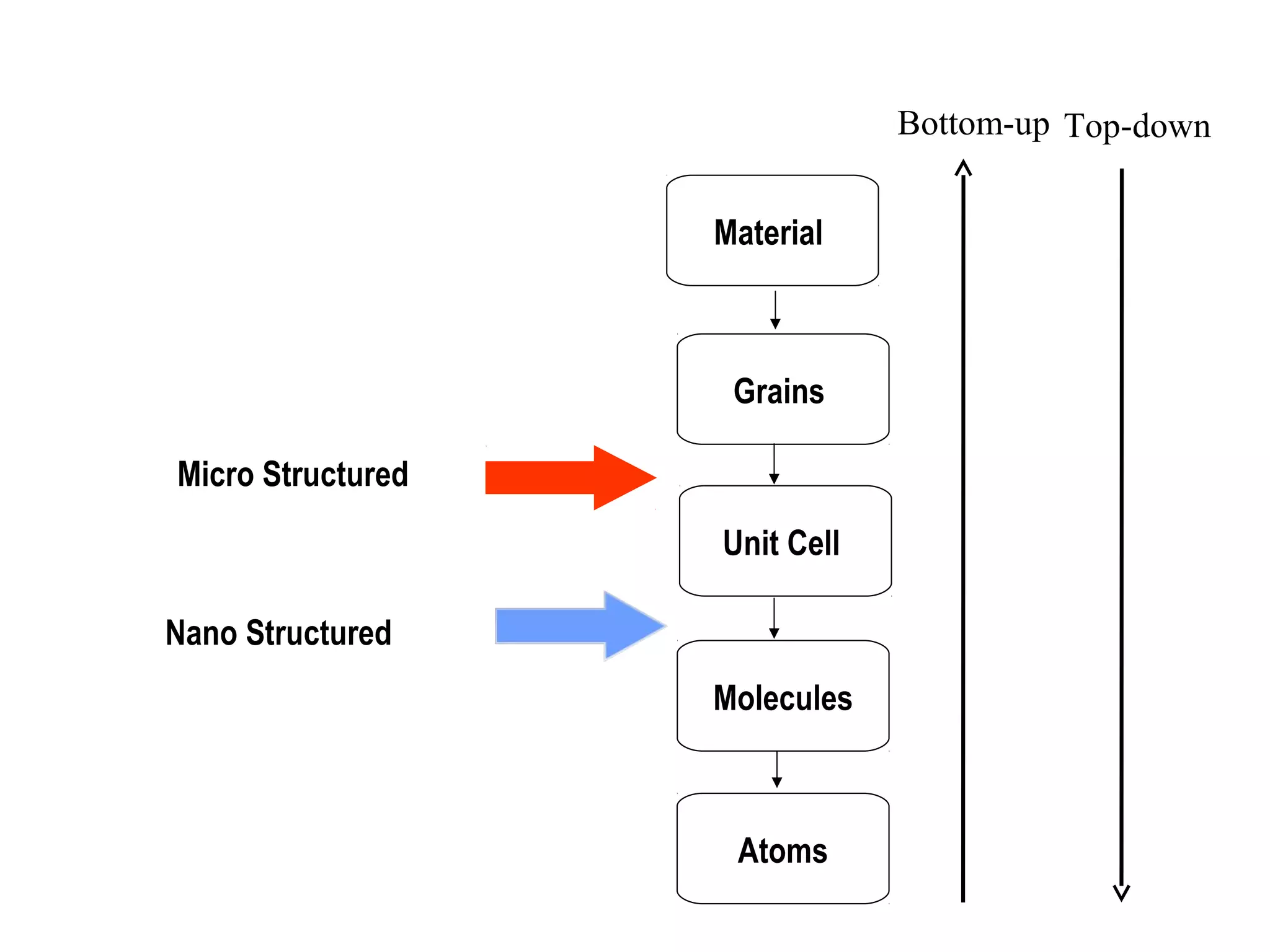
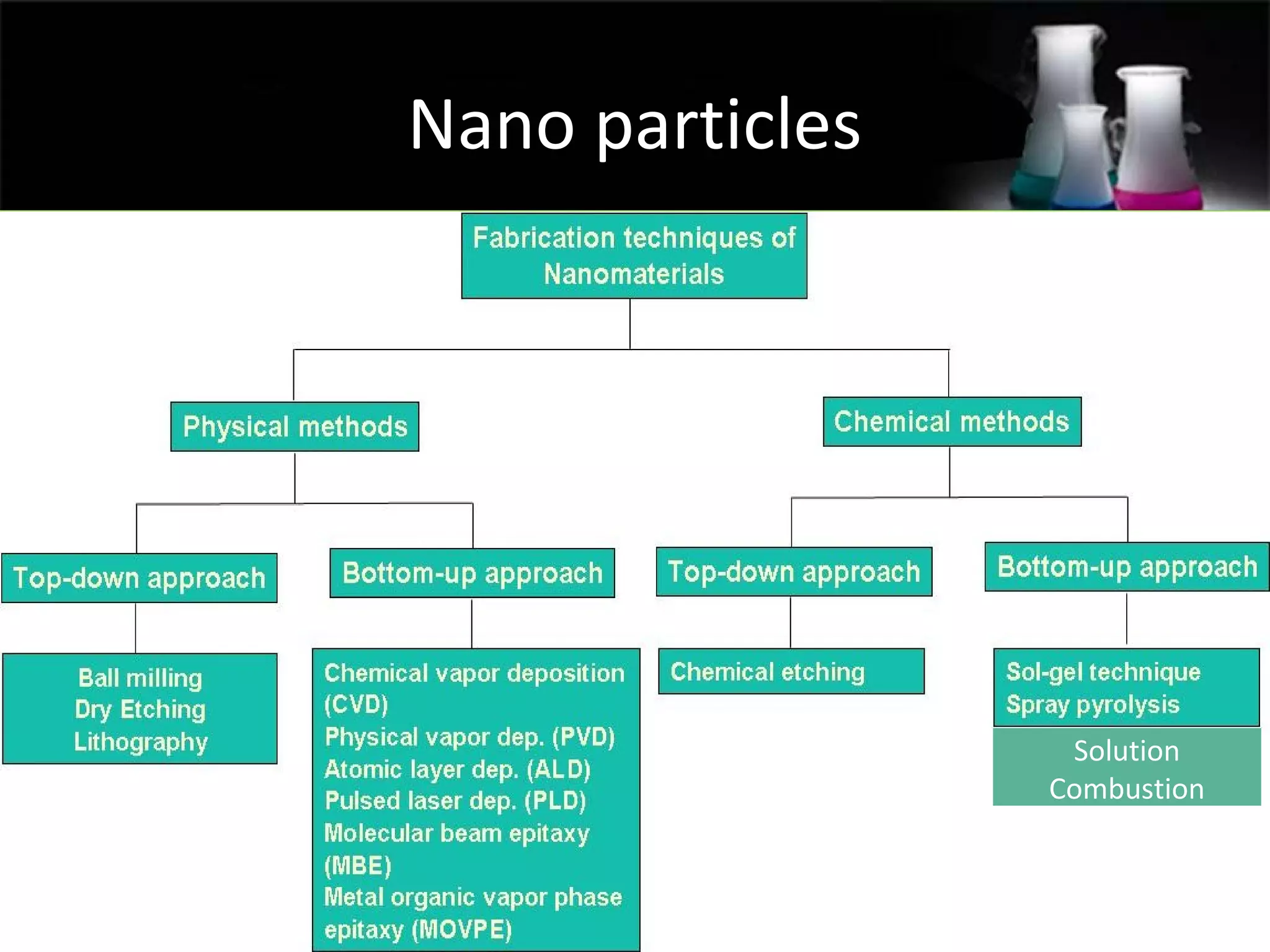
Synthesis mainly classified into two approaches.
1. Bottom-up approach
2. Top-down approach
Bottom-up Top-down
Material

Grains
Micro Structured
Unit Cell
Nano Structured
Molecules

Atoms
Nano particles

Solution
Combustion
SOLUTION COMBUSTION
SYNTHESIS
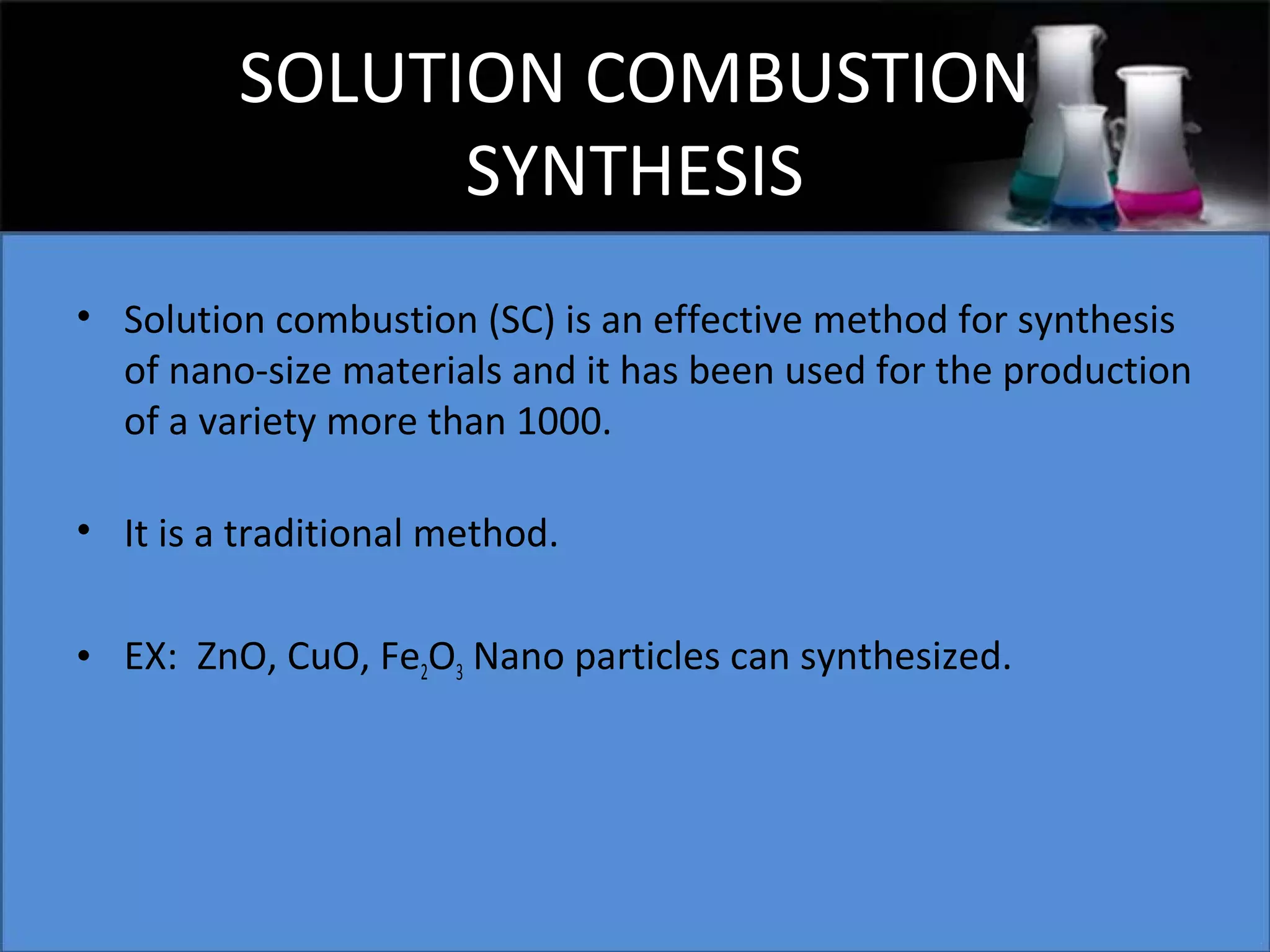
• Solution combustion (SC) is an effective method for synthesis
of nano-size materials and it has been used for the production
of a variety more than 1000.
• It is a traditional method.
• EX: ZnO, CuO, Fe2O3 Nano particles can synthesized.
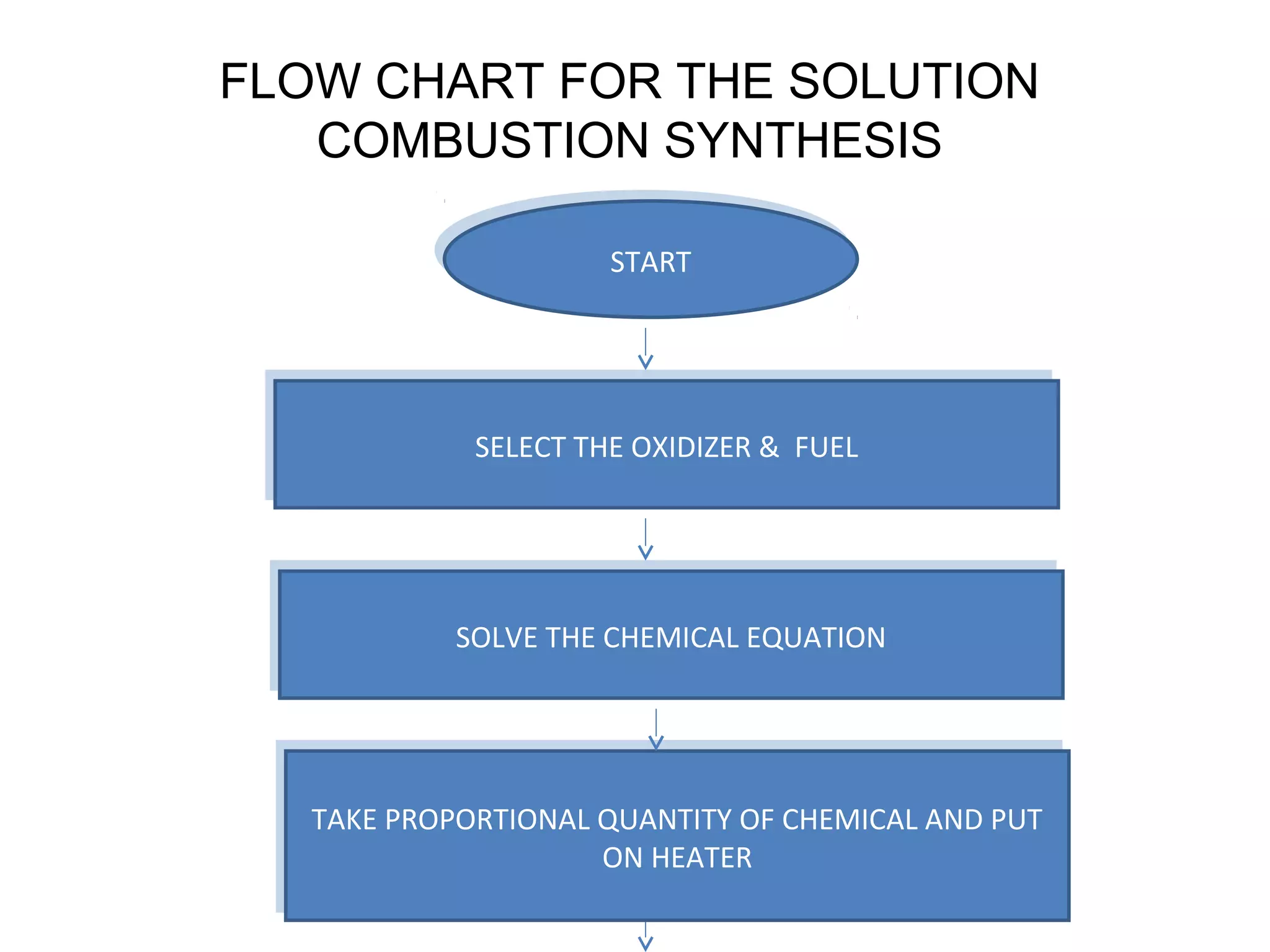
FLOW CHART FOR THE SOLUTION
COMBUSTION SYNTHESIS
START
START

SELECT THE OXIDIZER & FUEL

SOLVE THE CHEMICAL EQUATION

TAKE PROPORTIONAL QUANTITY OF CHEMICAL AND PUT
ON HEATER
ON HEATER
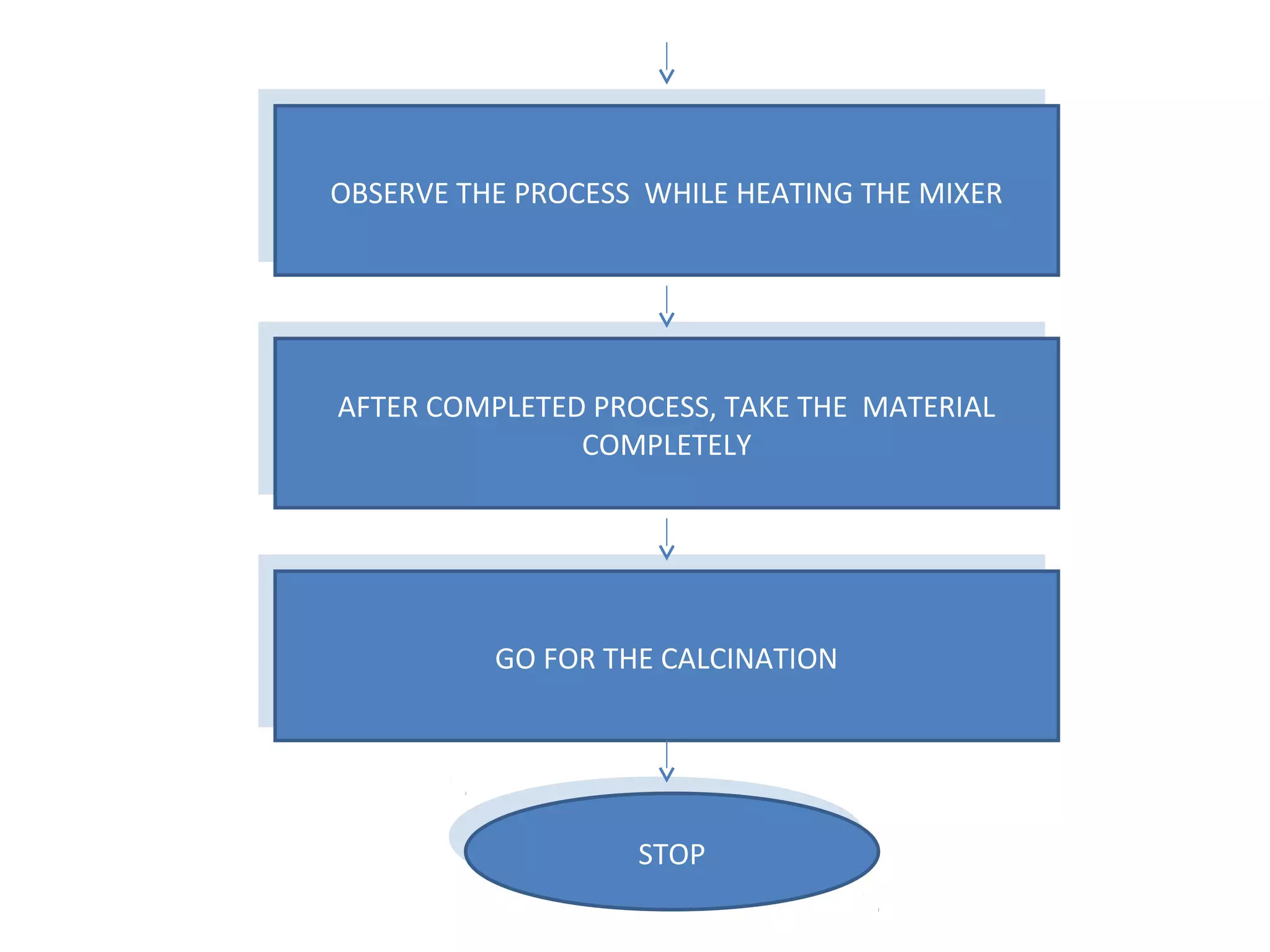
OBSERVE THE PROCESS WHILE HEATING THE MIXER

AFTER COMPLETED PROCESS, TAKE THE MATERIAL
COMPLETELY
COMPLETELY

GO FOR THE CALCINATION

STOP
STOP
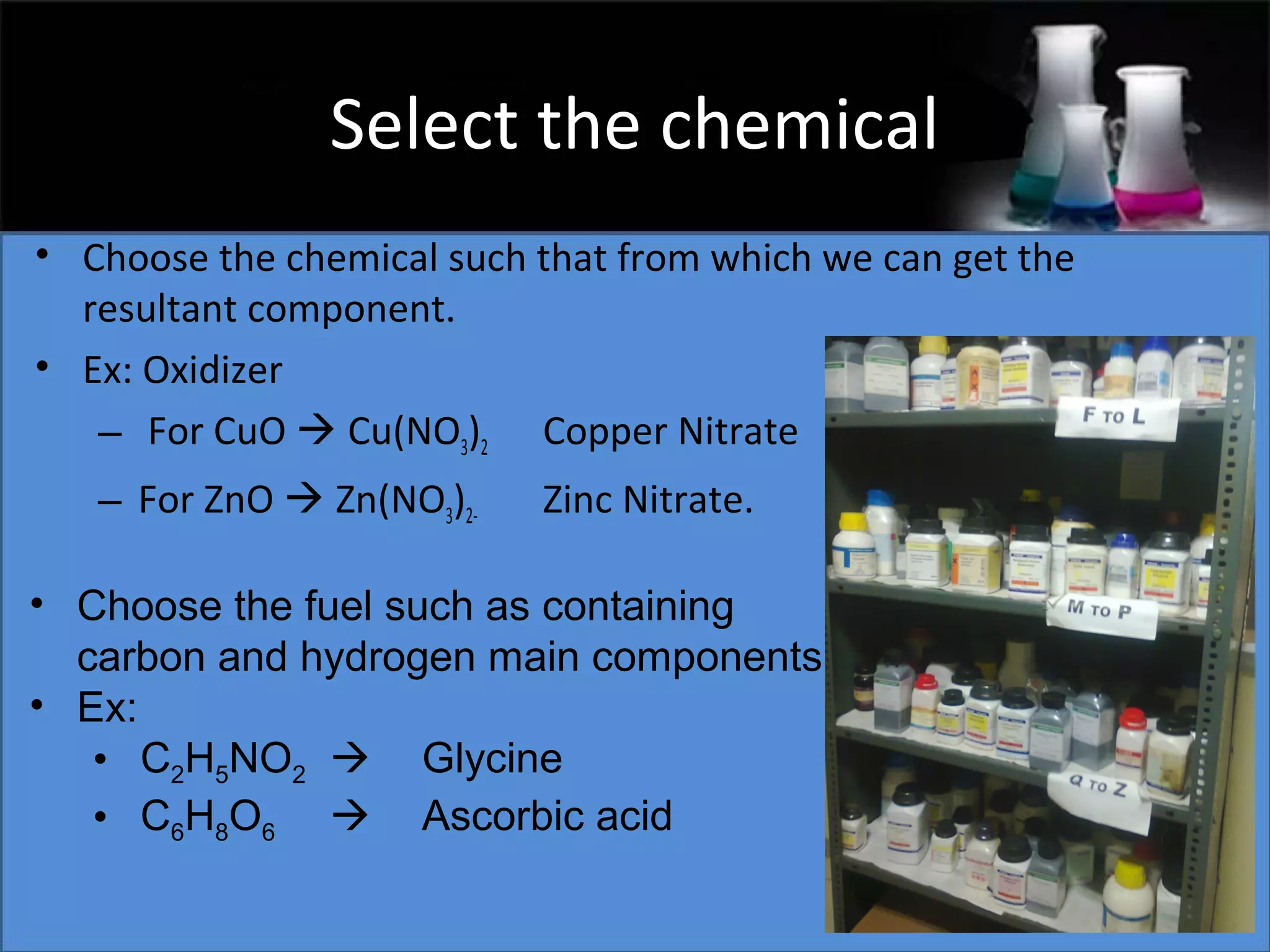
Select the chemical
• Choose the chemical such that from which we can get the
resultant component.
• Ex: Oxidizer
– For CuO  Cu(NO3)2 Copper Nitrate
– For ZnO  Zn(NO3)2-

Zinc Nitrate.

• Choose the fuel such as containing
carbon and hydrogen main components
• Ex:
• C2H5NO2  Glycine
• C6H8O6  Ascorbic acid
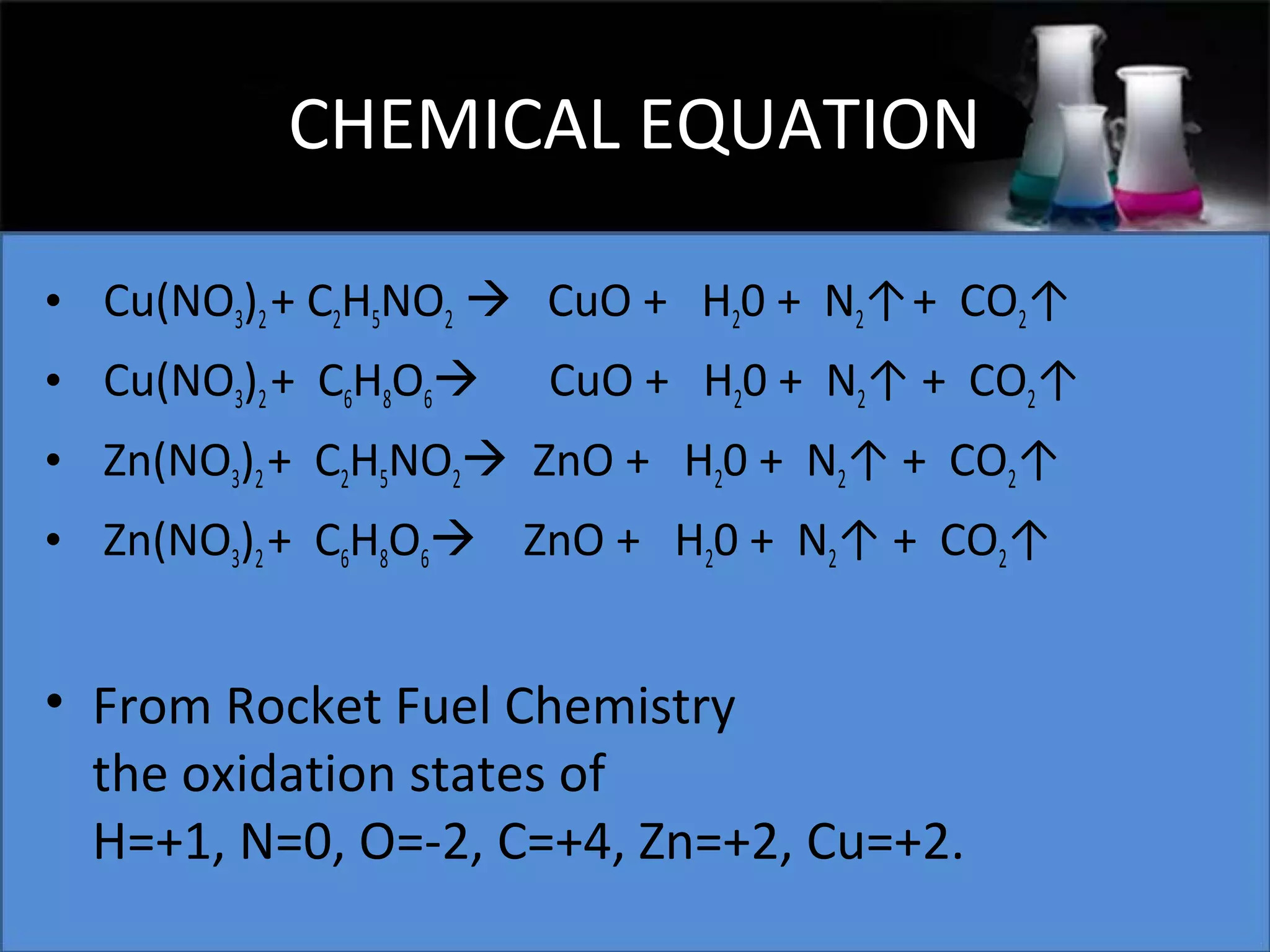
CHEMICAL EQUATION
• Cu(NO3)2 + C2H5NO2  CuO + H20 + N2↑ + CO2↑
• Cu(NO3)2 + C6H8O6

CuO + H20 + N2↑ + CO2↑

• Zn(NO3)2 + C2H5NO2 ZnO + H20 + N2↑ + CO2↑
• Zn(NO3)2 + C6H8O6 ZnO + H20 + N2↑ + CO2↑

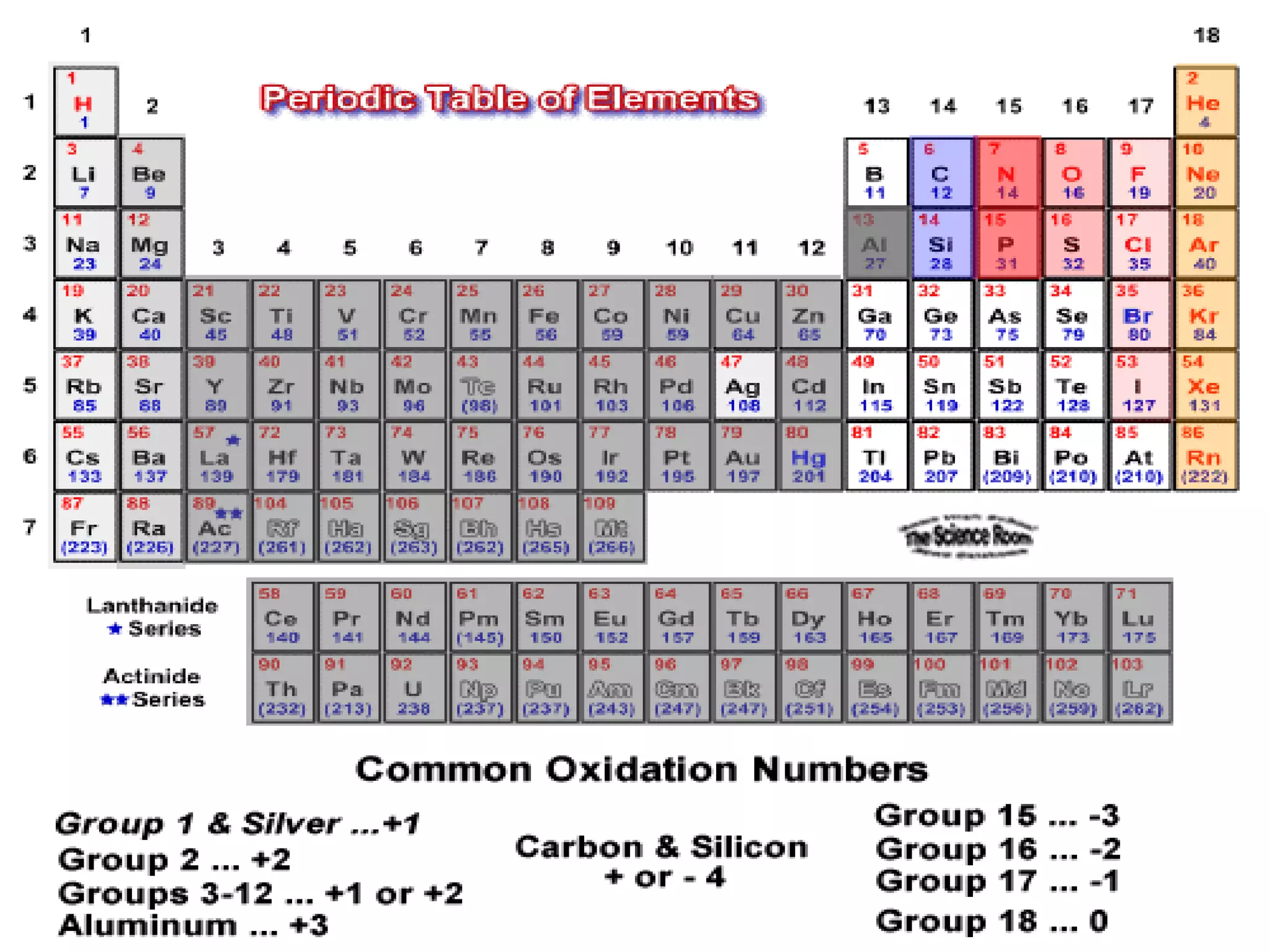
• From Rocket Fuel Chemistry
the oxidation states of
H=+1, N=0, O=-2, C=+4, Zn=+2, Cu=+2.
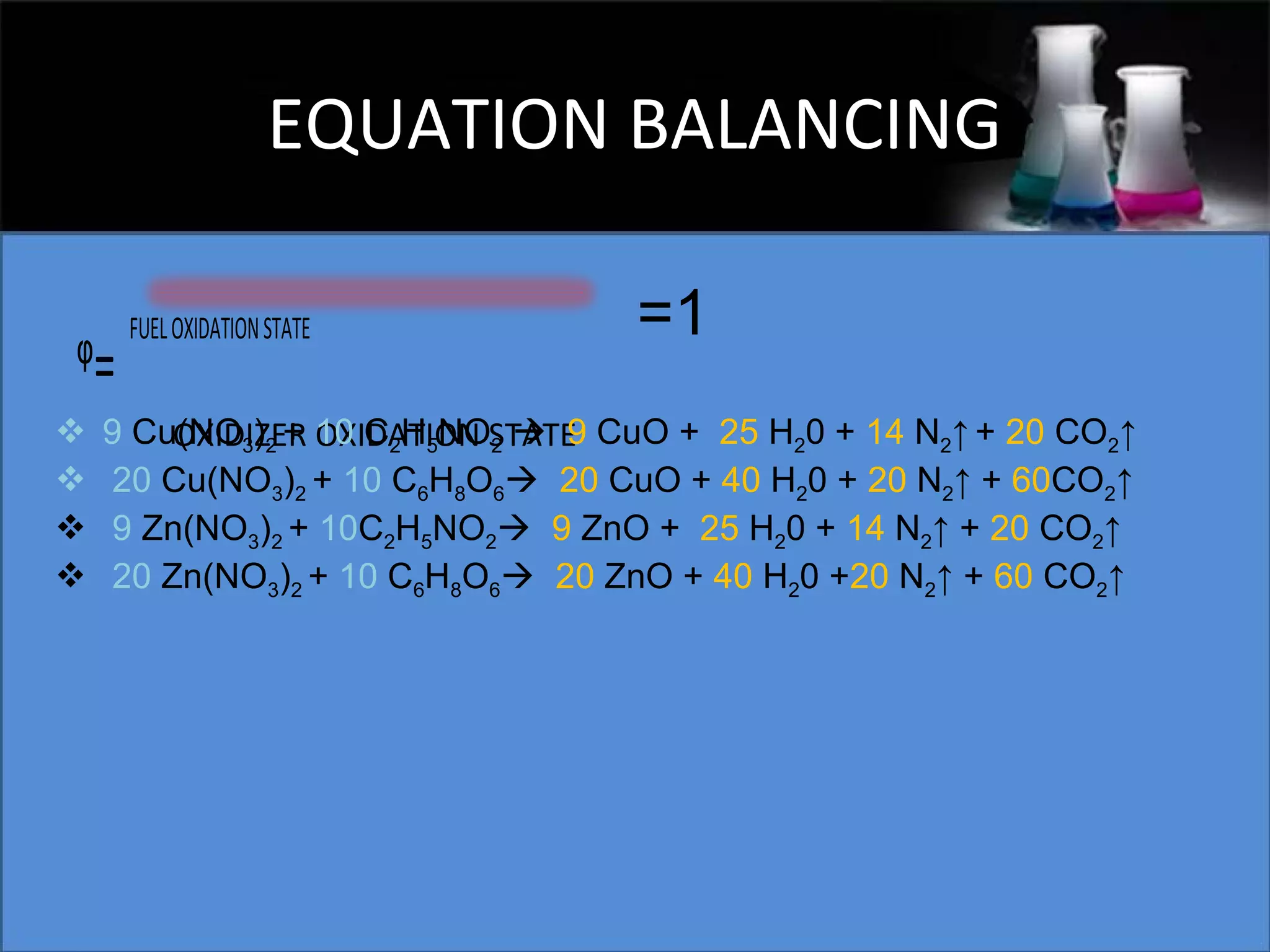
EQUATION BALANCING
ᵠ=





FUEL OXIDATION STATE

=1

9 Cu(NO3)2 + 10 C2H5NOSTATE CuO + 25 H20 + 14 N2↑ + 20 CO2↑
OXIDIZER OXIDATION 2  9
20 Cu(NO3)2 + 10 C6H8O6 20 CuO + 40 H20 + 20 N2↑ + 60CO2↑
9 Zn(NO3)2 + 10C2H5NO2 9 ZnO + 25 H20 + 14 N2↑ + 20 CO2↑
20 Zn(NO3)2 + 10 C6H8O6 20 ZnO + 40 H20 +20 N2↑ + 60 CO2↑
QUANTITY
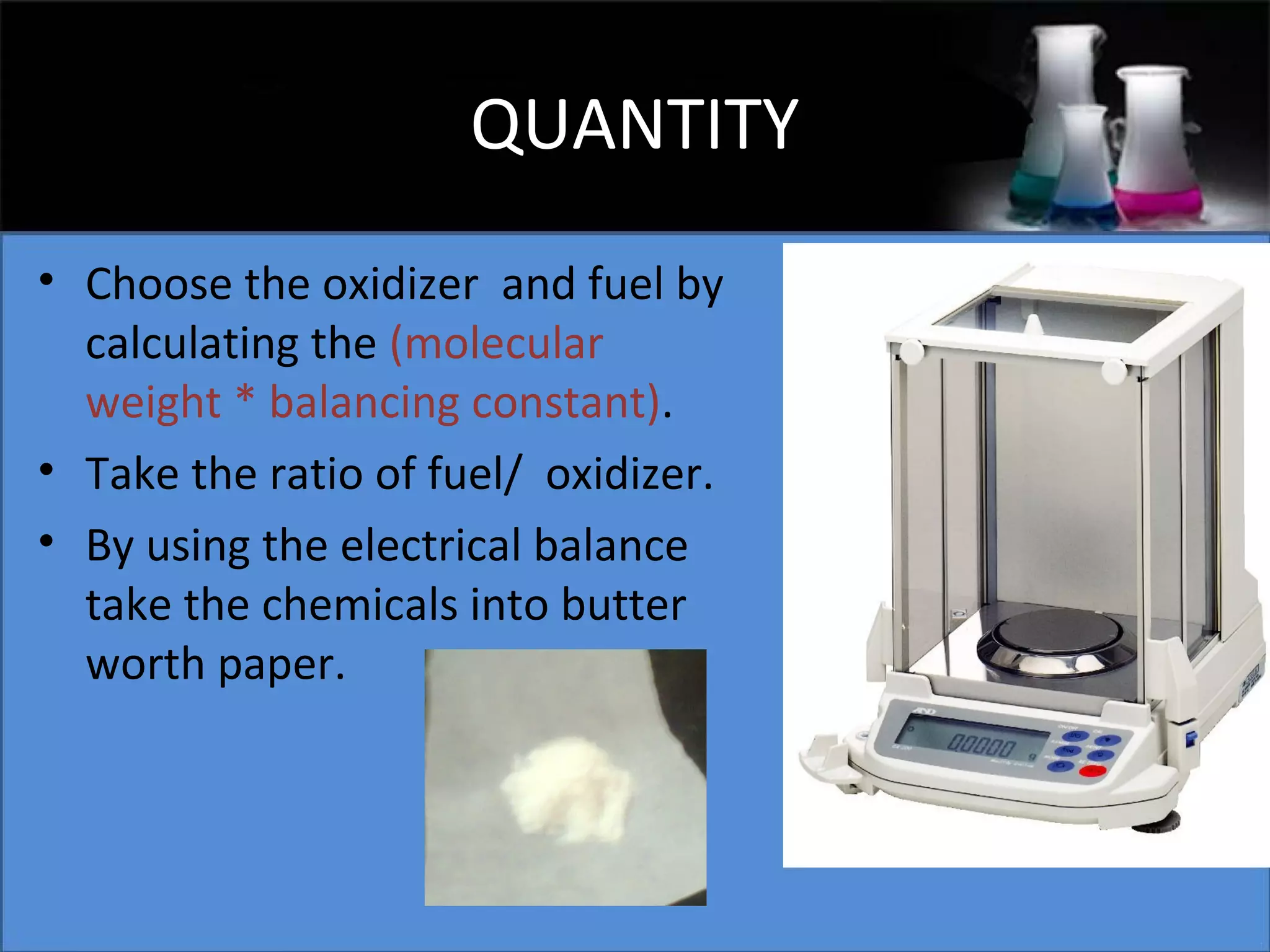
• Choose the oxidizer and fuel by
calculating the (molecular
weight * balancing constant).
• Take the ratio of fuel/ oxidizer.
• By using the electrical balance
take the chemicals into butter
worth paper.
PROCEDURE
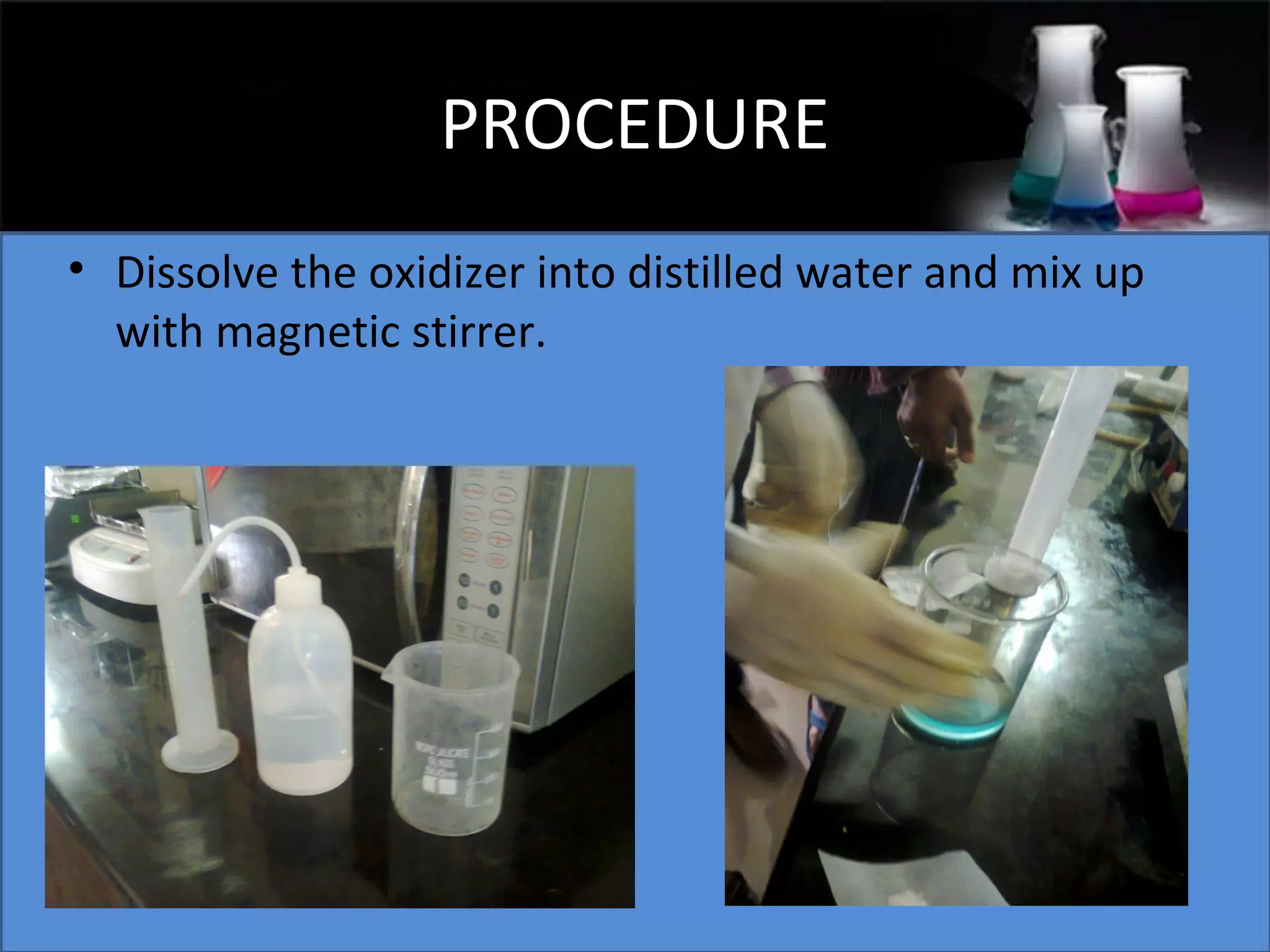
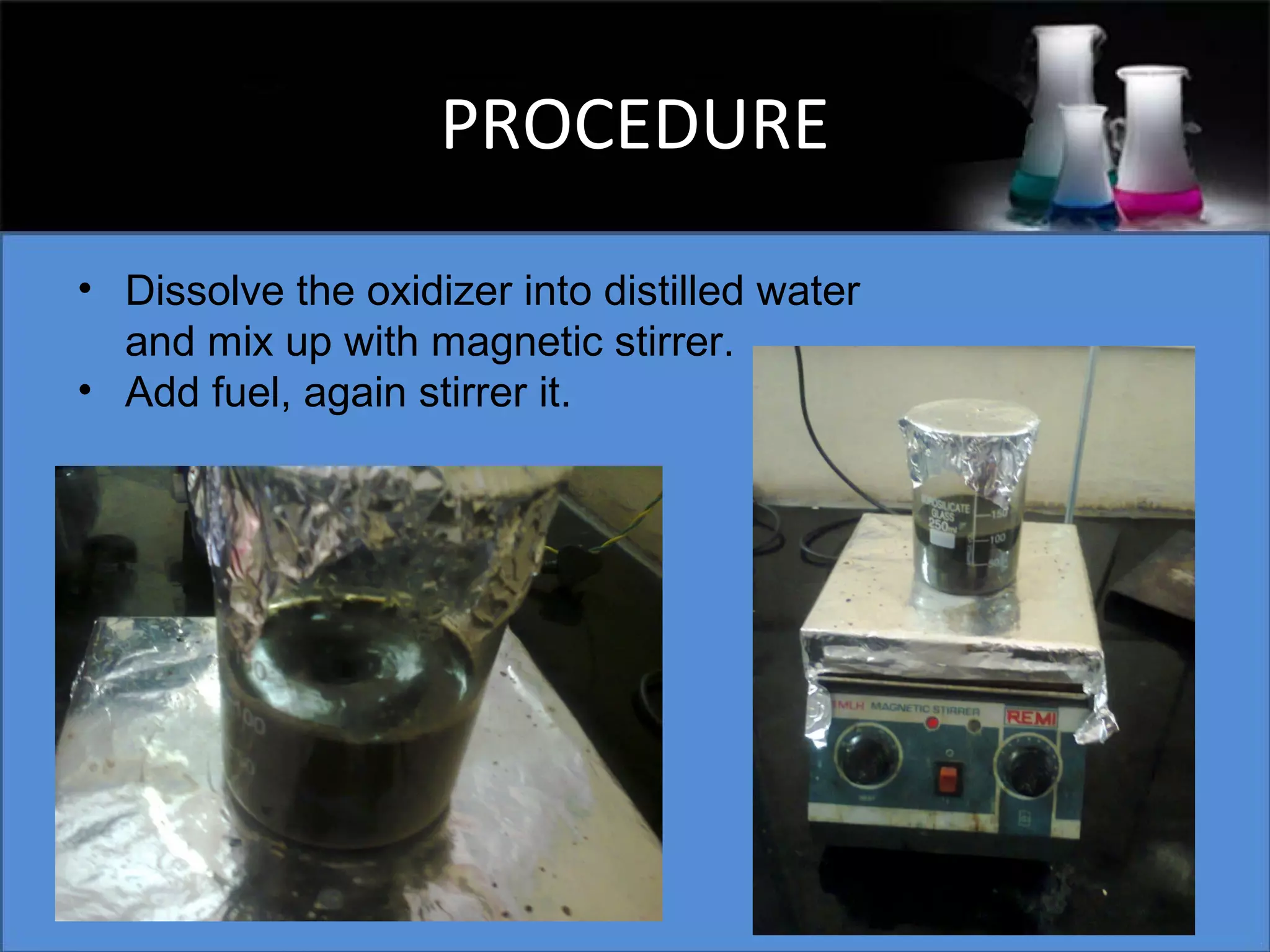
• Dissolve the oxidizer into distilled water and mix up
with magnetic stirrer.
PROCEDURE
• Dissolve the oxidizer into distilled water
and mix up with magnetic stirrer.
• Add fuel, again stirrer it.
PROCEDURE
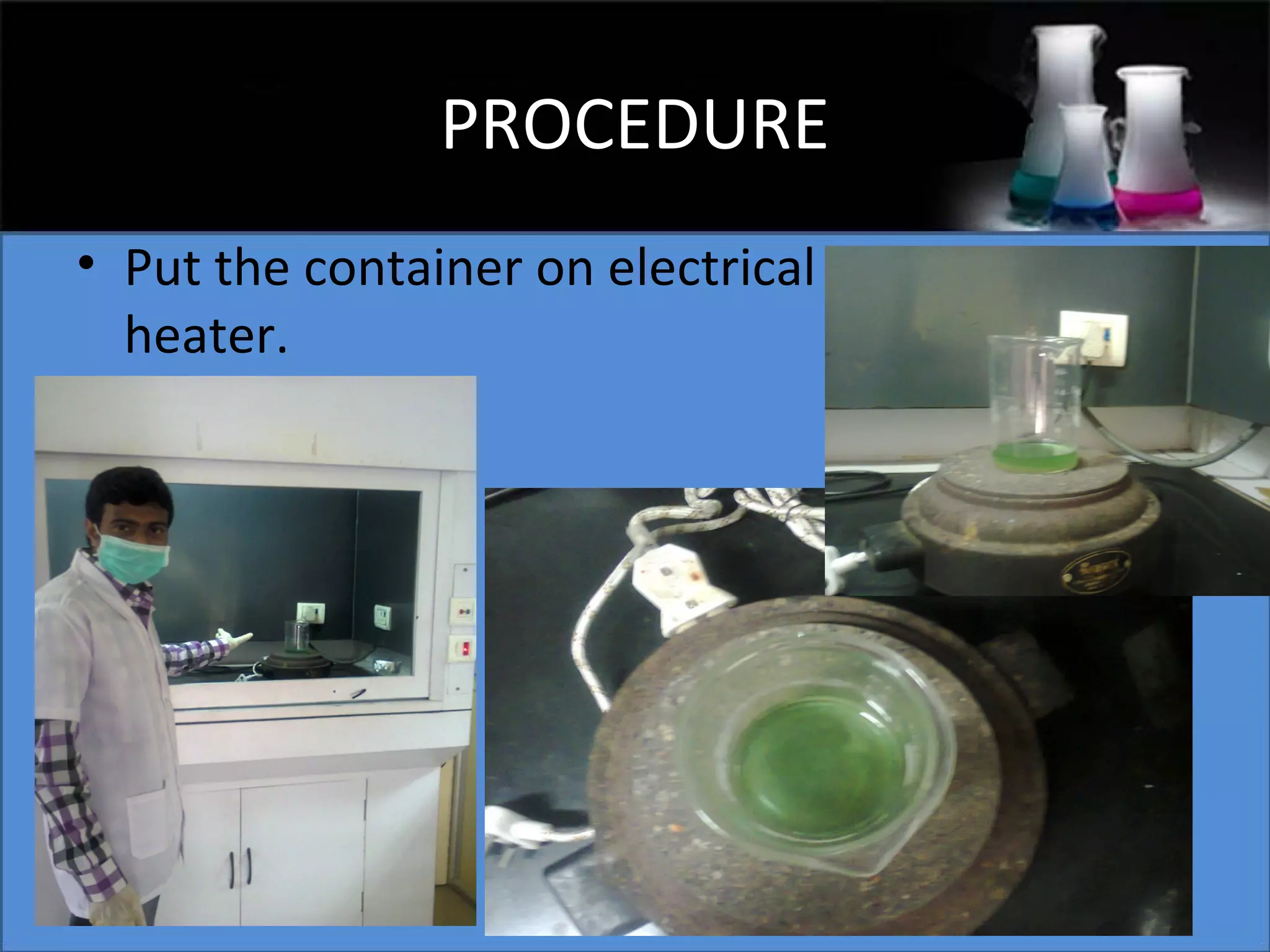
• Put the container on electrical
heater.
PROCEDURE
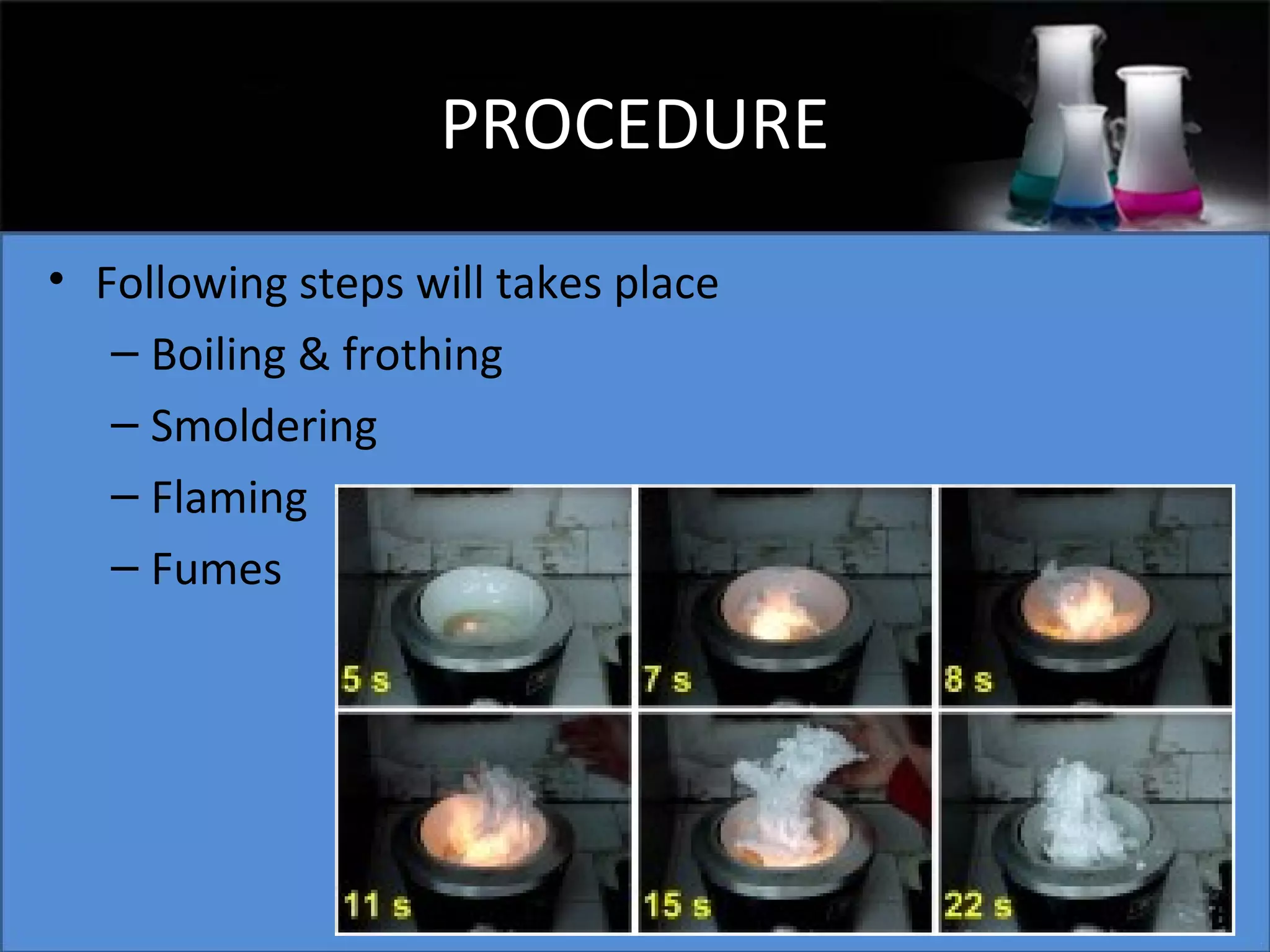
• Following steps will takes place
– Boiling & frothing
– Smoldering
– Flaming
– Fumes
PROCEDURE
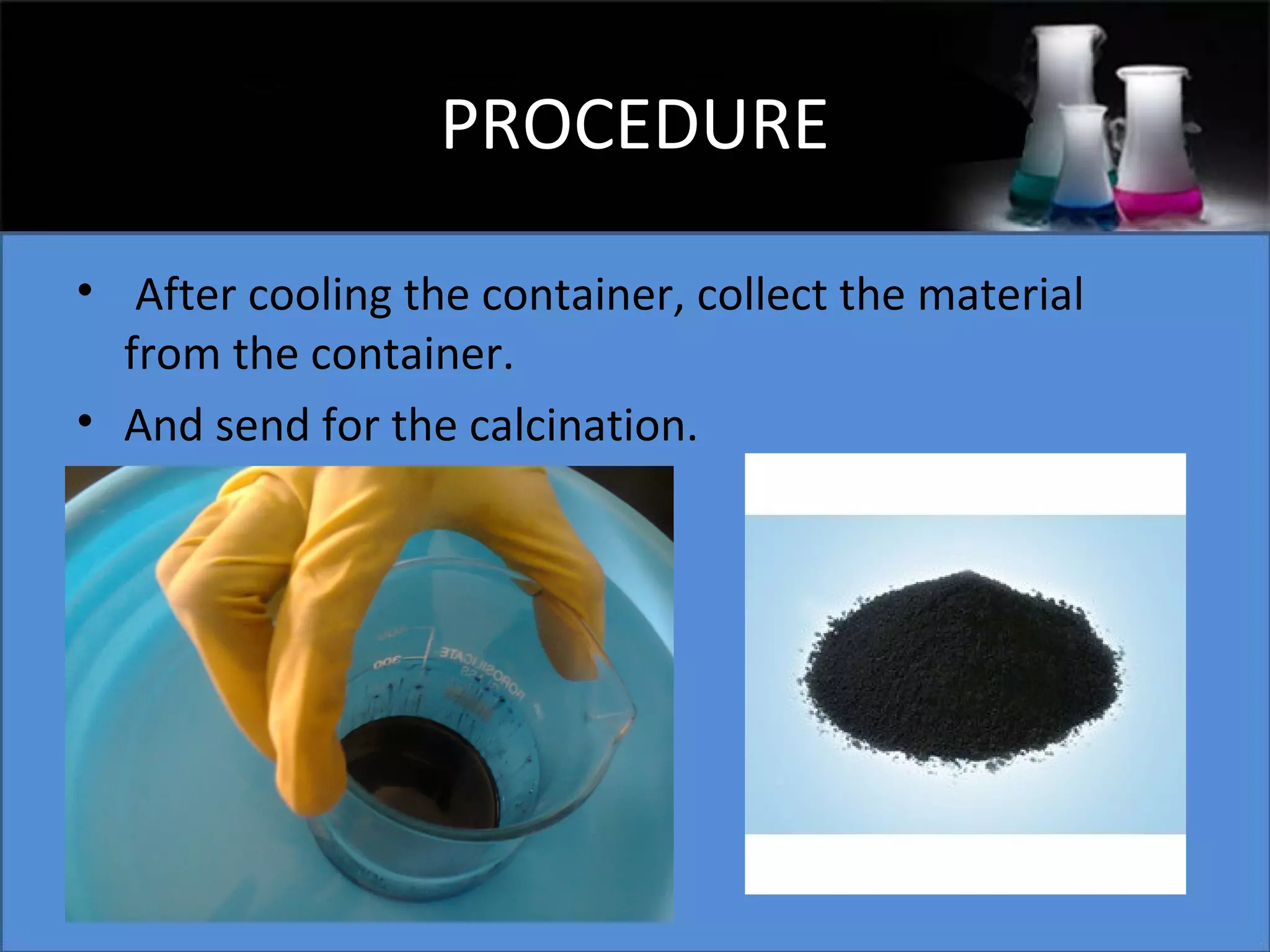
• After cooling the container, collect the material
from the container.
• And send for the calcination.
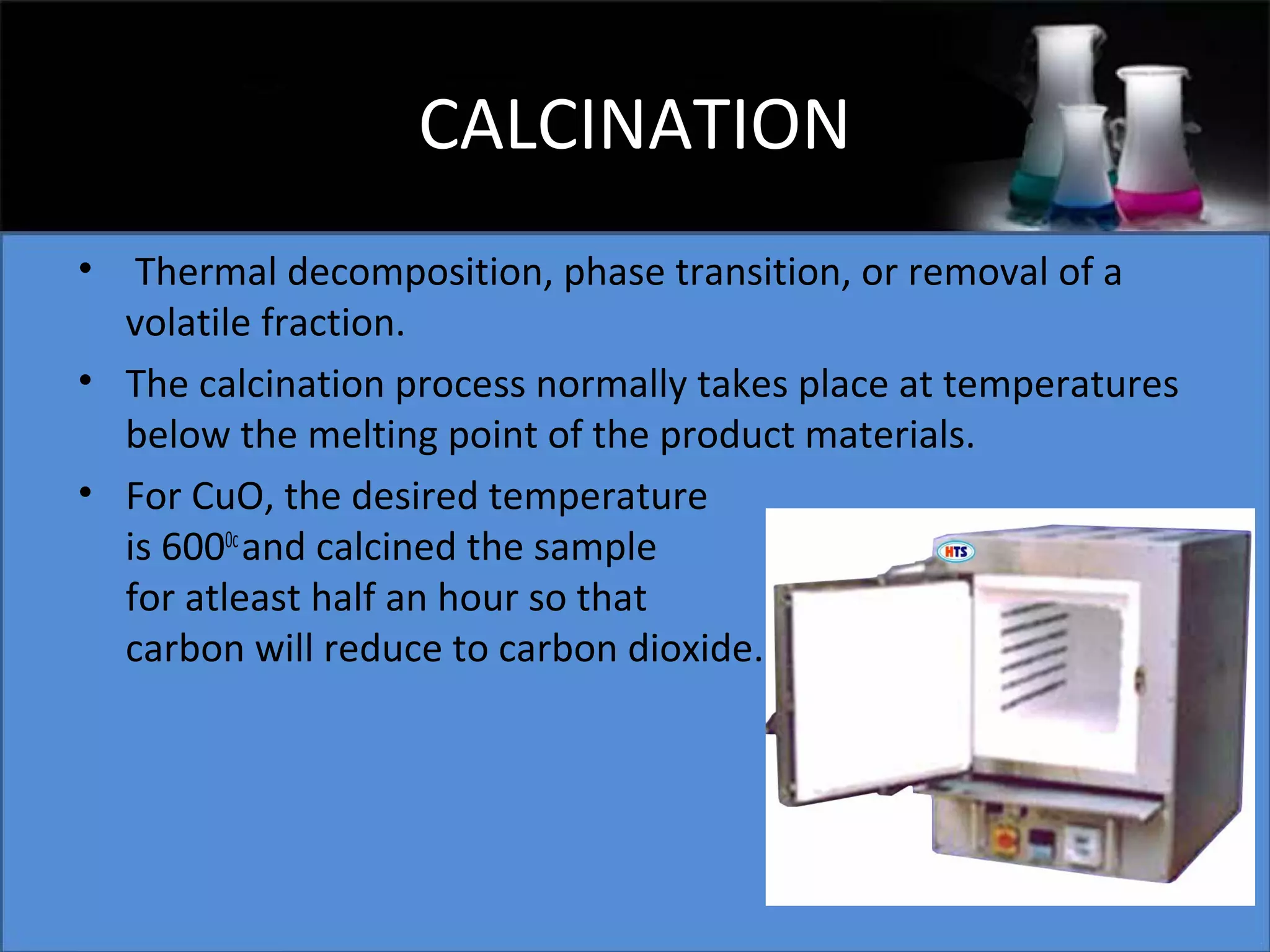
CALCINATION
•

Thermal decomposition, phase transition, or removal of a
volatile fraction.
• The calcination process normally takes place at temperatures
below the melting point of the product materials.
• For CuO, the desired temperature
is 6000c and calcined the sample
for atleast half an hour so that
carbon will reduce to carbon dioxide.
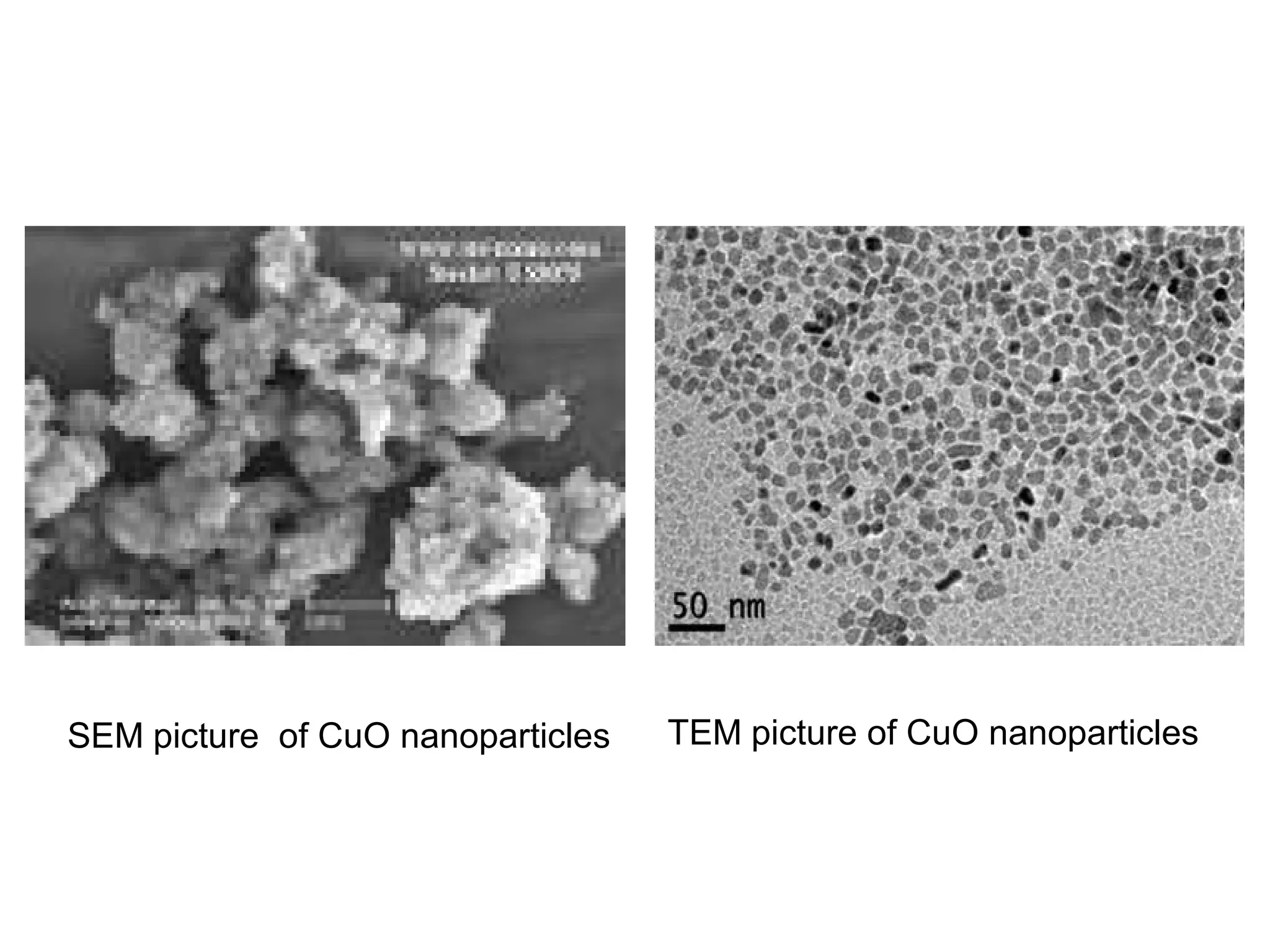
SEM picture of CuO nanoparticles

TEM picture of CuO nanoparticles
ADVANTAGE OF SCS
•
•
•
•
•

20-50 nm size nanoparticles can synthesis.
Less time is required.
No Inert gas in required.
No need of vacuum.
Less cost.
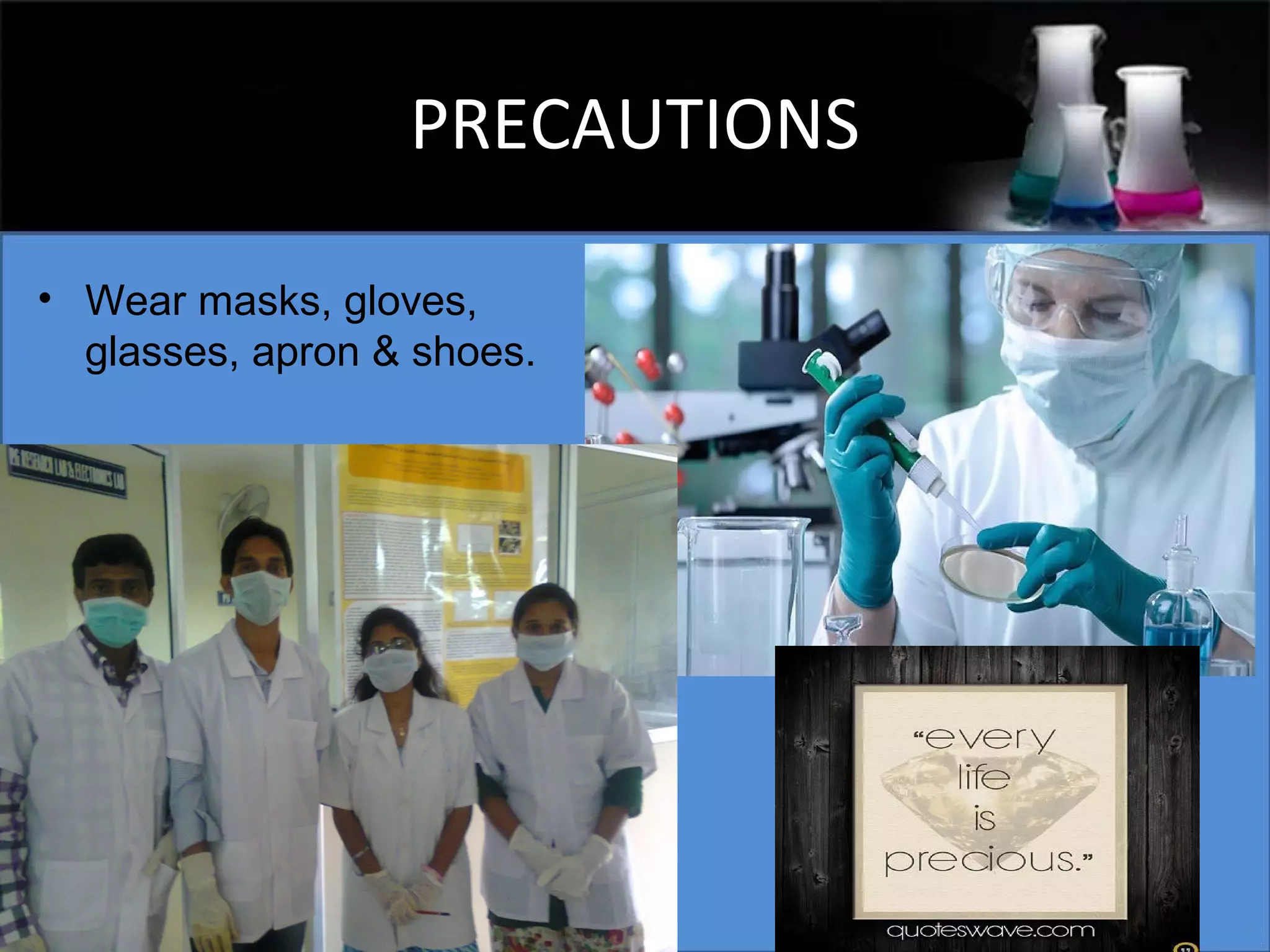
PRECAUTIONS
• Wear masks, gloves,
glasses, apron & shoes.
Videos

1
2
3
4
REFRENCE
• http://whynano.wordpress.com/materialsynthesis-and-characterization/
• http://www.science.uwaterloo.ca/~cchieh/ca
ct/c123/oxidstat.html
• http://en.wikipedia.org/wiki/List_of_oxidation
_states_of_the_elements
• http://www.youtube.com/watch?
v=u3IDWm3XZxI
Solution combustion method for syntheis of nano particles

Solution combustion method for syntheis of nano particles

  • 1.
    A Seminar On SynthesisOf Nano Particles By Solution Combustion Presented By K. GANAPATHI RAO (13031D6003)
  • 2.
  • 3.
    Nano particles • Amaterial or structure has at least one dimension in the Nano range, which is called as Nanomaterial or Nanostructure. • Nano is the scale range between in (1-100)nm. • cm = 10-2m, mm = 10-3m, μm = 10-6m, nm = 10-9m, pm=10-12m • Atom ≈ 0.1 nm , DNA (width) 2 nm , Protein 5 –50 nm. Virus 75 -100nm , Materials internalized by cells < 100 nm
  • 4.
    Nano particles  Nanoparticlesof a defined material, e.g. gold or silicon, may exhibit completely different optical, electronic and chemical behaviour compared to bulk gold or silicon.  Nanoparticles often have unexpected visible properties because they are small enough to scatter visible light rather than absorb it. Gold particles in glass 25 nm — red reflected 50 nm — green reflected 100 nm —orange reflected
  • 5.
    What is Synthesis? • Synthesis refers to a combination of two or more entities that together form something new. Synthesis mainly classified into two approaches. 1. Bottom-up approach 2. Top-down approach
  • 6.
  • 7.
  • 8.
    SOLUTION COMBUSTION SYNTHESIS • Solutioncombustion (SC) is an effective method for synthesis of nano-size materials and it has been used for the production of a variety more than 1000. • It is a traditional method. • EX: ZnO, CuO, Fe2O3 Nano particles can synthesized.
  • 9.
    FLOW CHART FORTHE SOLUTION COMBUSTION SYNTHESIS START START SELECT THE OXIDIZER & FUEL SELECT THE OXIDIZER & FUEL SOLVE THE CHEMICAL EQUATION SOLVE THE CHEMICAL EQUATION TAKE PROPORTIONAL QUANTITY OF CHEMICAL AND PUT TAKE PROPORTIONAL QUANTITY OF CHEMICAL AND PUT ON HEATER ON HEATER
  • 10.
    OBSERVE THE PROCESSWHILE HEATING THE MIXER OBSERVE THE PROCESS WHILE HEATING THE MIXER AFTER COMPLETED PROCESS, TAKE THE MATERIAL AFTER COMPLETED PROCESS, TAKE THE MATERIAL COMPLETELY COMPLETELY GO FOR THE CALCINATION GO FOR THE CALCINATION STOP STOP
  • 11.
    Select the chemical •Choose the chemical such that from which we can get the resultant component. • Ex: Oxidizer – For CuO  Cu(NO3)2 Copper Nitrate – For ZnO  Zn(NO3)2- Zinc Nitrate. • Choose the fuel such as containing carbon and hydrogen main components • Ex: • C2H5NO2  Glycine • C6H8O6  Ascorbic acid
  • 12.
    CHEMICAL EQUATION • Cu(NO3)2+ C2H5NO2  CuO + H20 + N2↑ + CO2↑ • Cu(NO3)2 + C6H8O6 CuO + H20 + N2↑ + CO2↑ • Zn(NO3)2 + C2H5NO2 ZnO + H20 + N2↑ + CO2↑ • Zn(NO3)2 + C6H8O6 ZnO + H20 + N2↑ + CO2↑ • From Rocket Fuel Chemistry the oxidation states of H=+1, N=0, O=-2, C=+4, Zn=+2, Cu=+2.
  • 14.
    EQUATION BALANCING ᵠ=     FUEL OXIDATIONSTATE =1 9 Cu(NO3)2 + 10 C2H5NOSTATE CuO + 25 H20 + 14 N2↑ + 20 CO2↑ OXIDIZER OXIDATION 2  9 20 Cu(NO3)2 + 10 C6H8O6 20 CuO + 40 H20 + 20 N2↑ + 60CO2↑ 9 Zn(NO3)2 + 10C2H5NO2 9 ZnO + 25 H20 + 14 N2↑ + 20 CO2↑ 20 Zn(NO3)2 + 10 C6H8O6 20 ZnO + 40 H20 +20 N2↑ + 60 CO2↑
  • 15.
    QUANTITY • Choose theoxidizer and fuel by calculating the (molecular weight * balancing constant). • Take the ratio of fuel/ oxidizer. • By using the electrical balance take the chemicals into butter worth paper.
  • 16.
    PROCEDURE • Dissolve theoxidizer into distilled water and mix up with magnetic stirrer.
  • 17.
    PROCEDURE • Dissolve theoxidizer into distilled water and mix up with magnetic stirrer. • Add fuel, again stirrer it.
  • 18.
    PROCEDURE • Put thecontainer on electrical heater.
  • 19.
    PROCEDURE • Following stepswill takes place – Boiling & frothing – Smoldering – Flaming – Fumes
  • 20.
    PROCEDURE • After coolingthe container, collect the material from the container. • And send for the calcination.
  • 21.
    CALCINATION • Thermal decomposition, phasetransition, or removal of a volatile fraction. • The calcination process normally takes place at temperatures below the melting point of the product materials. • For CuO, the desired temperature is 6000c and calcined the sample for atleast half an hour so that carbon will reduce to carbon dioxide.
  • 23.
    SEM picture ofCuO nanoparticles TEM picture of CuO nanoparticles
  • 24.
    ADVANTAGE OF SCS • • • • • 20-50nm size nanoparticles can synthesis. Less time is required. No Inert gas in required. No need of vacuum. Less cost.
  • 25.
    PRECAUTIONS • Wear masks,gloves, glasses, apron & shoes.
  • 27.
  • 28.
    REFRENCE • http://whynano.wordpress.com/materialsynthesis-and-characterization/ • http://www.science.uwaterloo.ca/~cchieh/ca ct/c123/oxidstat.html •http://en.wikipedia.org/wiki/List_of_oxidation _states_of_the_elements • http://www.youtube.com/watch? v=u3IDWm3XZxI

Editor's Notes