NANOMAGNETISM
   Javier Tejada
 University of Barcelona
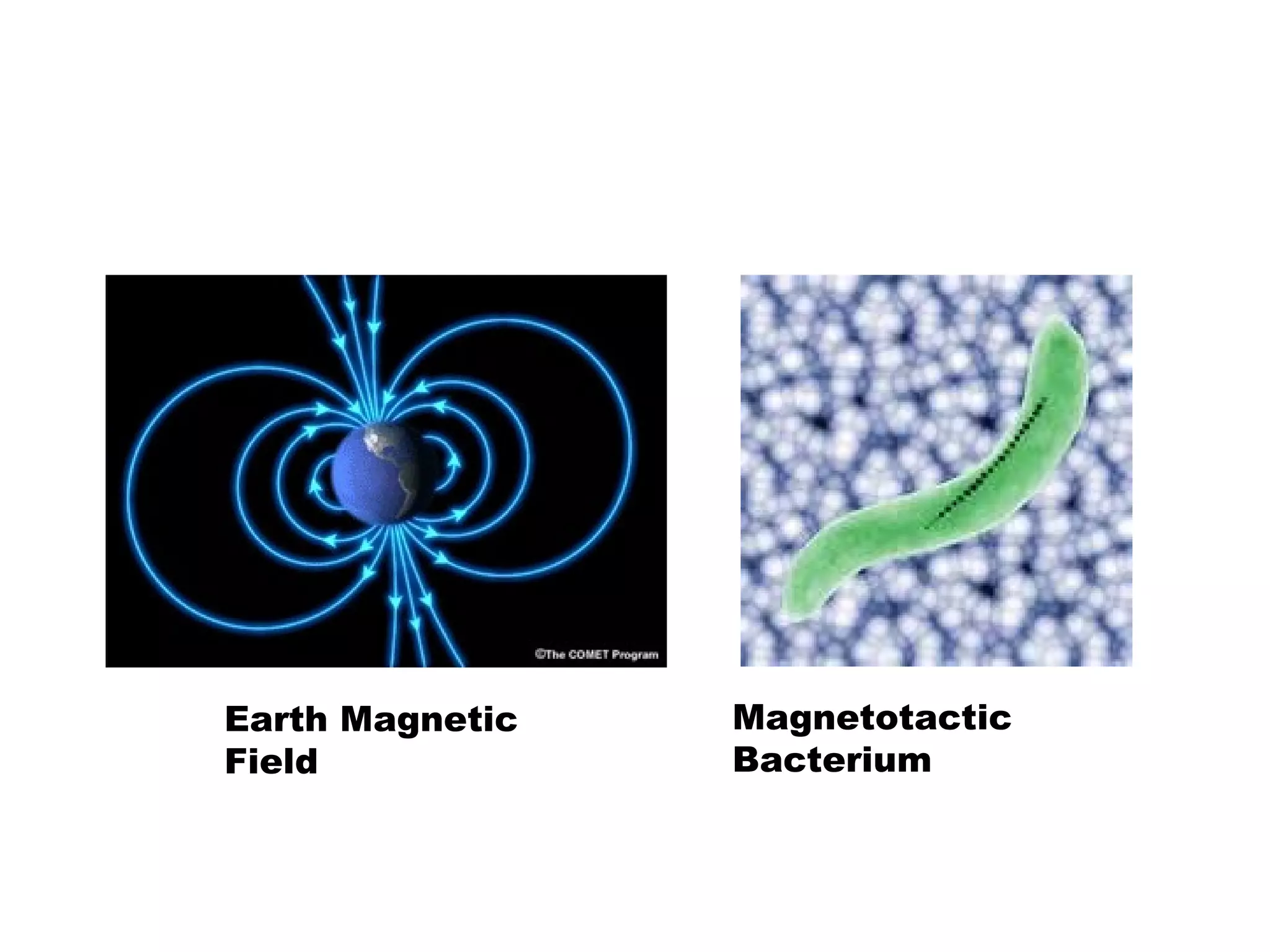
Earth Magnetic   Magnetotactic
Field            Bacterium
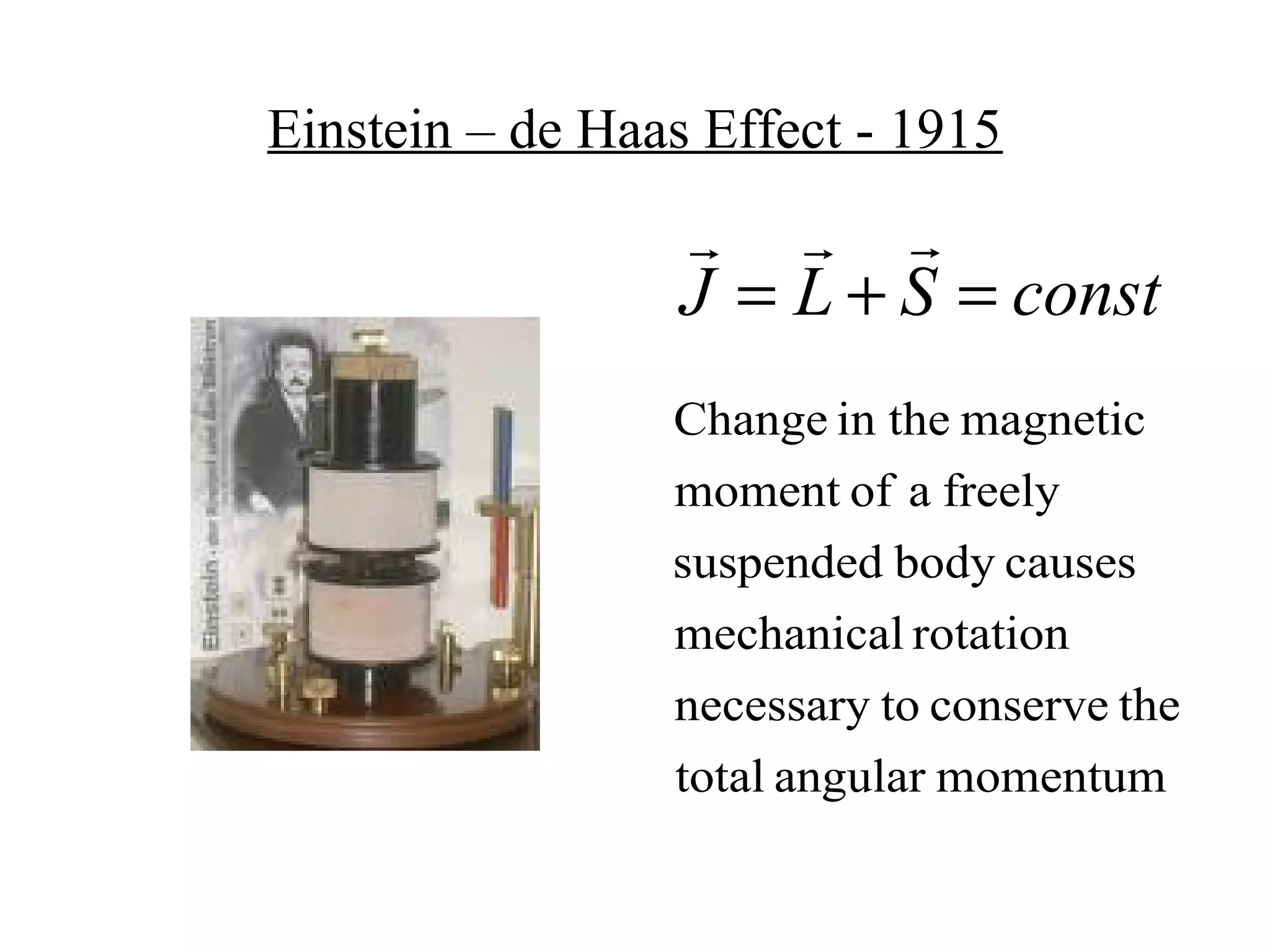
Einstein – de Haas Effect - 1915
                    
                  J = L + S = const
                 Change in the magnetic
                 moment of a freely
                 suspended body causes
                 mechanical rotation
                 necessary to conserve the
                 total angular momentum
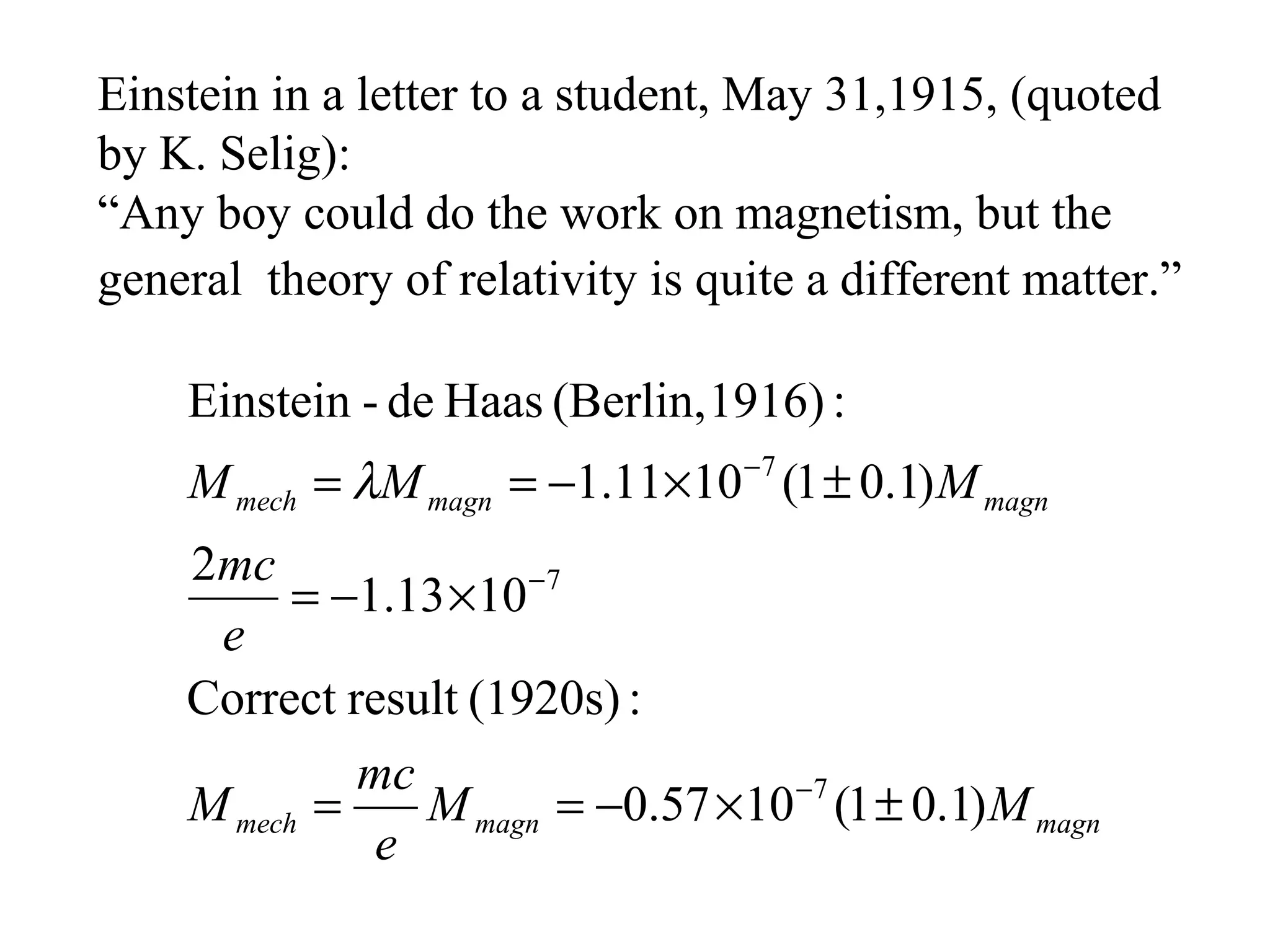
Einstein in a letter to a student, May 31,1915, (quoted
by K. Selig):
“Any boy could do the work on magnetism, but the
general theory of relativity is quite a different matter.”

    Einstein - de Haas (Berlin, 1916) :
    M mech = λM magn = −1.11×10 −7 (1 ± 0.1) M magn
    2mc
          = −1.13 ×10 −7
     e
    Correct result (1920s) :
             mc
    M mech =    M magn = −0.57 × 10 −7 (1 ± 0.1) M magn
              e
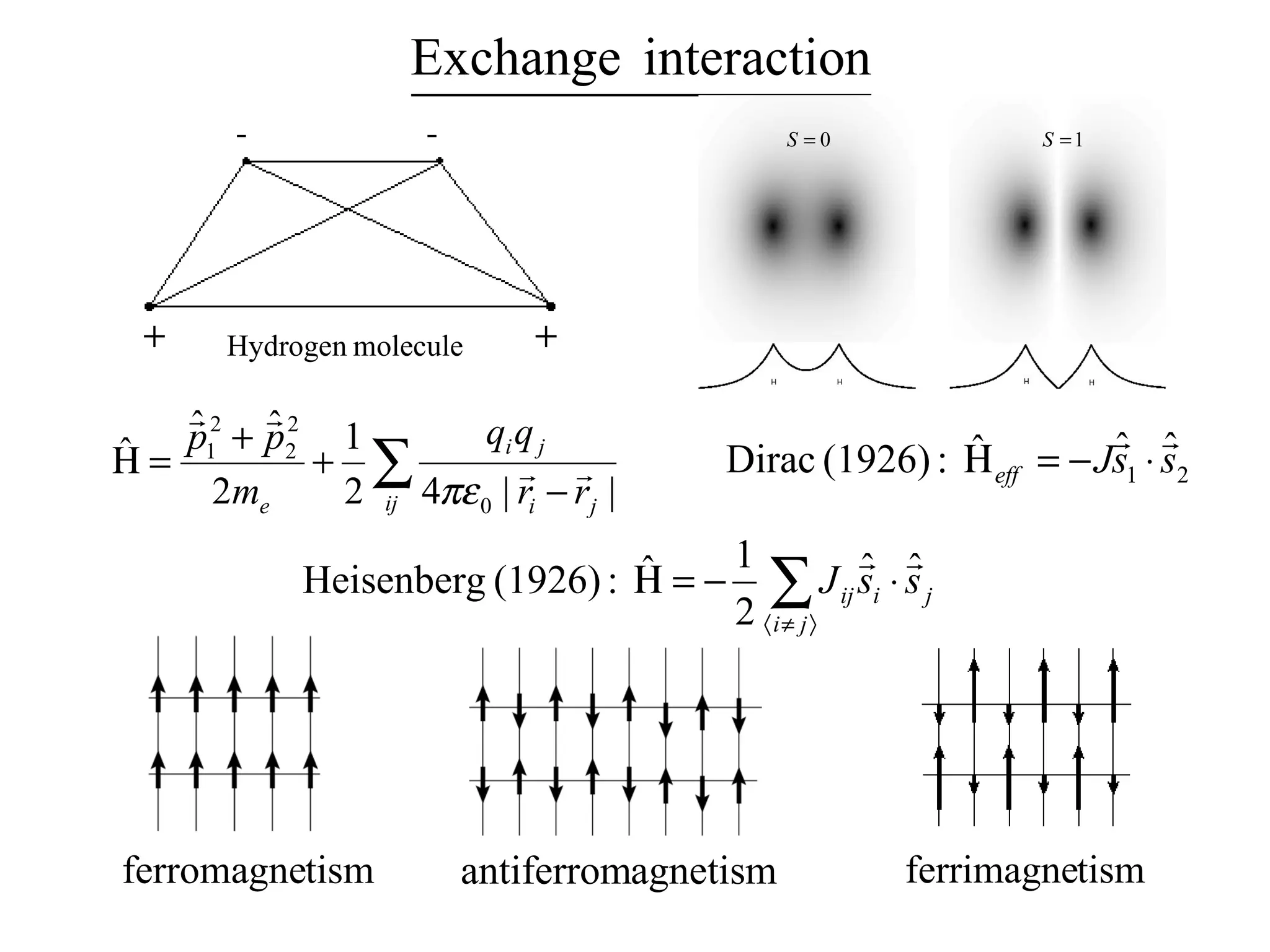
Exchange interaction
        −             −                        S =0            S =1


  +     Hydrogen molecule     +
    
    ˆ     2
          ˆ
    p12 + p2 1          qi q j                                      
ˆ =
Η            + ∑                                      ˆ          ˆ ˆ
                                         Dirac (1926) : Η eff = − Js1 ⋅ s2
      2me     2 ij 4πε 0 | ri − rj |

                                 ˆ = − 1 ∑J s ⋅s
             Heisenberg (1926) : Η
                                                   
                                                  ˆ ˆ
                                                ij i  j
                                       2 〈i≠ j〉


ferromagnetism            antiferromagnetism          ferrimagnetism

       ˆ ˆ
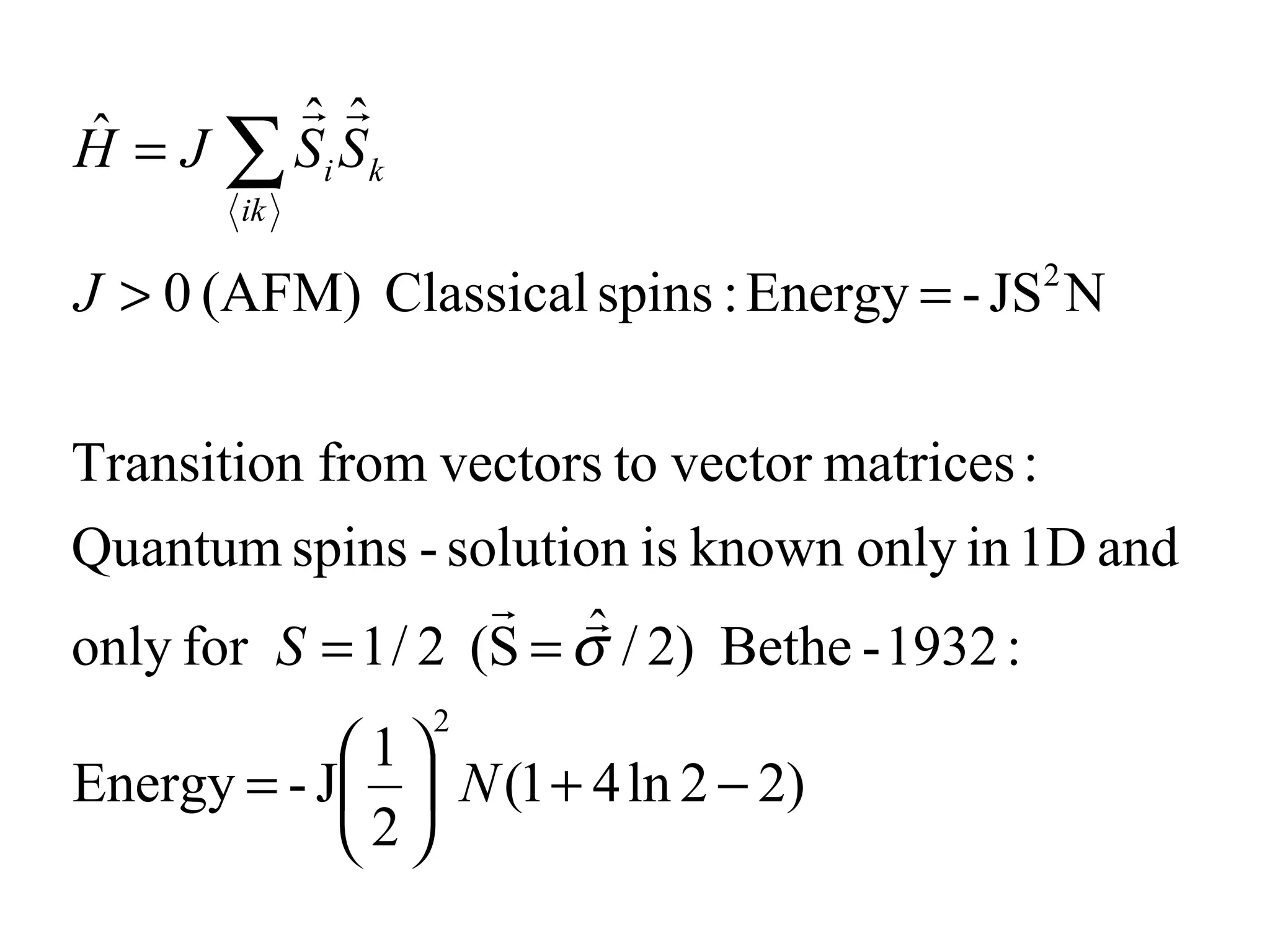
ˆ = J ∑S S
H       i k
       ik

J > 0 (AFM) Classical spins : Energy = - JS N
                                          2


Transition from vectors to vector matrices :
Quantum spins - solution is known only in 1D and
                     
                         ˆ
only for S = 1 / 2 (S = σ / 2) Bethe - 1932 :
                2
            1
Energy = - J  N (1 + 4 ln 2 − 2)
            2
Magnetic Anisotropy
                                 
                                B =v×E
               E
                                ˆ                    
                                                    ˆ
                               Η local   = − ge µB s ⋅ B
   v
 ˆ
 Η A = bαβ sα sβ + cαβγδ sα sβ sγ sδ + ...
                    2                        4
             v                      v
       bαβ ∝   ,           cαβγδ   ∝  ,         ...
             c                      c

Uniaxial :    ˆ
              Η A = − DS z2
Biaxial :     ˆ
              Η A = − DS z2 + E ( S x2 − S y )
                                           2


Cubic :       ˆ          [                                         ]
              Η A = C {S x2 , S y } + {S x2 , S z2 } + {S y , S z2 }
                                2                         2
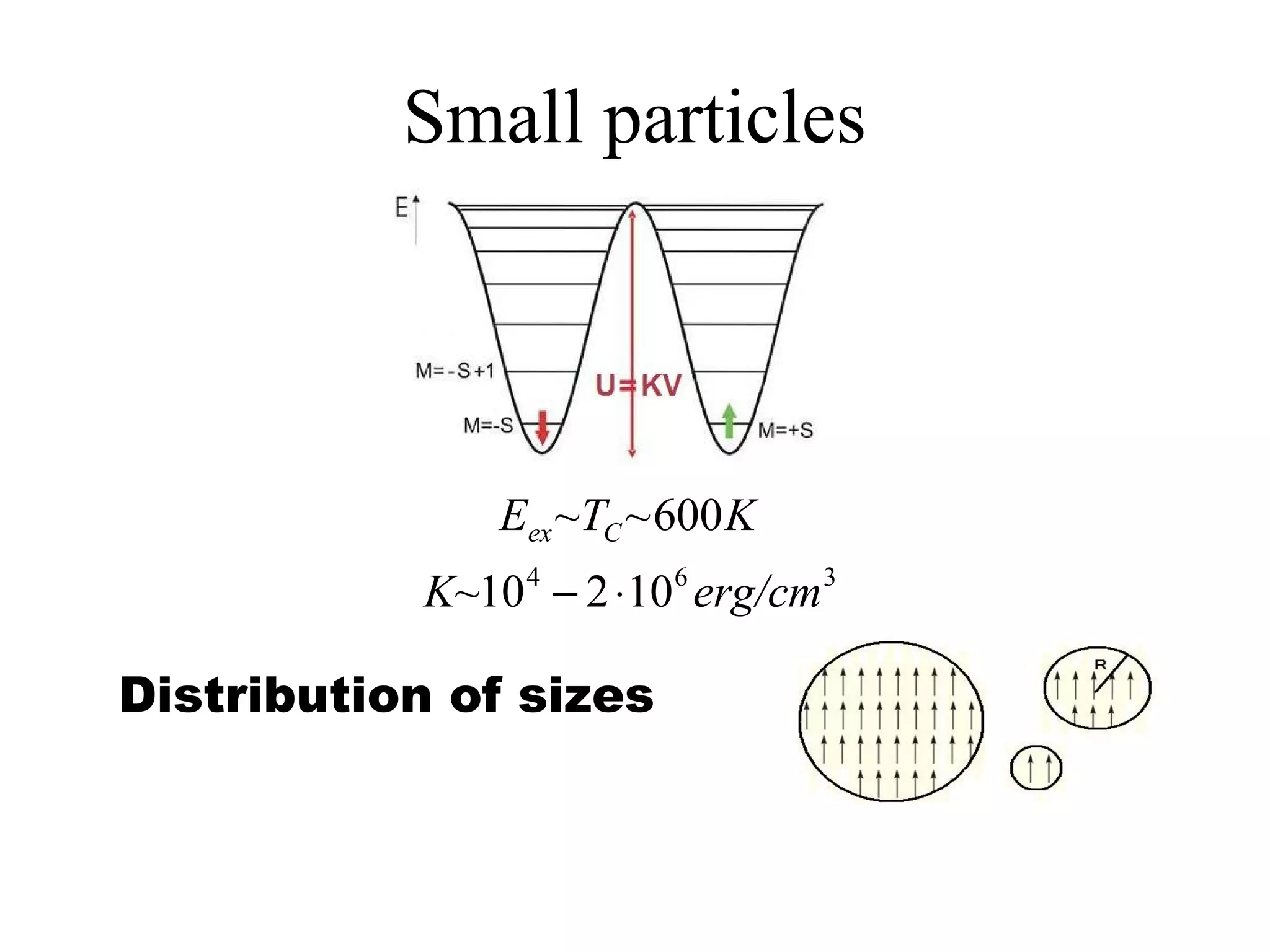
Small particles


               Eex ~TC ~ 600 K
           K~10 4 − 2 ⋅106 erg/cm 3

Distribution of sizes
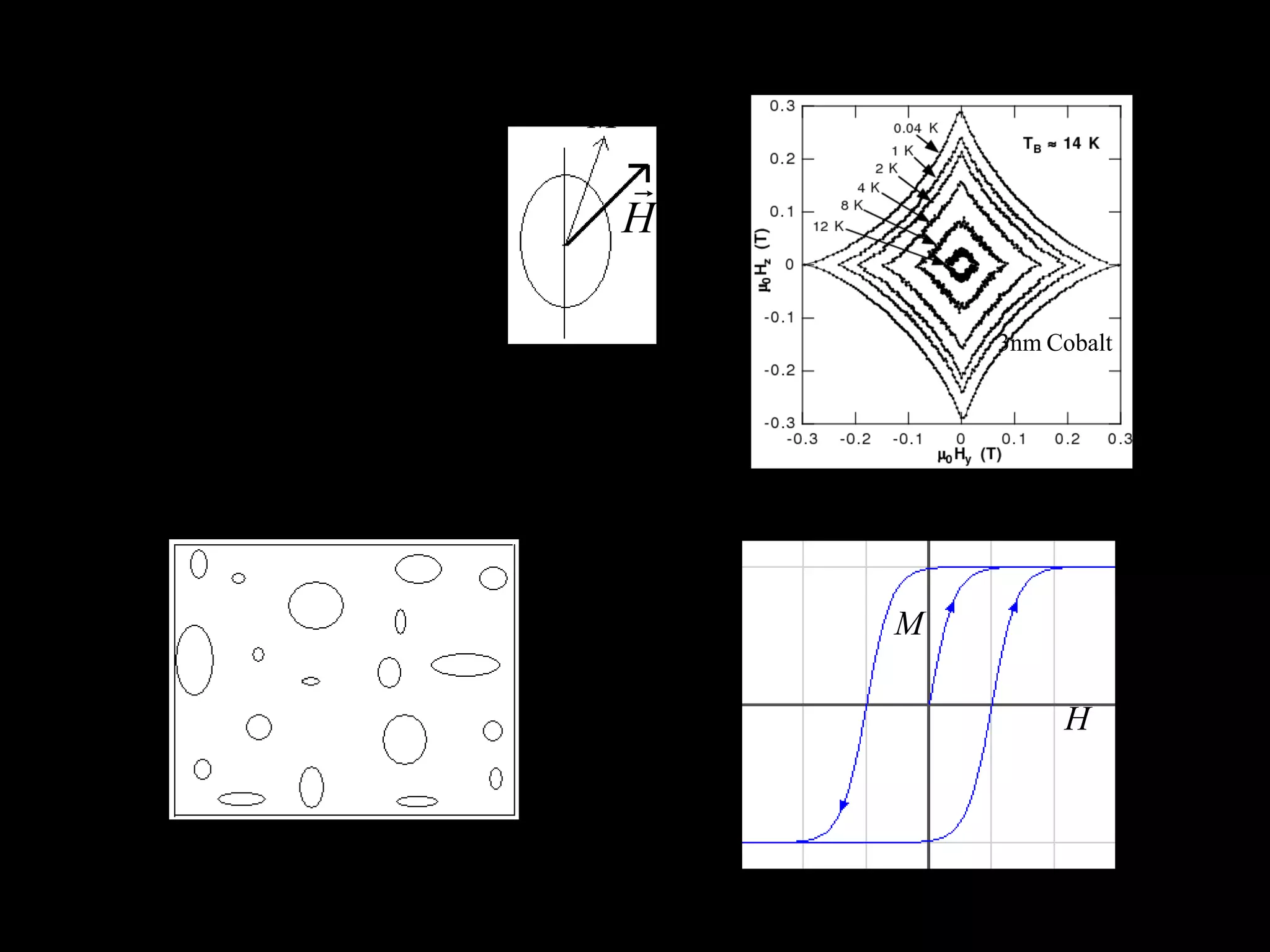
Superparamagnetism                
                                  M
single - domain                       
                                      H
magnetic particle
                                              3nm Cobalt

    H y / 2 + H z3 / 2 = H A/ 2
      3                    3


                                          M
                                  ⇒
                                                   H


 Array of particles in a solid
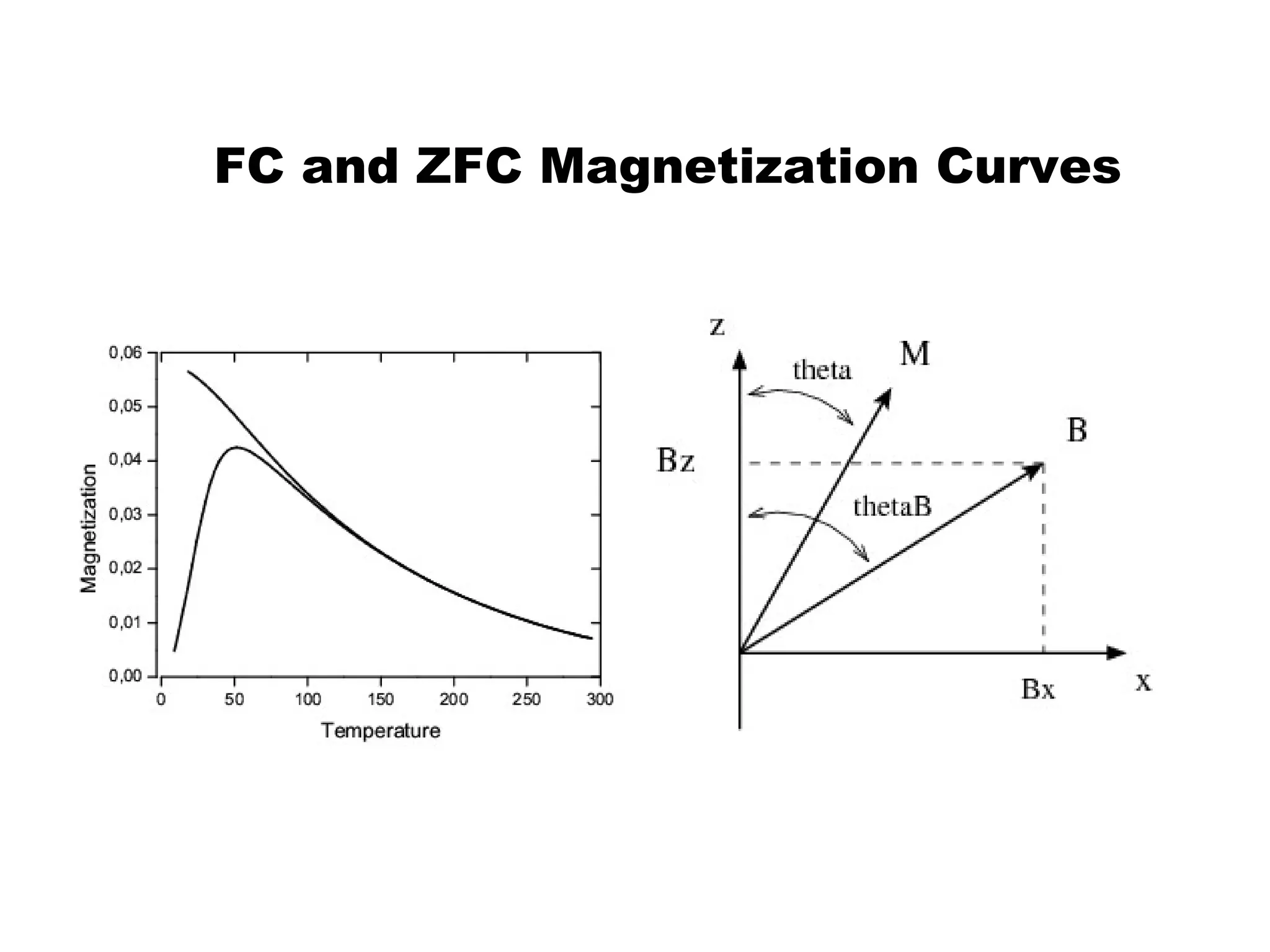
FC and ZFC Magnetization Curves
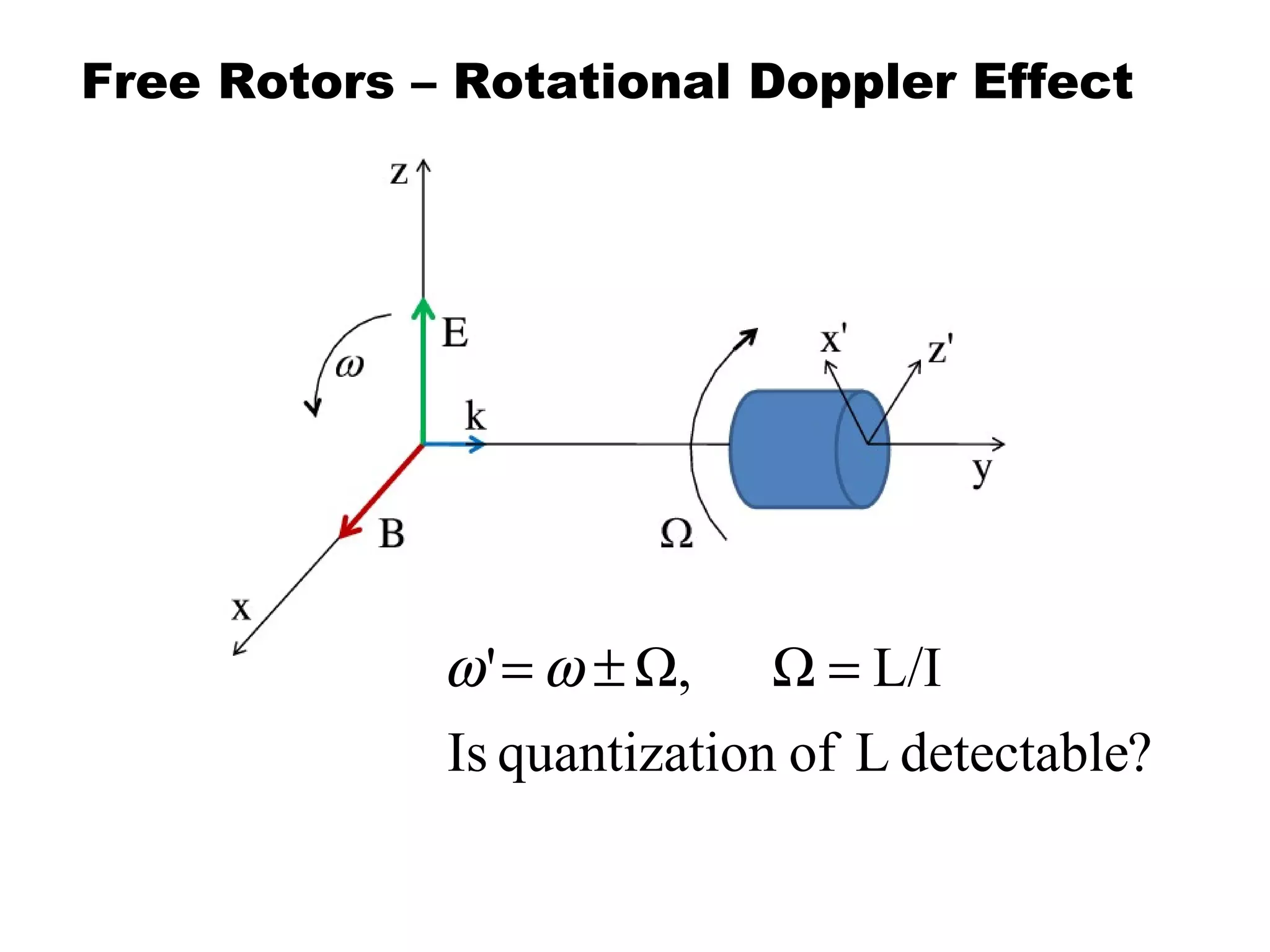
Free Rotors – Rotational Doppler Effect


             ω ' = ω ± Ω, Ω = L/I
             Is quantization of L detectable?
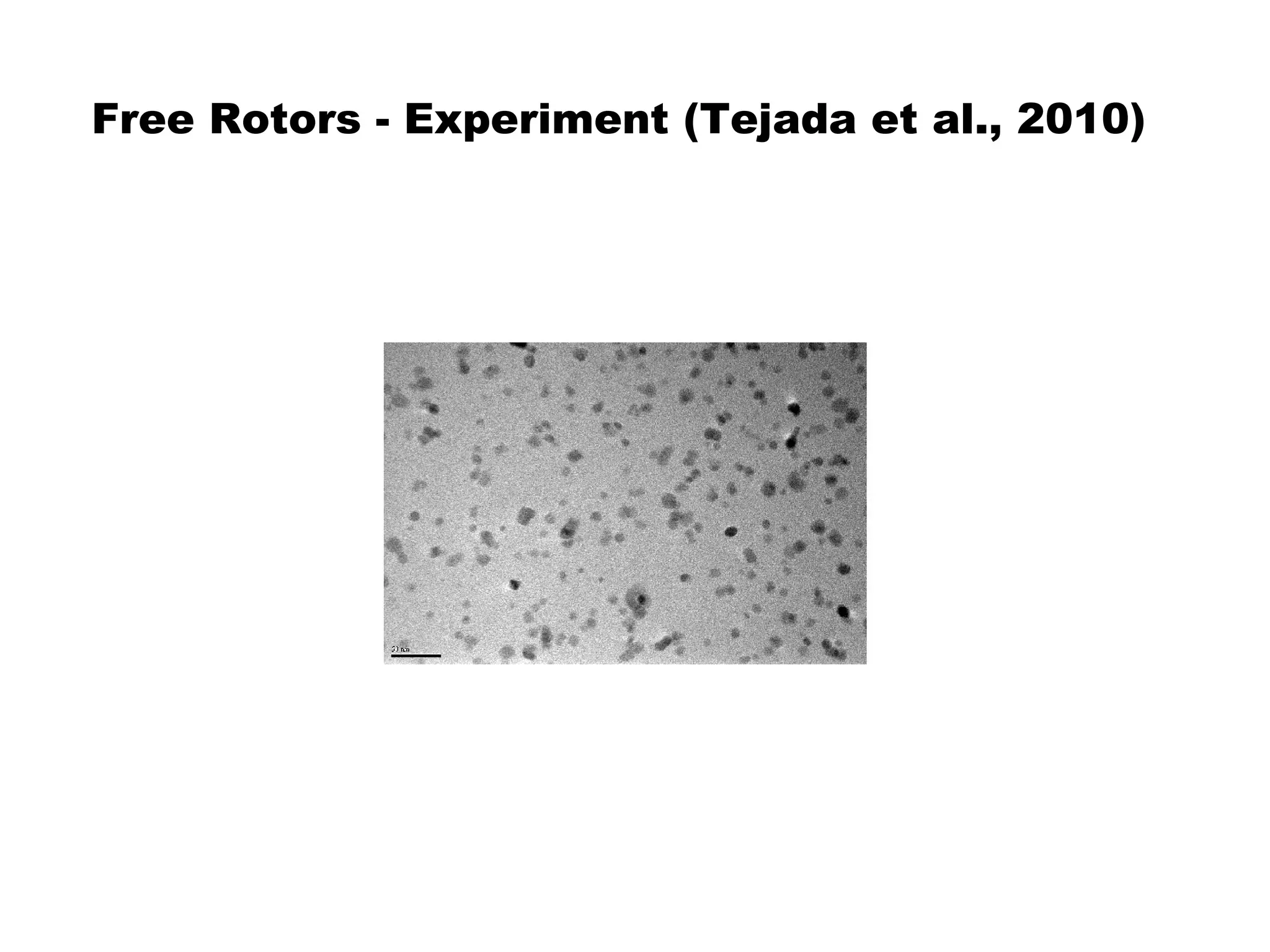
Free Rotors - Experiment (Tejada et al., 2010)
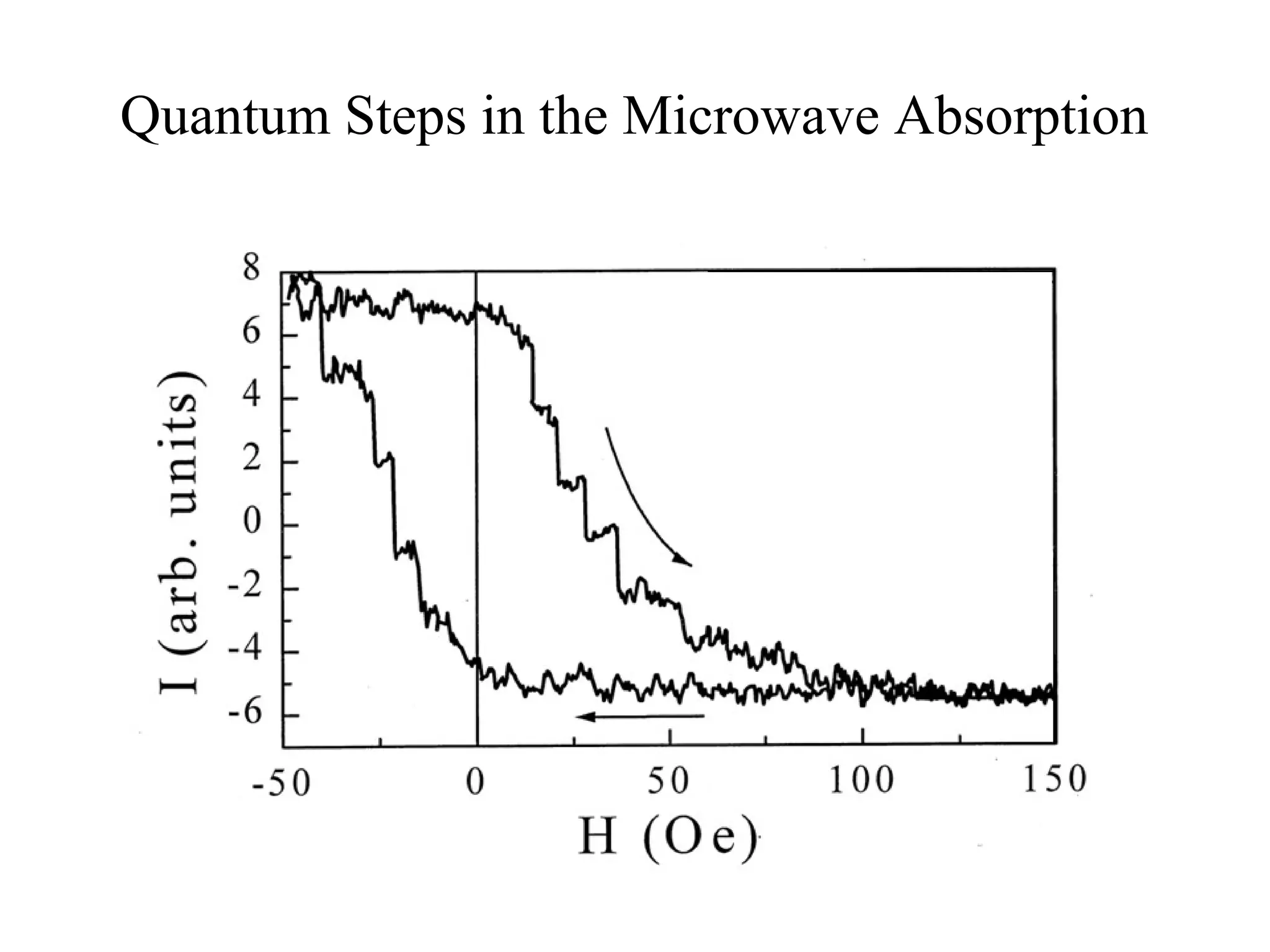
Quantum Steps in the Microwave Absorption
Magnetic bistability of Mn12 acetate :
  [Mn12 O12 (CH 3COO)16 (H 2 O) 4 ] ⋅ 2CH 3COOH ⋅ 4H 2 O


                                      1.73 nm
    S = 10                                          1.73 nm

ˆ      ˆ      ˆ
Η = − DS z2 + Η ⊥                                      1.24 nm

 ˆ
[Η ⊥ , S z ] ≠ 0                Mn12 acetate crystal
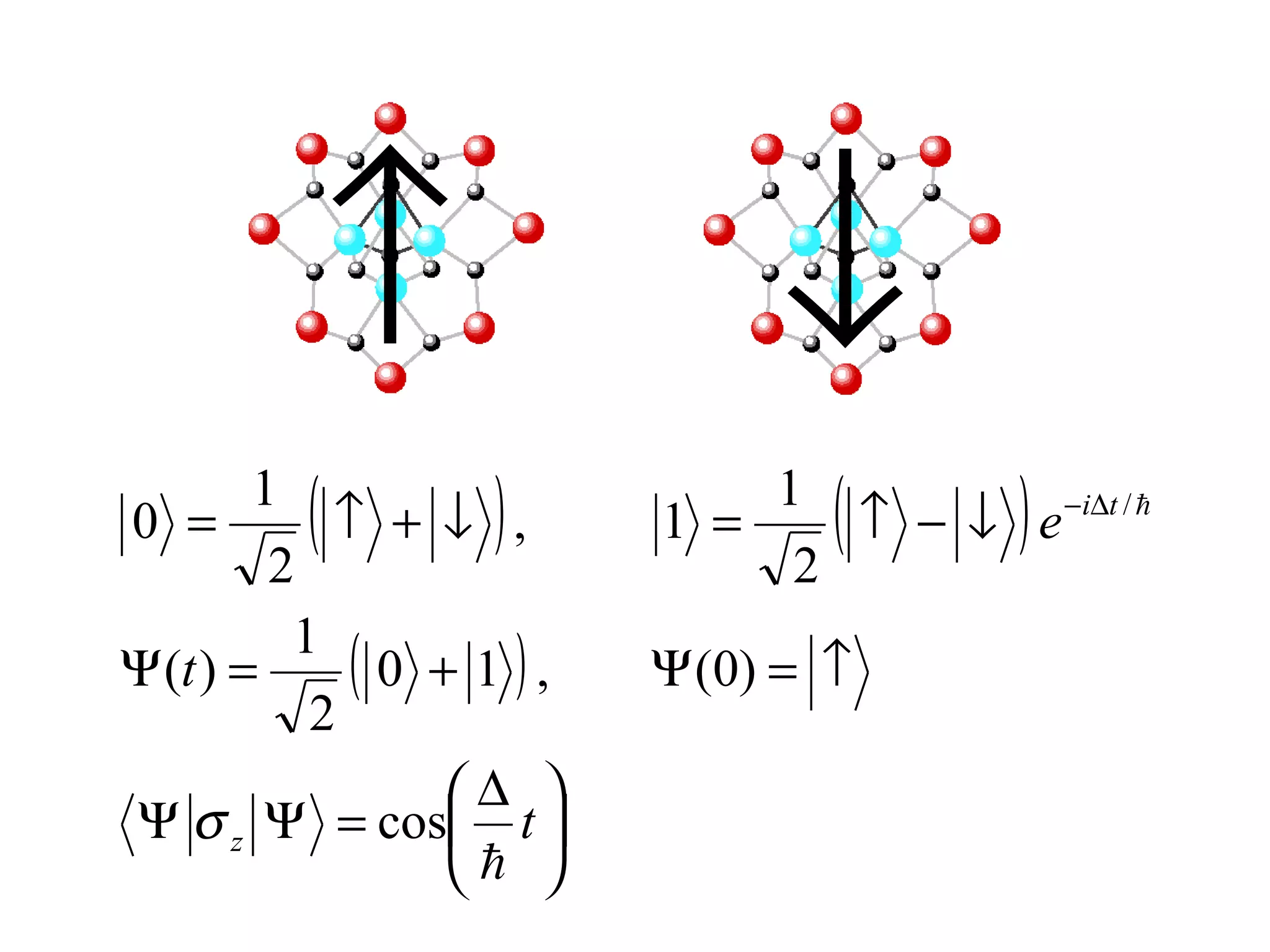
↑                 ↓
0 =
        1
         (
         2
            ↑ + ↓ ,)      1 =
                              1
                               2
                                  (
                                 ↑ −↓ e   )
                                        −i∆t / 


Ψ (t ) =
          1
             ( 0 + 1 ),   Ψ (0) = ↑
           2
                  ∆ 
Ψ σ z Ψ = cos t 
                   
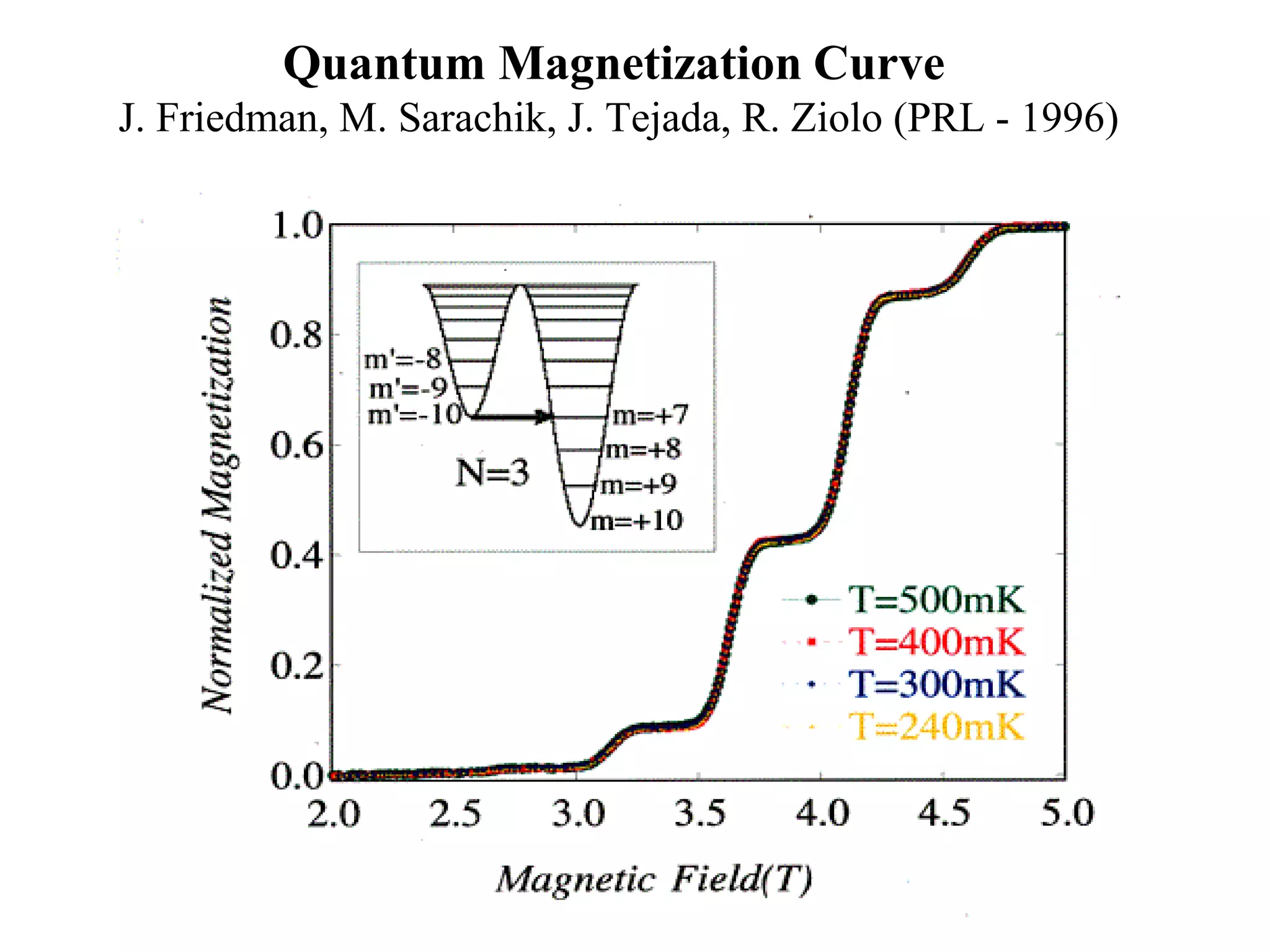
Quantum Magnetization Curve
J. Friedman, M. Sarachik, J. Tejada, R. Ziolo (PRL - 1996)
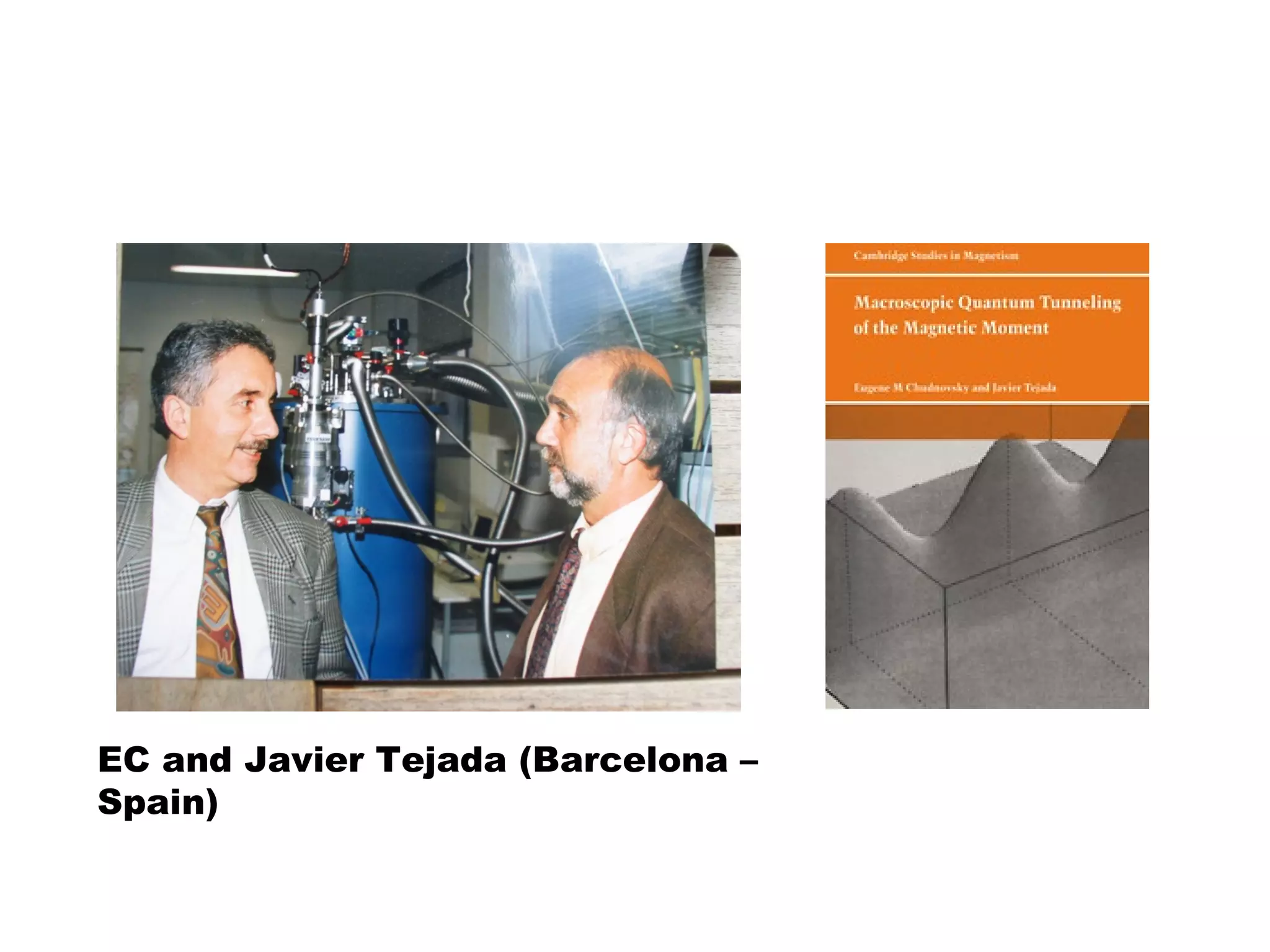
EC and Javier Tejada (Barcelona –
Spain)
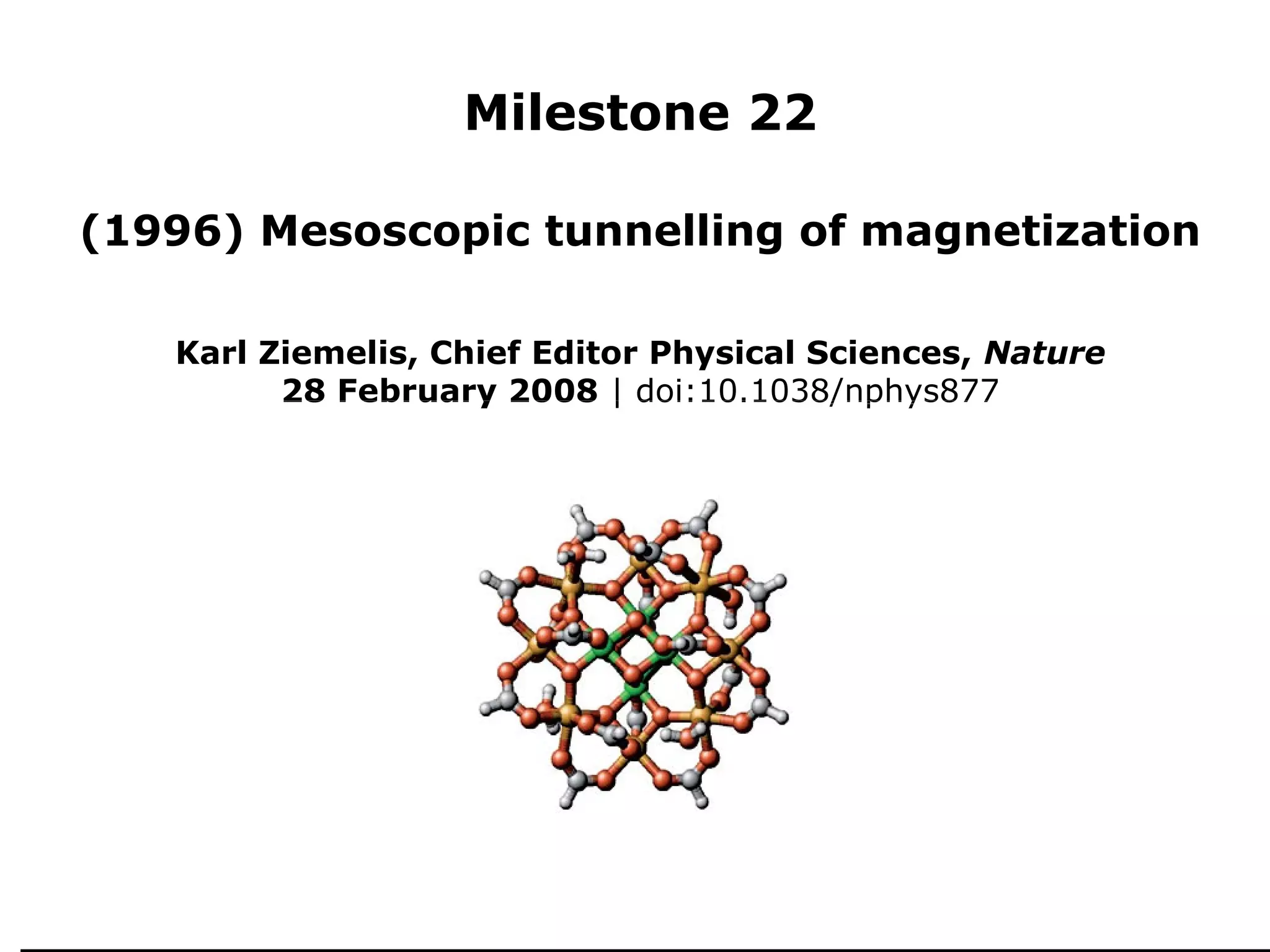
Milestone 22
 
    (1996) Mesoscopic tunnelling of magnetization

       Karl Ziemelis, Chief Editor Physical Sciences, Nature
             28 February 2008 | doi:10.1038/nphys877
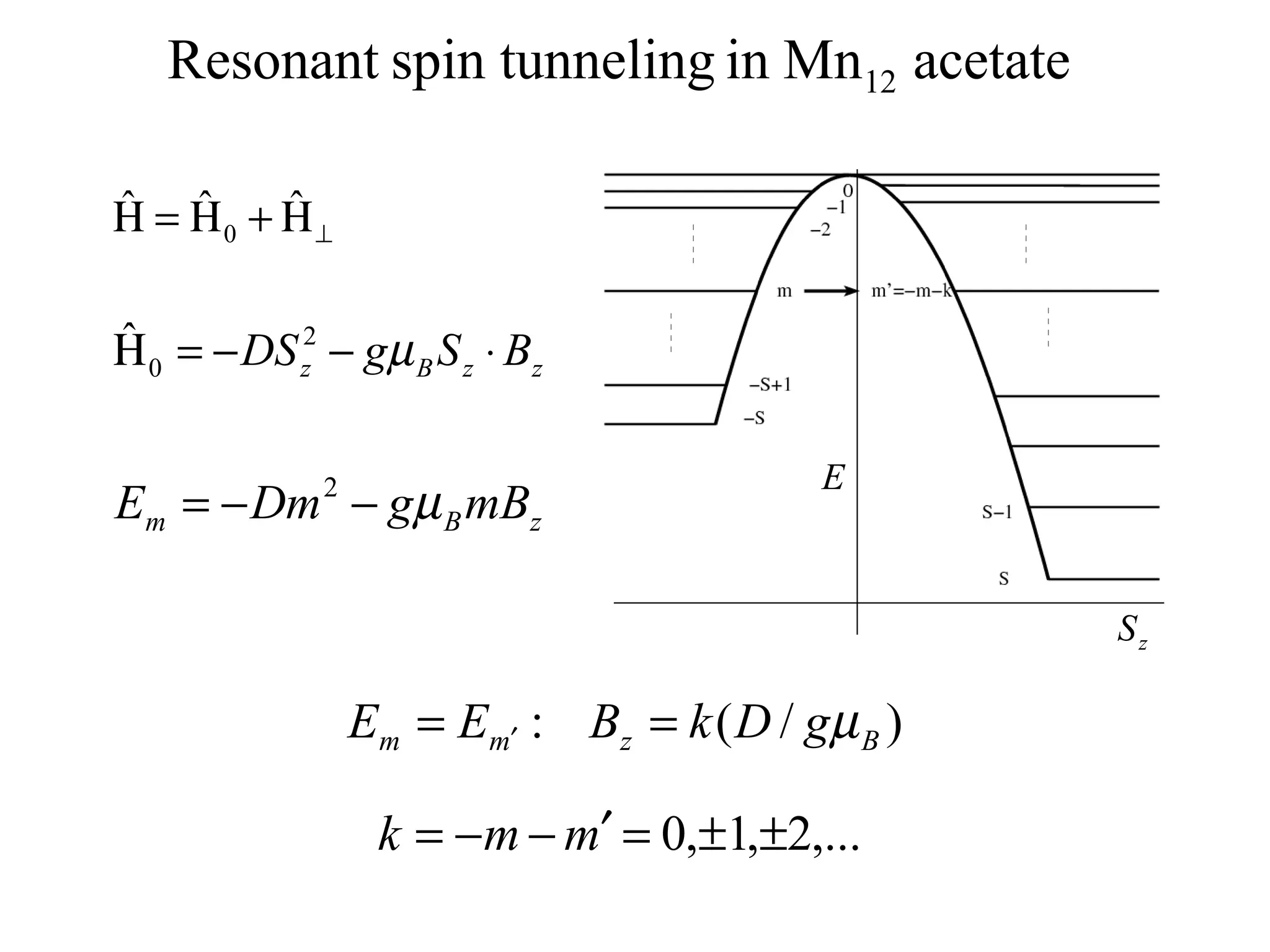
Resonant spin tunneling in Mn12 acetate

ˆ ˆ      ˆ
Η = Η0 + Η⊥

ˆ
Η 0 = − DS z2 − gµ B S z ⋅ Bz

                                           E
Em = − Dm − gµ B mBz
              2


                                                   Sz

                  Em = Em′ : Bz = k ( D / gµ B )

                   k = −m − m′ = 0,±1,±2,...
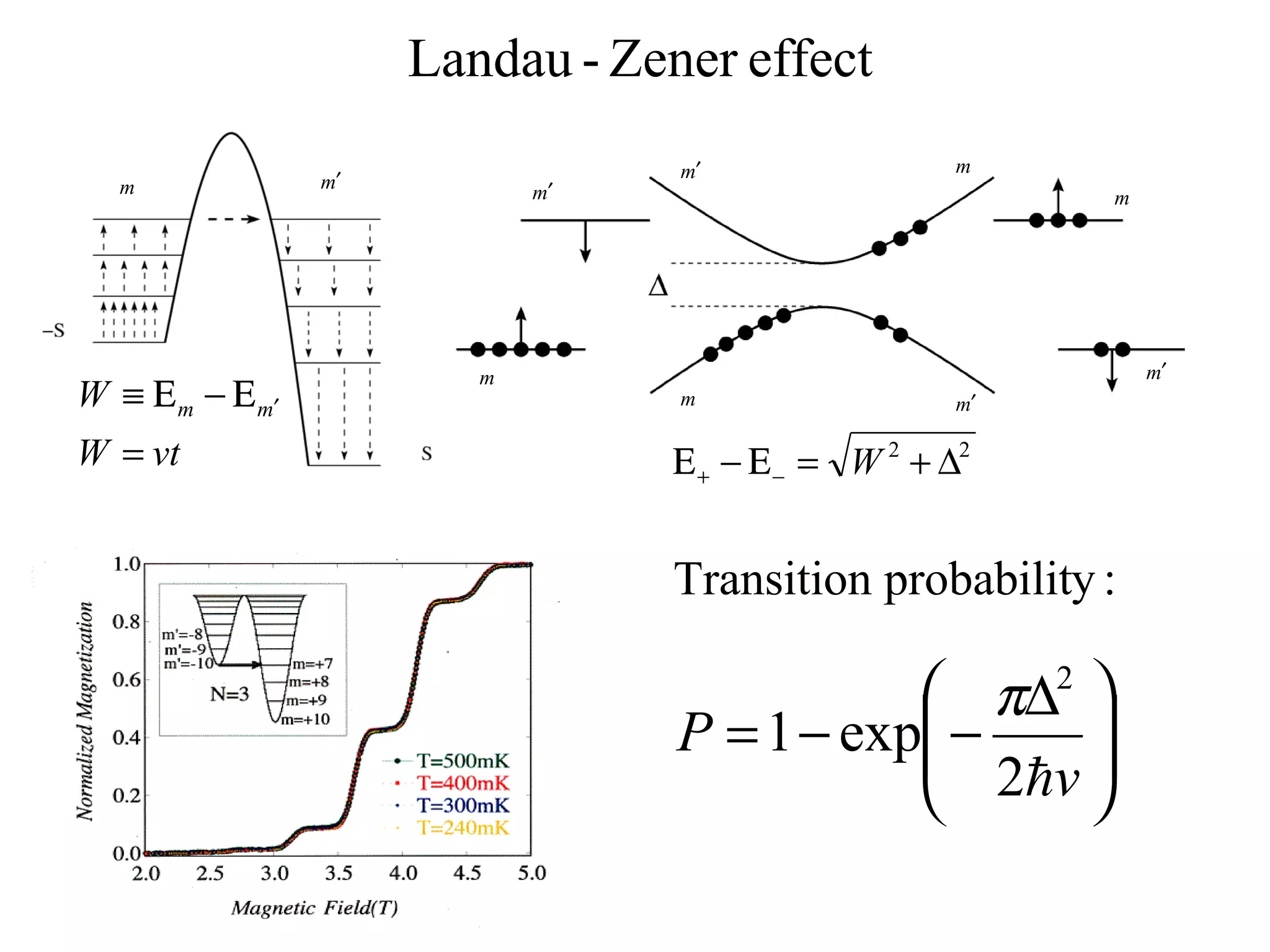
Landau - Zener effect
                                  m′                 m
  m              m′          m′                           m


                         m                                    m′
W ≡ Ε m − Ε m′                    m                  m′

W = vt                            Ε + − Ε − = W 2 + ∆2


                                  Transition probability :

                                              π∆2 
                                  P = 1 − exp −
                                              2v 
                                                   
                                                  
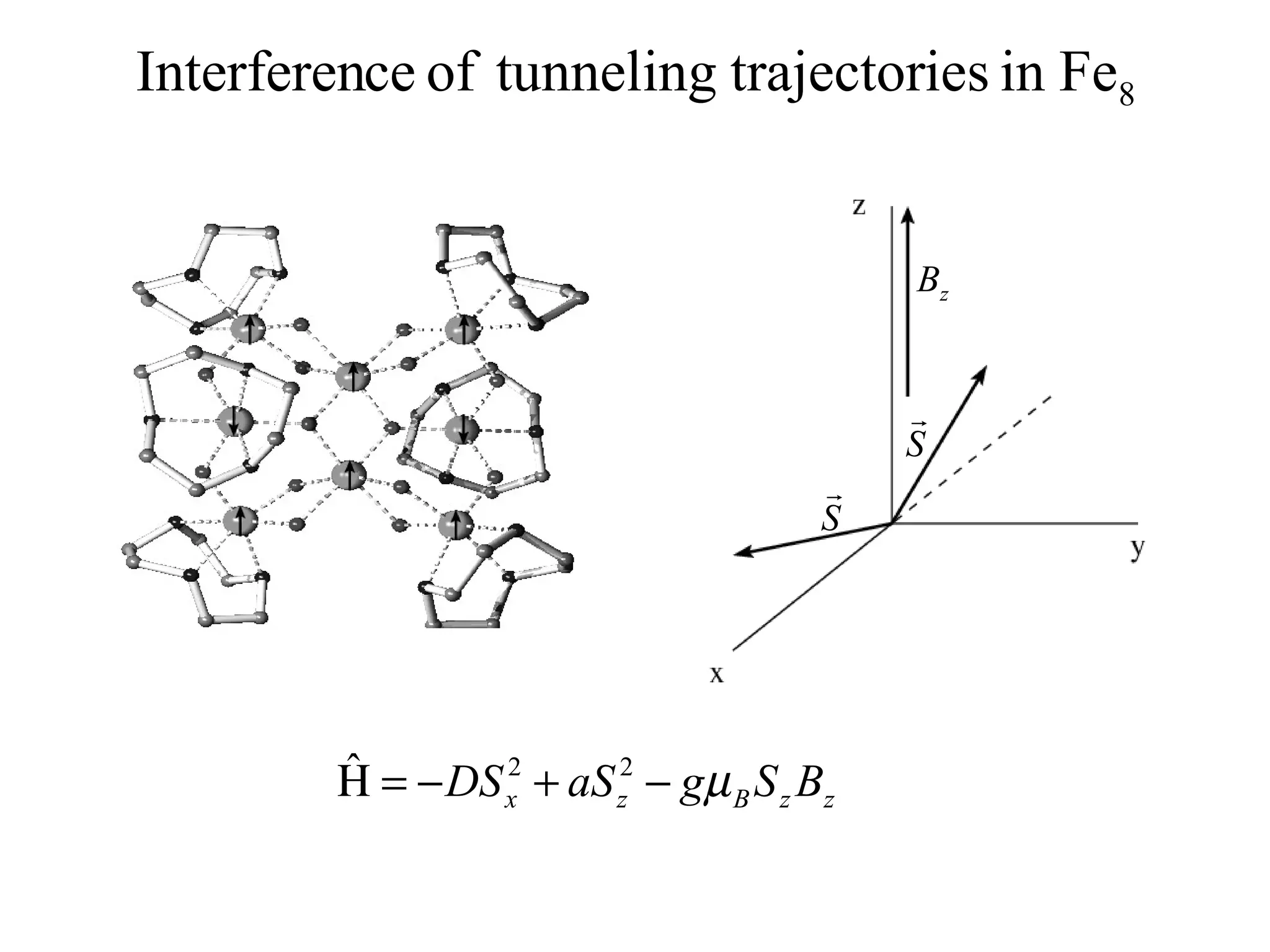
Interference of tunneling trajectories in Fe8


                                             Bz


                                             
                                             S
                                         
                                         S


         ˆ
         Η = − DS x2 + aS z2 − gµ B S z Bz
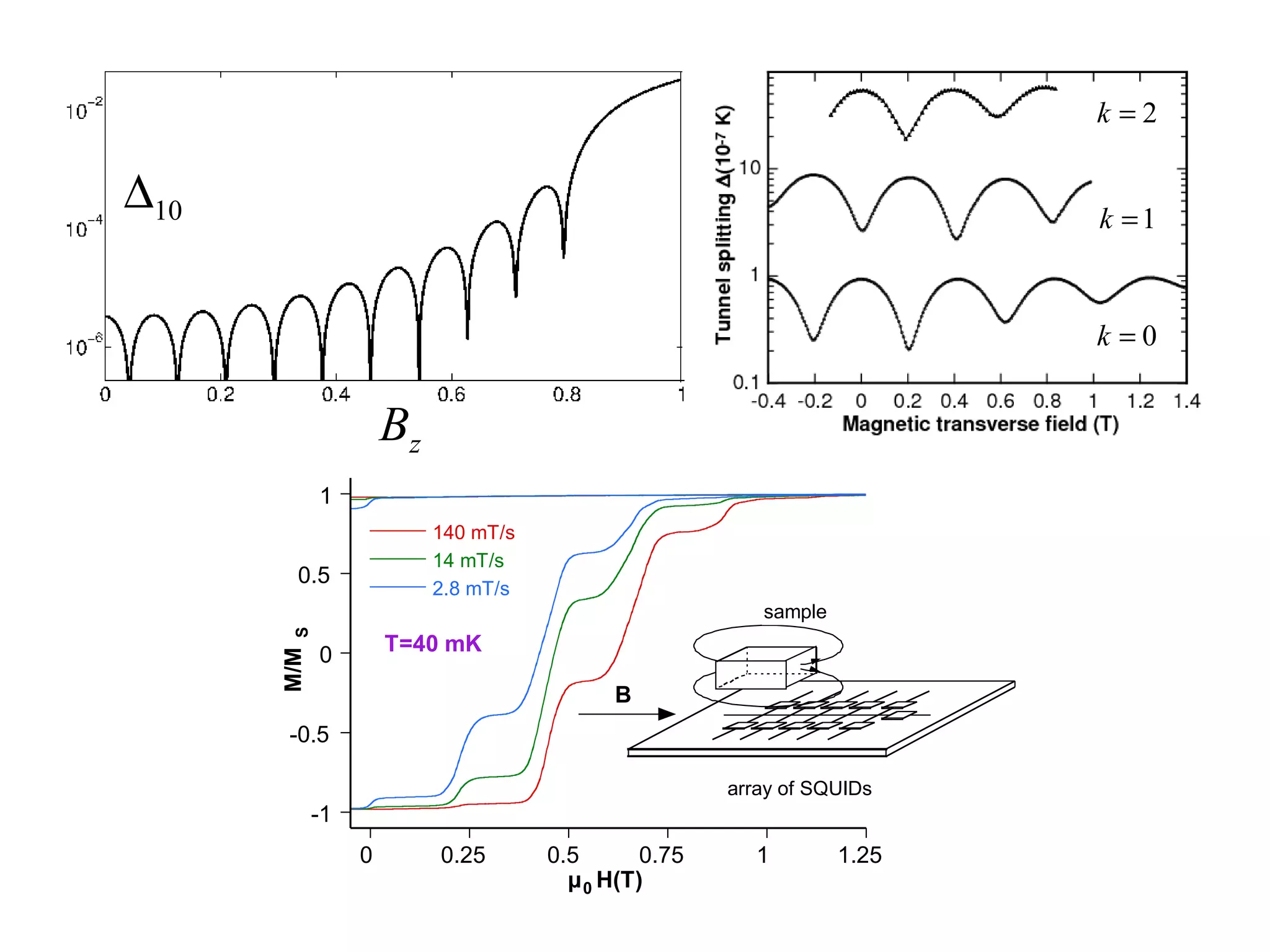
k =2

∆10                                                                      k =1


                                                                         k =0


                     Bz
            1
                          140 mT/s
                          14 mT/s
        0.5
                          2.8 mT/s
                                                         sample
       S


            0        T=40 mK
      M/M


                                           B
       -0.5

                                                      array of SQUIDs
            -1
                 0        0.25       0.5       0.75     1         1.25
                                       µ 0 H(T)
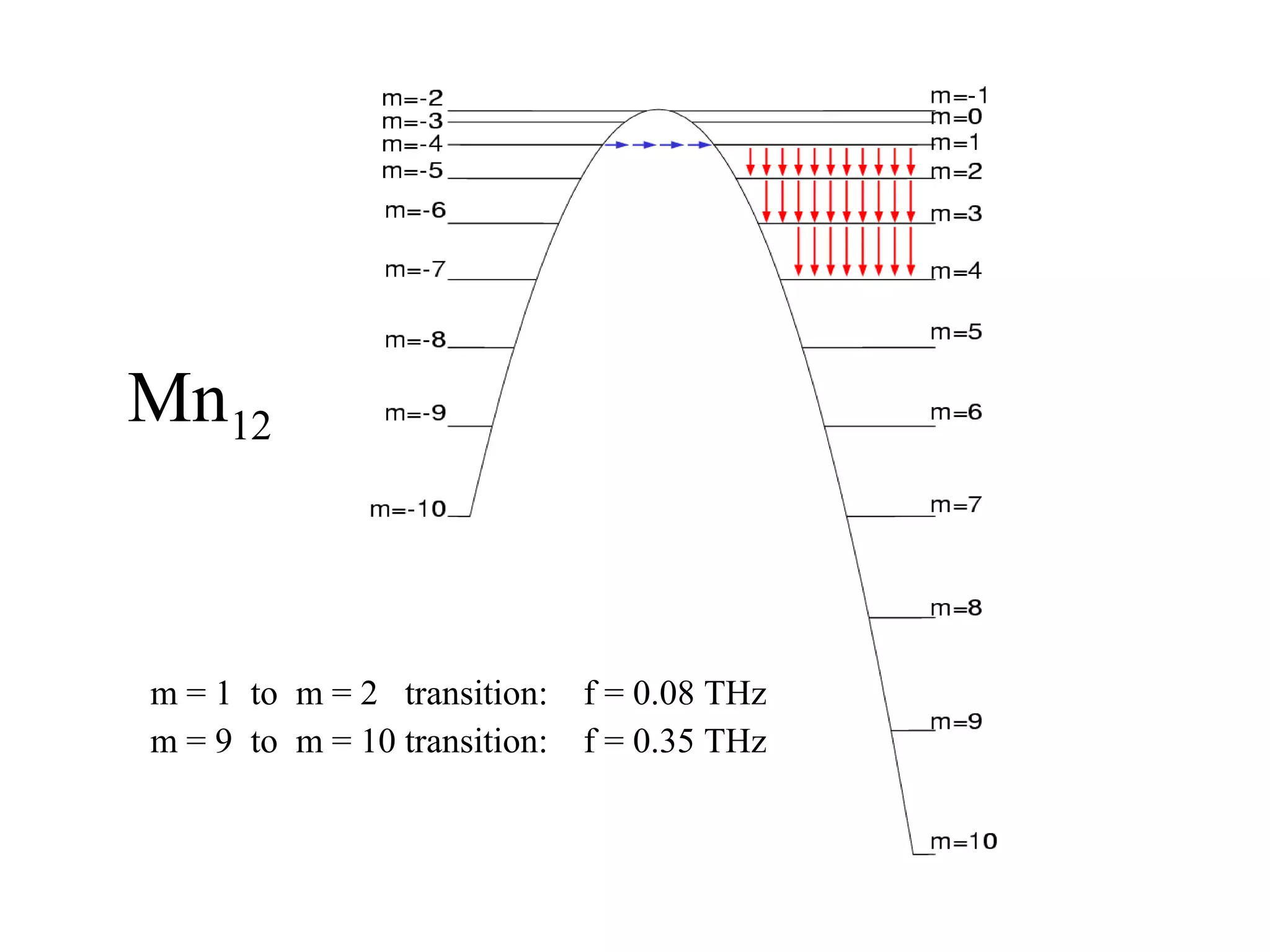
Mn12


m = 1 to m = 2 transition:    f = 0.08 THz
m = 9 to m = 10 transition:   f = 0.35 THz
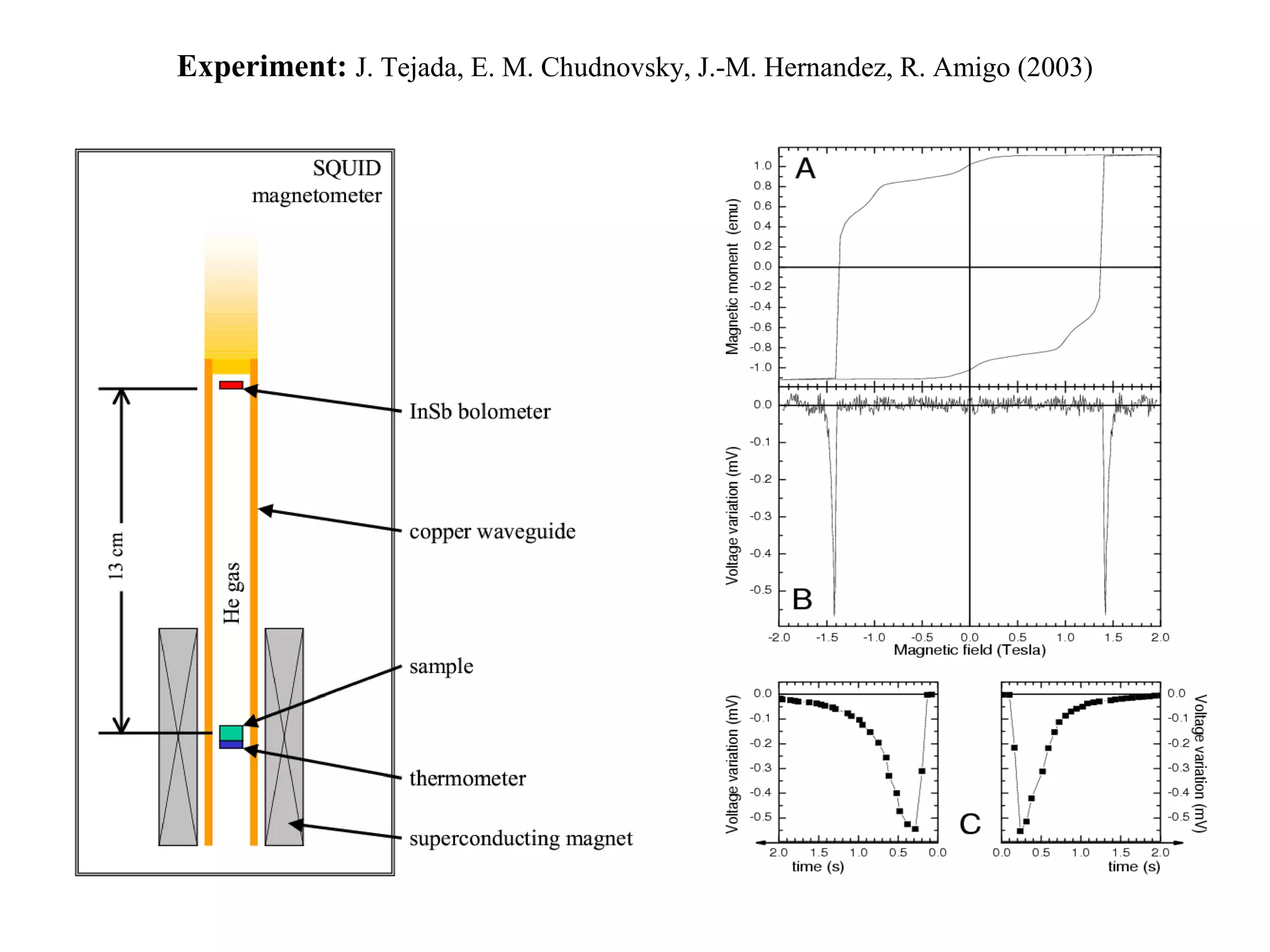
Experiment: J. Tejada, E. M. Chudnovsky, J.-M. Hernandez, R. Amigo (2003)
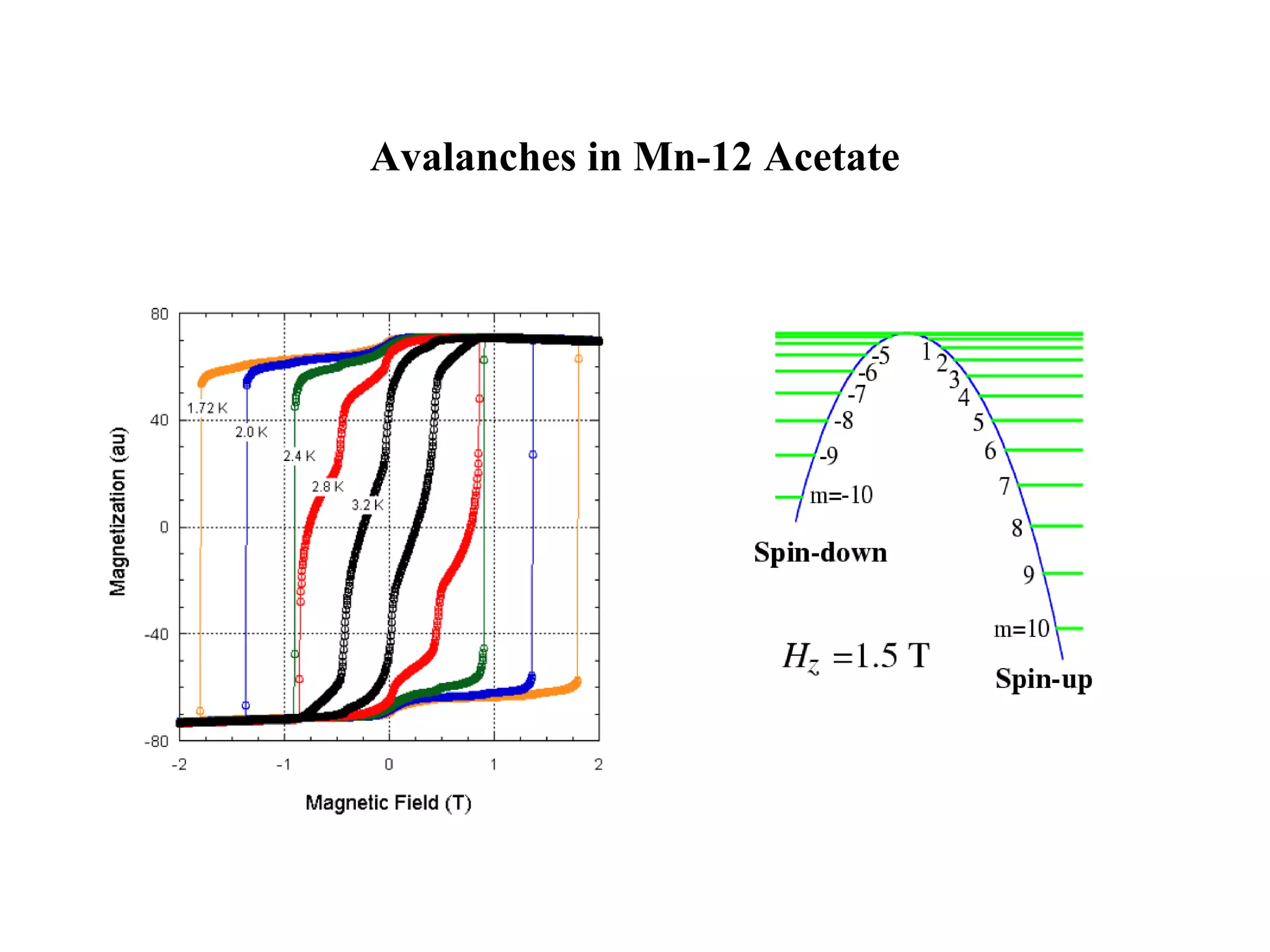
Avalanches in Mn-12 Acetate
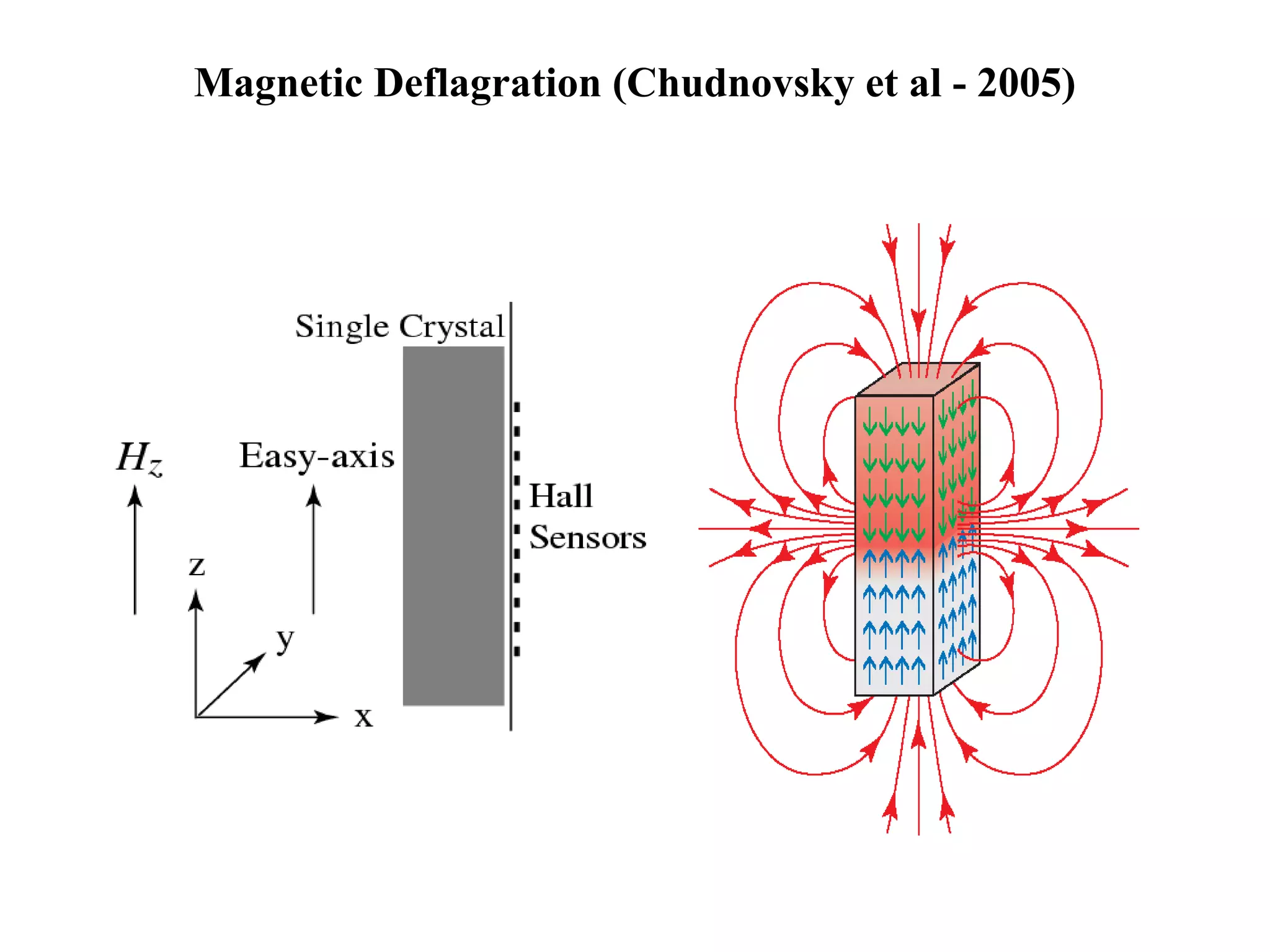
Magnetic Deflagration (Chudnovsky et al - 2005)
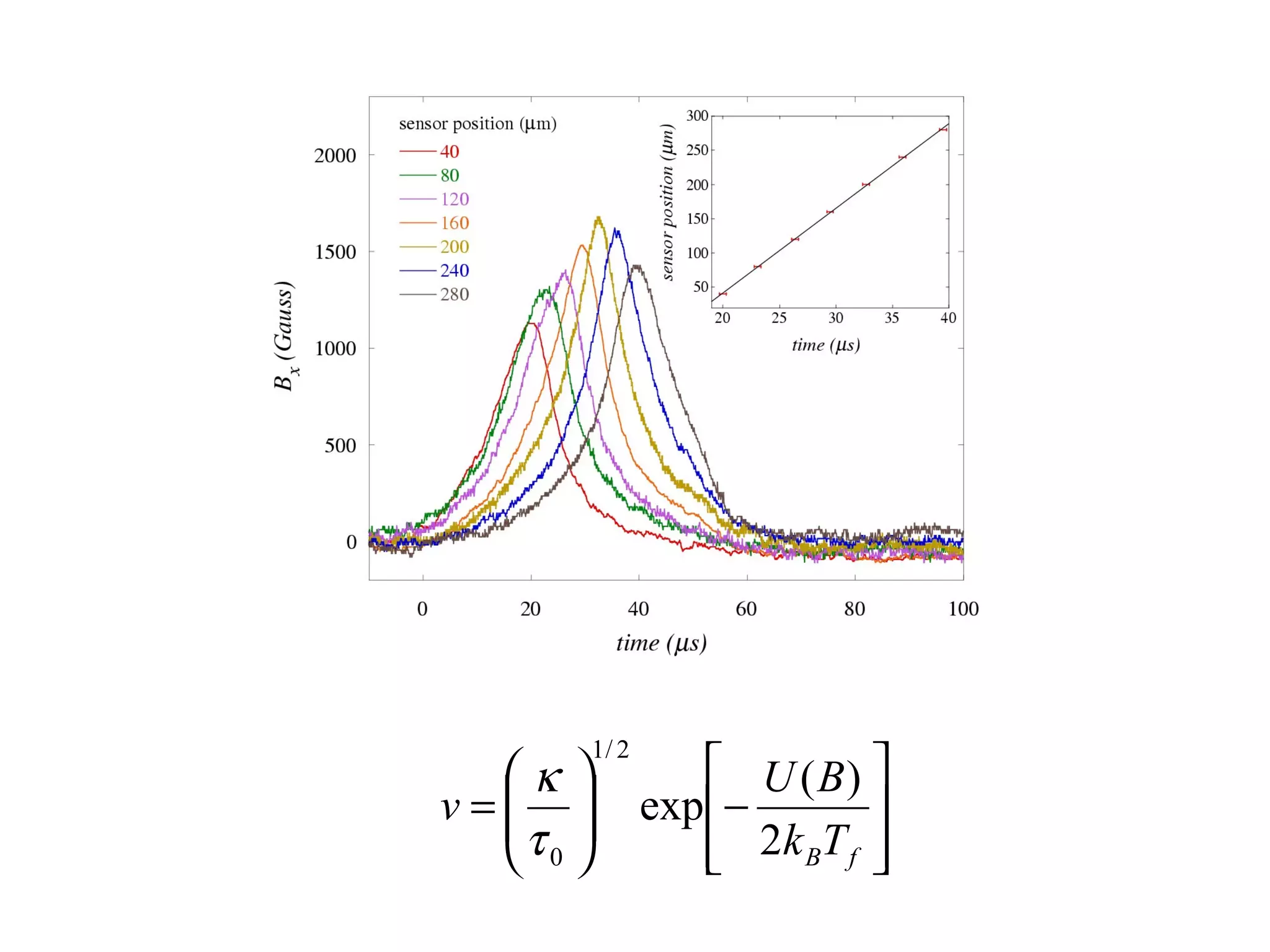
1/ 2
  κ            U ( B) 
v= 
  τ       exp −         
   0           2 k BT f 
                          
Quantum Magnetic Deflagration
     [Tejada et al - 2005]



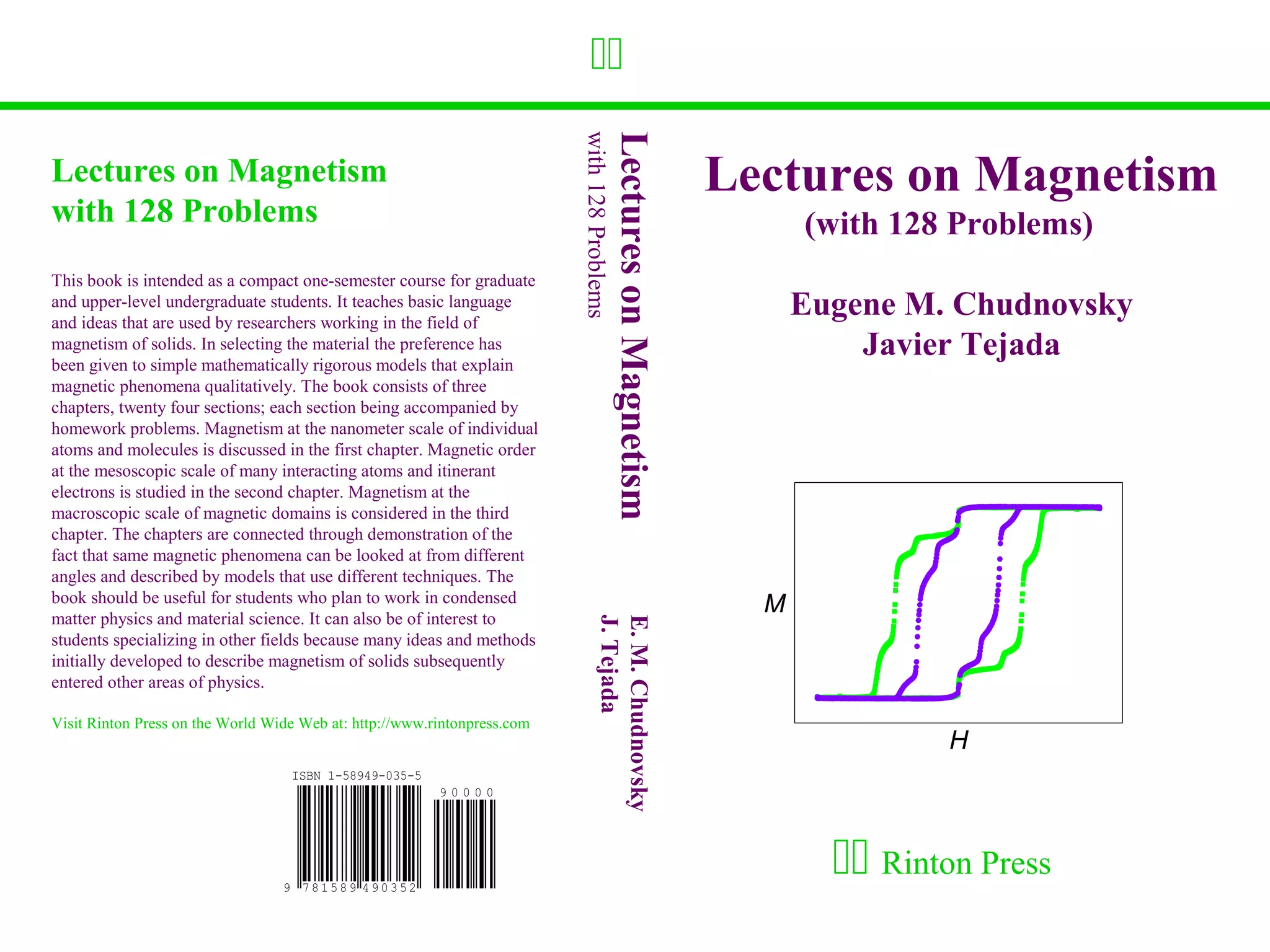
                                                                          with 128 Problems
                                                                                              Lectures on Magnetism
Lectures on Magnetism                                                                                                 Lectures on Magnetism
with 128 Problems                                                                                                           (with 128 Problems)
This book is intended as a compact one-semester course for graduate
and upper-level undergraduate students. It teaches basic language
and ideas that are used by researchers working in the field of
                                                                                                                            Eugene M. Chudnovsky
magnetism of solids. In selecting the material the preference has
been given to simple mathematically rigorous models that explain
                                                                                                                                Javier Tejada
magnetic phenomena qualitatively. The book consists of three
chapters, twenty four sections; each section being accompanied by
homework problems. Magnetism at the nanometer scale of individual
atoms and molecules is discussed in the first chapter. Magnetic order
at the mesoscopic scale of many interacting atoms and itinerant
electrons is studied in the second chapter. Magnetism at the
macroscopic scale of magnetic domains is considered in the third
chapter. The chapters are connected through demonstration of the
fact that same magnetic phenomena can be looked at from different
angles and described by models that use different techniques. The
book should be useful for students who plan to work in condensed
matter physics and material science. It can also be of interest to
                                                                                  J. Tejada                             M
                                                                                  E. M. Chudnovsky
students specializing in other fields because many ideas and methods
initially developed to describe magnetism of solids subsequently
entered other areas of physics.

Visit Rinton Press on the World Wide Web at: http://www.rintonpress.com
                                                                                                                                     H


                                                                                                                               Rinton Press
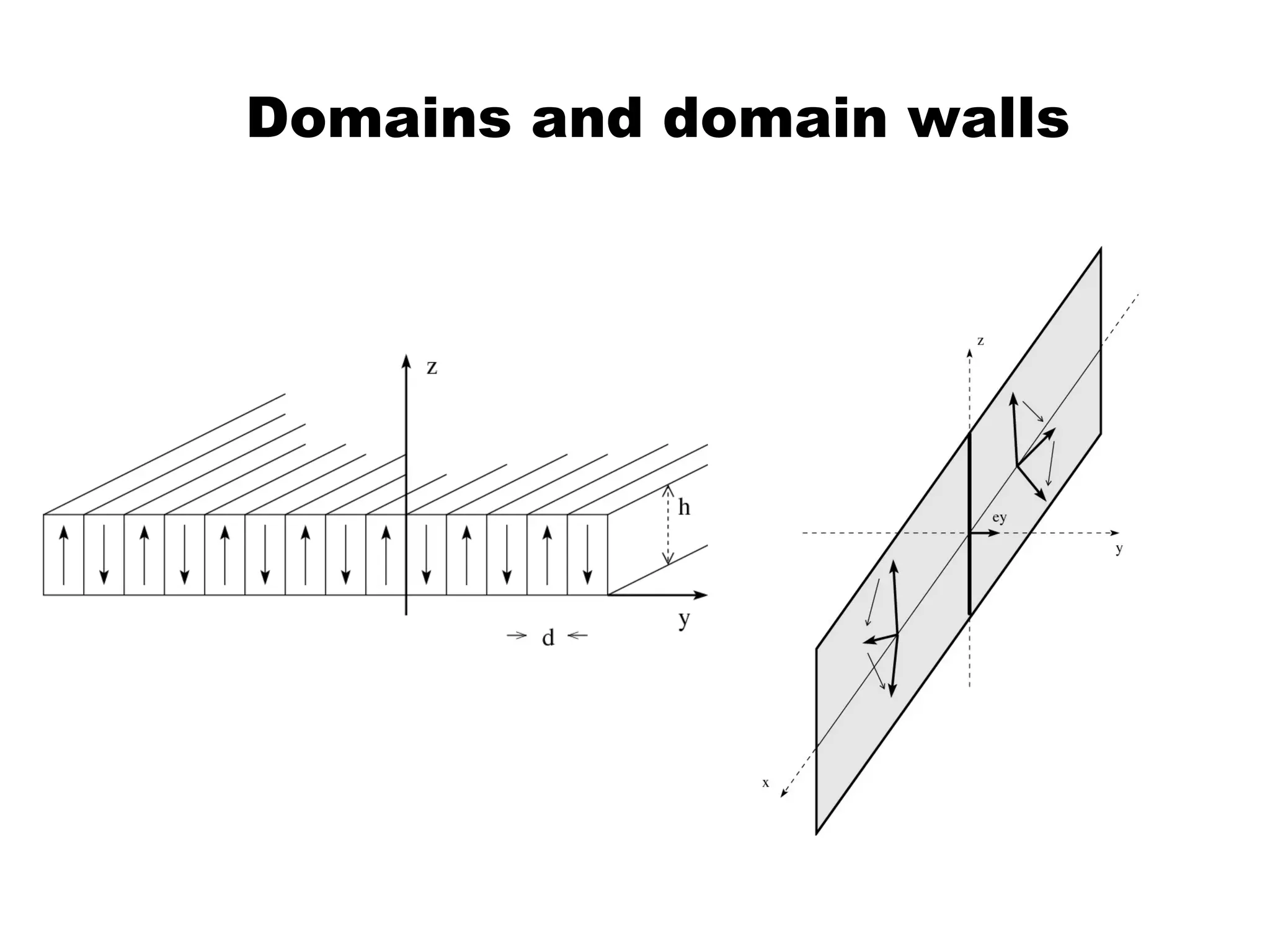
Domains and domain walls
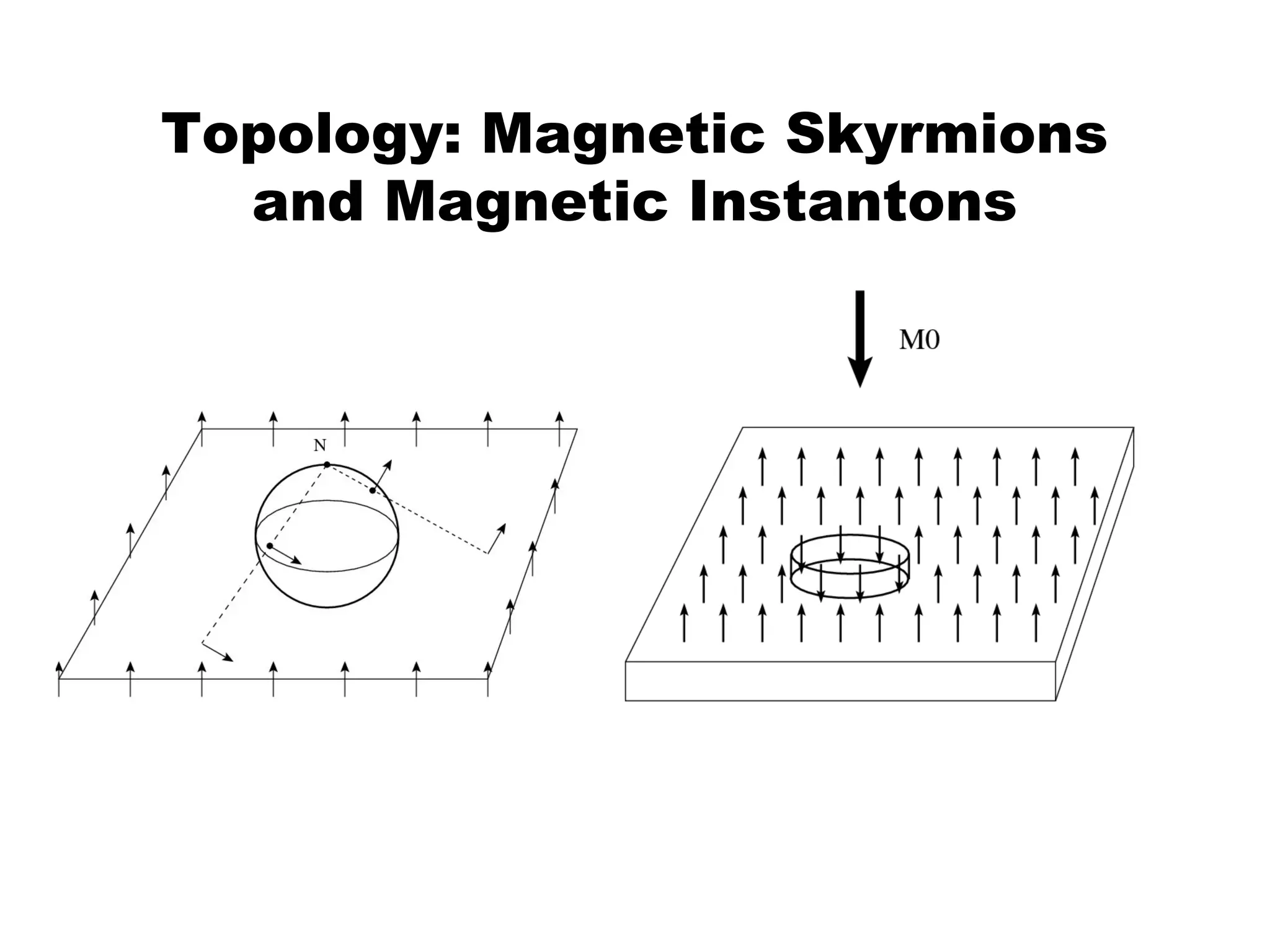
Topology: Magnetic Skyrmions
  and Magnetic Instantons
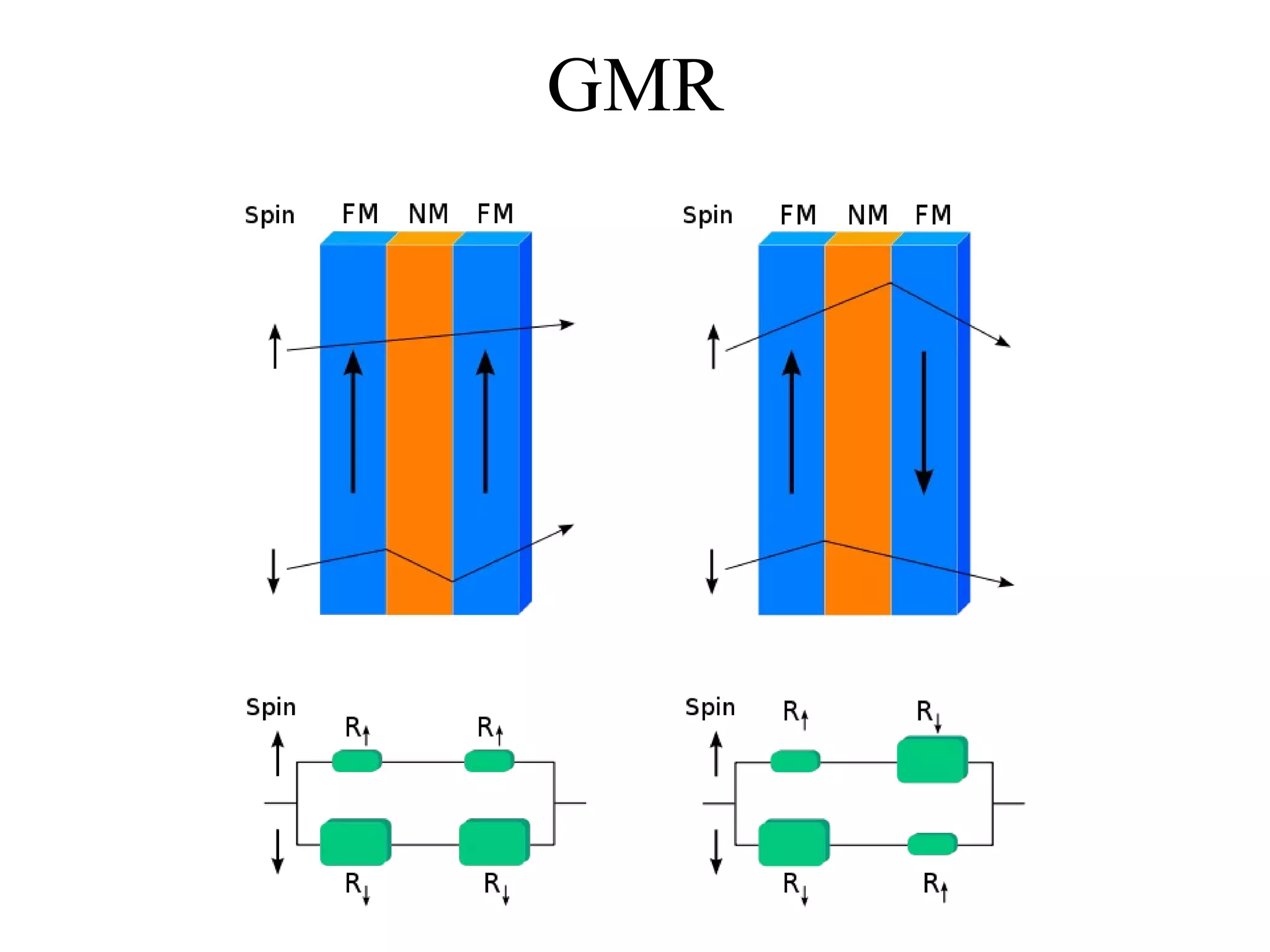
GMR

Nanomagnetism, Javier Tejada

  • 1.
    NANOMAGNETISM Javier Tejada University of Barcelona
  • 2.
    Earth Magnetic Magnetotactic Field Bacterium
  • 3.
    Einstein – deHaas Effect - 1915    J = L + S = const Change in the magnetic moment of a freely suspended body causes mechanical rotation necessary to conserve the total angular momentum
  • 4.
    Einstein in aletter to a student, May 31,1915, (quoted by K. Selig): “Any boy could do the work on magnetism, but the general theory of relativity is quite a different matter.” Einstein - de Haas (Berlin, 1916) : M mech = λM magn = −1.11×10 −7 (1 ± 0.1) M magn 2mc = −1.13 ×10 −7 e Correct result (1920s) : mc M mech = M magn = −0.57 × 10 −7 (1 ± 0.1) M magn e
  • 5.
    Exchange interaction − − S =0 S =1 + Hydrogen molecule +  ˆ 2 ˆ p12 + p2 1 qi q j   ˆ = Η + ∑   ˆ ˆ ˆ Dirac (1926) : Η eff = − Js1 ⋅ s2 2me 2 ij 4πε 0 | ri − rj | ˆ = − 1 ∑J s ⋅s Heisenberg (1926) : Η   ˆ ˆ ij i j 2 〈i≠ j〉 ferromagnetism antiferromagnetism ferrimagnetism
  • 6.
     ˆ ˆ ˆ = J ∑S S H i k ik J > 0 (AFM) Classical spins : Energy = - JS N 2 Transition from vectors to vector matrices : Quantum spins - solution is known only in 1D and   ˆ only for S = 1 / 2 (S = σ / 2) Bethe - 1932 : 2 1 Energy = - J  N (1 + 4 ln 2 − 2) 2
  • 7.
    Magnetic Anisotropy     B =v×E E ˆ   ˆ  Η local = − ge µB s ⋅ B v ˆ Η A = bαβ sα sβ + cαβγδ sα sβ sγ sδ + ... 2 4 v v bαβ ∝   , cαβγδ ∝  , ... c c Uniaxial : ˆ Η A = − DS z2 Biaxial : ˆ Η A = − DS z2 + E ( S x2 − S y ) 2 Cubic : ˆ [ ] Η A = C {S x2 , S y } + {S x2 , S z2 } + {S y , S z2 } 2 2
  • 9.
    Small particles Eex ~TC ~ 600 K K~10 4 − 2 ⋅106 erg/cm 3 Distribution of sizes
  • 10.
    Superparamagnetism  M single - domain  H magnetic particle 3nm Cobalt H y / 2 + H z3 / 2 = H A/ 2 3 3 M ⇒ H Array of particles in a solid
  • 11.
    FC and ZFCMagnetization Curves
  • 12.
    Free Rotors –Rotational Doppler Effect ω ' = ω ± Ω, Ω = L/I Is quantization of L detectable?
  • 13.
    Free Rotors -Experiment (Tejada et al., 2010)
  • 14.
    Quantum Steps inthe Microwave Absorption
  • 15.
    Magnetic bistability ofMn12 acetate : [Mn12 O12 (CH 3COO)16 (H 2 O) 4 ] ⋅ 2CH 3COOH ⋅ 4H 2 O 1.73 nm S = 10 1.73 nm ˆ ˆ ˆ Η = − DS z2 + Η ⊥ 1.24 nm ˆ [Η ⊥ , S z ] ≠ 0 Mn12 acetate crystal
  • 16.
    ↓ 0 = 1 ( 2 ↑ + ↓ ,) 1 = 1 2 ( ↑ −↓ e ) −i∆t /  Ψ (t ) = 1 ( 0 + 1 ), Ψ (0) = ↑ 2 ∆  Ψ σ z Ψ = cos t   
  • 17.
    Quantum Magnetization Curve J.Friedman, M. Sarachik, J. Tejada, R. Ziolo (PRL - 1996)
  • 18.
    EC and JavierTejada (Barcelona – Spain)
  • 19.
    Milestone 22   (1996) Mesoscopic tunnelling of magnetization Karl Ziemelis, Chief Editor Physical Sciences, Nature 28 February 2008 | doi:10.1038/nphys877
  • 20.
    Resonant spin tunnelingin Mn12 acetate ˆ ˆ ˆ Η = Η0 + Η⊥ ˆ Η 0 = − DS z2 − gµ B S z ⋅ Bz E Em = − Dm − gµ B mBz 2 Sz Em = Em′ : Bz = k ( D / gµ B ) k = −m − m′ = 0,±1,±2,...
  • 21.
    Landau - Zenereffect m′ m m m′ m′ m m m′ W ≡ Ε m − Ε m′ m m′ W = vt Ε + − Ε − = W 2 + ∆2 Transition probability :  π∆2  P = 1 − exp −  2v    
  • 22.
    Interference of tunnelingtrajectories in Fe8 Bz  S  S ˆ Η = − DS x2 + aS z2 − gµ B S z Bz
  • 23.
    k =2 ∆10 k =1 k =0 Bz 1 140 mT/s 14 mT/s 0.5 2.8 mT/s sample S 0 T=40 mK M/M B -0.5 array of SQUIDs -1 0 0.25 0.5 0.75 1 1.25 µ 0 H(T)
  • 24.
    Mn12 m = 1to m = 2 transition: f = 0.08 THz m = 9 to m = 10 transition: f = 0.35 THz
  • 25.
    Experiment: J. Tejada,E. M. Chudnovsky, J.-M. Hernandez, R. Amigo (2003)
  • 27.
  • 28.
  • 29.
    1/ 2 κ   U ( B)  v=  τ  exp −   0  2 k BT f   
  • 30.
    Quantum Magnetic Deflagration [Tejada et al - 2005]
  • 31.
     with 128 Problems Lectures on Magnetism Lectures on Magnetism Lectures on Magnetism with 128 Problems (with 128 Problems) This book is intended as a compact one-semester course for graduate and upper-level undergraduate students. It teaches basic language and ideas that are used by researchers working in the field of Eugene M. Chudnovsky magnetism of solids. In selecting the material the preference has been given to simple mathematically rigorous models that explain Javier Tejada magnetic phenomena qualitatively. The book consists of three chapters, twenty four sections; each section being accompanied by homework problems. Magnetism at the nanometer scale of individual atoms and molecules is discussed in the first chapter. Magnetic order at the mesoscopic scale of many interacting atoms and itinerant electrons is studied in the second chapter. Magnetism at the macroscopic scale of magnetic domains is considered in the third chapter. The chapters are connected through demonstration of the fact that same magnetic phenomena can be looked at from different angles and described by models that use different techniques. The book should be useful for students who plan to work in condensed matter physics and material science. It can also be of interest to J. Tejada M E. M. Chudnovsky students specializing in other fields because many ideas and methods initially developed to describe magnetism of solids subsequently entered other areas of physics. Visit Rinton Press on the World Wide Web at: http://www.rintonpress.com H  Rinton Press
  • 32.
  • 33.
    Topology: Magnetic Skyrmions and Magnetic Instantons
  • 34.