Detectors
Submitted by: Preeti choudhary
MSc(Applied Physics)
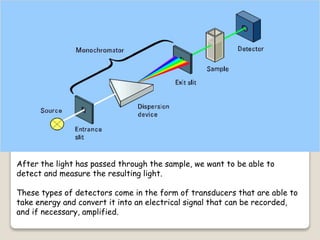
After the light has passed through the sample, we want to be able to
detect and measure the resulting light.
These types of detectors come in the form of transducers that are able to
take energy and convert it into an electrical signal that can be recorded,
and if necessary, amplified.
Types of photo detectors:-
• Vacuum Phototubes
•Photomultiplier Tubes
• Silicon photodiode
• Photovoltaic cells
• Multichannel Photo detectors
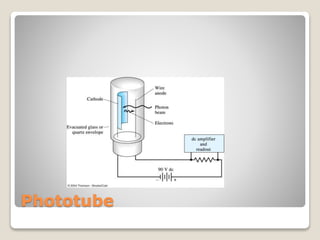
• This detector is a vacuum tube with a cesium-coated
photocathode- photoemissive in nature
•Photons of sufficiently high energy hitting the cathode
can dislodge electrons, which are collected at the wire
anode.
•Photon flux is measured by the current flow in the
system.
Phototube Detector
Phototube
Photomultiplier Tubes
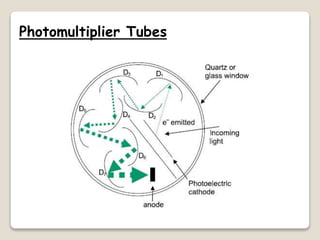
• Photomultiplier tube consists of a cathode, anode a few dynodes.
• Cathode supports a layer of photo emissive material such as an alkali metal
or metal oxide, that tends to emit electrons upon being irradiated.
• The emitted electrons are accelerated toward a dynode maintained at a
potential 90V more positive than the cathode.
• Upon striking the dynode surface, each accelerated photoelectron
produces several additional electron, all of which are then accelerated to
dynode 2, which is 90V more positive than dynode 1.
• Here again amplification occurs.
• By the time this process has been repeated at each of the remaining
dynodes, 10^6 to 10^7 electrons have been produced for each photon.
• This cascade is finally collected to the anode.
• The resulting current is then further amplified electronically and
measured.
Silicon Photodiodes
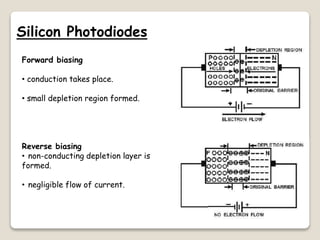
Forward biasing
• conduction takes place.
• small depletion region formed.
Reverse biasing
• non-conducting depletion layer is
formed.
• negligible flow of current.
Silicon photodiode
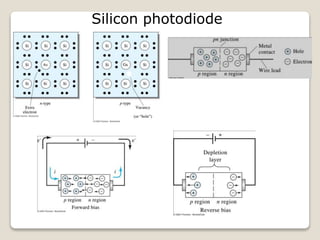
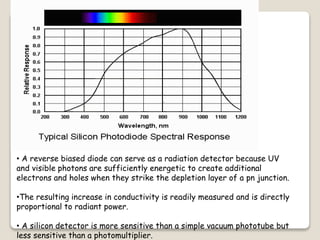
• A reverse biased diode can serve as a radiation detector because UV
and visible photons are sufficiently energetic to create additional
electrons and holes when they strike the depletion layer of a pn junction.
•The resulting increase in conductivity is readily measured and is directly
proportional to radiant power.
• A silicon detector is more sensitive than a simple vacuum phototube but
less sensitive than a photomultiplier.
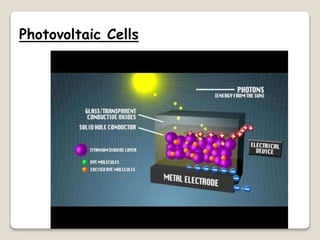
Photovoltaic Cells
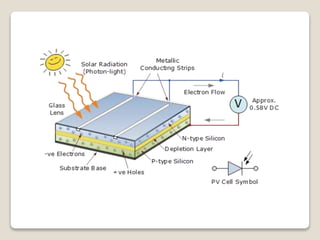
• It consists of a flat copper or iron electrode upon which is
deposited a layer of a semiconducting material (selenium oxide).
• The outer surface of the semiconductor is coated with a thin
transparent film of gold, silver, or lead, which serves as the collector
electrode.
• When radiation is absorbed on the surface of the semiconductor,
electron and holes are formed and migrate in opposite directions,
thus creating a current.
• If the two electrodes are connected with a low resistance circuit,
the current produced is directly proportional to the power of the
incident beam.
• The current can be measured through a simple microammeter.
Advantages:-
•Rugged
•Low cost
•No external power source is required.
Disadvantages:-
•Not as sensitive as other detectors
MULTI CHANNEL PHOTON
DETECTORS
Consists of an array of tiny photosensitive detectors that are arranged in
such a pattern that all elements of a beam of radiation that has been
dispersed by a grating can be measured simultaneously
Three types of such devices-
1. Linear photodiode arrays
2. Vidicons
3. Charge transfer detectors
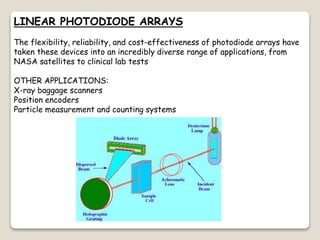
LINEAR PHOTODIODE ARRAYS
The flexibility, reliability, and cost-effectiveness of photodiode arrays have
taken these devices into an incredibly diverse range of applications, from
NASA satellites to clinical lab tests
OTHER APPLICATIONS:
X-ray baggage scanners
Position encoders
Particle measurement and counting systems
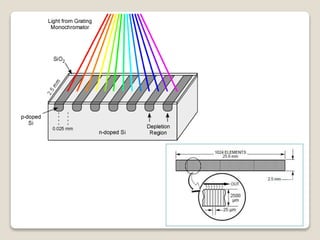
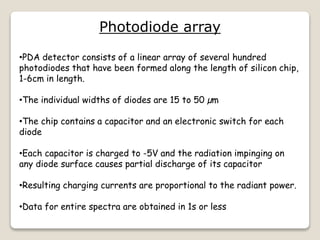
Photodiode array
•PDA detector consists of a linear array of several hundred
photodiodes that have been formed along the length of silicon chip,
1-6cm in length.
•The individual widths of diodes are 15 to 50 µm
•The chip contains a capacitor and an electronic switch for each
diode
•Each capacitor is charged to -5V and the radiation impinging on
any diode surface causes partial discharge of its capacitor
•Resulting charging currents are proportional to the radiant power.
•Data for entire spectra are obtained in 1s or less
ADVANTAGES OF MULTI-
CHANNEL PHOTON DETECTORS
Simultaneous Multi-wavelength measurement
Fast scan speed
High signal to noise ratio
Wavelength precision
Minimal stray light effects
Ruggedness
Thank-you

Detectors

  • 1.
    Detectors Submitted by: Preetichoudhary MSc(Applied Physics)
  • 2.
    After the lighthas passed through the sample, we want to be able to detect and measure the resulting light. These types of detectors come in the form of transducers that are able to take energy and convert it into an electrical signal that can be recorded, and if necessary, amplified.
  • 3.
    Types of photodetectors:- • Vacuum Phototubes •Photomultiplier Tubes • Silicon photodiode • Photovoltaic cells • Multichannel Photo detectors
  • 4.
    • This detectoris a vacuum tube with a cesium-coated photocathode- photoemissive in nature •Photons of sufficiently high energy hitting the cathode can dislodge electrons, which are collected at the wire anode. •Photon flux is measured by the current flow in the system. Phototube Detector
  • 5.
  • 6.
  • 7.
    • Photomultiplier tubeconsists of a cathode, anode a few dynodes. • Cathode supports a layer of photo emissive material such as an alkali metal or metal oxide, that tends to emit electrons upon being irradiated. • The emitted electrons are accelerated toward a dynode maintained at a potential 90V more positive than the cathode. • Upon striking the dynode surface, each accelerated photoelectron produces several additional electron, all of which are then accelerated to dynode 2, which is 90V more positive than dynode 1. • Here again amplification occurs. • By the time this process has been repeated at each of the remaining dynodes, 10^6 to 10^7 electrons have been produced for each photon. • This cascade is finally collected to the anode. • The resulting current is then further amplified electronically and measured.
  • 8.
    Silicon Photodiodes Forward biasing •conduction takes place. • small depletion region formed. Reverse biasing • non-conducting depletion layer is formed. • negligible flow of current.
  • 9.
  • 10.
    • A reversebiased diode can serve as a radiation detector because UV and visible photons are sufficiently energetic to create additional electrons and holes when they strike the depletion layer of a pn junction. •The resulting increase in conductivity is readily measured and is directly proportional to radiant power. • A silicon detector is more sensitive than a simple vacuum phototube but less sensitive than a photomultiplier.
  • 11.
  • 13.
    • It consistsof a flat copper or iron electrode upon which is deposited a layer of a semiconducting material (selenium oxide). • The outer surface of the semiconductor is coated with a thin transparent film of gold, silver, or lead, which serves as the collector electrode. • When radiation is absorbed on the surface of the semiconductor, electron and holes are formed and migrate in opposite directions, thus creating a current. • If the two electrodes are connected with a low resistance circuit, the current produced is directly proportional to the power of the incident beam. • The current can be measured through a simple microammeter.
  • 14.
    Advantages:- •Rugged •Low cost •No externalpower source is required. Disadvantages:- •Not as sensitive as other detectors
  • 15.
    MULTI CHANNEL PHOTON DETECTORS Consistsof an array of tiny photosensitive detectors that are arranged in such a pattern that all elements of a beam of radiation that has been dispersed by a grating can be measured simultaneously Three types of such devices- 1. Linear photodiode arrays 2. Vidicons 3. Charge transfer detectors
  • 16.
    LINEAR PHOTODIODE ARRAYS Theflexibility, reliability, and cost-effectiveness of photodiode arrays have taken these devices into an incredibly diverse range of applications, from NASA satellites to clinical lab tests OTHER APPLICATIONS: X-ray baggage scanners Position encoders Particle measurement and counting systems
  • 18.
    Photodiode array •PDA detectorconsists of a linear array of several hundred photodiodes that have been formed along the length of silicon chip, 1-6cm in length. •The individual widths of diodes are 15 to 50 µm •The chip contains a capacitor and an electronic switch for each diode •Each capacitor is charged to -5V and the radiation impinging on any diode surface causes partial discharge of its capacitor •Resulting charging currents are proportional to the radiant power. •Data for entire spectra are obtained in 1s or less
  • 19.
    ADVANTAGES OF MULTI- CHANNELPHOTON DETECTORS Simultaneous Multi-wavelength measurement Fast scan speed High signal to noise ratio Wavelength precision Minimal stray light effects Ruggedness
  • 20.