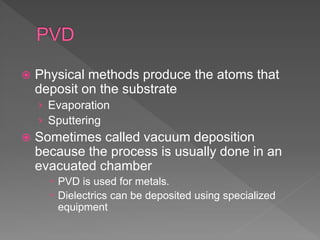
 Physical methods produce the atoms that
deposit on the substrate
› Evaporation
› Sputtering
 Sometimes called vacuum deposition
because the process is usually done in an
evacuated chamber
 PVD is used for metals.
 Dielectrics can be deposited using specialized
equipment
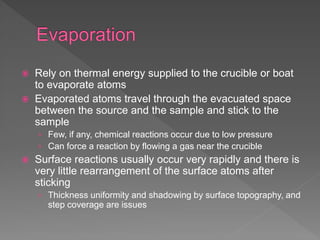
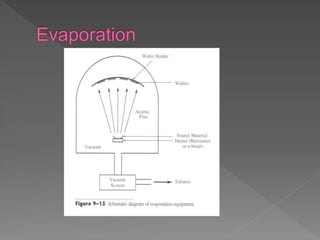
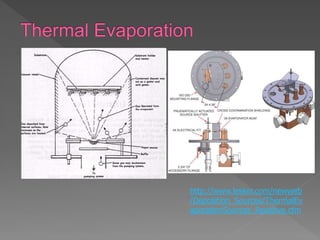
 Rely on thermal energy supplied to the crucible or boat
to evaporate atoms
 Evaporated atoms travel through the evacuated space
between the source and the sample and stick to the
sample
› Few, if any, chemical reactions occur due to low pressure
› Can force a reaction by flowing a gas near the crucible
 Surface reactions usually occur very rapidly and there is
very little rearrangement of the surface atoms after
sticking
› Thickness uniformity and shadowing by surface topography, and
step coverage are issues
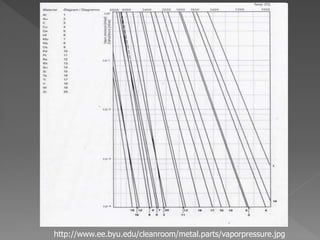
http://www.ee.byu.edu/cleanroom/metal.parts/vaporpressure.jpg
)in torr(
05.0
Law)Gas(Ideal
2
1
2
P
nRTPV
ndo






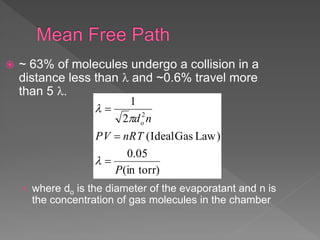
 ~ 63% of molecules undergo a collision in a
distance less than  and ~0.6% travel more
than 5 .
› where do is the diameter of the evaporatant and n is
the concentration of gas molecules in the chamber
 The vacuum is usually < 10-5 torr
› 4x10⁻⁶ torr,  = 18 inches
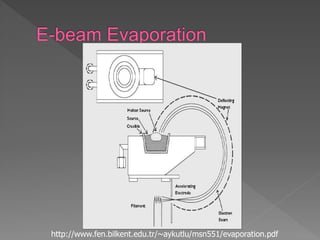
 The source heater can be
› Resistance (W, Mo, Ta filament)
 Contaminants in filament systems are Na or K because they are
used in the production of W
› E-beam (graphite or W crucible)
 E-beam is often cleaner although S is a common contaminant in
graphite
 Top surface of metal is melted during evaporation so there is little
contamination from the crucible
 More materials can be evaporated (high melting-point materials)
 A downside of e-beam is that X-rays are produced when the electron
beam hits the Al melt
 These X-rays can create trapped charges in the gate oxide
 This damage must be removed by annealing
http://www.lesker.com/newweb
/Deposition_Sources/ThermalEv
aporationSources_Resistive.cfm
http://www.fen.bilkent.edu.tr/~aykutlu/msn551/evaporation.pdf
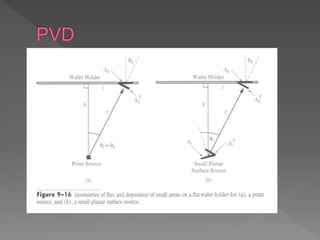
 At sufficiently low pressure and reasonable
distances between source and wafer,
evaporant travel in straight line to the wafer
› Step coverage is close to zero
› If the source is small, we can treat it as a point
source
› If the source emission is isotropic, it is easy to
compute the distribution of atoms at the surface
of the wafer
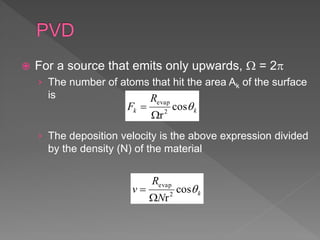
 For a source that emits only upwards,  = 2
› The number of atoms that hit the area Ak of the surface
is
› The deposition velocity is the above expression divided
by the density (N) of the material
kk
R
F cos
r2
evap


k
N
R
v cos
r2
evap


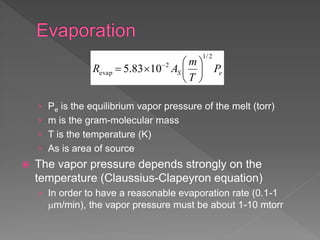
› Pe is the equilibrium vapor pressure of the melt (torr)
› m is the gram-molecular mass
› T is the temperature (K)
› As is area of source
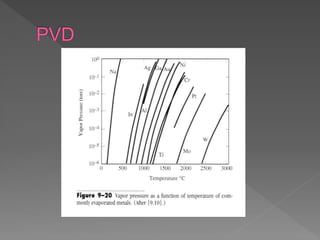
 The vapor pressure depends strongly on the
temperature (Claussius-Clapeyron equation)
› In order to have a reasonable evaporation rate (0.1-1
m/min), the vapor pressure must be about 1-10 mtorr
eS P
T
m
AR
2/1
2
evap 1083.5 





 
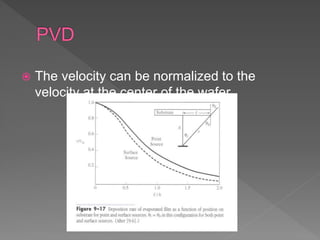
 The velocity can be normalized to the
velocity at the center of the wafer
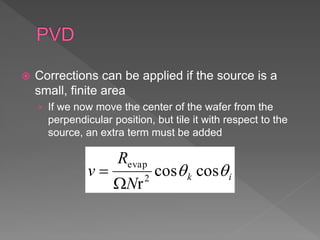
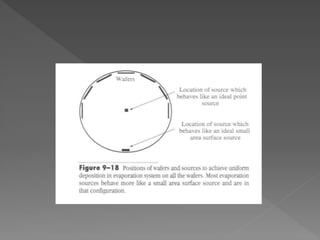
 Corrections can be applied if the source is a
small, finite area
› If we now move the center of the wafer from the
perpendicular position, but tile it with respect to the
source, an extra term must be added
ik
N
R
v  coscos
r2
evap


 Wafer holders that rotate wafer position
during deposition to increase film thickness
uniformity across wafer and from one wafer
to another.
› Wobbling wafer holders increase step coverage
 Nonuniformity of evaporatant can occur
when angular emission of evaporant is
narrower than the ideal source
› Crucible geometry
› Melt depth to melt area ratio
› Density of gas atoms over the surface of the melt
 Evaporating alloys is difficult Because of the
differing vapor pressures.
› Composition of the deposited material may very
different from that of the target material
 The problem can be overcome by
› Using multiple e-beams on multiple sources
 This technique causes difficulties in sample uniformity
because of the spacing of the sources
› Evaporating source to completion (until no material is
left)
 Dangerous to do in e-beam system
 Compounds are also hard to evaporate
because the molecular species may be
different from the compound composition
› Energy provided may be used to dissociate
compound.
› When evaporating SiO2, SiO is deposited.
Evaporation in a reactive environment (flowing
O2 gas near crucible during deposition) helps
reconstitute oxide.
 Advantages
› Little damage to the
wafer
› Deposited films are
usually very pure
› Limited step coverage
 Disadvantages
› Materials with low
vapor pressures ae
very difficult to
evaporated
 Refractory metals
 High temperature
dielectrics
› No in situ precleaning
› Limited step coverage
› Film adhesion can be
problematic
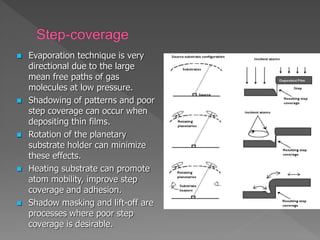
 Evaporation technique is very
directional due to the large
mean free paths of gas
molecules at low pressure.
 Shadowing of patterns and poor
step coverage can occur when
depositing thin films.
 Rotation of the planetary
substrate holder can minimize
these effects.
 Heating substrate can promote
atom mobility, improve step
coverage and adhesion.
 Shadow masking and lift-off are
processes where poor step
coverage is desirable.
 Other deposition techniques include
› Sputter deposition (DC, RF, and reactive)
› Bias sputtering
› Magnetron sputtering
› Collimated and ionized sputter deposition
› Hot sputter deposition
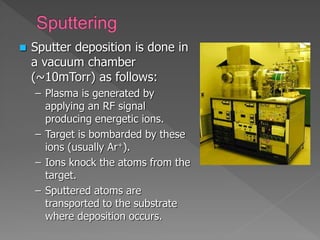
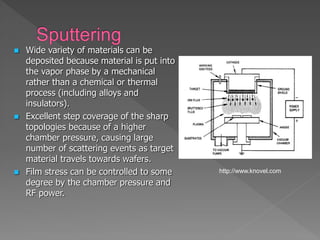
 Sputter deposition is done in
a vacuum chamber
(~10mTorr) as follows:
– Plasma is generated by
applying an RF signal
producing energetic ions.
– Target is bombarded by these
ions (usually Ar+).
– Ions knock the atoms from the
target.
– Sputtered atoms are
transported to the substrate
where deposition occurs.
 Wide variety of materials can be
deposited because material is put into
the vapor phase by a mechanical
rather than a chemical or thermal
process (including alloys and
insulators).
 Excellent step coverage of the sharp
topologies because of a higher
chamber pressure, causing large
number of scattering events as target
material travels towards wafers.
 Film stress can be controlled to some
degree by the chamber pressure and
RF power.
http://www.knovel.com
 Temperature: Room to higher
 Pressure: 100mtorr
› compromise between increasing number of Ar
ions and increasing scattering of Ar ions with
neutral Ar atoms
 Power
› Heating of target material
 Low temperature metals can melt from temperature
rise caused by energy transfer from Ar ions
 Magnetron
› Magnetic field traps freed electron near target
› Move in helical pattern, causing large number of scattering
events with Ar gas – creating high density of ionized Ar
 Ion beam
› Plasma of ions generated away from target and then
accelerated toward start by electric field
 Reactive sputtering
› Gas used in plasma reacts with target material to form compond
that is deposited on wafer
 Ion-assisted deposition
› Wafer is biased so that some Ar ion impact its surface, density
the deposited film. May sputter material off of wafer prior to
deposition for in-situ cleaning.
 Advantages
› Large-size targets, simplifying
the deposition of thins with
uniform thickness over large
wafers
› Film thickness is easily
controlled by fixing the
operating parameters and
simply adjusting the deposition
time
› Control of the alloy
composition, step coverage,
grain structure is easier
obtained through evaporation
› Sputter-cleaning of the
substrate in vacuum prior to
film deposition
› Device damage from X-rays
generated by electron beam
evaporation is avoided.
 Disadvantages
› High capital expenses are
required
› Rates of deposition of some
materials (such as SiO2) are
relatively low
› Some materials such as
organic solids are easily
degraded by ionic
bombardment
› Greater probability to
introduce impurities in the
substrate because the former
operates under a higher
pressure
http://www.research.ibm.com/journal/rd/444/jordansweet.html

Physical Vapour Deposition

  • 2.
     Physical methodsproduce the atoms that deposit on the substrate › Evaporation › Sputtering  Sometimes called vacuum deposition because the process is usually done in an evacuated chamber  PVD is used for metals.  Dielectrics can be deposited using specialized equipment
  • 3.
     Rely onthermal energy supplied to the crucible or boat to evaporate atoms  Evaporated atoms travel through the evacuated space between the source and the sample and stick to the sample › Few, if any, chemical reactions occur due to low pressure › Can force a reaction by flowing a gas near the crucible  Surface reactions usually occur very rapidly and there is very little rearrangement of the surface atoms after sticking › Thickness uniformity and shadowing by surface topography, and step coverage are issues
  • 5.
  • 6.
    )in torr( 05.0 Law)Gas(Ideal 2 1 2 P nRTPV ndo        ~63% of molecules undergo a collision in a distance less than  and ~0.6% travel more than 5 . › where do is the diameter of the evaporatant and n is the concentration of gas molecules in the chamber
  • 7.
     The vacuumis usually < 10-5 torr › 4x10⁻⁶ torr,  = 18 inches  The source heater can be › Resistance (W, Mo, Ta filament)  Contaminants in filament systems are Na or K because they are used in the production of W › E-beam (graphite or W crucible)  E-beam is often cleaner although S is a common contaminant in graphite  Top surface of metal is melted during evaporation so there is little contamination from the crucible  More materials can be evaporated (high melting-point materials)  A downside of e-beam is that X-rays are produced when the electron beam hits the Al melt  These X-rays can create trapped charges in the gate oxide  This damage must be removed by annealing
  • 8.
  • 9.
  • 10.
     At sufficientlylow pressure and reasonable distances between source and wafer, evaporant travel in straight line to the wafer › Step coverage is close to zero › If the source is small, we can treat it as a point source › If the source emission is isotropic, it is easy to compute the distribution of atoms at the surface of the wafer
  • 12.
     For asource that emits only upwards,  = 2 › The number of atoms that hit the area Ak of the surface is › The deposition velocity is the above expression divided by the density (N) of the material kk R F cos r2 evap   k N R v cos r2 evap  
  • 13.
    › Pe isthe equilibrium vapor pressure of the melt (torr) › m is the gram-molecular mass › T is the temperature (K) › As is area of source  The vapor pressure depends strongly on the temperature (Claussius-Clapeyron equation) › In order to have a reasonable evaporation rate (0.1-1 m/min), the vapor pressure must be about 1-10 mtorr eS P T m AR 2/1 2 evap 1083.5        
  • 15.
     The velocitycan be normalized to the velocity at the center of the wafer
  • 16.
     Corrections canbe applied if the source is a small, finite area › If we now move the center of the wafer from the perpendicular position, but tile it with respect to the source, an extra term must be added ik N R v  coscos r2 evap  
  • 18.
     Wafer holdersthat rotate wafer position during deposition to increase film thickness uniformity across wafer and from one wafer to another. › Wobbling wafer holders increase step coverage
  • 19.
     Nonuniformity ofevaporatant can occur when angular emission of evaporant is narrower than the ideal source › Crucible geometry › Melt depth to melt area ratio › Density of gas atoms over the surface of the melt
  • 20.
     Evaporating alloysis difficult Because of the differing vapor pressures. › Composition of the deposited material may very different from that of the target material  The problem can be overcome by › Using multiple e-beams on multiple sources  This technique causes difficulties in sample uniformity because of the spacing of the sources › Evaporating source to completion (until no material is left)  Dangerous to do in e-beam system
  • 21.
     Compounds arealso hard to evaporate because the molecular species may be different from the compound composition › Energy provided may be used to dissociate compound. › When evaporating SiO2, SiO is deposited. Evaporation in a reactive environment (flowing O2 gas near crucible during deposition) helps reconstitute oxide.
  • 22.
     Advantages › Littledamage to the wafer › Deposited films are usually very pure › Limited step coverage  Disadvantages › Materials with low vapor pressures ae very difficult to evaporated  Refractory metals  High temperature dielectrics › No in situ precleaning › Limited step coverage › Film adhesion can be problematic
  • 23.
     Evaporation techniqueis very directional due to the large mean free paths of gas molecules at low pressure.  Shadowing of patterns and poor step coverage can occur when depositing thin films.  Rotation of the planetary substrate holder can minimize these effects.  Heating substrate can promote atom mobility, improve step coverage and adhesion.  Shadow masking and lift-off are processes where poor step coverage is desirable.
  • 24.
     Other depositiontechniques include › Sputter deposition (DC, RF, and reactive) › Bias sputtering › Magnetron sputtering › Collimated and ionized sputter deposition › Hot sputter deposition
  • 25.
     Sputter depositionis done in a vacuum chamber (~10mTorr) as follows: – Plasma is generated by applying an RF signal producing energetic ions. – Target is bombarded by these ions (usually Ar+). – Ions knock the atoms from the target. – Sputtered atoms are transported to the substrate where deposition occurs.
  • 26.
     Wide varietyof materials can be deposited because material is put into the vapor phase by a mechanical rather than a chemical or thermal process (including alloys and insulators).  Excellent step coverage of the sharp topologies because of a higher chamber pressure, causing large number of scattering events as target material travels towards wafers.  Film stress can be controlled to some degree by the chamber pressure and RF power. http://www.knovel.com
  • 27.
     Temperature: Roomto higher  Pressure: 100mtorr › compromise between increasing number of Ar ions and increasing scattering of Ar ions with neutral Ar atoms  Power › Heating of target material  Low temperature metals can melt from temperature rise caused by energy transfer from Ar ions
  • 28.
     Magnetron › Magneticfield traps freed electron near target › Move in helical pattern, causing large number of scattering events with Ar gas – creating high density of ionized Ar  Ion beam › Plasma of ions generated away from target and then accelerated toward start by electric field  Reactive sputtering › Gas used in plasma reacts with target material to form compond that is deposited on wafer  Ion-assisted deposition › Wafer is biased so that some Ar ion impact its surface, density the deposited film. May sputter material off of wafer prior to deposition for in-situ cleaning.
  • 29.
     Advantages › Large-sizetargets, simplifying the deposition of thins with uniform thickness over large wafers › Film thickness is easily controlled by fixing the operating parameters and simply adjusting the deposition time › Control of the alloy composition, step coverage, grain structure is easier obtained through evaporation › Sputter-cleaning of the substrate in vacuum prior to film deposition › Device damage from X-rays generated by electron beam evaporation is avoided.  Disadvantages › High capital expenses are required › Rates of deposition of some materials (such as SiO2) are relatively low › Some materials such as organic solids are easily degraded by ionic bombardment › Greater probability to introduce impurities in the substrate because the former operates under a higher pressure
  • 30.