Column chromatography
Submitted by: Preeti choudhary
MSC(applied physics)
PRINCIPLES OF
CHROMATOGRAPHY
CHROMATOGRAPHY I S T H E
P R O C E S S O F S E P A R A T I N G C O M P O N E N T S I N A M I X T U R E
F R O M O N E A N O T H E R B A S E D O N D I F F E R E N C E I N T H E I R
P R O P E R T I E S .
A C O M M O N F E A T U R E T O A L L C H R O M A T O G R A P H I C
M E T H O D S I S T H E D I S T R I B U T I O N O F T H E C O M P O N E N T S
B E T W E E N T W O P H A S E S , T H E S T A T I O N A R Y P H A S E A N D
T H E M O B I L E P H A S E .
Principles of Chromatography
Chromatography classification
T H E F I R S T D E T A I L E D D E S C R I P T I O N O F
C H R O M A T O G R A P H Y I S C R E D I T E D T O M I C H A E L T S W E T T ,
A R U S S I A N B I O C H E M I S T , W H O S E P A R A T E D
C H L O R O P H Y L L F R O M A M I X T U R E O F P L A N T P I G M E N T S
I N 1 9 0 3 .
H E P L A C E D A S M A L L A M O U N T O F M I X T U R E O N A
C O L U M N P A C K E D W I T H P O W D E R E D C A L C I U M
C A R B O N A T E ( T H E S T A T I O N A R Y P H A S E ) A N D W A S H E D
T H E S A M P L E T H R O U G H W I T H P E T R O L E U M E T H E R ( T H E
M O B I L E P H A S E ) .
Principles of Chromatography
A S T H E S A M P L E P R O G R E S S E D D O W N T H E C O L U M N T H E
V A R I O U S C O M P O N E N T S M O V E D A T D I F F E R E N T R A T E S .
S A M P L E C O M P O N E N T S A R E C A R R I E D B Y T H E M O B I L E
P H A S E T H R O U G H A B E D O F S T A T I O N A R Y P H A S E .
E A C H C O M P O N E N T P R O D U C E D A B A N D T H A T H A D
D I S T I N C T I V E C O L O R . T H U S T H E G R E E K W O R D
C H R O M A T O G R A P H Y F O R C O L O U R A N D T O W R I T E .
A L T H O U G H T H E C O L O R E D B A N D S W E R E P A R T O F T H I S
F I R S T E X P E R I M E N T , C O L O R I S N O T I M P O R T A N T F O R
T H E M E T H O D T O W O R K .
Principles of Chromatography
A + B
B
A B
B
B
A
A
Sample Mobile Phase
INDIVIDUAL SPECIES ARE
RETARDED BY THE
STATIONARY PHASE BASED
ON VARIOUS INTERACTIONS
SUCH AS :
• SURFACE ADSORPTION
• RELATIVE SOLUBILITY
• CHARGE
Principles of Chromatography
Partition/Distribution Coefficient
As the mobile phase bearing the solute enters the
column, the solute distributes itself between
stationary and mobile phase.
This distribution between the 2 phases is described
by the Distribution Coefficient ‘K’, defined as
K = Cs / CM
where Cs & CM refer to the concentrations of the
solute in the stationary and mobile phases.
 IF THE VALUE OF K = 1 THEN THE SOLUTE
IS EQUALLY DISTRIBUTED BETWEEN
STATIONARY AND MOBILE PHASES.
 FOR K < 1, THE SOLUTE TRAVELS FASTER
THROUGH THE COLUMN BECAUSE IT
SPENDS MORE TIME IN MOBILE PHASE.
 FOR K > 1, THE SOLUTE WILL BE
RETAINED IN THE STATIONARY PHASE OR
WILL EXIT THE COLUMN AFTER LONGER
TIME.
DIFFERENT SOLUTES WILL HAVE
DIFFERENT VALUES OF DISTRIBUTION
COEFFICIENTS, SO THEIR MOVEMENT
THROUGH THE COLUMN WILL BE OF
DIFFERENT RATES.
Partition Coefficient
Chromatogram
The detector produces a signal which is
plotted graphically on the chart of an
electronic recorder and is called a
Chromatogram.
A chromatogram gives
 Qualitative information using retention
time of various peaks
 Quantitative data from peak area or peak
height of the components.
Chromatogram - Retention Times
tM = retention time of mobile phase (dead time)
tR = retention time of analyte (solute)
tS = time spent in stationary phase (adjusted retention time)
L = length of the column
Velocities : Linear rate of solute migration
M
R
t
L
t
L
v



Velocity = distance/time  length of column/ retention times
Velocity of solute:
Velocity of mobile phase:
Retention time and volume
Retention time, tR - time required to reach the peak
maximum from the point of injection.
Dead time, tM - time required for the unretained
species to reach the peak maximum from the point
of injection.
Retention volume, VR – volume of mobile phase
required to elute a solute to a maximum from a
column.
.
Velocity Relationships
MS
M
S
MMSS
SSMM
MM
VVK
v
c
c
K
VcVc
v
VcVc
Vc
v
/1
1
ConstantonDistributi
/1
1










Capacity and Selectivity Factors
 Capacity / Retention Factor (kA)– it describes rate of
migration of solute in a column or relative indication
of time spent by solute in a column.
 Selectivity Factor (α) – It provides a measure of how
well a column separates the two analytes
Capacity/Retention Factor
M
MR
A
AMR
A
MSAA
MS
t
tt
k
kt
L
t
L
k
v
VVKk
VVK
v









1
1
1
1
Factor)(Retention/
/1
1


Adjusted retention time
Capacity/Retention Factor
where kA is the capacity factor for solute A.
 Its value should lie between 1 and 5.
 If k is less than unity, accurate determination of its
retention time is difficult.
 If its too large, elution time becomes inordinately
long
Selectivity Factor: can you separate from your
neighbour?
MAR
MBR
M
MBR
B
M
MAR
A
A
B
A
B
tt
tt
t
tt
kand
t
tt
k
k
k
K
K









)(
)(
)()(



B retained more than A   >1
Selectivity factor
 The selectivity factor for two analytes in a column
provides a measure of how well the column will
separate the two.
 α is always greater than unity.
 Greater the selectivity factor, greater will be the
separation between the two components.
Principles of Chromatography
Raising
VS General increase in retention time
VM General decrease in retention time
µ Increases speed of separation.
 VS and VM can be altered by changing column
diameter and length for specific column
packing.
 µ can be altered by changing the flowrate.
 All terms can be found by knowing how the
column was prepared.
All research in this field is aimed towards
maximum separation of components in minimum
time possible or in other words increasing the
efficiency of the column
Measure of column efficiency is given by
number of Theoretical Plates and Height
equivalent to theoretical plates (HETP)
Explained by Plate and Rate Theories
Plate Theory
Plate theory assumes that a column is
mathematically equivalent to a plate column.
An equilibrium is established for the solute
between the mobile and stationary phase on each
plate.
It is a useful theory and can predict many aspects of
chromatographic performance.
Plates of fractionating column
 In a fractioning column
equilibrium is established
between the liquid and
gaseous phase at every
bubble cap plate.
 Likewise it is imagined
that in a chromatographic
column , solute
equilibrium is established
between stationary and
mobile phase at every
imaginary plate
Plate and Rate Theories
s  standard deviation s2/L variance per unit length.
L = length of column packing
L
H
H
L
N
N
H
2
platesofnumber
heightplate
s




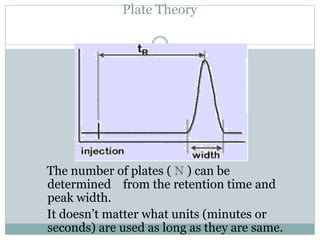
Plate Theory
The number of plates ( N ) can be
determined from the retention time and
peak width.
It doesn’t matter what units (minutes or
seconds) are used as long as they are same.
Determination of N
The number of plates is calculated as:
N = 16 tR
W
This approach is taken because peaks evolve as
Gaussian-like shapes and can be treated
statistically.
In essence, we are taking  2 s or 4 s.
2
Determination of N
• We can measure the
width at half height.
• This insures that we
are well above
background noise
and away from any
detector sensitivity
limit problems.
Determination of N
Since the peak is Gaussian in nature, we end up with the
following modified formula.
N = 5.54 tR
W1/2
For a fixed length column, we can calculate an additional
term – h (or HETP)
h = height equivalent of a theoretical plate
= column length / N
2
2
2/1
2
54.5
16
patesofnumber















W
t
N
W
t
N
N
R
R
Summary of Plate Theory
 Successfully accounts for the peak shapes and rate of
movement
 Does not account for the ‘mechanism’ causing peak
broadening
 No indication of other parameters’ effects
 No indication for adjusting experimental parameters
Band/ Zone broadening
 In this example, we have materials with the same
elution time but different numbers of plates
 Zone broadening is related to Mass Transfer
processes
Band Broadening
Band Broadening is a major problem because it effects the
resolution of solutes that have similar retention time. The
peak width increases with the square root of column
length. Therefore, we just cannot make a column longer
to obtain a ‘better’ separation.
Rate theory
Plate theory neglects the concepts of solute diffusion
and flow paths which lead to band broadening.
Rate theory accounts for these and presumes band
broadening is caused due to:
 Slow equilibrium of solute between mobile and
stationary phases
 Time is required for solute molecules to diffuse from
the interior of these phase to there interface where
transfer occur
Theory of Band Broadening
van Deemter Equation
Theoretical studies of zone broadening in the 1950s
by Dutch chemical engineers led to the van
Deemter equation, which can be written in the
form
H = B + CSu + Cmu
u
where
B – longitudinal diffusion
CS – mass transfer coefficient in mobile phase
CM - mass transfer coefficient in stationary phase
u– velocity of mobile phase
LONGITUDINAL DIFFUSION
Longitudinal diffusion term (B/u) depends
upon diffusion coefficient DM. Solute
continuously diffuses away from the
concentrated center of its zone.
The longer the solute is in the column,
broadening effect increases,
Zone of solute after short time on column
Zone of solute after longer time on column
Direction of travel
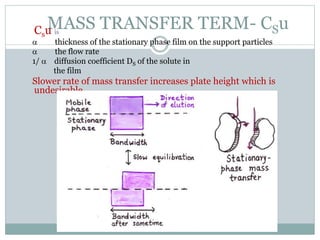
MASS TRANSFER TERM- CSuCsu is
 thickness of the stationary phase film on the support particles
 the flow rate
1/  diffusion coefficient DS of the solute in
the film
Slower rate of mass transfer increases plate height which is
undesirable
MASS TRANSFER TERM CMU
 square of particle diameter of the packing
 square of column diameter
 flow rate
1/  diffusion coefficient of analyte in the
mobile phase DM
Zone broadening or band broadening occurs due to
a) eddy diffusion- different path lengths passed by
solutes
b) diffusion of solute from one stream of mobile phase
to another
c) stagnant or static pools of solvent formed within
stationary phase
Effect of flow rate (µ)
 Broadening effects may be minimized by careful
control of the flow rate.
 Generally, the amount of broadening increases
as the flow rate decreases.
 Broadening  1 / µ
 Sufficient time must be allowed for the solute to
equilibrate between the two phases. For a given
separation there will be some optimum flow rate.
 This optimum flow rate is found
experimentally.
Methods for Reducing Band Broadening
 Small packing diameter (of stationary
phase)
 Small column diameter
 For liquid stationary phase- thickness of
the layer should be minimized
 Optimum flow-rate of mobile phase
 Optimum temperature
 Variation in solvent composition
Packed GLC Column
Open tubular column
Capillary columns
Not much effect from CSu or CMu as there is no
packing and the phase is very thin
Liquid chromatography
• At first, LC relied
on irregular
packing. Now the
packing are pretty
good so the CSu
term is very low.
• The B/u and CMu
terms are low
because liquids
diffuse much more
slowly than gases
Column Resolution
Resolution R, of a column provides a quantitative
measure of its ability to separate two analytes.
Resolution of 1.5 gives almost complete peak
separation
The smaller the HETP or larger the N, the
higher the resolving power of the column.
Resolution
Resolution
R = 2Z = 2[(tR) B  (tR) A]
WA + WB WA + WB
Chromatographic
Separations with a twist
FACTORS FOR INCREASING RESOLUTION
1. Increase column length
2.Decrease column diameter
3.Decrease flow-rate
4.Pack column uniformly
5.Use uniform stationary phase (packing material)
6.Decrease sample size
7.Select proper stationary phase
8.Select proper mobile phase
9.Use proper pressure
10. Use gradient elution
Unsymmetrical bands
Often the actual bands observed are not symmetrical
Gaussian curves but rather show one of following
behaviours.
Careful adjustment of the operational parameters,
especially the size of sample may correct these
problems.
They may also be attributed to poor column packing
or sample injection.
Fronting and Tailing
Chromatogram of Orange Juice Compounds
Thank- you

Column chromatography

  • 1.
    Column chromatography Submitted by:Preeti choudhary MSC(applied physics)
  • 2.
  • 3.
    CHROMATOGRAPHY I ST H E P R O C E S S O F S E P A R A T I N G C O M P O N E N T S I N A M I X T U R E F R O M O N E A N O T H E R B A S E D O N D I F F E R E N C E I N T H E I R P R O P E R T I E S . A C O M M O N F E A T U R E T O A L L C H R O M A T O G R A P H I C M E T H O D S I S T H E D I S T R I B U T I O N O F T H E C O M P O N E N T S B E T W E E N T W O P H A S E S , T H E S T A T I O N A R Y P H A S E A N D T H E M O B I L E P H A S E . Principles of Chromatography
  • 4.
  • 5.
    T H EF I R S T D E T A I L E D D E S C R I P T I O N O F C H R O M A T O G R A P H Y I S C R E D I T E D T O M I C H A E L T S W E T T , A R U S S I A N B I O C H E M I S T , W H O S E P A R A T E D C H L O R O P H Y L L F R O M A M I X T U R E O F P L A N T P I G M E N T S I N 1 9 0 3 . H E P L A C E D A S M A L L A M O U N T O F M I X T U R E O N A C O L U M N P A C K E D W I T H P O W D E R E D C A L C I U M C A R B O N A T E ( T H E S T A T I O N A R Y P H A S E ) A N D W A S H E D T H E S A M P L E T H R O U G H W I T H P E T R O L E U M E T H E R ( T H E M O B I L E P H A S E ) . Principles of Chromatography
  • 6.
    A S TH E S A M P L E P R O G R E S S E D D O W N T H E C O L U M N T H E V A R I O U S C O M P O N E N T S M O V E D A T D I F F E R E N T R A T E S . S A M P L E C O M P O N E N T S A R E C A R R I E D B Y T H E M O B I L E P H A S E T H R O U G H A B E D O F S T A T I O N A R Y P H A S E . E A C H C O M P O N E N T P R O D U C E D A B A N D T H A T H A D D I S T I N C T I V E C O L O R . T H U S T H E G R E E K W O R D C H R O M A T O G R A P H Y F O R C O L O U R A N D T O W R I T E . A L T H O U G H T H E C O L O R E D B A N D S W E R E P A R T O F T H I S F I R S T E X P E R I M E N T , C O L O R I S N O T I M P O R T A N T F O R T H E M E T H O D T O W O R K . Principles of Chromatography
  • 7.
    A + B B AB B B A A Sample Mobile Phase
  • 8.
    INDIVIDUAL SPECIES ARE RETARDEDBY THE STATIONARY PHASE BASED ON VARIOUS INTERACTIONS SUCH AS : • SURFACE ADSORPTION • RELATIVE SOLUBILITY • CHARGE Principles of Chromatography
  • 9.
    Partition/Distribution Coefficient As themobile phase bearing the solute enters the column, the solute distributes itself between stationary and mobile phase. This distribution between the 2 phases is described by the Distribution Coefficient ‘K’, defined as K = Cs / CM where Cs & CM refer to the concentrations of the solute in the stationary and mobile phases.
  • 10.
     IF THEVALUE OF K = 1 THEN THE SOLUTE IS EQUALLY DISTRIBUTED BETWEEN STATIONARY AND MOBILE PHASES.  FOR K < 1, THE SOLUTE TRAVELS FASTER THROUGH THE COLUMN BECAUSE IT SPENDS MORE TIME IN MOBILE PHASE.  FOR K > 1, THE SOLUTE WILL BE RETAINED IN THE STATIONARY PHASE OR WILL EXIT THE COLUMN AFTER LONGER TIME. DIFFERENT SOLUTES WILL HAVE DIFFERENT VALUES OF DISTRIBUTION COEFFICIENTS, SO THEIR MOVEMENT THROUGH THE COLUMN WILL BE OF DIFFERENT RATES. Partition Coefficient
  • 11.
    Chromatogram The detector producesa signal which is plotted graphically on the chart of an electronic recorder and is called a Chromatogram. A chromatogram gives  Qualitative information using retention time of various peaks  Quantitative data from peak area or peak height of the components.
  • 12.
    Chromatogram - RetentionTimes tM = retention time of mobile phase (dead time) tR = retention time of analyte (solute) tS = time spent in stationary phase (adjusted retention time) L = length of the column
  • 13.
    Velocities : Linearrate of solute migration M R t L t L v    Velocity = distance/time  length of column/ retention times Velocity of solute: Velocity of mobile phase:
  • 14.
    Retention time andvolume Retention time, tR - time required to reach the peak maximum from the point of injection. Dead time, tM - time required for the unretained species to reach the peak maximum from the point of injection. Retention volume, VR – volume of mobile phase required to elute a solute to a maximum from a column. .
  • 15.
  • 16.
    Capacity and SelectivityFactors  Capacity / Retention Factor (kA)– it describes rate of migration of solute in a column or relative indication of time spent by solute in a column.  Selectivity Factor (α) – It provides a measure of how well a column separates the two analytes
  • 17.
  • 18.
    Capacity/Retention Factor where kAis the capacity factor for solute A.  Its value should lie between 1 and 5.  If k is less than unity, accurate determination of its retention time is difficult.  If its too large, elution time becomes inordinately long
  • 19.
    Selectivity Factor: canyou separate from your neighbour? MAR MBR M MBR B M MAR A A B A B tt tt t tt kand t tt k k k K K          )( )( )()(    B retained more than A   >1
  • 20.
    Selectivity factor  Theselectivity factor for two analytes in a column provides a measure of how well the column will separate the two.  α is always greater than unity.  Greater the selectivity factor, greater will be the separation between the two components.
  • 21.
    Principles of Chromatography Raising VSGeneral increase in retention time VM General decrease in retention time µ Increases speed of separation.  VS and VM can be altered by changing column diameter and length for specific column packing.  µ can be altered by changing the flowrate.  All terms can be found by knowing how the column was prepared.
  • 22.
    All research inthis field is aimed towards maximum separation of components in minimum time possible or in other words increasing the efficiency of the column Measure of column efficiency is given by number of Theoretical Plates and Height equivalent to theoretical plates (HETP) Explained by Plate and Rate Theories
  • 23.
    Plate Theory Plate theoryassumes that a column is mathematically equivalent to a plate column. An equilibrium is established for the solute between the mobile and stationary phase on each plate. It is a useful theory and can predict many aspects of chromatographic performance.
  • 24.
    Plates of fractionatingcolumn  In a fractioning column equilibrium is established between the liquid and gaseous phase at every bubble cap plate.  Likewise it is imagined that in a chromatographic column , solute equilibrium is established between stationary and mobile phase at every imaginary plate
  • 25.
    Plate and RateTheories s  standard deviation s2/L variance per unit length. L = length of column packing L H H L N N H 2 platesofnumber heightplate s    
  • 26.
    Plate Theory The numberof plates ( N ) can be determined from the retention time and peak width. It doesn’t matter what units (minutes or seconds) are used as long as they are same.
  • 27.
    Determination of N Thenumber of plates is calculated as: N = 16 tR W This approach is taken because peaks evolve as Gaussian-like shapes and can be treated statistically. In essence, we are taking  2 s or 4 s. 2
  • 28.
    Determination of N •We can measure the width at half height. • This insures that we are well above background noise and away from any detector sensitivity limit problems.
  • 29.
    Determination of N Sincethe peak is Gaussian in nature, we end up with the following modified formula. N = 5.54 tR W1/2 For a fixed length column, we can calculate an additional term – h (or HETP) h = height equivalent of a theoretical plate = column length / N 2
  • 30.
  • 31.
    Summary of PlateTheory  Successfully accounts for the peak shapes and rate of movement  Does not account for the ‘mechanism’ causing peak broadening  No indication of other parameters’ effects  No indication for adjusting experimental parameters
  • 32.
    Band/ Zone broadening In this example, we have materials with the same elution time but different numbers of plates  Zone broadening is related to Mass Transfer processes
  • 33.
    Band Broadening Band Broadeningis a major problem because it effects the resolution of solutes that have similar retention time. The peak width increases with the square root of column length. Therefore, we just cannot make a column longer to obtain a ‘better’ separation.
  • 34.
    Rate theory Plate theoryneglects the concepts of solute diffusion and flow paths which lead to band broadening. Rate theory accounts for these and presumes band broadening is caused due to:  Slow equilibrium of solute between mobile and stationary phases  Time is required for solute molecules to diffuse from the interior of these phase to there interface where transfer occur
  • 35.
    Theory of BandBroadening van Deemter Equation Theoretical studies of zone broadening in the 1950s by Dutch chemical engineers led to the van Deemter equation, which can be written in the form H = B + CSu + Cmu u where B – longitudinal diffusion CS – mass transfer coefficient in mobile phase CM - mass transfer coefficient in stationary phase u– velocity of mobile phase
  • 36.
    LONGITUDINAL DIFFUSION Longitudinal diffusionterm (B/u) depends upon diffusion coefficient DM. Solute continuously diffuses away from the concentrated center of its zone. The longer the solute is in the column, broadening effect increases, Zone of solute after short time on column Zone of solute after longer time on column Direction of travel
  • 37.
    MASS TRANSFER TERM-CSuCsu is  thickness of the stationary phase film on the support particles  the flow rate 1/  diffusion coefficient DS of the solute in the film Slower rate of mass transfer increases plate height which is undesirable
  • 38.
    MASS TRANSFER TERMCMU  square of particle diameter of the packing  square of column diameter  flow rate 1/  diffusion coefficient of analyte in the mobile phase DM Zone broadening or band broadening occurs due to a) eddy diffusion- different path lengths passed by solutes b) diffusion of solute from one stream of mobile phase to another c) stagnant or static pools of solvent formed within stationary phase
  • 40.
    Effect of flowrate (µ)  Broadening effects may be minimized by careful control of the flow rate.  Generally, the amount of broadening increases as the flow rate decreases.  Broadening  1 / µ  Sufficient time must be allowed for the solute to equilibrate between the two phases. For a given separation there will be some optimum flow rate.  This optimum flow rate is found experimentally.
  • 43.
    Methods for ReducingBand Broadening  Small packing diameter (of stationary phase)  Small column diameter  For liquid stationary phase- thickness of the layer should be minimized  Optimum flow-rate of mobile phase  Optimum temperature  Variation in solvent composition
  • 44.
  • 45.
  • 46.
    Capillary columns Not mucheffect from CSu or CMu as there is no packing and the phase is very thin
  • 47.
    Liquid chromatography • Atfirst, LC relied on irregular packing. Now the packing are pretty good so the CSu term is very low. • The B/u and CMu terms are low because liquids diffuse much more slowly than gases
  • 48.
    Column Resolution Resolution R,of a column provides a quantitative measure of its ability to separate two analytes. Resolution of 1.5 gives almost complete peak separation The smaller the HETP or larger the N, the higher the resolving power of the column.
  • 49.
  • 50.
    Resolution R = 2Z= 2[(tR) B  (tR) A] WA + WB WA + WB
  • 51.
  • 52.
    FACTORS FOR INCREASINGRESOLUTION 1. Increase column length 2.Decrease column diameter 3.Decrease flow-rate 4.Pack column uniformly 5.Use uniform stationary phase (packing material) 6.Decrease sample size 7.Select proper stationary phase 8.Select proper mobile phase 9.Use proper pressure 10. Use gradient elution
  • 53.
    Unsymmetrical bands Often theactual bands observed are not symmetrical Gaussian curves but rather show one of following behaviours. Careful adjustment of the operational parameters, especially the size of sample may correct these problems. They may also be attributed to poor column packing or sample injection.
  • 54.
  • 55.
    Chromatogram of OrangeJuice Compounds
  • 56.