12/4//2015
1
UNIT - V
Nanomaterials
Introduction
 Nano means 10-9. ( Nanometer is billionth of a meter)
 Nanomaterials (nanocryatalline materials) are materials possessing sizes on
the order of a billionth of a meter.
(or)
Nanomaterials could be defined as the materials with at least one
of its dimensions in the range of a nano meter.
 All materials are composed of grains, which in turn comprise many
atoms. These grains are usually invisible to the naked eye, depending
on their size.
 Conventional materials have grains varying in size from 100’s of
microns (μm) to millimeters (mm)
12/4//2015
2
Nano Technology
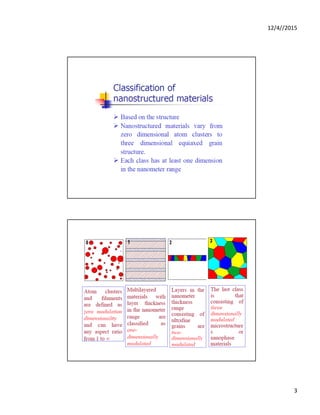
Nanotechnology can be defined as the design,
characterization, production and application
of structures devices and systems by
controlling shape and size at a Nano meter
Scale.
12/4//2015
3
12/4//2015
4
Why Properties of Nano Materials are different ?
The properties of Nano Materials are very much
different from those at a larger scale.
Two principal factors cause the properties of Nano
Materials to differ significantly from other materials.
1.Increase in surface to volume ratio.
2.Quantum confinement effect.
These factors can charge or enhance properties such as
reactivity , strength and electrical characteristics.
Increase in a Surface Area to Volume ratio
Nano Materials have a relatively larger Surface area when
compared to the same volume or mass of the material
produced in a larger form.
Let us consider a Sphere of radius “r”.
Its Surface Area =4πr2.
Its volume= 4/3πr3
Surface Area to Volume Ratio= 3/r.
Thus when the radius of the Sphere decreases , its
Surface to Volume ratio increases.
12/4//2015
5
2
2
6
1
6 m
m
area
surface 


m
1
2
2
12
8
)
2
1
(
6 m
m
area
surface 



m
2
1
12/4//2015
6
2
2
18
27
)
3
1
(
6 m
m
area
surface 



m
3
1
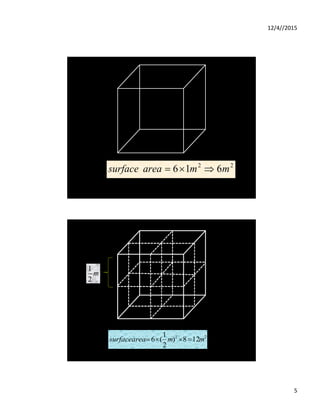
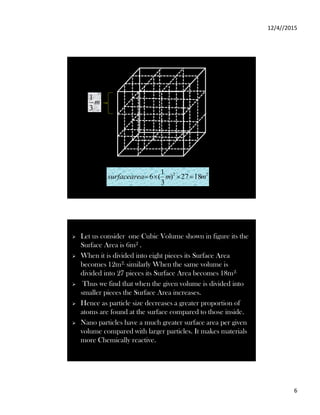
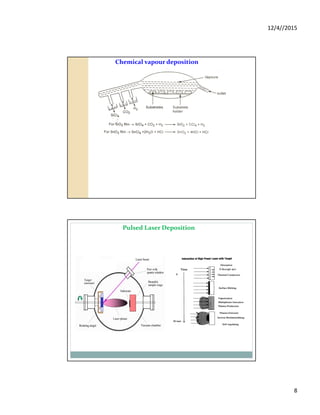
 Let us consider one Cubic Volume shown in figure its the
Surface Area is 6m2 .
 When it is divided into eight pieces its Surface Area
becomes 12m2, similarly When the same volume is
divided into 27 pieces its Surface Area becomes 18m2.
 Thus we find that when the given volume is divided into
smaller pieces the Surface Area increases.
 Hence as particle size decreases a greater proportion of
atoms are found at the surface compared to those inside.
 Nano particles have a much greater surface area per given
volume compared with larger particles. It makes materials
more Chemically reactive.
12/4//2015
7
Synthesis of nanomaterials
Bulk
Powder
Nanoparticles
Top Down method Bottom Up method
Nanoparticles
Clusters
Atoms
Sol-gel technique
Zr[OCH(CH3)]4.(CH3)2COOH Zirconium chloride
TOPO
60oC, Argon Atm.
340oC
Stirring
Cooled 60oC
Zirconia Nanoparticle
Precipitation
Washing
Calcination
800oC
Acetone
12/4//2015
8
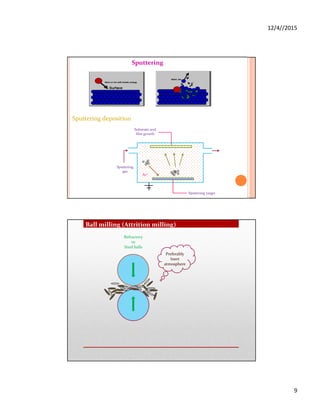
Chemical vapour deposition
Pulsed Laser Deposition
12/4//2015
9
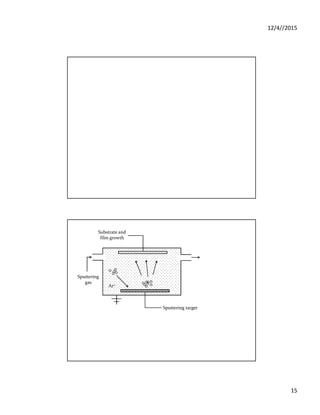
Sputtering
Ar+
Sputtering target
Substrate and
film growth
Sputtering
gas
Sputtering deposition
Refractory
or
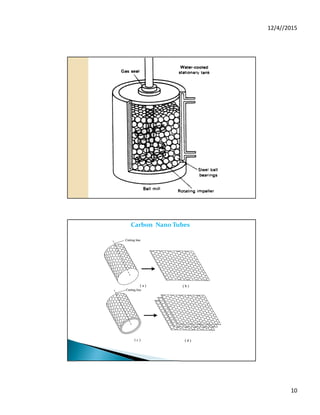
Steel balls
Preferably
Inert
atmosphere
Ball milling (Attrition milling)
12/4//2015
10
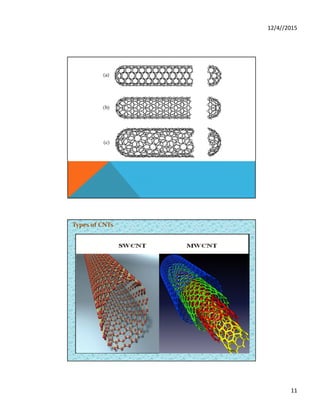
Carbon Nano Tubes
12/4//2015
11
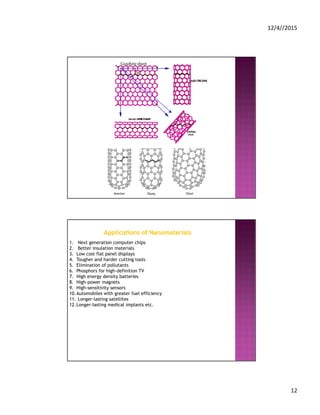
Types of CNTs
12/4//2015
12
30o
Graphite sheet
Applications of Nanomaterials
1. Next generation computer chips
2. Better insulation materials
3. Low cost flat panel displays
4. Tougher and harder cutting tools
5. Elimination of pollutants
6. Phosphors for high-definition TV
7. High energy density batteries
8. High-power magnets
9. High-sensitivity sensors
10.Automobiles with greater fuel efficiency
11. Longer-lasting satellites
12.Longer-lasting medical implants etc.
12/4//2015
13
12/4//2015
14
12/4//2015
15
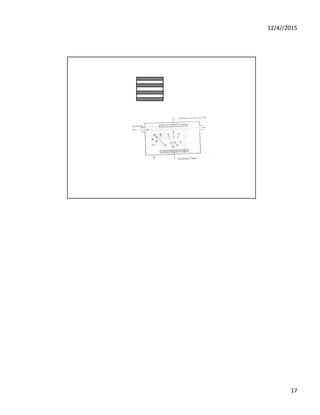
Ar+
Sputtering target
Substrate and
film growth
Sputtering
gas
12/4//2015
16
Sol-gel technique
Zr[OCH(CH3)]4.(CH3)2COOH Zirconium chloride
TOPO
60oC, Argon Atm.
340oC
Stirring
Cooled 60oC
Zirconia Nanoparticle
Precipitation
Washing
Calcination
800oC
Acetone
Refractory
or
Steel balls
Preferably
Inert
atmosphere
12/4//2015
17

Nanomaterials

  • 1.
    12/4//2015 1 UNIT - V Nanomaterials Introduction Nano means 10-9. ( Nanometer is billionth of a meter)  Nanomaterials (nanocryatalline materials) are materials possessing sizes on the order of a billionth of a meter. (or) Nanomaterials could be defined as the materials with at least one of its dimensions in the range of a nano meter.  All materials are composed of grains, which in turn comprise many atoms. These grains are usually invisible to the naked eye, depending on their size.  Conventional materials have grains varying in size from 100’s of microns (μm) to millimeters (mm)
  • 2.
    12/4//2015 2 Nano Technology Nanotechnology canbe defined as the design, characterization, production and application of structures devices and systems by controlling shape and size at a Nano meter Scale.
  • 3.
  • 4.
    12/4//2015 4 Why Properties ofNano Materials are different ? The properties of Nano Materials are very much different from those at a larger scale. Two principal factors cause the properties of Nano Materials to differ significantly from other materials. 1.Increase in surface to volume ratio. 2.Quantum confinement effect. These factors can charge or enhance properties such as reactivity , strength and electrical characteristics. Increase in a Surface Area to Volume ratio Nano Materials have a relatively larger Surface area when compared to the same volume or mass of the material produced in a larger form. Let us consider a Sphere of radius “r”. Its Surface Area =4πr2. Its volume= 4/3πr3 Surface Area to Volume Ratio= 3/r. Thus when the radius of the Sphere decreases , its Surface to Volume ratio increases.
  • 5.
  • 6.
    12/4//2015 6 2 2 18 27 ) 3 1 ( 6 m m area surface     m 3 1 Let us consider one Cubic Volume shown in figure its the Surface Area is 6m2 .  When it is divided into eight pieces its Surface Area becomes 12m2, similarly When the same volume is divided into 27 pieces its Surface Area becomes 18m2.  Thus we find that when the given volume is divided into smaller pieces the Surface Area increases.  Hence as particle size decreases a greater proportion of atoms are found at the surface compared to those inside.  Nano particles have a much greater surface area per given volume compared with larger particles. It makes materials more Chemically reactive.
  • 7.
    12/4//2015 7 Synthesis of nanomaterials Bulk Powder Nanoparticles TopDown method Bottom Up method Nanoparticles Clusters Atoms Sol-gel technique Zr[OCH(CH3)]4.(CH3)2COOH Zirconium chloride TOPO 60oC, Argon Atm. 340oC Stirring Cooled 60oC Zirconia Nanoparticle Precipitation Washing Calcination 800oC Acetone
  • 8.
  • 9.
    12/4//2015 9 Sputtering Ar+ Sputtering target Substrate and filmgrowth Sputtering gas Sputtering deposition Refractory or Steel balls Preferably Inert atmosphere Ball milling (Attrition milling)
  • 10.
  • 11.
  • 12.
    12/4//2015 12 30o Graphite sheet Applications ofNanomaterials 1. Next generation computer chips 2. Better insulation materials 3. Low cost flat panel displays 4. Tougher and harder cutting tools 5. Elimination of pollutants 6. Phosphors for high-definition TV 7. High energy density batteries 8. High-power magnets 9. High-sensitivity sensors 10.Automobiles with greater fuel efficiency 11. Longer-lasting satellites 12.Longer-lasting medical implants etc.
  • 13.
  • 14.
  • 15.
  • 16.
    12/4//2015 16 Sol-gel technique Zr[OCH(CH3)]4.(CH3)2COOH Zirconiumchloride TOPO 60oC, Argon Atm. 340oC Stirring Cooled 60oC Zirconia Nanoparticle Precipitation Washing Calcination 800oC Acetone Refractory or Steel balls Preferably Inert atmosphere
  • 17.