ETE444 :: Lecture 6
 Nano Fabrication
  Dr. Mashiur Rahman
Limitations of Photolithography
Current photolithography techniques used in microelectronics manufacturing
use a projection printing system (known as a stepper). In this system, the
image of the mask is reduced and projected, via a high numerical aperture lens
system, onto a thin film of photoresist that has been spin coated onto a wafer.
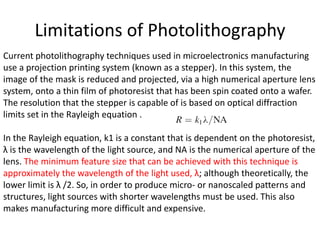
The resolution that the stepper is capable of is based on optical diffraction
limits set in the Rayleigh equation .

In the Rayleigh equation, k1 is a constant that is dependent on the photoresist,
λ is the wavelength of the light source, and NA is the numerical aperture of the
lens. The minimum feature size that can be achieved with this technique is
approximately the wavelength of the light used, λ; although theoretically, the
lower limit is λ /2. So, in order to produce micro- or nanoscaled patterns and
structures, light sources with shorter wavelengths must be used. This also
makes manufacturing more difficult and expensive.
Nano Fabrication
•   Electron Beam Lithography
•   Soft Lithography
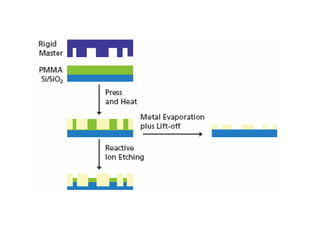
•   Scanned Probe Techniques
•   Self-Assembly and Template
    Manufacturing
Nano Fabrication
•   Electron Beam Lithography
•   Soft Lithography
•   Scanned Probe Techniques
•   Self-Assembly and Template
    Manufacturing
Electron Beam Lithography

 Introduction
 Applications
 Electron Beam Writing tool
 Advantages
 Limitations
Electron Beam Lithography
• Very popular in research environments
• Used for mask making commercially
• Typically, EBL is direct write serial (slow)
  process
• Projection EBL systems have been developed
  – e.g., SCALPEL(SCALPEL = Scattering with Angular
    Limitation Projection Electron-beam Lithography
Applications of Electron Beam Lithography


• Research
  - Nanopatterning on Nanoparticles
  - Nanowires
  - Nanopillars
  - Gratings
  - Micro Ring Resonators
  - Nanofluidic Channels


• Industrial / Commercial
  - Exposure Masks for Optical Lithography
  - Writing features
Examples


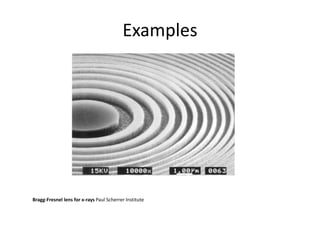
Bragg-Fresnel lens for x-rays Paul Scherrer Institute
• Suspended AuPd wires made by standard e-beam
  lithography and etching techniques. The inset is a blowup
  view of one of the wires. The scale bar is 1 micron.
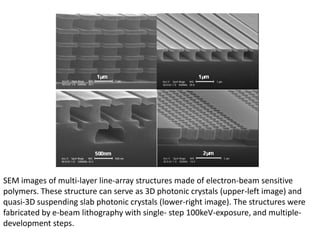
SEM images of multi-layer line-array structures made of electron-beam sensitive
polymers. These structure can serve as 3D photonic crystals (upper-left image) and
quasi-3D suspending slab photonic crystals (lower-right image). The structures were
fabricated by e-beam lithography with single- step 100keV-exposure, and multiple-
development steps.
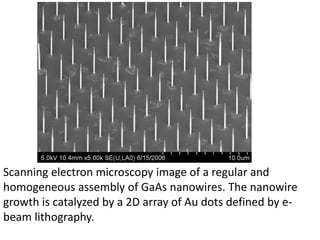
Scanning electron microscopy image of a regular and
homogeneous assembly of GaAs nanowires. The nanowire
growth is catalyzed by a 2D array of Au dots defined by e-
beam lithography.
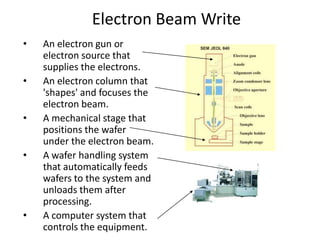
Electron Beam Write
•   An electron gun or
    electron source that
    supplies the electrons.
•   An electron column that
    'shapes' and focuses the
    electron beam.
•   A mechanical stage that
    positions the wafer
    under the electron beam.
•   A wafer handling system
    that automatically feeds
    wafers to the system and
    unloads them after
    processing.
•   A computer system that
    controls the equipment.
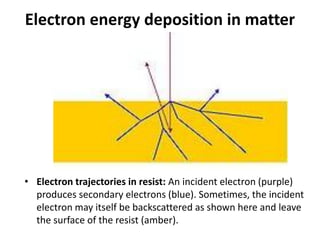
Electron energy deposition in matter


• Electron trajectories in resist: An incident electron (purple)
  produces secondary electrons (blue). Sometimes, the incident
  electron may itself be backscattered as shown here and leave
  the surface of the resist (amber).
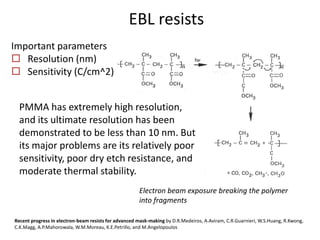
EBL resists
Important parameters
 Resolution (nm)
 Sensitivity (C/cm^2)


  PMMA has extremely high resolution,
  and its ultimate resolution has been
  demonstrated to be less than 10 nm. But
  its major problems are its relatively poor
  sensitivity, poor dry etch resistance, and
  moderate thermal stability.
                                                      Electron beam exposure breaking the polymer
                                                      into fragments

Recent progress in electron-beam resists for advanced mask-making by D.R.Medeiros, A.Aviram, C.R.Guarnieri, W.S.Huang, R.Kwong,
C.K.Magg, A.P.Mahorowala, W.M.Moreau, K.E.Petrillo, and M.Angelopoulos
Advantages

• High resolution
  – down to 5 nm
• Useful design tool
  – direct write allows for quick pattern changes (no
    masks are needed)
Limitation
• Cost (up to $6 –10 million for hardware)
• Direct write has low throughput slow and expensive
   – E-beam lithography is not suitable for high-volume manufacturing
      because of its limited throughput.
   – The serial nature of electron beam writing makes for very slow
      pattern generation compared with a parallel technique like
      photolithography (the current standard) in which the entire surface
      is patterned at once.
   – To pattern a single wafer with an electron beam lithography system
      for sub-100 nm resolution, it would typically take days, compared
      to the few minutes it would take with a photolithography system.
   – Currently an optical maskless lithography tool is much faster than
      an electron beam tool used at the same resolution for photomask
      patterning.
Nano Fabrication
•   Electron Beam Lithography
•   Soft Lithography
•   Scanned Probe Techniques
•   Self-Assembly and Template
    Manufacturing
Soft Lithography
• Introduction
• Nanoimprint Lithography
• Micro contact printing (μCP)
Introduction
Soft lithography is called ‘‘soft’’ because an elastomeric stamp
or mold is the part that transfers patterns to the substrate
and this method uses flexible organic molecules and materials
rather than the rigid inorganic materials commonly used
during the fabrication of microelectronic systems.

This process, developed by George Whitesides, does not
depend on a resist layer to transfer a pattern onto the
substrate. Soft lithography can produce micropatterns of self-
assembled monolayers (SAMs) through contact printing or
form microstructures in materials through imprinting
(embossing) or replica molding.
Nanoimprint lithography (NIL)
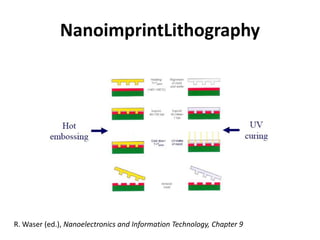
• Nanoimprint lithography (NIL) has primarily been used to emboss
  hard thermoplastic polymers. The micromolding and embossing of
  elastomers has attracted considerable interest as these materials
  have found important applications in softlithographic techniques
  such as microcontact printing (µCP).
• In this technique, a monolayer of a material is printed off an
  elastomeric stamp [made of poly(dimethylsiloxane) (PDMS)] after
  forming conformal contact between stamp and substrate. Sub-
  micron surface relief structures can easily be introduced in PDMS by
  curing the polymers against a lithographically prepared master.
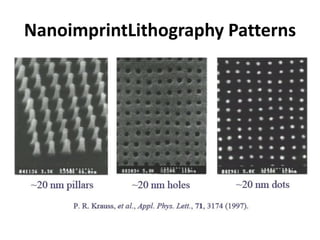
• Feature sizes in the 10–100 nm size range.
• After imprinting the polymer film, further etching can transfer the
  pattern into the underlying substrate. Alternatively, metal
  evaporation and lift-off of the polymer mask produces nanopattern
  metal features.
Advantages
• Nanoimprint lithography (NIL) has the potential of
  high-throughput due to the parallel processing, does
  not require sophisticated tools, and allows nanoscale
  replication for data storage.
• NIL is also compatible with conventional device
  processing techniques. The quality of the
  nanoimprinting process depends on a number of
  experimental parameters like T, viscosity in the melt,
  adhesion of the polymer to the mold, etc.
NanoimprintLithography


R. Waser (ed.), Nanoelectronics and Information Technology, Chapter 9
NanoimprintLithography Patterns
Micro contact printing (μCP)
• Micro contact printing (or μCP) uses the relief
  patterns on a PDMS stamp to form patterns of
  self-assembled monolayers (SAMs) of inks on the
  surface of a substrate through conformal contact.
  Micro contact printing differs from other printing
  methods, like inkjet printing or 3D printing, in the
  use of self-assembly (especially, the use of SAMs)
  to form micro patterns and microstructures of
  various materials.
• The advantage of µCP is the ability to pattern
  surfaces chemically at the sub-micron level.
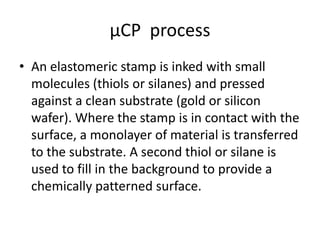
μCP process
• An elastomeric stamp is inked with small
  molecules (thiols or silanes) and pressed
  against a clean substrate (gold or silicon
  wafer). Where the stamp is in contact with the
  surface, a monolayer of material is transferred
  to the substrate. A second thiol or silane is
  used to fill in the background to provide a
  chemically patterned surface.
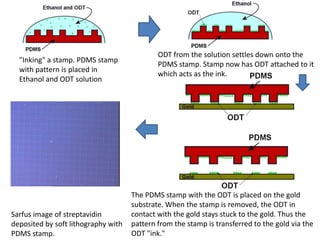
ODT from the solution settles down onto the
  "Inking" a stamp. PDMS stamp
                                             PDMS stamp. Stamp now has ODT attached to it
  with pattern is placed in
                                             which acts as the ink.
  Ethanol and ODT solution


                                     The PDMS stamp with the ODT is placed on the gold
                                     substrate. When the stamp is removed, the ODT in
Sarfus image of streptavidin         contact with the gold stays stuck to the gold. Thus the
deposited by soft lithography with   pattern from the stamp is transferred to the gold via the
PDMS stamp.                          ODT "ink."
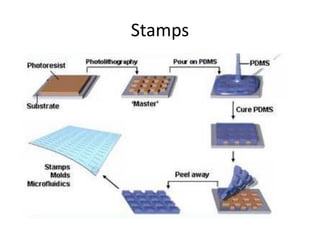
Stamps
Nano Fabrication
•   Electron Beam Lithography
•   Soft Lithography
•   Scanned Probe Techniques
•   Self-Assembly and Template
    Manufacturing
Scanned Probe Techniques
• SPM systems are capable of controlling the
  movement of an atomically sharp tip in close
  proximity to or in contact with a surface with
  subnanometer accuracy.
  – Scanning Probe Induced Oxidation
  – Dip Pen Lithography
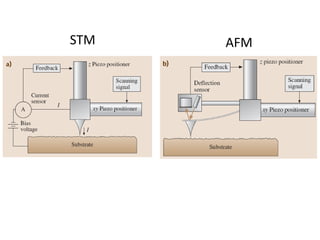
STM   AFM
Local oxidation nanolithography
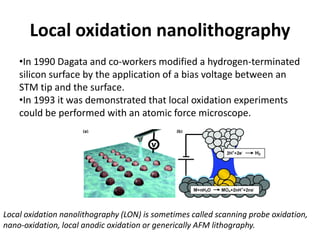
    •In 1990 Dagata and co-workers modified a hydrogen-terminated
    silicon surface by the application of a bias voltage between an
    STM tip and the surface.
    •In 1993 it was demonstrated that local oxidation experiments
    could be performed with an atomic force microscope.


Local oxidation nanolithography (LON) is sometimes called scanning probe oxidation,
nano-oxidation, local anodic oxidation or generically AFM lithography.
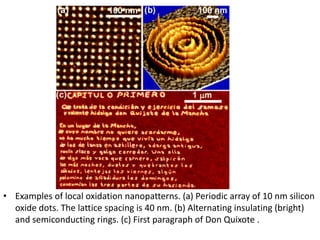
• Examples of local oxidation nanopatterns. (a) Periodic array of 10 nm silicon
  oxide dots. The lattice spacing is 40 nm. (b) Alternating insulating (bright)
  and semiconducting rings. (c) First paragraph of Don Quixote .
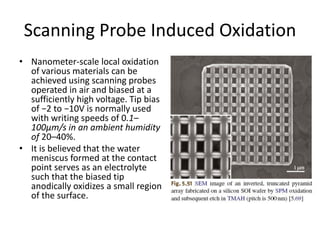
Scanning Probe Induced Oxidation
• Nanometer-scale local oxidation
  of various materials can be
  achieved using scanning probes
  operated in air and biased at a
  sufficiently high voltage. Tip bias
  of −2 to −10V is normally used
  with writing speeds of 0.1–
  100μm/s in an ambient humidity
  of 20–40%.
• It is believed that the water
  meniscus formed at the contact
  point serves as an electrolyte
  such that the biased tip
  anodically oxidizes a small region
  of the surface.
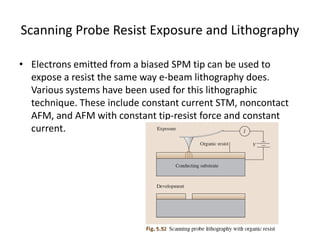
Scanning Probe Resist Exposure and Lithography

• Electrons emitted from a biased SPM tip can be used to
  expose a resist the same way e-beam lithography does.
  Various systems have been used for this lithographic
  technique. These include constant current STM, noncontact
  AFM, and AFM with constant tip-resist force and constant
  current.
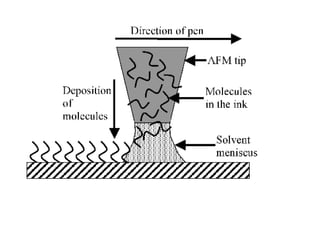
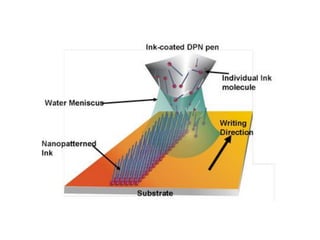
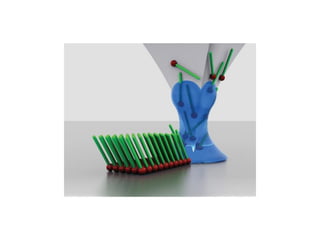
Dip Pen Lithography
• Dip pen lithography is a type of scanning probe
  lithography. In this lithographic technique, the tip
  of an atomic force microscope (AFM) is used to
  create micro- and nanoscaled structures by
  depositing material onto a substrate. The AFMtip
  delivers the molecules to the substrate surface
  using a solvent meniscus that forms in ambient
  atmospheres. Structures with features ranging
  from several hundreds of nanometers to sub-50
  nm can be generated using this technique
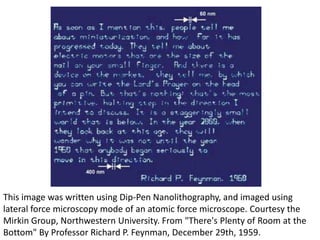
This image was written using Dip-Pen Nanolithography, and imaged using
lateral force microscopy mode of an atomic force microscope. Courtesy the
Mirkin Group, Northwestern University. From "There's Plenty of Room at the
Bottom" By Professor Richard P. Feynman, December 29th, 1959.
Nano Fabrication
•   Electron Beam Lithography
•   Soft Lithography
•   Scanned Probe Techniques
•   Self-Assembly and Template
    Manufacturing
Self-Assembly and Template
            Manufacturing
• Nanopatterning of self-assembled
  monolayers
• Template growth of organic and
  biological structures onto
  nanopatterns
Nanopatterning of self-assembled monolayers

• Self-assembly, chemical functionality and
  nanopatterning are concepts very akin to
  nanotechnology, so it is not surprising to discover
  various approaches to modify self-assembled
  monolayers or to induce a selective self assembly
  process by LON.
• Sugimura and co-workers pioneered the protocol
  to generated coplanar nanostructures consisting
  of two different types of self-assembled
  monolayers (SAM).
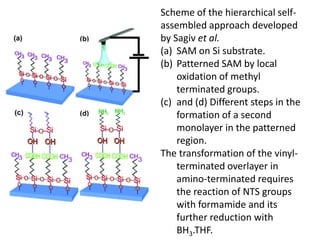
Scheme of the hierarchical self-
assembled approach developed
by Sagiv et al.
(a) SAM on Si substrate.
(b) Patterned SAM by local
    oxidation of methyl
    terminated groups.
(c) and (d) Different steps in the
    formation of a second
    monolayer in the patterned
    region.
The transformation of the vinyl-
    terminated overlayer in
    amino-terminated requires
    the reaction of NTS groups
    with formamide and its
    further reduction with
    BH3.THF.
Template growth of organic and biological
     structures onto nanopatterns
• Developing methods that allow the deposition
  of small functional molecules at pre-
  determined positions on a substrate is one of
  the exciting challenges for alternative
  nanolithographies. In this section we illustrate
  the potential of LON in this topic by describing
  three applications, fabrication of gold patterns
  and nanowires onto SAM templates,
  patterning of proteins (ferritin) and fabrication
  of conjugated molecular tracks and nanowires.
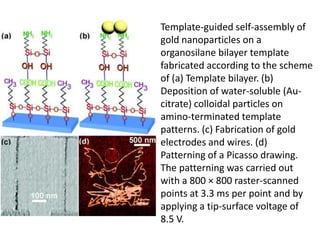
Template-guided self-assembly of
gold nanoparticles on a
organosilane bilayer template
fabricated according to the scheme
of (a) Template bilayer. (b)
Deposition of water-soluble (Au-
citrate) colloidal particles on
amino-terminated template
patterns. (c) Fabrication of gold
electrodes and wires. (d)
Patterning of a Picasso drawing.
The patterning was carried out
with a 800 × 800 raster-scanned
points at 3.3 ms per point and by
applying a tip-surface voltage of
8.5 V.
Thanks
• Questions.
• Quiz will be on the next day: Lec 5 & Lec 6

ETE444-lec6-nanofabrication.pdf

  • 1.
    ETE444 :: Lecture6 Nano Fabrication Dr. Mashiur Rahman
  • 2.
    Limitations of Photolithography Currentphotolithography techniques used in microelectronics manufacturing use a projection printing system (known as a stepper). In this system, the image of the mask is reduced and projected, via a high numerical aperture lens system, onto a thin film of photoresist that has been spin coated onto a wafer. The resolution that the stepper is capable of is based on optical diffraction limits set in the Rayleigh equation . In the Rayleigh equation, k1 is a constant that is dependent on the photoresist, λ is the wavelength of the light source, and NA is the numerical aperture of the lens. The minimum feature size that can be achieved with this technique is approximately the wavelength of the light used, λ; although theoretically, the lower limit is λ /2. So, in order to produce micro- or nanoscaled patterns and structures, light sources with shorter wavelengths must be used. This also makes manufacturing more difficult and expensive.
  • 3.
    Nano Fabrication • Electron Beam Lithography • Soft Lithography • Scanned Probe Techniques • Self-Assembly and Template Manufacturing
  • 4.
    Nano Fabrication • Electron Beam Lithography • Soft Lithography • Scanned Probe Techniques • Self-Assembly and Template Manufacturing
  • 5.
    Electron Beam Lithography Introduction  Applications  Electron Beam Writing tool  Advantages  Limitations
  • 6.
    Electron Beam Lithography •Very popular in research environments • Used for mask making commercially • Typically, EBL is direct write serial (slow) process • Projection EBL systems have been developed – e.g., SCALPEL(SCALPEL = Scattering with Angular Limitation Projection Electron-beam Lithography
  • 7.
    Applications of ElectronBeam Lithography • Research - Nanopatterning on Nanoparticles - Nanowires - Nanopillars - Gratings - Micro Ring Resonators - Nanofluidic Channels • Industrial / Commercial - Exposure Masks for Optical Lithography - Writing features
  • 8.
    Examples Bragg-Fresnel lens forx-rays Paul Scherrer Institute
  • 9.
    • Suspended AuPdwires made by standard e-beam lithography and etching techniques. The inset is a blowup view of one of the wires. The scale bar is 1 micron.
  • 10.
    SEM images ofmulti-layer line-array structures made of electron-beam sensitive polymers. These structure can serve as 3D photonic crystals (upper-left image) and quasi-3D suspending slab photonic crystals (lower-right image). The structures were fabricated by e-beam lithography with single- step 100keV-exposure, and multiple- development steps.
  • 11.
    Scanning electron microscopyimage of a regular and homogeneous assembly of GaAs nanowires. The nanowire growth is catalyzed by a 2D array of Au dots defined by e- beam lithography.
  • 12.
    Electron Beam Write • An electron gun or electron source that supplies the electrons. • An electron column that 'shapes' and focuses the electron beam. • A mechanical stage that positions the wafer under the electron beam. • A wafer handling system that automatically feeds wafers to the system and unloads them after processing. • A computer system that controls the equipment.
  • 13.
    Electron energy depositionin matter • Electron trajectories in resist: An incident electron (purple) produces secondary electrons (blue). Sometimes, the incident electron may itself be backscattered as shown here and leave the surface of the resist (amber).
  • 14.
    EBL resists Important parameters Resolution (nm)  Sensitivity (C/cm^2) PMMA has extremely high resolution, and its ultimate resolution has been demonstrated to be less than 10 nm. But its major problems are its relatively poor sensitivity, poor dry etch resistance, and moderate thermal stability. Electron beam exposure breaking the polymer into fragments Recent progress in electron-beam resists for advanced mask-making by D.R.Medeiros, A.Aviram, C.R.Guarnieri, W.S.Huang, R.Kwong, C.K.Magg, A.P.Mahorowala, W.M.Moreau, K.E.Petrillo, and M.Angelopoulos
  • 15.
    Advantages • High resolution – down to 5 nm • Useful design tool – direct write allows for quick pattern changes (no masks are needed)
  • 16.
    Limitation • Cost (upto $6 –10 million for hardware) • Direct write has low throughput slow and expensive – E-beam lithography is not suitable for high-volume manufacturing because of its limited throughput. – The serial nature of electron beam writing makes for very slow pattern generation compared with a parallel technique like photolithography (the current standard) in which the entire surface is patterned at once. – To pattern a single wafer with an electron beam lithography system for sub-100 nm resolution, it would typically take days, compared to the few minutes it would take with a photolithography system. – Currently an optical maskless lithography tool is much faster than an electron beam tool used at the same resolution for photomask patterning.
  • 17.
    Nano Fabrication • Electron Beam Lithography • Soft Lithography • Scanned Probe Techniques • Self-Assembly and Template Manufacturing
  • 18.
    Soft Lithography • Introduction •Nanoimprint Lithography • Micro contact printing (μCP)
  • 19.
    Introduction Soft lithography iscalled ‘‘soft’’ because an elastomeric stamp or mold is the part that transfers patterns to the substrate and this method uses flexible organic molecules and materials rather than the rigid inorganic materials commonly used during the fabrication of microelectronic systems. This process, developed by George Whitesides, does not depend on a resist layer to transfer a pattern onto the substrate. Soft lithography can produce micropatterns of self- assembled monolayers (SAMs) through contact printing or form microstructures in materials through imprinting (embossing) or replica molding.
  • 20.
    Nanoimprint lithography (NIL) •Nanoimprint lithography (NIL) has primarily been used to emboss hard thermoplastic polymers. The micromolding and embossing of elastomers has attracted considerable interest as these materials have found important applications in softlithographic techniques such as microcontact printing (µCP). • In this technique, a monolayer of a material is printed off an elastomeric stamp [made of poly(dimethylsiloxane) (PDMS)] after forming conformal contact between stamp and substrate. Sub- micron surface relief structures can easily be introduced in PDMS by curing the polymers against a lithographically prepared master. • Feature sizes in the 10–100 nm size range. • After imprinting the polymer film, further etching can transfer the pattern into the underlying substrate. Alternatively, metal evaporation and lift-off of the polymer mask produces nanopattern metal features.
  • 21.
    Advantages • Nanoimprint lithography(NIL) has the potential of high-throughput due to the parallel processing, does not require sophisticated tools, and allows nanoscale replication for data storage. • NIL is also compatible with conventional device processing techniques. The quality of the nanoimprinting process depends on a number of experimental parameters like T, viscosity in the melt, adhesion of the polymer to the mold, etc.
  • 23.
    NanoimprintLithography R. Waser (ed.),Nanoelectronics and Information Technology, Chapter 9
  • 24.
  • 25.
    Micro contact printing(μCP) • Micro contact printing (or μCP) uses the relief patterns on a PDMS stamp to form patterns of self-assembled monolayers (SAMs) of inks on the surface of a substrate through conformal contact. Micro contact printing differs from other printing methods, like inkjet printing or 3D printing, in the use of self-assembly (especially, the use of SAMs) to form micro patterns and microstructures of various materials. • The advantage of µCP is the ability to pattern surfaces chemically at the sub-micron level.
  • 26.
    μCP process • Anelastomeric stamp is inked with small molecules (thiols or silanes) and pressed against a clean substrate (gold or silicon wafer). Where the stamp is in contact with the surface, a monolayer of material is transferred to the substrate. A second thiol or silane is used to fill in the background to provide a chemically patterned surface.
  • 27.
    ODT from thesolution settles down onto the "Inking" a stamp. PDMS stamp PDMS stamp. Stamp now has ODT attached to it with pattern is placed in which acts as the ink. Ethanol and ODT solution The PDMS stamp with the ODT is placed on the gold substrate. When the stamp is removed, the ODT in Sarfus image of streptavidin contact with the gold stays stuck to the gold. Thus the deposited by soft lithography with pattern from the stamp is transferred to the gold via the PDMS stamp. ODT "ink."
  • 28.
  • 29.
    Nano Fabrication • Electron Beam Lithography • Soft Lithography • Scanned Probe Techniques • Self-Assembly and Template Manufacturing
  • 30.
    Scanned Probe Techniques •SPM systems are capable of controlling the movement of an atomically sharp tip in close proximity to or in contact with a surface with subnanometer accuracy. – Scanning Probe Induced Oxidation – Dip Pen Lithography
  • 31.
    STM AFM
  • 32.
    Local oxidation nanolithography •In 1990 Dagata and co-workers modified a hydrogen-terminated silicon surface by the application of a bias voltage between an STM tip and the surface. •In 1993 it was demonstrated that local oxidation experiments could be performed with an atomic force microscope. Local oxidation nanolithography (LON) is sometimes called scanning probe oxidation, nano-oxidation, local anodic oxidation or generically AFM lithography.
  • 33.
    • Examples oflocal oxidation nanopatterns. (a) Periodic array of 10 nm silicon oxide dots. The lattice spacing is 40 nm. (b) Alternating insulating (bright) and semiconducting rings. (c) First paragraph of Don Quixote .
  • 34.
    Scanning Probe InducedOxidation • Nanometer-scale local oxidation of various materials can be achieved using scanning probes operated in air and biased at a sufficiently high voltage. Tip bias of −2 to −10V is normally used with writing speeds of 0.1– 100μm/s in an ambient humidity of 20–40%. • It is believed that the water meniscus formed at the contact point serves as an electrolyte such that the biased tip anodically oxidizes a small region of the surface.
  • 35.
    Scanning Probe ResistExposure and Lithography • Electrons emitted from a biased SPM tip can be used to expose a resist the same way e-beam lithography does. Various systems have been used for this lithographic technique. These include constant current STM, noncontact AFM, and AFM with constant tip-resist force and constant current.
  • 36.
    Dip Pen Lithography •Dip pen lithography is a type of scanning probe lithography. In this lithographic technique, the tip of an atomic force microscope (AFM) is used to create micro- and nanoscaled structures by depositing material onto a substrate. The AFMtip delivers the molecules to the substrate surface using a solvent meniscus that forms in ambient atmospheres. Structures with features ranging from several hundreds of nanometers to sub-50 nm can be generated using this technique
  • 40.
    This image waswritten using Dip-Pen Nanolithography, and imaged using lateral force microscopy mode of an atomic force microscope. Courtesy the Mirkin Group, Northwestern University. From "There's Plenty of Room at the Bottom" By Professor Richard P. Feynman, December 29th, 1959.
  • 41.
    Nano Fabrication • Electron Beam Lithography • Soft Lithography • Scanned Probe Techniques • Self-Assembly and Template Manufacturing
  • 42.
    Self-Assembly and Template Manufacturing • Nanopatterning of self-assembled monolayers • Template growth of organic and biological structures onto nanopatterns
  • 43.
    Nanopatterning of self-assembledmonolayers • Self-assembly, chemical functionality and nanopatterning are concepts very akin to nanotechnology, so it is not surprising to discover various approaches to modify self-assembled monolayers or to induce a selective self assembly process by LON. • Sugimura and co-workers pioneered the protocol to generated coplanar nanostructures consisting of two different types of self-assembled monolayers (SAM).
  • 44.
    Scheme of thehierarchical self- assembled approach developed by Sagiv et al. (a) SAM on Si substrate. (b) Patterned SAM by local oxidation of methyl terminated groups. (c) and (d) Different steps in the formation of a second monolayer in the patterned region. The transformation of the vinyl- terminated overlayer in amino-terminated requires the reaction of NTS groups with formamide and its further reduction with BH3.THF.
  • 45.
    Template growth oforganic and biological structures onto nanopatterns • Developing methods that allow the deposition of small functional molecules at pre- determined positions on a substrate is one of the exciting challenges for alternative nanolithographies. In this section we illustrate the potential of LON in this topic by describing three applications, fabrication of gold patterns and nanowires onto SAM templates, patterning of proteins (ferritin) and fabrication of conjugated molecular tracks and nanowires.
  • 46.
    Template-guided self-assembly of goldnanoparticles on a organosilane bilayer template fabricated according to the scheme of (a) Template bilayer. (b) Deposition of water-soluble (Au- citrate) colloidal particles on amino-terminated template patterns. (c) Fabrication of gold electrodes and wires. (d) Patterning of a Picasso drawing. The patterning was carried out with a 800 × 800 raster-scanned points at 3.3 ms per point and by applying a tip-surface voltage of 8.5 V.
  • 47.
    Thanks • Questions. • Quizwill be on the next day: Lec 5 & Lec 6