HANOI UNIVERSITY OF SCIENCE AND
             TECHNOLOGY
Center for Training of Excellent Students
      Advanced Training Program


ADVANCED LITHOGRAPHY:
      ION-BEAM
   LITHOGRAPHY
                   group:      Hoàng Văn Tiến
                               Nguyễn Đình Trung
                               Phạm Đức Thịnh
                   Class :     MSE-K54
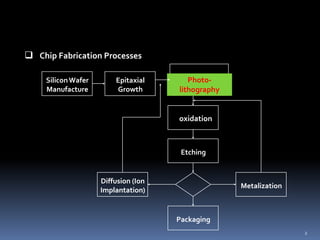
 Chip Fabrication Processes

     Silicon Wafer       Epitaxial       Photo-
     Manufacture         Growth       lithography


                                      oxidation


                                       Etching


                     Diffusion (Ion
                                                    Metalization
                     Implantation)


                                      Packaging
                                                                   2
Ion beam lithography

 Ion beam lithography is the practice of
  scanning a focused beam of ions in a
  patterned fashion across a surface in order to
  create very small structures such
  as integrated circuits or other nanostructures.
 Ion beam (focus ion beam) lithography has
  high potential to play an important role in
  nanometer technology because of the lack of
  backscattered electrons.
Why use Ion beam lithography?

-Ions have heavy mass than electrons
-less proximity effects(due to back scattering)
-less scattering effect
-offers higher resolution patterning than UV, X-ray,
or electron beam lithography because these heavier
particles have more momentum.
- This gives the ion beam a smaller wavelength than even
an e-beam and therefore almost no diffraction.
- The momentum also reduces scattering in the target
and in any residual gas. There is also a reduced potential
radiation effect to sensitive underlying structures
compared to x-ray and e-beam lithography.
•Ion beam sources:
    -Gas source : Hydrogen, hellium,…
    -Metal sources :
        •The most common used source metal is Ga
        •Au/Si and Au/Si/Be alloys have also been used for lithography because
        these sources can supply lighter mass ions
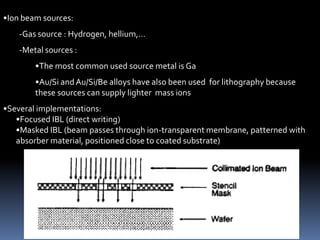
•Several implementations:
   •Focused IBL (direct writing)
   •Masked IBL (beam passes through ion-transparent membrane, patterned with
   absorber material, positioned close to coated substrate)
• -Resists: Polymethylmethacrylate (PMMA) is most
  common, Poly(butene-1-sulfone), Poly(2,2,2-
  trifluoroethyl-α-chloroacrylate)
• Features :
  • Penetration of the particle beam is small, compared to
     electron beam
  • Reduce blurring resulting from beam scattering
     (reduce proximity effect; increase localization,
     precision)
Focus ion beam lithography

 Simple columns:
   Ion source
   Single electrostatic lens
   Electrostatic detectors
  - Two types :
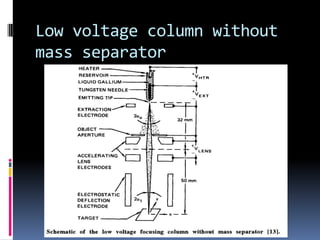
    - Low acceleration voltage (< 50 kV) columns without
    mass separation (designed for applications such as mask repair,
      microcircuit modification, and scanning ion microscopes using a Ga
      LMIS)
    - High acceleration voltage (> 100 kV) columns with mass
      separators.(designed for applications such as ion implantation and
      lithography with an alloy LMIS)
Low voltage column without
mass separator
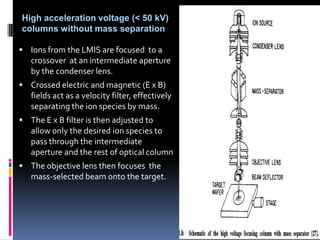
High acceleration voltage (< 50 kV)
columns without mass separation

 Ions from the LMIS are focused to a
   crossover at an intermediate aperture
   by the condenser lens.
 Crossed electric and magnetic (E x B)
   fields act as a velocity filter, effectively
   separating the ion species by mass.
 The E x B filter is then adjusted to
   allow only the desired ion species to
   pass through the intermediate
   aperture and the rest of optical column
 The objective lens then focuses the
   mass-selected beam onto the target.
Ion sources

 Electron bombardment ion source: Electron beam
  is derected onto a gas. Produce low- energy beams of noble gas ions
  ( Ar+,He+…)

 Gas discharge ion source: ion are created by plasma or
  by electric discharge . Used in high energy accelerators and ion
  implanters for semiconductor manufacture.

 Field ionazation source : operate by desorption of ions
  from a sharp tip in a strong electric field .

 Liquid metal ion source : operate by desorption of
  metal ions from liquid metal under a strong electrical field
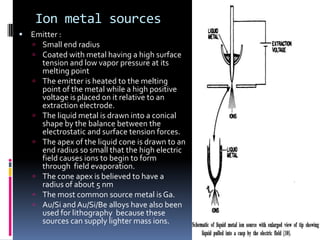
Ion metal sources
   Emitter :
     Small end radius
     Coated with metal having a high surface
      tension and low vapor pressure at its
      melting point
     The emitter is heated to the melting
      point of the metal while a high positive
      voltage is placed on it relative to an
      extraction electrode.
     The liquid metal is drawn into a conical
      shape by the balance between the
      electrostatic and surface tension forces.
     The apex of the liquid cone is drawn to an
      end radius so small that the high electric
      field causes ions to begin to form
      through field evaporation.
     The cone apex is believed to have a
      radius of about 5 nm
     The most common source metal is Ga.
     Au/Si and Au/Si/Be alloys have also been
      used for lithography because these
      sources can supply lighter mass ions.
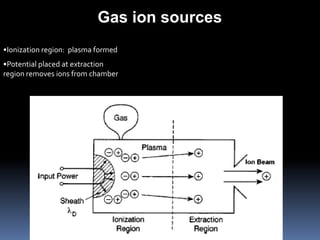
Gas ion sources
•Ionization region: plasma formed
•Potential placed at extraction
region removes ions from chamber
Lithography

 Lithography is employed to defined a patterns
  inside a target.
 Patterns can be defined by:
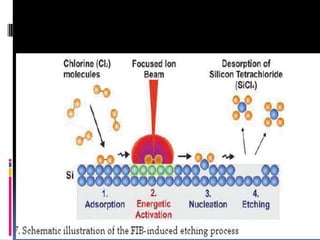
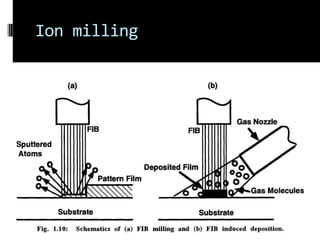
   Physically sputtering the target atoms (FIB milling)
   Striggering chemical reactions inside an adsorbed
    layer of a precursor gas (gas-assisted processing)
   Ion implantation
FIB milling and gas-assisted
processing
-When an ion hits the target ,surface elastic and inelastic
scattering processes will take place
 Inelastic processes are responsible for the generation of photons and
  secondary electron
 Elastic processes scattering will transfer kinetic energy from the ion to
  the target atoms
-The energy transfer will cause the displacement of the
  target atoms and strigger a recoid cascade whereby
  kinetic energy is tranfered from one atom to another by
  elastic scattering processes
-Number of target atoms a single ion is able to remove is
  largely dependent on the target material,the ion species,its
  energy and the angle of incidence of ion beams
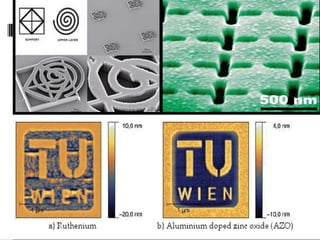
Ion milling
Advantages and disadvantages

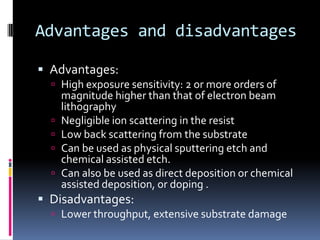
 Advantages:
   High exposure sensitivity: 2 or more orders of
      magnitude higher than that of electron beam
      lithography
     Negligible ion scattering in the resist
     Low back scattering from the substrate
     Can be used as physical sputtering etch and
      chemical assisted etch.
     Can also be used as direct deposition or chemical
      assisted deposition, or doping .
 Disadvantages:
   Lower throughput, extensive substrate damage
Conclusions

 Ion beam lithography is a versatile technique
  with several variations of the process .
 Ion beam lithography has been found to be
  useful for transferring high-fidelity patterns
  on three-dimensional surfaces
 This process can anyway be an advantage in
  the applications where lager surface areas are
  needed.
References

 L. F. Thompson, C. G. Willson, and M. J. Boeden,
    Introduction Microlithography (American Chemical
    Society, Washington, D. C., 1983)
   www.wikipedia.org
   http://www.intechopen.com/books/recent-advances-in-
    nanofabrication-techniques-and-applications/focused-
    ion-beam-lithography
   www.physics.ucdavis.edu/.../Lithography2.pd
   www.seminarprojects.net/.../ion-beam-lithography
Thank for your
   listening

Ion beam lithography

  • 1.
    HANOI UNIVERSITY OFSCIENCE AND TECHNOLOGY Center for Training of Excellent Students Advanced Training Program ADVANCED LITHOGRAPHY: ION-BEAM LITHOGRAPHY group: Hoàng Văn Tiến Nguyễn Đình Trung Phạm Đức Thịnh Class : MSE-K54
  • 2.
     Chip FabricationProcesses Silicon Wafer Epitaxial Photo- Manufacture Growth lithography oxidation Etching Diffusion (Ion Metalization Implantation) Packaging 2
  • 3.
    Ion beam lithography Ion beam lithography is the practice of scanning a focused beam of ions in a patterned fashion across a surface in order to create very small structures such as integrated circuits or other nanostructures.  Ion beam (focus ion beam) lithography has high potential to play an important role in nanometer technology because of the lack of backscattered electrons.
  • 4.
    Why use Ionbeam lithography? -Ions have heavy mass than electrons -less proximity effects(due to back scattering) -less scattering effect -offers higher resolution patterning than UV, X-ray, or electron beam lithography because these heavier particles have more momentum. - This gives the ion beam a smaller wavelength than even an e-beam and therefore almost no diffraction. - The momentum also reduces scattering in the target and in any residual gas. There is also a reduced potential radiation effect to sensitive underlying structures compared to x-ray and e-beam lithography.
  • 5.
    •Ion beam sources: -Gas source : Hydrogen, hellium,… -Metal sources : •The most common used source metal is Ga •Au/Si and Au/Si/Be alloys have also been used for lithography because these sources can supply lighter mass ions •Several implementations: •Focused IBL (direct writing) •Masked IBL (beam passes through ion-transparent membrane, patterned with absorber material, positioned close to coated substrate)
  • 6.
    • -Resists: Polymethylmethacrylate(PMMA) is most common, Poly(butene-1-sulfone), Poly(2,2,2- trifluoroethyl-α-chloroacrylate) • Features : • Penetration of the particle beam is small, compared to electron beam • Reduce blurring resulting from beam scattering (reduce proximity effect; increase localization, precision)
  • 7.
    Focus ion beamlithography  Simple columns:  Ion source  Single electrostatic lens  Electrostatic detectors - Two types : - Low acceleration voltage (< 50 kV) columns without mass separation (designed for applications such as mask repair, microcircuit modification, and scanning ion microscopes using a Ga LMIS) - High acceleration voltage (> 100 kV) columns with mass separators.(designed for applications such as ion implantation and lithography with an alloy LMIS)
  • 8.
    Low voltage columnwithout mass separator
  • 9.
    High acceleration voltage(< 50 kV) columns without mass separation  Ions from the LMIS are focused to a crossover at an intermediate aperture by the condenser lens.  Crossed electric and magnetic (E x B) fields act as a velocity filter, effectively separating the ion species by mass.  The E x B filter is then adjusted to allow only the desired ion species to pass through the intermediate aperture and the rest of optical column  The objective lens then focuses the mass-selected beam onto the target.
  • 10.
    Ion sources  Electronbombardment ion source: Electron beam is derected onto a gas. Produce low- energy beams of noble gas ions ( Ar+,He+…)  Gas discharge ion source: ion are created by plasma or by electric discharge . Used in high energy accelerators and ion implanters for semiconductor manufacture.  Field ionazation source : operate by desorption of ions from a sharp tip in a strong electric field .  Liquid metal ion source : operate by desorption of metal ions from liquid metal under a strong electrical field
  • 11.
    Ion metal sources  Emitter :  Small end radius  Coated with metal having a high surface tension and low vapor pressure at its melting point  The emitter is heated to the melting point of the metal while a high positive voltage is placed on it relative to an extraction electrode.  The liquid metal is drawn into a conical shape by the balance between the electrostatic and surface tension forces.  The apex of the liquid cone is drawn to an end radius so small that the high electric field causes ions to begin to form through field evaporation.  The cone apex is believed to have a radius of about 5 nm  The most common source metal is Ga.  Au/Si and Au/Si/Be alloys have also been used for lithography because these sources can supply lighter mass ions.
  • 12.
    Gas ion sources •Ionizationregion: plasma formed •Potential placed at extraction region removes ions from chamber
  • 13.
    Lithography  Lithography isemployed to defined a patterns inside a target.  Patterns can be defined by:  Physically sputtering the target atoms (FIB milling)  Striggering chemical reactions inside an adsorbed layer of a precursor gas (gas-assisted processing)  Ion implantation
  • 14.
    FIB milling andgas-assisted processing -When an ion hits the target ,surface elastic and inelastic scattering processes will take place  Inelastic processes are responsible for the generation of photons and secondary electron  Elastic processes scattering will transfer kinetic energy from the ion to the target atoms -The energy transfer will cause the displacement of the target atoms and strigger a recoid cascade whereby kinetic energy is tranfered from one atom to another by elastic scattering processes -Number of target atoms a single ion is able to remove is largely dependent on the target material,the ion species,its energy and the angle of incidence of ion beams
  • 16.
  • 18.
    Advantages and disadvantages Advantages:  High exposure sensitivity: 2 or more orders of magnitude higher than that of electron beam lithography  Negligible ion scattering in the resist  Low back scattering from the substrate  Can be used as physical sputtering etch and chemical assisted etch.  Can also be used as direct deposition or chemical assisted deposition, or doping .  Disadvantages:  Lower throughput, extensive substrate damage
  • 19.
    Conclusions  Ion beamlithography is a versatile technique with several variations of the process .  Ion beam lithography has been found to be useful for transferring high-fidelity patterns on three-dimensional surfaces  This process can anyway be an advantage in the applications where lager surface areas are needed.
  • 20.
    References  L. F.Thompson, C. G. Willson, and M. J. Boeden, Introduction Microlithography (American Chemical Society, Washington, D. C., 1983)  www.wikipedia.org  http://www.intechopen.com/books/recent-advances-in- nanofabrication-techniques-and-applications/focused- ion-beam-lithography  www.physics.ucdavis.edu/.../Lithography2.pd  www.seminarprojects.net/.../ion-beam-lithography
  • 21.
    Thank for your listening