The document discusses top-down and bottom-up processes for manufacturing structures at the nanoscale. Top-down processes start with bulk material and use techniques like lithography and etching to pattern structures, while bottom-up processes build structures from the atomic or molecular scale using self-assembly. Both approaches are needed as bottom-up is required to make smaller structures than lithography allows, and applications include growing carbon nanotubes, nanodots, and using self-assembled monolayers. Challenges of bottom-up include controlling assembly, but the future will see more integration of both top-down and bottom-up nanomanufacturing.
Introduction to the presentation focusing on top-down and bottom-up processes along with an outline of key areas to be covered.
Details on the top-down approach, its methodology, current technology using excimer lasers, and the challenges faced including costs and physical limits.
Introduction to the bottom-up approach which builds structures atom by atom, its natural occurrences, and advantages over top-down processes such as material efficiency.
Explains self-assembly as a principle of bottom-up processing, with applications in creating silicon nanodots and methods for their formation.
Information on carbon nanotubes, including types, growth methods, transistor designs, resistance advantages, and potential interconnect applications.
Discussion on challenges faced in bottom-up processes such as contamination and complexity, and strategies to combine both approaches for better outcomes.
Exploration of advancements and future prospects for both techniques, emphasizing the increasing significance of bottom-up methods in semiconductor manufacturing.
Summary highlighting the dominance of top-down processing while acknowledging the growing importance of bottom-up approaches in future technologies.
Outline of Presentation
Top-down approach
Bottom-up approach
Why will it be needed?
Applications
Challenges of Bottom-up processing
The future of top-down and bottom-up processing
Summary
3.
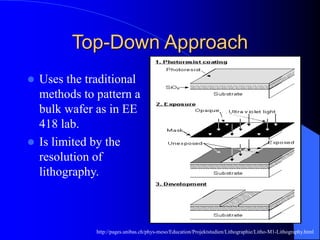
Top-Down Approach
Usesthe traditional
methods to pattern a
bulk wafer as in EE
418 lab.
Is limited by the
resolution of
lithography.
http://pages.unibas.ch/phys-meso/Education/Projektstudien/Lithographie/Litho-M1-Lithography.html
4.
What Constitutes aTop-down
Process?
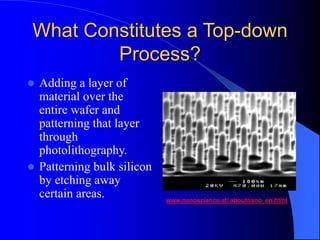
Adding a layer of
material over the
entire wafer and
patterning that layer
through
photolithography.
Patterning bulk silicon
by etching away
certain areas. www.nanoscience.at/ aboutnano_en.html
5.
Current Top-down Technology
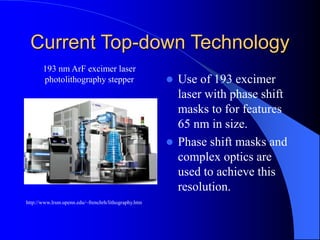
Use of 193 excimer
laser with phase shift
masks to for features
65 nm in size.
Phase shift masks and
complex optics are
used to achieve this
resolution.
http://www.lrsm.upenn.edu/~frenchrh/lithography.htm
193 nm ArF excimer laser
photolithography stepper
6.
Problems with theTop-down
Process
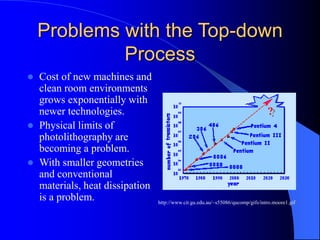
Cost of new machines and
clean room environments
grows exponentially with
newer technologies.
Physical limits of
photolithography are
becoming a problem.
With smaller geometries
and conventional
materials, heat dissipation
is a problem. http://www.cit.gu.edu.au/~s55086/qucomp/gifs/intro.moore1.gif
7.
Bottom-Up Approach
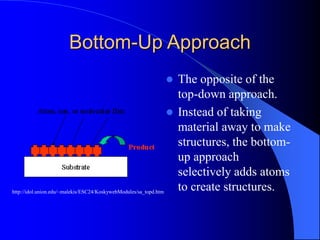
Theopposite of the
top-down approach.
Instead of taking
material away to make
structures, the bottom-
up approach
selectively adds atoms
to create structures.http://idol.union.edu/~malekis/ESC24/KoskywebModules/sa_topd.htm
8.
The Ideas Behindthe Bottom-
up Approach
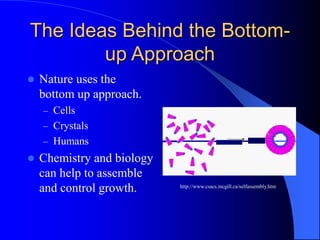
Nature uses the
bottom up approach.
– Cells
– Crystals
– Humans
Chemistry and biology
can help to assemble
and control growth. http://www.csacs.mcgill.ca/selfassembly.htm
9.
Top-down Versus Bottom-up
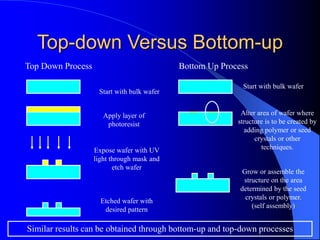
Etchedwafer with
desired pattern
Apply layer of
photoresist
Expose wafer with UV
light through mask and
etch wafer
Start with bulk wafer
Top Down Process Bottom Up Process
Start with bulk wafer
Alter area of wafer where
structure is to be created by
adding polymer or seed
crystals or other
techniques.
Grow or assemble the
structure on the area
determined by the seed
crystals or polymer.
(self assembly)
Similar results can be obtained through bottom-up and top-down processes
10.
Why is Bottom-UpProcessing
Needed?
Allows smaller geometries than photolithography.
Certain structures such as Carbon Nanotubes and
Si nanowires are grown through a bottom-up
process.
New technologies such as organic semiconductors
employ bottom-up processes to pattern them.
Can make formation of films and structures much
easier.
Is more economical than top-down in that it does
not waste material to etching.
11.
Self Assembly
Theprinciple behind bottom-up processing.
Self assembly is the coordinated action of
independent entities to produce larger,
ordered structures or achieve a desired
shape.
Found in nature.
Start on the atomic scale.
12.
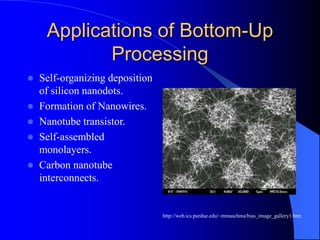
Applications of Bottom-Up
Processing
Self-organizing deposition
of silicon nanodots.
Formation of Nanowires.
Nanotube transistor.
Self-assembled
monolayers.
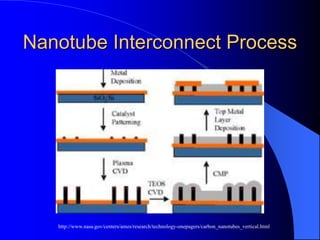
Carbon nanotube
interconnects.
http://web.ics.purdue.edu/~mmaschma/bias_image_gallery1.htm
13.
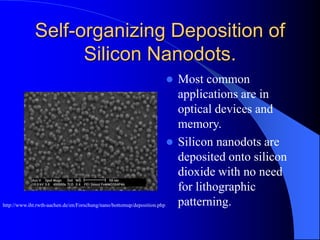
Self-organizing Deposition of
SiliconNanodots.
Most common
applications are in
optical devices and
memory.
Silicon nanodots are
deposited onto silicon
dioxide with no need
for lithographic
patterning.http://www.iht.rwth-aachen.de/en/Forschung/nano/bottomup/deposition.php
14.
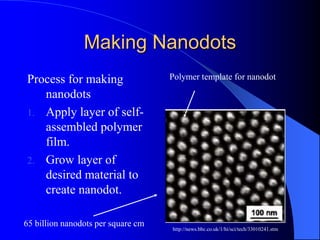
Making Nanodots
Process formaking
nanodots
1. Apply layer of self-
assembled polymer
film.
2. Grow layer of
desired material to
create nanodot.
Polymer template for nanodot
65 billion nanodots per square cm
http://news.bbc.co.uk/1/hi/sci/tech/33010241.stm
15.
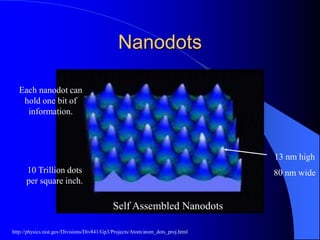
Nanodots
Each nanodot can
holdone bit of
information.
10 Trillion dots
per square inch.
13 nm high
80 nm wide
Self Assembled Nanodots
http://physics.nist.gov/Divisions/Div841/Gp3/Projects/Atom/atom_dots_proj.html
16.
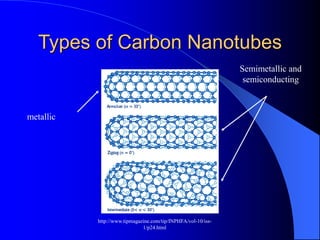
Types of CarbonNanotubes
metallic
http://www.tipmagazine.com/tip/INPHFA/vol-10/iss-
1/p24.html
Semimetallic and
semiconducting
17.
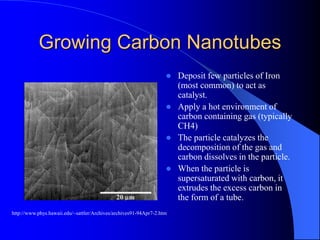
Growing Carbon Nanotubes
Deposit few particles of Iron
(most common) to act as
catalyst.
Apply a hot environment of
carbon containing gas (typically
CH4)
The particle catalyzes the
decomposition of the gas and
carbon dissolves in the particle.
When the particle is
supersaturated with carbon, it
extrudes the excess carbon in
the form of a tube.
http://www.phys.hawaii.edu/~sattler/Archives/archives91-94Apr7-2.htm
18.
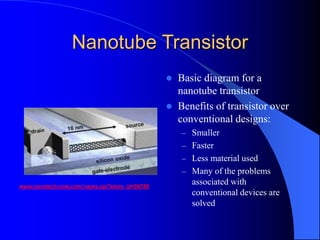
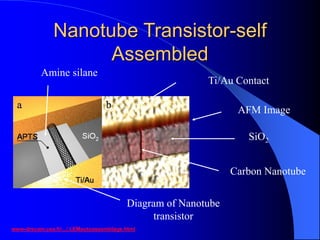
Nanotube Transistor
Basicdiagram for a
nanotube transistor
Benefits of transistor over
conventional designs:
– Smaller
– Faster
– Less material used
– Many of the problems
associated with
conventional devices are
solved
www.nanotech-now.com/ news.cgi?story_id=06788
Nanotube Transistor
Construction byDNA
DNA strands connect to
gold electrodes on top of
silicon.
DNA strands connect to
ends of carbon nanotube.
Silicon and nanotubes are
mixed and the DNA
makes the connections to
form nanotube transistors.
http://www.trnmag.com/Photos/2004/12150
4/DNA%20makes%20nanotube%20transist
ors%20Image.html
21.
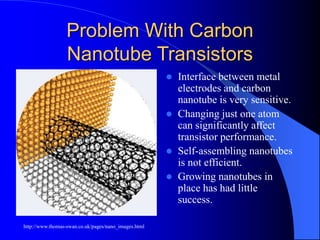
Problem With Carbon
NanotubeTransistors
Interface between metal
electrodes and carbon
nanotube is very sensitive.
Changing just one atom
can significantly affect
transistor performance.
Self-assembling nanotubes
is not efficient.
Growing nanotubes in
place has had little
success.
http://www.thomas-swan.co.uk/pages/nano_images.html
22.
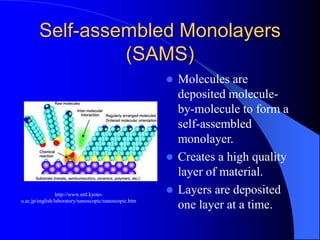
Self-assembled Monolayers
(SAMS)
Moleculesare
deposited molecule-
by-molecule to form a
self-assembled
monolayer.
Creates a high quality
layer of material.
Layers are deposited
one layer at a time.
http://www.mtl.kyoto-
u.ac.jp/english/laboratory/nanoscopic/nanoscopic.htm
23.
Monolayers
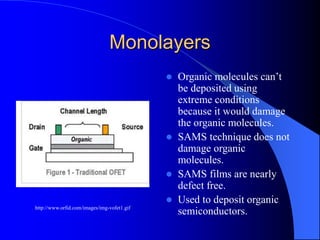
Organic moleculescan’t
be deposited using
extreme conditions
because it would damage
the organic molecules.
SAMS technique does not
damage organic
molecules.
SAMS films are nearly
defect free.
Used to deposit organic
semiconductors.http://www.orfid.com/images/img-vofet1.gif
24.
Carbon Nanowire
Interconnects
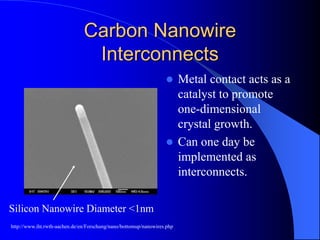
Metalcontact acts as a
catalyst to promote
one-dimensional
crystal growth.
Can one day be
implemented as
interconnects.
Silicon Nanowire Diameter <1nm
http://www.iht.rwth-aachen.de/en/Forschung/nano/bottomup/nanowires.php
Benefits and Challengesof
Nanotube Interconnects
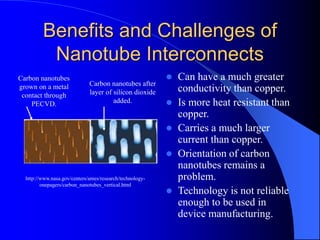
Can have a much greater
conductivity than copper.
Is more heat resistant than
copper.
Carries a much larger
current than copper.
Orientation of carbon
nanotubes remains a
problem.
Technology is not reliable
enough to be used in
device manufacturing.
http://www.nasa.gov/centers/ames/research/technology-
onepagers/carbon_nanotubes_vertical.html
Carbon nanotubes
grown on a metal
contact through
PECVD.
Carbon nanotubes after
layer of silicon dioxide
added.
27.
Challenges for theBottom-Up
Approach
Making sure that the structures grow and
assemble in the correct way.
Forming complex patterns and structures
using self assembly.
Contamination has a significant impact on
devices with such small geometries.
Fabricating robust structures.
28.
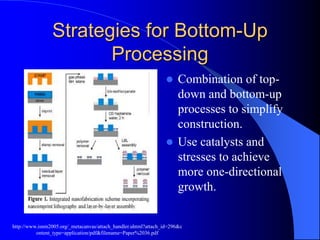
Strategies for Bottom-Up
Processing
Combination of top-
down and bottom-up
processes to simplify
construction.
Use catalysts and
stresses to achieve
more one-directional
growth.
http://www.isnm2005.org/_metacanvas/attach_handler.uhtml?attach_id=296&c
ontent_type=application/pdf&filename=Paper%2036.pdf
29.
Future of Top-downand
Bottom-Up Processing
http://www.imec.be/wwwinter/business/nanotechnology.pdf
30.
Advancements Made soFar
Carbon nanotube
transistor (Stanford U.)
Organic monolayers for
organic transistor (Yale
U.)
Nanotube based circuit
constructed (IBM)
Nanomotors and gears
created (NASA)
http://snf.stanford.edu/Education/Nanotechnology.SNF.ppt
31.
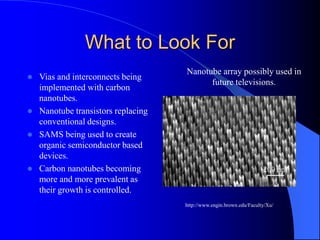
What to LookFor
Vias and interconnects being
implemented with carbon
nanotubes.
Nanotube transistors replacing
conventional designs.
SAMS being used to create
organic semiconductor based
devices.
Carbon nanotubes becoming
more and more prevalent as
their growth is controlled.
http://www.engin.brown.edu/Faculty/Xu/
Nanotube array possibly used in
future televisions.
32.
Conclusion
Top-down processinghas been and will be the
dominant process in semiconductor
manufacturing.
Newer technologies such as nanotubes and organic
semiconductors will require a bottom-up approach
for processing.
Self-assembly eliminates the need for
photolithography.
Bottom-up processing will become more and more
prevalent in semiconductor manufacturing.