Dr.P.Senthilkumar,
Professor,
Department of Mechanical Engineering,
SVS College of Engineering,
Coimbatore
OutLine of My Talk
What is lithography
Photolithography
Electron beam lithography
Nanolithography
X-ray lithography
AFM nanolithography
Soft lithography
Nanoimprint lithography
Dip-pen nanolithography
10/7/2020Dr.PSK, Professor, SVSCE
2
Lithography Sensors in Robotics
What is the use of sensors in Robots?
Light sensors
Sound Sensor
Temperature Sensor
Tactile Sensors
Positioning Sensors
Proximity Sensor
Acceleration Sensor
What is Lithography
10/7/2020Dr.PSK, Professor, SVSCE
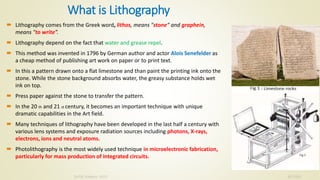
3 Lithography comes from the Greek word, lithos, means "stone“ and graphein,
means "to write”.
 Lithography depend on the fact that water and grease repel.
 This method was invented in 1796 by German author and actor Alois Senefelder as
a cheap method of publishing art work on paper or to print text.
 In this a pattern drawn onto a flat limestone and than paint the printing ink onto the
stone. While the stone background absorbs water, the greasy substance holds wet
ink on top.
 Press paper against the stone to transfer the pattern.
 In the 20 th and 21 st century, it becomes an important technique with unique
dramatic capabilities in the Art field.
 Many techniques of lithography have been developed in the last half a century with
various lens systems and exposure radiation sources including photons, X-rays,
electrons, ions and neutral atoms.
 Photolithography is the most widely used technique in microelectronic fabrication,
particularly for mass production of integrated circuits.
Photolithography
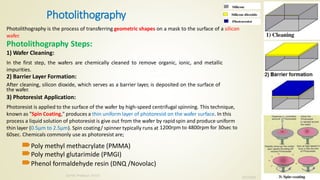
Photolithography is the process of transferring geometric shapes on a mask to the surface of a silicon
wafer.
Photolithography Steps:
1) Wafer Cleaning:
In the first step, the wafers are chemically cleaned to remove organic, ionic, and metallic
impurities.
2) Barrier Layer Formation:
After cleaning, silicon dioxide, which serves as a barrier layer, is deposited on the surface of
the wafer.
3) Photoresist Application:
Photoresist is applied to the surface of the wafer by high-speed centrifugal spinning. This technique,
known as "Spin Coating," produces a thin uniform layer of photoresist on the wafer surface. In this
process a liquid solution of photoresist is give out from the wafer by rapid spin and produce uniform
thin layer (0.5µm to 2.5µm). Spin coating/ spinner typically runs at 1200rpm to 4800rpm for 30sec to
60sec. Chemicals commonly use as photoresist are;
Poly methyl methacrylate (PMMA)
Poly methyl glutarimide (PMGI)
Phenol formaldehyde resin (DNQ /Novolac)
10/7/2020
Dr.PSK, Professor, SVSCE
4
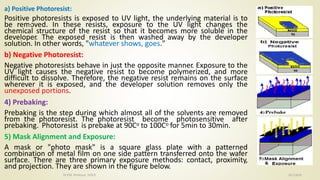
a) Positive Photoresist:
Positive photoresists is exposed to UV light, the underlying material is to
be removed. In these resists, exposure to the UV light changes the
chemical structure of the resist so that it becomes more soluble in the
developer. The exposed resist is then washed away by the developer
solution. In other words, "whatever shows, goes."
b) Negative Photoresist:
Negative photoresists behave in just the opposite manner. Exposure to the
UV light causes the negative resist to become polymerized, and more
difficult to dissolve. Therefore, the negative resist remains on the surface
wherever it is exposed, and the developer solution removes only the
unexposed portions.
4) Prebaking:
Prebaking is the step during which almost all of the solvents are removed
from the photoresist. The photoresist become photosensitive after
prebaking. Photoresist is prebake at 90Co to 100Co for 5min to 30min.
5) Mask Alignment and Exposure:
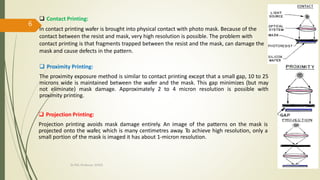
A mask or "photo mask" is a square glass plate with a patterned
combination of metal film on one side pattern transferred onto the wafer
surface. There are three primary exposure methods: contact, proximity,
and projection. They are shown in the figure below.
10/7/2020Dr.PSK, Professor, SVSCE
5
 Contact Printing:
In contact printing wafer is brought into physical contact with photo mask. Because of the
contact between the resist and mask, very high resolution is possible. The problem with
contact printing is that fragments trapped between the resist and the mask, can damage the
mask and cause defects in the pattern.
 Proximity Printing:
The proximity exposure method is similar to contact printing except that a small gap, 10 to 25
microns wide is maintained between the wafer and the mask. This gap minimizes (but may
not eliminate) mask damage. Approximately 2 to 4 micron resolution is possible with
proximity printing.
 Projection Printing:
Projection printing avoids mask damage entirely. An image of the patterns on the mask is
projected onto the wafer, which is many centimetres away. To achieve high resolution, only a
small portion of the mask is imaged it has about 1-micron resolution.
10/7/2020Dr.PSK, Professor, SVSCE
6
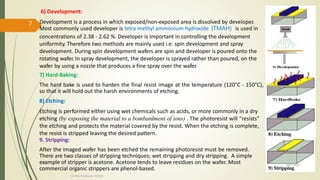
6) Development:
Development is a process in which exposed/non-exposed area is dissolved by developer.
Most commonly used developer is tetra methyl ammonium hydroxide (TMAH) is used in
concentrations of 2.38 - 2.62 %. Developer is important in controlling the development
uniformity. Therefore two methods are mainly used i.e. spin development and spray
development. During spin development wafers are spin and developer is poured onto the
rotating wafer. In spray development, the developer is sprayed rather than poured, on the
wafer by using a nozzle that produces a fine spray over the wafer.
7) Hard-Baking:
The hard bake is used to harden the final resist image at the temperature (120°C - 150°C),
so that it will hold out the harsh environments of etching.
8) Etching:
Etching is performed either using wet chemicals such as acids, or more commonly in a dry
etching (by exposing the material to a bombardment of ions) . The photoresist will “resists”
the etching and protects the material covered by the resist. When the etching is complete,
the resist is stripped leaving the desired pattern.
9. Stripping:
After the imaged wafer has been etched the remaining photoresist must be removed.
There are two classes of stripping techniques; wet stripping and dry stripping. A simple
example of stripper is acetone. Acetone tends to leave residues on the wafer. Most
commercial organic strippers are phenol-based.
10/7/2020
Dr.PSK, Professor, SVSCE
7
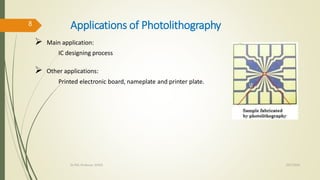
Applications of Photolithography
 Main application:
IC designing process
 Other applications:
Printed electronic board, nameplate and printer plate.
10/7/2020Dr.PSK, Professor, SVSCE
8
Electron Beam Lithography is a specialized technique for creating
extremely fine patterns. It is derived from the scanning electron
microscope. Electron beams
diameter.
can be focused to a few nanometres in
The basic idea behind electron beam lithography is identical to
optical lithography. The substrate is coated with a thin layer of resist,
which is chemically changed under exposure to the electron beam, so
that the exposed/non-exposed areas can
solvent.
be dissolved in a specific
Electron beam lithography is the most power
nm.
full tool for the
fabrication of feathers as small as 3nm to 5
Electron Beam Lithography
10/7/2020Dr.PSK, Professor, SVSCE
9
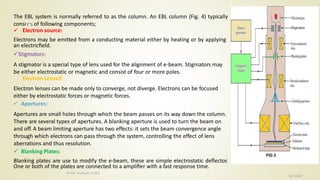
The EBL system is normally referred to as the column. An EBL column (Fig. 4) typically
consists of following components;
 Electron source:
Electrons may be emitted from a conducting material either by heating or by applying
an electricfield.
Stigmators:
A stigmator is a special type of lens used for the alignment of e-beam. Stigmators may
be either electrostatic or magnetic and consist of four or more poles.
Electron Lenses:
Electron lenses can be made only to converge, not diverge. Electrons can be focused
either by electrostatic forces or magnetic forces.
 Apertures:
Apertures are small holes through which the beam passes on its way down the column.
There are several types of apertures. A blanking aperture is used to turn the beam on
and off. A beam limiting aperture has two effects: it sets the beam convergence angle
through which electrons can pass through the system, controlling the effect of lens
aberrations and thus resolution.
 Blanking Plates:
Blanking plates are use to modify the e-beam, these are simple electrostatic deflector.
One or both of the plates are connected to a amplifier with a fast response time.
10/7/2020
Dr.PSK, Professor, SVSCE
10
 Print complex patterns directly on wafers
 Eliminates the diffraction problem
 High resolution up to 20 nm (photolithography ~50nm)
 Flexible technique
 Slower than optical lithography (approximately 5 wafers / hour at less than 0.1 µ resolution).
 Expensive and complicated
 Forward scattering
 Backward scattering
 Secondary electrons
Advantages of EBL
Disadvantages
10/7/2020Dr.PSK, Professor, SVSCE
11
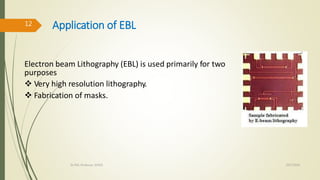
Electron beam Lithography (EBL) is used primarily for two
purposes
 Very high resolution lithography.
 Fabrication of masks.
Application of EBL
10/7/2020Dr.PSK, Professor, SVSCE
12
Nanolithography
 Nanolithography concerns with the study and application of nanometre-scale structures.
 Nanolithography is derived from the Greek words “nanos”, meaning (dwarf) “lithos”, meaning (rock
or stone) and “graphein” meaning (to write).
 Therefore the correct translation is "tiny writing on stone“.
 Nanolithography is used e.g. during the nanofabrication of semiconductor integrated circuits
(nanocircuitry), for nanoelectromechanical systems (NEMS) or for almost any other
fundamental application across various scientific disciplines in nanoresearch. This method is
different to various existing nanolithography techniques like;
X-ray lithography
Atomic Force Microscope (AFM) nanolithography.
Soft lithography
Nanoimprint lithography (NIL).
Dip-pen (DPN) nanolithography
NANOCIRCUITRY 10/7/2020
Dr.PSK, Professor, SVSCE
13
X-ray lithography
X-rays having wavelengths of 0.04nm to 0.5 nm represent another
radiation source for high-resolution design reproduction into
polymeric resist materials.
X-ray lithography was first demonstrated to obtain high-resolution
designs using X-ray proximity printing by Spears and Smith.
X-ray lithography can be extended optical resolution of 15 nm.
Essential elements in X-ray lithography
 A mask consisting of a pattern made with an X-ray absorbing
material on a thin X-ray transparent membrane.
 An X-ray source of sufficient brightness.
 An X-ray sensitive resist material.
10/7/2020Dr.PSK, Professor, SVSCE
14
X-Ray Lithography Cont…
The X-rays illuminate a mask placed in proximity of a resist-coated wafer.
The X-rays are typically from synchrotron radiation source, allowing rapid
exposure.
X-ray lithography is expensive, because of the expense of operating a
synchrotron. The actual operating expenses without considering the initial
investment of tens-of-millions of dollars. Therefore, the LIGA process was
developed to reduce the dependency on a synchrotron.
LIGA is the abbreviation from the German words, “Lithographie”
(Lithography), “Galvanik” (Electroplating), & “Abformung” (Molding).10/7/2020Dr.PSK, Professor, SVSCE
15
X-Ray Lithography Steps1. Irradiation:
The first step in x- ray lithography is irradiation which involves exposing a thick layer of resist to high-
energy beam of x-rays from a synchrotron. The mask membrane is normally a low atomic number
material such as diamond, beryllium, or a thin membrane of a higher atomic number material such as
silicon or silicon carbide.
2. Development:
In this step the pattern is etched into the resist substrate by the use of x- rays.
3. Electroforming:
Electroforming is the same as electroplating. Electroforming suggests that the plating is used to create
an actual metal component.
4. Mould insert:
A chemical solvent PMMA (poly methyl methacrylate) C5O2H8 is used to dissolve material, resulting
model of the mask pattern. After removal of the resist, a freestanding metal structure is produced.
5. Mould filling:
The metal structure may be a final product, or serve as a mold insert for precision plastic moulding.
6. Mould releases:
The plastic mold retains the same shape, size, and form as the original resist structure but is produced
quickly. Moulded plastic parts may then be final product.
10/7/2020
Dr.PSK, Professor, SVSCE
16
Advantages of X-Ray Lithography
 Short wavelength from X-rays 0.4-4 nm
 No diffraction effect
 Simple to use
 No lens
 Faster than EBL
 Uniform refraction pattern
 High resolution for small feature size
Disadvantages of X-Ray Lithography
 Thin lens
 Distortion in absorber
 Cannot be focused through lens
 Masks are expensive to produce
10/7/2020
Dr.PSK, Professor, SVSCE
17
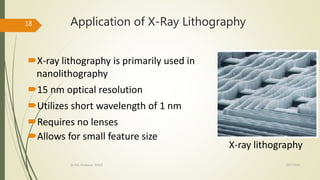
Application of X-Ray Lithography
X-ray lithography is primarily used in
nanolithography
15 nm optical resolution
Utilizes short wavelength of 1 nm
Requires no lenses
Allows for small feature size
X-ray lithography
10/7/2020Dr.PSK, Professor, SVSCE
18
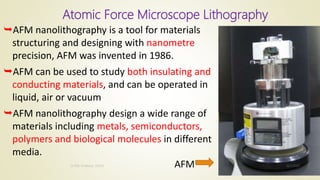
Atomic Force Microscope Lithography
AFM nanolithography is a tool for materials
structuring and designing with nanometre
precision, AFM was invented in 1986.
AFM can be used to study both insulating and
conducting materials, and can be operated in
liquid, air or vacuum
AFM nanolithography design a wide range of
materials including metals, semiconductors,
polymers and biological molecules in different
media.
AFM 10/7/2020Dr.PSK, Professor, SVSCE
19
Working Principle of AFM
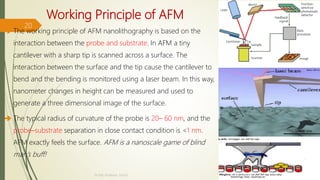
 The working principle of AFM nanolithography is based on the
interaction between the probe and substrate. In AFM a tiny
cantilever with a sharp tip is scanned across a surface. The
interaction between the surface and the tip cause the cantilever to
bend and the bending is monitored using a laser beam. In this way,
nanometer changes in height can be measured and used to
generate a three dimensional image of the surface.
 The typical radius of curvature of the probe is 20– 60 nm, and the
probe–substrate separation in close contact condition is <1 nm.
AFM exactly feels the surface. AFM is a nanoscale game of blind
man’s buff!
10/7/2020
Dr.PSK, Professor, SVSCE
20
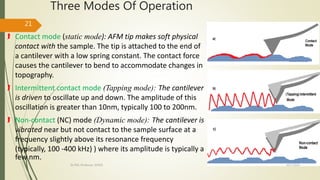
Three Modes Of Operation
 Contact mode (static mode): AFM tip makes soft physical
contact with the sample. The tip is attached to the end of
a cantilever with a low spring constant. The contact force
causes the cantilever to bend to accommodate changes in
topography.
 Intermittent contact mode (Tapping mode): The cantilever
is driven to oscillate up and down. The amplitude of this
oscillation is greater than 10nm, typically 100 to 200nm.
 Non-contact (NC) mode (Dynamic mode): The cantilever is
vibrated near but not contact to the sample surface at a
frequency slightly above its resonance frequency
(typically, 100 -400 kHz) ) where its amplitude is typically a
few nm.
10/7/2020Dr.PSK, Professor, SVSCE
21
Conclusions
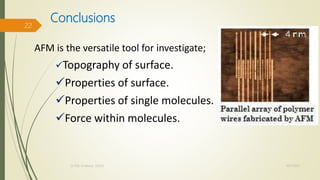
AFM is the versatile tool for investigate;
Topography of surface.
Properties of surface.
Properties of single molecules.
Force within molecules.
10/7/2020Dr.PSK, Professor, SVSCE
22
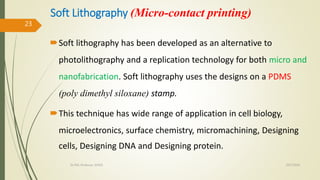
Soft Lithography (Micro-contact printing)
Soft lithography has been developed as an alternative to
photolithography and a replication technology for both micro and
nanofabrication. Soft lithography uses the designs on a PDMS
(poly dimethyl siloxane) stamp.
This technique has wide range of application in cell biology,
microelectronics, surface chemistry, micromachining, Designing
cells, Designing DNA and Designing protein.
10/7/2020Dr.PSK, Professor, SVSCE
23
Nanoimprint Lithography (NIL)
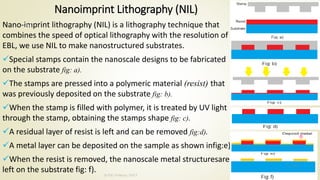
Nano-imprint lithography (NIL) is a lithography technique that
combines the speed of optical lithography with the resolution of
EBL, we use NIL to make nanostructured substrates.
Special stamps contain the nanoscale designs to be fabricated
on the substrate fig: a).
The stamps are pressed into a polymeric material (resist) that
was previously deposited on the substrate fig: b).
When the stamp is filled with polymer, it is treated by UV light
through the stamp, obtaining the stamps shape fig: c).
A residual layer of resist is left and can be removed fig:d).
A metal layer can be deposited on the sample as shown infig:e)
When the resist is removed, the nanoscale metal structuresare
left on the substrate fig: f).
10/7/2020
Dr.PSK, Professor, SVSCE
24
Applications
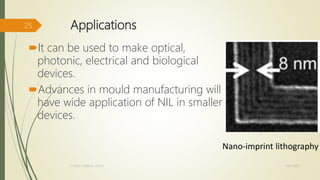
It can be used to make optical,
photonic, electrical and biological
devices.
Advances in mould manufacturing will
have wide application of NIL in smaller
devices.
Nano-imprint lithography
10/7/2020Dr.PSK, Professor, SVSCE
25
Dip-pen Nanolithography
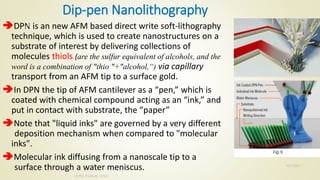
DPN is an new AFM based direct write soft-lithography
technique, which is used to create nanostructures on a
substrate of interest by delivering collections of
molecules thiols (are the sulfur equivalent of alcohols, and the
word is a combination of "thio "+"alcohol,“) via capillary
transport from an AFM tip to a surface gold.
In DPN the tip of AFM cantilever as a “pen,” which is
coated with chemical compound acting as an “ink,” and
put in contact with substrate, the “paper”
Note that "liquid inks" are governed by a very different
deposition mechanism when compared to "molecular
inks".
Molecular ink diffusing from a nanoscale tip to a
surface through a water meniscus. 10/7/2020
Dr.PSK, Professor, SVSCE
26
Applications
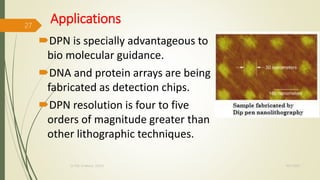
DPN is specially advantageous to
bio molecular guidance.
DNA and protein arrays are being
fabricated as detection chips.
DPN resolution is four to five
orders of magnitude greater than
other lithographic techniques.
10/7/2020Dr.PSK, Professor, SVSCE
27
Microlithography and Nanolithography refer specifically to
lithographic patterning methods capable of structuring
material on a fine scale.
Typically, features smaller than 10 micrometer are considered
microlithographic, and features smaller than 100 nanometer
are considered nanolithographic.
Nanolithography manufacturing tchnologies with capabilities
of deposition at the atomic level.
It is used to reduce the size of the sensors.
10/7/2020Dr.PSK, Professor, SVSCE
28
10/7/2020Dr.PSK, Professor, SVSCE
29
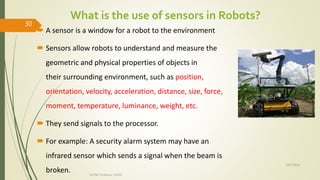
What is the use of sensors in Robots?
 A sensor is a window for a robot to the environment
 Sensors allow robots to understand and measure the
geometric and physical properties of objects in
their surrounding environment, such as position,
orientation, velocity, acceleration, distance, size, force,
moment, temperature, luminance, weight, etc.
 They send signals to the processor.
 For example: A security alarm system may have an
infrared sensor which sends a signal when the beam is
broken.
10/7/2020
Dr.PSK, Professor, SVSCE
30
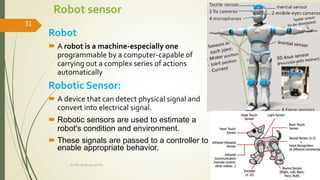
Robot sensor
Robot
 A robot is a machine-especially one
programmable by a computer-capable of
carrying out a complex series of actions
automatically
Robotic Sensor:
 A device that can detect physical signal and
convert into electrical signal.
 Robotic sensors are used to estimate a
robot's condition and environment.
 These signals are passed to a controller to
enable appropriate behavior.
10/7/2020Dr.PSK, Professor, SVSCE
31
Sensor Classification
Sensors are generally classified into two groups:
 Internal sensors and external sensors.
Internal sensors such as its position sensor, velocity
sensor, acceleration sensors, motor torque sensor, etc
obtain the information about the robot itself,
External sensors such as cameras, range sensors (IR
sensor, laser range finder, and ultrasonic sensor) contact
and proximity sensors (photodiode, IR detector, RFID,
touch, etc.) and force sensors gather the information in the
surrounding environment. 10/7/2020Dr.PSK, Professor, SVSCE
32
Types of robotic sensor
Light sensors.
Sound Sensor.
Temperature Sensor.
Tactile Sensor.
Position Sensor.
Proximity Sensor.
Acceleration sensor.
Distance Sensor.
Pressure Sensors. ...
Voltage sensor
Current sensor
IMU Sensor
10/7/2020
Dr.PSK, Professor, SVSCE
33
TYPES OF LIGHT SENSOR
 VEX light sensor
 LEGO light sensor
 Light Sensor 1000 lux
 SCI-BOX Light Detector
 TAOS TSL235R Light to Frequency Converter
 Parallax QTI Sensor
 DF Robot Ambient Light Sensor
 Arduino Lily Pad light sensor
 DF Robot BH1750 light sensor
 CdS photoconductive cell
Light sensors
A Light sensor is used to detect
light and create a voltage
difference.
The two main light sensors
generally used in robots are
photoresistor and Photovoltaic
cells.
Other light sensors like
phototubes, phototransistors,
CCDs (charge-coupled device) ,
etc. are rarely used.
10/7/2020Dr.PSK, Professor, SVSCE
34
10/7/2020
Dr.PSK, Professor, SVSCE
35
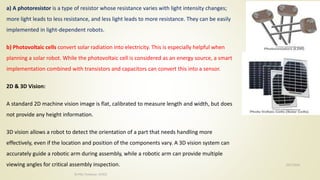
a) A photoresistor is a type of resistor whose resistance varies with light intensity changes;
more light leads to less resistance, and less light leads to more resistance. They can be easily
implemented in light-dependent robots.
b) Photovoltaic cells convert solar radiation into electricity. This is especially helpful when
planning a solar robot. While the photovoltaic cell is considered as an energy source, a smart
implementation combined with transistors and capacitors can convert this into a sensor.
2D & 3D Vision:
A standard 2D machine vision image is flat, calibrated to measure length and width, but does
not provide any height information.
3D vision allows a robot to detect the orientation of a part that needs handling more
effectively, even if the location and position of the components vary. A 3D vision system can
accurately guide a robotic arm during assembly, while a robotic arm can provide multiple
viewing angles for critical assembly inspection.
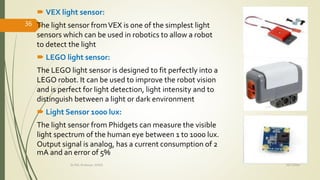
 VEX light sensor:
The light sensor fromVEX is one of the simplest light
sensors which can be used in robotics to allow a robot
to detect the light
 LEGO light sensor:
The LEGO light sensor is designed to fit perfectly into a
LEGO robot. It can be used to improve the robot vision
and is perfect for light detection, light intensity and to
distinguish between a light or dark environment
 Light Sensor 1000 lux:
The light sensor from Phidgets can measure the visible
light spectrum of the human eye between 1 to 1000 lux.
Output signal is analog, has a current consumption of 2
mA and an error of 5%
10/7/2020Dr.PSK, Professor, SVSCE
36
 SCI-BOX Light Detector:
SCI-BOX light detector is used to detect ambient light
density. SCI-BOX has two different voltage outputs and
works with a photo resistor.
 TAOS TSL235R Light to Frequency Converter:
The TSL235R from TAOS is a sensor that measures light
intensity and its output is frequency. It can communicate
with a microcontroller or other logic circuitry.
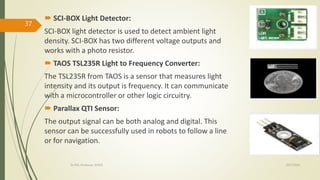
 Parallax QTI Sensor:
The output signal can be both analog and digital. This
sensor can be successfully used in robots to follow a line
or for navigation.
10/7/2020Dr.PSK, Professor, SVSCE
37
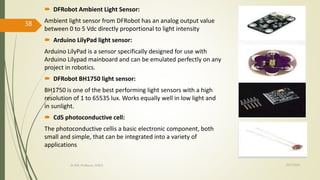
 DFRobot Ambient Light Sensor:
Ambient light sensor from DFRobot has an analog output value
between 0 to 5 Vdc directly proportional to light intensity
 Arduino LilyPad light sensor:
Arduino LilyPad is a sensor specifically designed for use with
Arduino Lilypad mainboard and can be emulated perfectly on any
project in robotics.
 DFRobot BH1750 light sensor:
BH1750 is one of the best performing light sensors with a high
resolution of 1 to 65535 lux. Works equally well in low light and
in sunlight.
 CdS photoconductive cell:
The photoconductive cellis a basic electronic component, both
small and simple, that can be integrated into a variety of
applications
10/7/2020Dr.PSK, Professor, SVSCE
38
SOUND SENSOR
 This sensor (generally a microphone) detects sound
and returns a voltage proportional to the sound level.
 A simple robot can be designed to navigate based on
the sound it receives.
 Imagine a robot which turns right for one clap and turns
left for two claps.
 Complex robots can use the same microphone for
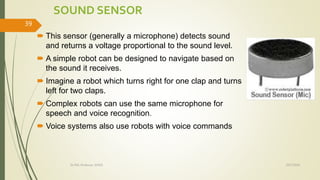
speech and voice recognition.
 Voice systems also use robots with voice commands
10/7/2020Dr.PSK, Professor, SVSCE
39
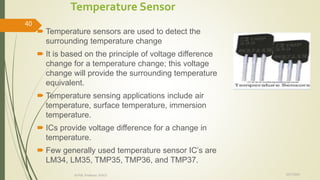
Temperature Sensor
 Temperature sensors are used to detect the
surrounding temperature change
 It is based on the principle of voltage difference
change for a temperature change; this voltage
change will provide the surrounding temperature
equivalent.
 Temperature sensing applications include air
temperature, surface temperature, immersion
temperature.
 ICs provide voltage difference for a change in
temperature.
 Few generally used temperature sensor IC’s are
LM34, LM35, TMP35, TMP36, and TMP37.
10/7/2020Dr.PSK, Professor, SVSCE
40
Tactile Sensors
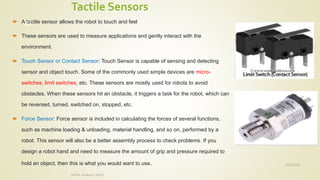
 A tactile sensor allows the robot to touch and feel
 These sensors are used to measure applications and gently interact with the
environment.
 Touch Sensor or Contact Sensor: Touch Sensor is capable of sensing and detecting
sensor and object touch. Some of the commonly used simple devices are micro-
switches, limit switches, etc. These sensors are mostly used for robots to avoid
obstacles. When these sensors hit an obstacle, it triggers a task for the robot, which can
be reversed, turned, switched on, stopped, etc.
 Force Sensor: Force sensor is included in calculating the forces of several functions,
such as machine loading & unloading, material handling, and so on, performed by a
robot. This sensor will also be a better assembly process to check problems. If you
design a robot hand and need to measure the amount of grip and pressure required to
hold an object, then this is what you would want to use. 10/7/2020
Dr.PSK, Professor, SVSCE
41
Positioning Sensors
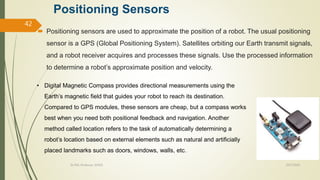
 Positioning sensors are used to approximate the position of a robot. The usual positioning
sensor is a GPS (Global Positioning System). Satellites orbiting our Earth transmit signals,
and a robot receiver acquires and processes these signals. Use the processed information
to determine a robot’s approximate position and velocity.
10/7/2020Dr.PSK, Professor, SVSCE
42
• Digital Magnetic Compass provides directional measurements using the
Earth’s magnetic field that guides your robot to reach its destination.
Compared to GPS modules, these sensors are cheap, but a compass works
best when you need both positional feedback and navigation. Another
method called location refers to the task of automatically determining a
robot’s location based on external elements such as natural and artificially
placed landmarks such as doors, windows, walls, etc.
Proximity Sensor
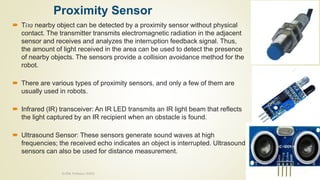
 The nearby object can be detected by a proximity sensor without physical
contact. The transmitter transmits electromagnetic radiation in the adjacent
sensor and receives and analyzes the interruption feedback signal. Thus,
the amount of light received in the area can be used to detect the presence
of nearby objects. The sensors provide a collision avoidance method for the
robot.
 There are various types of proximity sensors, and only a few of them are
usually used in robots.
 Infrared (IR) transceiver: An IR LED transmits an IR light beam that reflects
the light captured by an IR recipient when an obstacle is found.
 Ultrasound Sensor: These sensors generate sound waves at high
frequencies; the received echo indicates an object is interrupted. Ultrasound
sensors can also be used for distance measurement.
10/7/2020
Dr.PSK, Professor, SVSCE
43
Acceleration Sensor
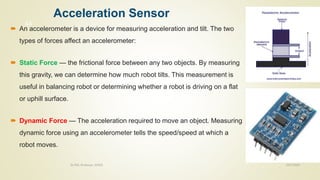
 An accelerometer is a device for measuring acceleration and tilt. The two
types of forces affect an accelerometer:
 Static Force — the frictional force between any two objects. By measuring
this gravity, we can determine how much robot tilts. This measurement is
useful in balancing robot or determining whether a robot is driving on a flat
or uphill surface.
 Dynamic Force — The acceleration required to move an object. Measuring
dynamic force using an accelerometer tells the speed/speed at which a
robot moves.
10/7/2020Dr.PSK, Professor, SVSCE
44
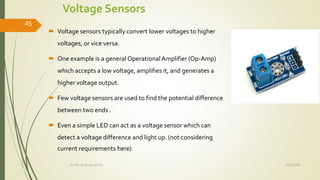
Voltage Sensors
 Voltage sensors typically convert lower voltages to higher
voltages, or vice versa.
 One example is a general OperationalAmplifier (Op-Amp)
which accepts a low voltage, amplifies it, and generates a
higher voltage output.
 Few voltage sensors are used to find the potential difference
between two ends .
 Even a simple LED can act as a voltage sensor which can
detect a voltage difference and light up. (not considering
current requirements here)
10/7/2020Dr.PSK, Professor, SVSCE
45
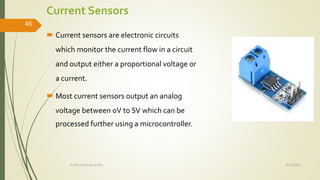
Current Sensors
 Current sensors are electronic circuits
which monitor the current flow in a circuit
and output either a proportional voltage or
a current.
 Most current sensors output an analog
voltage between 0V to 5V which can be
processed further using a microcontroller.
10/7/2020Dr.PSK, Professor, SVSCE
46
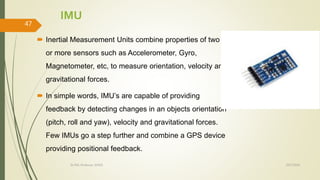
IMU
 Inertial Measurement Units combine properties of two
or more sensors such as Accelerometer, Gyro,
Magnetometer, etc, to measure orientation, velocity and
gravitational forces.
 In simple words, IMU’s are capable of providing
feedback by detecting changes in an objects orientation
(pitch, roll and yaw), velocity and gravitational forces.
Few IMUs go a step further and combine a GPS device
providing positional feedback.
10/7/2020Dr.PSK, Professor, SVSCE
47
10/7/2020
Dr.PSK, Professor, SVSCE
48
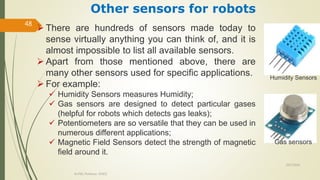
 There are hundreds of sensors made today to
sense virtually anything you can think of, and it is
almost impossible to list all available sensors.
 Apart from those mentioned above, there are
many other sensors used for specific applications.
 For example:
 Humidity Sensors measures Humidity;
 Gas sensors are designed to detect particular gases
(helpful for robots which detects gas leaks);
 Potentiometers are so versatile that they can be used in
numerous different applications;
 Magnetic Field Sensors detect the strength of magnetic
field around it.
Other sensors for robots
Gas sensors
Humidity Sensors
10/7/2020Dr.PSK, Professor, SVSCE
49
Conclusion
 A simple obstacle avoider robot can be built using a couple of
photoresistors, or an infrared sensor.
 The more complex your robot gets, the more number of sensors you
tend to use.
 A single task may require a combination of different sensors, or different
tasks can be achieved using a single sensor.
 Sometimes, a task can be performed from any of the many available
sensors.
 Decide the best sensor based on availability, cost and ease of use.
10/7/2020Dr.PSK, Professor, SVSCE
50

Lithography 7.10.2020

  • 1.
    Dr.P.Senthilkumar, Professor, Department of MechanicalEngineering, SVS College of Engineering, Coimbatore
  • 2.
    OutLine of MyTalk What is lithography Photolithography Electron beam lithography Nanolithography X-ray lithography AFM nanolithography Soft lithography Nanoimprint lithography Dip-pen nanolithography 10/7/2020Dr.PSK, Professor, SVSCE 2 Lithography Sensors in Robotics What is the use of sensors in Robots? Light sensors Sound Sensor Temperature Sensor Tactile Sensors Positioning Sensors Proximity Sensor Acceleration Sensor
  • 3.
    What is Lithography 10/7/2020Dr.PSK,Professor, SVSCE 3 Lithography comes from the Greek word, lithos, means "stone“ and graphein, means "to write”.  Lithography depend on the fact that water and grease repel.  This method was invented in 1796 by German author and actor Alois Senefelder as a cheap method of publishing art work on paper or to print text.  In this a pattern drawn onto a flat limestone and than paint the printing ink onto the stone. While the stone background absorbs water, the greasy substance holds wet ink on top.  Press paper against the stone to transfer the pattern.  In the 20 th and 21 st century, it becomes an important technique with unique dramatic capabilities in the Art field.  Many techniques of lithography have been developed in the last half a century with various lens systems and exposure radiation sources including photons, X-rays, electrons, ions and neutral atoms.  Photolithography is the most widely used technique in microelectronic fabrication, particularly for mass production of integrated circuits.
  • 4.
    Photolithography Photolithography is theprocess of transferring geometric shapes on a mask to the surface of a silicon wafer. Photolithography Steps: 1) Wafer Cleaning: In the first step, the wafers are chemically cleaned to remove organic, ionic, and metallic impurities. 2) Barrier Layer Formation: After cleaning, silicon dioxide, which serves as a barrier layer, is deposited on the surface of the wafer. 3) Photoresist Application: Photoresist is applied to the surface of the wafer by high-speed centrifugal spinning. This technique, known as "Spin Coating," produces a thin uniform layer of photoresist on the wafer surface. In this process a liquid solution of photoresist is give out from the wafer by rapid spin and produce uniform thin layer (0.5µm to 2.5µm). Spin coating/ spinner typically runs at 1200rpm to 4800rpm for 30sec to 60sec. Chemicals commonly use as photoresist are; Poly methyl methacrylate (PMMA) Poly methyl glutarimide (PMGI) Phenol formaldehyde resin (DNQ /Novolac) 10/7/2020 Dr.PSK, Professor, SVSCE 4
  • 5.
    a) Positive Photoresist: Positivephotoresists is exposed to UV light, the underlying material is to be removed. In these resists, exposure to the UV light changes the chemical structure of the resist so that it becomes more soluble in the developer. The exposed resist is then washed away by the developer solution. In other words, "whatever shows, goes." b) Negative Photoresist: Negative photoresists behave in just the opposite manner. Exposure to the UV light causes the negative resist to become polymerized, and more difficult to dissolve. Therefore, the negative resist remains on the surface wherever it is exposed, and the developer solution removes only the unexposed portions. 4) Prebaking: Prebaking is the step during which almost all of the solvents are removed from the photoresist. The photoresist become photosensitive after prebaking. Photoresist is prebake at 90Co to 100Co for 5min to 30min. 5) Mask Alignment and Exposure: A mask or "photo mask" is a square glass plate with a patterned combination of metal film on one side pattern transferred onto the wafer surface. There are three primary exposure methods: contact, proximity, and projection. They are shown in the figure below. 10/7/2020Dr.PSK, Professor, SVSCE 5
  • 6.
     Contact Printing: Incontact printing wafer is brought into physical contact with photo mask. Because of the contact between the resist and mask, very high resolution is possible. The problem with contact printing is that fragments trapped between the resist and the mask, can damage the mask and cause defects in the pattern.  Proximity Printing: The proximity exposure method is similar to contact printing except that a small gap, 10 to 25 microns wide is maintained between the wafer and the mask. This gap minimizes (but may not eliminate) mask damage. Approximately 2 to 4 micron resolution is possible with proximity printing.  Projection Printing: Projection printing avoids mask damage entirely. An image of the patterns on the mask is projected onto the wafer, which is many centimetres away. To achieve high resolution, only a small portion of the mask is imaged it has about 1-micron resolution. 10/7/2020Dr.PSK, Professor, SVSCE 6
  • 7.
    6) Development: Development isa process in which exposed/non-exposed area is dissolved by developer. Most commonly used developer is tetra methyl ammonium hydroxide (TMAH) is used in concentrations of 2.38 - 2.62 %. Developer is important in controlling the development uniformity. Therefore two methods are mainly used i.e. spin development and spray development. During spin development wafers are spin and developer is poured onto the rotating wafer. In spray development, the developer is sprayed rather than poured, on the wafer by using a nozzle that produces a fine spray over the wafer. 7) Hard-Baking: The hard bake is used to harden the final resist image at the temperature (120°C - 150°C), so that it will hold out the harsh environments of etching. 8) Etching: Etching is performed either using wet chemicals such as acids, or more commonly in a dry etching (by exposing the material to a bombardment of ions) . The photoresist will “resists” the etching and protects the material covered by the resist. When the etching is complete, the resist is stripped leaving the desired pattern. 9. Stripping: After the imaged wafer has been etched the remaining photoresist must be removed. There are two classes of stripping techniques; wet stripping and dry stripping. A simple example of stripper is acetone. Acetone tends to leave residues on the wafer. Most commercial organic strippers are phenol-based. 10/7/2020 Dr.PSK, Professor, SVSCE 7
  • 8.
    Applications of Photolithography Main application: IC designing process  Other applications: Printed electronic board, nameplate and printer plate. 10/7/2020Dr.PSK, Professor, SVSCE 8
  • 9.
    Electron Beam Lithographyis a specialized technique for creating extremely fine patterns. It is derived from the scanning electron microscope. Electron beams diameter. can be focused to a few nanometres in The basic idea behind electron beam lithography is identical to optical lithography. The substrate is coated with a thin layer of resist, which is chemically changed under exposure to the electron beam, so that the exposed/non-exposed areas can solvent. be dissolved in a specific Electron beam lithography is the most power nm. full tool for the fabrication of feathers as small as 3nm to 5 Electron Beam Lithography 10/7/2020Dr.PSK, Professor, SVSCE 9
  • 10.
    The EBL systemis normally referred to as the column. An EBL column (Fig. 4) typically consists of following components;  Electron source: Electrons may be emitted from a conducting material either by heating or by applying an electricfield. Stigmators: A stigmator is a special type of lens used for the alignment of e-beam. Stigmators may be either electrostatic or magnetic and consist of four or more poles. Electron Lenses: Electron lenses can be made only to converge, not diverge. Electrons can be focused either by electrostatic forces or magnetic forces.  Apertures: Apertures are small holes through which the beam passes on its way down the column. There are several types of apertures. A blanking aperture is used to turn the beam on and off. A beam limiting aperture has two effects: it sets the beam convergence angle through which electrons can pass through the system, controlling the effect of lens aberrations and thus resolution.  Blanking Plates: Blanking plates are use to modify the e-beam, these are simple electrostatic deflector. One or both of the plates are connected to a amplifier with a fast response time. 10/7/2020 Dr.PSK, Professor, SVSCE 10
  • 11.
     Print complexpatterns directly on wafers  Eliminates the diffraction problem  High resolution up to 20 nm (photolithography ~50nm)  Flexible technique  Slower than optical lithography (approximately 5 wafers / hour at less than 0.1 µ resolution).  Expensive and complicated  Forward scattering  Backward scattering  Secondary electrons Advantages of EBL Disadvantages 10/7/2020Dr.PSK, Professor, SVSCE 11
  • 12.
    Electron beam Lithography(EBL) is used primarily for two purposes  Very high resolution lithography.  Fabrication of masks. Application of EBL 10/7/2020Dr.PSK, Professor, SVSCE 12
  • 13.
    Nanolithography  Nanolithography concernswith the study and application of nanometre-scale structures.  Nanolithography is derived from the Greek words “nanos”, meaning (dwarf) “lithos”, meaning (rock or stone) and “graphein” meaning (to write).  Therefore the correct translation is "tiny writing on stone“.  Nanolithography is used e.g. during the nanofabrication of semiconductor integrated circuits (nanocircuitry), for nanoelectromechanical systems (NEMS) or for almost any other fundamental application across various scientific disciplines in nanoresearch. This method is different to various existing nanolithography techniques like; X-ray lithography Atomic Force Microscope (AFM) nanolithography. Soft lithography Nanoimprint lithography (NIL). Dip-pen (DPN) nanolithography NANOCIRCUITRY 10/7/2020 Dr.PSK, Professor, SVSCE 13
  • 14.
    X-ray lithography X-rays havingwavelengths of 0.04nm to 0.5 nm represent another radiation source for high-resolution design reproduction into polymeric resist materials. X-ray lithography was first demonstrated to obtain high-resolution designs using X-ray proximity printing by Spears and Smith. X-ray lithography can be extended optical resolution of 15 nm. Essential elements in X-ray lithography  A mask consisting of a pattern made with an X-ray absorbing material on a thin X-ray transparent membrane.  An X-ray source of sufficient brightness.  An X-ray sensitive resist material. 10/7/2020Dr.PSK, Professor, SVSCE 14
  • 15.
    X-Ray Lithography Cont… TheX-rays illuminate a mask placed in proximity of a resist-coated wafer. The X-rays are typically from synchrotron radiation source, allowing rapid exposure. X-ray lithography is expensive, because of the expense of operating a synchrotron. The actual operating expenses without considering the initial investment of tens-of-millions of dollars. Therefore, the LIGA process was developed to reduce the dependency on a synchrotron. LIGA is the abbreviation from the German words, “Lithographie” (Lithography), “Galvanik” (Electroplating), & “Abformung” (Molding).10/7/2020Dr.PSK, Professor, SVSCE 15
  • 16.
    X-Ray Lithography Steps1.Irradiation: The first step in x- ray lithography is irradiation which involves exposing a thick layer of resist to high- energy beam of x-rays from a synchrotron. The mask membrane is normally a low atomic number material such as diamond, beryllium, or a thin membrane of a higher atomic number material such as silicon or silicon carbide. 2. Development: In this step the pattern is etched into the resist substrate by the use of x- rays. 3. Electroforming: Electroforming is the same as electroplating. Electroforming suggests that the plating is used to create an actual metal component. 4. Mould insert: A chemical solvent PMMA (poly methyl methacrylate) C5O2H8 is used to dissolve material, resulting model of the mask pattern. After removal of the resist, a freestanding metal structure is produced. 5. Mould filling: The metal structure may be a final product, or serve as a mold insert for precision plastic moulding. 6. Mould releases: The plastic mold retains the same shape, size, and form as the original resist structure but is produced quickly. Moulded plastic parts may then be final product. 10/7/2020 Dr.PSK, Professor, SVSCE 16
  • 17.
    Advantages of X-RayLithography  Short wavelength from X-rays 0.4-4 nm  No diffraction effect  Simple to use  No lens  Faster than EBL  Uniform refraction pattern  High resolution for small feature size Disadvantages of X-Ray Lithography  Thin lens  Distortion in absorber  Cannot be focused through lens  Masks are expensive to produce 10/7/2020 Dr.PSK, Professor, SVSCE 17
  • 18.
    Application of X-RayLithography X-ray lithography is primarily used in nanolithography 15 nm optical resolution Utilizes short wavelength of 1 nm Requires no lenses Allows for small feature size X-ray lithography 10/7/2020Dr.PSK, Professor, SVSCE 18
  • 19.
    Atomic Force MicroscopeLithography AFM nanolithography is a tool for materials structuring and designing with nanometre precision, AFM was invented in 1986. AFM can be used to study both insulating and conducting materials, and can be operated in liquid, air or vacuum AFM nanolithography design a wide range of materials including metals, semiconductors, polymers and biological molecules in different media. AFM 10/7/2020Dr.PSK, Professor, SVSCE 19
  • 20.
    Working Principle ofAFM  The working principle of AFM nanolithography is based on the interaction between the probe and substrate. In AFM a tiny cantilever with a sharp tip is scanned across a surface. The interaction between the surface and the tip cause the cantilever to bend and the bending is monitored using a laser beam. In this way, nanometer changes in height can be measured and used to generate a three dimensional image of the surface.  The typical radius of curvature of the probe is 20– 60 nm, and the probe–substrate separation in close contact condition is <1 nm. AFM exactly feels the surface. AFM is a nanoscale game of blind man’s buff! 10/7/2020 Dr.PSK, Professor, SVSCE 20
  • 21.
    Three Modes OfOperation  Contact mode (static mode): AFM tip makes soft physical contact with the sample. The tip is attached to the end of a cantilever with a low spring constant. The contact force causes the cantilever to bend to accommodate changes in topography.  Intermittent contact mode (Tapping mode): The cantilever is driven to oscillate up and down. The amplitude of this oscillation is greater than 10nm, typically 100 to 200nm.  Non-contact (NC) mode (Dynamic mode): The cantilever is vibrated near but not contact to the sample surface at a frequency slightly above its resonance frequency (typically, 100 -400 kHz) ) where its amplitude is typically a few nm. 10/7/2020Dr.PSK, Professor, SVSCE 21
  • 22.
    Conclusions AFM is theversatile tool for investigate; Topography of surface. Properties of surface. Properties of single molecules. Force within molecules. 10/7/2020Dr.PSK, Professor, SVSCE 22
  • 23.
    Soft Lithography (Micro-contactprinting) Soft lithography has been developed as an alternative to photolithography and a replication technology for both micro and nanofabrication. Soft lithography uses the designs on a PDMS (poly dimethyl siloxane) stamp. This technique has wide range of application in cell biology, microelectronics, surface chemistry, micromachining, Designing cells, Designing DNA and Designing protein. 10/7/2020Dr.PSK, Professor, SVSCE 23
  • 24.
    Nanoimprint Lithography (NIL) Nano-imprintlithography (NIL) is a lithography technique that combines the speed of optical lithography with the resolution of EBL, we use NIL to make nanostructured substrates. Special stamps contain the nanoscale designs to be fabricated on the substrate fig: a). The stamps are pressed into a polymeric material (resist) that was previously deposited on the substrate fig: b). When the stamp is filled with polymer, it is treated by UV light through the stamp, obtaining the stamps shape fig: c). A residual layer of resist is left and can be removed fig:d). A metal layer can be deposited on the sample as shown infig:e) When the resist is removed, the nanoscale metal structuresare left on the substrate fig: f). 10/7/2020 Dr.PSK, Professor, SVSCE 24
  • 25.
    Applications It can beused to make optical, photonic, electrical and biological devices. Advances in mould manufacturing will have wide application of NIL in smaller devices. Nano-imprint lithography 10/7/2020Dr.PSK, Professor, SVSCE 25
  • 26.
    Dip-pen Nanolithography DPN isan new AFM based direct write soft-lithography technique, which is used to create nanostructures on a substrate of interest by delivering collections of molecules thiols (are the sulfur equivalent of alcohols, and the word is a combination of "thio "+"alcohol,“) via capillary transport from an AFM tip to a surface gold. In DPN the tip of AFM cantilever as a “pen,” which is coated with chemical compound acting as an “ink,” and put in contact with substrate, the “paper” Note that "liquid inks" are governed by a very different deposition mechanism when compared to "molecular inks". Molecular ink diffusing from a nanoscale tip to a surface through a water meniscus. 10/7/2020 Dr.PSK, Professor, SVSCE 26
  • 27.
    Applications DPN is speciallyadvantageous to bio molecular guidance. DNA and protein arrays are being fabricated as detection chips. DPN resolution is four to five orders of magnitude greater than other lithographic techniques. 10/7/2020Dr.PSK, Professor, SVSCE 27
  • 28.
    Microlithography and Nanolithographyrefer specifically to lithographic patterning methods capable of structuring material on a fine scale. Typically, features smaller than 10 micrometer are considered microlithographic, and features smaller than 100 nanometer are considered nanolithographic. Nanolithography manufacturing tchnologies with capabilities of deposition at the atomic level. It is used to reduce the size of the sensors. 10/7/2020Dr.PSK, Professor, SVSCE 28
  • 29.
  • 30.
    What is theuse of sensors in Robots?  A sensor is a window for a robot to the environment  Sensors allow robots to understand and measure the geometric and physical properties of objects in their surrounding environment, such as position, orientation, velocity, acceleration, distance, size, force, moment, temperature, luminance, weight, etc.  They send signals to the processor.  For example: A security alarm system may have an infrared sensor which sends a signal when the beam is broken. 10/7/2020 Dr.PSK, Professor, SVSCE 30
  • 31.
    Robot sensor Robot  Arobot is a machine-especially one programmable by a computer-capable of carrying out a complex series of actions automatically Robotic Sensor:  A device that can detect physical signal and convert into electrical signal.  Robotic sensors are used to estimate a robot's condition and environment.  These signals are passed to a controller to enable appropriate behavior. 10/7/2020Dr.PSK, Professor, SVSCE 31
  • 32.
    Sensor Classification Sensors aregenerally classified into two groups:  Internal sensors and external sensors. Internal sensors such as its position sensor, velocity sensor, acceleration sensors, motor torque sensor, etc obtain the information about the robot itself, External sensors such as cameras, range sensors (IR sensor, laser range finder, and ultrasonic sensor) contact and proximity sensors (photodiode, IR detector, RFID, touch, etc.) and force sensors gather the information in the surrounding environment. 10/7/2020Dr.PSK, Professor, SVSCE 32
  • 33.
    Types of roboticsensor Light sensors. Sound Sensor. Temperature Sensor. Tactile Sensor. Position Sensor. Proximity Sensor. Acceleration sensor. Distance Sensor. Pressure Sensors. ... Voltage sensor Current sensor IMU Sensor 10/7/2020 Dr.PSK, Professor, SVSCE 33
  • 34.
    TYPES OF LIGHTSENSOR  VEX light sensor  LEGO light sensor  Light Sensor 1000 lux  SCI-BOX Light Detector  TAOS TSL235R Light to Frequency Converter  Parallax QTI Sensor  DF Robot Ambient Light Sensor  Arduino Lily Pad light sensor  DF Robot BH1750 light sensor  CdS photoconductive cell Light sensors A Light sensor is used to detect light and create a voltage difference. The two main light sensors generally used in robots are photoresistor and Photovoltaic cells. Other light sensors like phototubes, phototransistors, CCDs (charge-coupled device) , etc. are rarely used. 10/7/2020Dr.PSK, Professor, SVSCE 34
  • 35.
    10/7/2020 Dr.PSK, Professor, SVSCE 35 a)A photoresistor is a type of resistor whose resistance varies with light intensity changes; more light leads to less resistance, and less light leads to more resistance. They can be easily implemented in light-dependent robots. b) Photovoltaic cells convert solar radiation into electricity. This is especially helpful when planning a solar robot. While the photovoltaic cell is considered as an energy source, a smart implementation combined with transistors and capacitors can convert this into a sensor. 2D & 3D Vision: A standard 2D machine vision image is flat, calibrated to measure length and width, but does not provide any height information. 3D vision allows a robot to detect the orientation of a part that needs handling more effectively, even if the location and position of the components vary. A 3D vision system can accurately guide a robotic arm during assembly, while a robotic arm can provide multiple viewing angles for critical assembly inspection.
  • 36.
     VEX lightsensor: The light sensor fromVEX is one of the simplest light sensors which can be used in robotics to allow a robot to detect the light  LEGO light sensor: The LEGO light sensor is designed to fit perfectly into a LEGO robot. It can be used to improve the robot vision and is perfect for light detection, light intensity and to distinguish between a light or dark environment  Light Sensor 1000 lux: The light sensor from Phidgets can measure the visible light spectrum of the human eye between 1 to 1000 lux. Output signal is analog, has a current consumption of 2 mA and an error of 5% 10/7/2020Dr.PSK, Professor, SVSCE 36
  • 37.
     SCI-BOX LightDetector: SCI-BOX light detector is used to detect ambient light density. SCI-BOX has two different voltage outputs and works with a photo resistor.  TAOS TSL235R Light to Frequency Converter: The TSL235R from TAOS is a sensor that measures light intensity and its output is frequency. It can communicate with a microcontroller or other logic circuitry.  Parallax QTI Sensor: The output signal can be both analog and digital. This sensor can be successfully used in robots to follow a line or for navigation. 10/7/2020Dr.PSK, Professor, SVSCE 37
  • 38.
     DFRobot AmbientLight Sensor: Ambient light sensor from DFRobot has an analog output value between 0 to 5 Vdc directly proportional to light intensity  Arduino LilyPad light sensor: Arduino LilyPad is a sensor specifically designed for use with Arduino Lilypad mainboard and can be emulated perfectly on any project in robotics.  DFRobot BH1750 light sensor: BH1750 is one of the best performing light sensors with a high resolution of 1 to 65535 lux. Works equally well in low light and in sunlight.  CdS photoconductive cell: The photoconductive cellis a basic electronic component, both small and simple, that can be integrated into a variety of applications 10/7/2020Dr.PSK, Professor, SVSCE 38
  • 39.
    SOUND SENSOR  Thissensor (generally a microphone) detects sound and returns a voltage proportional to the sound level.  A simple robot can be designed to navigate based on the sound it receives.  Imagine a robot which turns right for one clap and turns left for two claps.  Complex robots can use the same microphone for speech and voice recognition.  Voice systems also use robots with voice commands 10/7/2020Dr.PSK, Professor, SVSCE 39
  • 40.
    Temperature Sensor  Temperaturesensors are used to detect the surrounding temperature change  It is based on the principle of voltage difference change for a temperature change; this voltage change will provide the surrounding temperature equivalent.  Temperature sensing applications include air temperature, surface temperature, immersion temperature.  ICs provide voltage difference for a change in temperature.  Few generally used temperature sensor IC’s are LM34, LM35, TMP35, TMP36, and TMP37. 10/7/2020Dr.PSK, Professor, SVSCE 40
  • 41.
    Tactile Sensors  Atactile sensor allows the robot to touch and feel  These sensors are used to measure applications and gently interact with the environment.  Touch Sensor or Contact Sensor: Touch Sensor is capable of sensing and detecting sensor and object touch. Some of the commonly used simple devices are micro- switches, limit switches, etc. These sensors are mostly used for robots to avoid obstacles. When these sensors hit an obstacle, it triggers a task for the robot, which can be reversed, turned, switched on, stopped, etc.  Force Sensor: Force sensor is included in calculating the forces of several functions, such as machine loading & unloading, material handling, and so on, performed by a robot. This sensor will also be a better assembly process to check problems. If you design a robot hand and need to measure the amount of grip and pressure required to hold an object, then this is what you would want to use. 10/7/2020 Dr.PSK, Professor, SVSCE 41
  • 42.
    Positioning Sensors  Positioningsensors are used to approximate the position of a robot. The usual positioning sensor is a GPS (Global Positioning System). Satellites orbiting our Earth transmit signals, and a robot receiver acquires and processes these signals. Use the processed information to determine a robot’s approximate position and velocity. 10/7/2020Dr.PSK, Professor, SVSCE 42 • Digital Magnetic Compass provides directional measurements using the Earth’s magnetic field that guides your robot to reach its destination. Compared to GPS modules, these sensors are cheap, but a compass works best when you need both positional feedback and navigation. Another method called location refers to the task of automatically determining a robot’s location based on external elements such as natural and artificially placed landmarks such as doors, windows, walls, etc.
  • 43.
    Proximity Sensor  Thenearby object can be detected by a proximity sensor without physical contact. The transmitter transmits electromagnetic radiation in the adjacent sensor and receives and analyzes the interruption feedback signal. Thus, the amount of light received in the area can be used to detect the presence of nearby objects. The sensors provide a collision avoidance method for the robot.  There are various types of proximity sensors, and only a few of them are usually used in robots.  Infrared (IR) transceiver: An IR LED transmits an IR light beam that reflects the light captured by an IR recipient when an obstacle is found.  Ultrasound Sensor: These sensors generate sound waves at high frequencies; the received echo indicates an object is interrupted. Ultrasound sensors can also be used for distance measurement. 10/7/2020 Dr.PSK, Professor, SVSCE 43
  • 44.
    Acceleration Sensor  Anaccelerometer is a device for measuring acceleration and tilt. The two types of forces affect an accelerometer:  Static Force — the frictional force between any two objects. By measuring this gravity, we can determine how much robot tilts. This measurement is useful in balancing robot or determining whether a robot is driving on a flat or uphill surface.  Dynamic Force — The acceleration required to move an object. Measuring dynamic force using an accelerometer tells the speed/speed at which a robot moves. 10/7/2020Dr.PSK, Professor, SVSCE 44
  • 45.
    Voltage Sensors  Voltagesensors typically convert lower voltages to higher voltages, or vice versa.  One example is a general OperationalAmplifier (Op-Amp) which accepts a low voltage, amplifies it, and generates a higher voltage output.  Few voltage sensors are used to find the potential difference between two ends .  Even a simple LED can act as a voltage sensor which can detect a voltage difference and light up. (not considering current requirements here) 10/7/2020Dr.PSK, Professor, SVSCE 45
  • 46.
    Current Sensors  Currentsensors are electronic circuits which monitor the current flow in a circuit and output either a proportional voltage or a current.  Most current sensors output an analog voltage between 0V to 5V which can be processed further using a microcontroller. 10/7/2020Dr.PSK, Professor, SVSCE 46
  • 47.
    IMU  Inertial MeasurementUnits combine properties of two or more sensors such as Accelerometer, Gyro, Magnetometer, etc, to measure orientation, velocity and gravitational forces.  In simple words, IMU’s are capable of providing feedback by detecting changes in an objects orientation (pitch, roll and yaw), velocity and gravitational forces. Few IMUs go a step further and combine a GPS device providing positional feedback. 10/7/2020Dr.PSK, Professor, SVSCE 47
  • 48.
    10/7/2020 Dr.PSK, Professor, SVSCE 48 There are hundreds of sensors made today to sense virtually anything you can think of, and it is almost impossible to list all available sensors.  Apart from those mentioned above, there are many other sensors used for specific applications.  For example:  Humidity Sensors measures Humidity;  Gas sensors are designed to detect particular gases (helpful for robots which detects gas leaks);  Potentiometers are so versatile that they can be used in numerous different applications;  Magnetic Field Sensors detect the strength of magnetic field around it. Other sensors for robots Gas sensors Humidity Sensors
  • 49.
    10/7/2020Dr.PSK, Professor, SVSCE 49 Conclusion A simple obstacle avoider robot can be built using a couple of photoresistors, or an infrared sensor.  The more complex your robot gets, the more number of sensors you tend to use.  A single task may require a combination of different sensors, or different tasks can be achieved using a single sensor.  Sometimes, a task can be performed from any of the many available sensors.  Decide the best sensor based on availability, cost and ease of use.
  • 50.