Gas Chromatography
Presented by: Preeti Choudhary
MSc (Applied Physics)
chaudharypreeti1997@gmail.com
Invention of Chromatography
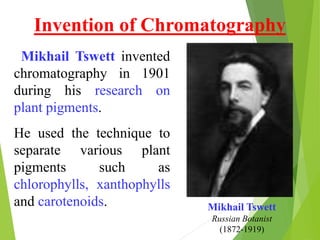
Mikhail Tswett
Russian Botanist
(1872-1919)
Mikhail Tswett invented
chromatography in 1901
during his research on
plant pigments.
He used the technique to
separate various plant
pigments such as
chlorophylls, xanthophylls
and carotenoids.
Original Chromatography Experiment
Later
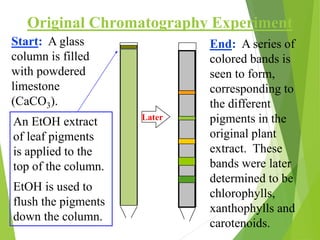
Start: A glass
column is filled
with powdered
limestone
(CaCO3).
End: A series of
colored bands is
seen to form,
corresponding to
the different
pigments in the
original plant
extract. These
bands were later
determined to be
chlorophylls,
xanthophylls and
carotenoids.
An EtOH extract
of leaf pigments
is applied to the
top of the column.
EtOH is used to
flush the pigments
down the column.
Chromatography: (Greek = chroma “color” and
graphein “writing” ) Tswett named this new technique
chromatography based on the fact that it separated the
components of a solution by color.
Common Types of Chromatography
Tswett’s technique is based on Liquid Chromatography.
There are now several common chromatographic
methods. These include:
Paper Chromatography
Thin Layer Chromatography (TLC)
Liquid Chromatography (LC)
High Pressure Liquid Chromatography (HPLC)
Ion Chromatography
Gas Chromatography (GC)
Paper and Thin Layer Chromatography
Later
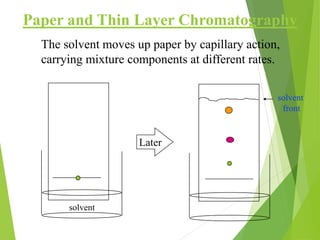
The solvent moves up paper by capillary action,
carrying mixture components at different rates.
solvent
solvent
front
How Does Chromatography Work?
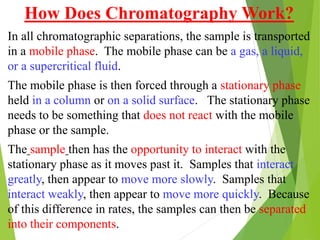
In all chromatographic separations, the sample is transported
in a mobile phase. The mobile phase can be a gas, a liquid,
or a supercritical fluid.
The mobile phase is then forced through a stationary phase
held in a column or on a solid surface. The stationary phase
needs to be something that does not react with the mobile
phase or the sample.
The sample then has the opportunity to interact with the
stationary phase as it moves past it. Samples that interact
greatly, then appear to move more slowly. Samples that
interact weakly, then appear to move more quickly. Because
of this difference in rates, the samples can then be separated
into their components.
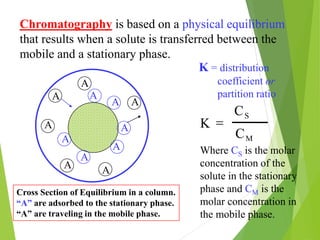
Chromatography is based on a physical equilibrium
that results when a solute is transferred between the
mobile and a stationary phase.
A
A
A
A
A
A
A
A
A
A
A
A
K = distribution
coefficient or
partition ratio
K =
CS
CM
Where CS is the molar
concentration of the
solute in the stationary
phase and CM is the
molar concentration in
the mobile phase.
Cross Section of Equilibrium in a column.
“A” are adsorbed to the stationary phase.
“A” are traveling in the mobile phase.
Flow
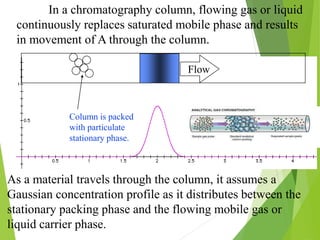
As a material travels through the column, it assumes a
Gaussian concentration profile as it distributes between the
stationary packing phase and the flowing mobile gas or
liquid carrier phase.
In a chromatography column, flowing gas or liquid
continuously replaces saturated mobile phase and results
in movement of A through the column.
Column is packed
with particulate
stationary phase.
Flow
Flow
Flow
Flow
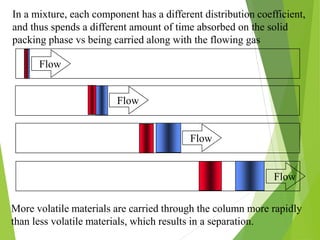
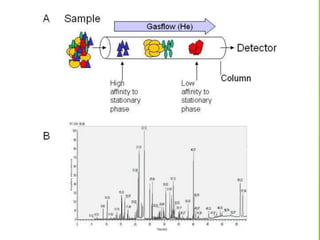
In a mixture, each component has a different distribution coefficient,
and thus spends a different amount of time absorbed on the solid
packing phase vs being carried along with the flowing gas
More volatile materials are carried through the column more rapidly
than less volatile materials, which results in a separation.
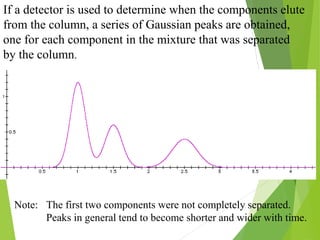
Note: The first two components were not completely separated.
Peaks in general tend to become shorter and wider with time.
If a detector is used to determine when the components elute
from the column, a series of Gaussian peaks are obtained,
one for each component in the mixture that was separated
by the column.
Theoretical plate is a term coined by Martin &
Synge. It is based on a study in which they imagined that
chromatographic columns were analogous to distillation
columns and made up or numerous discrete but connected
narrow layers or plates. Movement of the solute down the
column then could be treated as a stepwise transfer.
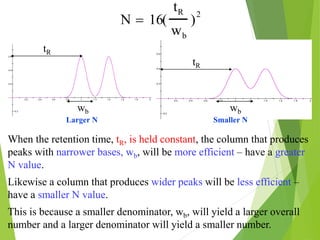
Theoretical plates (N) measure how efficiently a
column can separate a mixture into its components. This
efficiency is based on the retention time of the
components and the width of the peaks.
The Theoretical Plate
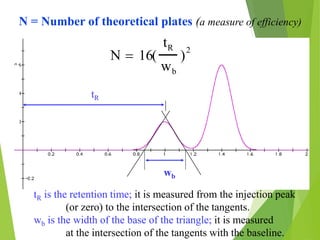
wb
tR
N =16(
tR
wb
)2
N = Number of theoretical plates (a measure of efficiency)
tR is the retention time; it is measured from the injection peak
(or zero) to the intersection of the tangents.
wb is the width of the base of the triangle; it is measured
at the intersection of the tangents with the baseline.
When the retention time, tR, is held constant, the column that produces
peaks with narrower bases, wb, will be more efficient – have a greater
N value.
Likewise a column that produces wider peaks will be less efficient –
have a smaller N value.
This is because a smaller denominator, wb, will yield a larger overall
number and a larger denominator will yield a smaller number.
Larger N Smaller N
tR
tR
wb wb
N =16(
tR
wb
)
2
Gas Chromatography
 Gas chromatography (GC), is a chromatographic technique
that can be used to separate volatile organic compounds.
 In gas chromatography the sample is vaporized and
injected onto the head of a chromatographic column.
Elution is brought about by the flow of an inert gaseous
mobile phase.
 The mobile phase does not interact with molecule of the
analyte. Its only function is to transport the analyte
through the column, hence called carrier gas.
 Gas-liquid chromatography is based upon the partition of
the analyte between a gaseous mobile phase and a liquid
phase immobilized on the surface of an inert solid.
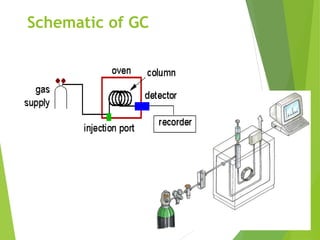
Gas Chromatography (GC)
It consists of
• a flowing mobile phase- carrier gas
• pressure regulators and gauges
• a flow meter
• an injection port
• a separation column (the stationary phase)
• an oven
• a detector
• a recorder
• a display device
Schematic of GC
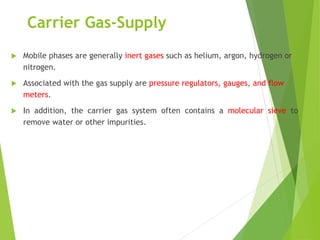
Carrier Gas-Supply
 Mobile phases are generally inert gases such as helium, argon, hydrogen or
nitrogen.
 Associated with the gas supply are pressure regulators, gauges, and flow
meters.
 In addition, the carrier gas system often contains a molecular sieve to
remove water or other impurities.
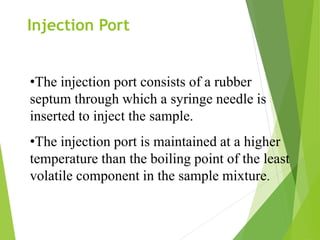
•The injection port consists of a rubber
septum through which a syringe needle is
inserted to inject the sample.
•The injection port is maintained at a higher
temperature than the boiling point of the least
volatile component in the sample mixture.
Injection Port
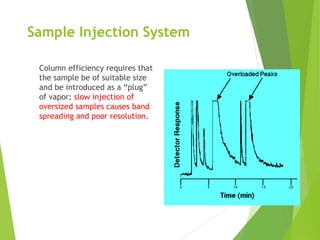
Sample Injection System
Column efficiency requires that
the sample be of suitable size
and be introduced as a “plug”
of vapor; slow injection of
oversized samples causes band
spreading and poor resolution.
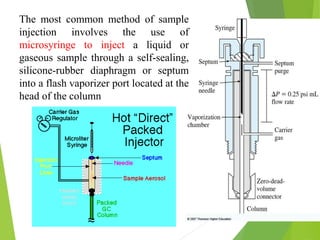
The most common method of sample
injection involves the use of
microsyringe to inject a liquid or
gaseous sample through a self-sealing,
silicone-rubber diaphragm or septum
into a flash vaporizer port located at the
head of the column
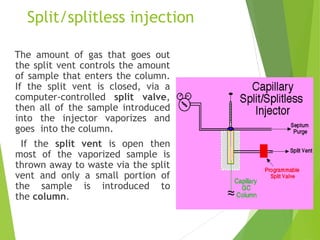
Split/splitless injection
The amount of gas that goes out
the split vent controls the amount
of sample that enters the column.
If the split vent is closed, via a
computer-controlled split valve,
then all of the sample introduced
into the injector vaporizes and
goes into the column.
If the split vent is open then
most of the vaporized sample is
thrown away to waste via the split
vent and only a small portion of
the sample is introduced to
the column.
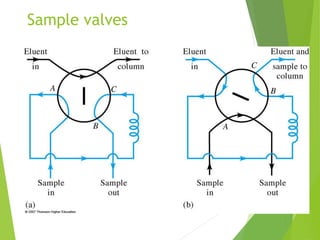
Sample valves
 For quantitative work, more reproducible sample sizes for both liquids and
gases are obtained by means of a rotary sample valve.
 Errors due to sample size can be reduced to 0.5% to 2% relative.
 The sampling loop is filled by injection of an excess of sample.
 Rotation of the valve by 45 deg then introduces the reproducible volume
ACB into the mobile phase.
Sample valves
Column Configurations
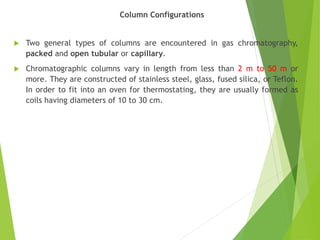
 Two general types of columns are encountered in gas chromatography,
packed and open tubular or capillary.
 Chromatographic columns vary in length from less than 2 m to 50 m or
more. They are constructed of stainless steel, glass, fused silica, or Teflon.
In order to fit into an oven for thermostating, they are usually formed as
coils having diameters of 10 to 30 cm.
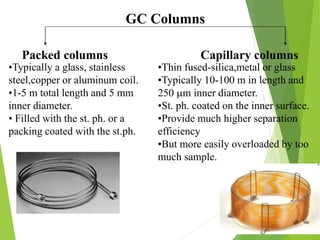
GC Columns
Capillary columns
Packed columns
•Typically a glass, stainless
steel,copper or aluminum coil.
•1-5 m total length and 5 mm
inner diameter.
• Filled with the st. ph. or a
packing coated with the st.ph.
•Thin fused-silica,metal or glass
•Typically 10-100 m in length and
250 mm inner diameter.
•St. ph. coated on the inner surface.
•Provide much higher separation
efficiency
•But more easily overloaded by too
much sample.
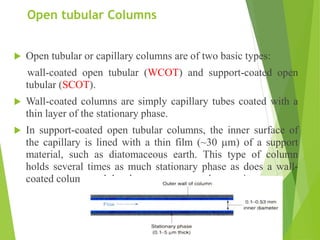
Open tubular Columns
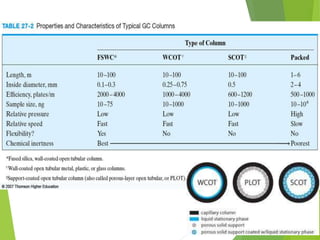
 Open tubular or capillary columns are of two basic types:
wall-coated open tubular (WCOT) and support-coated open
tubular (SCOT).
 Wall-coated columns are simply capillary tubes coated with a
thin layer of the stationary phase.
 In support-coated open tubular columns, the inner surface of
the capillary is lined with a thin film (~30 mm) of a support
material, such as diatomaceous earth. This type of column
holds several times as much stationary phase as does a wall-
coated column and thus has a greater sample capacity.
Since the partitioning behavior is dependent
on temperature, the column is usually
contained in a thermostat-controlled oven.
Separating components with a wide range of
boiling points is accomplished by starting at a
low oven temperature and increasing the
temperature over time to elute the high-boiling
point components. This is called temperature
programming.
Temperature control
Temperature Programming
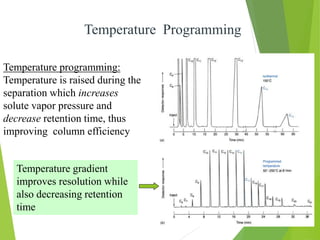
Temperature programming:
Temperature is raised during the
separation which increases
solute vapor pressure and
decrease retention time, thus
improving column efficiency
Temperature gradient
improves resolution while
also decreasing retention
time
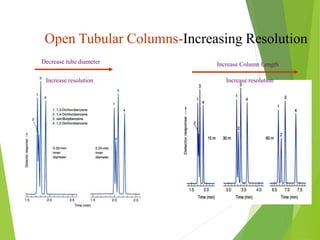
Open Tubular Columns-Increasing Resolution
Decrease tube diameter
Increase resolution
Increase Column Length
Increase resolution
Solid Support Materials
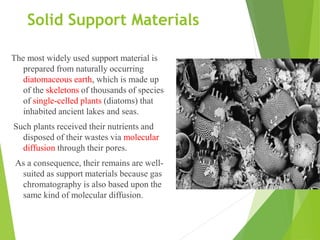
The most widely used support material is
prepared from naturally occurring
diatomaceous earth, which is made up
of the skeletons of thousands of species
of single-celled plants (diatoms) that
inhabited ancient lakes and seas.
Such plants received their nutrients and
disposed of their wastes via molecular
diffusion through their pores.
As a consequence, their remains are well-
suited as support materials because gas
chromatography is also based upon the
same kind of molecular diffusion.
Particle Size of Supports
The efficiency of a gas-chromatographic column increases rapidly with decreasing
particle diameter of the packing.
The pressure difference required to maintain a given flow rate of carrier gas,
however, varies inversely as the square of the particle diameter.
The Stationary Phase
Desirable properties for the immobilized liquid
phase in a gas-liquid chromatographic column
include:
 low volatility (ideally, the boiling point of the
liquid should be 100oC lower than the maximum
operating temperature for the column)
 thermal stability
 chemical inertness
 solvent characteristics such that k` and 
values for the solutes to be resolved fall within a
suitable range.
The retention time for a solute on a column
depends upon its distribution constant which in
turn is related to the chemical nature of the
stationary phase.
The Stationary Phase
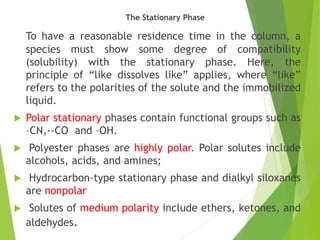
To have a reasonable residence time in the column, a
species must show some degree of compatibility
(solubility) with the stationary phase. Here, the
principle of “like dissolves like” applies, where “like”
refers to the polarities of the solute and the immobilized
liquid.
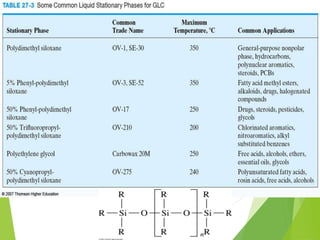
 Polar stationary phases contain functional groups such as
–CN,--CO and –OH.
 Polyester phases are highly polar. Polar solutes include
alcohols, acids, and amines;
 Hydrocarbon-type stationary phase and dialkyl siloxanes
are nonpolar
 Solutes of medium polarity include ethers, ketones, and
aldehydes.
Film Thickness
 Commercial columns are available having stationary
phases that vary in thickness from 0.1 to 5mm. Film
thickness primarily affects the retentive character and
the capacity of a column.
 Thick films are used with highly volatile analytes because
such films retain solutes for a longer time, thus providing
a greater time for separation to take place.
 Thin films are useful for separating species of low
volatility in a reasonable length of time.
 For most applications with 0.26- or 0.32-mm columns, a
film thickness of 0.26 mm is recommended. With
megabore columns, 1- to 1.5 mm films are often used.
Detection Systems
Characteristics of the Ideal Detector: The ideal detector for gas
chromatography has the following characteristics:
1. Adequate sensitivity
2. Good stability and reproducibility.
3. A linear response to solutes that extends over several orders of
magnitude.
4. A temperature range from room temperature to at least 400oC.
Characteristics of the Ideal Detector
5. A short response time that is independent of flow rate.
6. High reliability and ease of use.
7. Similarity in response toward all solutes or a highly selective response
toward one or more classes of solutes.
8. Nondestructive of sample.
GC Detectors
After the components of a mixture are separated using gas
chromatography, they must be detected as they exit the GC
column.
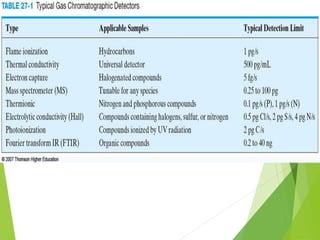
Thermal-conductivity (TCD) and flame ionization (FID)
detectors are the two most common detectors on
commercial GCs.
The others are
1. Atomic-emmision detector (AED)
2. Chemiluminescence detector
3. Electron-capture detector (ECD)
4. Flame-photometric detector (FPD)
5. Mass spectrometer (MS)
6. Photoionization detector (PID)
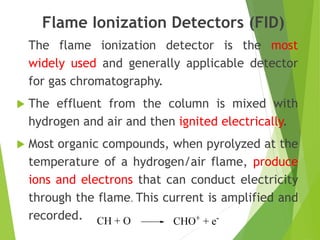
Flame Ionization Detectors (FID)
The flame ionization detector is the most
widely used and generally applicable detector
for gas chromatography.
 The effluent from the column is mixed with
hydrogen and air and then ignited electrically.
 Most organic compounds, when pyrolyzed at the
temperature of a hydrogen/air flame, produce
ions and electrons that can conduct electricity
through the flame. This current is amplified and
recorded.
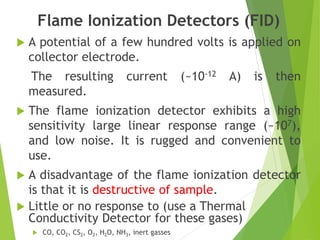
Flame Ionization Detectors (FID)
 A potential of a few hundred volts is applied on
collector electrode.
The resulting current (~10-12 A) is then
measured.
 The flame ionization detector exhibits a high
sensitivity large linear response range (~107),
and low noise. It is rugged and convenient to
use.
 A disadvantage of the flame ionization detector
is that it is destructive of sample.
 Little or no response to (use a Thermal
Conductivity Detector for these gases)
 CO, CO2, CS2, O2, H2O, NH3, inert gasses
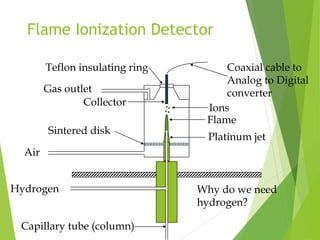
Flame Ionization Detector
Hydrogen
Air
Capillary tube (column)
Platinum jet
Collector
Sintered disk
Teflon insulating ring
Flame
Gas outlet
Coaxial cable to
Analog to Digital
converter
Ions
Why do we need
hydrogen?
Thermal Conductivity Detectors(TCD)
A very early detector for gas chromatography, and
one that still finds wide application, is based upon
changes in the thermal conductivity of the gas
stream brought about by the presence of analyte
molecules.
 The sensing element of TCD or katharometer is
an electrically heated element whose
temperature at constant electrical power depends
upon the thermal conductivity of the surrounding
gas.
 The heated element may be a fine platinum, gold,
or tungsten wire or a semiconducting thermistor.
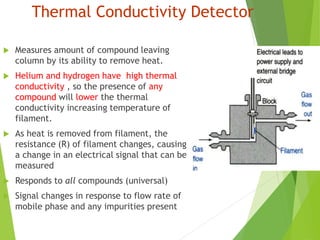
Thermal Conductivity Detector
 Measures amount of compound leaving
column by its ability to remove heat.
 Helium and hydrogen have high thermal
conductivity , so the presence of any
compound will lower the thermal
conductivity increasing temperature of
filament.
 As heat is removed from filament, the
resistance (R) of filament changes, causing
a change in an electrical signal that can be
measured
 Responds to all compounds (universal)
 Signal changes in response to flow rate of
mobile phase and any impurities present
Thermal Conductivity Detector(TCD)
 The advantage of the thermal conductivity detector is its simplicity, its
large linear dynamic range(~105), its general response to both organic and
inorganic species, and its nondestructive character, which permits
collection of solutes after detection.
 A limitation of the katharometer is its relatively low sensitivity.
 Other detectors exceed this sensitivity by factors as large as 104 to 107.
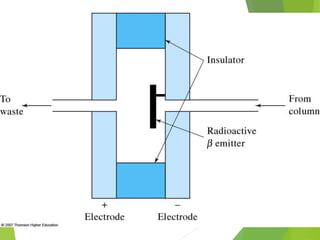
Electron-Capture Detector (ECD)
 The electron-capture detector has become one of the
most widely used detectors for environmental samples
because this detector selectivity detects halogen
containing compounds, such as pesticides and
polychlorinated biphenyls.
 The effluent from the column is passed over a  emitter,
usually nickel-63.
 An electron from the emitter causes ionization of the
carrier gas and the production of a burst of electrons.
 In the absence of organic species, a constant standing
current between a pair of electrodes results from this
ionization process.
 However, in the presence of organic molecules that tend
to capture electrons, the current decreases markedly .
Electron-Capture Detectors(ECD)
 The electron-capture detector is selective in its response being highly
sensitive to molecules containing electronegative functional groups such
as halogens, peroxides, quinones, and nitro groups.
 It is insensitive to functional groups such as amines, alcohols, and
hydrocarbons.
 An important application of the electron-capture detector has been for
the detection and determination of chlorinated insecticides.
Thank-You


Gas Chromatography

  • 1.
    Gas Chromatography Presented by:Preeti Choudhary MSc (Applied Physics) chaudharypreeti1997@gmail.com
  • 2.
    Invention of Chromatography MikhailTswett Russian Botanist (1872-1919) Mikhail Tswett invented chromatography in 1901 during his research on plant pigments. He used the technique to separate various plant pigments such as chlorophylls, xanthophylls and carotenoids.
  • 3.
    Original Chromatography Experiment Later Start:A glass column is filled with powdered limestone (CaCO3). End: A series of colored bands is seen to form, corresponding to the different pigments in the original plant extract. These bands were later determined to be chlorophylls, xanthophylls and carotenoids. An EtOH extract of leaf pigments is applied to the top of the column. EtOH is used to flush the pigments down the column.
  • 4.
    Chromatography: (Greek =chroma “color” and graphein “writing” ) Tswett named this new technique chromatography based on the fact that it separated the components of a solution by color. Common Types of Chromatography Tswett’s technique is based on Liquid Chromatography. There are now several common chromatographic methods. These include: Paper Chromatography Thin Layer Chromatography (TLC) Liquid Chromatography (LC) High Pressure Liquid Chromatography (HPLC) Ion Chromatography Gas Chromatography (GC)
  • 5.
    Paper and ThinLayer Chromatography Later The solvent moves up paper by capillary action, carrying mixture components at different rates. solvent solvent front
  • 6.
    How Does ChromatographyWork? In all chromatographic separations, the sample is transported in a mobile phase. The mobile phase can be a gas, a liquid, or a supercritical fluid. The mobile phase is then forced through a stationary phase held in a column or on a solid surface. The stationary phase needs to be something that does not react with the mobile phase or the sample. The sample then has the opportunity to interact with the stationary phase as it moves past it. Samples that interact greatly, then appear to move more slowly. Samples that interact weakly, then appear to move more quickly. Because of this difference in rates, the samples can then be separated into their components.
  • 7.
    Chromatography is basedon a physical equilibrium that results when a solute is transferred between the mobile and a stationary phase. A A A A A A A A A A A A K = distribution coefficient or partition ratio K = CS CM Where CS is the molar concentration of the solute in the stationary phase and CM is the molar concentration in the mobile phase. Cross Section of Equilibrium in a column. “A” are adsorbed to the stationary phase. “A” are traveling in the mobile phase.
  • 8.
    Flow As a materialtravels through the column, it assumes a Gaussian concentration profile as it distributes between the stationary packing phase and the flowing mobile gas or liquid carrier phase. In a chromatography column, flowing gas or liquid continuously replaces saturated mobile phase and results in movement of A through the column. Column is packed with particulate stationary phase.
  • 9.
    Flow Flow Flow Flow In a mixture,each component has a different distribution coefficient, and thus spends a different amount of time absorbed on the solid packing phase vs being carried along with the flowing gas More volatile materials are carried through the column more rapidly than less volatile materials, which results in a separation.
  • 10.
    Note: The firsttwo components were not completely separated. Peaks in general tend to become shorter and wider with time. If a detector is used to determine when the components elute from the column, a series of Gaussian peaks are obtained, one for each component in the mixture that was separated by the column.
  • 11.
    Theoretical plate isa term coined by Martin & Synge. It is based on a study in which they imagined that chromatographic columns were analogous to distillation columns and made up or numerous discrete but connected narrow layers or plates. Movement of the solute down the column then could be treated as a stepwise transfer. Theoretical plates (N) measure how efficiently a column can separate a mixture into its components. This efficiency is based on the retention time of the components and the width of the peaks. The Theoretical Plate
  • 12.
    wb tR N =16( tR wb )2 N =Number of theoretical plates (a measure of efficiency) tR is the retention time; it is measured from the injection peak (or zero) to the intersection of the tangents. wb is the width of the base of the triangle; it is measured at the intersection of the tangents with the baseline.
  • 13.
    When the retentiontime, tR, is held constant, the column that produces peaks with narrower bases, wb, will be more efficient – have a greater N value. Likewise a column that produces wider peaks will be less efficient – have a smaller N value. This is because a smaller denominator, wb, will yield a larger overall number and a larger denominator will yield a smaller number. Larger N Smaller N tR tR wb wb N =16( tR wb ) 2
  • 14.
    Gas Chromatography  Gaschromatography (GC), is a chromatographic technique that can be used to separate volatile organic compounds.  In gas chromatography the sample is vaporized and injected onto the head of a chromatographic column. Elution is brought about by the flow of an inert gaseous mobile phase.  The mobile phase does not interact with molecule of the analyte. Its only function is to transport the analyte through the column, hence called carrier gas.  Gas-liquid chromatography is based upon the partition of the analyte between a gaseous mobile phase and a liquid phase immobilized on the surface of an inert solid.
  • 16.
    Gas Chromatography (GC) Itconsists of • a flowing mobile phase- carrier gas • pressure regulators and gauges • a flow meter • an injection port • a separation column (the stationary phase) • an oven • a detector • a recorder • a display device
  • 17.
  • 18.
    Carrier Gas-Supply  Mobilephases are generally inert gases such as helium, argon, hydrogen or nitrogen.  Associated with the gas supply are pressure regulators, gauges, and flow meters.  In addition, the carrier gas system often contains a molecular sieve to remove water or other impurities.
  • 19.
    •The injection portconsists of a rubber septum through which a syringe needle is inserted to inject the sample. •The injection port is maintained at a higher temperature than the boiling point of the least volatile component in the sample mixture. Injection Port
  • 20.
    Sample Injection System Columnefficiency requires that the sample be of suitable size and be introduced as a “plug” of vapor; slow injection of oversized samples causes band spreading and poor resolution.
  • 21.
    The most commonmethod of sample injection involves the use of microsyringe to inject a liquid or gaseous sample through a self-sealing, silicone-rubber diaphragm or septum into a flash vaporizer port located at the head of the column
  • 22.
    Split/splitless injection The amountof gas that goes out the split vent controls the amount of sample that enters the column. If the split vent is closed, via a computer-controlled split valve, then all of the sample introduced into the injector vaporizes and goes into the column. If the split vent is open then most of the vaporized sample is thrown away to waste via the split vent and only a small portion of the sample is introduced to the column.
  • 23.
    Sample valves  Forquantitative work, more reproducible sample sizes for both liquids and gases are obtained by means of a rotary sample valve.  Errors due to sample size can be reduced to 0.5% to 2% relative.  The sampling loop is filled by injection of an excess of sample.  Rotation of the valve by 45 deg then introduces the reproducible volume ACB into the mobile phase.
  • 24.
  • 25.
    Column Configurations  Twogeneral types of columns are encountered in gas chromatography, packed and open tubular or capillary.  Chromatographic columns vary in length from less than 2 m to 50 m or more. They are constructed of stainless steel, glass, fused silica, or Teflon. In order to fit into an oven for thermostating, they are usually formed as coils having diameters of 10 to 30 cm.
  • 26.
    GC Columns Capillary columns Packedcolumns •Typically a glass, stainless steel,copper or aluminum coil. •1-5 m total length and 5 mm inner diameter. • Filled with the st. ph. or a packing coated with the st.ph. •Thin fused-silica,metal or glass •Typically 10-100 m in length and 250 mm inner diameter. •St. ph. coated on the inner surface. •Provide much higher separation efficiency •But more easily overloaded by too much sample.
  • 27.
    Open tubular Columns Open tubular or capillary columns are of two basic types: wall-coated open tubular (WCOT) and support-coated open tubular (SCOT).  Wall-coated columns are simply capillary tubes coated with a thin layer of the stationary phase.  In support-coated open tubular columns, the inner surface of the capillary is lined with a thin film (~30 mm) of a support material, such as diatomaceous earth. This type of column holds several times as much stationary phase as does a wall- coated column and thus has a greater sample capacity.
  • 29.
    Since the partitioningbehavior is dependent on temperature, the column is usually contained in a thermostat-controlled oven. Separating components with a wide range of boiling points is accomplished by starting at a low oven temperature and increasing the temperature over time to elute the high-boiling point components. This is called temperature programming. Temperature control
  • 30.
    Temperature Programming Temperature programming: Temperatureis raised during the separation which increases solute vapor pressure and decrease retention time, thus improving column efficiency Temperature gradient improves resolution while also decreasing retention time
  • 31.
    Open Tubular Columns-IncreasingResolution Decrease tube diameter Increase resolution Increase Column Length Increase resolution
  • 32.
    Solid Support Materials Themost widely used support material is prepared from naturally occurring diatomaceous earth, which is made up of the skeletons of thousands of species of single-celled plants (diatoms) that inhabited ancient lakes and seas. Such plants received their nutrients and disposed of their wastes via molecular diffusion through their pores. As a consequence, their remains are well- suited as support materials because gas chromatography is also based upon the same kind of molecular diffusion.
  • 33.
    Particle Size ofSupports The efficiency of a gas-chromatographic column increases rapidly with decreasing particle diameter of the packing. The pressure difference required to maintain a given flow rate of carrier gas, however, varies inversely as the square of the particle diameter.
  • 35.
    The Stationary Phase Desirableproperties for the immobilized liquid phase in a gas-liquid chromatographic column include:  low volatility (ideally, the boiling point of the liquid should be 100oC lower than the maximum operating temperature for the column)  thermal stability  chemical inertness  solvent characteristics such that k` and  values for the solutes to be resolved fall within a suitable range. The retention time for a solute on a column depends upon its distribution constant which in turn is related to the chemical nature of the stationary phase.
  • 36.
    The Stationary Phase Tohave a reasonable residence time in the column, a species must show some degree of compatibility (solubility) with the stationary phase. Here, the principle of “like dissolves like” applies, where “like” refers to the polarities of the solute and the immobilized liquid.  Polar stationary phases contain functional groups such as –CN,--CO and –OH.  Polyester phases are highly polar. Polar solutes include alcohols, acids, and amines;  Hydrocarbon-type stationary phase and dialkyl siloxanes are nonpolar  Solutes of medium polarity include ethers, ketones, and aldehydes.
  • 38.
    Film Thickness  Commercialcolumns are available having stationary phases that vary in thickness from 0.1 to 5mm. Film thickness primarily affects the retentive character and the capacity of a column.  Thick films are used with highly volatile analytes because such films retain solutes for a longer time, thus providing a greater time for separation to take place.  Thin films are useful for separating species of low volatility in a reasonable length of time.  For most applications with 0.26- or 0.32-mm columns, a film thickness of 0.26 mm is recommended. With megabore columns, 1- to 1.5 mm films are often used.
  • 39.
    Detection Systems Characteristics ofthe Ideal Detector: The ideal detector for gas chromatography has the following characteristics: 1. Adequate sensitivity 2. Good stability and reproducibility. 3. A linear response to solutes that extends over several orders of magnitude. 4. A temperature range from room temperature to at least 400oC.
  • 40.
    Characteristics of theIdeal Detector 5. A short response time that is independent of flow rate. 6. High reliability and ease of use. 7. Similarity in response toward all solutes or a highly selective response toward one or more classes of solutes. 8. Nondestructive of sample.
  • 41.
    GC Detectors After thecomponents of a mixture are separated using gas chromatography, they must be detected as they exit the GC column. Thermal-conductivity (TCD) and flame ionization (FID) detectors are the two most common detectors on commercial GCs. The others are 1. Atomic-emmision detector (AED) 2. Chemiluminescence detector 3. Electron-capture detector (ECD) 4. Flame-photometric detector (FPD) 5. Mass spectrometer (MS) 6. Photoionization detector (PID)
  • 43.
    Flame Ionization Detectors(FID) The flame ionization detector is the most widely used and generally applicable detector for gas chromatography.  The effluent from the column is mixed with hydrogen and air and then ignited electrically.  Most organic compounds, when pyrolyzed at the temperature of a hydrogen/air flame, produce ions and electrons that can conduct electricity through the flame. This current is amplified and recorded.
  • 44.
    Flame Ionization Detectors(FID)  A potential of a few hundred volts is applied on collector electrode. The resulting current (~10-12 A) is then measured.  The flame ionization detector exhibits a high sensitivity large linear response range (~107), and low noise. It is rugged and convenient to use.  A disadvantage of the flame ionization detector is that it is destructive of sample.  Little or no response to (use a Thermal Conductivity Detector for these gases)  CO, CO2, CS2, O2, H2O, NH3, inert gasses
  • 45.
    Flame Ionization Detector Hydrogen Air Capillarytube (column) Platinum jet Collector Sintered disk Teflon insulating ring Flame Gas outlet Coaxial cable to Analog to Digital converter Ions Why do we need hydrogen?
  • 46.
    Thermal Conductivity Detectors(TCD) Avery early detector for gas chromatography, and one that still finds wide application, is based upon changes in the thermal conductivity of the gas stream brought about by the presence of analyte molecules.  The sensing element of TCD or katharometer is an electrically heated element whose temperature at constant electrical power depends upon the thermal conductivity of the surrounding gas.  The heated element may be a fine platinum, gold, or tungsten wire or a semiconducting thermistor.
  • 47.
    Thermal Conductivity Detector Measures amount of compound leaving column by its ability to remove heat.  Helium and hydrogen have high thermal conductivity , so the presence of any compound will lower the thermal conductivity increasing temperature of filament.  As heat is removed from filament, the resistance (R) of filament changes, causing a change in an electrical signal that can be measured  Responds to all compounds (universal)  Signal changes in response to flow rate of mobile phase and any impurities present
  • 48.
    Thermal Conductivity Detector(TCD) The advantage of the thermal conductivity detector is its simplicity, its large linear dynamic range(~105), its general response to both organic and inorganic species, and its nondestructive character, which permits collection of solutes after detection.  A limitation of the katharometer is its relatively low sensitivity.  Other detectors exceed this sensitivity by factors as large as 104 to 107.
  • 49.
    Electron-Capture Detector (ECD) The electron-capture detector has become one of the most widely used detectors for environmental samples because this detector selectivity detects halogen containing compounds, such as pesticides and polychlorinated biphenyls.  The effluent from the column is passed over a  emitter, usually nickel-63.  An electron from the emitter causes ionization of the carrier gas and the production of a burst of electrons.  In the absence of organic species, a constant standing current between a pair of electrodes results from this ionization process.  However, in the presence of organic molecules that tend to capture electrons, the current decreases markedly .
  • 51.
    Electron-Capture Detectors(ECD)  Theelectron-capture detector is selective in its response being highly sensitive to molecules containing electronegative functional groups such as halogens, peroxides, quinones, and nitro groups.  It is insensitive to functional groups such as amines, alcohols, and hydrocarbons.  An important application of the electron-capture detector has been for the detection and determination of chlorinated insecticides.
  • 53.