1
Low Power VLSI Design:Low Power VLSI Design:
Challenges and solutionsChallenges and solutions
Dr.S.SaravananDr.S.Saravanan M.E.,PhDM.E.,PhD
HOD/EEE(UG)HOD/EEE(UG)
Muthayammal Engineering CollegeMuthayammal Engineering College
RasipuramRasipuram
12.03.2012
2
AgendaAgenda
 MotivationMotivation
 Introduction To VLSI designIntroduction To VLSI design
 Sources of Power DissipationSources of Power Dissipation
 Low Power Design MethodologiesLow Power Design Methodologies
 Low Power Soc DesignsLow Power Soc Designs
 Low Power Multiplier DesignLow Power Multiplier Design
 Design of Low Power MACDesign of Low Power MAC
 ConclusionsConclusions
12.03.2012
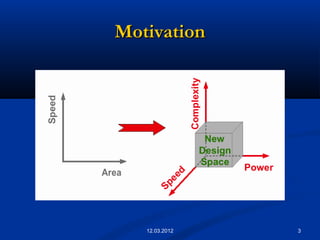
MotivationMotivation
312.03.2012
4
MotivationMotivation
 PORTABLE DEVICES …….Note BookPORTABLE DEVICES …….Note Book
Computers, PDAs, Laptops, Cell Phones,Computers, PDAs, Laptops, Cell Phones,
Pacemaker etc historical drivers of low powerPacemaker etc historical drivers of low power
……..require low power consumption & high……..require low power consumption & high
through putthrough put
12.03.2012
5
Motivation (Contd..)Motivation (Contd..)
• New portable compute-intensive applicationsNew portable compute-intensive applications
* Multi-media* Multi-media
* Video display and capture* Video display and capture
* Audio reproduction & capture* Audio reproduction & capture
* Handwriting recognition* Handwriting recognition
* Notebook computer* Notebook computer
* Personal data assistant* Personal data assistant
* Implantable medical electronics* Implantable medical electronics
12.03.2012
6
Motivation (contd..)Motivation (contd..)
 Why so much of stress on Low Power?Why so much of stress on Low Power?
Portable devices run on batteryPortable devices run on battery
Battery life is limitedBattery life is limited
Energy density of Nickel-MetalEnergy density of Nickel-Metal
Hydride (NiMH) is low@30Wh/lbHydride (NiMH) is low@30Wh/lb
 The battery technology is not improving atThe battery technology is not improving at
the same speed as that of VLSIthe same speed as that of VLSI
12.03.2012
VLSI Chip Power DensityVLSI Chip Power Density
4004
8008
8080
8085
8086
286
386
486
Pentium®
P6
1
10
100
1000
10000
1970 1980 1990 2000 2010
Year
PowerDensity(W/cm2
)
Hot Plate
Nuclea
rReacto
r
Rocket
Nozzle
Surface
Sun’s
712.03.2012
8
Motivation (contd..)Motivation (contd..)
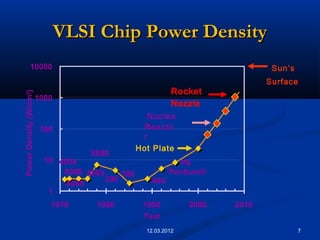
 Power dissipation increases with the increase inPower dissipation increases with the increase in
clock speedclock speed
 This will increase the costThis will increase the cost packagingpackaging to remove theto remove the
heatheat
 Increased Power will generate excessive heat. ThisIncreased Power will generate excessive heat. This
will causewill cause Electro migrationElectro migration
 ThusThus ReliabilityReliability becomes an added issue to costbecomes an added issue to cost

12.03.2012
9
AgendaAgenda
 MotivationMotivation
 Introduction To VLSI DesignIntroduction To VLSI Design
 Sources Of Power DissipationSources Of Power Dissipation
 Low Power Design MethodologiesLow Power Design Methodologies
 Low Power Soc DesignsLow Power Soc Designs
 Low Power Multiplier DesignLow Power Multiplier Design
 Design of Low Power MACDesign of Low Power MAC
 ConclusionConclusion
12.03.2012
10
What is MicroWhat is Micro
Electronics?Electronics?
• The size of the Electronic Devices in
μ- Electronics is in the range of micrometers
• Advantages of such devices…..
• Examples.. ICs……..
• μ- Electronics gave ICs
12.03.2012
11
Some Land MarksSome Land Marks
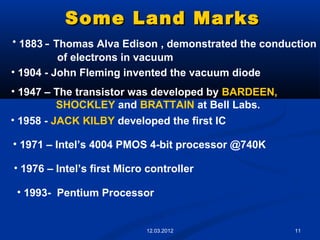
• 1883 - Thomas Alva Edison , demonstrated the conduction
of electrons in vacuum
• 1904 - John Fleming invented the vacuum diode
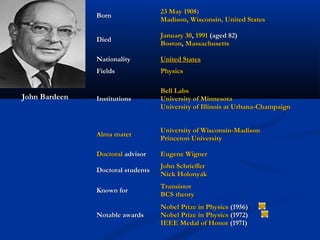
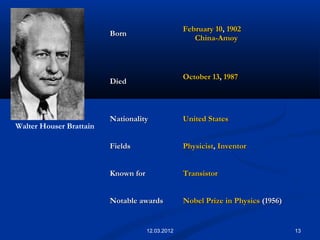
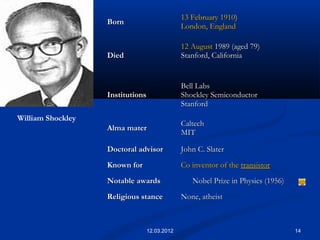
• 1947 – The transistor was developed by BARDEEN,
SHOCKLEY and BRATTAIN at Bell Labs.
• 1958 - JACK KILBY developed the first IC
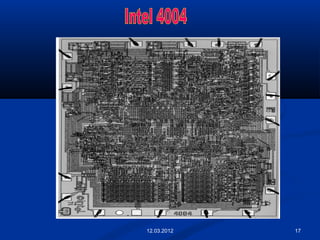
• 1971 – Intel’s 4004 PMOS 4-bit processor @740K
• 1976 – Intel’s first Micro controller
• 1993- Pentium Processor
12.03.2012
BornBorn
23 May23 May 19081908))
Madison, WisconsinMadison, Wisconsin,, United StatesUnited States
DiedDied
January 30January 30,, 19911991 (aged 82)(aged 82)
BostonBoston,, MassachusettsMassachusetts
NationalityNationality United StatesUnited States
FieldsFields PhysicsPhysics
InstitutionsInstitutions
Bell LabsBell Labs
University of MinnesotaUniversity of Minnesota
University of Illinois at Urbana-ChampaignUniversity of Illinois at Urbana-Champaign
Alma materAlma mater
University of Wisconsin-MadisonUniversity of Wisconsin-Madison
Princeton UniversityPrinceton University
DoctoralDoctoral advisoradvisor Eugene WignerEugene Wigner             
Doctoral studentsDoctoral students
John SchriefferJohn Schrieffer             
Nick HolonyakNick Holonyak
Known forKnown for
TransistorTransistor
BCS theoryBCS theory
Notable awardsNotable awards
Nobel Prize in PhysicsNobel Prize in Physics (1956)(1956)
Nobel Prize in PhysicsNobel Prize in Physics (1972)(1972)
IEEE Medal of HonorIEEE Medal of Honor (1971)(1971)
John Bardeen
13
BornBorn
February 10February 10,, 19021902
China-AmoyChina-Amoy
DiedDied
October 13October 13,, 19871987
NationalityNationality United StatesUnited States
FieldsFields PhysicistPhysicist,, InventorInventor
Known forKnown for TransistorTransistor
Notable awardsNotable awards Nobel Prize in PhysicsNobel Prize in Physics (1956)(1956)
Walter Houser Brattain
12.03.2012
14
BornBorn
13 February13 February 19101910))
London, EnglandLondon, England
DiedDied
12 August12 August 1989 (aged 79)1989 (aged 79)
Stanford, CaliforniaStanford, California
InstitutionsInstitutions
Bell LabsBell Labs
Shockley SemiconductorShockley Semiconductor
StanfordStanford
Alma materAlma mater
CaltechCaltech
MITMIT
Doctoral advisorDoctoral advisor John C. SlaterJohn C. Slater
Known forKnown for Co inventor of theCo inventor of the transistortransistor
Notable awardsNotable awards        Nobel Prize in Physics (1956)Nobel Prize in Physics (1956)
Religious stanceReligious stance None, atheistNone, atheist
William Shockley
12.03.2012
15
What is VLSI?What is VLSI?
• Classification of ICs….. Based on no. of transistors
• In VLSI… Transistor count is in excess of 40 thousand
• A state of art of VLSI has more than 100 million transistors
• VLSI Chip…. Only CMOS transistors
• CAD tools are a must to design , verify and test the
VLSI chips
• SOC- System On Chip
• ASP-Application Specific Product using IP CORES
12.03.2012
16
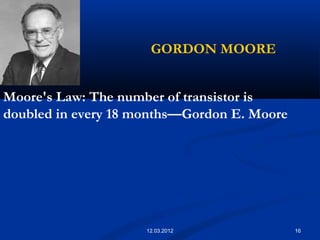
GORDON MOORE
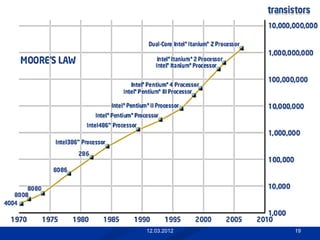
Moore's Law: The number of transistor is
doubled in every 18 months—Gordon E. Moore
12.03.2012
1712.03.2012
1812.03.2012
1912.03.2012
20
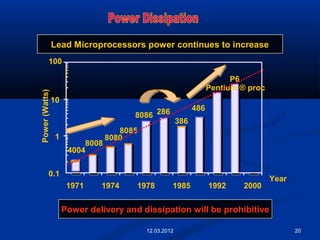
P6
Pentium ® proc
486
386
2868086
8085
8080
8008
4004
0.1
1
10
100
1971 1974 1978 1985 1992 2000
Year
Power(Watts) Lead Microprocessors power continues to increaseLead Microprocessors power continues to increase
Power delivery and dissipation will be prohibitivePower delivery and dissipation will be prohibitive
12.03.2012
21
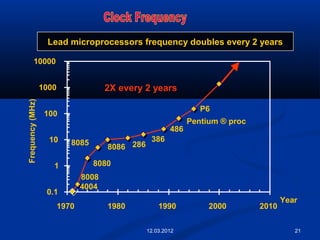
Lead microprocessors frequency doubles every 2 yearsLead microprocessors frequency doubles every 2 years
P6
Pentium ® proc
486
386
2868086
8085
8080
8008
4004
0.1
1
10
100
1000
10000
1970 1980 1990 2000 2010
Year
Frequency(MHz)
2X every 2 years
12.03.2012
22
4004
8008
8080
8085 8086
286
386
486
Pentium® proc
P6
0.001
0.01
0.1
1
10
100
1000
1970 1980 1990 2000 2010
Year
Transistors(M)
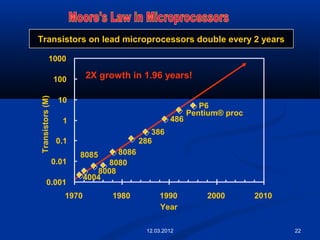
2X growth in 1.96 years!
Transistors on lead microprocessors double every 2 yearsTransistors on lead microprocessors double every 2 years
12.03.2012
23
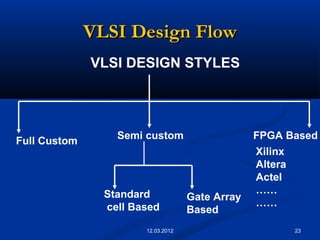
VLSI Design FlowVLSI Design Flow
VLSI DESIGN STYLES
Full Custom
Semi custom FPGA Based
Standard
cell Based
Gate Array
Based
Xilinx
Altera
Actel
……
……
12.03.2012
24
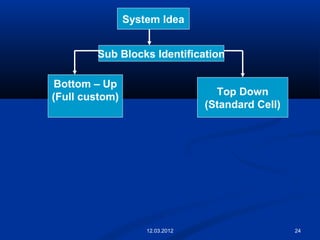
System Idea
Sub Blocks Identification
Bottom – Up
(Full custom) Top Down
(Standard Cell)
12.03.2012
25
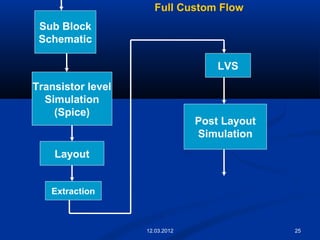
Sub Block
Schematic
Transistor level
Simulation
(Spice)
Layout
Extraction
LVS
Post Layout
Simulation
Full Custom Flow
12.03.2012
26
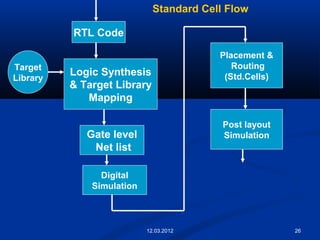
RTL Code
Logic Synthesis
& Target Library
Mapping
Target
Library
Gate level
Net list
Digital
Simulation
Placement &
Routing
(Std.Cells)
Post layout
Simulation
Standard Cell Flow
12.03.2012
27
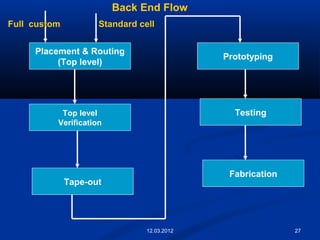
Placement & Routing
(Top level)
Top level
Verification
Tape-out
Prototyping
Testing
Fabrication
Back End Flow
Full custom Standard cell
12.03.2012
28
CAD in VLSI
E (Engg) CAD
T (Technology) CAD
CONCEPT
VLSI
Ckt.
Design
VLSI Chip
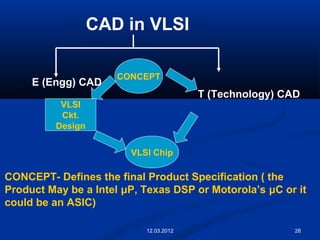
CONCEPT- Defines the final Product Specification ( the
Product May be a Intel μP, Texas DSP or Motorola’s μC or it
could be an ASIC)
12.03.2012
29
VLSI ProcessingVLSI Processing
 OxidationOxidation
 Diffusion/Ion ImplantationDiffusion/Ion Implantation
 Poly DepositionPoly Deposition
 EtchingEtching
 Metallisation(vacuum/Sputtering)Metallisation(vacuum/Sputtering)
 TestingTesting
 SCRIBING And PACKAGINGSCRIBING And PACKAGING
 Testing…..Release To MarketTesting…..Release To Market
12.03.2012
30
AgendaAgenda
 MotivationMotivation
 Introduction To VLSI DesignIntroduction To VLSI Design
 Sources Of Power DissipationSources Of Power Dissipation
 Low Power Design MethodologiesLow Power Design Methodologies
 Low Power Soc DesignsLow Power Soc Designs
 Low Power Multiplier DesignLow Power Multiplier Design
 Design of Low Power MACDesign of Low Power MAC
 ConclusionConclusion
12.03.2012
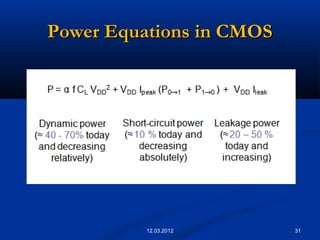
Power Equations in CMOSPower Equations in CMOS
3112.03.2012
Techniques For Low PowerTechniques For Low Power
 Supply voltageSupply voltage
 Physical capacitancePhysical capacitance
 Switching ActivitySwitching Activity
3212.03.2012
33
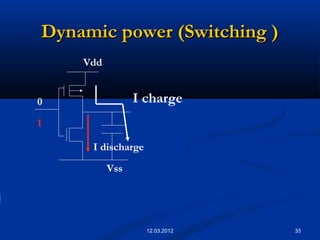
Dynamic power (Switching )Dynamic power (Switching )
I charge
I discharge
0
1
Vdd
Vss
12.03.2012
34
Sources of Power DissipationSources of Power Dissipation
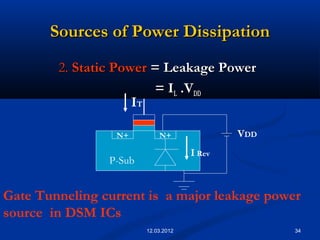
2.2. Static PowerStatic Power = Leakage Power= Leakage Power
= I= ILL .V.VDDDD
N+ N+
I Rev
VDD
P-Sub
Gate Tunneling current is a major leakage power
source in DSM ICs
IT
12.03.2012
35
Sources of Power DissipationSources of Power Dissipation
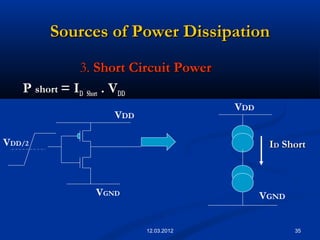
3.3. Short Circuit PowerShort Circuit Power
PP shortshort = I= IDD ShortShort . V. VDDDD
IIDD ShortShort
VDD
VDD
VGND VGND
VDD/2
12.03.2012
36
AgendaAgenda
 MotivationMotivation
 Introduction To VLSI DesignIntroduction To VLSI Design
 Sources Of Power DissipationSources Of Power Dissipation
 Low Power Design MethodologiesLow Power Design Methodologies
 Low Power Soc DesignsLow Power Soc Designs
 Low Power Multiplier DesignLow Power Multiplier Design
 Design of Low Power MACDesign of Low Power MAC
 ConclusionConclusion
12.03.2012
37
Levels ofLevels of OptimizationOptimization
12.03.2012
38
Reduction of switching activity
• By proper choice of logic topology
• By circuit level optimization
• The representation of data can have significant
impact on switching activity at the system level
Ex: Use of Gray coding instead of binary coding
in applications where data bits change sequentially
such as address bits
12.03.2012
39
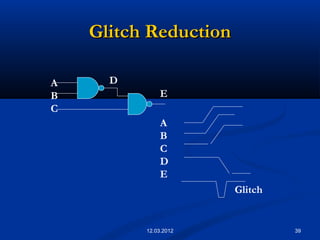
Glitch ReductionGlitch Reduction
A
B
C
D
E
A
B
C
D
E
Glitch
12.03.2012
40
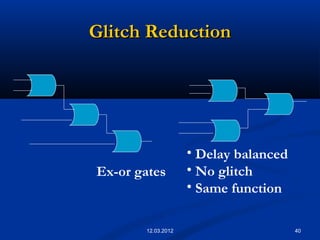
Glitch ReductionGlitch Reduction
• Delay balanced
• No glitch
• Same function
Ex-or gates
12.03.2012
41
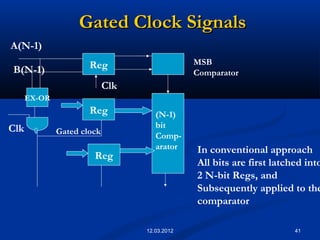
Gated Clock SignalsGated Clock Signals
Reg
Reg
Reg
EX-OR
MSB
Comparator
(N-1)
bit
Comp-
arator
Clk Gated clock
A(N-1)
B(N-1)
In conventional approach
All bits are first latched into
2 N-bit Regs, and
Subsequently applied to the
comparator
Clk
12.03.2012
42
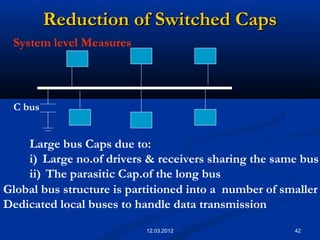
Reduction of Switched CapsReduction of Switched Caps
System level Measures
Large bus Caps due to:
i) Large no.of drivers & receivers sharing the same bus
ii) The parasitic Cap.of the long bus
Global bus structure is partitioned into a number of smaller
Dedicated local buses to handle data transmission
C bus
12.03.2012
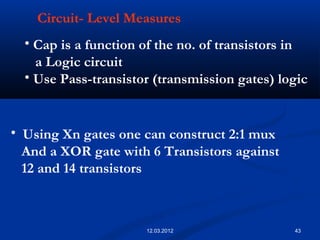
43
Circuit- Level Measures
• Cap is a function of the no. of transistors in
a Logic circuit
• Use Pass-transistor (transmission gates) logic
• Using Xn gates one can construct 2:1 mux
And a XOR gate with 6 Transistors against
12 and 14 transistors
12.03.2012
44
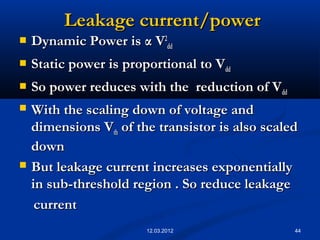
Leakage current/powerLeakage current/power
 Dynamic Power isDynamic Power is αα VV22
dddd
 Static power is proportional to VStatic power is proportional to Vdddd
 So power reduces with the reduction of VSo power reduces with the reduction of Vdddd
 With the scaling down of voltage andWith the scaling down of voltage and
dimensions Vdimensions Vthth of the transistor is also scaledof the transistor is also scaled
downdown
 But leakage current increases exponentiallyBut leakage current increases exponentially
in sub-threshold region . So reduce leakagein sub-threshold region . So reduce leakage
currentcurrent
12.03.2012
45
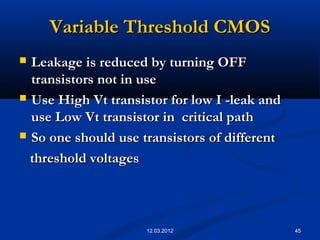
Variable Threshold CMOSVariable Threshold CMOS
 Leakage is reduced by turning OFFLeakage is reduced by turning OFF
transistors not in usetransistors not in use
 Use High Vt transistor for low I -leak andUse High Vt transistor for low I -leak and
use Low Vt transistor in critical pathuse Low Vt transistor in critical path
 So one should use transistors of differentSo one should use transistors of different
threshold voltagesthreshold voltages
12.03.2012
46
Software Design For Low PowerSoftware Design For Low Power
 Most efforts….focused on hardware designMost efforts….focused on hardware design
 It is because HW is the physical means byIt is because HW is the physical means by
which power is converted into usefulwhich power is converted into useful
computationcomputation
 It would be unwise to ignore the influence ofIt would be unwise to ignore the influence of
SW on power dissipationSW on power dissipation
 In systems based on digital processors orIn systems based on digital processors or
controllers, it is SW that directs much of thecontrollers, it is SW that directs much of the
activity of the HWactivity of the HW
12.03.2012
47
 So , the manner in which SW uses the HWSo , the manner in which SW uses the HW
can have a substantial impact on the powercan have a substantial impact on the power
dissipation of a systemdissipation of a system
 Can draw an analogy from automobilesCan draw an analogy from automobiles
 The manner in which one drives his/herThe manner in which one drives his/her
automobile can have a significant effect onautomobile can have a significant effect on
total fuel consumptiontotal fuel consumption
12.03.2012
48
AgendaAgenda
 MotivationMotivation
 Introduction To VLSI DesignIntroduction To VLSI Design
 Sources Of Power DissipationSources Of Power Dissipation
 Low Power Design MethodologiesLow Power Design Methodologies
 Low Power Soc DesignsLow Power Soc Designs
 Low Power Multiplier DesignLow Power Multiplier Design
 Design of Low Power MACDesign of Low Power MAC
 ConclusionConclusion
12.03.2012
49
IntroductionIntroduction
 Power is a serious concern in today'sPower is a serious concern in today's
SoC design.SoC design.
 Core based SoC design is common toCore based SoC design is common to
get time to market advantage.get time to market advantage.
 Cores are designed to be generic andCores are designed to be generic and
reusable with configurability.reusable with configurability.
 Need For Core customization.Need For Core customization.
 Core evaluation for PowerCore evaluation for Power
12.03.2012
50
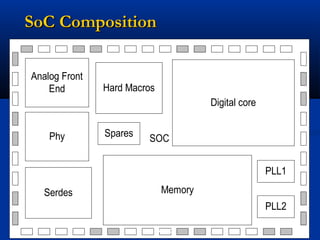
SoC CompositionSoC Composition
SOC
Digital core
Analog Front
End
Serdes
PLL1
PLL2
Phy
Memory
Hard Macros
Spares
12.03.2012
51
AgendaAgenda
 MotivationMotivation
 Introduction To VLSI DesignIntroduction To VLSI Design
 Sources Of Power DissipationSources Of Power Dissipation
 Low Power Design MethodologiesLow Power Design Methodologies
 Low Power Soc DesignsLow Power Soc Designs
 Low Power Multiplier DesignLow Power Multiplier Design
 Design of Low Power MACDesign of Low Power MAC
 ConclusionConclusion
12.03.2012
VLSI Signal Processing BuildingVLSI Signal Processing Building
BlocksBlocks
 AdderAdder
 MultiplierMultiplier
5212.03.2012
Existing Low-power TechniquesExisting Low-power Techniques
 Partially Guarded Computation (PGC).Partially Guarded Computation (PGC).
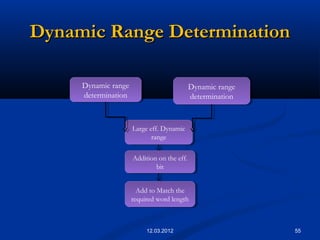
 Dynamic-range Determination (DRD).Dynamic-range Determination (DRD).
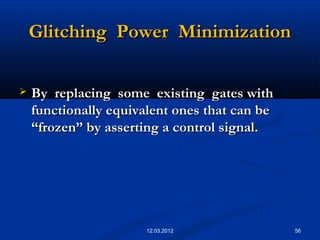
 Glitching Power Minimization (GPM).Glitching Power Minimization (GPM).
5312.03.2012
5412.03.2012
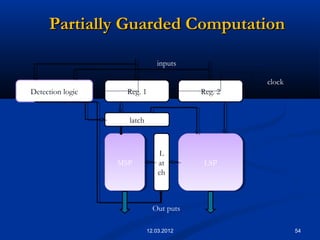
Partially Guarded ComputationPartially Guarded Computation
MSPMSP LSPLSP
Detection logic Reg. 2Reg. 1
L
at
ch
latch
clock
inputs
Out puts
Dynamic Range DeterminationDynamic Range Determination
5512.03.2012
Add to Match the
required word length
Add to Match the
required word length
Dynamic range
determination
Dynamic range
determination
Dynamic range
determination
Dynamic range
determination
Large eff. Dynamic
range
Large eff. Dynamic
range
Addition on the eff.
bit
Addition on the eff.
bit
Glitching Power MinimizationGlitching Power Minimization
 By replacing some existing gates withBy replacing some existing gates with
functionally equivalent ones that can befunctionally equivalent ones that can be
“frozen” by asserting a control signal.“frozen” by asserting a control signal.
5612.03.2012
Main Functions in MultiplierMain Functions in Multiplier
 Partial products generationPartial products generation
 Partial product compressionPartial product compression
 Partial product additionPartial product addition
5712.03.2012
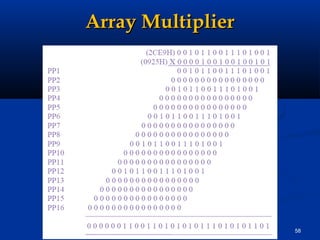
Array MultiplierArray Multiplier
5812.03.2012
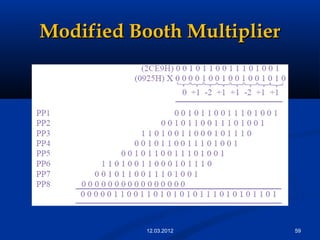
Modified Booth MultiplierModified Booth Multiplier
5912.03.2012
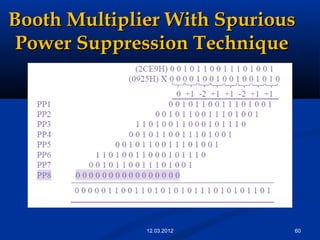
Booth Multiplier With SpuriousBooth Multiplier With Spurious
Power Suppression TechniquePower Suppression Technique
6012.03.2012
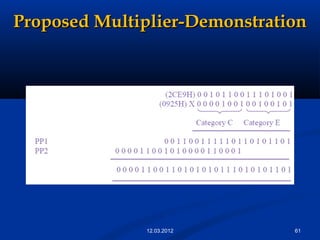
Proposed Multiplier-DemonstrationProposed Multiplier-Demonstration
6112.03.2012
62
AgendaAgenda
 MotivationMotivation
 Introduction To VLSI DesignIntroduction To VLSI Design
 Sources Of Power DissipationSources Of Power Dissipation
 Low Power Design MethodologiesLow Power Design Methodologies
 Low Power Soc DesignsLow Power Soc Designs
 Low Power Multiplier DesignLow Power Multiplier Design
 Design of Low Power MACDesign of Low Power MAC
 ConclusionConclusion
12.03.2012
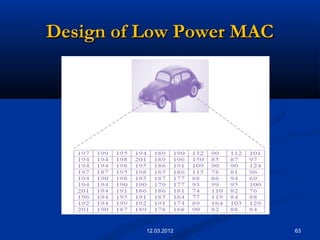
Design of Low Power MACDesign of Low Power MAC
6312.03.2012
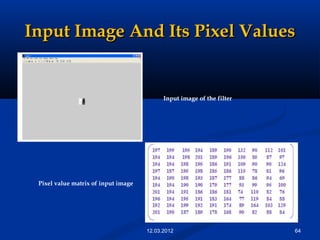
Input Image And Its Pixel ValuesInput Image And Its Pixel Values
6412.03.2012
1/9 1/9 1/9
1/9 1/9 1/9
1/9 1/9 1/9
Input image of the filterInput image of the filter
Pixel value matrix of input image
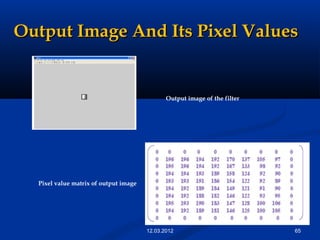
Output Image And Its Pixel ValuesOutput Image And Its Pixel Values
6512.03.2012
Output image of the filter
Pixel value matrix of output image
66
ConclusionsConclusions
 State of art VLSI chip ( SOC) containsState of art VLSI chip ( SOC) contains
hundres of million transistorshundres of million transistors
 So it dissipates lot of powerSo it dissipates lot of power
 To keep the packaging cost low….lowTo keep the packaging cost low….low
power technologypower technology
 For portable devices low power ICs …aFor portable devices low power ICs …a
mustmust
 There are different low power designThere are different low power design
techniquestechniques
12.03.2012
67
ReferencesReferences
 Principles of CMOS VLSI Design---Neil westePrinciples of CMOS VLSI Design---Neil weste
and K.Eshraghianand K.Eshraghian
 ASICs -------M.J.SmithASICs -------M.J.Smith
 CMOS Design, layout and simulationCMOS Design, layout and simulation
R.Jacob BakerR.Jacob Baker
 Introduction to VLSI circuits & systemsIntroduction to VLSI circuits & systems
-----John Uvemura-----John Uvemura
 Digital systems design using VHDL----Jr.RothDigital systems design using VHDL----Jr.Roth
 VHDL Primer----Jayaram BhaskarVHDL Primer----Jayaram Bhaskar
 Low-Power CMOS VLSI Circuit Design------Low-Power CMOS VLSI Circuit Design------
Kaushik Roy, Sharat PrasadKaushik Roy, Sharat Prasad
12.03.2012
68
THANK YOU
12.03.2012

Low power VLSI design

  • 1.
    1 Low Power VLSIDesign:Low Power VLSI Design: Challenges and solutionsChallenges and solutions Dr.S.SaravananDr.S.Saravanan M.E.,PhDM.E.,PhD HOD/EEE(UG)HOD/EEE(UG) Muthayammal Engineering CollegeMuthayammal Engineering College RasipuramRasipuram 12.03.2012
  • 2.
    2 AgendaAgenda  MotivationMotivation  IntroductionTo VLSI designIntroduction To VLSI design  Sources of Power DissipationSources of Power Dissipation  Low Power Design MethodologiesLow Power Design Methodologies  Low Power Soc DesignsLow Power Soc Designs  Low Power Multiplier DesignLow Power Multiplier Design  Design of Low Power MACDesign of Low Power MAC  ConclusionsConclusions 12.03.2012
  • 3.
  • 4.
    4 MotivationMotivation  PORTABLE DEVICES…….Note BookPORTABLE DEVICES …….Note Book Computers, PDAs, Laptops, Cell Phones,Computers, PDAs, Laptops, Cell Phones, Pacemaker etc historical drivers of low powerPacemaker etc historical drivers of low power ……..require low power consumption & high……..require low power consumption & high through putthrough put 12.03.2012
  • 5.
    5 Motivation (Contd..)Motivation (Contd..) •New portable compute-intensive applicationsNew portable compute-intensive applications * Multi-media* Multi-media * Video display and capture* Video display and capture * Audio reproduction & capture* Audio reproduction & capture * Handwriting recognition* Handwriting recognition * Notebook computer* Notebook computer * Personal data assistant* Personal data assistant * Implantable medical electronics* Implantable medical electronics 12.03.2012
  • 6.
    6 Motivation (contd..)Motivation (contd..) Why so much of stress on Low Power?Why so much of stress on Low Power? Portable devices run on batteryPortable devices run on battery Battery life is limitedBattery life is limited Energy density of Nickel-MetalEnergy density of Nickel-Metal Hydride (NiMH) is low@30Wh/lbHydride (NiMH) is low@30Wh/lb  The battery technology is not improving atThe battery technology is not improving at the same speed as that of VLSIthe same speed as that of VLSI 12.03.2012
  • 7.
    VLSI Chip PowerDensityVLSI Chip Power Density 4004 8008 8080 8085 8086 286 386 486 Pentium® P6 1 10 100 1000 10000 1970 1980 1990 2000 2010 Year PowerDensity(W/cm2 ) Hot Plate Nuclea rReacto r Rocket Nozzle Surface Sun’s 712.03.2012
  • 8.
    8 Motivation (contd..)Motivation (contd..) Power dissipation increases with the increase inPower dissipation increases with the increase in clock speedclock speed  This will increase the costThis will increase the cost packagingpackaging to remove theto remove the heatheat  Increased Power will generate excessive heat. ThisIncreased Power will generate excessive heat. This will causewill cause Electro migrationElectro migration  ThusThus ReliabilityReliability becomes an added issue to costbecomes an added issue to cost 12.03.2012
  • 9.
    9 AgendaAgenda  MotivationMotivation  IntroductionTo VLSI DesignIntroduction To VLSI Design  Sources Of Power DissipationSources Of Power Dissipation  Low Power Design MethodologiesLow Power Design Methodologies  Low Power Soc DesignsLow Power Soc Designs  Low Power Multiplier DesignLow Power Multiplier Design  Design of Low Power MACDesign of Low Power MAC  ConclusionConclusion 12.03.2012
  • 10.
    10 What is MicroWhatis Micro Electronics?Electronics? • The size of the Electronic Devices in μ- Electronics is in the range of micrometers • Advantages of such devices….. • Examples.. ICs…….. • μ- Electronics gave ICs 12.03.2012
  • 11.
    11 Some Land MarksSomeLand Marks • 1883 - Thomas Alva Edison , demonstrated the conduction of electrons in vacuum • 1904 - John Fleming invented the vacuum diode • 1947 – The transistor was developed by BARDEEN, SHOCKLEY and BRATTAIN at Bell Labs. • 1958 - JACK KILBY developed the first IC • 1971 – Intel’s 4004 PMOS 4-bit processor @740K • 1976 – Intel’s first Micro controller • 1993- Pentium Processor 12.03.2012
  • 12.
    BornBorn 23 May23 May19081908)) Madison, WisconsinMadison, Wisconsin,, United StatesUnited States DiedDied January 30January 30,, 19911991 (aged 82)(aged 82) BostonBoston,, MassachusettsMassachusetts NationalityNationality United StatesUnited States FieldsFields PhysicsPhysics InstitutionsInstitutions Bell LabsBell Labs University of MinnesotaUniversity of Minnesota University of Illinois at Urbana-ChampaignUniversity of Illinois at Urbana-Champaign Alma materAlma mater University of Wisconsin-MadisonUniversity of Wisconsin-Madison Princeton UniversityPrinceton University DoctoralDoctoral advisoradvisor Eugene WignerEugene Wigner              Doctoral studentsDoctoral students John SchriefferJohn Schrieffer              Nick HolonyakNick Holonyak Known forKnown for TransistorTransistor BCS theoryBCS theory Notable awardsNotable awards Nobel Prize in PhysicsNobel Prize in Physics (1956)(1956) Nobel Prize in PhysicsNobel Prize in Physics (1972)(1972) IEEE Medal of HonorIEEE Medal of Honor (1971)(1971) John Bardeen
  • 13.
    13 BornBorn February 10February 10,,19021902 China-AmoyChina-Amoy DiedDied October 13October 13,, 19871987 NationalityNationality United StatesUnited States FieldsFields PhysicistPhysicist,, InventorInventor Known forKnown for TransistorTransistor Notable awardsNotable awards Nobel Prize in PhysicsNobel Prize in Physics (1956)(1956) Walter Houser Brattain 12.03.2012
  • 14.
    14 BornBorn 13 February13 February19101910)) London, EnglandLondon, England DiedDied 12 August12 August 1989 (aged 79)1989 (aged 79) Stanford, CaliforniaStanford, California InstitutionsInstitutions Bell LabsBell Labs Shockley SemiconductorShockley Semiconductor StanfordStanford Alma materAlma mater CaltechCaltech MITMIT Doctoral advisorDoctoral advisor John C. SlaterJohn C. Slater Known forKnown for Co inventor of theCo inventor of the transistortransistor Notable awardsNotable awards        Nobel Prize in Physics (1956)Nobel Prize in Physics (1956) Religious stanceReligious stance None, atheistNone, atheist William Shockley 12.03.2012
  • 15.
    15 What is VLSI?Whatis VLSI? • Classification of ICs….. Based on no. of transistors • In VLSI… Transistor count is in excess of 40 thousand • A state of art of VLSI has more than 100 million transistors • VLSI Chip…. Only CMOS transistors • CAD tools are a must to design , verify and test the VLSI chips • SOC- System On Chip • ASP-Application Specific Product using IP CORES 12.03.2012
  • 16.
    16 GORDON MOORE Moore's Law: Thenumber of transistor is doubled in every 18 months—Gordon E. Moore 12.03.2012
  • 17.
  • 18.
  • 19.
  • 20.
    20 P6 Pentium ® proc 486 386 2868086 8085 8080 8008 4004 0.1 1 10 100 19711974 1978 1985 1992 2000 Year Power(Watts) Lead Microprocessors power continues to increaseLead Microprocessors power continues to increase Power delivery and dissipation will be prohibitivePower delivery and dissipation will be prohibitive 12.03.2012
  • 21.
    21 Lead microprocessors frequencydoubles every 2 yearsLead microprocessors frequency doubles every 2 years P6 Pentium ® proc 486 386 2868086 8085 8080 8008 4004 0.1 1 10 100 1000 10000 1970 1980 1990 2000 2010 Year Frequency(MHz) 2X every 2 years 12.03.2012
  • 22.
    22 4004 8008 8080 8085 8086 286 386 486 Pentium® proc P6 0.001 0.01 0.1 1 10 100 1000 19701980 1990 2000 2010 Year Transistors(M) 2X growth in 1.96 years! Transistors on lead microprocessors double every 2 yearsTransistors on lead microprocessors double every 2 years 12.03.2012
  • 23.
    23 VLSI Design FlowVLSIDesign Flow VLSI DESIGN STYLES Full Custom Semi custom FPGA Based Standard cell Based Gate Array Based Xilinx Altera Actel …… …… 12.03.2012
  • 24.
    24 System Idea Sub BlocksIdentification Bottom – Up (Full custom) Top Down (Standard Cell) 12.03.2012
  • 25.
  • 26.
    26 RTL Code Logic Synthesis &Target Library Mapping Target Library Gate level Net list Digital Simulation Placement & Routing (Std.Cells) Post layout Simulation Standard Cell Flow 12.03.2012
  • 27.
    27 Placement & Routing (Toplevel) Top level Verification Tape-out Prototyping Testing Fabrication Back End Flow Full custom Standard cell 12.03.2012
  • 28.
    28 CAD in VLSI E(Engg) CAD T (Technology) CAD CONCEPT VLSI Ckt. Design VLSI Chip CONCEPT- Defines the final Product Specification ( the Product May be a Intel μP, Texas DSP or Motorola’s μC or it could be an ASIC) 12.03.2012
  • 29.
    29 VLSI ProcessingVLSI Processing OxidationOxidation  Diffusion/Ion ImplantationDiffusion/Ion Implantation  Poly DepositionPoly Deposition  EtchingEtching  Metallisation(vacuum/Sputtering)Metallisation(vacuum/Sputtering)  TestingTesting  SCRIBING And PACKAGINGSCRIBING And PACKAGING  Testing…..Release To MarketTesting…..Release To Market 12.03.2012
  • 30.
    30 AgendaAgenda  MotivationMotivation  IntroductionTo VLSI DesignIntroduction To VLSI Design  Sources Of Power DissipationSources Of Power Dissipation  Low Power Design MethodologiesLow Power Design Methodologies  Low Power Soc DesignsLow Power Soc Designs  Low Power Multiplier DesignLow Power Multiplier Design  Design of Low Power MACDesign of Low Power MAC  ConclusionConclusion 12.03.2012
  • 31.
    Power Equations inCMOSPower Equations in CMOS 3112.03.2012
  • 32.
    Techniques For LowPowerTechniques For Low Power  Supply voltageSupply voltage  Physical capacitancePhysical capacitance  Switching ActivitySwitching Activity 3212.03.2012
  • 33.
    33 Dynamic power (Switching)Dynamic power (Switching ) I charge I discharge 0 1 Vdd Vss 12.03.2012
  • 34.
    34 Sources of PowerDissipationSources of Power Dissipation 2.2. Static PowerStatic Power = Leakage Power= Leakage Power = I= ILL .V.VDDDD N+ N+ I Rev VDD P-Sub Gate Tunneling current is a major leakage power source in DSM ICs IT 12.03.2012
  • 35.
    35 Sources of PowerDissipationSources of Power Dissipation 3.3. Short Circuit PowerShort Circuit Power PP shortshort = I= IDD ShortShort . V. VDDDD IIDD ShortShort VDD VDD VGND VGND VDD/2 12.03.2012
  • 36.
    36 AgendaAgenda  MotivationMotivation  IntroductionTo VLSI DesignIntroduction To VLSI Design  Sources Of Power DissipationSources Of Power Dissipation  Low Power Design MethodologiesLow Power Design Methodologies  Low Power Soc DesignsLow Power Soc Designs  Low Power Multiplier DesignLow Power Multiplier Design  Design of Low Power MACDesign of Low Power MAC  ConclusionConclusion 12.03.2012
  • 37.
    37 Levels ofLevels ofOptimizationOptimization 12.03.2012
  • 38.
    38 Reduction of switchingactivity • By proper choice of logic topology • By circuit level optimization • The representation of data can have significant impact on switching activity at the system level Ex: Use of Gray coding instead of binary coding in applications where data bits change sequentially such as address bits 12.03.2012
  • 39.
  • 40.
    40 Glitch ReductionGlitch Reduction •Delay balanced • No glitch • Same function Ex-or gates 12.03.2012
  • 41.
    41 Gated Clock SignalsGatedClock Signals Reg Reg Reg EX-OR MSB Comparator (N-1) bit Comp- arator Clk Gated clock A(N-1) B(N-1) In conventional approach All bits are first latched into 2 N-bit Regs, and Subsequently applied to the comparator Clk 12.03.2012
  • 42.
    42 Reduction of SwitchedCapsReduction of Switched Caps System level Measures Large bus Caps due to: i) Large no.of drivers & receivers sharing the same bus ii) The parasitic Cap.of the long bus Global bus structure is partitioned into a number of smaller Dedicated local buses to handle data transmission C bus 12.03.2012
  • 43.
    43 Circuit- Level Measures •Cap is a function of the no. of transistors in a Logic circuit • Use Pass-transistor (transmission gates) logic • Using Xn gates one can construct 2:1 mux And a XOR gate with 6 Transistors against 12 and 14 transistors 12.03.2012
  • 44.
    44 Leakage current/powerLeakage current/power Dynamic Power isDynamic Power is αα VV22 dddd  Static power is proportional to VStatic power is proportional to Vdddd  So power reduces with the reduction of VSo power reduces with the reduction of Vdddd  With the scaling down of voltage andWith the scaling down of voltage and dimensions Vdimensions Vthth of the transistor is also scaledof the transistor is also scaled downdown  But leakage current increases exponentiallyBut leakage current increases exponentially in sub-threshold region . So reduce leakagein sub-threshold region . So reduce leakage currentcurrent 12.03.2012
  • 45.
    45 Variable Threshold CMOSVariableThreshold CMOS  Leakage is reduced by turning OFFLeakage is reduced by turning OFF transistors not in usetransistors not in use  Use High Vt transistor for low I -leak andUse High Vt transistor for low I -leak and use Low Vt transistor in critical pathuse Low Vt transistor in critical path  So one should use transistors of differentSo one should use transistors of different threshold voltagesthreshold voltages 12.03.2012
  • 46.
    46 Software Design ForLow PowerSoftware Design For Low Power  Most efforts….focused on hardware designMost efforts….focused on hardware design  It is because HW is the physical means byIt is because HW is the physical means by which power is converted into usefulwhich power is converted into useful computationcomputation  It would be unwise to ignore the influence ofIt would be unwise to ignore the influence of SW on power dissipationSW on power dissipation  In systems based on digital processors orIn systems based on digital processors or controllers, it is SW that directs much of thecontrollers, it is SW that directs much of the activity of the HWactivity of the HW 12.03.2012
  • 47.
    47  So ,the manner in which SW uses the HWSo , the manner in which SW uses the HW can have a substantial impact on the powercan have a substantial impact on the power dissipation of a systemdissipation of a system  Can draw an analogy from automobilesCan draw an analogy from automobiles  The manner in which one drives his/herThe manner in which one drives his/her automobile can have a significant effect onautomobile can have a significant effect on total fuel consumptiontotal fuel consumption 12.03.2012
  • 48.
    48 AgendaAgenda  MotivationMotivation  IntroductionTo VLSI DesignIntroduction To VLSI Design  Sources Of Power DissipationSources Of Power Dissipation  Low Power Design MethodologiesLow Power Design Methodologies  Low Power Soc DesignsLow Power Soc Designs  Low Power Multiplier DesignLow Power Multiplier Design  Design of Low Power MACDesign of Low Power MAC  ConclusionConclusion 12.03.2012
  • 49.
    49 IntroductionIntroduction  Power isa serious concern in today'sPower is a serious concern in today's SoC design.SoC design.  Core based SoC design is common toCore based SoC design is common to get time to market advantage.get time to market advantage.  Cores are designed to be generic andCores are designed to be generic and reusable with configurability.reusable with configurability.  Need For Core customization.Need For Core customization.  Core evaluation for PowerCore evaluation for Power 12.03.2012
  • 50.
    50 SoC CompositionSoC Composition SOC Digitalcore Analog Front End Serdes PLL1 PLL2 Phy Memory Hard Macros Spares 12.03.2012
  • 51.
    51 AgendaAgenda  MotivationMotivation  IntroductionTo VLSI DesignIntroduction To VLSI Design  Sources Of Power DissipationSources Of Power Dissipation  Low Power Design MethodologiesLow Power Design Methodologies  Low Power Soc DesignsLow Power Soc Designs  Low Power Multiplier DesignLow Power Multiplier Design  Design of Low Power MACDesign of Low Power MAC  ConclusionConclusion 12.03.2012
  • 52.
    VLSI Signal ProcessingBuildingVLSI Signal Processing Building BlocksBlocks  AdderAdder  MultiplierMultiplier 5212.03.2012
  • 53.
    Existing Low-power TechniquesExistingLow-power Techniques  Partially Guarded Computation (PGC).Partially Guarded Computation (PGC).  Dynamic-range Determination (DRD).Dynamic-range Determination (DRD).  Glitching Power Minimization (GPM).Glitching Power Minimization (GPM). 5312.03.2012
  • 54.
    5412.03.2012 Partially Guarded ComputationPartiallyGuarded Computation MSPMSP LSPLSP Detection logic Reg. 2Reg. 1 L at ch latch clock inputs Out puts
  • 55.
    Dynamic Range DeterminationDynamicRange Determination 5512.03.2012 Add to Match the required word length Add to Match the required word length Dynamic range determination Dynamic range determination Dynamic range determination Dynamic range determination Large eff. Dynamic range Large eff. Dynamic range Addition on the eff. bit Addition on the eff. bit
  • 56.
    Glitching Power MinimizationGlitchingPower Minimization  By replacing some existing gates withBy replacing some existing gates with functionally equivalent ones that can befunctionally equivalent ones that can be “frozen” by asserting a control signal.“frozen” by asserting a control signal. 5612.03.2012
  • 57.
    Main Functions inMultiplierMain Functions in Multiplier  Partial products generationPartial products generation  Partial product compressionPartial product compression  Partial product additionPartial product addition 5712.03.2012
  • 58.
  • 59.
    Modified Booth MultiplierModifiedBooth Multiplier 5912.03.2012
  • 60.
    Booth Multiplier WithSpuriousBooth Multiplier With Spurious Power Suppression TechniquePower Suppression Technique 6012.03.2012
  • 61.
  • 62.
    62 AgendaAgenda  MotivationMotivation  IntroductionTo VLSI DesignIntroduction To VLSI Design  Sources Of Power DissipationSources Of Power Dissipation  Low Power Design MethodologiesLow Power Design Methodologies  Low Power Soc DesignsLow Power Soc Designs  Low Power Multiplier DesignLow Power Multiplier Design  Design of Low Power MACDesign of Low Power MAC  ConclusionConclusion 12.03.2012
  • 63.
    Design of LowPower MACDesign of Low Power MAC 6312.03.2012
  • 64.
    Input Image AndIts Pixel ValuesInput Image And Its Pixel Values 6412.03.2012 1/9 1/9 1/9 1/9 1/9 1/9 1/9 1/9 1/9 Input image of the filterInput image of the filter Pixel value matrix of input image
  • 65.
    Output Image AndIts Pixel ValuesOutput Image And Its Pixel Values 6512.03.2012 Output image of the filter Pixel value matrix of output image
  • 66.
    66 ConclusionsConclusions  State ofart VLSI chip ( SOC) containsState of art VLSI chip ( SOC) contains hundres of million transistorshundres of million transistors  So it dissipates lot of powerSo it dissipates lot of power  To keep the packaging cost low….lowTo keep the packaging cost low….low power technologypower technology  For portable devices low power ICs …aFor portable devices low power ICs …a mustmust  There are different low power designThere are different low power design techniquestechniques 12.03.2012
  • 67.
    67 ReferencesReferences  Principles ofCMOS VLSI Design---Neil westePrinciples of CMOS VLSI Design---Neil weste and K.Eshraghianand K.Eshraghian  ASICs -------M.J.SmithASICs -------M.J.Smith  CMOS Design, layout and simulationCMOS Design, layout and simulation R.Jacob BakerR.Jacob Baker  Introduction to VLSI circuits & systemsIntroduction to VLSI circuits & systems -----John Uvemura-----John Uvemura  Digital systems design using VHDL----Jr.RothDigital systems design using VHDL----Jr.Roth  VHDL Primer----Jayaram BhaskarVHDL Primer----Jayaram Bhaskar  Low-Power CMOS VLSI Circuit Design------Low-Power CMOS VLSI Circuit Design------ Kaushik Roy, Sharat PrasadKaushik Roy, Sharat Prasad 12.03.2012
  • 68.

Editor's Notes

  • #50 As more and more applications are getting added in a small portable devices working on battery, it is becoming important to put in conscience effort to reduce power so that the device can operate for longer time for the same battery power. As the innovations to increase the battery life has yielded the advantage, there is a three fold increase in the complexity of the Systems and also number of applications being run on these devices has increased in many folds. This makes all designers to be aware of the low power methodology at all stages of design cycle. Today's SoCs are of very high complexity of the order of multi million gates which puts a mandatory need to go an IP cores integration way to get the time to market advantage. So it has become the rule of the game to use the IP cores customized and integrated to get the complete SoC. As ready cores are used in SOC design, these cores has to be evaluated for power considerations to achieve the set power target for the SOC. We shall discuss the evaluation consideration for a blue tooth core and results of evaluation.