CSE460: VLSI Design
Lecture 1
Very Large Scale Integration or VLSI
Contents
● Topics of this course
● History
● Transistors
● Moore’s law
● Types of chips
● Design abstraction
● Design methodology
What will you learn in this course?
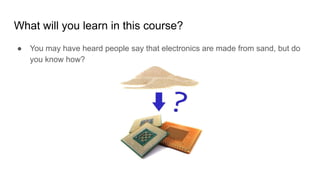
● You may have heard people say that electronics are made from sand, but do
you know how?
What will you learn in this course?
● A solid introduction to VLSI
● Different kinds of chips/ICs
● How to build one
● Theoretical background to making a good chip
● Quality measures of a chip
● The complete lifecycle of a chip
The Transistor
● Transistor concept
○ Transistors can be viewed as electrically controlled switches with a control terminal and two
other terminals that are connected or disconnected depending on the voltage or current
applied to the control terminal
Transistor Invention
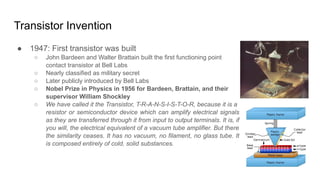
● 1947: First transistor was built
○ John Bardeen and Walter Brattain built the first functioning point
contact transistor at Bell Labs
○ Nearly classified as military secret
○ Later publicly introduced by Bell Labs
○ Nobel Prize in Physics in 1956 for Bardeen, Brattain, and their
supervisor William Shockley
○ We have called it the Transistor, T-R-A-N-S-I-S-T-O-R, because it is a
resistor or semiconductor device which can amplify electrical signals
as they are transferred through it from input to output terminals. It is, if
you will, the electrical equivalent of a vacuum tube amplifier. But there
the similarity ceases. It has no vacuum, no filament, no glass tube. It
is composed entirely of cold, solid substances.
First IC
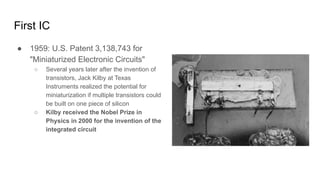
● 1959: U.S. Patent 3,138,743 for
"Miniaturized Electronic Circuits"
○ Several years later after the invention of
transistors, Jack Kilby at Texas
Instruments realized the potential for
miniaturization if multiple transistors could
be built on one piece of silicon
○ Kilby received the Nobel Prize in
Physics in 2000 for the invention of the
integrated circuit
Bipolar Junction Transistor
● Bipolar Junction Transistor (BJT)
○ Developed by Bell Labs
● More reliable, less noisy, and more
power-efficient than the point contact transistor
● BJTs require a small current into the control
(base) terminal to switch much larger currents
between the other two (emitter and collector)
terminals
● Power being dissipated by these base
currents even when idle
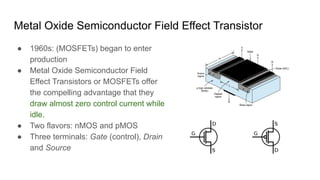
Metal Oxide Semiconductor Field Effect Transistor
● 1960s: (MOSFETs) began to enter
production
● Metal Oxide Semiconductor Field
Effect Transistors or MOSFETs offer
the compelling advantage that they
draw almost zero control current while
idle.
● Two flavors: nMOS and pMOS
● Three terminals: Gate (control), Drain
and Source
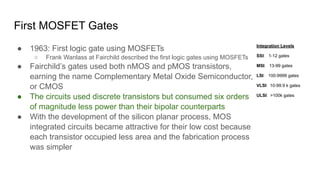
First MOSFET Gates
● 1963: First logic gate using MOSFETs
○ Frank Wanlass at Fairchild described the first logic gates using MOSFETs
● Fairchild’s gates used both nMOS and pMOS transistors,
earning the name Complementary Metal Oxide Semiconductor,
or CMOS
● The circuits used discrete transistors but consumed six orders
of magnitude less power than their bipolar counterparts
● With the development of the silicon planar process, MOS
integrated circuits became attractive for their low cost because
each transistor occupied less area and the fabrication process
was simpler
Integration Levels
SSI: 1-12 gates
MSI: 13-99 gates
LSI: 100-9999 gates
VLSI: 10-99.9 k gates
ULSI: >100k gates
Trend in MOSFET IC Design
● Early commercial processes used only pMOS transistors and
suffered from poor performance, yield, and reliability
● Processes using nMOS transistors became common in the
1970s
● While nMOS process was less expensive than CMOS, nMOS
logic gates still consumed power while idle
● Power consumption became a major issue in the 1980s as
hundreds of thousands of transistors were integrated onto a
single die
● CMOS processes were widely adopted and replaced all the
other technologies (pMOS, nMOS)
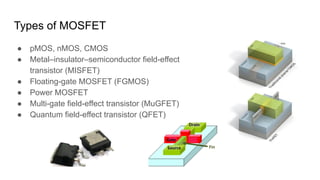
Types of MOSFET
● pMOS, nMOS, CMOS
● Metal–insulator–semiconductor field-effect
transistor (MISFET)
● Floating-gate MOSFET (FGMOS)
● Power MOSFET
● Multi-gate field-effect transistor (MuGFET)
● Quantum field-effect transistor (QFET)
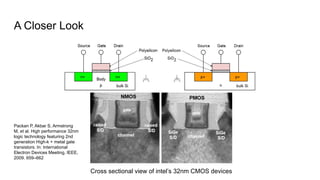
A Closer Look
Packan P, Akbar S, Armstrong
M, et al. High performance 32nm
logic technology featuring 2nd
generation High-k + metal gate
transistors. In: International
Electron Devices Meeting, IEEE,
2009. 659–662
Cross sectional view of intel’s 32nm CMOS devices
A Closer Look
Photomicrograph of a submicron MOS transistor (courtesy Agere)
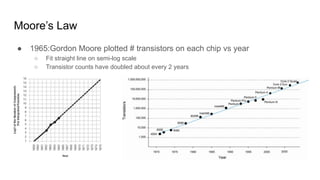
Moore’s Law
● 1965:Gordon Moore plotted # transistors on each chip vs year
○ Fit straight line on semi-log scale
○ Transistor counts have doubled about every 2 years
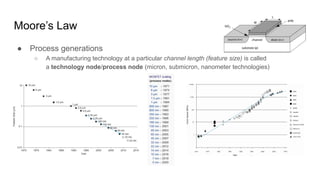
Moore’s Law
● Process generations
○ A manufacturing technology at a particular channel length (feature size) is called
a technology node/process node (micron, submicron, nanometer technologies)
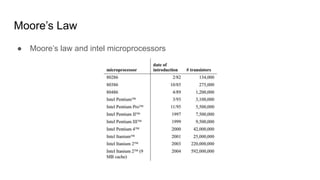
Moore’s Law
● Moore’s law and intel microprocessors
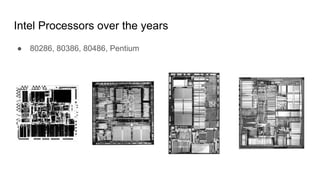
Intel Processors over the years
● 80286, 80386, 80486, Pentium
Types of chips
● Cell-based design
○ In the 1960s, standard parts were logic gates; in the 1970s they were
LSI components. Today, standard parts include fairly specialized
components: communication network interfaces, graphics accelerators
● Full custom
○ Designed manually piece by piece, fully custom layouts
● Application-specific integrated circuits (ASICs)
○ Rather than build a system out of standard parts, designers can now
create a single chip for their particular application
● Systems-on-chips (SoCs)
○ a single-chip computer can include a CPU, bus, I/O devices, and
memory
Chip Lifecycle
● A wafer > fabrication > chips > packaging
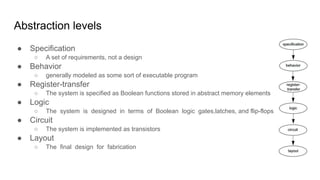
Abstraction levels
● Specification
○ A set of requirements, not a design
● Behavior
○ generally modeled as some sort of executable program
● Register-transfer
○ The system is specified as Boolean functions stored in abstract memory elements
● Logic
○ The system is designed in terms of Boolean logic gates,latches, and flip-flops
● Circuit
○ The system is implemented as transistors
● Layout
○ The final design for fabrication
Design methodologies
● Top-down approach
○ Start from the specification and
reach device specification
● Bottom-up approach
○ Start from the device optimization
and go up to meet specification
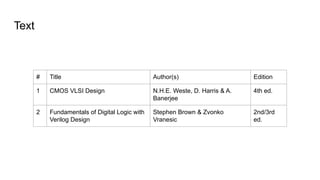
Text
# Title Author(s) Edition
1 CMOS VLSI Design N.H.E. Weste, D. Harris & A.
Banerjee
4th ed.
2 Fundamentals of Digital Logic with
Verilog Design
Stephen Brown & Zvonko
Vranesic
2nd/3rd
ed.
Transistors = Switches
Slide References
1. https://en.wikipedia.org/wiki/MOSFET
2. https://www.techspot.com/article/1840-how-cpus-are-designed-and-built-part-
3/
3. https://ieeexplore.ieee.org/document/5424253
4. Wayne Wolf - Modern VLSI Design IP based design
5. Jan M. Rabaey - Digital Integrated Circuits
6. Weste and Harris - CMOS VLSI Design
Thank you!

CSE460 Lecture 1.pptx.pdf

  • 1.
  • 2.
    Very Large ScaleIntegration or VLSI
  • 3.
    Contents ● Topics ofthis course ● History ● Transistors ● Moore’s law ● Types of chips ● Design abstraction ● Design methodology
  • 4.
    What will youlearn in this course? ● You may have heard people say that electronics are made from sand, but do you know how?
  • 5.
    What will youlearn in this course? ● A solid introduction to VLSI ● Different kinds of chips/ICs ● How to build one ● Theoretical background to making a good chip ● Quality measures of a chip ● The complete lifecycle of a chip
  • 6.
    The Transistor ● Transistorconcept ○ Transistors can be viewed as electrically controlled switches with a control terminal and two other terminals that are connected or disconnected depending on the voltage or current applied to the control terminal
  • 7.
    Transistor Invention ● 1947:First transistor was built ○ John Bardeen and Walter Brattain built the first functioning point contact transistor at Bell Labs ○ Nearly classified as military secret ○ Later publicly introduced by Bell Labs ○ Nobel Prize in Physics in 1956 for Bardeen, Brattain, and their supervisor William Shockley ○ We have called it the Transistor, T-R-A-N-S-I-S-T-O-R, because it is a resistor or semiconductor device which can amplify electrical signals as they are transferred through it from input to output terminals. It is, if you will, the electrical equivalent of a vacuum tube amplifier. But there the similarity ceases. It has no vacuum, no filament, no glass tube. It is composed entirely of cold, solid substances.
  • 8.
    First IC ● 1959:U.S. Patent 3,138,743 for "Miniaturized Electronic Circuits" ○ Several years later after the invention of transistors, Jack Kilby at Texas Instruments realized the potential for miniaturization if multiple transistors could be built on one piece of silicon ○ Kilby received the Nobel Prize in Physics in 2000 for the invention of the integrated circuit
  • 9.
    Bipolar Junction Transistor ●Bipolar Junction Transistor (BJT) ○ Developed by Bell Labs ● More reliable, less noisy, and more power-efficient than the point contact transistor ● BJTs require a small current into the control (base) terminal to switch much larger currents between the other two (emitter and collector) terminals ● Power being dissipated by these base currents even when idle
  • 10.
    Metal Oxide SemiconductorField Effect Transistor ● 1960s: (MOSFETs) began to enter production ● Metal Oxide Semiconductor Field Effect Transistors or MOSFETs offer the compelling advantage that they draw almost zero control current while idle. ● Two flavors: nMOS and pMOS ● Three terminals: Gate (control), Drain and Source
  • 11.
    First MOSFET Gates ●1963: First logic gate using MOSFETs ○ Frank Wanlass at Fairchild described the first logic gates using MOSFETs ● Fairchild’s gates used both nMOS and pMOS transistors, earning the name Complementary Metal Oxide Semiconductor, or CMOS ● The circuits used discrete transistors but consumed six orders of magnitude less power than their bipolar counterparts ● With the development of the silicon planar process, MOS integrated circuits became attractive for their low cost because each transistor occupied less area and the fabrication process was simpler Integration Levels SSI: 1-12 gates MSI: 13-99 gates LSI: 100-9999 gates VLSI: 10-99.9 k gates ULSI: >100k gates
  • 12.
    Trend in MOSFETIC Design ● Early commercial processes used only pMOS transistors and suffered from poor performance, yield, and reliability ● Processes using nMOS transistors became common in the 1970s ● While nMOS process was less expensive than CMOS, nMOS logic gates still consumed power while idle ● Power consumption became a major issue in the 1980s as hundreds of thousands of transistors were integrated onto a single die ● CMOS processes were widely adopted and replaced all the other technologies (pMOS, nMOS)
  • 13.
    Types of MOSFET ●pMOS, nMOS, CMOS ● Metal–insulator–semiconductor field-effect transistor (MISFET) ● Floating-gate MOSFET (FGMOS) ● Power MOSFET ● Multi-gate field-effect transistor (MuGFET) ● Quantum field-effect transistor (QFET)
  • 14.
    A Closer Look PackanP, Akbar S, Armstrong M, et al. High performance 32nm logic technology featuring 2nd generation High-k + metal gate transistors. In: International Electron Devices Meeting, IEEE, 2009. 659–662 Cross sectional view of intel’s 32nm CMOS devices
  • 15.
    A Closer Look Photomicrographof a submicron MOS transistor (courtesy Agere)
  • 16.
    Moore’s Law ● 1965:GordonMoore plotted # transistors on each chip vs year ○ Fit straight line on semi-log scale ○ Transistor counts have doubled about every 2 years
  • 17.
    Moore’s Law ● Processgenerations ○ A manufacturing technology at a particular channel length (feature size) is called a technology node/process node (micron, submicron, nanometer technologies)
  • 18.
    Moore’s Law ● Moore’slaw and intel microprocessors
  • 19.
    Intel Processors overthe years ● 80286, 80386, 80486, Pentium
  • 20.
    Types of chips ●Cell-based design ○ In the 1960s, standard parts were logic gates; in the 1970s they were LSI components. Today, standard parts include fairly specialized components: communication network interfaces, graphics accelerators ● Full custom ○ Designed manually piece by piece, fully custom layouts ● Application-specific integrated circuits (ASICs) ○ Rather than build a system out of standard parts, designers can now create a single chip for their particular application ● Systems-on-chips (SoCs) ○ a single-chip computer can include a CPU, bus, I/O devices, and memory
  • 21.
    Chip Lifecycle ● Awafer > fabrication > chips > packaging
  • 22.
    Abstraction levels ● Specification ○A set of requirements, not a design ● Behavior ○ generally modeled as some sort of executable program ● Register-transfer ○ The system is specified as Boolean functions stored in abstract memory elements ● Logic ○ The system is designed in terms of Boolean logic gates,latches, and flip-flops ● Circuit ○ The system is implemented as transistors ● Layout ○ The final design for fabrication
  • 23.
    Design methodologies ● Top-downapproach ○ Start from the specification and reach device specification ● Bottom-up approach ○ Start from the device optimization and go up to meet specification
  • 24.
    Text # Title Author(s)Edition 1 CMOS VLSI Design N.H.E. Weste, D. Harris & A. Banerjee 4th ed. 2 Fundamentals of Digital Logic with Verilog Design Stephen Brown & Zvonko Vranesic 2nd/3rd ed.
  • 25.
  • 26.
    Slide References 1. https://en.wikipedia.org/wiki/MOSFET 2.https://www.techspot.com/article/1840-how-cpus-are-designed-and-built-part- 3/ 3. https://ieeexplore.ieee.org/document/5424253 4. Wayne Wolf - Modern VLSI Design IP based design 5. Jan M. Rabaey - Digital Integrated Circuits 6. Weste and Harris - CMOS VLSI Design
  • 27.