Introduction to VLSI Circuits and
Systems
4th
Generation Microprocessor
VLSI
Prepared by: Soma.O.Muhammad
The beginning
 Microprocessors are essential to many of the products we use every day such as TVs, cars, radios,
home appliances and of course, computers. Transistors are the main components of
microprocessors.
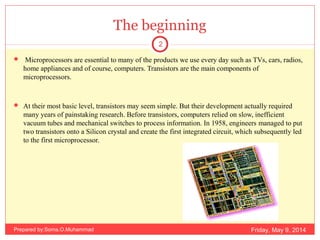
 At their most basic level, transistors may seem simple. But their development actually required
many years of painstaking research. Before transistors, computers relied on slow, inefficient
vacuum tubes and mechanical switches to process information. In 1958, engineers managed to put
two transistors onto a Silicon crystal and create the first integrated circuit, which subsequently led
to the first microprocessor.
Friday, May 9, 2014
2
Prepared by:Soma.O.Muhammad
History and Evolution
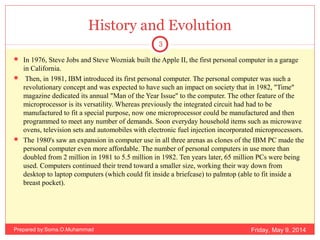
 In 1976, Steve Jobs and Steve Wozniak built the Apple II, the first personal computer in a garage
in California.
 Then, in 1981, IBM introduced its first personal computer. The personal computer was such a
revolutionary concept and was expected to have such an impact on society that in 1982, "Time"
magazine dedicated its annual "Man of the Year Issue" to the computer. The other feature of the
microprocessor is its versatility. Whereas previously the integrated circuit had had to be
manufactured to fit a special purpose, now one microprocessor could be manufactured and then
programmed to meet any number of demands. Soon everyday household items such as microwave
ovens, television sets and automobiles with electronic fuel injection incorporated microprocessors.
 The 1980's saw an expansion in computer use in all three arenas as clones of the IBM PC made the
personal computer even more affordable. The number of personal computers in use more than
doubled from 2 million in 1981 to 5.5 million in 1982. Ten years later, 65 million PCs were being
used. Computers continued their trend toward a smaller size, working their way down from
desktop to laptop computers (which could fit inside a briefcase) to palmtop (able to fit inside a
breast pocket).
Friday, May 9, 2014
3
Prepared by:Soma.O.Muhammad
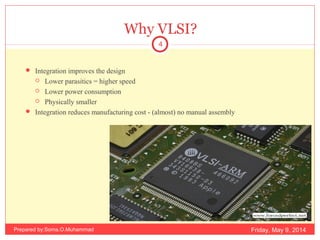
 Integration improves the design
 Lower parasitics = higher speed
 Lower power consumption
 Physically smaller
 Integration reduces manufacturing cost - (almost) no manual assembly
Why VLSI?
Friday, May 9, 2014
4
Prepared by:Soma.O.Muhammad
Introduction
Very-large-scale integration (VLSI) is the process of creating an IC by combining thousands of
transistors into a single chip. VLSI began in the 1970s when complexsemiconductor and
communication technologies were being developed. The microprocessor is a VLSI device. Before
the introduction of VLSI technology most ICs had a limited set of functions they could perform.
An electronic circuit might consist of a CPU, ROM, RAM and other glue logic. VLSI lets IC
makers add all of these into one chip.
By the 1980's, very large scale integration (VLSI) squeezed hundreds of thousands of components
onto a chip. The ability to fit so much onto an area about half the size of a U.S. dime helped diminish
the size and price of computers. It also increased their power, efficiency and reliability. Marcian Hoff
invented a device which could replace several of the components of earlier computers, the
microprocessor. The microprocessor is the characteristic of fourth generation computers, capable of
performing all of the functions of a computer's central processing unit. The reduced size, reduced
cost, and increased speed of the microprocessor led to the creation of the first personal computers.
Until now computers had been the almost exclusively the domain of universities, business and
government.
Friday, May 9, 2014
5
Prepared by:Soma.O.Muhammad
Introduction
IC: Integrated Circuits, many transistors on one chip
VLSI: Very Large Scale Integration, a modern
technology of IC design flow
MOS: Metal-Oxide-Silicon transistor (also called
device)
CMOS: Complementary Metal Oxide Semiconductor
Friday, May 9, 2014
6
Prepared by:Soma.O.Muhammad
Moore’s Law
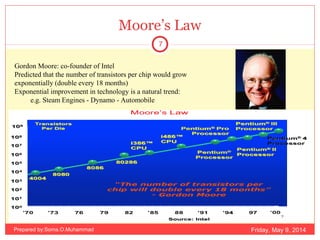
Gordon Moore: co-founder of Intel
Predicted that the number of transistors per chip would grow
exponentially (double every 18 months)
Exponential improvement in technology is a natural trend:
e.g. Steam Engines - Dynamo - Automobile
Friday, May 9, 2014
7
Prepared by:Soma.O.Muhammad
Technology Background
What is a Silicon Chip?
A pattern of interconnected switches and gates on the surface of a crystal
of semiconductor (typically Si)
These switches and gates are made of
areas of n-type silicon
areas of p-type silicon
areas of insulator
lines of conductor (interconnects) joining areas together
Aluminium, Copper, Titanium, Molybdenum, polysilicon, tungsten
The geometryof these areas is known as the layout of the chip
Connections from the chip to the outside world are made around the edge
of the chip to facilitate connections to other devices
Friday, May 9, 2014
8
Prepared by:Soma.O.Muhammad
Technology Background
Semiconductors and Doping
•Adding trace amounts of certain materials to semiconductors alters the crystal
structure and can change their electrical properties
in particular it can change the number of free electrons or holes
•N-Type
semiconductor has free electrons
dopant is (typically) phosphorus, arsenic, antimony
•P-Type
semiconductor has free holes
dopant is (typically) boron, indium, gallium
Dopants are usually implanted into the semiconductor using Implant Technology,
followed by thermal process to diffuse the dopants
Friday, May 9, 2014
9
Prepared by:Soma.O.Muhammad
Silicon Lattice
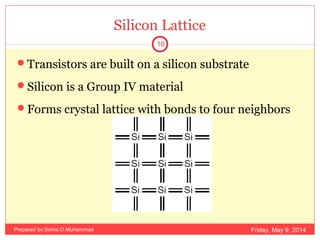
Transistors are built on a silicon substrate
Silicon is a Group IV material
Forms crystal lattice with bonds to four neighbors
Friday, May 9, 2014
10
Prepared by:Soma.O.Muhammad
Dopants
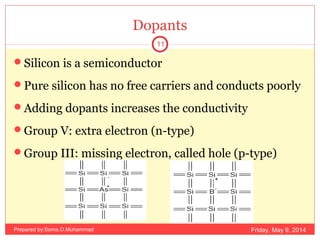
Silicon is a semiconductor
Pure silicon has no free carriers and conducts poorly
Adding dopants increases the conductivity
Group V: extra electron (n-type)
Group III: missing electron, called hole (p-type)
Friday, May 9, 2014
11
Prepared by:Soma.O.Muhammad
Complexity and Design
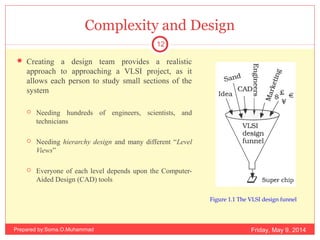
 Creating a design team provides a realistic
approach to approaching a VLSI project, as it
allows each person to study small sections of the
system
 Needing hundreds of engineers, scientists, and
technicians
 Needing hierarchy design and many different “Level
Views”
 Everyone of each level depends upon the Computer-
Aided Design (CAD) tools
Figure 1.1 The VLSI design funnel
Friday, May 9, 2014
12
Prepared by:Soma.O.Muhammad
Design Hierarchy (1/2)
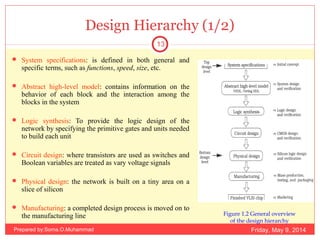
 System specifications: is defined in both general and
specific terms, such as functions, speed, size, etc.
 Abstract high-level model: contains information on the
behavior of each block and the interaction among the
blocks in the system
 Logic synthesis: To provide the logic design of the
network by specifying the primitive gates and units needed
to build each unit
 Circuit design: where transistors are used as switches and
Boolean variables are treated as vary voltage signals
 Physical design: the network is built on a tiny area on a
slice of silicon
 Manufacturing: a completed design process is moved on to
the manufacturing line Figure 1.2 General overview
of the design hierarchy
Friday, May 9, 2014
13
Prepared by:Soma.O.Muhammad
Design Hierarchy (2/2)
 Hierarchical design
 Top-down design
 the initial work is quite abstract and
theoretical and there is no direct
connection to silicon until many steps
have been completed
 Acceptable in modern digital system
design
 Co-design with combining HW/SW is
critical
 Similar to Cell-based Design Flow
 Bottom-up design
 starts at the silicon or circuit level and
builds primitive units such as logic gates,
adders, and registers as the first steps
 Acceptable for small projects
 Similar to Full-custom Design Flow
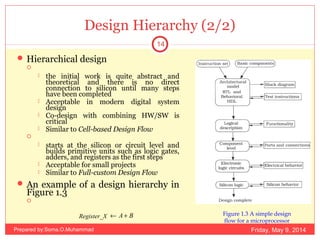
 An example of a design hierarchy in
Figure 1.3
 an instruction design of a microprocessor
Figure 1.3 A simple design
flow for a microprocessor
BA +←Register_X
Friday, May 9, 2014
14
Prepared by:Soma.O.Muhammad
VLSI Chip Types
At the engineering level, digital VLSI chips are classified by
the approach used to implement and build the circuit
 Full-custom Design: where every circuit is custom designed for the
project
 Extremely tedious
 Time-consuming process
 Application-Specific Integrated Circuits (ASICs): using an
extensive suite of CAD tools that portray the system design in terms of
standard digital logic constructs
 Including state diagrams, functions tables, and logic diagram
 Designer does not need any knowledge of the underlying electronics or the
physic of the silicon chip
 Major drawback is that all characteristics are set by the architectural design
 Semi-custom Design: between that of a full-custom and ASICs
 Using a group of primitive predefined cells as building blocks, called cell
library
Friday, May 9, 2014
15
Prepared by:Soma.O.Muhammad
Integrated Circuits
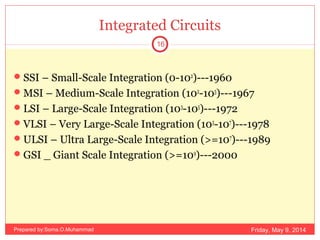
SSI – Small-Scale Integration (0-102
)---1960
MSI – Medium-Scale Integration (102
-103
)---1967
LSI – Large-Scale Integration (103
-105
)---1972
VLSI – Very Large-Scale Integration (105
-107
)---1978
ULSI – Ultra Large-Scale Integration (>=107
)---1989
GSI _ Giant Scale Integration (>=109
)---2000
Friday, May 9, 2014
16
Prepared by:Soma.O.Muhammad
Integrated Circuits
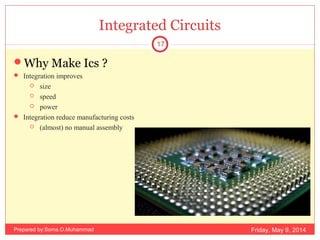
Why Make Ics ?
 Integration improves
 size
 speed
 power
 Integration reduce manufacturing costs
 (almost) no manual assembly
Friday, May 9, 2014
17
Prepared by:Soma.O.Muhammad
IC Evolution (1/3)
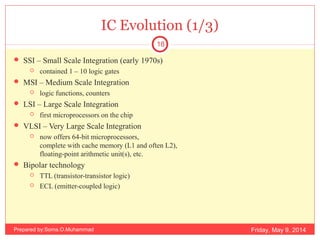
 SSI – Small Scale Integration (early 1970s)
 contained 1 – 10 logic gates
 MSI – Medium Scale Integration
 logic functions, counters
 LSI – Large Scale Integration
 first microprocessors on the chip
 VLSI – Very Large Scale Integration
 now offers 64-bit microprocessors,
complete with cache memory (L1 and often L2),
floating-point arithmetic unit(s), etc.
 Bipolar technology
 TTL (transistor-transistor logic)
 ECL (emitter-coupled logic)
Friday, May 9, 2014
18
Prepared by:Soma.O.Muhammad
IC Evolution (2/3)
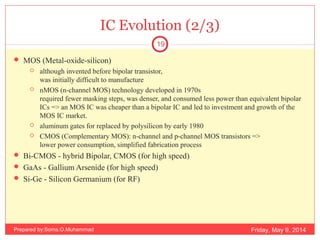
 MOS (Metal-oxide-silicon)
 although invented before bipolar transistor,
was initially difficult to manufacture
 nMOS (n-channel MOS) technology developed in 1970s
required fewer masking steps, was denser, and consumed less power than equivalent bipolar
ICs => an MOS IC was cheaper than a bipolar IC and led to investment and growth of the
MOS IC market.
 aluminum gates for replaced by polysilicon by early 1980
 CMOS (Complementary MOS): n-channel and p-channel MOS transistors =>
lower power consumption, simplified fabrication process
 Bi-CMOS - hybrid Bipolar, CMOS (for high speed)
 GaAs - Gallium Arsenide (for high speed)
 Si-Ge - Silicon Germanium (for RF)
Friday, May 9, 2014
19
Prepared by:Soma.O.Muhammad
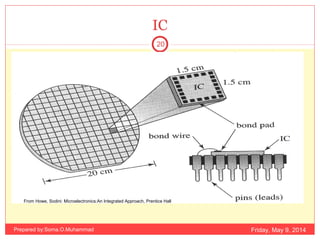
IC
From Howe, Sodini: Microelectronics:An Integrated Approach, Prentice Hall
Friday, May 9, 2014
20
Prepared by:Soma.O.Muhammad
Chips
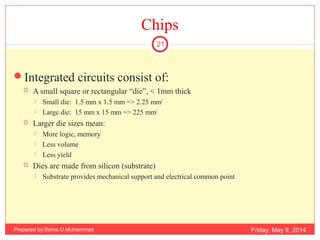
Integrated circuits consist of:
 A small square or rectangular “die”, < 1mm thick
 Small die: 1.5 mm x 1.5 mm => 2.25 mm2
 Large die: 15 mm x 15 mm => 225 mm2
 Larger die sizes mean:
 More logic, memory
 Less volume
 Less yield
 Dies are made from silicon (substrate)
 Substrate provides mechanical support and electrical common point
Friday, May 9, 2014
21
Prepared by:Soma.O.Muhammad
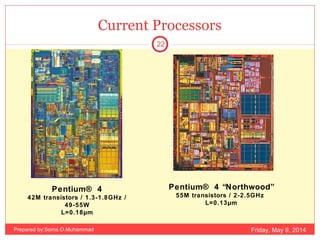
Current Processors
Pentium® 4
42M transistors / 1.3-1.8GHz /
49-55W
L=0.18µm
Pentium® 4 “Northwood”
55M transistors / 2-2.5GHz
L=0.13µm
Friday, May 9, 2014
22
Prepared by:Soma.O.Muhammad
VLSI-Chip Manufacturing
Friday, May 9, 2014Prepared by:Soma.O.Muhammad
23
References:-
1. AUTHOR STREAM:
http://www.authorstream.com/Presentation/aSGuest43958-383515-vlsi-spdas1vlsibput-education-ppt-powerpoint/
2. SLIDE SHARE:
http://www.slideshare.net/illpa/introduction-to-vlsi
3. ENGINEERS GARAGE: -
http://www.engineersgarage.com/articles/vlsi-design-future
4. FORCEPERFECT:
http://www.forcedperfect.net/hardware/cards/applepowermacintoshupgradecard/images/applepowermacintoshupgradecard-vlsi.jpg
5. Uyemura, John P.
Introduction to VLSI Circuits and Systems
6. http://www.cs.sun.ac.za/museum/gen4.html
7. http://www.youtube.com/watch?v=hO455B9d7zY
Friday, May 9, 2014
24
Prepared by:Soma.O.Muhammad

VLSI

  • 1.
    Introduction to VLSICircuits and Systems 4th Generation Microprocessor VLSI Prepared by: Soma.O.Muhammad
  • 2.
    The beginning  Microprocessorsare essential to many of the products we use every day such as TVs, cars, radios, home appliances and of course, computers. Transistors are the main components of microprocessors.  At their most basic level, transistors may seem simple. But their development actually required many years of painstaking research. Before transistors, computers relied on slow, inefficient vacuum tubes and mechanical switches to process information. In 1958, engineers managed to put two transistors onto a Silicon crystal and create the first integrated circuit, which subsequently led to the first microprocessor. Friday, May 9, 2014 2 Prepared by:Soma.O.Muhammad
  • 3.
    History and Evolution In 1976, Steve Jobs and Steve Wozniak built the Apple II, the first personal computer in a garage in California.  Then, in 1981, IBM introduced its first personal computer. The personal computer was such a revolutionary concept and was expected to have such an impact on society that in 1982, "Time" magazine dedicated its annual "Man of the Year Issue" to the computer. The other feature of the microprocessor is its versatility. Whereas previously the integrated circuit had had to be manufactured to fit a special purpose, now one microprocessor could be manufactured and then programmed to meet any number of demands. Soon everyday household items such as microwave ovens, television sets and automobiles with electronic fuel injection incorporated microprocessors.  The 1980's saw an expansion in computer use in all three arenas as clones of the IBM PC made the personal computer even more affordable. The number of personal computers in use more than doubled from 2 million in 1981 to 5.5 million in 1982. Ten years later, 65 million PCs were being used. Computers continued their trend toward a smaller size, working their way down from desktop to laptop computers (which could fit inside a briefcase) to palmtop (able to fit inside a breast pocket). Friday, May 9, 2014 3 Prepared by:Soma.O.Muhammad
  • 4.
     Integration improvesthe design  Lower parasitics = higher speed  Lower power consumption  Physically smaller  Integration reduces manufacturing cost - (almost) no manual assembly Why VLSI? Friday, May 9, 2014 4 Prepared by:Soma.O.Muhammad
  • 5.
    Introduction Very-large-scale integration (VLSI)is the process of creating an IC by combining thousands of transistors into a single chip. VLSI began in the 1970s when complexsemiconductor and communication technologies were being developed. The microprocessor is a VLSI device. Before the introduction of VLSI technology most ICs had a limited set of functions they could perform. An electronic circuit might consist of a CPU, ROM, RAM and other glue logic. VLSI lets IC makers add all of these into one chip. By the 1980's, very large scale integration (VLSI) squeezed hundreds of thousands of components onto a chip. The ability to fit so much onto an area about half the size of a U.S. dime helped diminish the size and price of computers. It also increased their power, efficiency and reliability. Marcian Hoff invented a device which could replace several of the components of earlier computers, the microprocessor. The microprocessor is the characteristic of fourth generation computers, capable of performing all of the functions of a computer's central processing unit. The reduced size, reduced cost, and increased speed of the microprocessor led to the creation of the first personal computers. Until now computers had been the almost exclusively the domain of universities, business and government. Friday, May 9, 2014 5 Prepared by:Soma.O.Muhammad
  • 6.
    Introduction IC: Integrated Circuits,many transistors on one chip VLSI: Very Large Scale Integration, a modern technology of IC design flow MOS: Metal-Oxide-Silicon transistor (also called device) CMOS: Complementary Metal Oxide Semiconductor Friday, May 9, 2014 6 Prepared by:Soma.O.Muhammad
  • 7.
    Moore’s Law Gordon Moore:co-founder of Intel Predicted that the number of transistors per chip would grow exponentially (double every 18 months) Exponential improvement in technology is a natural trend: e.g. Steam Engines - Dynamo - Automobile Friday, May 9, 2014 7 Prepared by:Soma.O.Muhammad
  • 8.
    Technology Background What isa Silicon Chip? A pattern of interconnected switches and gates on the surface of a crystal of semiconductor (typically Si) These switches and gates are made of areas of n-type silicon areas of p-type silicon areas of insulator lines of conductor (interconnects) joining areas together Aluminium, Copper, Titanium, Molybdenum, polysilicon, tungsten The geometryof these areas is known as the layout of the chip Connections from the chip to the outside world are made around the edge of the chip to facilitate connections to other devices Friday, May 9, 2014 8 Prepared by:Soma.O.Muhammad
  • 9.
    Technology Background Semiconductors andDoping •Adding trace amounts of certain materials to semiconductors alters the crystal structure and can change their electrical properties in particular it can change the number of free electrons or holes •N-Type semiconductor has free electrons dopant is (typically) phosphorus, arsenic, antimony •P-Type semiconductor has free holes dopant is (typically) boron, indium, gallium Dopants are usually implanted into the semiconductor using Implant Technology, followed by thermal process to diffuse the dopants Friday, May 9, 2014 9 Prepared by:Soma.O.Muhammad
  • 10.
    Silicon Lattice Transistors arebuilt on a silicon substrate Silicon is a Group IV material Forms crystal lattice with bonds to four neighbors Friday, May 9, 2014 10 Prepared by:Soma.O.Muhammad
  • 11.
    Dopants Silicon is asemiconductor Pure silicon has no free carriers and conducts poorly Adding dopants increases the conductivity Group V: extra electron (n-type) Group III: missing electron, called hole (p-type) Friday, May 9, 2014 11 Prepared by:Soma.O.Muhammad
  • 12.
    Complexity and Design Creating a design team provides a realistic approach to approaching a VLSI project, as it allows each person to study small sections of the system  Needing hundreds of engineers, scientists, and technicians  Needing hierarchy design and many different “Level Views”  Everyone of each level depends upon the Computer- Aided Design (CAD) tools Figure 1.1 The VLSI design funnel Friday, May 9, 2014 12 Prepared by:Soma.O.Muhammad
  • 13.
    Design Hierarchy (1/2) System specifications: is defined in both general and specific terms, such as functions, speed, size, etc.  Abstract high-level model: contains information on the behavior of each block and the interaction among the blocks in the system  Logic synthesis: To provide the logic design of the network by specifying the primitive gates and units needed to build each unit  Circuit design: where transistors are used as switches and Boolean variables are treated as vary voltage signals  Physical design: the network is built on a tiny area on a slice of silicon  Manufacturing: a completed design process is moved on to the manufacturing line Figure 1.2 General overview of the design hierarchy Friday, May 9, 2014 13 Prepared by:Soma.O.Muhammad
  • 14.
    Design Hierarchy (2/2) Hierarchical design  Top-down design  the initial work is quite abstract and theoretical and there is no direct connection to silicon until many steps have been completed  Acceptable in modern digital system design  Co-design with combining HW/SW is critical  Similar to Cell-based Design Flow  Bottom-up design  starts at the silicon or circuit level and builds primitive units such as logic gates, adders, and registers as the first steps  Acceptable for small projects  Similar to Full-custom Design Flow  An example of a design hierarchy in Figure 1.3  an instruction design of a microprocessor Figure 1.3 A simple design flow for a microprocessor BA +←Register_X Friday, May 9, 2014 14 Prepared by:Soma.O.Muhammad
  • 15.
    VLSI Chip Types Atthe engineering level, digital VLSI chips are classified by the approach used to implement and build the circuit  Full-custom Design: where every circuit is custom designed for the project  Extremely tedious  Time-consuming process  Application-Specific Integrated Circuits (ASICs): using an extensive suite of CAD tools that portray the system design in terms of standard digital logic constructs  Including state diagrams, functions tables, and logic diagram  Designer does not need any knowledge of the underlying electronics or the physic of the silicon chip  Major drawback is that all characteristics are set by the architectural design  Semi-custom Design: between that of a full-custom and ASICs  Using a group of primitive predefined cells as building blocks, called cell library Friday, May 9, 2014 15 Prepared by:Soma.O.Muhammad
  • 16.
    Integrated Circuits SSI –Small-Scale Integration (0-102 )---1960 MSI – Medium-Scale Integration (102 -103 )---1967 LSI – Large-Scale Integration (103 -105 )---1972 VLSI – Very Large-Scale Integration (105 -107 )---1978 ULSI – Ultra Large-Scale Integration (>=107 )---1989 GSI _ Giant Scale Integration (>=109 )---2000 Friday, May 9, 2014 16 Prepared by:Soma.O.Muhammad
  • 17.
    Integrated Circuits Why MakeIcs ?  Integration improves  size  speed  power  Integration reduce manufacturing costs  (almost) no manual assembly Friday, May 9, 2014 17 Prepared by:Soma.O.Muhammad
  • 18.
    IC Evolution (1/3) SSI – Small Scale Integration (early 1970s)  contained 1 – 10 logic gates  MSI – Medium Scale Integration  logic functions, counters  LSI – Large Scale Integration  first microprocessors on the chip  VLSI – Very Large Scale Integration  now offers 64-bit microprocessors, complete with cache memory (L1 and often L2), floating-point arithmetic unit(s), etc.  Bipolar technology  TTL (transistor-transistor logic)  ECL (emitter-coupled logic) Friday, May 9, 2014 18 Prepared by:Soma.O.Muhammad
  • 19.
    IC Evolution (2/3) MOS (Metal-oxide-silicon)  although invented before bipolar transistor, was initially difficult to manufacture  nMOS (n-channel MOS) technology developed in 1970s required fewer masking steps, was denser, and consumed less power than equivalent bipolar ICs => an MOS IC was cheaper than a bipolar IC and led to investment and growth of the MOS IC market.  aluminum gates for replaced by polysilicon by early 1980  CMOS (Complementary MOS): n-channel and p-channel MOS transistors => lower power consumption, simplified fabrication process  Bi-CMOS - hybrid Bipolar, CMOS (for high speed)  GaAs - Gallium Arsenide (for high speed)  Si-Ge - Silicon Germanium (for RF) Friday, May 9, 2014 19 Prepared by:Soma.O.Muhammad
  • 20.
    IC From Howe, Sodini:Microelectronics:An Integrated Approach, Prentice Hall Friday, May 9, 2014 20 Prepared by:Soma.O.Muhammad
  • 21.
    Chips Integrated circuits consistof:  A small square or rectangular “die”, < 1mm thick  Small die: 1.5 mm x 1.5 mm => 2.25 mm2  Large die: 15 mm x 15 mm => 225 mm2  Larger die sizes mean:  More logic, memory  Less volume  Less yield  Dies are made from silicon (substrate)  Substrate provides mechanical support and electrical common point Friday, May 9, 2014 21 Prepared by:Soma.O.Muhammad
  • 22.
    Current Processors Pentium® 4 42Mtransistors / 1.3-1.8GHz / 49-55W L=0.18µm Pentium® 4 “Northwood” 55M transistors / 2-2.5GHz L=0.13µm Friday, May 9, 2014 22 Prepared by:Soma.O.Muhammad
  • 23.
    VLSI-Chip Manufacturing Friday, May9, 2014Prepared by:Soma.O.Muhammad 23
  • 24.
    References:- 1. AUTHOR STREAM: http://www.authorstream.com/Presentation/aSGuest43958-383515-vlsi-spdas1vlsibput-education-ppt-powerpoint/ 2.SLIDE SHARE: http://www.slideshare.net/illpa/introduction-to-vlsi 3. ENGINEERS GARAGE: - http://www.engineersgarage.com/articles/vlsi-design-future 4. FORCEPERFECT: http://www.forcedperfect.net/hardware/cards/applepowermacintoshupgradecard/images/applepowermacintoshupgradecard-vlsi.jpg 5. Uyemura, John P. Introduction to VLSI Circuits and Systems 6. http://www.cs.sun.ac.za/museum/gen4.html 7. http://www.youtube.com/watch?v=hO455B9d7zY Friday, May 9, 2014 24 Prepared by:Soma.O.Muhammad