Established as per the Section 2(f) of the UGC Act, 1956
Approved by AICTE, COA and BCI, New Delhi
Need For Low Power VLSI Design
S c h o o l o f E C E
Prameela.n@reva.edu.in
D r. P ra m e e l a K u m a r i N
KEY LEARNINGS
1. Need of VLSI circuits operating with low power
2. Key factors that influence Low Power VLSI Design
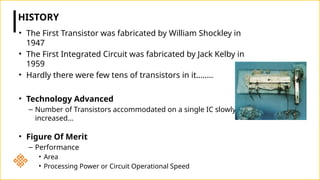
HISTORY
• The First Transistor was fabricated by William Shockley in
1947
• The First Integrated Circuit was fabricated by Jack Kelby in
1959
• Hardly there were few tens of transistors in it……..
• Technology Advanced
– Number of Transistors accommodated on a single IC slowly
increased…
• Figure Of Merit
– Performance
• Area
• Processing Power or Circuit Operational Speed
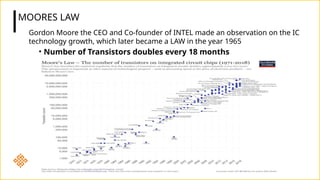
MOORES LAW
Gordon Moore the CEO and Co-founder of INTEL made an observation on the IC
technology growth, which later became a LAW in the year 1965
• Number of Transistors doubles every 18 months
IMPACT ON THE IC COST
• As the number of transistors doubles every 18 months
• Device density is also expected to increase by 10 fold for every 7 years
– Area is a major concern
• Increased Packaging cost
• Reduced fabrication yield
FACTORS INFLUENCING LOW POWER VLSI DESIGN
Technology advancement as per MOORE’s prediction
Increased demand for Portable Devices
Battery Power
High Performance Computing
Reducing the Total Energy Consumption
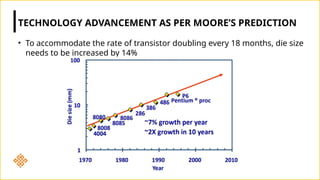
TECHNOLOGY ADVANCEMENT AS PER MOORE’S PREDICTION
• To accommodate the rate of transistor doubling every 18 months, die size
needs to be increased by 14%
TECHNOLOGY ADVANCEMENT AS PER MOORE’S PREDICTION
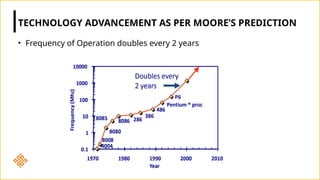
• Frequency of Operation doubles every 2 years
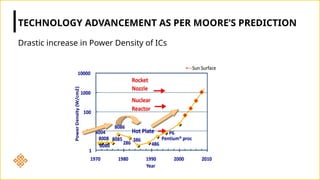
Drastic increase in Power Density of ICs
TECHNOLOGY ADVANCEMENT AS PER MOORE’S PREDICTION
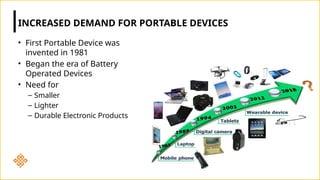
• First Portable Device was
invented in 1981
• Began the era of Battery
Operated Devices
• Need for
– Smaller
– Lighter
– Durable Electronic Products
INCREASED DEMAND FOR PORTABLE DEVICES
• Heaviest and Biggest component in a portable system
• Specific Weight
– Stored Energy per unit weight
– Barely doubles in several years
– Safety Concerns
• Energy density is approaching that of explosive chemicals
BATTERY LIFE
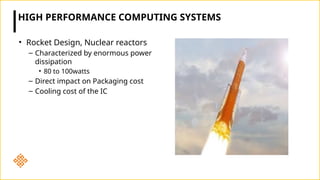
HIGH PERFORMANCE COMPUTING SYSTEMS
• Rocket Design, Nuclear reactors
– Characterized by enormous power
dissipation
• 80 to 100watts
– Direct impact on Packaging cost
– Cooling cost of the IC
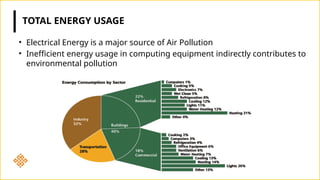
• Electrical Energy is a major source of Air Pollution
• Inefficient energy usage in computing equipment indirectly contributes to
environmental pollution
TOTAL ENERGY USAGE
• Understood about the need for designing VLSI
circuits operating with low power
• Grasped an overall idea about the key factors
that influence Low Power VLSI Design
OUTCOMES
Thank You

Unit1_Need_for_LPVLSI-1.pptx...................................

  • 1.
    Established as perthe Section 2(f) of the UGC Act, 1956 Approved by AICTE, COA and BCI, New Delhi Need For Low Power VLSI Design S c h o o l o f E C E Prameela.n@reva.edu.in D r. P ra m e e l a K u m a r i N
  • 2.
    KEY LEARNINGS 1. Needof VLSI circuits operating with low power 2. Key factors that influence Low Power VLSI Design
  • 3.
    HISTORY • The FirstTransistor was fabricated by William Shockley in 1947 • The First Integrated Circuit was fabricated by Jack Kelby in 1959 • Hardly there were few tens of transistors in it…….. • Technology Advanced – Number of Transistors accommodated on a single IC slowly increased… • Figure Of Merit – Performance • Area • Processing Power or Circuit Operational Speed
  • 4.
    MOORES LAW Gordon Moorethe CEO and Co-founder of INTEL made an observation on the IC technology growth, which later became a LAW in the year 1965 • Number of Transistors doubles every 18 months
  • 5.
    IMPACT ON THEIC COST • As the number of transistors doubles every 18 months • Device density is also expected to increase by 10 fold for every 7 years – Area is a major concern • Increased Packaging cost • Reduced fabrication yield
  • 6.
    FACTORS INFLUENCING LOWPOWER VLSI DESIGN Technology advancement as per MOORE’s prediction Increased demand for Portable Devices Battery Power High Performance Computing Reducing the Total Energy Consumption
  • 7.
    TECHNOLOGY ADVANCEMENT ASPER MOORE’S PREDICTION • To accommodate the rate of transistor doubling every 18 months, die size needs to be increased by 14%
  • 8.
    TECHNOLOGY ADVANCEMENT ASPER MOORE’S PREDICTION • Frequency of Operation doubles every 2 years
  • 9.
    Drastic increase inPower Density of ICs TECHNOLOGY ADVANCEMENT AS PER MOORE’S PREDICTION
  • 10.
    • First PortableDevice was invented in 1981 • Began the era of Battery Operated Devices • Need for – Smaller – Lighter – Durable Electronic Products INCREASED DEMAND FOR PORTABLE DEVICES
  • 11.
    • Heaviest andBiggest component in a portable system • Specific Weight – Stored Energy per unit weight – Barely doubles in several years – Safety Concerns • Energy density is approaching that of explosive chemicals BATTERY LIFE
  • 12.
    HIGH PERFORMANCE COMPUTINGSYSTEMS • Rocket Design, Nuclear reactors – Characterized by enormous power dissipation • 80 to 100watts – Direct impact on Packaging cost – Cooling cost of the IC
  • 13.
    • Electrical Energyis a major source of Air Pollution • Inefficient energy usage in computing equipment indirectly contributes to environmental pollution TOTAL ENERGY USAGE
  • 14.
    • Understood aboutthe need for designing VLSI circuits operating with low power • Grasped an overall idea about the key factors that influence Low Power VLSI Design OUTCOMES
  • 15.