Presented by:
MARIANNE TAPAYAN - EVANGELISTA, MSHRM
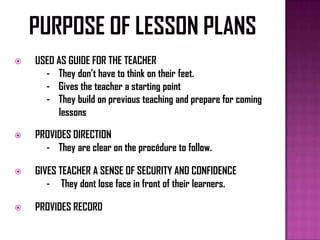
 USED AS GUIDE FOR THE TEACHER
- They don‟t have to think on their feet.
- Gives the teacher a starting point
- They build on previous teaching and prepare for coming
lessons
 PROVIDES DIRECTION
- They are clear on the procédure to follow.
 GIVES TEACHER A SENSE OF SECURITY AND CONFIDENCE
- They dont lose face in front of their learners.
 PROVIDES RECORD
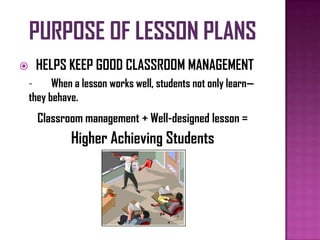
 HELPS KEEP GOOD CLASSROOM MANAGEMENT
- When a lesson works well, students not only learn—
they behave.
Classroom management + Well-designed lesson =
Higher Achieving Students
FOR THE LEARNER
 They realize that the teacher cares for
their learning.
 They attend a structured lesson: easier to
assimilate
 They appreciate their teacher‟s work as a
model of well-organized work to imitate.
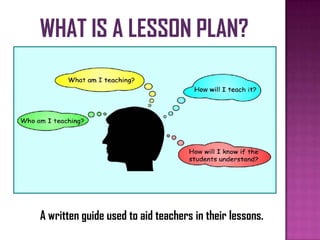
A written guide used to aid teachers in their lessons.
Based on 4 things
Interests and abilities of students
Your own interests and strengths
Your beliefs about teaching and learning
Your own openness to change your plan
Inform students why they are with you
What they will be able to do
The learner will……….
 Objectives should also follow the „S.M.A.R.T rule‟:
• Specific
• Measurable
• Attainable
• Result-oriented
• Time bound
 Transition
 Use time
 Variety
 Easy to follow
 Precise
 Get class ready to
learn
 Motivates students
 Hint to the theme
 Teaches skill
 Presents information
 Lecture, demo, pictures, etc.
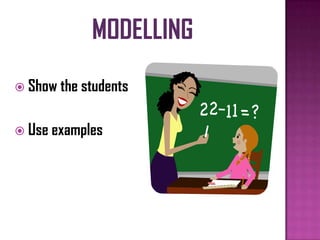
 Show the students
 Use examples
 May be predefined by the
teacher
 Teacher and student activities
defined together with
“intents” and “displays.”
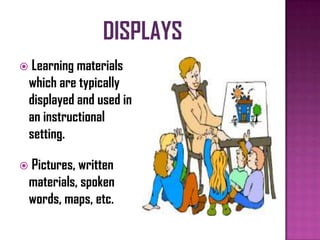
 Learning materials
which are typically
displayed and used in
an instructional
setting.
 Pictures, written
materials, spoken
words, maps, etc.
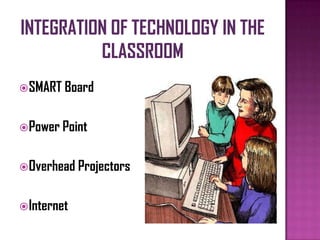
SMART Board
Power Point
Overhead Projectors
Internet
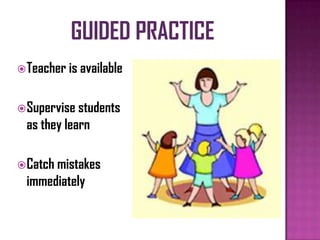
Teacher is available
Supervise students
as they learn
Catch mistakes
immediately
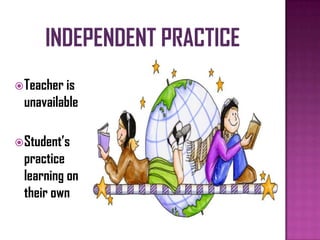
Teacher is
unavailable
Student‟s
practice
learning on
their own
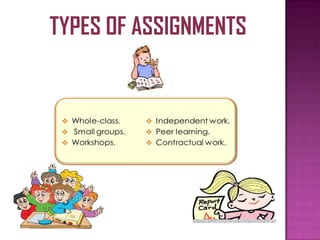
TYPES OF ASSIGNMENTS
Cognitive Outcomes: Intellectual outcomes. They
involve the application of facts, theories and
concepts.
Psychomotor Outcomes: They describe skills the
learner develops (Physical).
Affective Outcomes: They describe feelings and
attitudes which shape our behavior towards people,
work and our world (behavioral).
2 way Q and A- Ongoing
Bring lesson to an end
Review key points
Tie everything together
• Used to assess
students knowledge
• Provides grades for
report cards
• Keeps parents updated
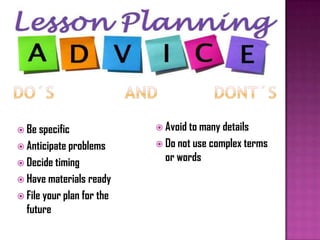
 Be specific
 Anticipate problems
 Decide timing
 Have materials ready
 File your plan for the
future
 Avoid to many details
 Do not use complex terms
or words
 If students are
misbehaving:
 consider re-arranging the
order of delivery.
 compare what actually
happened with your original
plan.
Presented to: Dr. Orias
And the students under Professional
Education of
The Divine Mercy College Foundation
Inc (Batch 2013)