Presented by:
PROF. MARIANNE T. EVANGELISTA, MSHRM
METHOD OF EXECUTION
PART 04
ISSUING
ISSUING
• All goods should be
issued after a
proper requisition.
• The store keeper
must follow the rule
of ‘FIRST IN FIRST
OUT (F.I.F.O.), which
means the goods
received first are
issued first.
ISSUANCE OF
STOCKS CONTROL
• Issuance of stocks control is intended to
ensure that all items released from the
storeroom are accompanied by justified and
approved requisitions, that they are
acknowledge by issuing and receiving
parties, and that said issuances are properly
documented.
ISSUANCE POLICIES
AND PROCEDURES
• The issuing function shall be the responsibility
of the stock clerk or storekeeper or his
authorized alternate in case he is not around
• Issuances shall be made only upon presentation
of duly approved requisition form
• Issuances have to be acknowledge – signed by the
issuing and receiving party.
• All served requisitions are kept on file with the
stock clerk
• Whenever stock clerk notices slow moving items
that are about to expire, he/she should inform
the chef, and may resort to forced issue rather
than wait for the items to be spoiled or damaged.
REQUISITION FORM
• A requisition is
a request for
something,
especially a formal
written request on
a pre-printed form.
• In the kitchen, it is
a form prepared by
a member of the
kitchen staff,
listing the items
and quantities
needed from stores.
DETERMINING OPERATING
REQUIREMENTS
• To ensure efficient and speedy flow of service,
establishing and maintaining sufficient budget
for supplies and equipments are necessary. It is
also important to avoid inadequate supply or
maintaining excessive stock, more than what is
required.
• You have to consider the following date to
prevent this problems:
- Par stock / Par Level
- Inventory
- Breakages / Losses
- Lead Time
PAR STOCK / PAR LEVEL
• Number of units
related to usage
in order to
maintain the
quantity of
stocks in the
service station
in order to
maintain
efficient flow of
service
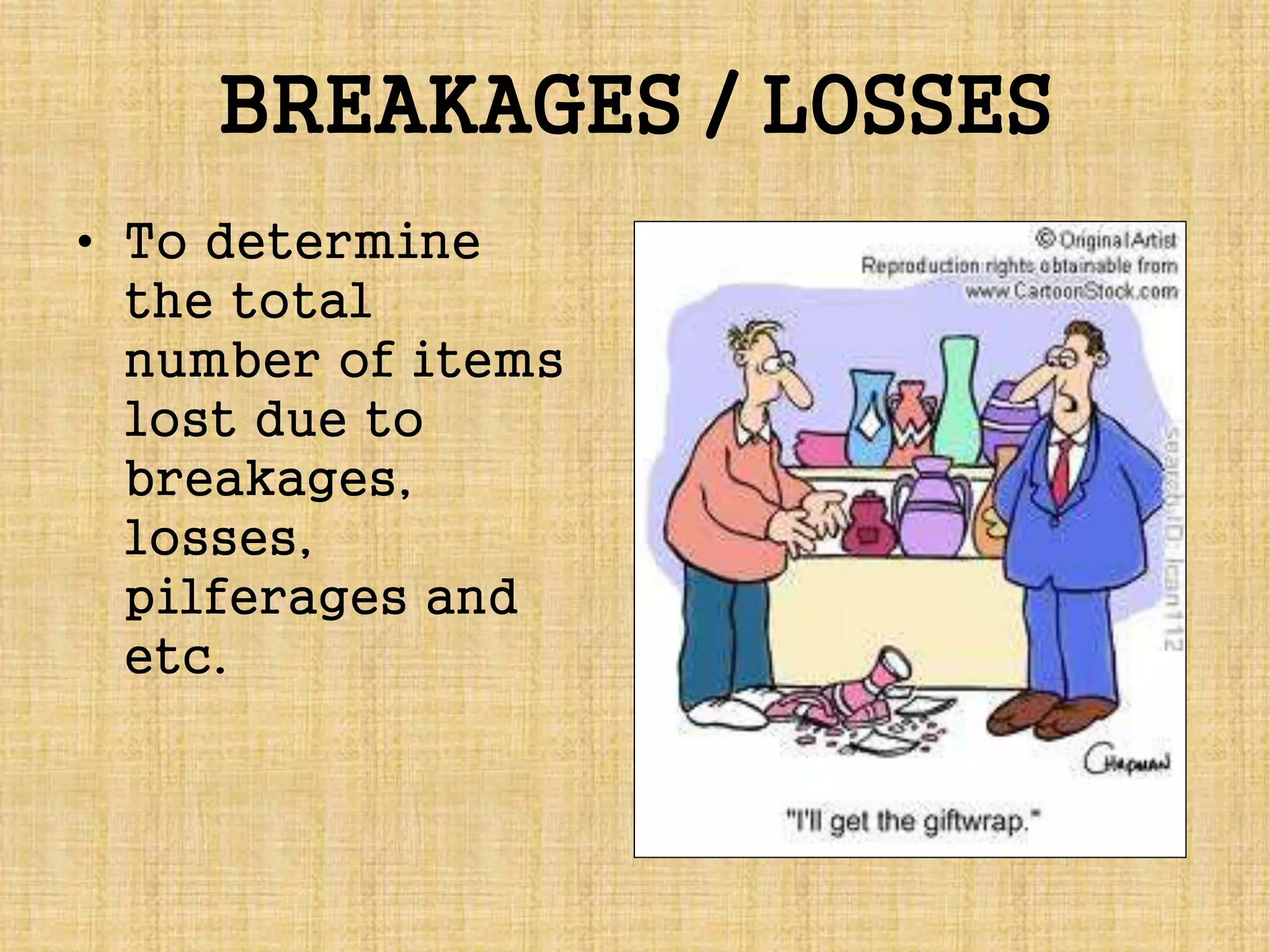
BREAKAGES / LOSSES
• To determine
the total
number of items
lost due to
breakages,
losses,
pilferages and
etc.
LEAD TIME
• Waiting time for
the purchase of
the items. This
happens when
waiting for a
long period of
importing and
transporting
items.

ISSUANCE CONTROL

  • 1.
    Presented by: PROF. MARIANNET. EVANGELISTA, MSHRM
  • 2.
  • 3.
    ISSUING • All goodsshould be issued after a proper requisition. • The store keeper must follow the rule of ‘FIRST IN FIRST OUT (F.I.F.O.), which means the goods received first are issued first.
  • 4.
    ISSUANCE OF STOCKS CONTROL •Issuance of stocks control is intended to ensure that all items released from the storeroom are accompanied by justified and approved requisitions, that they are acknowledge by issuing and receiving parties, and that said issuances are properly documented.
  • 5.
    ISSUANCE POLICIES AND PROCEDURES •The issuing function shall be the responsibility of the stock clerk or storekeeper or his authorized alternate in case he is not around • Issuances shall be made only upon presentation of duly approved requisition form • Issuances have to be acknowledge – signed by the issuing and receiving party. • All served requisitions are kept on file with the stock clerk • Whenever stock clerk notices slow moving items that are about to expire, he/she should inform the chef, and may resort to forced issue rather than wait for the items to be spoiled or damaged.
  • 6.
    REQUISITION FORM • Arequisition is a request for something, especially a formal written request on a pre-printed form. • In the kitchen, it is a form prepared by a member of the kitchen staff, listing the items and quantities needed from stores.
  • 7.
    DETERMINING OPERATING REQUIREMENTS • Toensure efficient and speedy flow of service, establishing and maintaining sufficient budget for supplies and equipments are necessary. It is also important to avoid inadequate supply or maintaining excessive stock, more than what is required. • You have to consider the following date to prevent this problems: - Par stock / Par Level - Inventory - Breakages / Losses - Lead Time
  • 8.
    PAR STOCK /PAR LEVEL • Number of units related to usage in order to maintain the quantity of stocks in the service station in order to maintain efficient flow of service
  • 9.
    BREAKAGES / LOSSES •To determine the total number of items lost due to breakages, losses, pilferages and etc.
  • 10.
    LEAD TIME • Waitingtime for the purchase of the items. This happens when waiting for a long period of importing and transporting items.