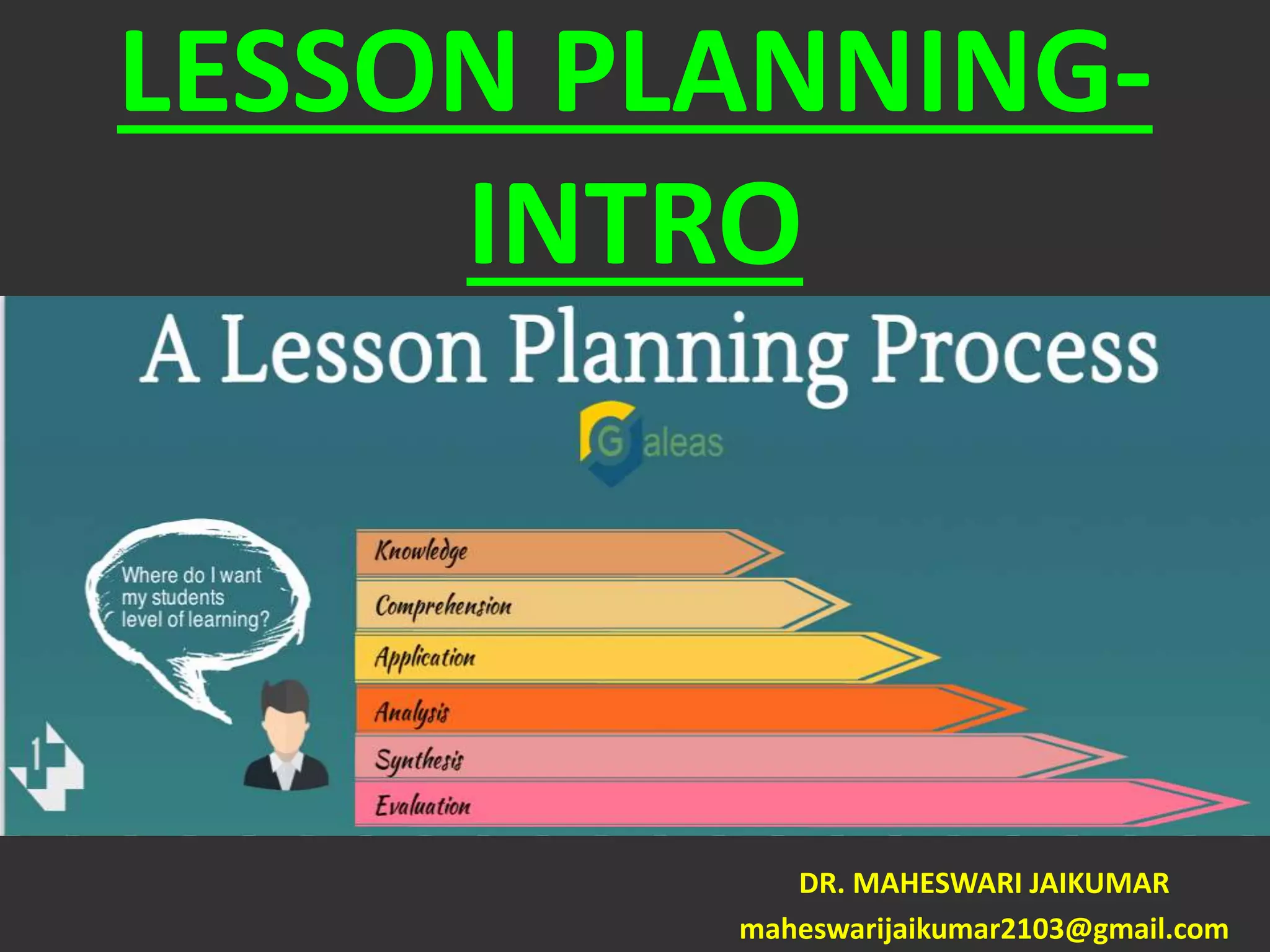
LESSON PLANNING-
INTRO
DR. MAHESWARI JAIKUMAR
maheswarijaikumar2103@gmail.com
• A lesson plan is a teacher's
detailed description of the
course of instruction, or
'learning trajectory' for
a lesson.
• A lesson plan is the
instructor’s road map of what
students need to learn and
how it will be done effectively
during the class time.
• A daily lesson plan is
developed by a teacher to
guide class learning.
• Details will vary depending on
the preference of the teacher,
subject being covered, and
the needs of the students.
DEFINITIONS
• “A lesson plan is actually a plan
of action. it includes the
working philosophy of the
teacher, his knowledge of
educational philosophy, his
information about his
understanding of the pupil,
……..cont..
Cont…
• His comprehension of the
objectives of education, his
knowledge of the material to
be taught and his ability to
utilize effective methods”…
L.B SANDS
DEFINITION
• “Lesson plan is the title given
to a statement of the
achievements to be realized
and the specific meaning by
which these are to be attained
as a result of the activities
engaged during the
period.”…L.S. BOSSING
• Lesson planning is an
important part of daily
teaching plan. The origin of a
lesson plan is from gestalt
theory of learning.
• According to the gestalt
theory “the whole is
perceived by part”. The
WHOLE in terms of teaching
refers to THE SUBJECT
(planning) and THE PART
refers to THE LESSON PLAN.
• Both are inter-related to each
other. The lesson plan
contains a brief outlines of
the main subject of the
lesson.
• The lesson plan focuses on
aims, purposes, resources to
be used, methods of teaching-
learning, arrangement of
subject matter & plan of
evaluation.
• A lesson planning must be
done in advance. Even an
experienced teacher must
take note of what he is going
to teach in the class and how
he is to proceed with the
lesson.
• A good lesson plan spells out
clearly what has already been
taught, in what direction and
what the teacher intends to
do, what will be role of the
pupil, activities that are to be
pursued etc.
• A good lesson plan is one in
which there are a clear and
precise statements of the
aims, purpose of the lesson &
techniques to be employed by
the teacher.
• A daily lesson plan directs the
daily work towards the over
all goals of the course. Daily
lesson plan guides a teacher
in her teaching.
NATURE OF LESSON
PLAN
• The following are the nature of a
lesson plan :
1. It is an “experience in anticipatory
teaching.
2. A teacher’s mental & emotional
visualization of the teaching activity.
• 3. based on the operational
philosophy of the teacher.
• 4. requires a teacher’s
understanding of the learner.
• 5. Influenced by the level of
knowledge of the subject by
the teacher.
• 6. Is a blue print, a guide map
of actions for the teaching
process.
• 7. Is a flexible, systematic
approach for teaching
concepts, skills & attitudes.
• 8. It is organized in to two
phases-reactive & post active.
• A successful lesson plan
addresses and integrates
these three key components
as follows :
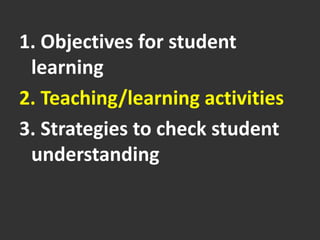
1. Objectives for student
learning
2. Teaching/learning activities
3. Strategies to check student
understanding
PURPOSE/IMPORTANCE
OF LESSON PLAN
• A lesson plan is a detailed
description of the course of
instruction by a teacher
designed for an individual
lesson.
• Gives a teacher a greater
confidence, self-reliance in
handling a lesson.
• Specifies the objectives of the
day’s work.
• Helps in tracking on the
progress of teaching.
• Helps in organizing the class
room activities.
• Offers reasoning, imagination
& guides in decision making.
• Helps in continuity in
education process.
• Lesson plan serves in the
evaluation of the teaching
rendered.
• Encourages the learners to
learn as the contents are
systematically presented.
• Provides guidelines for
teacher in teaching- learning.
• Facilitates micro teaching.
• Helps in apt selection of
subject matter, procedures
and planning.
• Serves as check on unplanned
curriculum.
• Provides a framework to keep
teaching along with the lines of
syllabus.
• Helps the teacher to systematize
the learning process.
• It makes the teaching-learning
process well knit, inter-
connected & associated.
ESSENTIALS OF A LESSON
PLAN
• A good lesson plan should
have the following
characteristics.
• It should be in a written form.
• It should have a clearly stated
general & specific objectives
to be attained.
• A good lesson plan has link
with the previous knowledge
of the learners.
• The lesson plan should clearly
state the teaching – learning
activities that is expected to
take place in the class.
• The lesson plan should cover
the entire subjected matter
intended to be taught.
• The lesson plan should follow
the maxims of teaching.
• The lesson plan should
include the instructional aids
to be used.
• A good lesson plan contains an
organized subject matter and
the materials for instruction.
• A good lesson plan provides
scope for the learner’s to
actively participate in the
process.
• It should provide an
opportunity for a continuity in
the teaching process.
• It should have an apt
framework for teaching.
LESSON PLAN
• L -Link previous knowledge
• E -Ensure definite assignment
• S -Systematized learning
process
• S - Summarization
• O - Over come nervousness &
anxiety.
• N - New learning introduction.
• P - Prevents from wandering
away from the subject.
• L – Learning by exercise,
practice & revision.
• A – Assignment & availability
of adequate materials for
the lesson.
• N - New and clear ideas.
AT THE END OF THE CLASS
THANK YOU

INTRODUCTION TO LESSON PLANNING

  • 1.
    LESSON PLANNING- INTRO DR. MAHESWARIJAIKUMAR maheswarijaikumar2103@gmail.com
  • 2.
    • A lessonplan is a teacher's detailed description of the course of instruction, or 'learning trajectory' for a lesson.
  • 4.
    • A lessonplan is the instructor’s road map of what students need to learn and how it will be done effectively during the class time.
  • 5.
    • A dailylesson plan is developed by a teacher to guide class learning.
  • 6.
    • Details willvary depending on the preference of the teacher, subject being covered, and the needs of the students.
  • 7.
    DEFINITIONS • “A lessonplan is actually a plan of action. it includes the working philosophy of the teacher, his knowledge of educational philosophy, his information about his understanding of the pupil, ……..cont..
  • 8.
    Cont… • His comprehensionof the objectives of education, his knowledge of the material to be taught and his ability to utilize effective methods”… L.B SANDS
  • 9.
    DEFINITION • “Lesson planis the title given to a statement of the achievements to be realized and the specific meaning by which these are to be attained as a result of the activities engaged during the period.”…L.S. BOSSING
  • 10.
    • Lesson planningis an important part of daily teaching plan. The origin of a lesson plan is from gestalt theory of learning.
  • 11.
    • According tothe gestalt theory “the whole is perceived by part”. The WHOLE in terms of teaching refers to THE SUBJECT (planning) and THE PART refers to THE LESSON PLAN.
  • 12.
    • Both areinter-related to each other. The lesson plan contains a brief outlines of the main subject of the lesson.
  • 13.
    • The lessonplan focuses on aims, purposes, resources to be used, methods of teaching- learning, arrangement of subject matter & plan of evaluation.
  • 14.
    • A lessonplanning must be done in advance. Even an experienced teacher must take note of what he is going to teach in the class and how he is to proceed with the lesson.
  • 15.
    • A goodlesson plan spells out clearly what has already been taught, in what direction and what the teacher intends to do, what will be role of the pupil, activities that are to be pursued etc.
  • 16.
    • A goodlesson plan is one in which there are a clear and precise statements of the aims, purpose of the lesson & techniques to be employed by the teacher.
  • 17.
    • A dailylesson plan directs the daily work towards the over all goals of the course. Daily lesson plan guides a teacher in her teaching.
  • 18.
    NATURE OF LESSON PLAN •The following are the nature of a lesson plan : 1. It is an “experience in anticipatory teaching. 2. A teacher’s mental & emotional visualization of the teaching activity.
  • 19.
    • 3. basedon the operational philosophy of the teacher. • 4. requires a teacher’s understanding of the learner.
  • 20.
    • 5. Influencedby the level of knowledge of the subject by the teacher. • 6. Is a blue print, a guide map of actions for the teaching process.
  • 21.
    • 7. Isa flexible, systematic approach for teaching concepts, skills & attitudes. • 8. It is organized in to two phases-reactive & post active.
  • 22.
    • A successfullesson plan addresses and integrates these three key components as follows :
  • 23.
    1. Objectives forstudent learning 2. Teaching/learning activities 3. Strategies to check student understanding
  • 24.
    PURPOSE/IMPORTANCE OF LESSON PLAN •A lesson plan is a detailed description of the course of instruction by a teacher designed for an individual lesson.
  • 25.
    • Gives ateacher a greater confidence, self-reliance in handling a lesson. • Specifies the objectives of the day’s work. • Helps in tracking on the progress of teaching.
  • 26.
    • Helps inorganizing the class room activities. • Offers reasoning, imagination & guides in decision making. • Helps in continuity in education process.
  • 27.
    • Lesson planserves in the evaluation of the teaching rendered. • Encourages the learners to learn as the contents are systematically presented. • Provides guidelines for teacher in teaching- learning.
  • 28.
    • Facilitates microteaching. • Helps in apt selection of subject matter, procedures and planning. • Serves as check on unplanned curriculum.
  • 29.
    • Provides aframework to keep teaching along with the lines of syllabus. • Helps the teacher to systematize the learning process. • It makes the teaching-learning process well knit, inter- connected & associated.
  • 30.
    ESSENTIALS OF ALESSON PLAN • A good lesson plan should have the following characteristics.
  • 31.
    • It shouldbe in a written form. • It should have a clearly stated general & specific objectives to be attained. • A good lesson plan has link with the previous knowledge of the learners.
  • 32.
    • The lessonplan should clearly state the teaching – learning activities that is expected to take place in the class. • The lesson plan should cover the entire subjected matter intended to be taught.
  • 33.
    • The lessonplan should follow the maxims of teaching. • The lesson plan should include the instructional aids to be used.
  • 34.
    • A goodlesson plan contains an organized subject matter and the materials for instruction. • A good lesson plan provides scope for the learner’s to actively participate in the process.
  • 35.
    • It shouldprovide an opportunity for a continuity in the teaching process. • It should have an apt framework for teaching.
  • 36.
    LESSON PLAN • L-Link previous knowledge • E -Ensure definite assignment • S -Systematized learning process • S - Summarization
  • 37.
    • O -Over come nervousness & anxiety. • N - New learning introduction. • P - Prevents from wandering away from the subject.
  • 38.
    • L –Learning by exercise, practice & revision. • A – Assignment & availability of adequate materials for the lesson. • N - New and clear ideas.
  • 39.
    AT THE ENDOF THE CLASS
  • 40.