Presented by:
PROF. MARIANNE T. EVANGELISTA, MSHRM
METHOD OF EXECUTION
PART 03
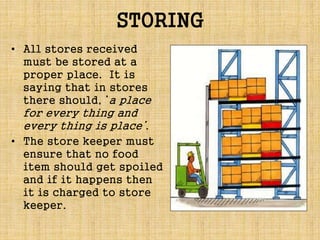
STORING
STORING
• All stores received
must be stored at a
proper place. It is
saying that in stores
there should, ‘a place
for every thing and
every thing is place’.
• The store keeper must
ensure that no food
item should get spoiled
and if it happens then
it is charged to store
keeper.
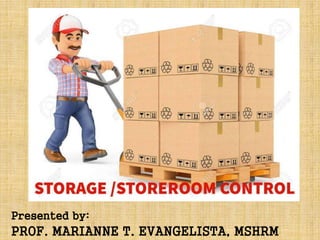
STORAGE / STOREROOM
• A depository for
goods or supplies;
• Refrigerated
storage for
preservation
• Can be classified
into 2 Types:
1. Wet/Cold Storage –
For Perishable
(Fresh) items
2. Dry Storage – For
Non-perishable
items
ESSENTIALS FOR EFFECTIVE
STORAGE CONTROL
• Adequate space
• Security of contents
• Right temperature, humidity and lighting
• Arrangement of contents
• Protection from insects
• Storage containers
• Shelving
• Cleanliness
• Rotation of Stocks
• Dating and Pricing
REFRIGERATION CONTROL
• In order for the company to
minimize cost and expenses
a control for the prevention
of spoilage should be
implemented and by knowing
the ideal storage
temperature for certain
items or refrigeration
control
EXAMPLE:
– Cheese = 36’ to 38’F
– Fresh Milk = 40’ to 45’F
– Butter = 45’ to 50’F
– Liquors & = 10’C to 16’C
Soft Drinks
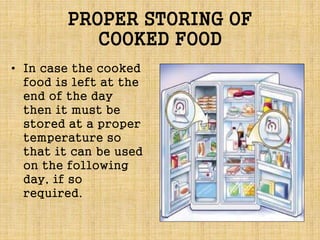
PROPER STORING OF
COOKED FOOD
• In case the cooked
food is left at the
end of the day
then it must be
stored at a proper
temperature so
that it can be used
on the following
day, if so
required.
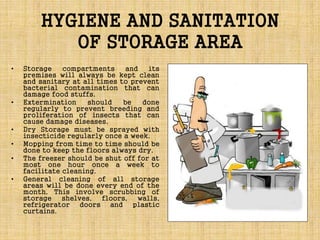
HYGIENE AND SANITATION
OF STORAGE AREA
• Storage compartments and its
premises will always be kept clean
and sanitary at all times to prevent
bacterial contamination that can
damage food stuffs.
• Extermination should be done
regularly to prevent breeding and
proliferation of insects that can
cause damage diseases.
• Dry Storage must be sprayed with
insecticide regularly once a week.
• Mopping from time to time should be
done to keep the floors always dry.
• The freezer should be shut off for at
most one hour once a week to
facilitate cleaning.
• General cleaning of all storage
areas will be done every end of the
month. This involve scrubbing of
storage shelves, floors, walls,
refrigerator doors and plastic
curtains.

STORAGE / STOREROOM CONTROL

  • 1.
    Presented by: PROF. MARIANNET. EVANGELISTA, MSHRM
  • 2.
  • 3.
    STORING • All storesreceived must be stored at a proper place. It is saying that in stores there should, ‘a place for every thing and every thing is place’. • The store keeper must ensure that no food item should get spoiled and if it happens then it is charged to store keeper.
  • 4.
    STORAGE / STOREROOM •A depository for goods or supplies; • Refrigerated storage for preservation • Can be classified into 2 Types: 1. Wet/Cold Storage – For Perishable (Fresh) items 2. Dry Storage – For Non-perishable items
  • 5.
    ESSENTIALS FOR EFFECTIVE STORAGECONTROL • Adequate space • Security of contents • Right temperature, humidity and lighting • Arrangement of contents • Protection from insects • Storage containers • Shelving • Cleanliness • Rotation of Stocks • Dating and Pricing
  • 6.
    REFRIGERATION CONTROL • Inorder for the company to minimize cost and expenses a control for the prevention of spoilage should be implemented and by knowing the ideal storage temperature for certain items or refrigeration control EXAMPLE: – Cheese = 36’ to 38’F – Fresh Milk = 40’ to 45’F – Butter = 45’ to 50’F – Liquors & = 10’C to 16’C Soft Drinks
  • 7.
    PROPER STORING OF COOKEDFOOD • In case the cooked food is left at the end of the day then it must be stored at a proper temperature so that it can be used on the following day, if so required.
  • 8.
    HYGIENE AND SANITATION OFSTORAGE AREA • Storage compartments and its premises will always be kept clean and sanitary at all times to prevent bacterial contamination that can damage food stuffs. • Extermination should be done regularly to prevent breeding and proliferation of insects that can cause damage diseases. • Dry Storage must be sprayed with insecticide regularly once a week. • Mopping from time to time should be done to keep the floors always dry. • The freezer should be shut off for at most one hour once a week to facilitate cleaning. • General cleaning of all storage areas will be done every end of the month. This involve scrubbing of storage shelves, floors, walls, refrigerator doors and plastic curtains.