EFFECTIVE LESSON PLANNING AND
DESIGN
LaToya Gilmore
EDU 650
May 21, 2014
EFFECTIVE LESSON DESIGN AND
BACKWARDS DESIGN
EFFECTIVE LESSON DESIGN AND BACKWARDS
DESIGN
 What are the most important elements of effective
lesson design?
 Setting clear objectives
 What do you want students to be able to do and understand?
 Aligned objectives to the Common Core State
Standards (CCSS)
 Assessments
 Assignments
 Activities
EFFECTIVE LESSON DESIGN AND BACKWARDS
DESIGN
 Why are good learning objectives critical to
planning effective instruction?
 Objectives are important because they are what a
student must achieve to accomplish what the teacher
states is to be learned, comprehended, or mastered.
(Wong, 1998)
 Objectives are actions that are going to take place.
 A teacher must use these to continually make sure that the
class is aligned and is on course.
EFFECTIVE LESSON DESIGN AND BACKWARDS
DESIGN
 Sample learning
objective
 Specify and partition a
whole into equal parts,
identifying and counting
unit fractions by drawing
pictorial area models.
 This objective is “good”
because:
 Clear
 Concise
 Assessable
 Is aligned with the CCSS
– 3.NF.1
 Understand a fraction 1/b
as the quantity formed by
1 part when a whole is
partitioned into b equal
parts; understand a
fraction a/b as the quantity
formed by a parts of size
1/b
EFFECTIVE LESSON DESIGN AND BACKWARDS
DESIGN
 What are common pitfalls in planning effective
planning?
 Designing a lesson plan starting with assignments or
activities first.
 Not aligning objectives with CCSS
 Activities are not measurable
 Rushing through content
EFFECTIVE LESSON DESIGN AND BACKWARDS
DESIGN
 How to avoid common pitfalls in lesson planning?
 “Learning should be considered a comprehensive, holist
ic, transformative, and wide-ranging
process that integrates academic learning, goal setting,
student experiences, and assessment, processes
that are often considered independent of each other.”
(Newman, 2013)
 Begin with the end goal in mind
 What is it that you want students to be able to do or
understand at the end of this lesson?
 Think ahead
 How will this objective and activities connect with future
learning concepts?
EFFECTIVE LESSON DESIGN AND BACKWARDS
DESIGN
 What is backwards design?
 Backwards design is a way to design lessons beginning
with the focus standard and determining the final
outcome.
 Determine what is it you want students to be know or be able
to do at the end of the lesson.
 Next, design an assessment to measure students.
 Then, determine which activities or assignments will best help
students reach that outcome.
 Finally, you teach the content based on what you have outlined
and prepared for this content.
EFFECTIVE LESSON DESIGN AND BACKWARDS
DESIGN
 How does the CCSS Initiative play a role in designing
effective instruction?
 While the Common Core State Standards significantly reduced
the number of standards that must be covered, there are still
choices to be made. These include deciding which topic to
start teaching, which outcomes to start with, how to scaffold
skills and knowledge appropriately, and which standards to
break into smaller units, which to teach continuously, and
which to teach as a whole (Wiggins & McTighe, 2012).
BACKWARDS DESIGN VS.
TRADITIONAL MODEL
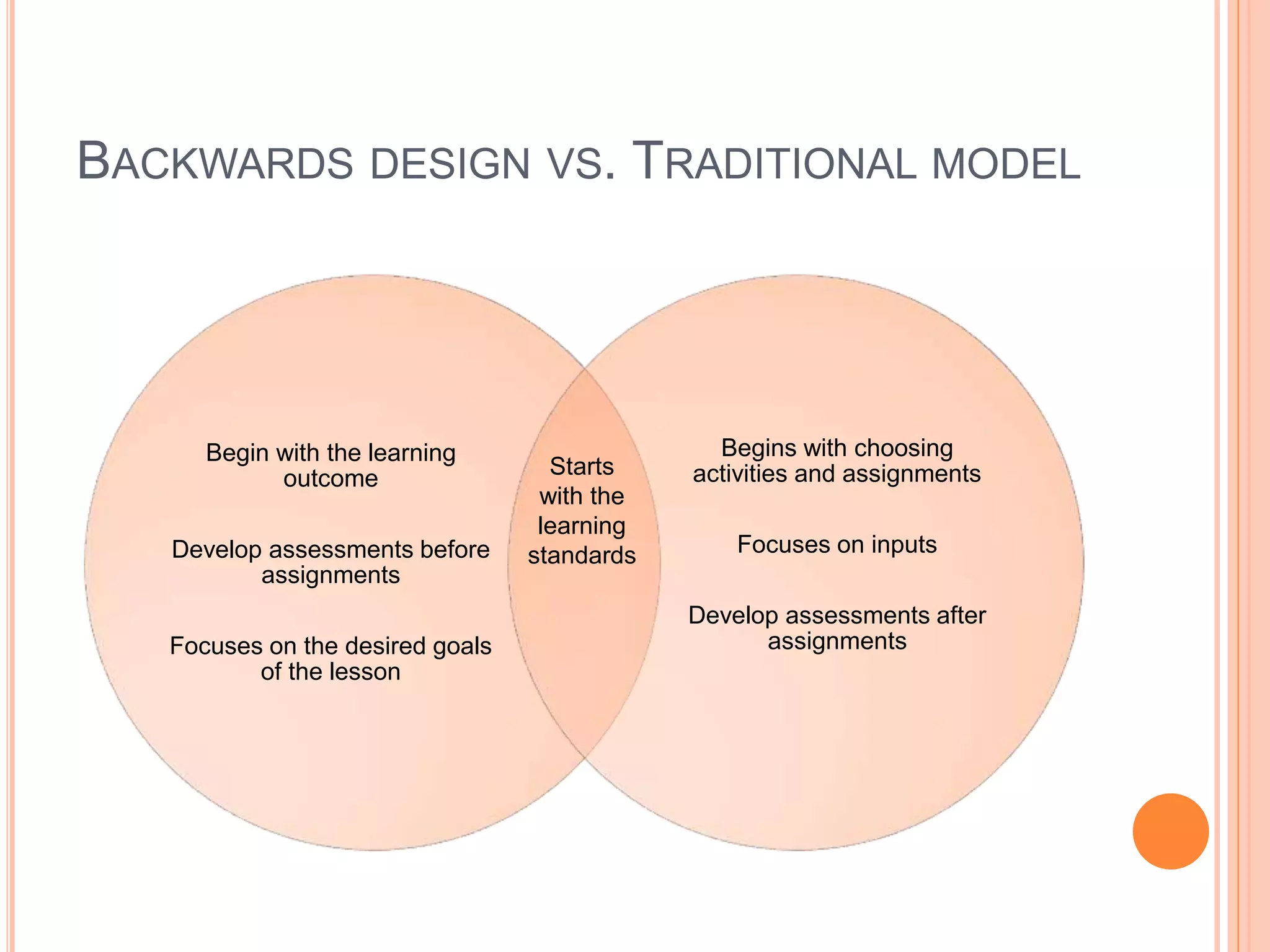
BACKWARDS DESIGN VS. TRADITIONAL MODEL
Begin with the learning
outcome
Develop assessments before
assignments
Focuses on the desired goals
of the lesson
Begins with choosing
activities and assignments
Focuses on inputs
Develop assessments after
assignments
Starts
with the
learning
standards
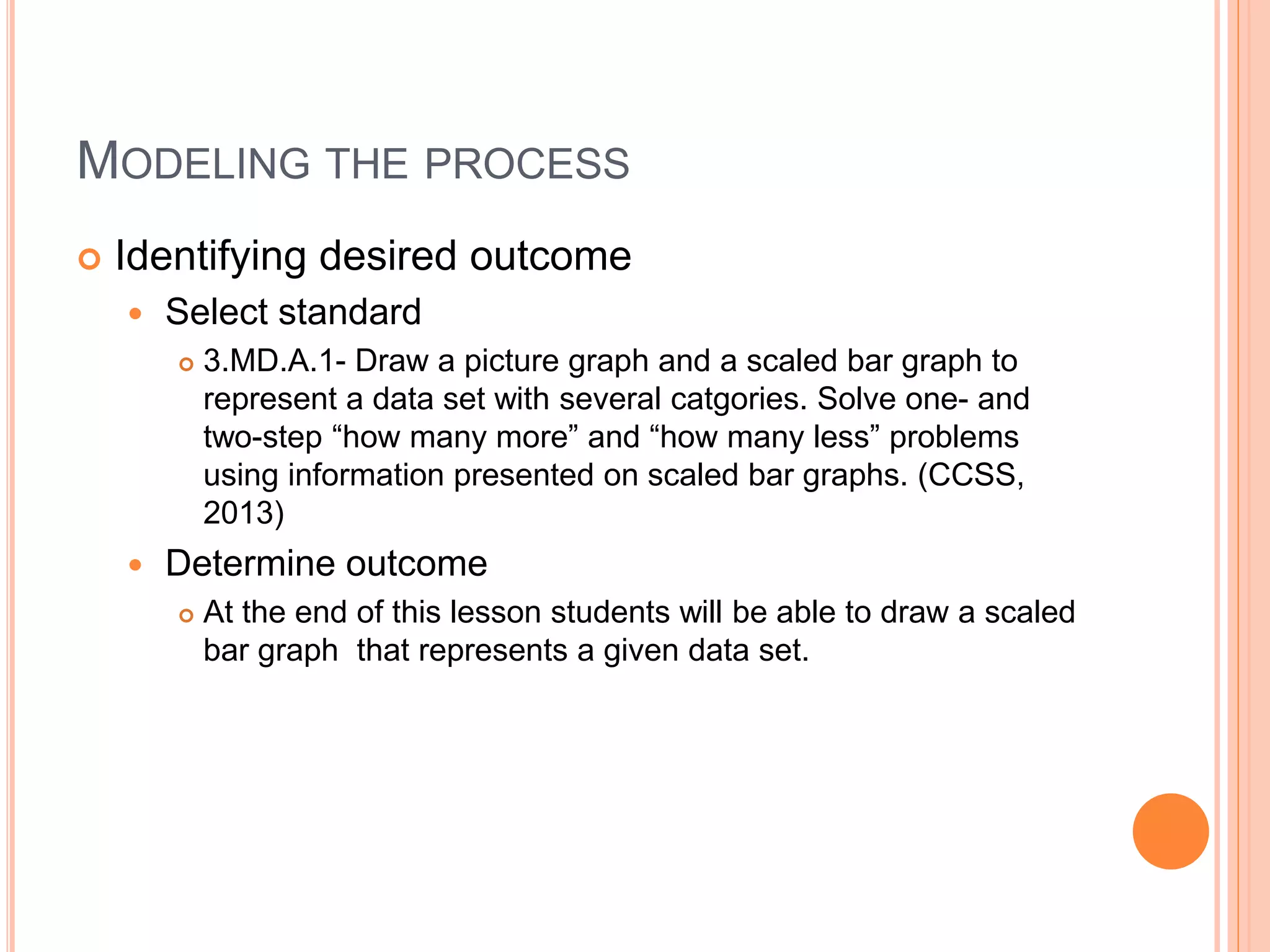
MODELING THE PROCESS
 Identifying desired outcome
 Select standard
 3.MD.A.1- Draw a picture graph and a scaled bar graph to
represent a data set with several catgories. Solve one- and
two-step “how many more” and “how many less” problems
using information presented on scaled bar graphs. (CCSS,
2013)
 Determine outcome
 At the end of this lesson students will be able to draw a scaled
bar graph that represents a given data set.
MODELING THE PROCESS
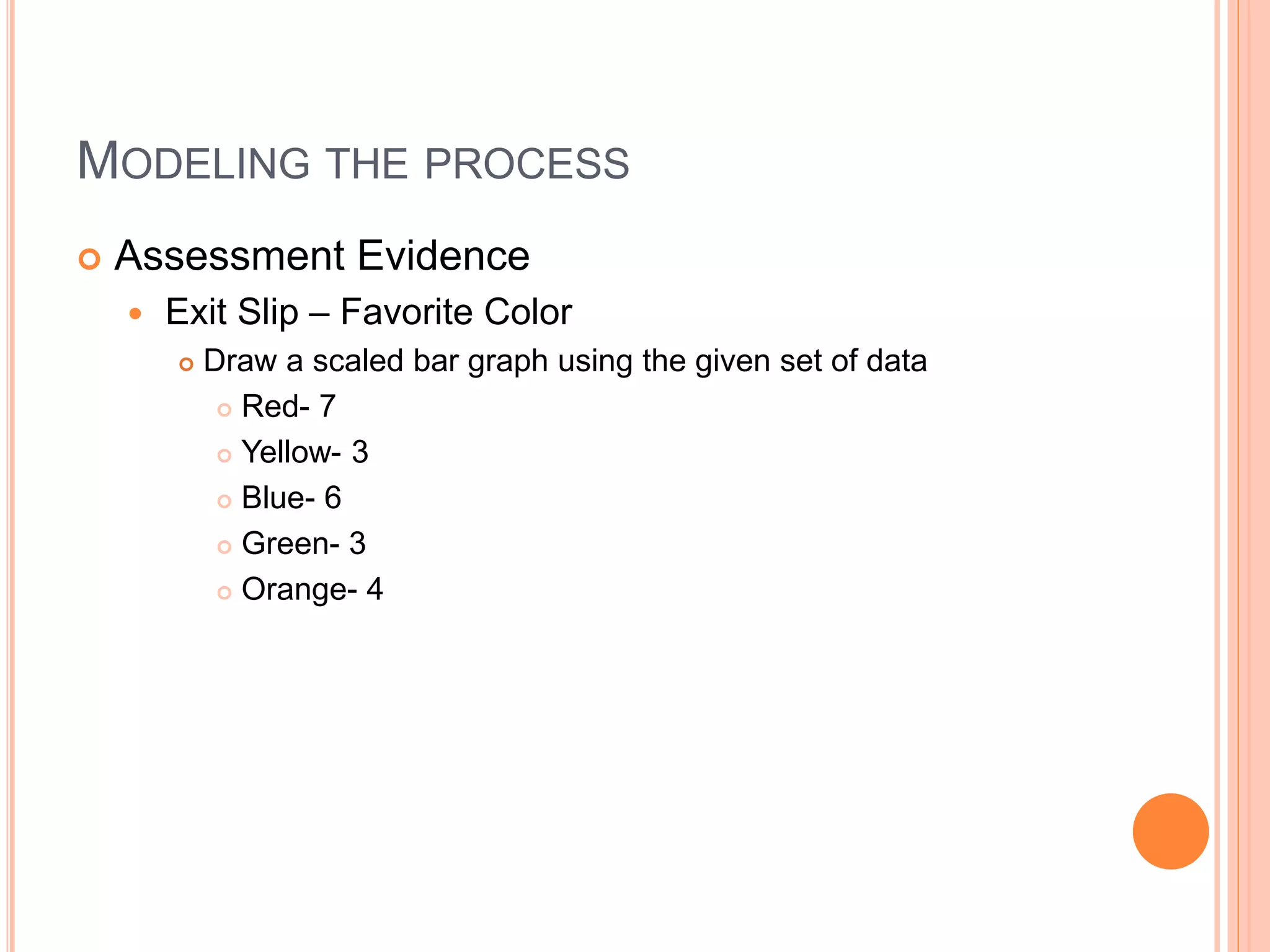
 Assessment Evidence
 Exit Slip – Favorite Color
 Draw a scaled bar graph using the given set of data
 Red- 7
 Yellow- 3
 Blue- 6
 Green- 3
 Orange- 4
MODELING THE PROCESS
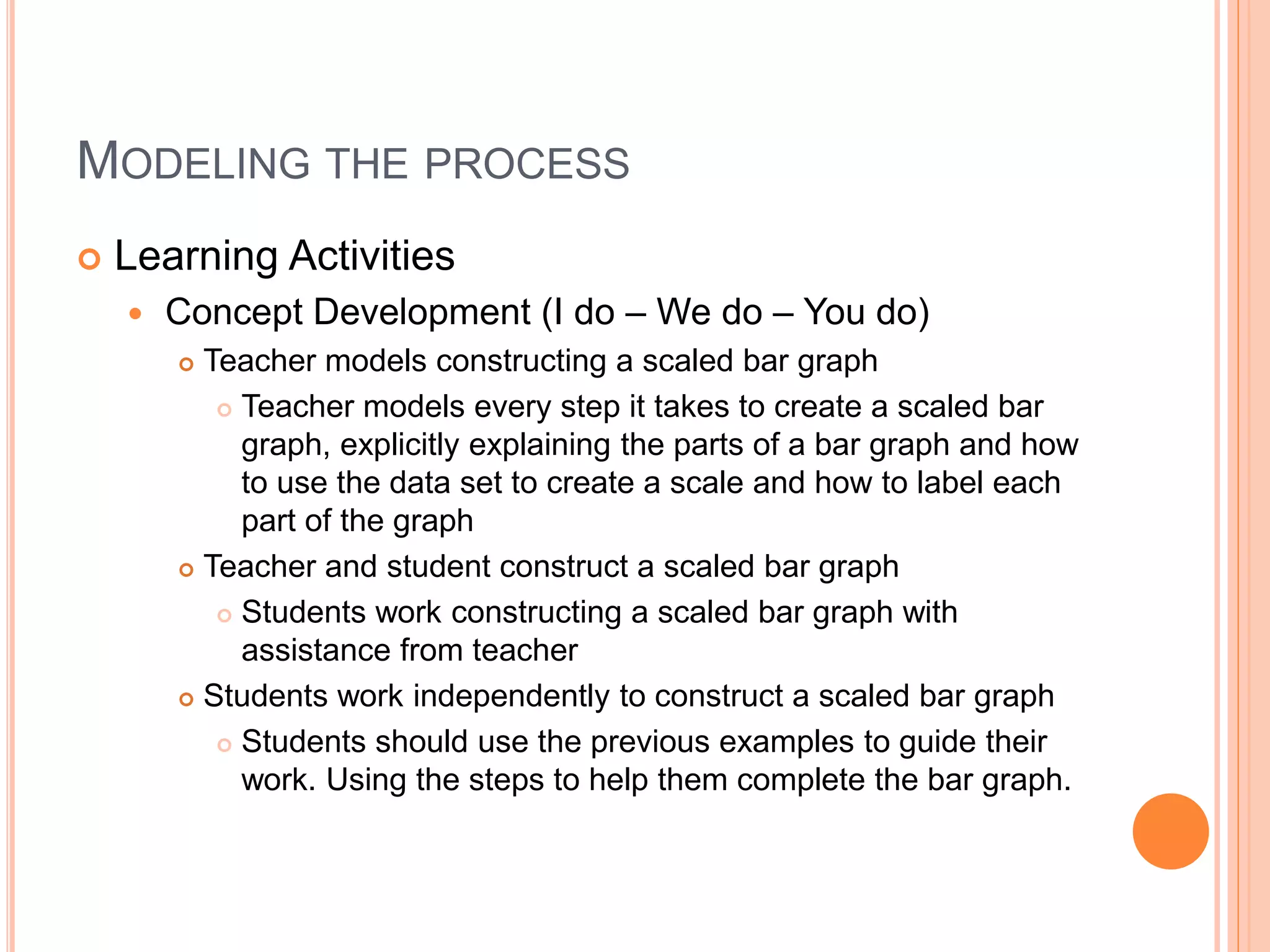
 Learning Activities
 Concept Development (I do – We do – You do)
 Teacher models constructing a scaled bar graph
 Teacher models every step it takes to create a scaled bar
graph, explicitly explaining the parts of a bar graph and how
to use the data set to create a scale and how to label each
part of the graph
 Teacher and student construct a scaled bar graph
 Students work constructing a scaled bar graph with
assistance from teacher
 Students work independently to construct a scaled bar graph
 Students should use the previous examples to guide their
work. Using the steps to help them complete the bar graph.
MODELING THE PROCESS
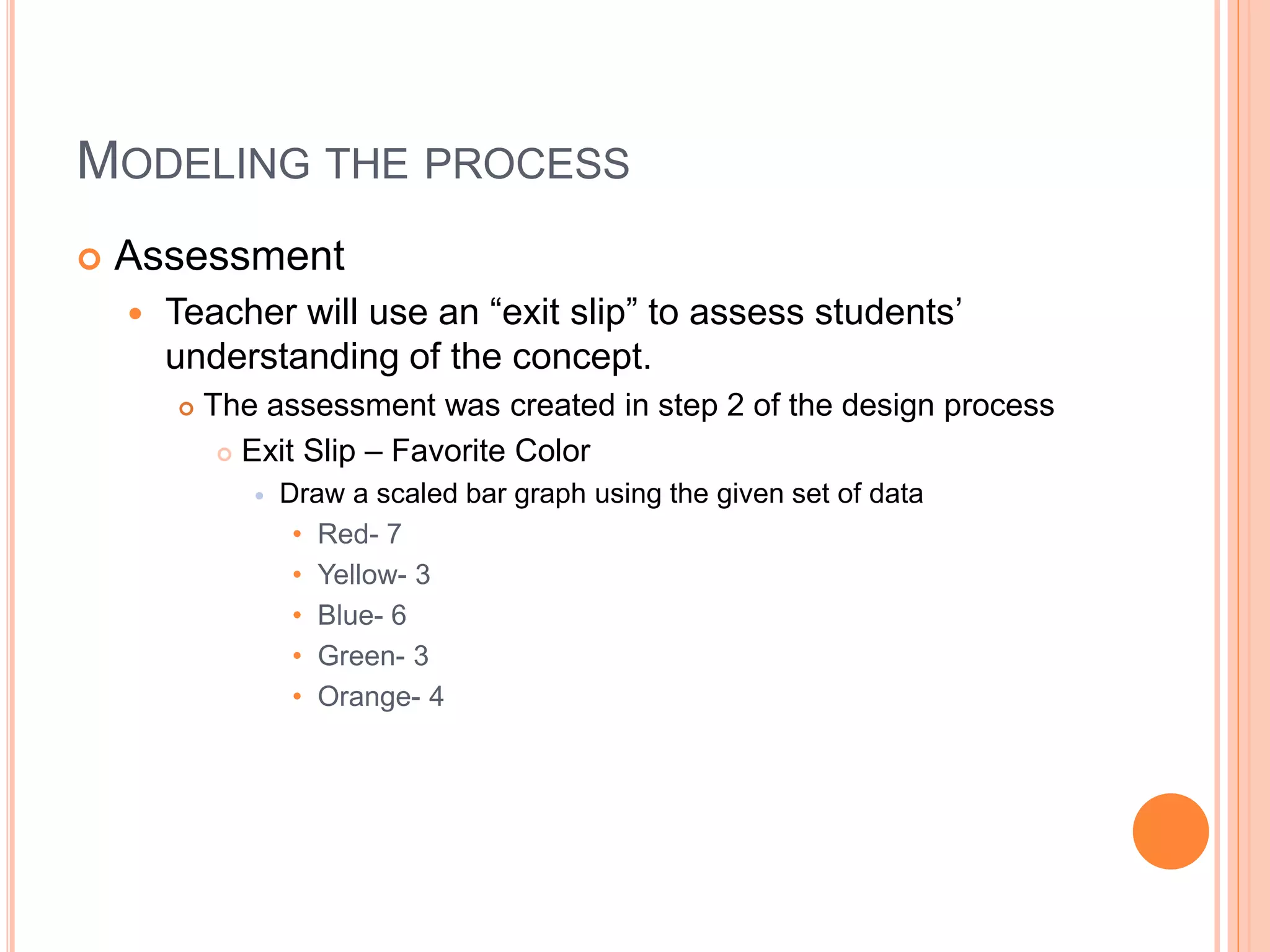
 Assessment
 Teacher will use an “exit slip” to assess students’
understanding of the concept.
 The assessment was created in step 2 of the design process
 Exit Slip – Favorite Color
 Draw a scaled bar graph using the given set of data
• Red- 7
• Yellow- 3
• Blue- 6
• Green- 3
• Orange- 4
MODELING THE PROCESS
 Feedback
 Teacher will use this
assessment to provide
feedback to students
 New Topic
 After completing the
lesson and assessing
students’ understanding
the teacher will then
begin preparing for the
new topic
REFERENCES
 Lemov, Doug (2010). Teach Like a Champion. Jossey-
Bass
 Wong, Harry (1998). The First Days of School. Harry K.
Wong Publications
 NYS Common Core Mathematics Curriculum (2013).
http://www.engageny.org/sites/default/files/resource/atta
chments/math-g3-m6-full-module.pdf
 Newman, Richard (2013). Teaching and Learning in the
21st Century: Connecting the Dots. Bridgepoint
Education, Inc.

Effective lesson planning and design

  • 1.
    EFFECTIVE LESSON PLANNINGAND DESIGN LaToya Gilmore EDU 650 May 21, 2014
  • 2.
    EFFECTIVE LESSON DESIGNAND BACKWARDS DESIGN
  • 3.
    EFFECTIVE LESSON DESIGNAND BACKWARDS DESIGN  What are the most important elements of effective lesson design?  Setting clear objectives  What do you want students to be able to do and understand?  Aligned objectives to the Common Core State Standards (CCSS)  Assessments  Assignments  Activities
  • 4.
    EFFECTIVE LESSON DESIGNAND BACKWARDS DESIGN  Why are good learning objectives critical to planning effective instruction?  Objectives are important because they are what a student must achieve to accomplish what the teacher states is to be learned, comprehended, or mastered. (Wong, 1998)  Objectives are actions that are going to take place.  A teacher must use these to continually make sure that the class is aligned and is on course.
  • 5.
    EFFECTIVE LESSON DESIGNAND BACKWARDS DESIGN  Sample learning objective  Specify and partition a whole into equal parts, identifying and counting unit fractions by drawing pictorial area models.  This objective is “good” because:  Clear  Concise  Assessable  Is aligned with the CCSS – 3.NF.1  Understand a fraction 1/b as the quantity formed by 1 part when a whole is partitioned into b equal parts; understand a fraction a/b as the quantity formed by a parts of size 1/b
  • 6.
    EFFECTIVE LESSON DESIGNAND BACKWARDS DESIGN  What are common pitfalls in planning effective planning?  Designing a lesson plan starting with assignments or activities first.  Not aligning objectives with CCSS  Activities are not measurable  Rushing through content
  • 7.
    EFFECTIVE LESSON DESIGNAND BACKWARDS DESIGN  How to avoid common pitfalls in lesson planning?  “Learning should be considered a comprehensive, holist ic, transformative, and wide-ranging process that integrates academic learning, goal setting, student experiences, and assessment, processes that are often considered independent of each other.” (Newman, 2013)  Begin with the end goal in mind  What is it that you want students to be able to do or understand at the end of this lesson?  Think ahead  How will this objective and activities connect with future learning concepts?
  • 8.
    EFFECTIVE LESSON DESIGNAND BACKWARDS DESIGN  What is backwards design?  Backwards design is a way to design lessons beginning with the focus standard and determining the final outcome.  Determine what is it you want students to be know or be able to do at the end of the lesson.  Next, design an assessment to measure students.  Then, determine which activities or assignments will best help students reach that outcome.  Finally, you teach the content based on what you have outlined and prepared for this content.
  • 9.
    EFFECTIVE LESSON DESIGNAND BACKWARDS DESIGN  How does the CCSS Initiative play a role in designing effective instruction?  While the Common Core State Standards significantly reduced the number of standards that must be covered, there are still choices to be made. These include deciding which topic to start teaching, which outcomes to start with, how to scaffold skills and knowledge appropriately, and which standards to break into smaller units, which to teach continuously, and which to teach as a whole (Wiggins & McTighe, 2012).
  • 10.
  • 11.
    BACKWARDS DESIGN VS.TRADITIONAL MODEL Begin with the learning outcome Develop assessments before assignments Focuses on the desired goals of the lesson Begins with choosing activities and assignments Focuses on inputs Develop assessments after assignments Starts with the learning standards
  • 12.
  • 13.
    MODELING THE PROCESS Identifying desired outcome  Select standard  3.MD.A.1- Draw a picture graph and a scaled bar graph to represent a data set with several catgories. Solve one- and two-step “how many more” and “how many less” problems using information presented on scaled bar graphs. (CCSS, 2013)  Determine outcome  At the end of this lesson students will be able to draw a scaled bar graph that represents a given data set.
  • 14.
    MODELING THE PROCESS Assessment Evidence  Exit Slip – Favorite Color  Draw a scaled bar graph using the given set of data  Red- 7  Yellow- 3  Blue- 6  Green- 3  Orange- 4
  • 15.
    MODELING THE PROCESS Learning Activities  Concept Development (I do – We do – You do)  Teacher models constructing a scaled bar graph  Teacher models every step it takes to create a scaled bar graph, explicitly explaining the parts of a bar graph and how to use the data set to create a scale and how to label each part of the graph  Teacher and student construct a scaled bar graph  Students work constructing a scaled bar graph with assistance from teacher  Students work independently to construct a scaled bar graph  Students should use the previous examples to guide their work. Using the steps to help them complete the bar graph.
  • 16.
    MODELING THE PROCESS Assessment  Teacher will use an “exit slip” to assess students’ understanding of the concept.  The assessment was created in step 2 of the design process  Exit Slip – Favorite Color  Draw a scaled bar graph using the given set of data • Red- 7 • Yellow- 3 • Blue- 6 • Green- 3 • Orange- 4
  • 17.
    MODELING THE PROCESS Feedback  Teacher will use this assessment to provide feedback to students  New Topic  After completing the lesson and assessing students’ understanding the teacher will then begin preparing for the new topic
  • 18.
    REFERENCES  Lemov, Doug(2010). Teach Like a Champion. Jossey- Bass  Wong, Harry (1998). The First Days of School. Harry K. Wong Publications  NYS Common Core Mathematics Curriculum (2013). http://www.engageny.org/sites/default/files/resource/atta chments/math-g3-m6-full-module.pdf  Newman, Richard (2013). Teaching and Learning in the 21st Century: Connecting the Dots. Bridgepoint Education, Inc.