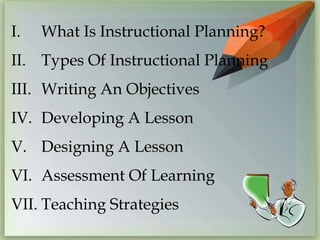
I. What Is Instructional Planning? 
II. Types Of Instructional Planning 
III. Writing An Objectives 
IV. Developing A Lesson 
V. Designing A Lesson 
VI. Assessment Of Learning 
VII. Teaching Strategies
Instructional planning 
is the ability of the teacher to visualize and 
forecast into the future of what, why and how 
of the teaching-learning process 
Zulueta, Francisco M. “Principles and Methods of Teaching”
Importance of Instructional 
Planning 
Provides for logical sequencing and pacing 
lessons 
Economizes cost - time and energy 
Provides for a variety of instructional 
objectives 
Creates the opportunity for higher level of 
questioning 
Guides teachers 
Zulueta, Francisco M. “Principles and Methods of Teaching”
Provides direction for the teachers 
Correlates instructional events 
Develops a sequence of well-organized 
learning experiences 
Presents a comprehensive, integrated and 
meaningful content at an appropriate level 
Prepares pupils/students for the day’s 
activities 
Zulueta, Francisco M. “Principles and Methods of Teaching”
Components of Instructional 
Planning: 
The teachers’ attitudes, beliefs, orientations 
and teachers’ social background 
The pupils’/students’ age, background, 
knowledge, motivational level of interest 
The type of content that influences the 
planning process, textbook and other 
instructional materials. 
Zulueta, Francisco M. “Principles and Methods of Teaching”
The learning content which is characterized 
by the subject matter guidelines 
Material resources which include 
equipment/tools for teaching 
Time frame which is considerable 
Zulueta, Francisco M. “Principles and Methods of Teaching”
PRINCIPLES OF 
INSTRUCTIONAL 
PLANNING
To understand the rationale of the 
course in the context of the goals of the 
educational institution 
To determine what content to 
incorporate into the course in relation to 
the set objectives. 
To clarify thrusts of the course
•To decide on the reasonable time 
frame for the course 
•To identify the important components 
of the lesson; see if they meet 
•To determine the appropriate 
approach in view of the goals
TYPES OF 
INSTRUCTIONAL 
PLANNING
COURSE 
PLAN
A long-range teacher guide is usually called 
a map or course of study. 
MAPPING – identifies and details the 
content, concepts, skills and sometimes, 
values to be taught for the entire course.
GUIDELINES FOR MAPPING 
1.Be sure you understand the rational of 
the course in the context of goals of the 
school. 
2.Be sure you understand the objectives 
of the course, according to DepEd or 
district guidelines. 
3.Clarify the focus of the course designed 
to stress subject matter, learner’s need, 
or social needs.
4. Determine if there is a special need 
(special audience, special instructional 
program) for the course 
5. Identify the important components: 
content, concepts, skills and values 
6. Examine the components to see if 
they
7. Decide on important components so 
that they can be used as framework for 
your unit planning 
8. Show the map to an experienced 
colleague or supervisor. Revise it in 
light of the feedback received. 
9. As you used the map, evaluate, 
modify and improve it. Note 
components that should be
UNIT 
PLAN
• A unit plan reflects long-range goals 
and is means of organizing various 
aspects of the course of the study and 
serves as a basis for developing a set of 
related daily teaching plans and 
educational activities.
1.Objectives 
2.Content 
3.Skills 
4.Learning activities 
5.Resources and Materials 
6.Evaluation procedures
LESSON 
PLAN
•A lesson plan is a very important tool of 
a teacher. It is a guide which includes the 
aims and objectives, subject matter, 
materials and devices to be used, time 
frame, anticipated problems and 
procedures, e.g., motivation, teaching 
strategies and techniques and evaluation 
for achieving the desired results.
COMPONENTS OF THE LESSON 
PLAN 
•objectives 
•motivation 
•outline 
•methods 
•materials and media 
•assignment or homework
TYPES OF LESSON PLAN 
1. Mastery Learning Lesson Plan 
2. Thinking Skills Lesson Plan 
3. Flexible Grouping Lesson Plan
WRITING 
AN 
OBJECTIVE
PRINCIPLE FOR GOALS AND 
OBJECTIVES 
SMART (Specific, Measurable, 
Attainable, Result-oriented, and Time-bound 
and Terminal)
TYPES OF OBJECTIVES: 
1. Performance Objectives 
2. Process Objectives
DEVELOPMENT 
& 
DESIGNING 
A LESSON
DIFFERENT TYPES OF 
LESSON 
1. Development Lesson 
2. Supervised Study Lesson 
3. Appreciation Lesson 
4. Drill Lesson 
5. Application Lesson
THREE PHASES OF 
DEVELOPING A LESSON 
1. The Initial Phase 
2. The Lesson Proper 
3. The Concluding Phase
ASSESSMENT
Is the ongoing process of 
interpreting the evidence of what 
a student can do 
Means finding out what 
students know and are able to do. 
Its emphasis is on observation of 
what is happening now
PURPOSE 
OF 
ASSESSMENT
To assist in student learning. 
To assess and improve student 
learning 
To identify children’s 
strengths and weaknesses. 
To assess the effectiveness of a 
particular instructional strategy.
TEACHING 
STRATEGIES
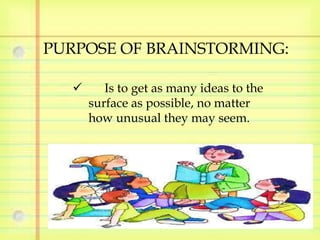
PURPOSE OF BRAINSTORMING: 
 Is to get as many ideas to the 
surface as possible, no matter 
how unusual they may seem.
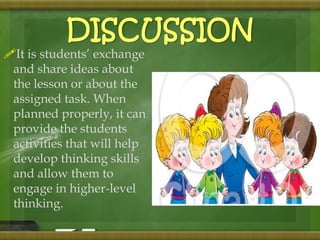
DISCUSSION 
It is students’ exchange 
and share ideas about 
the lesson or about the 
assigned task. When 
planned properly, it can 
provide the students 
activities that will help 
develop thinking skills 
and allow them to 
engage in higher-level 
thinking.
BRAINSTORMING 
is used when there is an issue that has 
to be clarified or a problem that calls for 
a solution. The basic design of a 
brainstorming session is presenting an 
open situation and creating an 
environment where students feel free to 
contribute their ideas without fear and 
failure.
THREE WAYS IN CONDUCTING 
DISCUSSION: 
1. Whole-class Discussion 
All students in the class exchange and 
share ideas about given topic with the 
teacher as a leader. 
2. Small-class Discussion 
This provides teachers opportunities to 
note students’ behavior, attitudes, and 
abilities to express ideas. Teachers find 
discussion situations as valuable source 
of information about students’ needs, 
personalities and backgrounds.
3. Panel Discussion 
 This strategy affords the presentation of 
a variety of perceptions on a single 
topic.
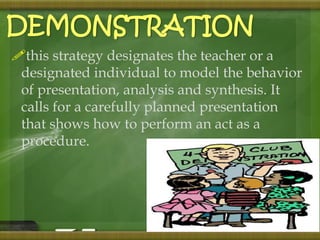
DEMONSTRATION 
this strategy designates the teacher or a 
designated individual to model the behavior 
of presentation, analysis and synthesis. It 
calls for a carefully planned presentation 
that shows how to perform an act as a 
procedure.
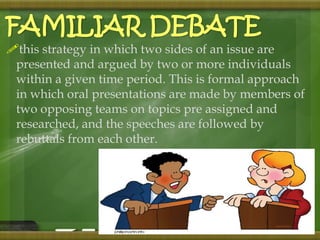
FAMILIAR DEBATE 
this strategy in which two sides of an issue are 
presented and argued by two or more individuals 
within a given time period. This is formal approach 
in which oral presentations are made by members of 
two opposing teams on topics pre assigned and 
researched, and the speeches are followed by 
rebuttals from each other.
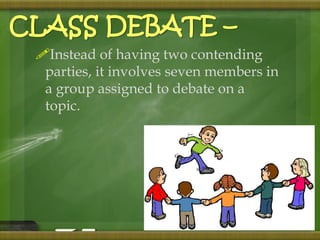
CLASS DEBATE – 
Instead of having two contending 
parties, it involves seven members in 
a group assigned to debate on a 
topic.
RESPONSIBILITIES OF EACH 
MEMBER TO PERFORM 
(Armstrong,1980) 
“PRO” position is the defenders’ attempt to marshal 
evidence in support of the proposition being debated. 
“CON” position seek to find evidence and develop a 
line of logic that opposes the proposition being debated. 
SKEPTICAL CRITIC seeks to find information 
that will be useful in attaching both arguments 
of the “pro” and the “con” sides.
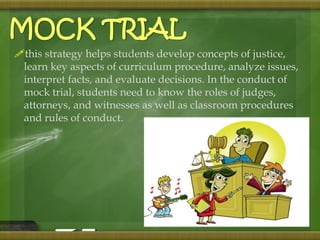
MOCK TRIAL 
this strategy helps students develop concepts of justice, 
learn key aspects of curriculum procedure, analyze issues, 
interpret facts, and evaluate decisions. In the conduct of 
mock trial, students need to know the roles of judges, 
attorneys, and witnesses as well as classroom procedures 
and rules of conduct.
THREE PHASES IN 
CONDUCTING MOCK 
TRIAL 
Briefing – pre planning in which the teacher’s task is 
the identification of the case drawn from the unit of 
study. 
Conducting the trial – simulation of the conduct of 
the trial 
Debriefing – asking questions like: 
What was the case about? 
Who were the participants in the mock trial? 
How were the roles played? 
What was the issue? 
What facts were relevant?
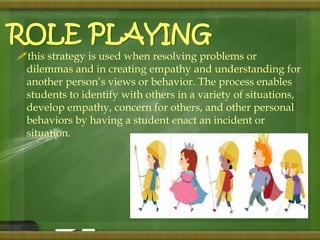
ROLE PLAYING 
this strategy is used when resolving problems or 
dilemmas and in creating empathy and understanding for 
another person’s views or behavior. The process enables 
students to identify with others in a variety of situations, 
develop empathy, concern for others, and other personal 
behaviors by having a student enact an incident or 
situation.
SIMULATION 
provides students with activities that are designed to provide 
lifelike problem-solving experiences. 
They provide a representation of some phenomenon, event, 
or issue that actually exists or existed in the real world. 
It can represent historical events, international affairs, family 
problems, military operations, schools, politics, or any 
activity. 
They permit students to perform vicariously expressive roles 
in decision making. It provides participants with an illusion 
of involvement in reality
 it is a well-prepared oral 
presentation of a lesson by 
the teacher. This most 
widely used exposition 
strategy when properly 
organized and planned for. 
This is a teacher-directed 
strategy designed to help 
learners understand 
relationships in organized 
bodies of knowledge. 
LECTURE

INSTRUCTIONAL PLANNING

  • 2.
    I. What IsInstructional Planning? II. Types Of Instructional Planning III. Writing An Objectives IV. Developing A Lesson V. Designing A Lesson VI. Assessment Of Learning VII. Teaching Strategies
  • 3.
    Instructional planning isthe ability of the teacher to visualize and forecast into the future of what, why and how of the teaching-learning process Zulueta, Francisco M. “Principles and Methods of Teaching”
  • 4.
    Importance of Instructional Planning Provides for logical sequencing and pacing lessons Economizes cost - time and energy Provides for a variety of instructional objectives Creates the opportunity for higher level of questioning Guides teachers Zulueta, Francisco M. “Principles and Methods of Teaching”
  • 5.
    Provides direction forthe teachers Correlates instructional events Develops a sequence of well-organized learning experiences Presents a comprehensive, integrated and meaningful content at an appropriate level Prepares pupils/students for the day’s activities Zulueta, Francisco M. “Principles and Methods of Teaching”
  • 6.
    Components of Instructional Planning: The teachers’ attitudes, beliefs, orientations and teachers’ social background The pupils’/students’ age, background, knowledge, motivational level of interest The type of content that influences the planning process, textbook and other instructional materials. Zulueta, Francisco M. “Principles and Methods of Teaching”
  • 7.
    The learning contentwhich is characterized by the subject matter guidelines Material resources which include equipment/tools for teaching Time frame which is considerable Zulueta, Francisco M. “Principles and Methods of Teaching”
  • 8.
  • 9.
    To understand therationale of the course in the context of the goals of the educational institution To determine what content to incorporate into the course in relation to the set objectives. To clarify thrusts of the course
  • 10.
    •To decide onthe reasonable time frame for the course •To identify the important components of the lesson; see if they meet •To determine the appropriate approach in view of the goals
  • 11.
  • 12.
  • 13.
    A long-range teacherguide is usually called a map or course of study. MAPPING – identifies and details the content, concepts, skills and sometimes, values to be taught for the entire course.
  • 14.
    GUIDELINES FOR MAPPING 1.Be sure you understand the rational of the course in the context of goals of the school. 2.Be sure you understand the objectives of the course, according to DepEd or district guidelines. 3.Clarify the focus of the course designed to stress subject matter, learner’s need, or social needs.
  • 15.
    4. Determine ifthere is a special need (special audience, special instructional program) for the course 5. Identify the important components: content, concepts, skills and values 6. Examine the components to see if they
  • 16.
    7. Decide onimportant components so that they can be used as framework for your unit planning 8. Show the map to an experienced colleague or supervisor. Revise it in light of the feedback received. 9. As you used the map, evaluate, modify and improve it. Note components that should be
  • 17.
  • 18.
    • A unitplan reflects long-range goals and is means of organizing various aspects of the course of the study and serves as a basis for developing a set of related daily teaching plans and educational activities.
  • 19.
    1.Objectives 2.Content 3.Skills 4.Learning activities 5.Resources and Materials 6.Evaluation procedures
  • 20.
  • 21.
    •A lesson planis a very important tool of a teacher. It is a guide which includes the aims and objectives, subject matter, materials and devices to be used, time frame, anticipated problems and procedures, e.g., motivation, teaching strategies and techniques and evaluation for achieving the desired results.
  • 22.
    COMPONENTS OF THELESSON PLAN •objectives •motivation •outline •methods •materials and media •assignment or homework
  • 23.
    TYPES OF LESSONPLAN 1. Mastery Learning Lesson Plan 2. Thinking Skills Lesson Plan 3. Flexible Grouping Lesson Plan
  • 24.
  • 25.
    PRINCIPLE FOR GOALSAND OBJECTIVES SMART (Specific, Measurable, Attainable, Result-oriented, and Time-bound and Terminal)
  • 26.
    TYPES OF OBJECTIVES: 1. Performance Objectives 2. Process Objectives
  • 27.
  • 28.
    DIFFERENT TYPES OF LESSON 1. Development Lesson 2. Supervised Study Lesson 3. Appreciation Lesson 4. Drill Lesson 5. Application Lesson
  • 29.
    THREE PHASES OF DEVELOPING A LESSON 1. The Initial Phase 2. The Lesson Proper 3. The Concluding Phase
  • 30.
  • 31.
    Is the ongoingprocess of interpreting the evidence of what a student can do Means finding out what students know and are able to do. Its emphasis is on observation of what is happening now
  • 32.
  • 33.
    To assist instudent learning. To assess and improve student learning To identify children’s strengths and weaknesses. To assess the effectiveness of a particular instructional strategy.
  • 34.
  • 35.
    PURPOSE OF BRAINSTORMING:  Is to get as many ideas to the surface as possible, no matter how unusual they may seem.
  • 36.
    DISCUSSION It isstudents’ exchange and share ideas about the lesson or about the assigned task. When planned properly, it can provide the students activities that will help develop thinking skills and allow them to engage in higher-level thinking.
  • 37.
    BRAINSTORMING is usedwhen there is an issue that has to be clarified or a problem that calls for a solution. The basic design of a brainstorming session is presenting an open situation and creating an environment where students feel free to contribute their ideas without fear and failure.
  • 38.
    THREE WAYS INCONDUCTING DISCUSSION: 1. Whole-class Discussion All students in the class exchange and share ideas about given topic with the teacher as a leader. 2. Small-class Discussion This provides teachers opportunities to note students’ behavior, attitudes, and abilities to express ideas. Teachers find discussion situations as valuable source of information about students’ needs, personalities and backgrounds.
  • 39.
    3. Panel Discussion  This strategy affords the presentation of a variety of perceptions on a single topic.
  • 40.
    DEMONSTRATION this strategydesignates the teacher or a designated individual to model the behavior of presentation, analysis and synthesis. It calls for a carefully planned presentation that shows how to perform an act as a procedure.
  • 41.
    FAMILIAR DEBATE thisstrategy in which two sides of an issue are presented and argued by two or more individuals within a given time period. This is formal approach in which oral presentations are made by members of two opposing teams on topics pre assigned and researched, and the speeches are followed by rebuttals from each other.
  • 42.
    CLASS DEBATE – Instead of having two contending parties, it involves seven members in a group assigned to debate on a topic.
  • 43.
    RESPONSIBILITIES OF EACH MEMBER TO PERFORM (Armstrong,1980) “PRO” position is the defenders’ attempt to marshal evidence in support of the proposition being debated. “CON” position seek to find evidence and develop a line of logic that opposes the proposition being debated. SKEPTICAL CRITIC seeks to find information that will be useful in attaching both arguments of the “pro” and the “con” sides.
  • 44.
    MOCK TRIAL thisstrategy helps students develop concepts of justice, learn key aspects of curriculum procedure, analyze issues, interpret facts, and evaluate decisions. In the conduct of mock trial, students need to know the roles of judges, attorneys, and witnesses as well as classroom procedures and rules of conduct.
  • 45.
    THREE PHASES IN CONDUCTING MOCK TRIAL Briefing – pre planning in which the teacher’s task is the identification of the case drawn from the unit of study. Conducting the trial – simulation of the conduct of the trial Debriefing – asking questions like: What was the case about? Who were the participants in the mock trial? How were the roles played? What was the issue? What facts were relevant?
  • 46.
    ROLE PLAYING thisstrategy is used when resolving problems or dilemmas and in creating empathy and understanding for another person’s views or behavior. The process enables students to identify with others in a variety of situations, develop empathy, concern for others, and other personal behaviors by having a student enact an incident or situation.
  • 47.
    SIMULATION provides studentswith activities that are designed to provide lifelike problem-solving experiences. They provide a representation of some phenomenon, event, or issue that actually exists or existed in the real world. It can represent historical events, international affairs, family problems, military operations, schools, politics, or any activity. They permit students to perform vicariously expressive roles in decision making. It provides participants with an illusion of involvement in reality
  • 48.
     it isa well-prepared oral presentation of a lesson by the teacher. This most widely used exposition strategy when properly organized and planned for. This is a teacher-directed strategy designed to help learners understand relationships in organized bodies of knowledge. LECTURE