TEACHING STRATEGIES
AND METHODOLOGIES
FOR TEACHING &
LEARNING
Prepared By:
The term Teaching method refers to the general
principles, pedagogy and management strategies used
for classroom instruction. Your method depends on
what are your goals, your individual style and your
school’s vision.
Teaching Method
Teachers are the main authority figure
Students are viewed as “empty vessels”
End goal is testing and assessment
Primary role of teachers is to pass knowledge to students.
Student learning is measured through objectively scored tests
Teacher-Centered Learning
Teachers and students play an equally active role in the
learning process
Teachers are coaches and facilitator of learning
Student learning is measured through authentic assessments
using summative and formative tools
Teacher-Centered Learning
1. Direct Instruction
2. Inquiry-based learning
3. Cooperative Learning
Educational Pedagogy: 3 Teaching Styles
1. Traditional teaching strategy
2. Teachers and professors are the sole supplier of knowledge and
information
3. Explicit teaching through lectures and teacher-led demonstrations
4. Effective in teaching basic and fundamental skills across all
content areas.
Direct Instruction
1. Focuses on student investigation and hands-on
learning.
2. Teacher’s primary role is that of a facilitator .
3. Students play an active and participatory role in
their own learning process.
Inquiry-based Learning
1. Emphasizes group work and a strong sense of community
2. Learners are placed in responsibility of their learning and
development .
3. Focuses on the belief that students learn best when
working with and learning from their peers.
Cooperative Learning
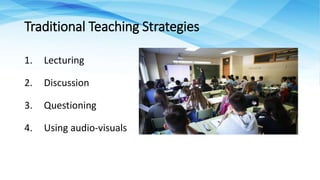
1. Lecturing
2. Discussion
3. Questioning
4. Using audio-visuals
Traditional Teaching Strategies
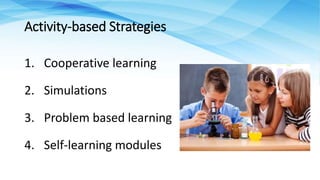
1. Cooperative learning
2. Simulations
3. Problem based learning
4. Self-learning modules
Activity-based Strategies
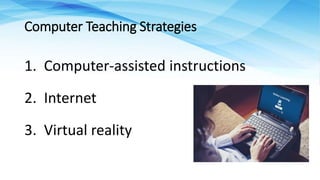
1. Computer-assisted instructions
2. Internet
3. Virtual reality
Computer Teaching Strategies
FORMAL DISCUSSIONS
 Announced topic
 Reading, watching movie – done in advance
INFORMAL DISCUSSIONS
 Spontaneous
TYPES OF DISCUSSIONS
1. Learns problem solving method (groups)
2. Opportunity to apply principles, concepts & theories
3. Clarifies information & concepts
4. Assists to evaluate beliefs/positions (professional, societal
or ethical issues) -change in attitudes & values
PURPOSES & ADVANTAGES
Make expectations clear.
 ‘Students know exactly what they have to do for discussion’
Ex. Chapter to read, watch a video
Set ground rules.
 Limitations (e.g. time, no. of speakers, interruptions during
speech)
DISCUSSION TECHNIQUES
Arrange physical space.
 Circle sitting arrangement
Plan a discussion starter.
 Ask participants to come up with opening questions
Study questions – handed out prior to meeting
DISCUSSION TECHNIQUES
Facilitate, do not discuss.
 Refrain from talking. Watch group progress. Keep everyone
engage in discussions.
Encourage quiet members to participate.
 Make eye contact and smile.
 Give direct, simple questions: “Mary, what do you think?”
DISCUSSION TECHNIQUES
Don’t allow monopolies.
 Eye contact.
Be blunt when needed.. “We’ve been hearing a lot fro Sarah.
Now, let us hear of the rest of you think.”
Direct the discussion among group members.
 Leaders facilitate.
DISCUSSION TECHNIQUES
Keep the discussion on track.
 “We seem to have strayed a little fro our topic. Let’s pick up
on the last topic that Lot was talking about.”
Clarify when confusion reigns.
 Recording may help the group. Let them learn the act of
clear self-expression.
DISCUSSION TECHNIQUES
Tolerate some silence. Silence gives everyone a chance
to think.
Summarize when appropriate.
DISCUSSION TECHNIQUES
ACTIVITY BASED
TEACHING STRATEGIES
1. Cooperative learning
2. Simulations
3. Problem based learning
4. Self-learning modules
 Small groups of learners can work together toward
achieving shared learning goal.
 Learners are aware that they are responsible not only
for their own learning but also for that of the others in
the group.
COOPERATIVE LEARNING
1. Promotes critical thinking
2. Enhances social skill
3. Helps address learning needs & learning styles
4. Members learn to function as a team.
ADVANTAGES OF COOPERATIVE LEARNING
1. Does not cover all content/ topics in syllabus.
DISADVANTAGES OF COOPERATIVE LEARNING
1. Form of drama – spontaneous acting out of roles
(interaction)
2. Lasts for 3 to 5 minutes (illustrates one aspect of human
relationship)
3. Expression of non-verbal and verbal behavior, response
patterns and implementation of principles
ROLE PLAYING
COMPUTER-AIDED
INSTRUCTIONS
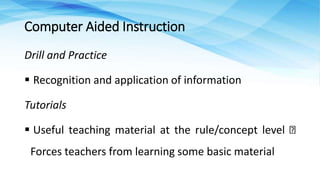
Drill and Practice
 Recognition and application of information
Tutorials
 Useful teaching material at the rule/concept level
Forces teachers from learning some basic material
Computer Aided Instruction
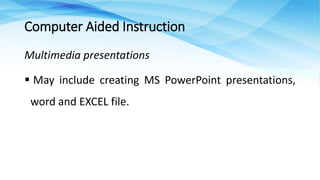
Multimedia presentations
 May include creating MS PowerPoint presentations,
word and EXCEL file.
Computer Aided Instruction
THANK YOU!!