A DETAILED LEASSON PLAN
IN ENGLISH VI
I. OBJECTIVES
Given a conversation, the grade VI pupils should be able:
1. spell the words with an initial letter k;
2. pronounce the words with /s/ and /z/ sound;
3. identify the adverb in the sentences presented;
4. differentiate the different kinds of adverbs;
5. construct sentences using adverbs.
II. SUBJECT MATTER: Identifying Adverb and its Kinds
References: Maria Perpetual Imelda B. Ho
English for a Brighter World VI
Brighthouse Publishing pp. 171 – 176
Girlie Grace S. Desuasido
English Made Easy VI
Cultural Publisher pp. 214 - 221
Materials: power point presentation
Spelling: words with initial letter k
Spelling Strategy: pencil and paper test
Phonics: /s/ and /z/
Phonics Strategy: in poem form
III. PROCEDURE
TEACHER’S ACTIVITY LEARNERS’ ACTIVITY
A. Preliminary
1. Spelling
Bring out your spelling booklet
or ½ sheet of paper lengthwise and
your ball pen because it is spelling
time with initial letter k.
Are you ready class?
Good, listen carefully class
because I will read each word twice
only.
Yes, we are ready teacher!
1. kaleidoscope
 it is a tube containing loose bits
of colored materials and two
mirrors at one end that shows
many different patterns as it is
turned
2. kangaroo
it is any various large leaping
marsupial mammal of
Australia
3. karaoke
a device that plays
instrumental accompaniment
for songs to which user sings
along
4. kedge
 it is a small anchor
5. keratin
any various sulfur containing
proteins that make up hair and
horny tissues
6. kidnapping
 to hold or carry a person away
by unlawful force
7. kilogram
 the basic metric unit of mass
K-A-L-E-I-D-O-S-C-O-P-E
K-A-N-G-A-R-O-O
K-A-R-A-O-K-E
K-E-D-G-E
K-E-R-A-T-I-N
K-I-D-N-A-P-P-I-N-G
8. kindergarten
 a class for children usually
from four to six years old
9. kinetics
 a science that deals with the
effects of forces upon the
motions of material bodies
10. kiosk
 a small structure with one or
more open sides
11. kitchenette
 a small kitchen
12. kleptomania
 a persistent neurotic impulse
to steal without economic
motive
13. knight
 a mounted warrior of feudal
times serving a king
14. koala
 a gray furry Australian
marsupial that has large hairy
ears and feeds on eucalyptus
leaves
K-I-L-O-G-R-A-M
K-I-N-D-E-R-G-A-R-T-E-N
K-I-N-E-T-I-C-S
K-I-O-S-K
K-I-T-C-H-E-N-E-T-T-E
K-L-E-P-T-O-M-A-N-I-A
K-N-I-G-H-T
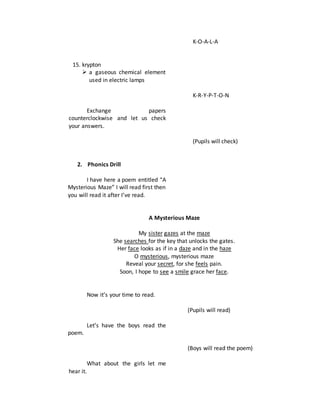
15. krypton
 a gaseous chemical element
used in electric lamps
Exchange papers
counterclockwise and let us check
your answers.
2. Phonics Drill
I have here a poem entitled “A
Mysterious Maze” I will read first then
you will read it after I’ve read.
K-O-A-L-A
K-R-Y-P-T-O-N
(Pupils will check)
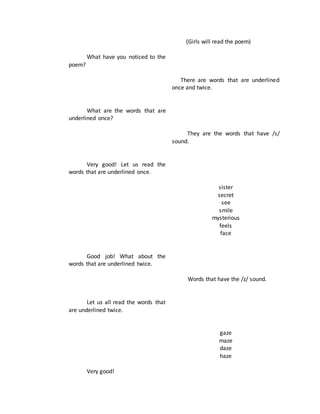
A Mysterious Maze
My sister gazes at the maze
She searches for the key that unlocks the gates.
Her face looks as if in a daze and in the haze
O mysterious, mysterious maze
Reveal your secret, for she feels pain.
Soon, I hope to see a smile grace her face.
Now it’s your time to read.
Let’s have the boys read the
poem.
What about the girls let me
hear it.
(Pupils will read)
(Boys will read the poem)
What have you noticed to the
poem?
What are the words that are
underlined once?
Very good! Let us read the
words that are underlined once.
Good job! What about the
words that are underlined twice.
Let us all read the words that
are underlined twice.
Very good!
(Girls will read the poem)
There are words that are underlined
once and twice.
They are the words that have /s/
sound.
sister
secret
see
smile
mysterious
feels
face
Words that have the /z/ sound.
gaze
maze
daze
haze
B. Lesson Proper
1. Motivation
Can you read this word
OBEY
What can you understand on
the word OBEY?
Very good! What else?
Very good! When was the last
time you obeyed your parents?
Good. What else?
If you obeyed your parents do
you have a reward or do they praise
you?
What are those rewards?
(Pupils will read)
To follow a command Ma’am.
To act according to what you have
been asked or ordered to do by someone
in authority ma’am.
Last night ma’am!
When we were at the sports center
ma’am.
Yes, Teacher.
If I obeyed my dad he usually give me
an extra money ma’am!
Wow! What else?
Very nice. When was the last
time you disobeyed your parents?
What happened?
Do you think disobeying you
parents is good?
Why do you say so?
Very good!
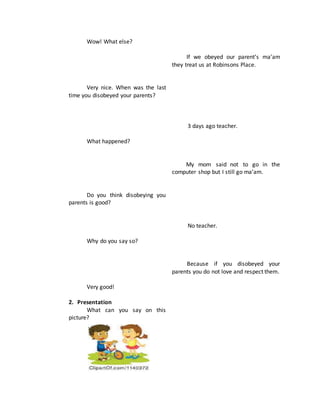
2. Presentation
What can you say on this
picture?
If we obeyed our parent’s ma’am
they treat us at Robinsons Place.
3 days ago teacher.
My mom said not to go in the
computer shop but I still go ma’am.
No teacher.
Because if you disobeyed your
parents you do not love and respect them.
Very good! What do you think
they are talking about?
What else?
Now I have here a
conversation, let us find out the good
things it will give you, for being
obedient.
Do you think it will give you
something good?
Do you think it is beneficial?
Let us see
3. Setting of Standard
Let us read the conversation of
Clark and Leah. The girls will read on
Leah and boys will read on Clark.
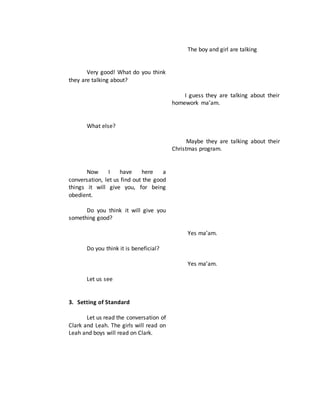
The boy and girl are talking
I guess they are talking about their
homework ma’am.
Maybe they are talking about their
Christmas program.
Yes ma’am.
Yes ma’am.
4. Reading Proper
5. Comprehension Check
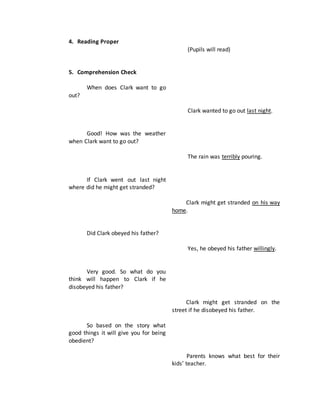
When does Clark want to go
out?
Good! How was the weather
when Clark want to go out?
If Clark went out last night
where did he might get stranded?
Did Clark obeyed his father?
Very good. So what do you
think will happen to Clark if he
disobeyed his father?
So based on the story what
good things it will give you for being
obedient?
(Pupils will read)
Clark wanted to go out last night.
The rain was terribly pouring.
Clark might get stranded on his way
home.
Yes, he obeyed his father willingly.
Clark might get stranded on the
street if he disobeyed his father.
Parents knows what best for their
kids’ teacher.
What else?
6. Developing of Language
Now let us read your answers!
Will you read the first
sentence.
What is the subject?
Good. What is the verb?
And what is the word that
comes before the verb?
Therefore, terribly modifies
the verb pouring.
I have here another sentence.
Clark made the people around
him very happy.
We should trust and believe what
our parents told us for they know what is
good and bad for us.
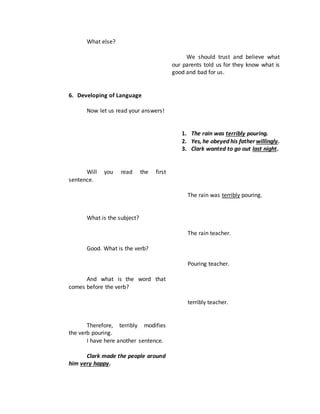
1. The rain was terribly pouring.
2. Yes, he obeyed his father willingly.
3. Clark wanted to go out last night.
The rain was terribly pouring.
The rain teacher.
Pouring teacher.
terribly teacher.
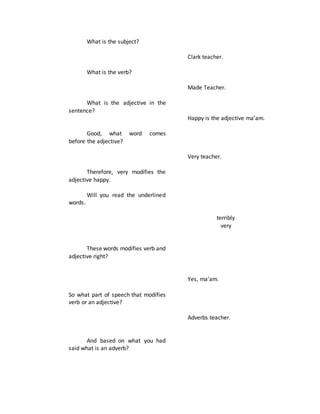
What is the subject?
What is the verb?
What is the adjective in the
sentence?
Good, what word comes
before the adjective?
Therefore, very modifies the
adjective happy.
Will you read the underlined
words.
These words modifies verb and
adjective right?
So what part of speech that modifies
verb or an adjective?
And based on what you had
said what is an adverb?
Clark teacher.
Made Teacher.
Happy is the adjective ma’am.
Very teacher.
terribly
very
Yes, ma’am.
Adverbs teacher.
Very good! I have here another
sentence.
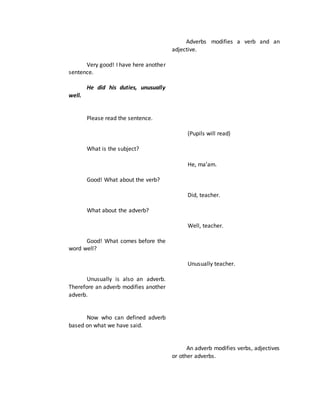
He did his duties, unusually
well.
Please read the sentence.
What is the subject?
Good! What about the verb?
What about the adverb?
Good! What comes before the
word well?
Unusually is also an adverb.
Therefore an adverb modifies another
adverb.
Now who can defined adverb
based on what we have said.
Adverbs modifies a verb and an
adjective.
(Pupils will read)
He, ma’am.
Did, teacher.
Well, teacher.
Unusually teacher.
An adverb modifies verbs, adjectives
or other adverbs.
Very good. So adverb describes
a verb, an adjective and another
adverb.
7. Comparison and Abstraction
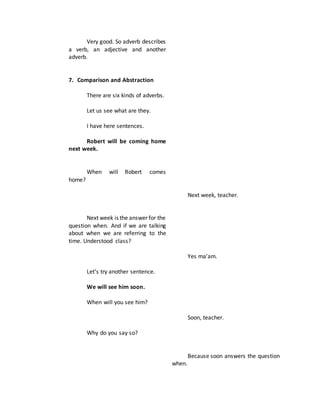
There are six kinds of adverbs.
Let us see what are they.
I have here sentences.
Robert will be coming home
next week.
When will Robert comes
home?
Next week is the answer for the
question when. And if we are talking
about when we are referring to the
time. Understood class?
Let’s try another sentence.
We will see him soon.
When will you see him?
Why do you say so?
Next week, teacher.
Yes ma’am.
Soon, teacher.
Because soon answers the question
when.
Good. Therefore if we are
talking about time and answers the
question when what kind of adverb is
it?
Very good. And what is an
adverb of time?
Nice. The first kind of adverb is
adverb of time and it answers the
questions when.
What is the first kind of
adverb?
Good. I have here another
sentence.
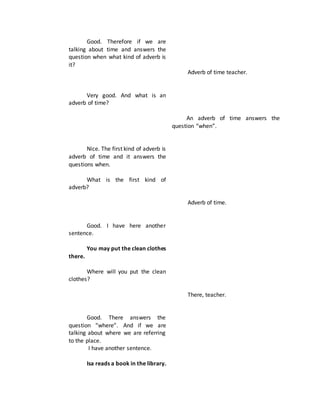
You may put the clean clothes
there.
Where will you put the clean
clothes?
Good. There answers the
question “where”. And if we are
talking about where we are referring
to the place.
I have another sentence.
Isa reads a book in the library.
Adverb of time teacher.
An adverb of time answers the
question “when”.
Adverb of time.
There, teacher.
Where did Isa reads a book?
Why do you say so?
Therefore if we are talking
about place and answers the question
where. What kind of adverb is it?
Nice. And what is an adverb of
place?
The second kind of adverb is
adverb of place and it answers the
question where.
What is the second kind of
adverb?
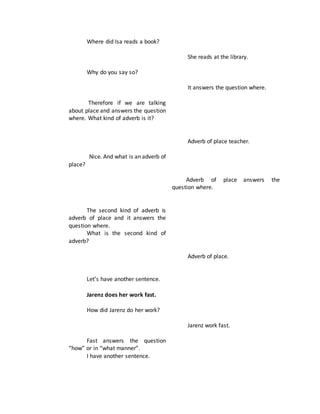
Let’s have another sentence.
Jarenz does her work fast.
How did Jarenz do her work?
Fast answers the question
“how” or in “what manner”.
I have another sentence.
She reads at the library.
It answers the question where.
Adverb of place teacher.
Adverb of place answers the
question where.
Adverb of place.
Jarenz work fast.
Shealso workscarefullyall the
time.
How does she work?
Carefully, and it answers the
question?
Good. Therefore if we are
talking about how or in what manner.
What kind of adverb is this?
Nice. And what is an adverb of
manner?
The third kind of adverb is
adverb of manner. It answers the
question how or in what manner.
What is the third kind of adverb?
Let’s go to another sentence.
The bus seldom stops in front
of our house.
How often does the bus stops
in front of their house?
Carefully ma’am.
It answers the question how.
Adverb of manner.
Adverb of manner answers the
question how or in what manner.
Adverb of manner.
Seldom answers the question
how often.
Therefore if we are talking
about the frequency or how often,
what kind of adverb is this?
Another sentence.
I am familiar with my father’s
friend because he frequently comes
to our house.
How often did he comes to
your house?
Frequently answers what
question?
Good! What is an adverb of
frequency?
The fourth kind of adverb is
adverb of frequency. It answers the
question how often.
What is the fourth kind of
adverb?
Seldom teacher
Adverb of frequency.
Frequently, teacher.
It answers the question how often.
Adverb of frequency answers the
question how often.
Adverb of frequency.
Good! Next sentence.
Yes, we will all go to Palawan.
Are they going to Palawan?
Why do you say they are going
to Palawan?
Good because the word yes
means it affirms or they agree.
What if the sentence is like this
The convict was never given a
fair trial.
Did the convict given a fair
trial?
Never means they denies.
Therefore if we affirms or denies we
are telling if it is true or false. What is
the fifth kind of adverb?
Good. And what is an adverb of
affirmation and negation.
The fifth kind of adverb is
adverb of affirmation and negation. It
Yes, teacher.
Because of the word yes, ma’am.
Never, teacher.
Adverb of affirmation and negation.
Adverb of affirmation and negation
tell whether a fact is true or false.
tells whether a fact is true or false or it
says yes or no. So if it is yes that’s
adverb of affirmation and if it is no it is
an adverb of negation. What is the
fifth kind of adverb?
Good. Another sentence.
Kyla cleaned their house
entirely.
How much Kyla cleaned the
house?
Entirely answers the question
how much or how little we are talking
about the degree. Therefore what is
the last kind of adverb?
Good. Next sentence.
He has nearly recovered.
How much he had recovered?
Why do you say so?
Good. What kind of adverb that
answers the question of how much or
how little?
Adverb of affirmation and negation.
Entirely teacher.
Adverb of degree.
Nearly, teacher.
Because nearly answers the question
how much.
And what is adverb of degree?
IV. GENERALIZATION
Based on what we discussed
can you define what an adverb is?
Good! And in adverbs there are
six kinds what are they?
You’re amazing! What is
adverb of time?
What about the adverb of
place?
Good. What about if I answer
the question “how” or “in what
manner” what kind of adverb is that?
Adverb of degree teacher.
It answers the question how much or
how little.
Adverbs describes a verb, adjective
and another adverb.
The kinds of adverbs are adverb of
time, adverb of place, adverb of manner,
adverb of degree, adverb of affirmation
and negation and adverb of frequency.
Adverb of time answers the question
when.
Adverb of place answers the
questions when.
Very good! What about the
adverb of degree?
Good! What about the adverbs
that affirms or denies?
Nice! What about the adverb
that answers the question “how
often” or “how frequent”
Very good!
Its adverb of manner.
Adverb of degree answers the
questions to what degree, how much or
how little.
The adverb that affirms or denies is
adverb of affirmation and negation.
It is adverb of frequency teacher.
V. APPLICATION
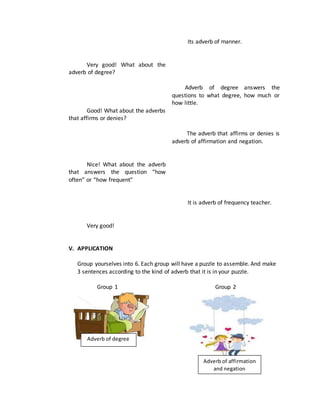
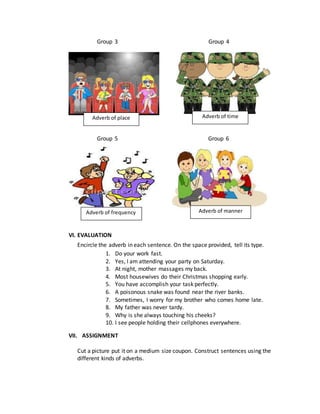
Group yourselves into 6. Each group will have a puzzle to assemble. And make
3 sentences according to the kind of adverb that it is in your puzzle.
Group 1 Group 2
Adverb of degree
Adverb of affirmation
and negation
Group 3 Group 4
Group 5 Group 6
VI. EVALUATION
Encircle the adverb in each sentence. On the space provided, tell its type.
1. Do your work fast.
2. Yes, I am attending your party on Saturday.
3. At night, mother massages my back.
4. Most housewives do their Christmas shopping early.
5. You have accomplish your task perfectly.
6. A poisonous snake was found near the river banks.
7. Sometimes, I worry for my brother who comes home late.
8. My father was never tardy.
9. Why is she always touching his cheeks?
10. I see people holding their cellphones everywhere.
VII. ASSIGNMENT
Cut a picture put it on a medium size coupon. Construct sentences using the
different kinds of adverbs.
Adverb of place Adverb of time
Adverb of frequency Adverb of manner
A DETAILED LESSON PLAN
IN
ENGLISH VI
IDENTIFYING ADVERBS AND ITS KINDS
Date of Submission: December 12, 2015
Date of Teaching: December 14, 2015
Submitted by:
JEAN KATHRINE Q. MACUGAY
Bachelor in Elementary Education 4
Student Teacher
Submitted to:
MR. JAKE B. ABRAGAR
Teacher Training Instructor

detailed lesson plan on adverbs for grade 6

  • 1.
    A DETAILED LEASSONPLAN IN ENGLISH VI I. OBJECTIVES Given a conversation, the grade VI pupils should be able: 1. spell the words with an initial letter k; 2. pronounce the words with /s/ and /z/ sound; 3. identify the adverb in the sentences presented; 4. differentiate the different kinds of adverbs; 5. construct sentences using adverbs. II. SUBJECT MATTER: Identifying Adverb and its Kinds References: Maria Perpetual Imelda B. Ho English for a Brighter World VI Brighthouse Publishing pp. 171 – 176 Girlie Grace S. Desuasido English Made Easy VI Cultural Publisher pp. 214 - 221 Materials: power point presentation Spelling: words with initial letter k Spelling Strategy: pencil and paper test Phonics: /s/ and /z/ Phonics Strategy: in poem form III. PROCEDURE TEACHER’S ACTIVITY LEARNERS’ ACTIVITY A. Preliminary 1. Spelling Bring out your spelling booklet or ½ sheet of paper lengthwise and your ball pen because it is spelling time with initial letter k. Are you ready class? Good, listen carefully class because I will read each word twice only. Yes, we are ready teacher!
  • 2.
    1. kaleidoscope  itis a tube containing loose bits of colored materials and two mirrors at one end that shows many different patterns as it is turned 2. kangaroo it is any various large leaping marsupial mammal of Australia 3. karaoke a device that plays instrumental accompaniment for songs to which user sings along 4. kedge  it is a small anchor 5. keratin any various sulfur containing proteins that make up hair and horny tissues 6. kidnapping  to hold or carry a person away by unlawful force 7. kilogram  the basic metric unit of mass K-A-L-E-I-D-O-S-C-O-P-E K-A-N-G-A-R-O-O K-A-R-A-O-K-E K-E-D-G-E K-E-R-A-T-I-N K-I-D-N-A-P-P-I-N-G
  • 3.
    8. kindergarten  aclass for children usually from four to six years old 9. kinetics  a science that deals with the effects of forces upon the motions of material bodies 10. kiosk  a small structure with one or more open sides 11. kitchenette  a small kitchen 12. kleptomania  a persistent neurotic impulse to steal without economic motive 13. knight  a mounted warrior of feudal times serving a king 14. koala  a gray furry Australian marsupial that has large hairy ears and feeds on eucalyptus leaves K-I-L-O-G-R-A-M K-I-N-D-E-R-G-A-R-T-E-N K-I-N-E-T-I-C-S K-I-O-S-K K-I-T-C-H-E-N-E-T-T-E K-L-E-P-T-O-M-A-N-I-A K-N-I-G-H-T
  • 4.
    15. krypton  agaseous chemical element used in electric lamps Exchange papers counterclockwise and let us check your answers. 2. Phonics Drill I have here a poem entitled “A Mysterious Maze” I will read first then you will read it after I’ve read. K-O-A-L-A K-R-Y-P-T-O-N (Pupils will check) A Mysterious Maze My sister gazes at the maze She searches for the key that unlocks the gates. Her face looks as if in a daze and in the haze O mysterious, mysterious maze Reveal your secret, for she feels pain. Soon, I hope to see a smile grace her face. Now it’s your time to read. Let’s have the boys read the poem. What about the girls let me hear it. (Pupils will read) (Boys will read the poem)
  • 5.
    What have younoticed to the poem? What are the words that are underlined once? Very good! Let us read the words that are underlined once. Good job! What about the words that are underlined twice. Let us all read the words that are underlined twice. Very good! (Girls will read the poem) There are words that are underlined once and twice. They are the words that have /s/ sound. sister secret see smile mysterious feels face Words that have the /z/ sound. gaze maze daze haze
  • 6.
    B. Lesson Proper 1.Motivation Can you read this word OBEY What can you understand on the word OBEY? Very good! What else? Very good! When was the last time you obeyed your parents? Good. What else? If you obeyed your parents do you have a reward or do they praise you? What are those rewards? (Pupils will read) To follow a command Ma’am. To act according to what you have been asked or ordered to do by someone in authority ma’am. Last night ma’am! When we were at the sports center ma’am. Yes, Teacher. If I obeyed my dad he usually give me an extra money ma’am!
  • 7.
    Wow! What else? Verynice. When was the last time you disobeyed your parents? What happened? Do you think disobeying you parents is good? Why do you say so? Very good! 2. Presentation What can you say on this picture? If we obeyed our parent’s ma’am they treat us at Robinsons Place. 3 days ago teacher. My mom said not to go in the computer shop but I still go ma’am. No teacher. Because if you disobeyed your parents you do not love and respect them.
  • 8.
    Very good! Whatdo you think they are talking about? What else? Now I have here a conversation, let us find out the good things it will give you, for being obedient. Do you think it will give you something good? Do you think it is beneficial? Let us see 3. Setting of Standard Let us read the conversation of Clark and Leah. The girls will read on Leah and boys will read on Clark. The boy and girl are talking I guess they are talking about their homework ma’am. Maybe they are talking about their Christmas program. Yes ma’am. Yes ma’am.
  • 9.
    4. Reading Proper 5.Comprehension Check When does Clark want to go out? Good! How was the weather when Clark want to go out? If Clark went out last night where did he might get stranded? Did Clark obeyed his father? Very good. So what do you think will happen to Clark if he disobeyed his father? So based on the story what good things it will give you for being obedient? (Pupils will read) Clark wanted to go out last night. The rain was terribly pouring. Clark might get stranded on his way home. Yes, he obeyed his father willingly. Clark might get stranded on the street if he disobeyed his father. Parents knows what best for their kids’ teacher.
  • 10.
    What else? 6. Developingof Language Now let us read your answers! Will you read the first sentence. What is the subject? Good. What is the verb? And what is the word that comes before the verb? Therefore, terribly modifies the verb pouring. I have here another sentence. Clark made the people around him very happy. We should trust and believe what our parents told us for they know what is good and bad for us. 1. The rain was terribly pouring. 2. Yes, he obeyed his father willingly. 3. Clark wanted to go out last night. The rain was terribly pouring. The rain teacher. Pouring teacher. terribly teacher.
  • 11.
    What is thesubject? What is the verb? What is the adjective in the sentence? Good, what word comes before the adjective? Therefore, very modifies the adjective happy. Will you read the underlined words. These words modifies verb and adjective right? So what part of speech that modifies verb or an adjective? And based on what you had said what is an adverb? Clark teacher. Made Teacher. Happy is the adjective ma’am. Very teacher. terribly very Yes, ma’am. Adverbs teacher.
  • 12.
    Very good! Ihave here another sentence. He did his duties, unusually well. Please read the sentence. What is the subject? Good! What about the verb? What about the adverb? Good! What comes before the word well? Unusually is also an adverb. Therefore an adverb modifies another adverb. Now who can defined adverb based on what we have said. Adverbs modifies a verb and an adjective. (Pupils will read) He, ma’am. Did, teacher. Well, teacher. Unusually teacher. An adverb modifies verbs, adjectives or other adverbs.
  • 13.
    Very good. Soadverb describes a verb, an adjective and another adverb. 7. Comparison and Abstraction There are six kinds of adverbs. Let us see what are they. I have here sentences. Robert will be coming home next week. When will Robert comes home? Next week is the answer for the question when. And if we are talking about when we are referring to the time. Understood class? Let’s try another sentence. We will see him soon. When will you see him? Why do you say so? Next week, teacher. Yes ma’am. Soon, teacher. Because soon answers the question when.
  • 14.
    Good. Therefore ifwe are talking about time and answers the question when what kind of adverb is it? Very good. And what is an adverb of time? Nice. The first kind of adverb is adverb of time and it answers the questions when. What is the first kind of adverb? Good. I have here another sentence. You may put the clean clothes there. Where will you put the clean clothes? Good. There answers the question “where”. And if we are talking about where we are referring to the place. I have another sentence. Isa reads a book in the library. Adverb of time teacher. An adverb of time answers the question “when”. Adverb of time. There, teacher.
  • 15.
    Where did Isareads a book? Why do you say so? Therefore if we are talking about place and answers the question where. What kind of adverb is it? Nice. And what is an adverb of place? The second kind of adverb is adverb of place and it answers the question where. What is the second kind of adverb? Let’s have another sentence. Jarenz does her work fast. How did Jarenz do her work? Fast answers the question “how” or in “what manner”. I have another sentence. She reads at the library. It answers the question where. Adverb of place teacher. Adverb of place answers the question where. Adverb of place. Jarenz work fast.
  • 16.
    Shealso workscarefullyall the time. Howdoes she work? Carefully, and it answers the question? Good. Therefore if we are talking about how or in what manner. What kind of adverb is this? Nice. And what is an adverb of manner? The third kind of adverb is adverb of manner. It answers the question how or in what manner. What is the third kind of adverb? Let’s go to another sentence. The bus seldom stops in front of our house. How often does the bus stops in front of their house? Carefully ma’am. It answers the question how. Adverb of manner. Adverb of manner answers the question how or in what manner. Adverb of manner.
  • 17.
    Seldom answers thequestion how often. Therefore if we are talking about the frequency or how often, what kind of adverb is this? Another sentence. I am familiar with my father’s friend because he frequently comes to our house. How often did he comes to your house? Frequently answers what question? Good! What is an adverb of frequency? The fourth kind of adverb is adverb of frequency. It answers the question how often. What is the fourth kind of adverb? Seldom teacher Adverb of frequency. Frequently, teacher. It answers the question how often. Adverb of frequency answers the question how often. Adverb of frequency.
  • 18.
    Good! Next sentence. Yes,we will all go to Palawan. Are they going to Palawan? Why do you say they are going to Palawan? Good because the word yes means it affirms or they agree. What if the sentence is like this The convict was never given a fair trial. Did the convict given a fair trial? Never means they denies. Therefore if we affirms or denies we are telling if it is true or false. What is the fifth kind of adverb? Good. And what is an adverb of affirmation and negation. The fifth kind of adverb is adverb of affirmation and negation. It Yes, teacher. Because of the word yes, ma’am. Never, teacher. Adverb of affirmation and negation. Adverb of affirmation and negation tell whether a fact is true or false.
  • 19.
    tells whether afact is true or false or it says yes or no. So if it is yes that’s adverb of affirmation and if it is no it is an adverb of negation. What is the fifth kind of adverb? Good. Another sentence. Kyla cleaned their house entirely. How much Kyla cleaned the house? Entirely answers the question how much or how little we are talking about the degree. Therefore what is the last kind of adverb? Good. Next sentence. He has nearly recovered. How much he had recovered? Why do you say so? Good. What kind of adverb that answers the question of how much or how little? Adverb of affirmation and negation. Entirely teacher. Adverb of degree. Nearly, teacher. Because nearly answers the question how much.
  • 20.
    And what isadverb of degree? IV. GENERALIZATION Based on what we discussed can you define what an adverb is? Good! And in adverbs there are six kinds what are they? You’re amazing! What is adverb of time? What about the adverb of place? Good. What about if I answer the question “how” or “in what manner” what kind of adverb is that? Adverb of degree teacher. It answers the question how much or how little. Adverbs describes a verb, adjective and another adverb. The kinds of adverbs are adverb of time, adverb of place, adverb of manner, adverb of degree, adverb of affirmation and negation and adverb of frequency. Adverb of time answers the question when. Adverb of place answers the questions when.
  • 21.
    Very good! Whatabout the adverb of degree? Good! What about the adverbs that affirms or denies? Nice! What about the adverb that answers the question “how often” or “how frequent” Very good! Its adverb of manner. Adverb of degree answers the questions to what degree, how much or how little. The adverb that affirms or denies is adverb of affirmation and negation. It is adverb of frequency teacher. V. APPLICATION Group yourselves into 6. Each group will have a puzzle to assemble. And make 3 sentences according to the kind of adverb that it is in your puzzle. Group 1 Group 2 Adverb of degree Adverb of affirmation and negation
  • 22.
    Group 3 Group4 Group 5 Group 6 VI. EVALUATION Encircle the adverb in each sentence. On the space provided, tell its type. 1. Do your work fast. 2. Yes, I am attending your party on Saturday. 3. At night, mother massages my back. 4. Most housewives do their Christmas shopping early. 5. You have accomplish your task perfectly. 6. A poisonous snake was found near the river banks. 7. Sometimes, I worry for my brother who comes home late. 8. My father was never tardy. 9. Why is she always touching his cheeks? 10. I see people holding their cellphones everywhere. VII. ASSIGNMENT Cut a picture put it on a medium size coupon. Construct sentences using the different kinds of adverbs. Adverb of place Adverb of time Adverb of frequency Adverb of manner
  • 23.
    A DETAILED LESSONPLAN IN ENGLISH VI IDENTIFYING ADVERBS AND ITS KINDS Date of Submission: December 12, 2015 Date of Teaching: December 14, 2015 Submitted by: JEAN KATHRINE Q. MACUGAY Bachelor in Elementary Education 4 Student Teacher Submitted to: MR. JAKE B. ABRAGAR Teacher Training Instructor