IMPORTANCE, FORMULATION & ELEMENTS
Dr. Tahira Nawaz
Principal,
GGHS Makhdoom Rashid
CONTENTS
 ICEBREACKING
 INTRODUCTION
 IMPORTENCE
 STRUCTURE OF LESSON PLAN
 PRACTICE OF LP
INTRODUCTIONS/ ICEBREACKING
 Name
 School and position
 What are the qualities of
effective teaching?
(What must a teacher know
and be able to do?)
IMPORTANCE OF PLANNING
WHY DO WE PLAN?
GOOD PLANNING
 Keeps us (the teacher and students) on track
 Achieves the objectives
 Helps us (teachers) to avoid “unpleasant” surprises
 Provides the roadmap and visuals in a logical sequence
 Provides direction to a substitute
 Encourages reflection, refinement, and improvement
 Enhances student achievement
POOR PLANNING
 Frustration for the teacher and the student
 Aimless wandering
 Unmet objectives
 No connections to prior learnings
 Disorganization
 Lack of needed materials
 A waste of time
 Poor management
A
teacher who is attempting to teach
without inspiring the pupil with a desire
to learn is hammering on a cold iron.
Horace Mann
PLANNING FOR TEACHING
PLANNING AND STRATEGIES FOR
TEACHERS
 Plans are developed to provide students with
meaningful learning experiences
 Plans connect to related learning opportunities
 Teaching is based instructional strategies that
focus on best practice and research
 Teaching is supported by strategies that foster
interest and progress
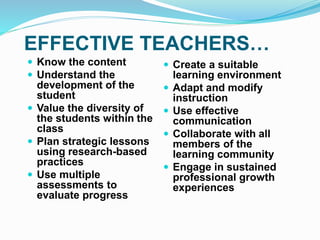
EFFECTIVE TEACHERS…
 Know the content
 Understand the
development of the
student
 Value the diversity of
the students within the
class
 Plan strategic lessons
using research-based
practices
 Use multiple
assessments to
evaluate progress
 Create a suitable
learning environment
 Adapt and modify
instruction
 Use effective
communication
 Collaborate with all
members of the
learning community
 Engage in sustained
professional growth
experiences
GETTING START
BEFORE PLANNING A LESSON
 WHAT DO STUDENTS KNOW?
 HOW CAN LOCAL RESOURSES BE USED?
 HOW TO BEGAIN?
 ACTIVITIES FOR ALL
BEFORE PLANNING A LESSON
 Identification of relevant standards
 Transform standards for students:
 Describe what needs to happen to meet
expectations
 Help students identify what is important
 Specify (and differentiate) knowledge and
learning skills
1. :
13
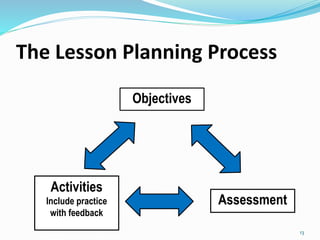
The Lesson Planning Process
Objectives
Assessment
Activities
Include practice
with feedback
A GOOD LESSON INCLUDES
 Objectives/SLOs
 Pre-assessment
 List of materials/RESOURSES
 Warm-up and introduction/opening
 Presentation of New material
 Practice
 Evaluation
 Closure
 Application
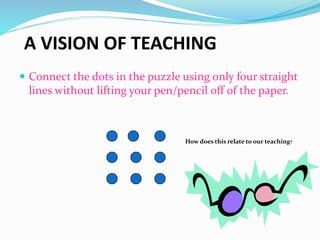
A VISION OF TEACHING
 Connect the dots in the puzzle using only four straight
lines without lifting your pen/pencil off of the paper.
How does this relate to our teaching?
LET’S BEGIN…
 The format of a
lesson should..
 Go one step at a time
 Have a picture for
every step
 Have a minimal
reliance on words
An effective lesson plan is a set of plans for building something –
it “constructs” the learning.
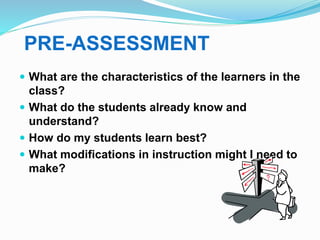
PRE-ASSESSMENT
 What are the characteristics of the learners in the
class?
 What do the students already know and
understand?
 How do my students learn best?
 What modifications in instruction might I need to
make?
OBJECTIVES/ SLOs
 A description of what the student will be able to
do at the end of the lesson
 Use behavioral verbs to describe the expected
outcomes (ACTION)
 No-no’s: appreciate, enjoy, understand, love, etc.
MATERIALS
 Plan! Prepare! Have on hand!
 Murphy’s Law
 Envision your needs.
 List all resources.
 Have enough manipulative (when needed) for
groups or individuals.
Model
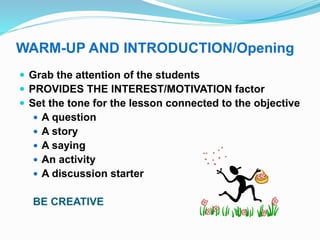
WARM-UP AND INTRODUCTION/Opening
 Grab the attention of the students
 PROVIDES THE INTEREST/MOTIVATION factor
 Set the tone for the lesson connected to the objective
 A question
 A story
 A saying
 An activity
 A discussion starter
BE CREATIVE
Introduction to New Material
 Sets up a step-by-step plan
 Provides a quick review of previous learning
 Provides specific activities to assist students in
developing the new knowledge
 Provides modeling of a new skill
 A picture is worth a thousand words.
 I hear, I see………..I do!
Input
Instructional
Strategies
That Affect
Student
Achievement
LEARNING ACTIVITIES
 Graphic organizers
 Creative play
 Peer presenting
 Performances
 Role playing
 Debates
 Game making
 Projects
 Cooperative groups
 Inquiry learning
 Direct instruction
 Differentiation
 Direct Instruction
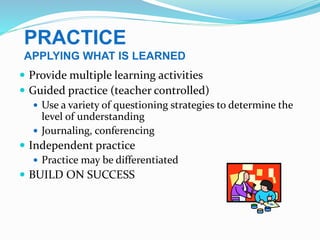
PRACTICE
APPLYING WHAT IS LEARNED
 Provide multiple learning activities
 Guided practice (teacher controlled)
 Use a variety of questioning strategies to determine the
level of understanding
 Journaling, conferencing
 Independent practice
 Practice may be differentiated
 BUILD ON SUCCESS
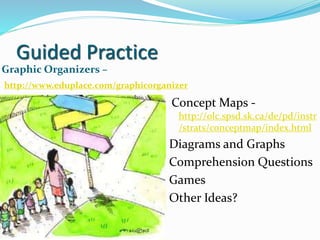
Guided Practice
Graphic Organizers –
http://www.eduplace.com/graphicorganizer
Concept Maps -
http://olc.spsd.sk.ca/de/pd/instr
/strats/conceptmap/index.html
Diagrams and Graphs
Comprehension Questions
Games
Other Ideas?
Independent Practice
CLOSURE
 Lesson Wrap-up: Leave students with an imprint of
what the lesson covered.
 Students summarize the major concepts
 Teacher recaps the main points
 Teacher sets the stage for the next phase of learning
EVALUATION
 Assess the learning
 Teacher made test
 In-class or homework
assignment
 Project to apply the
learning in real-life
situation
 Recitations and summaries
 Performance assessments
 Use of rubrics
 Portfolios
 Journals
 Informal assessment
REFLECTION
 What went well in the lesson?
 What problems did I experience?
 Are there things I could have done differently?
 How can I build on this lesson to make future
lessons successful?
THE SUBSTITUTE…
NOW WHAT?
 The Key to substitute success – DETAILED
LESSON PLANS
 Discipline routines
 Children with special needs
 Fire drill and emergency procedures
 Helpful students, helpful colleagues (phone #’s)
 Classroom schedule
 Names of administrators
 Expectations for the work
 Packet of extra activities
Evaluating lesson plans
 assessments? Is there evidence of an “Attention
Getters” (anticipatory set)?
 Are there clear objectives?
 Will students understand what they are learning and
why?
 To what extent does the lesson plan account for
how students are being asked to learn?
 To what extent does the lesson plan incorporate
appropriate technologies?
 To what extent does the lesson plan incorporate
effective
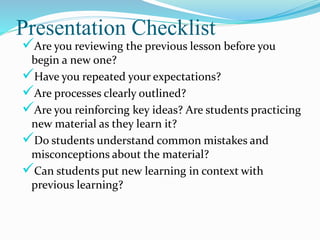
Presentation Checklist
Are you reviewing the previous lesson before you
begin a new one?
Have you repeated your expectations?
Are processes clearly outlined?
Are you reinforcing key ideas? Are students practicing
new material as they learn it?
Do students understand common mistakes and
misconceptions about the material?
Can students put new learning in context with
previous learning?
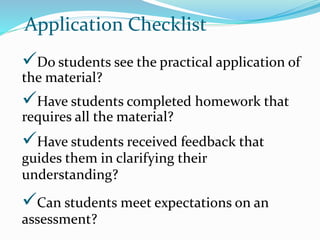
Do students see the practical application of
the material?
Have students completed homework that
requires all the material?
Have students received feedback that
guides them in clarifying their
understanding?
Can students meet expectations on an
assessment?
Application Checklist
The greater the structure of a lesson and the more precise
the directions on what is to be accomplished, the higher the
achievement rate.
Harry Wong, The First Days of Teaching
?
Now Practice
the Lesson
Planning