Portfolio
Assessment
Prepared by:
Robbie Liza E. Caytiles
Marie M. Loria
A portfolio is a “collection of a student work that has been
selected and organized”
 To show student learning progress (developmental
portfolio)
To show samples of the student’s best work (showcase
portfolio)
It is NOT a scrapbook but a purposeful collection of
anything worth considering.
Portfolio
A Portfolio’s content may be any
of the following:
1. Only the best work of students.
2. Evidences of individual student’s work
3. Evidences of group work
1. It can monitor the learning progress of a
student over a given period.
2. It can show the student’s best work.
3. It can compare the student’s best work
from the past to present.
Using a portfolio as an assessment tool has several
advantages.
These are as follows:
Using a portfolio as an assessment tool has several
advantages.
These are as follows:
4. It can develop reflective learning.
5. It can provide documentary evidences of learning to
teachers, parents and stakeholders.
6. It can foster teacher-student/parent-child
collaboration in the teaching learning process.
1. It is cumbersome to collect and store portfolio entries.
2. It is time consuming to make a portfolio.
3. It may create resistance on the part of the students.
Disadvantages of portfolios:
Purposes of Portfolio Assessment:
1. Monitor student progress (formative)
2. Assess student achievement (summative)
3. Determine students’ grades (summative)
Types of
Portfolios
1. Working Portfolios
Consist of collection of day-to-day work of
students.
They reflect the progress of a student in a particular
area of learning.
Provides opportunities to growth through self-
reflection.
Working Portfolios
Working Portfolios
Teachers can reflect on the effectiveness of
his/her instruction through working portfolios.
It can be compared to an artist’s studio: the
notes, the half-finished drafts, the sketches, and
the completed works.
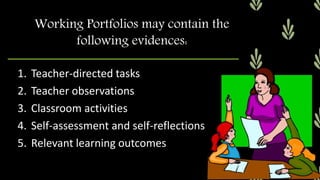
1. Teacher-directed tasks
2. Teacher observations
3. Classroom activities
4. Self-assessment and self-reflections
5. Relevant learning outcomes
Working Portfolios may contain the
following evidences:
Types of
Portfolios
1. Documentary
Portfolios
Documentary Portfolios
– Collections of the best work of students assembled for
assessment purposes
– Showcases the final products of student work
– Provide evidences that certain instructional goals are
realized
– Indicate students’ progress and weaknesses from one
learning area to another
Types of
Portfolios
1. Show Portfolios
– Purposeful collections of limited amount of student’s
work
– Usually finished products to display the best he/she
accomplished in a given period
– May contain art projects, essays, stories, poetry, or
research papers
– Reflect the curriculum goals of the learning areas
Show Portfolios
Key Elements in Portfolio
Assessment
– A good portfolio assessment involves teachers, students, and
parents
– Should specify a variety of materials systematically arranged
and organized
– Criteria should be identified
– Students should be required to evaluate portfolios periodically
– The school should schedule portfolio evaluation conference
Questions in Portfolio-
making
1. What is the purpose in making a portfolio?
2. Who should make the portfolio?
3. How long will it take to assemble the entries in a
portfolio?
4. How will it take to assemble the entries in a portfolio?
5. What entries will be included in the portfolio?
6. What criteria should be used to evaluate a
portfolio?
7. What conclusions can be made as he result of
the construction of the portfolio?
8. How can we summarize evaluative data in a
portfolio?
Questions in Portfolio-
making
Developmental vs.
Showcase Portfolio
Developmental
Portfolio
–aims to present the learning
process of a student
–used during instruction
Developmental Portfolio
Showcase
Portfolio
–provides samples of a student’s
performance at the end of the
instructional program
Showcase Portfolio
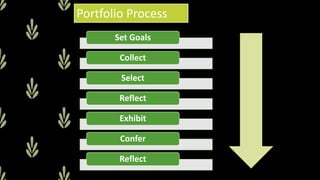
Portfolio Process
Set Goals
Collect
Select
Reflect
Exhibit
Confer
Reflect
Portfolio assessment

Portfolio assessment

  • 1.
  • 2.
    A portfolio isa “collection of a student work that has been selected and organized”  To show student learning progress (developmental portfolio) To show samples of the student’s best work (showcase portfolio) It is NOT a scrapbook but a purposeful collection of anything worth considering. Portfolio
  • 4.
    A Portfolio’s contentmay be any of the following: 1. Only the best work of students. 2. Evidences of individual student’s work 3. Evidences of group work
  • 5.
    1. It canmonitor the learning progress of a student over a given period. 2. It can show the student’s best work. 3. It can compare the student’s best work from the past to present. Using a portfolio as an assessment tool has several advantages. These are as follows:
  • 6.
    Using a portfolioas an assessment tool has several advantages. These are as follows: 4. It can develop reflective learning. 5. It can provide documentary evidences of learning to teachers, parents and stakeholders. 6. It can foster teacher-student/parent-child collaboration in the teaching learning process.
  • 7.
    1. It iscumbersome to collect and store portfolio entries. 2. It is time consuming to make a portfolio. 3. It may create resistance on the part of the students. Disadvantages of portfolios:
  • 8.
    Purposes of PortfolioAssessment: 1. Monitor student progress (formative) 2. Assess student achievement (summative) 3. Determine students’ grades (summative)
  • 9.
  • 10.
    Consist of collectionof day-to-day work of students. They reflect the progress of a student in a particular area of learning. Provides opportunities to growth through self- reflection. Working Portfolios
  • 11.
    Working Portfolios Teachers canreflect on the effectiveness of his/her instruction through working portfolios. It can be compared to an artist’s studio: the notes, the half-finished drafts, the sketches, and the completed works.
  • 12.
    1. Teacher-directed tasks 2.Teacher observations 3. Classroom activities 4. Self-assessment and self-reflections 5. Relevant learning outcomes Working Portfolios may contain the following evidences:
  • 13.
  • 14.
    Documentary Portfolios – Collectionsof the best work of students assembled for assessment purposes – Showcases the final products of student work – Provide evidences that certain instructional goals are realized – Indicate students’ progress and weaknesses from one learning area to another
  • 15.
  • 16.
    – Purposeful collectionsof limited amount of student’s work – Usually finished products to display the best he/she accomplished in a given period – May contain art projects, essays, stories, poetry, or research papers – Reflect the curriculum goals of the learning areas Show Portfolios
  • 17.
    Key Elements inPortfolio Assessment – A good portfolio assessment involves teachers, students, and parents – Should specify a variety of materials systematically arranged and organized – Criteria should be identified – Students should be required to evaluate portfolios periodically – The school should schedule portfolio evaluation conference
  • 18.
    Questions in Portfolio- making 1.What is the purpose in making a portfolio? 2. Who should make the portfolio? 3. How long will it take to assemble the entries in a portfolio? 4. How will it take to assemble the entries in a portfolio?
  • 19.
    5. What entrieswill be included in the portfolio? 6. What criteria should be used to evaluate a portfolio? 7. What conclusions can be made as he result of the construction of the portfolio? 8. How can we summarize evaluative data in a portfolio? Questions in Portfolio- making
  • 20.
  • 21.
  • 22.
    –aims to presentthe learning process of a student –used during instruction Developmental Portfolio
  • 23.
  • 24.
    –provides samples ofa student’s performance at the end of the instructional program Showcase Portfolio
  • 25.