PROBLEM-BASED LEARNING  In  Medical Education Presented by: Dr. Soha Rashed Aref Mostafa Prof. of Community Medicine  Member of Medical Education Department Faculty of Medicine Alexandria University Egypt
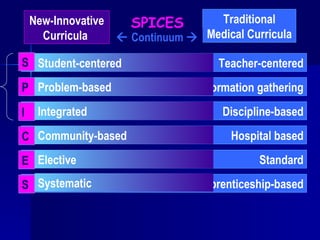
Teacher-centered Student-centered New-Innovative Curricula   Traditional Medical Curricula  Information gathering Problem-based Discipline-based Integrated Hospital based Community-based Standard Elective Apprenticeship-based Systematic    Continuum   S P I C E S SPICES
what is it?
Definition of PBL An  instructional student-centered approach  which uses  carefully constructed clinical problems  as a context for students to:  define their learning needs ,  conduct self-directed enquiry ,  integrate theory and practice , and  apply knowledge and skills to develop a solution to a defined problem.
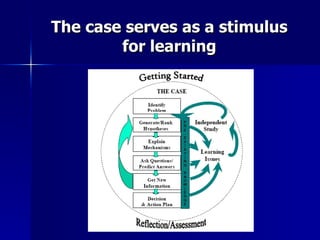
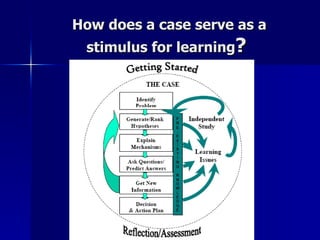
The case serves as a stimulus for learning
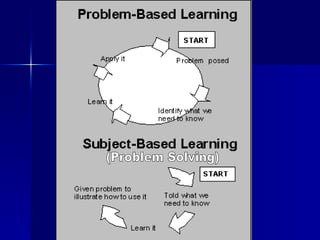
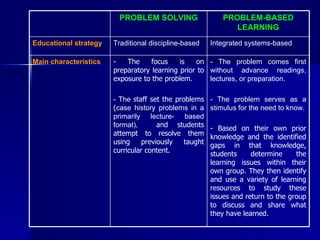
WHAT IS PROBLEM-BASED LEARNING, AND HOW DOES IT DIFFER FROM PROBLEM SOLVING?
Problem-solving  vs.  problem-based learning - different but inter-related - Problem-solving:  arriving at decisions based on prior knowledge and reasoning Problem-based learning:  the process of acquiring new knowledge based on recognition of a need to learn
(Problem Solving)
Integrated systems-based Traditional discipline-based Educational strategy - The problem comes first without advance readings, lectures, or preparation. - The problem serves as a stimulus for the need to know. - Based on their own prior knowledge and the identified gaps in that knowledge, students determine the learning issues within their own group. They then identify and use a variety of learning resources to study these issues and return to the group to discuss and share what they have learned. - The focus is on preparatory learning prior to exposure to the problem.  - The  staff set the problems ( case history problems in a primarily lecture- based format ),  and students attempt to resolve them using previously taught curricular content.  Main characteristics PROBLEM-BASED LEARNING PROBLEM SOLVING
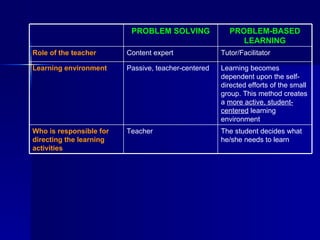
The student decides what he/she needs to learn Teacher Who is responsible for directing the learning activities Learning becomes dependent upon the self-directed efforts of the small group. This method creates a  more active, student-centered  learning environment  Passive, teacher-centered  Learning environment Tutor/Facilitator Content expert Role of the teacher PROBLEM-BASED LEARNING PROBLEM SOLVING
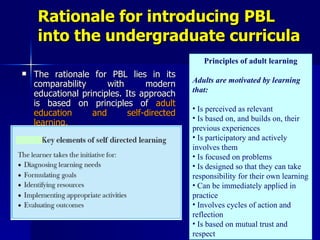
Rationale for introducing PBL into the undergraduate curricula The rationale for PBL lies in its comparability with modern educational principles. Its approach is based on principles of  adult education and self-directed learning. Principles of adult learning Adults are motivated by learning that: Is perceived as relevant Is based on, and builds on, their previous experiences Is participatory and actively involves them Is focused on problems Is designed so that they can take responsibility for their own learning Can be immediately applied in practice Involves cycles of action and reflection Is based on mutual trust and respect
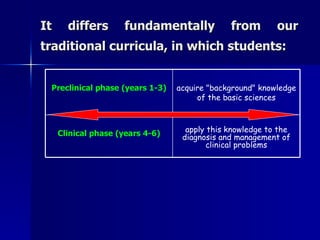
It differs fundamentally from our traditional curricula, in which students:   apply this knowledge to the diagnosis and management of clinical problems Clinical phase (years 4-6) acquire "background" knowledge of the basic sciences Preclinical phase (years 1-3)
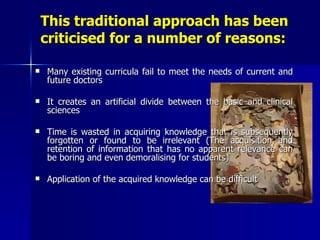
This traditional approach has been criticised for a number of reasons: Many existing curricula fail to meet the needs of current and future doctors It creates an artificial divide between the basic and clinical sciences Time is wasted in acquiring knowledge that is subsequently forgotten or found to be irrelevant (The acquisition and retention of information that has no apparent relevance can be boring and even demoralising for students) Application of the acquired knowledge can be difficult
The educational objectives of PBL address many of the perceived problems in traditional medical curricula Its possible advantages over traditional approaches include: its greater  relevance to the practice of medicine , its ability to  promote retention and application of knowledge , and its encouragement of  self-directed life-long learning
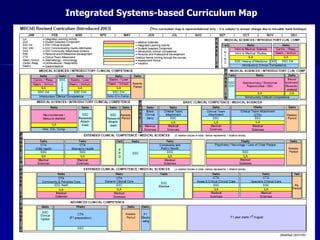
Course material is usually  systems- based   Integration of basic and clinical sciences
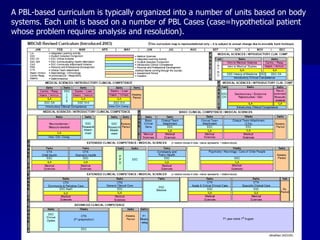
Integrated Systems-based Curriculum Map
Example   When studying PBL cases relating to CVS, students learn about: Normal bodily structure and function The clinical features, diagnosis and management of common CVDs Furthermore, they learn to take a relevant clinical history and to physically examine the CVS
Knowledge is acquired in context  and  builds on what is already known These facets aid  knowledge retention , add  interest  and increase  motivation  to learn Students continually explore their knowledge, identify both their personal learning needs and strategies required to address them. This process helps to develop  skills for life-long learning
Efficacy and advantages of PBL
 
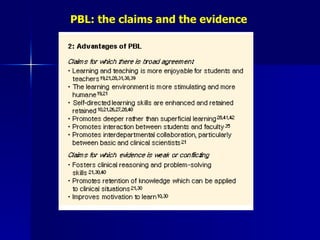
PBL: the claims and the evidence
 
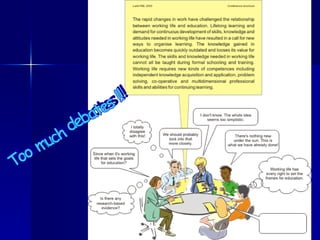
Too much debates !!
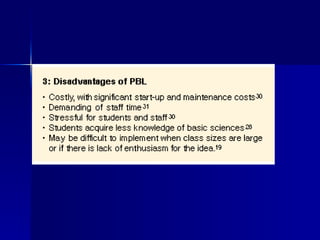
Although efficacy of PBL is difficult to evaluate, the current enthusiasm for PBL seems justified and its use is likely to increase further.
The place of PBL in the curriculum
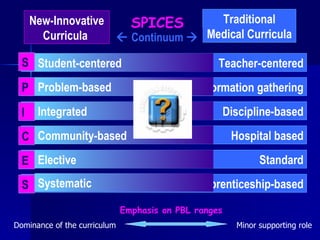
Teacher-centered Student-centered New-Innovative Curricula   Traditional Medical Curricula  Information gathering Problem-based Discipline-based Integrated Hospital based Community-based Standard Elective Apprenticeship-based Systematic    Continuum   S P I C E S SPICES Emphasis on PBL ranges Dominance of the curriculum  Minor supporting role
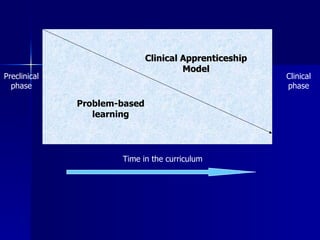
Problem-based learning Clinical Apprenticeship Model Time in the curriculum Preclinical phase Clinical phase
A PBL-based curriculum is typically organized into a number of units based on body systems. Each unit is based on a number of PBL Cases (case=hypothetical patient whose problem requires analysis and resolution).
 
Hybrid curricula In preclinical phase, PBL can be designed and timetabled so as to  complement  other teaching methods such as: Lectures Practicals, other laboratory work Computer-assisted learning
Example While learning about CVS in PBL tutorials, students  dissect the heart in   anatomy practicals , and have  lectures  on the  radiological features  of heart disease.
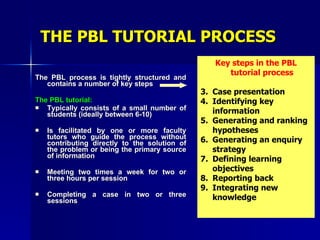
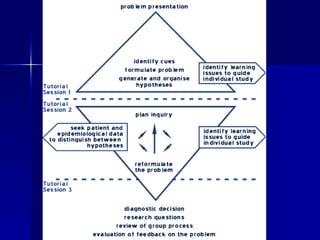
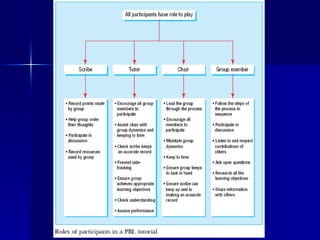
THE PBL TUTORIAL PROCESS The PBL process is tightly structured and contains a number of key steps The PBL tutorial: Typically consists of a small number of students (ideally between 6-10) Is facilitated by one or more faculty tutors who guide the process without contributing directly to the solution of the problem or being the primary source of information  Meeting two times a week for two or three hours per session Completing a case in two or three sessions Key steps in the PBL tutorial process Case presentation Identifying key information Generating and ranking hypotheses Generating an enquiry strategy Defining learning objectives Reporting back Integrating new knowledge
 
 
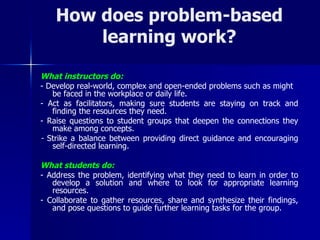
How does problem-based learning work? What instructors do: - Develop real-world, complex and open-ended problems such as might be faced in the workplace or daily life. - Act as facilitators, making sure students are staying on track and finding the resources they need. - Raise questions to student groups that deepen the connections they make among concepts. -  Strike a balance between providing direct guidance and encouraging self-directed learning. What students do: - Address the problem, identifying what they need to learn in order to develop a solution and where to look for appropriate learning resources. - Collaborate to gather resources, share and synthesize their findings, and pose questions to guide further learning tasks for the group.
e.g., 6-week Cardiovascular Unit Students might deal with  6 cases  in  18 PBL tutorials Each case is designed and written by experts  with specific learning objectives in mind e.g., one of the LO of a case dealing with  asthma  might be to stimulate students to learn about the  structure and function of  the respiratory system. Cases are written so as to  encourage students themselves to identify their own specific learning objectives. Learning process is  student-directed , and the tutor functions more as a  facilitator , not a didactic teacher.
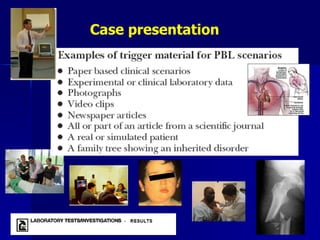
Case presentation
How does a case serve as a stimulus for learning ?
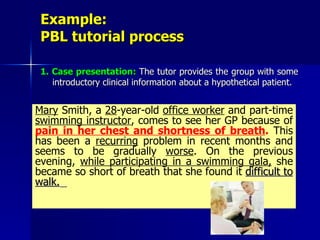
Example:  PBL tutorial process 1. Case presentation:  The tutor provides the group with some introductory clinical information about a hypothetical patient. Mary  Smith, a  28 -year-old  office worker  and part-time  swimming instructor , comes to see her GP because of  pain in her chest and shortness of breath .  This has been a  recurring  problem in recent months and seems to be gradually  worse . On the previous evening,  while participating in a swimming gala,  she became so short of breath that she found it  difficult to walk.
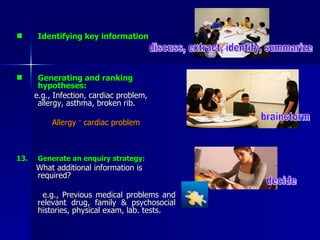
Identifying key information Generating and ranking hypotheses:   e.g., Infection, cardiac problem, allergy, asthma, broken rib. Allergy  ˃ cardiac problem Generate an enquiry strategy: What additional information is  required? e.g., Previous medical problems and relevant drug, family & psychosocial histories, physical exam, lab. tests.  discuss, extract, identify, summarize brainstorm decide
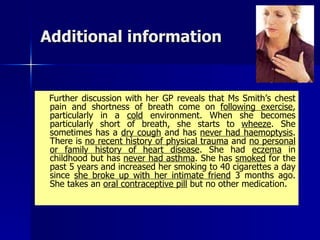
Additional information Further discussion with her GP reveals that Ms Smith’s chest pain and shortness of breath come on  following exercise , particularly in a  cold  environment. When she becomes particularly short of breath, she starts to  wheeze . She sometimes has a  dry cough  and has  never had haemoptysis . There is  no recent history of physical trauma  and  no personal or family history of heart disease . She had  eczema  in childhood but has  never had asthma . She has  smoked  for the past 5 years and increased her smoking to 40 cigarettes a day since  she broke up with her intimate friend  3 months ago. She takes an  oral contraceptive pill  but no other medication.
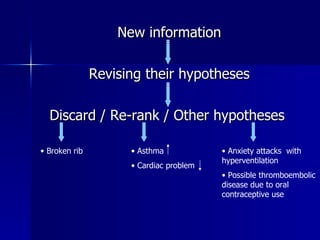
New information Revising their hypotheses Discard / Re-rank / Other hypotheses  Anxiety attacks  with hyperventilation Possible thromboembolic disease due to oral contraceptive use Asthma  Cardiac problem Broken rib
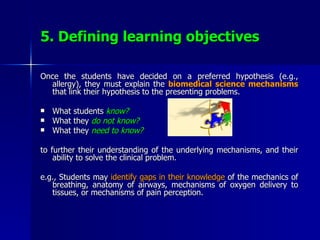
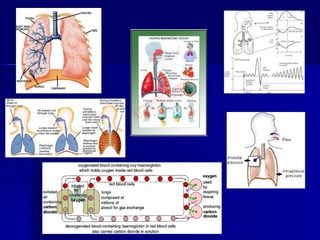
5. Defining learning objectives Once the students have decided on a preferred hypothesis (e.g., allergy), they must explain the  biomedical science mechanisms  that link their hypothesis to the presenting problems. What students  know? What they  do not know? What they  need to know? to further their understanding of the underlying mechanisms, and their ability to solve the clinical problem.  e.g., Students may  identify gaps in their knowledge  of the mechanics of breathing, anatomy of airways, mechanisms of oxygen delivery to tissues, or mechanisms of pain perception.
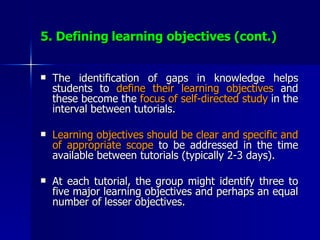
5. Defining   learning objectives (cont.) The identification of gaps in knowledge helps students to  define their learning objectives  and these become the  focus of self-directed study  in the interval between tutorials.  Learning objectives should be clear and specific and of appropriate scope  to be addressed in the time available between tutorials (typically 2-3 days).  At each tutorial, the group might identify three to five major learning objectives and perhaps an equal number of lesser objectives.
5. Defining   learning objectives (cont.) Although the PBL tutorial is student-centered,  major learning objectives are identified in advance by the case writers as part of the overall curriculum design.  Tutors may need to provide prompts to ensure that major objectives are identified and pursue d. In PBL, as  knowledge is acquired in the context of a specific clinical problem  (the problem is encountered before the student has the knowledge to understand it), it is likely to be  better focused and retained.
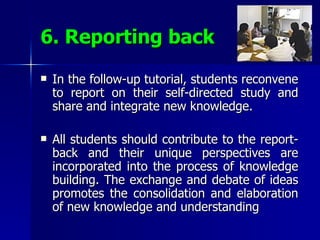
6. Reporting back In the follow-up tutorial, students reconvene to report on their self-directed study and share and integrate new knowledge.  All students should contribute to the report-back and their unique perspectives are incorporated into the process of knowledge building. The exchange and debate of ideas promotes the consolidation and elaboration of new knowledge and understanding
 
7. Integrating new knowledge Based on the principle that knowledge is consolidated more readily in context, students,  guided by the tutor/facilitator ,  should relate new biomedical knowledge to the patient's problem.   Students are required also to extend their discussion beyond the biomedical and clinical sciences and consider  the  public health, socioeconomic, ethical and legal aspects of the case.
How do I get started with PBL? Develop problems that: - Capture students’ interest by relating to real-world issues. - Draw on students’ previous learning and experience. - Integrate content objectives with problem-solving skills. - Require a cooperative, multi-staged method to solve. - Necessitate that students do some independent research to gather all information relevant to the problem. Design assessment tools that: - Account for  process  (e.g. research, collaboration) as well as content skills. - Are closely tied to course learning objectives. - Balance individual and group performance.
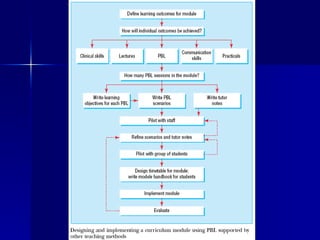
How to create effective PBL scenarios Learning objectives likely to be defined by the students after studying the scenario should be consistent with the faculty learning objectives Problems should be appropriate to the stage of the curriculum and the level of the students' understanding Scenarios should have sufficient intrinsic interest for the students or relevance to future practice Basic science should be presented in the context of a clinical scenario to encourage integration of knowledge Scenarios should contain cues to stimulate discussion and encourage students to seek explanations for the issues presented The problem should be sufficiently open, so that discussion is not curtailed too early in the process Scenarios should promote participation by the students in seeking information from various learning resources
CHECKLIST FOR PROBLEM CONSTRUCTION Is the content of the problem geared to students' prior knowledge? Is there a clear connection with one or more of the objectives of the block? Is the problem sufficiently complex to offer cues for initial discussion and for generating learning issues? Is the problem structured in such a way that it offers cues for discussion in the group? Has the problem been formulated clearly and, if possible, does it offer links with professional practice? Is the problem multidisciplinary and is clear to students? Does the length of the problem enable inclusion of all the relevant information that is needed for identifying learning issues and does the problem not contain superfluous irrelevant information? Is the available time sufficient for studying the learning issues? Is there sufficient time available for reporting on all the learning issues? Does the block offer sufficient variety in learning activities, i.e. does it include different types and formats of problems? Is the number of problems geared to the number of group meetings in the block? Has a schedule been drawn up that specifies which problems are to be discussed when? Which problems should be tackled in a specific sequence?
Handouts HOW PBL PROBLEMS ARE CREATED:  General guidelines & Tutor guide SAMPLE PBL TUTORIAL CASE:  Tutor guide including preset learning issues (Multidisciplinary) KEY STEPS IN THE PBL TUTORIAL PROCESS CONSTRUCTING PBL TUTORIAL CASES: General concepts & core guidelines Initial questions for consideration Planning the case Constructing & formatting the case GUIDE TO PBL TUTORIAL PROCESS AND SKILLS
Handouts  (cont.) ROLES OF THE TUTOR IN PBL TUTORIALS GUIDES FOR ASSESSING STUDENT PERFORMANCE:  Behavioral indicators for each category PBL EVALUATION CHECKLISTS: Assessment of student participation in PBL by facilitators Student assessment of the PBL facilitators Self-assessment of participation in PBL Peer assessment of participation in PBL
 

Problem Based Learning In Medical Education

  • 1.
    PROBLEM-BASED LEARNING In Medical Education Presented by: Dr. Soha Rashed Aref Mostafa Prof. of Community Medicine Member of Medical Education Department Faculty of Medicine Alexandria University Egypt
  • 2.
    Teacher-centered Student-centered New-InnovativeCurricula Traditional Medical Curricula Information gathering Problem-based Discipline-based Integrated Hospital based Community-based Standard Elective Apprenticeship-based Systematic  Continuum  S P I C E S SPICES
  • 3.
  • 4.
    Definition of PBLAn instructional student-centered approach which uses carefully constructed clinical problems as a context for students to: define their learning needs , conduct self-directed enquiry , integrate theory and practice , and apply knowledge and skills to develop a solution to a defined problem.
  • 5.
    The case servesas a stimulus for learning
  • 6.
    WHAT IS PROBLEM-BASEDLEARNING, AND HOW DOES IT DIFFER FROM PROBLEM SOLVING?
  • 7.
    Problem-solving vs. problem-based learning - different but inter-related - Problem-solving: arriving at decisions based on prior knowledge and reasoning Problem-based learning: the process of acquiring new knowledge based on recognition of a need to learn
  • 8.
  • 9.
    Integrated systems-based Traditionaldiscipline-based Educational strategy - The problem comes first without advance readings, lectures, or preparation. - The problem serves as a stimulus for the need to know. - Based on their own prior knowledge and the identified gaps in that knowledge, students determine the learning issues within their own group. They then identify and use a variety of learning resources to study these issues and return to the group to discuss and share what they have learned. - The focus is on preparatory learning prior to exposure to the problem. - The staff set the problems ( case history problems in a primarily lecture- based format ), and students attempt to resolve them using previously taught curricular content. Main characteristics PROBLEM-BASED LEARNING PROBLEM SOLVING
  • 10.
    The student decideswhat he/she needs to learn Teacher Who is responsible for directing the learning activities Learning becomes dependent upon the self-directed efforts of the small group. This method creates a more active, student-centered learning environment Passive, teacher-centered Learning environment Tutor/Facilitator Content expert Role of the teacher PROBLEM-BASED LEARNING PROBLEM SOLVING
  • 11.
    Rationale for introducingPBL into the undergraduate curricula The rationale for PBL lies in its comparability with modern educational principles. Its approach is based on principles of adult education and self-directed learning. Principles of adult learning Adults are motivated by learning that: Is perceived as relevant Is based on, and builds on, their previous experiences Is participatory and actively involves them Is focused on problems Is designed so that they can take responsibility for their own learning Can be immediately applied in practice Involves cycles of action and reflection Is based on mutual trust and respect
  • 12.
    It differs fundamentallyfrom our traditional curricula, in which students: apply this knowledge to the diagnosis and management of clinical problems Clinical phase (years 4-6) acquire "background" knowledge of the basic sciences Preclinical phase (years 1-3)
  • 13.
    This traditional approachhas been criticised for a number of reasons: Many existing curricula fail to meet the needs of current and future doctors It creates an artificial divide between the basic and clinical sciences Time is wasted in acquiring knowledge that is subsequently forgotten or found to be irrelevant (The acquisition and retention of information that has no apparent relevance can be boring and even demoralising for students) Application of the acquired knowledge can be difficult
  • 14.
    The educational objectivesof PBL address many of the perceived problems in traditional medical curricula Its possible advantages over traditional approaches include: its greater relevance to the practice of medicine , its ability to promote retention and application of knowledge , and its encouragement of self-directed life-long learning
  • 15.
    Course material isusually systems- based Integration of basic and clinical sciences
  • 16.
  • 17.
    Example When studying PBL cases relating to CVS, students learn about: Normal bodily structure and function The clinical features, diagnosis and management of common CVDs Furthermore, they learn to take a relevant clinical history and to physically examine the CVS
  • 18.
    Knowledge is acquiredin context and builds on what is already known These facets aid knowledge retention , add interest and increase motivation to learn Students continually explore their knowledge, identify both their personal learning needs and strategies required to address them. This process helps to develop skills for life-long learning
  • 19.
  • 20.
  • 21.
    PBL: the claimsand the evidence
  • 22.
  • 23.
  • 24.
    Although efficacy ofPBL is difficult to evaluate, the current enthusiasm for PBL seems justified and its use is likely to increase further.
  • 25.
    The place ofPBL in the curriculum
  • 26.
    Teacher-centered Student-centered New-InnovativeCurricula Traditional Medical Curricula Information gathering Problem-based Discipline-based Integrated Hospital based Community-based Standard Elective Apprenticeship-based Systematic  Continuum  S P I C E S SPICES Emphasis on PBL ranges Dominance of the curriculum Minor supporting role
  • 27.
    Problem-based learning ClinicalApprenticeship Model Time in the curriculum Preclinical phase Clinical phase
  • 28.
    A PBL-based curriculumis typically organized into a number of units based on body systems. Each unit is based on a number of PBL Cases (case=hypothetical patient whose problem requires analysis and resolution).
  • 29.
  • 30.
    Hybrid curricula Inpreclinical phase, PBL can be designed and timetabled so as to complement other teaching methods such as: Lectures Practicals, other laboratory work Computer-assisted learning
  • 31.
    Example While learningabout CVS in PBL tutorials, students dissect the heart in anatomy practicals , and have lectures on the radiological features of heart disease.
  • 32.
    THE PBL TUTORIALPROCESS The PBL process is tightly structured and contains a number of key steps The PBL tutorial: Typically consists of a small number of students (ideally between 6-10) Is facilitated by one or more faculty tutors who guide the process without contributing directly to the solution of the problem or being the primary source of information Meeting two times a week for two or three hours per session Completing a case in two or three sessions Key steps in the PBL tutorial process Case presentation Identifying key information Generating and ranking hypotheses Generating an enquiry strategy Defining learning objectives Reporting back Integrating new knowledge
  • 33.
  • 34.
  • 35.
    How does problem-basedlearning work? What instructors do: - Develop real-world, complex and open-ended problems such as might be faced in the workplace or daily life. - Act as facilitators, making sure students are staying on track and finding the resources they need. - Raise questions to student groups that deepen the connections they make among concepts. - Strike a balance between providing direct guidance and encouraging self-directed learning. What students do: - Address the problem, identifying what they need to learn in order to develop a solution and where to look for appropriate learning resources. - Collaborate to gather resources, share and synthesize their findings, and pose questions to guide further learning tasks for the group.
  • 36.
    e.g., 6-week CardiovascularUnit Students might deal with 6 cases in 18 PBL tutorials Each case is designed and written by experts with specific learning objectives in mind e.g., one of the LO of a case dealing with asthma might be to stimulate students to learn about the structure and function of the respiratory system. Cases are written so as to encourage students themselves to identify their own specific learning objectives. Learning process is student-directed , and the tutor functions more as a facilitator , not a didactic teacher.
  • 37.
  • 38.
    How does acase serve as a stimulus for learning ?
  • 39.
    Example: PBLtutorial process 1. Case presentation: The tutor provides the group with some introductory clinical information about a hypothetical patient. Mary Smith, a 28 -year-old office worker and part-time swimming instructor , comes to see her GP because of pain in her chest and shortness of breath . This has been a recurring problem in recent months and seems to be gradually worse . On the previous evening, while participating in a swimming gala, she became so short of breath that she found it difficult to walk.
  • 40.
    Identifying key informationGenerating and ranking hypotheses: e.g., Infection, cardiac problem, allergy, asthma, broken rib. Allergy ˃ cardiac problem Generate an enquiry strategy: What additional information is required? e.g., Previous medical problems and relevant drug, family & psychosocial histories, physical exam, lab. tests. discuss, extract, identify, summarize brainstorm decide
  • 41.
    Additional information Furtherdiscussion with her GP reveals that Ms Smith’s chest pain and shortness of breath come on following exercise , particularly in a cold environment. When she becomes particularly short of breath, she starts to wheeze . She sometimes has a dry cough and has never had haemoptysis . There is no recent history of physical trauma and no personal or family history of heart disease . She had eczema in childhood but has never had asthma . She has smoked for the past 5 years and increased her smoking to 40 cigarettes a day since she broke up with her intimate friend 3 months ago. She takes an oral contraceptive pill but no other medication.
  • 42.
    New information Revisingtheir hypotheses Discard / Re-rank / Other hypotheses Anxiety attacks with hyperventilation Possible thromboembolic disease due to oral contraceptive use Asthma Cardiac problem Broken rib
  • 43.
    5. Defining learningobjectives Once the students have decided on a preferred hypothesis (e.g., allergy), they must explain the biomedical science mechanisms that link their hypothesis to the presenting problems. What students know? What they do not know? What they need to know? to further their understanding of the underlying mechanisms, and their ability to solve the clinical problem. e.g., Students may identify gaps in their knowledge of the mechanics of breathing, anatomy of airways, mechanisms of oxygen delivery to tissues, or mechanisms of pain perception.
  • 44.
    5. Defining learning objectives (cont.) The identification of gaps in knowledge helps students to define their learning objectives and these become the focus of self-directed study in the interval between tutorials. Learning objectives should be clear and specific and of appropriate scope to be addressed in the time available between tutorials (typically 2-3 days). At each tutorial, the group might identify three to five major learning objectives and perhaps an equal number of lesser objectives.
  • 45.
    5. Defining learning objectives (cont.) Although the PBL tutorial is student-centered, major learning objectives are identified in advance by the case writers as part of the overall curriculum design. Tutors may need to provide prompts to ensure that major objectives are identified and pursue d. In PBL, as knowledge is acquired in the context of a specific clinical problem (the problem is encountered before the student has the knowledge to understand it), it is likely to be better focused and retained.
  • 46.
    6. Reporting backIn the follow-up tutorial, students reconvene to report on their self-directed study and share and integrate new knowledge. All students should contribute to the report-back and their unique perspectives are incorporated into the process of knowledge building. The exchange and debate of ideas promotes the consolidation and elaboration of new knowledge and understanding
  • 47.
  • 48.
    7. Integrating newknowledge Based on the principle that knowledge is consolidated more readily in context, students, guided by the tutor/facilitator , should relate new biomedical knowledge to the patient's problem. Students are required also to extend their discussion beyond the biomedical and clinical sciences and consider the public health, socioeconomic, ethical and legal aspects of the case.
  • 49.
    How do Iget started with PBL? Develop problems that: - Capture students’ interest by relating to real-world issues. - Draw on students’ previous learning and experience. - Integrate content objectives with problem-solving skills. - Require a cooperative, multi-staged method to solve. - Necessitate that students do some independent research to gather all information relevant to the problem. Design assessment tools that: - Account for process (e.g. research, collaboration) as well as content skills. - Are closely tied to course learning objectives. - Balance individual and group performance.
  • 50.
    How to createeffective PBL scenarios Learning objectives likely to be defined by the students after studying the scenario should be consistent with the faculty learning objectives Problems should be appropriate to the stage of the curriculum and the level of the students' understanding Scenarios should have sufficient intrinsic interest for the students or relevance to future practice Basic science should be presented in the context of a clinical scenario to encourage integration of knowledge Scenarios should contain cues to stimulate discussion and encourage students to seek explanations for the issues presented The problem should be sufficiently open, so that discussion is not curtailed too early in the process Scenarios should promote participation by the students in seeking information from various learning resources
  • 51.
    CHECKLIST FOR PROBLEMCONSTRUCTION Is the content of the problem geared to students' prior knowledge? Is there a clear connection with one or more of the objectives of the block? Is the problem sufficiently complex to offer cues for initial discussion and for generating learning issues? Is the problem structured in such a way that it offers cues for discussion in the group? Has the problem been formulated clearly and, if possible, does it offer links with professional practice? Is the problem multidisciplinary and is clear to students? Does the length of the problem enable inclusion of all the relevant information that is needed for identifying learning issues and does the problem not contain superfluous irrelevant information? Is the available time sufficient for studying the learning issues? Is there sufficient time available for reporting on all the learning issues? Does the block offer sufficient variety in learning activities, i.e. does it include different types and formats of problems? Is the number of problems geared to the number of group meetings in the block? Has a schedule been drawn up that specifies which problems are to be discussed when? Which problems should be tackled in a specific sequence?
  • 52.
    Handouts HOW PBLPROBLEMS ARE CREATED: General guidelines & Tutor guide SAMPLE PBL TUTORIAL CASE: Tutor guide including preset learning issues (Multidisciplinary) KEY STEPS IN THE PBL TUTORIAL PROCESS CONSTRUCTING PBL TUTORIAL CASES: General concepts & core guidelines Initial questions for consideration Planning the case Constructing & formatting the case GUIDE TO PBL TUTORIAL PROCESS AND SKILLS
  • 53.
    Handouts (cont.)ROLES OF THE TUTOR IN PBL TUTORIALS GUIDES FOR ASSESSING STUDENT PERFORMANCE: Behavioral indicators for each category PBL EVALUATION CHECKLISTS: Assessment of student participation in PBL by facilitators Student assessment of the PBL facilitators Self-assessment of participation in PBL Peer assessment of participation in PBL
  • 54.