Institute of New Khmer
Subject: Teaching Methodology
Teach By: Lecturer Phe Saorith
Conducted By: Group 6
Student Name
Top Pich and Nou Sovannarout
Academy 2016-2017
Classroom
Management
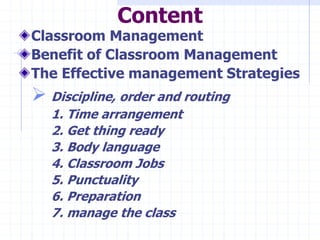
Content
Classroom Management
Benefit of Classroom Management
The Effective management Strategies
 Discipline, order and routing
1. Time arrangement
2. Get thing ready
3. Body language
4. Classroom Jobs
5. Punctuality
6. Preparation
7. manage the class
What is Classroom Management?
Classroom management is ways of
organizing the resources, pupils and
helpers so that teaching and learning can
proceed in an efficient and safe manner.
Managing the class is the most importance
for teaching in all level. So teacher should
manage the class strictly before, during
and finish the class. Because of we always
have some problems when we start
teaching.
Benefit of
Classroom
Management
Why is Classroom
Management Important?
Satisfaction and enjoyment in teaching
are dependent upon leading students to
cooperate
Classroom management issues are of
highest concern for beginning teachers
Classroom management and effective
instruction are key in ensuring student
success and learning
To optimize student learning and
achievement:
Manage the classroom manage include the
various intricacies of student learning that take
account of expectation, interaction, motivation
and behavior. An analysis of the classroom
management research shows four general
components of classroom management that affect
student achievement for all students. These four
components are (1) rules and procedures; (2)
disciplinary interventions, (3) teacher-student
relationships, and (4) mental set. "Mental set"
refers to the mindset with which you approach
your classroom management.
Improving your classroom management
means you are constantly working to create a
learning environment in which all students feel
safe and appropriately challenged. It means the
learning opportunities you provide to students
are organized and delivered in ways that allow
all students to succeed. Effective classroom
management is a crucial component of ensuring
that all students achieve in your classroom.
To successfully engage students.
Classroom management is important for
ensuring that students learn the material rather
than committing it to short-term memory for
tests. Engaging students in lectures by moving
around the room, asking questions, and
employing both verbal and nonverbal teaching
methods ensure that students are paying
attention and taking more from the learning
experience than simple facts. Engaging students
boosts their confidence and makes the lesson
more effective.
To manage classroom time effectively
The efficient use of time is an important variable in
helping students achieve learning goals and making the
classroom a pleasant place for trainers and students.
Instructional strategies must be planned to fit into fixed
time frames.
Variables that affect your use of time include no
instructional routine procedures, transitions between
activities or classes, and other interruptions. Managing
classroom time involves handling administrative tasks
quickly and developing strategies for making transitions
and interruptions as short and orderly as possible—even
using them as teachable moments. These routines and
procedures form the backbone of an efficiently run
classroom and help students feel secure in your
classroom.
To maintain a positive classroom
atmosphere
Developing and maintaining a positive learning
environment is a foundation for effective teaching.
Managing the learning environment is an ongoing
active process in which the teacher must be a careful
observer, communicator, facilitator, and manager.
Trainers try to offer their students a rich and
inviting classroom environment because they know
that the richness of students' experiences are
enhanced or diminished by their surroundings. The
classroom atmosphere also affects the way students
behave, as well as how much attention they pay to
instruction.
To maintain a positive classroom
atmosphere
To maintain a positive classroom
environment, it is important to establish rules,
procedures and standards; implement classroom
routines; prevent problems from occurring,
establish a clear standard of conduct; and instill a
sense of respect and community among
students. To further create a relaxed atmosphere
in the classroom, the trainer must be friendly,
understanding, respectful, patient, fair, set clear
and reasonable expectations and be willing to
provide help.
Sound behavior management to avoid
classroom indiscipline
• Classroom discipline management is a skill that is
not only learned but practiced daily. Sound
behavior management establishes the
environmental context that makes good instruction
possible.
• An effective discipline plan is the key. A trainer
must be fair and consistent towards students;
must come to class prepared for the lesson at
hand; make transitions between parts of lessons
smooth; look out for signs of possible problems;
make classroom rules understandable; use humor
to diffuse situations and avoid sarcasm.
To manage classroom resources
effectively Effective
classroom managers maximize the classroom’s
physical space to facilitate easy teacher movement
and proximity, as well as student movement and
transitions. A high-quality training program
necessitates a classroom rich in accessible, well-
organized materials and inviting spaces where
students can work alone, in groups, and with you.
Try different seating arrangements (e.g.,
circles, semicircles, U-shapes, and squares).
Constructive use of wall space makes a classroom
more conducive to learning and evokes a more
positive climate. Important factors include:
• The type of furniture
• The space in the classroom
• The type of instruction and activities you intend for the
class
• Individual workspaces
• Storage of materials and records
• Bulletin boards, chalk boards and other wall spaces,
including the door
• Student movement and flexibility
To accommodate every student in the classroom, a
trainer uses a wide range of audio visual support devices:
• Visual: Flipchart, Bulletin board/Pinboard, Whiteboard,
Overhead projector, Slide Projector, props and
Accessories, Video clips, Word pictures, Imaging
• Hearing: Music (for change of mood/illustrations), sound
effects, audio gimmicks, onomatopoeia
• Feeling: Handouts, anecdotes, metaphors, parables
Classroom Management
Classroom Management involves
establishing procedures, having rules,
and reducing discipline problems
Why do students cause discipline
problems?
Students misbehave for several
reasons:
They are bored.
They don’t know the purpose of your
presentation.
They don’t understand how the
information that you are delivering applies
to them.
Instruction is uninteresting
The pace of the instruction is incorrect
(too fast, or too slow).
Not enough interaction between and
among peers.
"Listen" To The Students’
Misbehavior.
Student misbehavior isn't just an
annoying disruption --- it's a secret
message the student is (unwittingly)
trying to convey to you.
The Effective management
Strategies
 Discipline, order and routine
a. Discipline (punishment)
The effective teaching depend on discipline first
before you start your class.
When we teach without discipline and order, it’s
easy to become chaotic,
If students are very lively and very bored if
students are the quite type.
Discipline are always positive way. Discipline
creates order and motivation.
We give the discipline to prevent problems by
creating a classroom atmosphere, talkative,
The Effective management
Strategies
And especially interrupting teachers.
a. Order and Routine
Some students are very bored during teaching. So
teachers should have many techniques to prevent
this problem.
What Order and Routine do we use in the
classroom?
1- Time arrangement
Start your lesson and bring lesson to an end on
time,
Mean before the bell ring. Especially finish your
lesson through the plan.
The Effective management
Strategies
2- Get things ready
Get your student actively, work as soon as they sit
down.
For example quickly to check their homework,
marks and correct them.
3- Body language
Before you share a new class, train your students
how they will attract your attention. You can ask
the to raise their hands and ignore shouting out
when they have something to say, to wait for
silence before speaking once.
The Effective management
Strategies
4- Classroom Jobs
Try to tell your students about the obligation to
do in the classroom like erasing the board,
collecting homework and prepare their materials.
5- Punctuality
Teacher should arrive first. So, That you have a
chance to organize the room, and stand near the
door. So, that you can have individual contact
with student as they come in and greet them by
their name.
The Effective management
Strategies
6- Preparation
Teacher must prepare all materials which related
to the lesson. And prepare what materials do you
should do first and collect them quickly.
7- Managing the class
Teach your class how to move into different
techniques and teach them signals which will tell
Them when to move, when to stop talking…
Why classroom routines are
important?
1) The routine creates order and security strictly
2) The routine are predictable. So student do not
get confused
3) Student are involved and do not have time to
get bored
4) Students have confidence in the teacher
because they see him as a well organize
person.
5) There are more time for real learning because
classroom management jobs do not take so
long.
Self-Check
 True or False Question
Determine if the statements below are true or
false. Write your answers in your answer
sheet.
1. When trainers are asked to identify the
most difficult problem faced during their
first few years, they typically cite
classroom management and discipline
problems.
2. 2. Classroom Management is important
only for managing classroom discipline.
Self-Check
 Multiple Choices:
Choose the best answer. Write the letter of your
choice on your answer sheet.
3. When effective classroom managers were
compared to ineffective managers, which behavior
was not observed?
A. Effective managers had procedures that governed
student talk, participation, and turning in work.
B. Misbehaviors were handled after class to prevent
disruption of the lesson.
C. Effective managers gave clear presentations and
explanations.
D. All of the above.
Self-Check
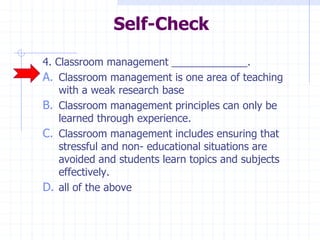
4. Classroom management _____________.
A. Classroom management is one area of teaching
with a weak research base
B. Classroom management principles can only be
learned through experience.
C. Classroom management includes ensuring that
stressful and non- educational situations are
avoided and students learn topics and subjects
effectively.
D. all of the above
Self-Check
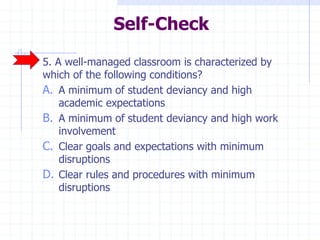
5. A well-managed classroom is characterized by
which of the following conditions?
A. A minimum of student deviancy and high
academic expectations
B. A minimum of student deviancy and high work
involvement
C. Clear goals and expectations with minimum
disruptions
D. Clear rules and procedures with minimum
disruptions

Classroom management

  • 1.
    Institute of NewKhmer Subject: Teaching Methodology Teach By: Lecturer Phe Saorith Conducted By: Group 6 Student Name Top Pich and Nou Sovannarout Academy 2016-2017
  • 2.
  • 3.
    Content Classroom Management Benefit ofClassroom Management The Effective management Strategies  Discipline, order and routing 1. Time arrangement 2. Get thing ready 3. Body language 4. Classroom Jobs 5. Punctuality 6. Preparation 7. manage the class
  • 4.
    What is ClassroomManagement? Classroom management is ways of organizing the resources, pupils and helpers so that teaching and learning can proceed in an efficient and safe manner. Managing the class is the most importance for teaching in all level. So teacher should manage the class strictly before, during and finish the class. Because of we always have some problems when we start teaching.
  • 5.
  • 6.
    Why is Classroom ManagementImportant? Satisfaction and enjoyment in teaching are dependent upon leading students to cooperate Classroom management issues are of highest concern for beginning teachers Classroom management and effective instruction are key in ensuring student success and learning
  • 7.
    To optimize studentlearning and achievement: Manage the classroom manage include the various intricacies of student learning that take account of expectation, interaction, motivation and behavior. An analysis of the classroom management research shows four general components of classroom management that affect student achievement for all students. These four components are (1) rules and procedures; (2) disciplinary interventions, (3) teacher-student relationships, and (4) mental set. "Mental set" refers to the mindset with which you approach your classroom management.
  • 8.
    Improving your classroommanagement means you are constantly working to create a learning environment in which all students feel safe and appropriately challenged. It means the learning opportunities you provide to students are organized and delivered in ways that allow all students to succeed. Effective classroom management is a crucial component of ensuring that all students achieve in your classroom.
  • 9.
    To successfully engagestudents. Classroom management is important for ensuring that students learn the material rather than committing it to short-term memory for tests. Engaging students in lectures by moving around the room, asking questions, and employing both verbal and nonverbal teaching methods ensure that students are paying attention and taking more from the learning experience than simple facts. Engaging students boosts their confidence and makes the lesson more effective.
  • 10.
    To manage classroomtime effectively The efficient use of time is an important variable in helping students achieve learning goals and making the classroom a pleasant place for trainers and students. Instructional strategies must be planned to fit into fixed time frames. Variables that affect your use of time include no instructional routine procedures, transitions between activities or classes, and other interruptions. Managing classroom time involves handling administrative tasks quickly and developing strategies for making transitions and interruptions as short and orderly as possible—even using them as teachable moments. These routines and procedures form the backbone of an efficiently run classroom and help students feel secure in your classroom.
  • 11.
    To maintain apositive classroom atmosphere Developing and maintaining a positive learning environment is a foundation for effective teaching. Managing the learning environment is an ongoing active process in which the teacher must be a careful observer, communicator, facilitator, and manager. Trainers try to offer their students a rich and inviting classroom environment because they know that the richness of students' experiences are enhanced or diminished by their surroundings. The classroom atmosphere also affects the way students behave, as well as how much attention they pay to instruction.
  • 12.
    To maintain apositive classroom atmosphere To maintain a positive classroom environment, it is important to establish rules, procedures and standards; implement classroom routines; prevent problems from occurring, establish a clear standard of conduct; and instill a sense of respect and community among students. To further create a relaxed atmosphere in the classroom, the trainer must be friendly, understanding, respectful, patient, fair, set clear and reasonable expectations and be willing to provide help.
  • 13.
    Sound behavior managementto avoid classroom indiscipline • Classroom discipline management is a skill that is not only learned but practiced daily. Sound behavior management establishes the environmental context that makes good instruction possible. • An effective discipline plan is the key. A trainer must be fair and consistent towards students; must come to class prepared for the lesson at hand; make transitions between parts of lessons smooth; look out for signs of possible problems; make classroom rules understandable; use humor to diffuse situations and avoid sarcasm.
  • 14.
    To manage classroomresources effectively Effective classroom managers maximize the classroom’s physical space to facilitate easy teacher movement and proximity, as well as student movement and transitions. A high-quality training program necessitates a classroom rich in accessible, well- organized materials and inviting spaces where students can work alone, in groups, and with you. Try different seating arrangements (e.g., circles, semicircles, U-shapes, and squares). Constructive use of wall space makes a classroom more conducive to learning and evokes a more positive climate. Important factors include:
  • 15.
    • The typeof furniture • The space in the classroom • The type of instruction and activities you intend for the class • Individual workspaces • Storage of materials and records • Bulletin boards, chalk boards and other wall spaces, including the door • Student movement and flexibility To accommodate every student in the classroom, a trainer uses a wide range of audio visual support devices: • Visual: Flipchart, Bulletin board/Pinboard, Whiteboard, Overhead projector, Slide Projector, props and Accessories, Video clips, Word pictures, Imaging • Hearing: Music (for change of mood/illustrations), sound effects, audio gimmicks, onomatopoeia • Feeling: Handouts, anecdotes, metaphors, parables
  • 16.
    Classroom Management Classroom Managementinvolves establishing procedures, having rules, and reducing discipline problems Why do students cause discipline problems?
  • 17.
    Students misbehave forseveral reasons: They are bored. They don’t know the purpose of your presentation. They don’t understand how the information that you are delivering applies to them. Instruction is uninteresting The pace of the instruction is incorrect (too fast, or too slow). Not enough interaction between and among peers.
  • 18.
    "Listen" To TheStudents’ Misbehavior. Student misbehavior isn't just an annoying disruption --- it's a secret message the student is (unwittingly) trying to convey to you.
  • 19.
    The Effective management Strategies Discipline, order and routine a. Discipline (punishment) The effective teaching depend on discipline first before you start your class. When we teach without discipline and order, it’s easy to become chaotic, If students are very lively and very bored if students are the quite type. Discipline are always positive way. Discipline creates order and motivation. We give the discipline to prevent problems by creating a classroom atmosphere, talkative,
  • 20.
    The Effective management Strategies Andespecially interrupting teachers. a. Order and Routine Some students are very bored during teaching. So teachers should have many techniques to prevent this problem. What Order and Routine do we use in the classroom? 1- Time arrangement Start your lesson and bring lesson to an end on time, Mean before the bell ring. Especially finish your lesson through the plan.
  • 21.
    The Effective management Strategies 2-Get things ready Get your student actively, work as soon as they sit down. For example quickly to check their homework, marks and correct them. 3- Body language Before you share a new class, train your students how they will attract your attention. You can ask the to raise their hands and ignore shouting out when they have something to say, to wait for silence before speaking once.
  • 22.
    The Effective management Strategies 4-Classroom Jobs Try to tell your students about the obligation to do in the classroom like erasing the board, collecting homework and prepare their materials. 5- Punctuality Teacher should arrive first. So, That you have a chance to organize the room, and stand near the door. So, that you can have individual contact with student as they come in and greet them by their name.
  • 23.
    The Effective management Strategies 6-Preparation Teacher must prepare all materials which related to the lesson. And prepare what materials do you should do first and collect them quickly. 7- Managing the class Teach your class how to move into different techniques and teach them signals which will tell Them when to move, when to stop talking…
  • 24.
    Why classroom routinesare important? 1) The routine creates order and security strictly 2) The routine are predictable. So student do not get confused 3) Student are involved and do not have time to get bored 4) Students have confidence in the teacher because they see him as a well organize person. 5) There are more time for real learning because classroom management jobs do not take so long.
  • 25.
    Self-Check  True orFalse Question Determine if the statements below are true or false. Write your answers in your answer sheet. 1. When trainers are asked to identify the most difficult problem faced during their first few years, they typically cite classroom management and discipline problems. 2. 2. Classroom Management is important only for managing classroom discipline.
  • 26.
    Self-Check  Multiple Choices: Choosethe best answer. Write the letter of your choice on your answer sheet. 3. When effective classroom managers were compared to ineffective managers, which behavior was not observed? A. Effective managers had procedures that governed student talk, participation, and turning in work. B. Misbehaviors were handled after class to prevent disruption of the lesson. C. Effective managers gave clear presentations and explanations. D. All of the above.
  • 27.
    Self-Check 4. Classroom management_____________. A. Classroom management is one area of teaching with a weak research base B. Classroom management principles can only be learned through experience. C. Classroom management includes ensuring that stressful and non- educational situations are avoided and students learn topics and subjects effectively. D. all of the above
  • 28.
    Self-Check 5. A well-managedclassroom is characterized by which of the following conditions? A. A minimum of student deviancy and high academic expectations B. A minimum of student deviancy and high work involvement C. Clear goals and expectations with minimum disruptions D. Clear rules and procedures with minimum disruptions