SING and                       VALUATING
NSTRUCTIONAL                                   ATERIALS
 “You should have a good idea of your destination.... If you do not
know where you are going, you cannot properly choose a way to get
                             there.”
• These are devices that assist the
  facilitator in the teaching-learning
  process. Instructional materials are
  not self-supporting; they are
  supplementary training devices.
QUESTION
• From the conversation, Linus
  said: “It was the real field, and
  we saw it… we saw that field.”
  What senses were at work in the
  field trip?
• Sight
• hearing
QUESTION

•What field trip does
 Linus was pertaining
 to?
Is this the real field trip?
QUESTION
• Did the field trip accomplish
  something specific for Linus?
  Why do you say so?
• Do the materials give a true
  picture of the ideas they present?
  To avoid misconceptions, it is
  always good to ask when the
  material was produced.
• Do the materials contribute
  meaningful content to the topic
  under study? Does the material
  help you achieve the instructional
  objective?
• Is the material appropriate for
  the age, intelligence, and
  experience of the learners?
• Is the physical
  condition of the
  material satisfactory?
  An example, is the
  microscope properly
  working?
• Is there a teacher’s guide to
  provide a briefing for effective
  use? The chance that the
  instructional material will be
  used to the maximum and to
  the optimum is increased
  with a teacher’s guide.
• Can the materials in question help to
  make students better thinkers and
  develop their critical faculties? With
  exposure to mass media, it is highly
  important that we maintain and
  strengthen our rational powers.
• Is the material worth the time,
  expense and effort involved? Is it
  more effective than any other less
  expensive and less demanding
  instructional material that can take
  its place? Or is there a better
  substitute?
• “It is one thing to select a good
  instructional materials; it is another thing
  to use it well.”
• Hayden Smith and Thomas Nagel (1972)
  book authors on Instructional Media
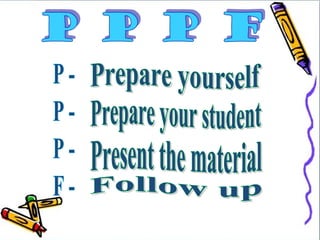
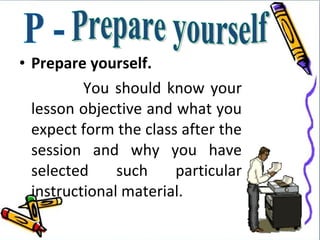
• Prepare yourself.
          You should know your
  lesson objective and what you
  expect form the class after the
  session and why you have
  selected     such    particular
  instructional material.
• Prepare your students.
     Set class expectations
  and learning goals.
  Motivate them and keep
  them interested and
  engaged.
• Present the material under the best
  possible conditions.
          Using media and materials,
  especially if they are mechanical in
  nature, often requires rehearsal and
  a carefully planned performance.
• Follow up.
         You use the
  instructional materials
  for the attainment of a
  lesson objective.
The materials that we select must:
Give a true picture of the ideas they
 present
Contribute to the attainment of the
 learning objective
Be appropriate to the age, intelligence
 and experience of the learners
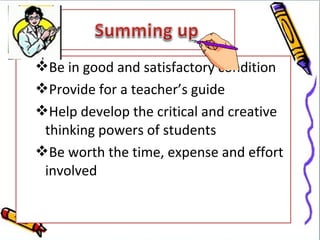
Be in good and satisfactory condition
Provide for a teacher’s guide
Help develop the critical and creative
 thinking powers of students
Be worth the time, expense and effort
 involved
For optimum use of the instructional
material, it is necessary that the teacher
prepares:
Herself
Her students
The instructional material and does
follow up
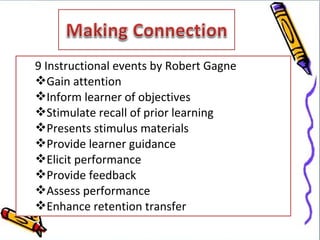
9 Instructional events by Robert Gagne
Gain attention
Inform learner of objectives
Stimulate recall of prior learning
Presents stimulus materials
Provide learner guidance
Elicit performance
Provide feedback
Assess performance
Enhance retention transfer
B i d a B e s t T e a c h e r


“Our choices dictate of what we will become in the future.”
                                           -Virginia L. Sevilla

Prof ed 602 - Educational Technology 1

  • 1.
    SING and VALUATING NSTRUCTIONAL ATERIALS “You should have a good idea of your destination.... If you do not know where you are going, you cannot properly choose a way to get there.”
  • 2.
    • These aredevices that assist the facilitator in the teaching-learning process. Instructional materials are not self-supporting; they are supplementary training devices.
  • 4.
    QUESTION • From theconversation, Linus said: “It was the real field, and we saw it… we saw that field.” What senses were at work in the field trip?
  • 5.
  • 6.
    QUESTION •What field tripdoes Linus was pertaining to?
  • 7.
    Is this thereal field trip?
  • 8.
    QUESTION • Did thefield trip accomplish something specific for Linus? Why do you say so?
  • 9.
    • Do thematerials give a true picture of the ideas they present? To avoid misconceptions, it is always good to ask when the material was produced.
  • 10.
    • Do thematerials contribute meaningful content to the topic under study? Does the material help you achieve the instructional objective?
  • 11.
    • Is thematerial appropriate for the age, intelligence, and experience of the learners?
  • 12.
    • Is thephysical condition of the material satisfactory? An example, is the microscope properly working?
  • 13.
    • Is therea teacher’s guide to provide a briefing for effective use? The chance that the instructional material will be used to the maximum and to the optimum is increased with a teacher’s guide.
  • 14.
    • Can thematerials in question help to make students better thinkers and develop their critical faculties? With exposure to mass media, it is highly important that we maintain and strengthen our rational powers.
  • 15.
    • Is thematerial worth the time, expense and effort involved? Is it more effective than any other less expensive and less demanding instructional material that can take its place? Or is there a better substitute?
  • 16.
    • “It isone thing to select a good instructional materials; it is another thing to use it well.” • Hayden Smith and Thomas Nagel (1972) book authors on Instructional Media
  • 18.
    • Prepare yourself. You should know your lesson objective and what you expect form the class after the session and why you have selected such particular instructional material.
  • 19.
    • Prepare yourstudents. Set class expectations and learning goals. Motivate them and keep them interested and engaged.
  • 20.
    • Present thematerial under the best possible conditions. Using media and materials, especially if they are mechanical in nature, often requires rehearsal and a carefully planned performance.
  • 21.
    • Follow up. You use the instructional materials for the attainment of a lesson objective.
  • 22.
    The materials thatwe select must: Give a true picture of the ideas they present Contribute to the attainment of the learning objective Be appropriate to the age, intelligence and experience of the learners
  • 23.
    Be in goodand satisfactory condition Provide for a teacher’s guide Help develop the critical and creative thinking powers of students Be worth the time, expense and effort involved
  • 24.
    For optimum useof the instructional material, it is necessary that the teacher prepares: Herself Her students The instructional material and does follow up
  • 25.
    9 Instructional eventsby Robert Gagne Gain attention Inform learner of objectives Stimulate recall of prior learning Presents stimulus materials Provide learner guidance Elicit performance Provide feedback Assess performance Enhance retention transfer
  • 26.
    B i da B e s t T e a c h e r “Our choices dictate of what we will become in the future.” -Virginia L. Sevilla