COMPONENTS OF
LESSON PLAN
DR. MAHESWARI JAIKUMAR
maheswarijaikumar2103@gmail.com
LESSON PLAN
LESSON PLAN
• “A teacher’s detailed
description of the course of
instruction for a individual
lesson”.
Wikipedia DICTIONARY
• “A lesson plan is a written
guide for the trainer’s plan in
order to achieve the intended
learning outcome…………..cont
Cont….
• It provides specific definition
& direction for learning in
terms of objectives,
equipments, instructional
media, material requirement
and conduct of
training”.Education dictionary
PRE REQUISITES FOR A
GOOD LESSON PLAN
• The teacher must have a
thorough knowledge about
the student’s interest, traits
and abilities.
• He teacher must have mastery
over the subject.
• The teacher should be
thoroughly acquainted with
the principles of teaching and
learning
• The teacher should have
adequate training of the skills
required to construct a good
lesson plan.
• The contents of the lesson
should be arranged in
psychological & logical fashion
• The teacher must be conversant
with the new methods and
techniques of teaching
• The teacher should ensure an
active pupil participation even
during the lesson planning stage.
• Even during the time of
preparing the lesson plan the
teacher should know the level of
the knowledge of the students.
CONSIDERATIONS FOR
LESSON PLAN
• A teacher who plan for a lesson
plan must consider the following
while writing a lesson plan :
1. STUDENTS.
2. CONTENTS.
3. MATERIALS.
STUDENTS
• The points to consider are:
• Abilities, interests,
background, attention span,
ability to work in group,
background knowledge,
special needs & learning
preferences.
CONTENTS
• The teacher to consider :
subject matter,
school/university curriculum,
national curriculum
standards.
MATERIALS
• Consideration to be made on
materials include :
technology, software, AV aids,
teacher mentors, community
resources, equipment, library
resources, teachers-guest
lecturers.
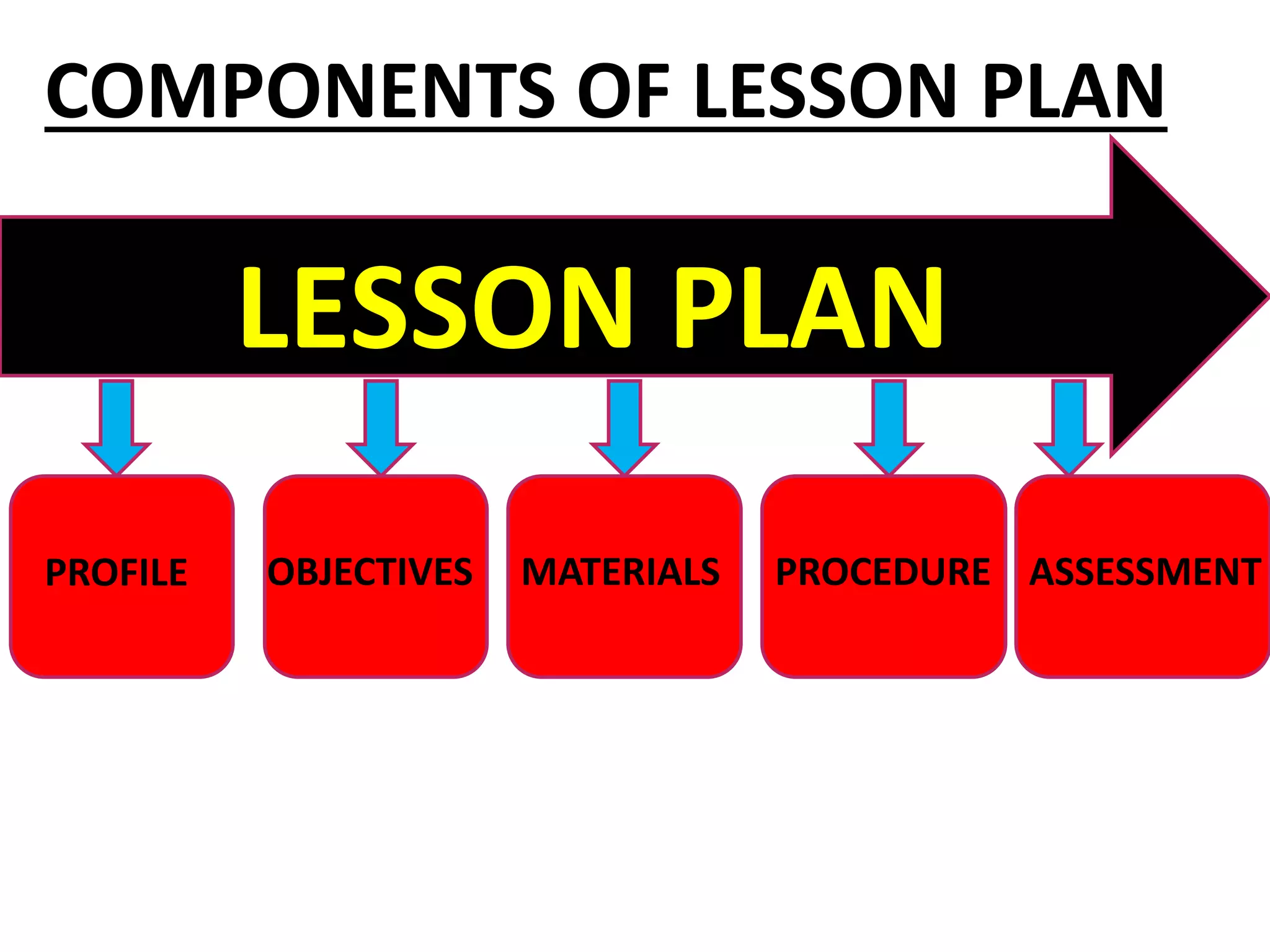
PROFILE OBJECTIVES MATERIALS PROCEDURE ASSESSMENT
LESSON PLAN
COMPONENTS OF LESSON PLAN
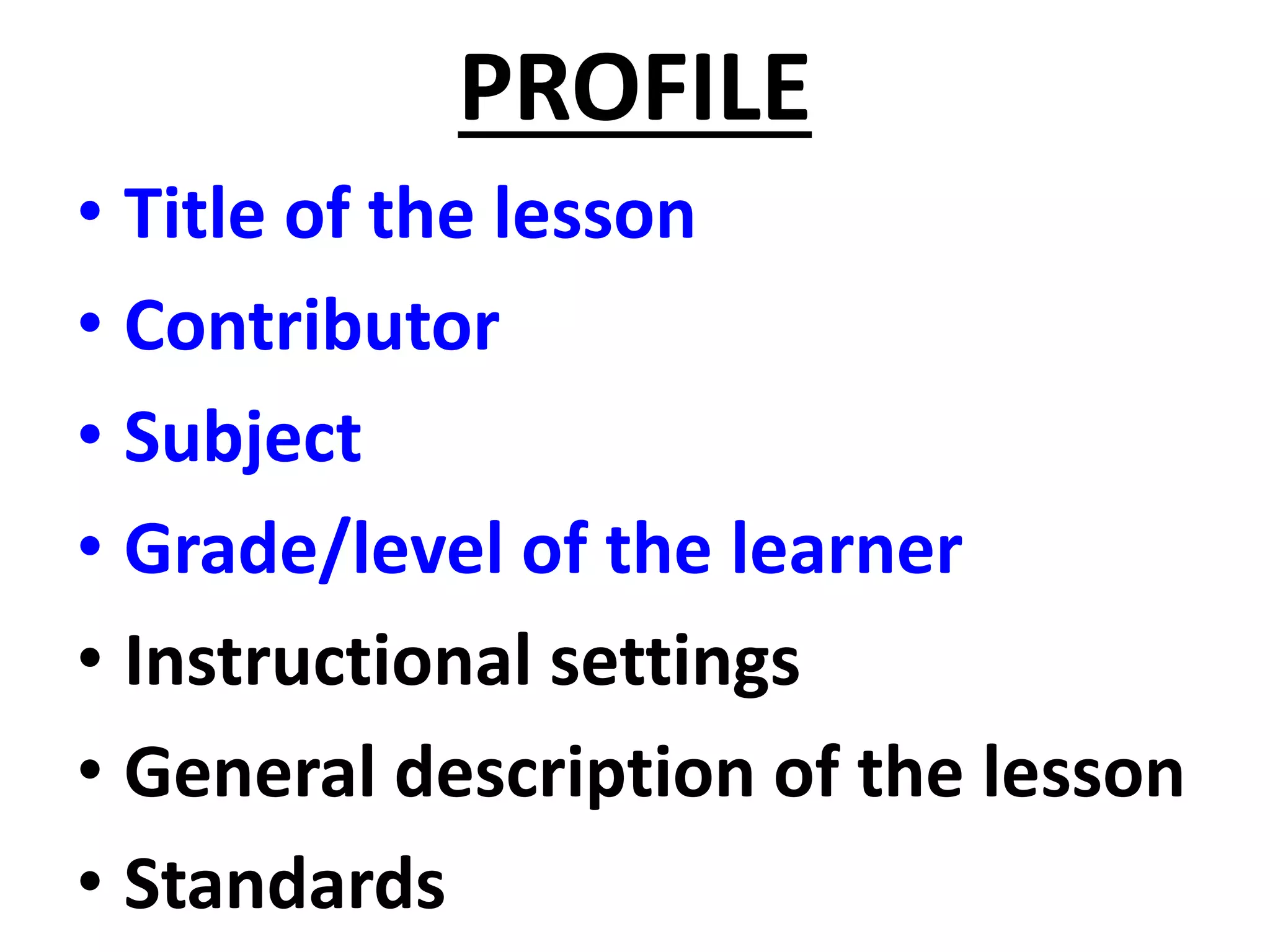
PROFILE
• Title of the lesson
• Contributor
• Subject
• Grade/level of the learner
• Instructional settings
• General description of the lesson
• Standards
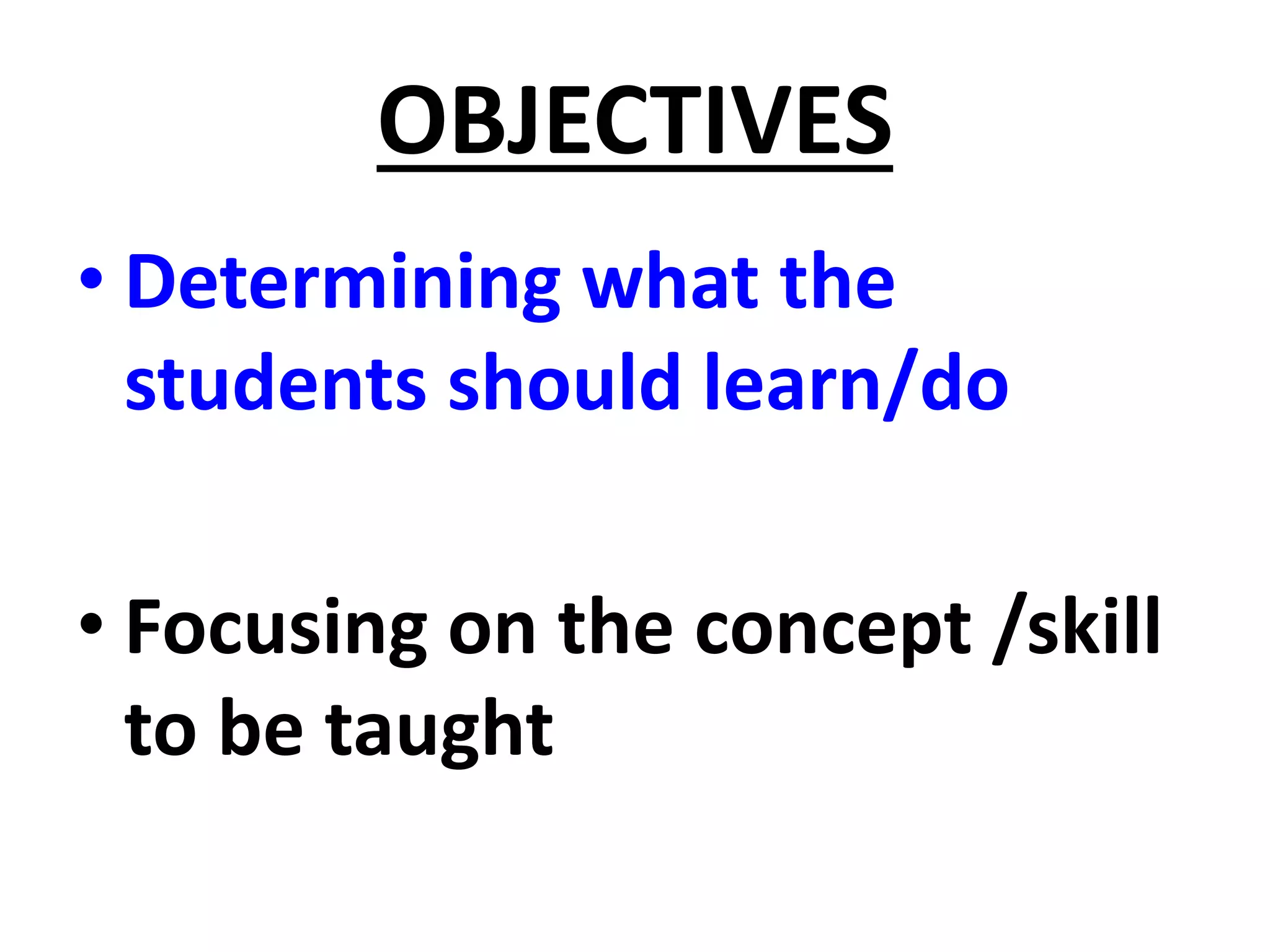
OBJECTIVES
• Determining what the
students should learn/do
• Focusing on the concept /skill
to be taught
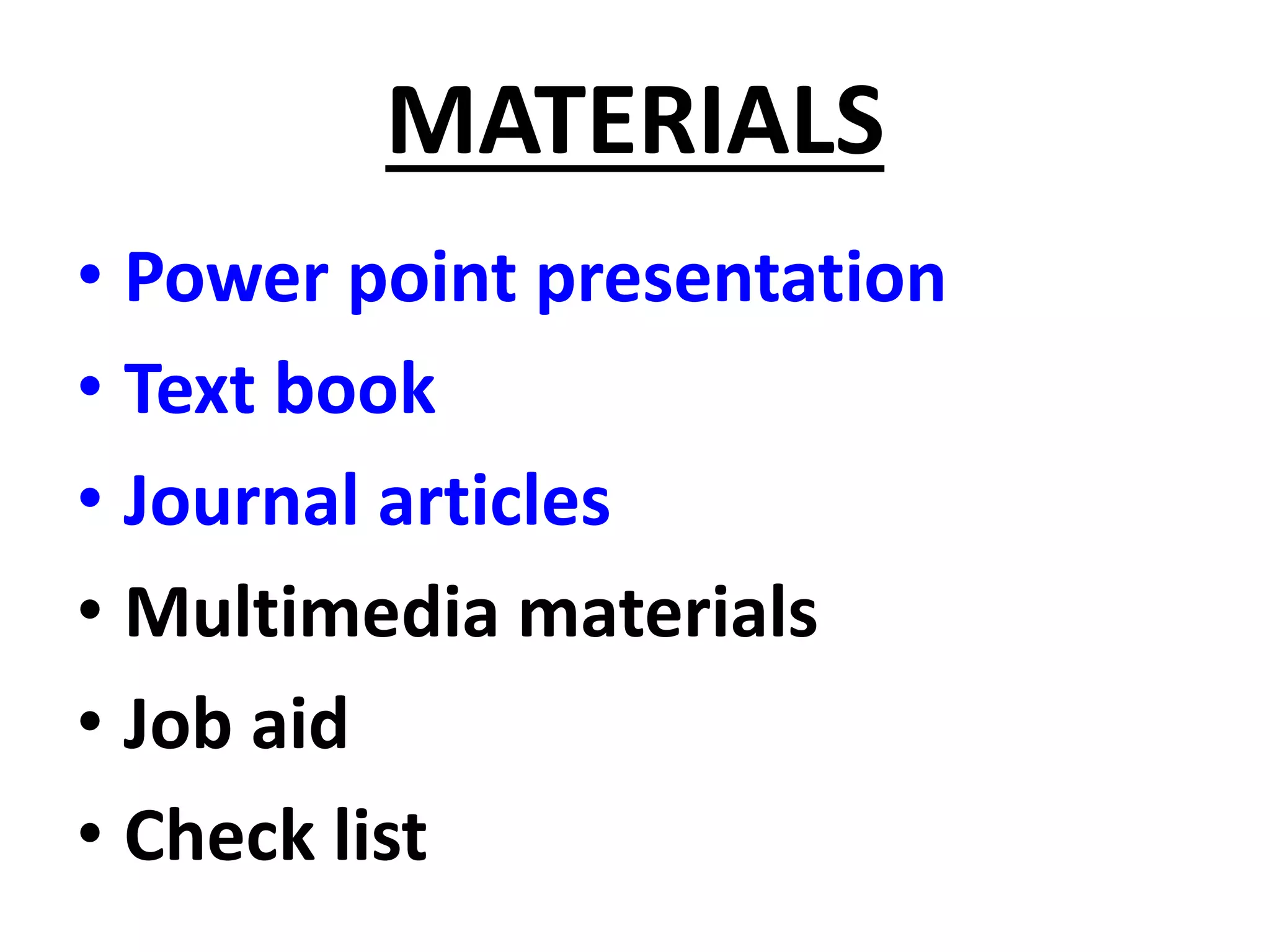
MATERIALS
• Power point presentation
• Text book
• Journal articles
• Multimedia materials
• Job aid
• Check list
PROCEDURE
• Outlining the steps of the
teaching-learning process
• Instructional strategies and
lesson plan
ASSESSMENT
• Assess as to what extent the
preset objectives were
achieved
• Assessment should correlate
with the pre stated objectives
• Reflect upon the result and
revise the lesson plan as per
the assessment outcome.
TYPES OF ASSESSMENTS
• Quizzes
• Tests
• Independent work sheets
• Co-operatively performed work
sheets
• Hands on experiments
• Oral discussion
• Question and answer discussion
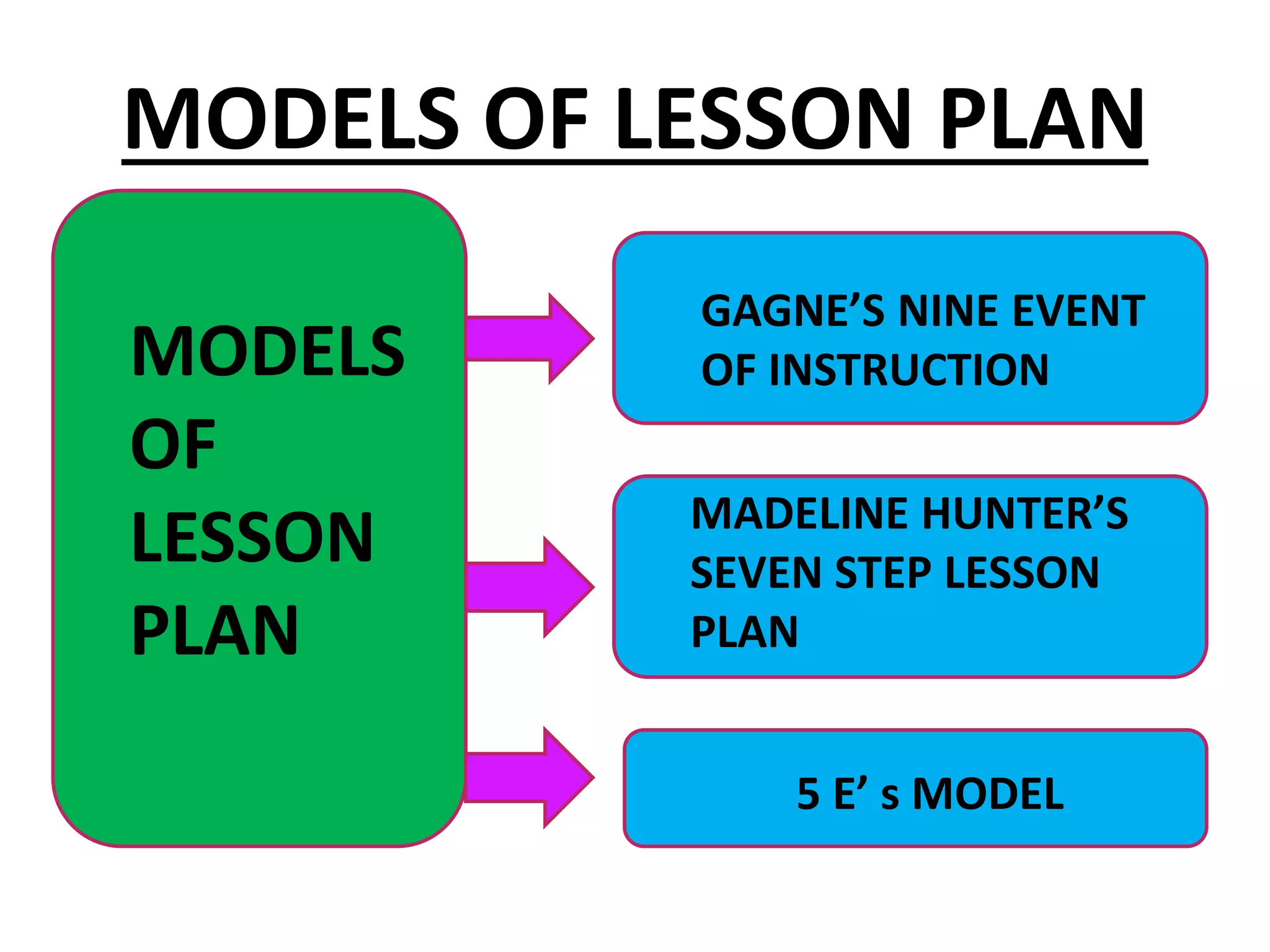
MODELS OF LESSON PLAN
MODELS
OF
LESSON
PLAN
GAGNE’S NINE EVENT
OF INSTRUCTION
MADELINE HUNTER’S
SEVEN STEP LESSON
PLAN
5 E’ s MODEL
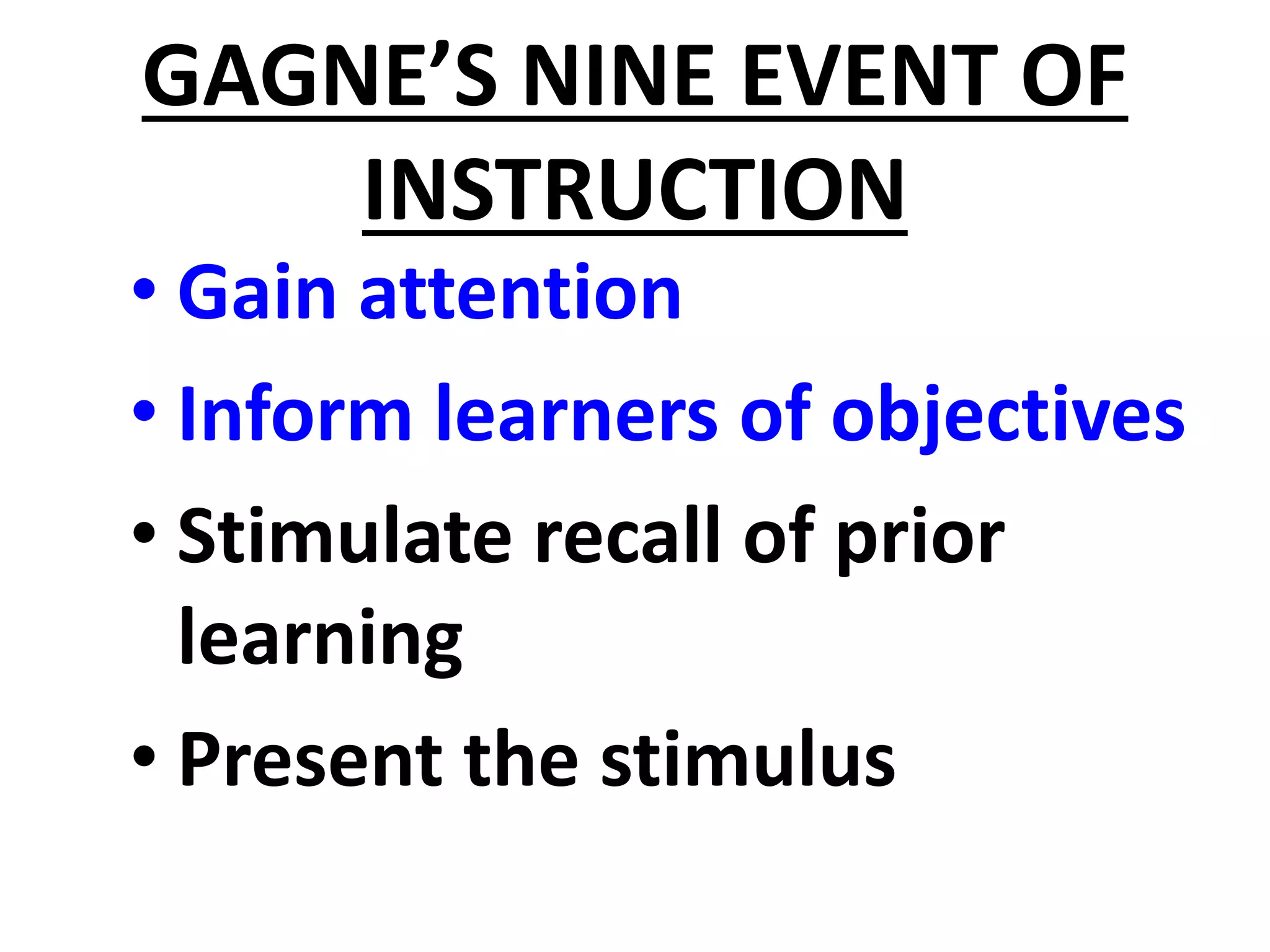
GAGNE’S NINE EVENT OF
INSTRUCTION
• Gain attention
• Inform learners of objectives
• Stimulate recall of prior
learning
• Present the stimulus
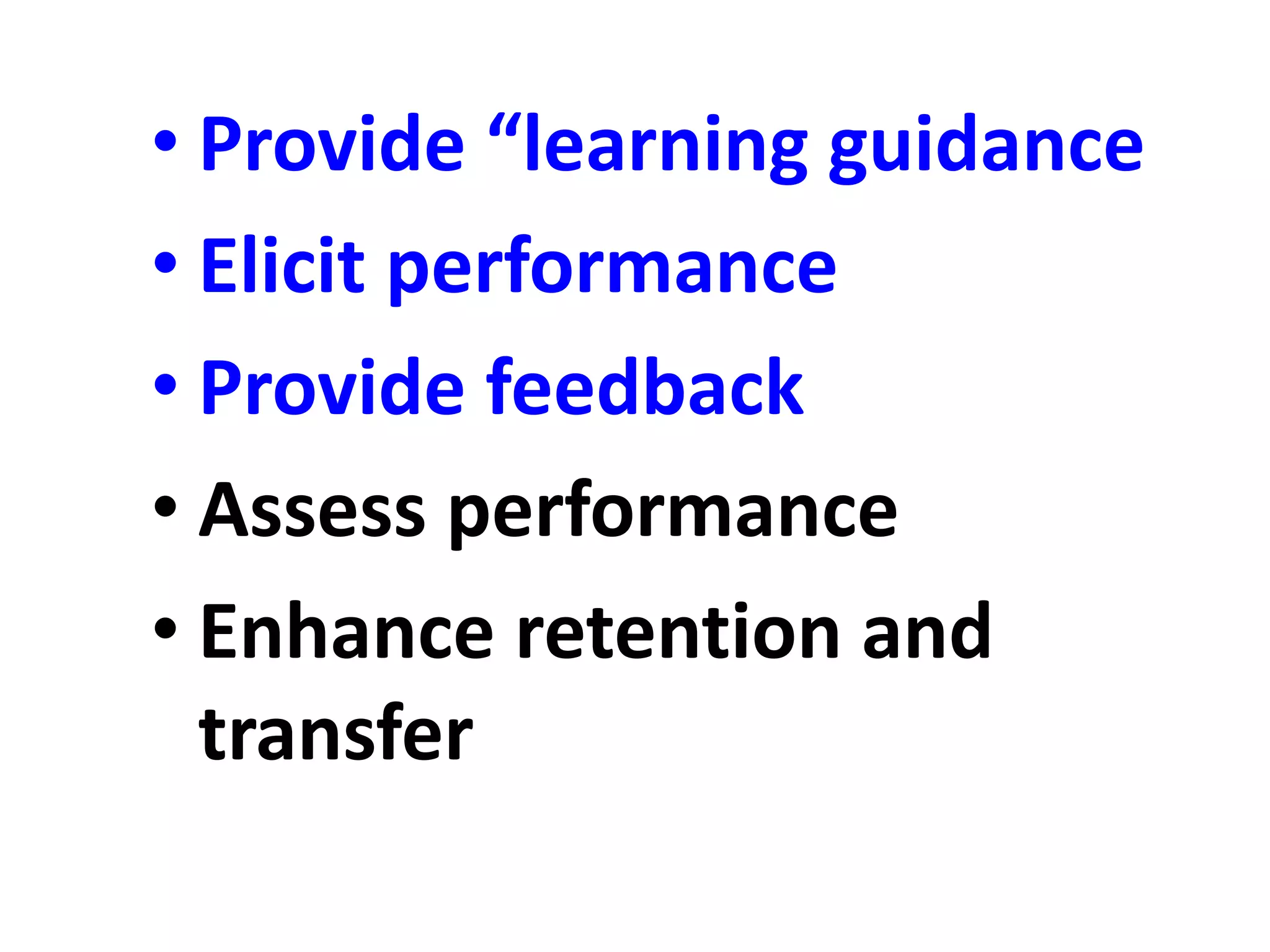
• Provide “learning guidance
• Elicit performance
• Provide feedback
• Assess performance
• Enhance retention and
transfer
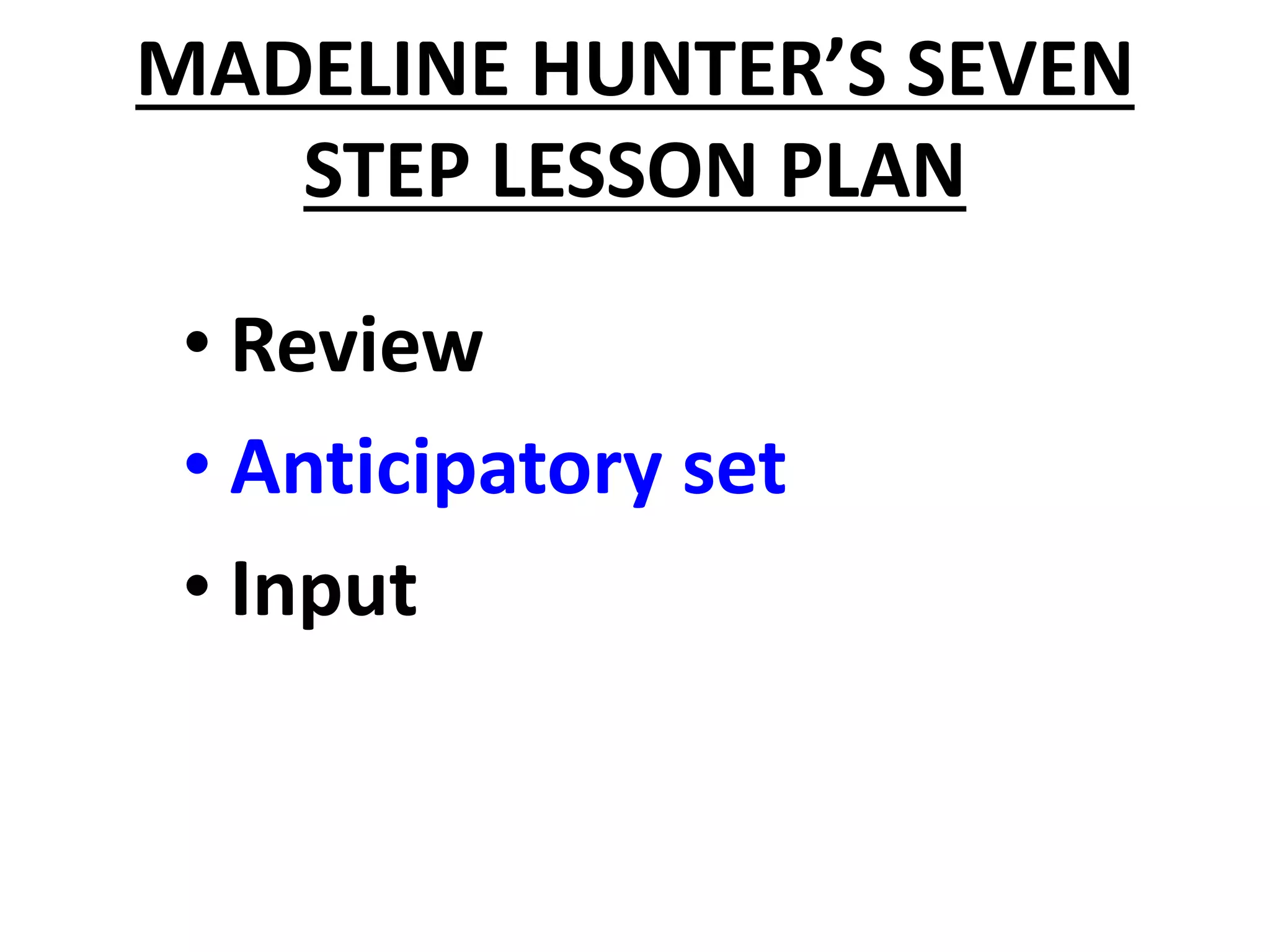
MADELINE HUNTER’S SEVEN
STEP LESSON PLAN
• Review
• Anticipatory set
• Input
• Objective & modeling
• Checking understanding
• Guided practice
• Independent practice
5 E’ s MODEL
• Engage
• Explore
• Explain
• Elaborate
• Evaluate
FORMAT-LESSON PLAN
• Title of the course.
• Unit.
• Topic.
• Name of the teacher.
• Duration of the class.
• Date & time.
• Pace.
• Students.
• Method of teaching.
• Audi-visual aids.
• Previous background of the
trainee.
• Objective of the class.
• General objective.
• Specific objective.
• Time.
• Content.
• Teaching – learning activity.
• Evaluation.
COMMON PROBLEMS IN
LESSON PLANNING
• The following are some of the
common problems in
formulating a lesson plan:
• PROVIDING EMOTIONAL
CONTROL.
• PROVISION FOR INDIVIDUAL
DIFFERENCES.
• PROVISION OF INTEGRATION OF
LEARNING EXPERIENCES.
• PROVISION FOR THE
EVALUATION OUTCOMES.
PROVIDING EMOTIONAL
CONTROL
• A learner gains knowledge
and acquires abilities in the
teaching learning process and
develops corresponding
values.
• This value that the student
acquires determines the
direction of her actions.
Hence the teacher should
carefully choose the teaching
learning activities so as to
provide emotional control.
• It is practically difficult for the
teacher to cater to individual
learner’s values and abilities.
Thus providing emotional
controls is a common problem
encountered in lesson
planning stage.
PROVISION FOR
INDIVIDUAL DIFFERENCES
• It is common to observe
individual differences among
the learners in terms of
abilities, interests,
intelligence, previous
experience, attitudes and
ideals .
• The teacher is vested with the
responsibility of choosing the
learning experiences that will
meet the students need and
thus becomes challenge to a
teacher working on the lesson
plan.
PROVISION OF INTEGRATION OF
LEARNING EXPERIENCES
• A teacher has to provide right
kind of learning opportunities
and facilitate integration of
the subject matter being
taught. This calls for active
intervention at the lesson
plan stage
PROVISION FOR THE
EVALUATION OUTCOMES
• The teacher should beforehand
decide on the expected
outcomes of the teaching
learning process and suitably
incorporate them in the lesson
plan according to the pre
stated objectives.
THANK YOU
DR. MAHESWARI JAIKUMAR
maheswarijaikumar2103@gmail.com
LESSON PLAN

COMPONENTS OF LESSON PLAN

  • 1.
    COMPONENTS OF LESSON PLAN DR.MAHESWARI JAIKUMAR maheswarijaikumar2103@gmail.com LESSON PLAN
  • 2.
    LESSON PLAN • “Ateacher’s detailed description of the course of instruction for a individual lesson”. Wikipedia DICTIONARY
  • 3.
    • “A lessonplan is a written guide for the trainer’s plan in order to achieve the intended learning outcome…………..cont
  • 4.
    Cont…. • It providesspecific definition & direction for learning in terms of objectives, equipments, instructional media, material requirement and conduct of training”.Education dictionary
  • 5.
    PRE REQUISITES FORA GOOD LESSON PLAN • The teacher must have a thorough knowledge about the student’s interest, traits and abilities. • He teacher must have mastery over the subject.
  • 6.
    • The teachershould be thoroughly acquainted with the principles of teaching and learning • The teacher should have adequate training of the skills required to construct a good lesson plan.
  • 7.
    • The contentsof the lesson should be arranged in psychological & logical fashion • The teacher must be conversant with the new methods and techniques of teaching
  • 8.
    • The teachershould ensure an active pupil participation even during the lesson planning stage. • Even during the time of preparing the lesson plan the teacher should know the level of the knowledge of the students.
  • 9.
    CONSIDERATIONS FOR LESSON PLAN •A teacher who plan for a lesson plan must consider the following while writing a lesson plan : 1. STUDENTS. 2. CONTENTS. 3. MATERIALS.
  • 10.
    STUDENTS • The pointsto consider are: • Abilities, interests, background, attention span, ability to work in group, background knowledge, special needs & learning preferences.
  • 11.
    CONTENTS • The teacherto consider : subject matter, school/university curriculum, national curriculum standards.
  • 12.
    MATERIALS • Consideration tobe made on materials include : technology, software, AV aids, teacher mentors, community resources, equipment, library resources, teachers-guest lecturers.
  • 13.
    PROFILE OBJECTIVES MATERIALSPROCEDURE ASSESSMENT LESSON PLAN COMPONENTS OF LESSON PLAN
  • 14.
    PROFILE • Title ofthe lesson • Contributor • Subject • Grade/level of the learner • Instructional settings • General description of the lesson • Standards
  • 15.
    OBJECTIVES • Determining whatthe students should learn/do • Focusing on the concept /skill to be taught
  • 16.
    MATERIALS • Power pointpresentation • Text book • Journal articles • Multimedia materials • Job aid • Check list
  • 17.
    PROCEDURE • Outlining thesteps of the teaching-learning process • Instructional strategies and lesson plan
  • 18.
    ASSESSMENT • Assess asto what extent the preset objectives were achieved • Assessment should correlate with the pre stated objectives
  • 19.
    • Reflect uponthe result and revise the lesson plan as per the assessment outcome.
  • 20.
    TYPES OF ASSESSMENTS •Quizzes • Tests • Independent work sheets • Co-operatively performed work sheets • Hands on experiments • Oral discussion • Question and answer discussion
  • 21.
    MODELS OF LESSONPLAN MODELS OF LESSON PLAN GAGNE’S NINE EVENT OF INSTRUCTION MADELINE HUNTER’S SEVEN STEP LESSON PLAN 5 E’ s MODEL
  • 22.
    GAGNE’S NINE EVENTOF INSTRUCTION • Gain attention • Inform learners of objectives • Stimulate recall of prior learning • Present the stimulus
  • 23.
    • Provide “learningguidance • Elicit performance • Provide feedback • Assess performance • Enhance retention and transfer
  • 24.
    MADELINE HUNTER’S SEVEN STEPLESSON PLAN • Review • Anticipatory set • Input
  • 25.
    • Objective &modeling • Checking understanding • Guided practice • Independent practice
  • 26.
    5 E’ sMODEL • Engage • Explore • Explain • Elaborate • Evaluate
  • 27.
    FORMAT-LESSON PLAN • Titleof the course. • Unit. • Topic. • Name of the teacher. • Duration of the class.
  • 28.
    • Date &time. • Pace. • Students. • Method of teaching. • Audi-visual aids. • Previous background of the trainee.
  • 29.
    • Objective ofthe class. • General objective. • Specific objective. • Time. • Content. • Teaching – learning activity. • Evaluation.
  • 30.
    COMMON PROBLEMS IN LESSONPLANNING • The following are some of the common problems in formulating a lesson plan:
  • 31.
    • PROVIDING EMOTIONAL CONTROL. •PROVISION FOR INDIVIDUAL DIFFERENCES. • PROVISION OF INTEGRATION OF LEARNING EXPERIENCES. • PROVISION FOR THE EVALUATION OUTCOMES.
  • 32.
    PROVIDING EMOTIONAL CONTROL • Alearner gains knowledge and acquires abilities in the teaching learning process and develops corresponding values.
  • 33.
    • This valuethat the student acquires determines the direction of her actions. Hence the teacher should carefully choose the teaching learning activities so as to provide emotional control.
  • 34.
    • It ispractically difficult for the teacher to cater to individual learner’s values and abilities. Thus providing emotional controls is a common problem encountered in lesson planning stage.
  • 35.
    PROVISION FOR INDIVIDUAL DIFFERENCES •It is common to observe individual differences among the learners in terms of abilities, interests, intelligence, previous experience, attitudes and ideals .
  • 36.
    • The teacheris vested with the responsibility of choosing the learning experiences that will meet the students need and thus becomes challenge to a teacher working on the lesson plan.
  • 37.
    PROVISION OF INTEGRATIONOF LEARNING EXPERIENCES • A teacher has to provide right kind of learning opportunities and facilitate integration of the subject matter being taught. This calls for active intervention at the lesson plan stage
  • 38.
    PROVISION FOR THE EVALUATIONOUTCOMES • The teacher should beforehand decide on the expected outcomes of the teaching learning process and suitably incorporate them in the lesson plan according to the pre stated objectives.
  • 39.
    THANK YOU DR. MAHESWARIJAIKUMAR maheswarijaikumar2103@gmail.com LESSON PLAN