The teacher tells or shows
directly what he/she wants to
teach. This is also referred to
as direct instruction.
According to Bob Adamson, “The
deductive method is often criticized
because:
a) it teaches grammar in an isolated way;
b) little attention is paid to meaning;
c) practice is often mechanical.”
Instruction makes use of student
“noticing”. Instead of explaining a
given concept and following this
explanation with examples, the
teacher presents students with many
examples showing how the concept is
used. The intent is for students to
“notice”, by way of the examples, how
the concept works.
 How personalized should the learning be?
Students will usually be more involved in
the learning experience and tend to
participate more actively when an
inductive approach is used. If a deductive
approach is chosen, it is important to
structure the learning experience in
order to draw on students' prior
experiences and learning, and to provide
for their active involvement.
 Should
learning
experiences
be
predictable? The deductive approach is
more predictable because the teacher
selects the information and the sequence
of presentation.
 What depth of understanding and rate of
retention is desired? Students tend to
understand and remember more when
learning occurs inductively.
 How much time is available to teach the
material? The deductive approach is
faster and can be an efficient way to
teach large numbers of facts and
concrete concepts.
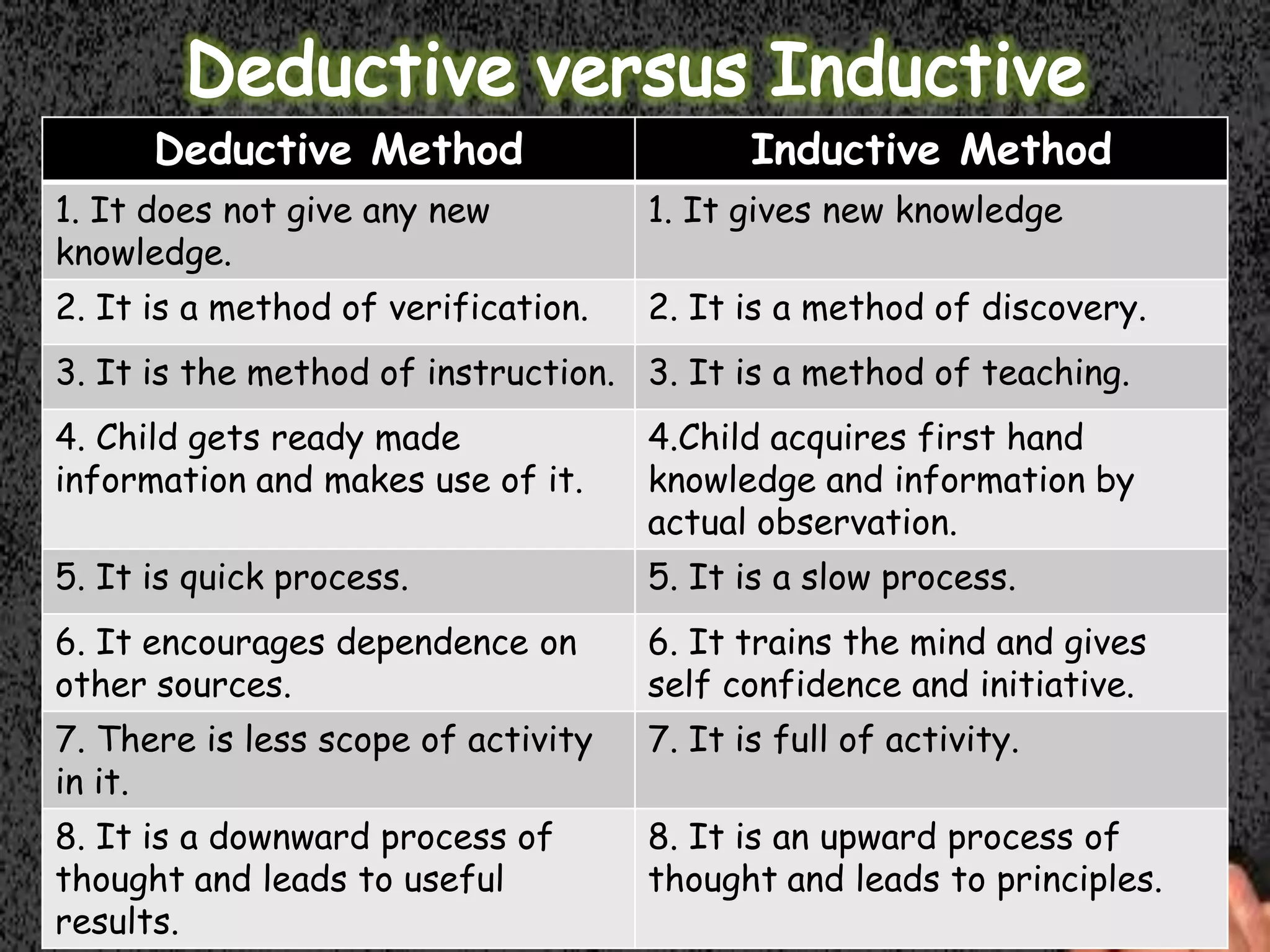
Deductive Method

Inductive Method

1. It does not give any new
knowledge.

1. It gives new knowledge

2. It is a method of verification.

2. It is a method of discovery.

3. It is the method of instruction. 3. It is a method of teaching.

4. Child gets ready made
information and makes use of it.

4.Child acquires first hand
knowledge and information by
actual observation.

5. It is quick process.

5. It is a slow process.

6. It encourages dependence on
other sources.

6. It trains the mind and gives
self confidence and initiative.

7. There is less scope of activity
in it.

7. It is full of activity.

8. It is a downward process of
thought and leads to useful
results.

8. It is an upward process of
thought and leads to principles.
1. Blended Learning
Learning that is facilitated by
the effective combination of
different modes of delivery, models
of teaching and styles of learning,
and is based on transparent
communication amongst all parties
involved with a course. Heinze, A.; C.

Procter (2004).
2. Reflective Teaching
Students/teachers learn
through an analysis and
evaluation
of
past
experiences.
Reported by:
Jhun Ar Ar R. Ramos
BSEd-II

Dr. Cecilia G. Salazar
Professor

Deductive and inductive method of teching

  • 2.
    The teacher tellsor shows directly what he/she wants to teach. This is also referred to as direct instruction.
  • 3.
    According to BobAdamson, “The deductive method is often criticized because: a) it teaches grammar in an isolated way; b) little attention is paid to meaning; c) practice is often mechanical.”
  • 4.
    Instruction makes useof student “noticing”. Instead of explaining a given concept and following this explanation with examples, the teacher presents students with many examples showing how the concept is used. The intent is for students to “notice”, by way of the examples, how the concept works.
  • 5.
     How personalizedshould the learning be? Students will usually be more involved in the learning experience and tend to participate more actively when an inductive approach is used. If a deductive approach is chosen, it is important to structure the learning experience in order to draw on students' prior experiences and learning, and to provide for their active involvement.
  • 6.
     Should learning experiences be predictable? Thedeductive approach is more predictable because the teacher selects the information and the sequence of presentation.  What depth of understanding and rate of retention is desired? Students tend to understand and remember more when learning occurs inductively.
  • 7.
     How muchtime is available to teach the material? The deductive approach is faster and can be an efficient way to teach large numbers of facts and concrete concepts.
  • 8.
    Deductive Method Inductive Method 1.It does not give any new knowledge. 1. It gives new knowledge 2. It is a method of verification. 2. It is a method of discovery. 3. It is the method of instruction. 3. It is a method of teaching. 4. Child gets ready made information and makes use of it. 4.Child acquires first hand knowledge and information by actual observation. 5. It is quick process. 5. It is a slow process. 6. It encourages dependence on other sources. 6. It trains the mind and gives self confidence and initiative. 7. There is less scope of activity in it. 7. It is full of activity. 8. It is a downward process of thought and leads to useful results. 8. It is an upward process of thought and leads to principles.
  • 9.
    1. Blended Learning Learningthat is facilitated by the effective combination of different modes of delivery, models of teaching and styles of learning, and is based on transparent communication amongst all parties involved with a course. Heinze, A.; C. Procter (2004).
  • 10.
    2. Reflective Teaching Students/teacherslearn through an analysis and evaluation of past experiences.
  • 11.
    Reported by: Jhun ArAr R. Ramos BSEd-II Dr. Cecilia G. Salazar Professor