Objectives
 Recognize physical features in the classroom
environment that affect the success of a lesson.
 Monitor your voice and body language and make
changes as necessary.
 Apply guidelines for dealing with unexpected,
unplanned moments, and turn them to your (and
students’) advantage.
 Develop some strategies for teaching large classes.
 Model roles and styles that are appropriate for a
given lesson and audience.
 Create a positive classroom climate
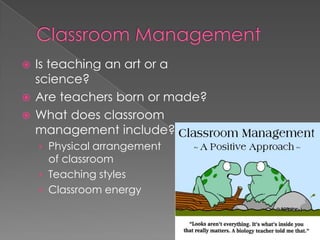
 Is teaching an art or a
science?
 Are teachers born or made?
 What does classroom
management include?
› Physical arrangement
of classroom
› Teaching styles
› Classroom energy
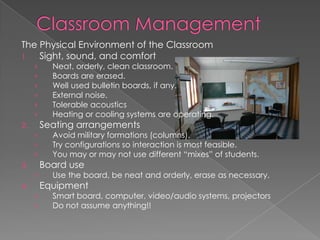
The Physical Environment of the Classroom
1. Sight, sound, and comfort
› Neat, orderly, clean classroom.
› Boards are erased.
› Well used bulletin boards, if any.
› External noise.
› Tolerable acoustics
› Heating or cooling systems are operating.
2. Seating arrangements
› Avoid military formations (columns).
› Try configurations so interaction is most feasible.
› You may or may not use different “mixes” of students.
3. Board use
› Use the board, be neat and orderly, erase as necessary.
4. Equipment
› Smart board, computer, video/audio systems, projectors
› Do not assume anything!!
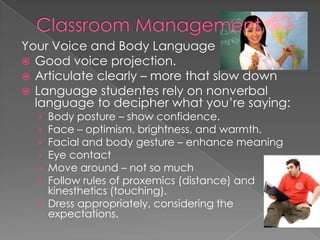
Your Voice and Body Language
 Good voice projection.
 Articulate clearly – more that slow down
 Language studentes rely on nonverbal
language to decipher what you’re saying:
› Body posture – show confidence.
› Face – optimism, brightness, and warmth.
› Facial and body gesture – enhance meaning
› Eye contact
› Move around – not so much
› Follow rules of proxemics (distance) and
kinesthetics (touching).
› Dress appropriately, considering the
expectations.
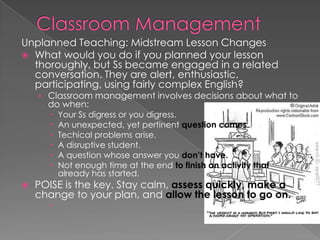
Unplanned Teaching: Midstream Lesson Changes
 What would you do if you planned your lesson
thoroughly, but Ss became engaged in a related
conversation. They are alert, enthusiastic,
participating, using fairly complex English?
› Classroom management involves decisions about what to
do when:
 Your Ss digress or you digress.
 An unexpected, yet pertinent question comes up.
 Techical problems arise.
 A disruptive student.
 A question whose answer you don’t have.
 Not enough time at the end to finish an activity that
already has started.
 POISE is the key. Stay calm, assess quickly, make a
change to your plan, and allow the lesson to go on.

Teaching Under Adverse Circumstances
 Institutions and People are imperfect
1. Teaching large classes.
2. Teaching multiple proficiency levels in the
same class.
3. Using “English only” in the classroom?
4. Compromising with the “institution”.
5. Disciplining.
6. Dealing with cheating
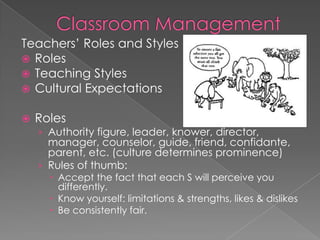
Teachers’ Roles and Styles
 Roles
 Teaching Styles
 Cultural Expectations
 Roles
› Authority figure, leader, knower, director,
manager, counselor, guide, friend, confidante,
parent, etc. (culture determines prominence)
› Rules of thumb:
 Accept the fact that each S will perceive you
differently.
 Know yourself: limitations & strengths, likes & dislikes
 Be consistently fair.
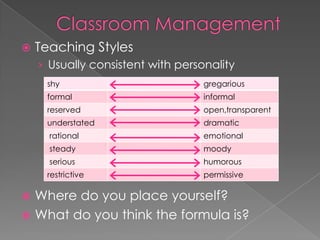
 Teaching Styles
› Usually consistent with personality
 Where do you place yourself?
 What do you think the formula is?
shy gregarious
formal informal
reserved open,transparent
understated dramatic
rational emotional
steady moody
serious humorous
restrictive permissive
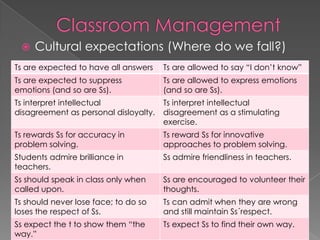
 Cultural expectations (Where do we fall?)
Ts are expected to have all answers Ts are allowed to say “I don’t know”
Ts are expected to suppress
emotions (and so are Ss).
Ts are allowed to express emotions
(and so are Ss).
Ts interpret intellectual
disagreement as personal disloyalty.
Ts interpret intellectual
disagreement as a stimulating
exercise.
Ts rewards Ss for accuracy in
problem solving.
Ts reward Ss for innovative
approaches to problem solving.
Students admire brilliance in
teachers.
Ss admire friendliness in teachers.
Ss should speak in class only when
called upon.
Ss are encouraged to volunteer their
thoughts.
Ts should never lose face; to do so
loses the respect of Ss.
Ts can admit when they are wrong
and still maintain Ss´respect.
Ss expect the t to show them “the
way.”
Ts expect Ss to find their own way.
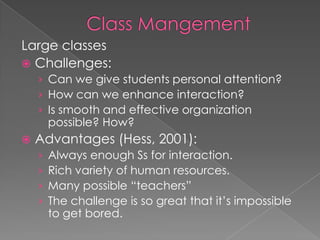
Large classes
 Challenges:
› Can we give students personal attention?
› How can we enhance interaction?
› Is smooth and effective organization
possible? How?
 Advantages (Hess, 2001):
› Always enough Ss for interaction.
› Rich variety of human resources.
› Many possible “teachers”
› The challenge is so great that it’s impossible
to get bored.
Large Classes
 Be organized
 Establish routines
 Use a diferent pace for different activities.
 Maximize individual work.
 Use students
 Use worksheets
 Use pairwork and groupwork
 Use chorus reaction
 Take account of vision and acoustics
 Use the size of the group to your advantage
Managing mixed ability
 Major concern, but it’s only natural.
 Given multiple intelligences & differing
primary perceived systems.
 To kind of solve problem placement
exams & streaming.
 Tomlinson (1995) speaks of a
differentiated classroom. ???????????
 It’s not always possible nor desirable.
 Working with different content
› Tailored or chosen according to individual needs.
 For that, give Ss options or give them some freedom.
 Obvious disadvantages
 Different student actions/responses
(Lindstromberg’s flexible tasks)
› Give students different tasks for same material
› Give students different roles (conversations/debates)
› Reward early finishers with extension tasks.
› Encourage different student responses (high limits,
creativity)
› Identify student strengths (linguistic or non-linguistic)
so everybody shines, thus motivating them to learn.
What the teacher does
 Responding to students
› Feedback, as a tutor, as a resource, as a
monitor, etc.
› Consider feelings, personalities, learning styles,
do they need mechanics or challenge,
organization or communication.
 Being inclusive
› High achievers-more able/low achievers-less
able.
› Start at the same level, once engaged, allow for
differentiation.
 Flexible groupings (heterogeneous-
homegeneous)
Realistic mixed-ability teaching
 Is it the same to do mixed-ability
teaching in a small class than in a large
class? Is it the same to do mixed-ability
teaching with your homeroom than
when you have to teach 5 or 6 different
large gruops like in Relaciones?
 Should we always differentiate? Is it
better to have Ss work in teams than to
have them work individually?
Creating a Positive Classroom Climate
Roles * Styles = Tools + positive,
stimulating and energizing climate
 Establishing rapport
 Balancing praise and criticism
 Generating energy
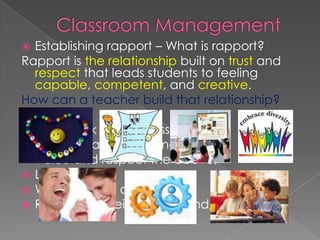
 Establishing rapport – What is rapport?
Rapport is the relationship built on trust and
respect that leads students to feeling
capable, competent, and creative.
How can a teacher build that relationship?
 Interest,
 Feedback on progress,
 Solicit ideas and feelings,
 Value and respect the above,
 Laugh with,
 Work with not against,
 Rejoice on their learning and/or success.
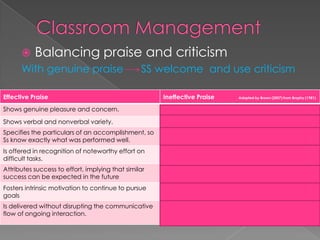
 Balancing praise and criticism
With genuine praise SS welcome and use criticism
Effective Praise Ineffective Praise Adapted by Brown (2007) from Brophy (1981)
Shows genuine pleasure and concern. Is impersonal, mechanical, and “robotic”.
Shows verbal and nonverbal variety. Shows bland uniformity.
Specifies the particulars of an accomplishment, so
Ss know exactly what was performed well.
Is restricted to global comments, so Ss are not sure
what was performed well.
Is offered in recognition of noteworthy effort on
difficult tasks.
Is offered equally strongly for easy and difficult
tasks.
Attributes success to effort, implying that similar
success can be expected in the future
Attributes success to ability, luck, or other external
factors
Fosters intrinsic motivation to continue to pursue
goals
Fosters extrinsic motivation to perform only to
receive more praise
Is delivered without disrupting the communicative
flow of ongoing interaction.
Disrupts the communicative flow of ongoing
interaction.
 Generating energy (Define it (I) (G) (C))
Brown suggests its a force, electricity, an aura,
released in the classroom and started by the
teacher. It’s only perceived by a “sixth sense”.
It’s that something that makes you say and feel
“what a great class that was!” after you leave
a classroom.
How?
Solid preparation,
Confidence in your ability to teach,
Genuine belief in your students’ ability to learn,
Sense of joy in what you do,
And perhaps above all,
by manifesting overtly all of the above.
Chapter 15 classroom_management_first_module

Chapter 15 classroom_management_first_module

  • 2.
    Objectives  Recognize physicalfeatures in the classroom environment that affect the success of a lesson.  Monitor your voice and body language and make changes as necessary.  Apply guidelines for dealing with unexpected, unplanned moments, and turn them to your (and students’) advantage.  Develop some strategies for teaching large classes.  Model roles and styles that are appropriate for a given lesson and audience.  Create a positive classroom climate
  • 3.
     Is teachingan art or a science?  Are teachers born or made?  What does classroom management include? › Physical arrangement of classroom › Teaching styles › Classroom energy
  • 4.
    The Physical Environmentof the Classroom 1. Sight, sound, and comfort › Neat, orderly, clean classroom. › Boards are erased. › Well used bulletin boards, if any. › External noise. › Tolerable acoustics › Heating or cooling systems are operating. 2. Seating arrangements › Avoid military formations (columns). › Try configurations so interaction is most feasible. › You may or may not use different “mixes” of students. 3. Board use › Use the board, be neat and orderly, erase as necessary. 4. Equipment › Smart board, computer, video/audio systems, projectors › Do not assume anything!!
  • 5.
    Your Voice andBody Language  Good voice projection.  Articulate clearly – more that slow down  Language studentes rely on nonverbal language to decipher what you’re saying: › Body posture – show confidence. › Face – optimism, brightness, and warmth. › Facial and body gesture – enhance meaning › Eye contact › Move around – not so much › Follow rules of proxemics (distance) and kinesthetics (touching). › Dress appropriately, considering the expectations.
  • 6.
    Unplanned Teaching: MidstreamLesson Changes  What would you do if you planned your lesson thoroughly, but Ss became engaged in a related conversation. They are alert, enthusiastic, participating, using fairly complex English? › Classroom management involves decisions about what to do when:  Your Ss digress or you digress.  An unexpected, yet pertinent question comes up.  Techical problems arise.  A disruptive student.  A question whose answer you don’t have.  Not enough time at the end to finish an activity that already has started.  POISE is the key. Stay calm, assess quickly, make a change to your plan, and allow the lesson to go on. 
  • 7.
    Teaching Under AdverseCircumstances  Institutions and People are imperfect 1. Teaching large classes. 2. Teaching multiple proficiency levels in the same class. 3. Using “English only” in the classroom? 4. Compromising with the “institution”. 5. Disciplining. 6. Dealing with cheating
  • 8.
    Teachers’ Roles andStyles  Roles  Teaching Styles  Cultural Expectations  Roles › Authority figure, leader, knower, director, manager, counselor, guide, friend, confidante, parent, etc. (culture determines prominence) › Rules of thumb:  Accept the fact that each S will perceive you differently.  Know yourself: limitations & strengths, likes & dislikes  Be consistently fair.
  • 9.
     Teaching Styles ›Usually consistent with personality  Where do you place yourself?  What do you think the formula is? shy gregarious formal informal reserved open,transparent understated dramatic rational emotional steady moody serious humorous restrictive permissive
  • 10.
     Cultural expectations(Where do we fall?) Ts are expected to have all answers Ts are allowed to say “I don’t know” Ts are expected to suppress emotions (and so are Ss). Ts are allowed to express emotions (and so are Ss). Ts interpret intellectual disagreement as personal disloyalty. Ts interpret intellectual disagreement as a stimulating exercise. Ts rewards Ss for accuracy in problem solving. Ts reward Ss for innovative approaches to problem solving. Students admire brilliance in teachers. Ss admire friendliness in teachers. Ss should speak in class only when called upon. Ss are encouraged to volunteer their thoughts. Ts should never lose face; to do so loses the respect of Ss. Ts can admit when they are wrong and still maintain Ss´respect. Ss expect the t to show them “the way.” Ts expect Ss to find their own way.
  • 11.
    Large classes  Challenges: ›Can we give students personal attention? › How can we enhance interaction? › Is smooth and effective organization possible? How?  Advantages (Hess, 2001): › Always enough Ss for interaction. › Rich variety of human resources. › Many possible “teachers” › The challenge is so great that it’s impossible to get bored.
  • 12.
    Large Classes  Beorganized  Establish routines  Use a diferent pace for different activities.  Maximize individual work.  Use students  Use worksheets  Use pairwork and groupwork  Use chorus reaction  Take account of vision and acoustics  Use the size of the group to your advantage
  • 13.
    Managing mixed ability Major concern, but it’s only natural.  Given multiple intelligences & differing primary perceived systems.  To kind of solve problem placement exams & streaming.  Tomlinson (1995) speaks of a differentiated classroom. ???????????  It’s not always possible nor desirable.
  • 14.
     Working withdifferent content › Tailored or chosen according to individual needs.  For that, give Ss options or give them some freedom.  Obvious disadvantages  Different student actions/responses (Lindstromberg’s flexible tasks) › Give students different tasks for same material › Give students different roles (conversations/debates) › Reward early finishers with extension tasks. › Encourage different student responses (high limits, creativity) › Identify student strengths (linguistic or non-linguistic) so everybody shines, thus motivating them to learn.
  • 15.
    What the teacherdoes  Responding to students › Feedback, as a tutor, as a resource, as a monitor, etc. › Consider feelings, personalities, learning styles, do they need mechanics or challenge, organization or communication.  Being inclusive › High achievers-more able/low achievers-less able. › Start at the same level, once engaged, allow for differentiation.  Flexible groupings (heterogeneous- homegeneous)
  • 16.
    Realistic mixed-ability teaching Is it the same to do mixed-ability teaching in a small class than in a large class? Is it the same to do mixed-ability teaching with your homeroom than when you have to teach 5 or 6 different large gruops like in Relaciones?  Should we always differentiate? Is it better to have Ss work in teams than to have them work individually?
  • 17.
    Creating a PositiveClassroom Climate Roles * Styles = Tools + positive, stimulating and energizing climate  Establishing rapport  Balancing praise and criticism  Generating energy
  • 18.
     Establishing rapport– What is rapport? Rapport is the relationship built on trust and respect that leads students to feeling capable, competent, and creative. How can a teacher build that relationship?  Interest,  Feedback on progress,  Solicit ideas and feelings,  Value and respect the above,  Laugh with,  Work with not against,  Rejoice on their learning and/or success.
  • 19.
     Balancing praiseand criticism With genuine praise SS welcome and use criticism Effective Praise Ineffective Praise Adapted by Brown (2007) from Brophy (1981) Shows genuine pleasure and concern. Is impersonal, mechanical, and “robotic”. Shows verbal and nonverbal variety. Shows bland uniformity. Specifies the particulars of an accomplishment, so Ss know exactly what was performed well. Is restricted to global comments, so Ss are not sure what was performed well. Is offered in recognition of noteworthy effort on difficult tasks. Is offered equally strongly for easy and difficult tasks. Attributes success to effort, implying that similar success can be expected in the future Attributes success to ability, luck, or other external factors Fosters intrinsic motivation to continue to pursue goals Fosters extrinsic motivation to perform only to receive more praise Is delivered without disrupting the communicative flow of ongoing interaction. Disrupts the communicative flow of ongoing interaction.
  • 20.
     Generating energy(Define it (I) (G) (C)) Brown suggests its a force, electricity, an aura, released in the classroom and started by the teacher. It’s only perceived by a “sixth sense”. It’s that something that makes you say and feel “what a great class that was!” after you leave a classroom. How? Solid preparation, Confidence in your ability to teach, Genuine belief in your students’ ability to learn, Sense of joy in what you do, And perhaps above all, by manifesting overtly all of the above.