Venue : DTSC/GCET FAISALABAD
 USED AS GUIDE FOR THE TEACHER
- They don’t have to think on their feet.
- Gives the teacher a starting point
- They build on previous teaching and prepare for
coming lessons.
 PROVIDES DIRECTION
- They are clear on the procédure to follow.
 GIVES TEACHER A SENSE OF SECURITY AND
CONFIDENCE
- They dont lose face in front of their learners.
 PROVIDES RECORD
 HELPS KEEP GOOD CLASSROOM
MANAGEMENT
- When a lesson works well, students not
only learn—they behave.
Classroom management + Well-designed lesson
=
Higher Achieving Students
FOR THE LEARNER
 They realize that the teacher
cares for their learning.
 They attend a structured
lesson: easier to assimilate
 They appreciate their teacher’s
work as a model of well-
organized work to imitate.
A written guide used to aid teachers in
their lessons.
Based on 4 things
Interests and abilities of
students
Your own interests and
strengths
Your beliefs about teaching and
learning
Your own openness to change
your plan
Inform students why they are with
you
What they will be able to do
The learner will……….
 Objectives should also follow the
‘S.M.A.R.T rule’:
• Specific
• Measurable
• Attainable
• Result-oriented
• Time bound
 Transition
 Use time
 Variety
 Easy to
follow
 Precise
 Get class ready
to learn
 Motivates
students
 Hint to the
theme
 Teaches skill
 Presents information
 Lecture, demo, pictures, etc.
 Show the
students
 Use examples
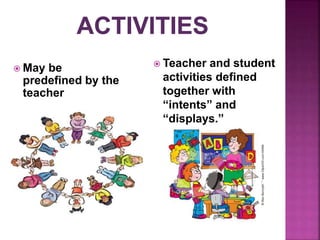
 May be
predefined by the
teacher
 Teacher and student
activities defined
together with
“intents” and
“displays.”
 Learning
materials which
are typically
displayed and
used in an
instructional
setting.
 Pictures,
written
materials,
spoken words,
maps, etc.
SMART Board
Power Point
 Overhead Projectors
Internet
Teacher is
available
Supervise
students as
they learn
Catch
mistakes
immediately
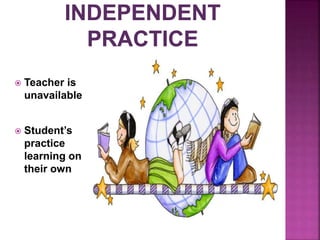
 Teacher is
unavailable
 Student’s
practice
learning on
their own
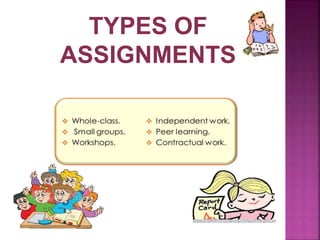
TYPES OF
ASSIGNMENTS
Cognitive Outcomes: Intellectual
outcomes. They involve the application
of facts, theories and concepts.
Psychomotor Outcomes: They
describe skills the learner develops
(Physical).
Affective Outcomes: They describe
feelings and attitudes which shape our
behavior towards people, work and our
world (behavioral).
2 way Q and A- Ongoing
Bring lesson to an end
Review key points
Tie everything together
• Used to assess
students
knowledge
• Provides grades
for report cards
• Keeps parents
updated
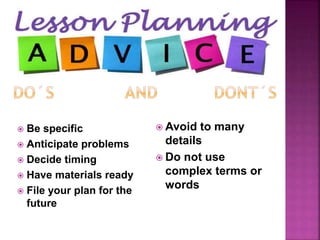
 Be specific
 Anticipate problems
 Decide timing
 Have materials ready
 File your plan for the
future
 Avoid to many
details
 Do not use
complex terms or
words
 If students are
misbehaving:
 consider re-
arranging the order
of delivery.
 compare what
actually happened
with your original
plan.
Lesson Plan

Lesson Plan

  • 2.
  • 6.
     USED ASGUIDE FOR THE TEACHER - They don’t have to think on their feet. - Gives the teacher a starting point - They build on previous teaching and prepare for coming lessons.  PROVIDES DIRECTION - They are clear on the procédure to follow.  GIVES TEACHER A SENSE OF SECURITY AND CONFIDENCE - They dont lose face in front of their learners.  PROVIDES RECORD
  • 7.
     HELPS KEEPGOOD CLASSROOM MANAGEMENT - When a lesson works well, students not only learn—they behave. Classroom management + Well-designed lesson = Higher Achieving Students
  • 8.
    FOR THE LEARNER They realize that the teacher cares for their learning.  They attend a structured lesson: easier to assimilate  They appreciate their teacher’s work as a model of well- organized work to imitate.
  • 9.
    A written guideused to aid teachers in their lessons.
  • 10.
    Based on 4things Interests and abilities of students Your own interests and strengths Your beliefs about teaching and learning Your own openness to change your plan
  • 11.
    Inform students whythey are with you What they will be able to do The learner will……….
  • 12.
     Objectives shouldalso follow the ‘S.M.A.R.T rule’: • Specific • Measurable • Attainable • Result-oriented • Time bound
  • 13.
     Transition  Usetime  Variety  Easy to follow  Precise
  • 14.
     Get classready to learn  Motivates students  Hint to the theme
  • 15.
     Teaches skill Presents information  Lecture, demo, pictures, etc.
  • 16.
  • 17.
     May be predefinedby the teacher  Teacher and student activities defined together with “intents” and “displays.”
  • 18.
     Learning materials which aretypically displayed and used in an instructional setting.  Pictures, written materials, spoken words, maps, etc.
  • 19.
    SMART Board Power Point Overhead Projectors Internet
  • 20.
    Teacher is available Supervise students as theylearn Catch mistakes immediately
  • 21.
     Teacher is unavailable Student’s practice learning on their own
  • 22.
  • 23.
    Cognitive Outcomes: Intellectual outcomes.They involve the application of facts, theories and concepts. Psychomotor Outcomes: They describe skills the learner develops (Physical). Affective Outcomes: They describe feelings and attitudes which shape our behavior towards people, work and our world (behavioral).
  • 24.
    2 way Qand A- Ongoing
  • 25.
    Bring lesson toan end Review key points Tie everything together
  • 26.
    • Used toassess students knowledge • Provides grades for report cards • Keeps parents updated
  • 27.
     Be specific Anticipate problems  Decide timing  Have materials ready  File your plan for the future  Avoid to many details  Do not use complex terms or words
  • 28.
     If studentsare misbehaving:  consider re- arranging the order of delivery.  compare what actually happened with your original plan.