
Dr. Akhlas Ahmed
Preston University
MBA Class, Lecture # 02
June 28th 2014
Decision making: the process by which
managers respond to opportunities and threats
by analyzing options, and making decisions
about goals and courses of action.
Decisions in response to opportunities:
managers respond to ways to improve
organizational performance.
Decisions in response to threats: occurs when
managers are impacted by adverse events to
the organization.
Programmed Decisions: routine, almost
automatic process.
 Managers have made decision many times before.
 There are rules or guidelines to follow.
 Example: Deciding to reorder office supplies.
Non-programmed Decisions: unusual situations
that have not been often addressed.
 No rules to follow since the decision is new.
 These decisions are made based on information, and a
manger’s intuition, and judgment.
 Example: Should the firm invest in a new technology?
Classical model of decision making: a
prescriptive model that tells how the decision
should be made.
 Assumes managers have access to all the
information needed to reach a decision.
 Managers can then make the optimum decision by
easily ranking their own preferences among
alternatives.
Unfortunately, mangers often do not have all
(or even most) required information.
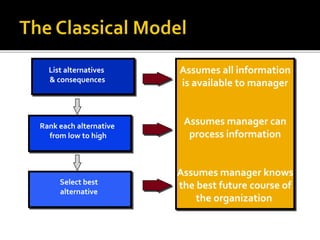
Rank each alternative
from low to high
Select best
alternative
List alternatives
& consequences
Assumes all information
is available to manager
Assumes manager can
process information
Assumes manager knows
the best future course of
the organization
Administrative Model of decision making:
Challenges the classical assumptions that managers have and
process all the information.
 As a result, decision making is risky.
 Bounded rationality: There is a large number of alternatives
and information is vast so that managers cannot consider it
all.
 Decisions are limited by people’s cognitive abilities.
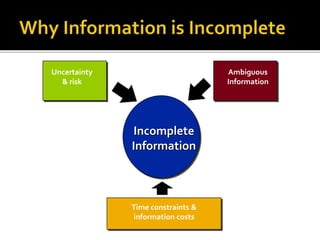
 Incomplete information: most managers do not see all
alternatives and decide based on incomplete information.
Uncertainty
& risk
Ambiguous
Information
Time constraints &
information costs
Incomplete
Information
Lecture # 02 decision making in management, models

Lecture # 02 decision making in management, models

  • 1.
    Dr. Akhlas Ahmed PrestonUniversity MBA Class, Lecture # 02 June 28th 2014
  • 2.
    Decision making: theprocess by which managers respond to opportunities and threats by analyzing options, and making decisions about goals and courses of action. Decisions in response to opportunities: managers respond to ways to improve organizational performance. Decisions in response to threats: occurs when managers are impacted by adverse events to the organization.
  • 3.
    Programmed Decisions: routine,almost automatic process.  Managers have made decision many times before.  There are rules or guidelines to follow.  Example: Deciding to reorder office supplies. Non-programmed Decisions: unusual situations that have not been often addressed.  No rules to follow since the decision is new.  These decisions are made based on information, and a manger’s intuition, and judgment.  Example: Should the firm invest in a new technology?
  • 4.
    Classical model ofdecision making: a prescriptive model that tells how the decision should be made.  Assumes managers have access to all the information needed to reach a decision.  Managers can then make the optimum decision by easily ranking their own preferences among alternatives. Unfortunately, mangers often do not have all (or even most) required information.
  • 5.
    Rank each alternative fromlow to high Select best alternative List alternatives & consequences Assumes all information is available to manager Assumes manager can process information Assumes manager knows the best future course of the organization
  • 6.
    Administrative Model ofdecision making: Challenges the classical assumptions that managers have and process all the information.  As a result, decision making is risky.  Bounded rationality: There is a large number of alternatives and information is vast so that managers cannot consider it all.  Decisions are limited by people’s cognitive abilities.  Incomplete information: most managers do not see all alternatives and decide based on incomplete information.
  • 7.
    Uncertainty & risk Ambiguous Information Time constraints& information costs Incomplete Information