Principle of
Management Process
    Decision Making


  Presented to:
                  Prof. Aftab Jillani
  Presented by:
                  Aima Masood
                  MCOM
                  PUNJAB College
Introduction:


Decision making can be regarded as the mental processes resulting
in the selection of a course of action among several alternatives.
Every decision making process produces a final choice. The output
can be an action or an opinion of choice.
 Problem Analysis vs. Decision Making

It is important to differentiate between problem analysis and
decision making. The concepts are completely separate from
one another. Problem analysis must be done first, then the
information gathered in that process may be used towards
decision making.
 Decision Making Process:

In general:
“Decision making is the process of making a choice
between a numbers of options and committing to a
future course of actions.
Decision making Steps:


•    There are eight steps of decision making:
•    Identification of problem
•    Identification of decision Criteria
•    Allocating weight to criteria
•   Develop alternatives
•   Analysis of Alternatives
•   Selection of alternatives
•   Implementation of the best alternatives
•   Evaluation of decision effectiveness
Problem

The decision-making process begins when a manager identifies
the real problem. The accurate definition of the problem
affects all the steps that follow; if the problem is inaccurately
defined, every step in the decision-making process will be based
on an incorrect starting point. One way that a manager can help
determines the true problem in a situation is by identifying the
problem separately from its symptoms.
The most obviously troubling situations found in an organization
can usually be identified as symptoms of underlying problems.
Step 1: Identification of a Problem

  A problem is defined as a discrepancy between an existing and
      a desired state of affairs. Some cautions about problem
                 identification include the following:
    1. Make sure it’s a problem and not just a symptom of a
       problem.
    2.Problem identification is subjective.
    3.Discrepancies can be found by comparing current results
       with some standard.
    4.Managers aren’t likely to characterize a discrepancy as a
       problem if they perceive that they don’t have the
       authority, information, or other resources needed to act
       on it.
So the problem we are identifying is to get a job in a school with
maximum salary and benefits.
Step 2: Identification of Decision Criteria


  Decision criteria are factors that are important (relevant) to
                      resolving the problem:

So the factors which are relevant in solving our problems are:
    1) Salary
    2) Opportunity to progress
    3) Job Env0irment
    4) Incentives
    5) Facilities
    6) Job securities
    7) Locati0n
    8) Timings
Step 3: Allocation of Weights to Criteria

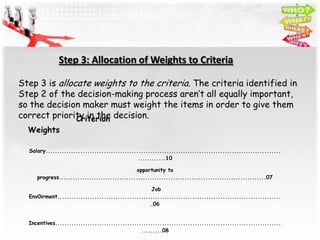
Step 3 is allocate weights to the criteria. The criteria identified in
Step 2 of the decision-making process aren’t all equally important,
so the decision maker must weight the items in order to give them
correct priority in the decision.
               Criterion
  Weights

  Salary.....................................................................................................
                                                ............10

                                               opportunity to
     progress.........................................................................................07

                                                    Job
  Env0irment................................................................................................
                                                    .06


  Incentives.................................................................................................
                                                 .........08
Step 4: Development of Alternatives

Identifying viable alternatives
   Alternatives are listed (without evaluation) that can resolve the
   problem
Name of schools
1) Unique
2) American Lycetuff
3) LDA
4) Allied
5) cathedral
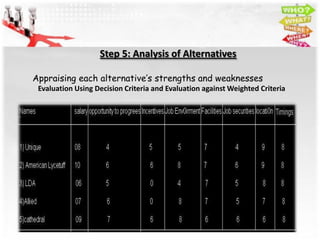
Step 5: Analysis of Alternatives

Appraising each alternative’s strengths and weaknesses
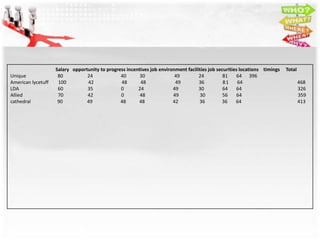
 Evaluation Using Decision Criteria and Evaluation against Weighted Criteria
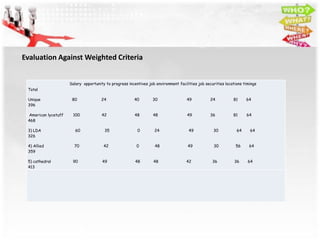
Evaluation Against Weighted Criteria


                     Salary opportunity to progress incentives job environment facilities job securities locations timings
 Total

 Unique               80              24                40       30                 49           24          81     64
 396

 American lycetuff    100             42                48        48                49           36          81     64
 468

 3) LDA                 60             35                0        24                 49           30           64     64
 326

 4) Allied             70              42                0         48               49             30         56      64
 359

 5) cathedral         90              49                48        48                42            36          36     64
 413
Salary opportunity to progress incentives job environment facilities job securities locations timings   Total
Unique               80          24             40       30              49         24          81    64 396
American lycetuff    100         42             48       48              49         36          81     64                           468
LDA                  60          35             0       24              49          30          64    64                            326
Allied               70          42             0        48             49           30         56    64                            359
cathedral            90          49             48      48              42          36         36     64                            413
Decision Making Process

Decision Making Process

  • 1.
    Principle of Management Process Decision Making Presented to: Prof. Aftab Jillani Presented by: Aima Masood MCOM PUNJAB College
  • 2.
    Introduction: Decision making canbe regarded as the mental processes resulting in the selection of a course of action among several alternatives. Every decision making process produces a final choice. The output can be an action or an opinion of choice.
  • 3.
     Problem Analysisvs. Decision Making It is important to differentiate between problem analysis and decision making. The concepts are completely separate from one another. Problem analysis must be done first, then the information gathered in that process may be used towards decision making.  Decision Making Process: In general: “Decision making is the process of making a choice between a numbers of options and committing to a future course of actions.
  • 4.
    Decision making Steps: • There are eight steps of decision making: • Identification of problem • Identification of decision Criteria • Allocating weight to criteria • Develop alternatives • Analysis of Alternatives • Selection of alternatives • Implementation of the best alternatives • Evaluation of decision effectiveness
  • 5.
    Problem The decision-making processbegins when a manager identifies the real problem. The accurate definition of the problem affects all the steps that follow; if the problem is inaccurately defined, every step in the decision-making process will be based on an incorrect starting point. One way that a manager can help determines the true problem in a situation is by identifying the problem separately from its symptoms. The most obviously troubling situations found in an organization can usually be identified as symptoms of underlying problems.
  • 6.
    Step 1: Identificationof a Problem A problem is defined as a discrepancy between an existing and a desired state of affairs. Some cautions about problem identification include the following: 1. Make sure it’s a problem and not just a symptom of a problem. 2.Problem identification is subjective. 3.Discrepancies can be found by comparing current results with some standard. 4.Managers aren’t likely to characterize a discrepancy as a problem if they perceive that they don’t have the authority, information, or other resources needed to act on it. So the problem we are identifying is to get a job in a school with maximum salary and benefits.
  • 7.
    Step 2: Identificationof Decision Criteria Decision criteria are factors that are important (relevant) to resolving the problem: So the factors which are relevant in solving our problems are: 1) Salary 2) Opportunity to progress 3) Job Env0irment 4) Incentives 5) Facilities 6) Job securities 7) Locati0n 8) Timings
  • 8.
    Step 3: Allocationof Weights to Criteria Step 3 is allocate weights to the criteria. The criteria identified in Step 2 of the decision-making process aren’t all equally important, so the decision maker must weight the items in order to give them correct priority in the decision. Criterion Weights Salary..................................................................................................... ............10 opportunity to progress.........................................................................................07 Job Env0irment................................................................................................ .06 Incentives................................................................................................. .........08
  • 9.
    Step 4: Developmentof Alternatives Identifying viable alternatives Alternatives are listed (without evaluation) that can resolve the problem Name of schools 1) Unique 2) American Lycetuff 3) LDA 4) Allied 5) cathedral
  • 10.
    Step 5: Analysisof Alternatives Appraising each alternative’s strengths and weaknesses Evaluation Using Decision Criteria and Evaluation against Weighted Criteria
  • 11.
    Evaluation Against WeightedCriteria Salary opportunity to progress incentives job environment facilities job securities locations timings Total Unique 80 24 40 30 49 24 81 64 396 American lycetuff 100 42 48 48 49 36 81 64 468 3) LDA 60 35 0 24 49 30 64 64 326 4) Allied 70 42 0 48 49 30 56 64 359 5) cathedral 90 49 48 48 42 36 36 64 413
  • 12.
    Salary opportunity toprogress incentives job environment facilities job securities locations timings Total Unique 80 24 40 30 49 24 81 64 396 American lycetuff 100 42 48 48 49 36 81 64 468 LDA 60 35 0 24 49 30 64 64 326 Allied 70 42 0 48 49 30 56 64 359 cathedral 90 49 48 48 42 36 36 64 413