Decision Analysis
Decision theory
By Dr.Ammara Khakwani
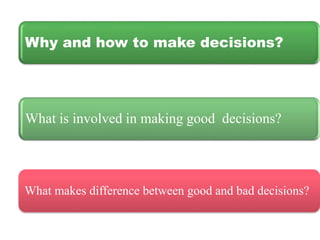
Why and how to make decisions?
What is involved in making good decisions?
What makes difference between good and bad decisions?
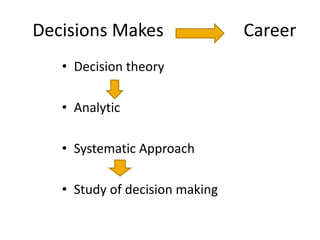
Decisions Makes Career
• Decision theory
• Analytic
• Systematic Approach
• Study of decision making
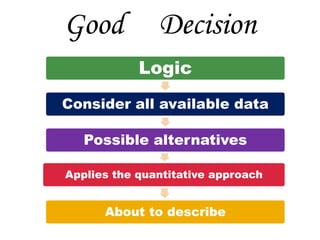
Good Decision
Logic
Consider all available data
Possible alternatives
Applies the quantitative approach
About to describe
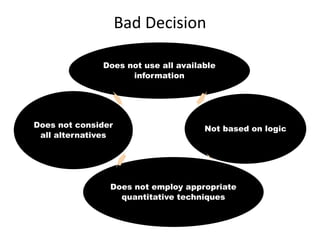
Bad Decision
Does not use all available
information
Not based on logic
Does not employ appropriate
quantitative techniques
Does not consider
all alternatives
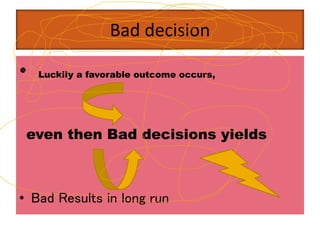
Bad decision
• Luckily a favorable outcome occurs,
even then Bad decisions yields
• Bad Results in long run
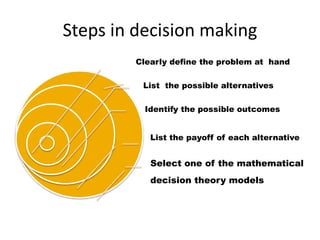
Steps in decision making
Clearly define the problem at hand
List the possible alternatives
Identify the possible outcomes
List the payoff of each alternative
Select one of the mathematical
decision theory models
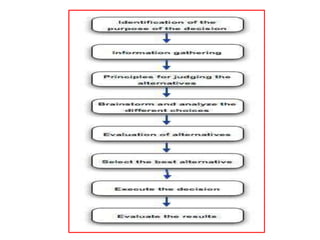
Step 1: Clearly define the problem
 Identification of the purpose of the decision.
 The problem is thoroughly analyzed. Means one should ask when it comes to
identifying the purpose of the decision.
 What exactly is the problem?
 Why the problem should be solved?
 Who are the affected parties of the problem?
 Does the problem have a deadline or a specific time-line?
• Step 2: List the possible Alternatives
 Information gathering.
 A problem of an organization will have many stakeholders.
 In addition, there can be dozens of factors involved and affected
by the problem.
 In the process of solving the problem, you will have to gather as
much as information related to the factors and stakeholders
involved in the problem.
 For the process of information gathering, tools such as 'Check
Sheets' can be effectively used.
• Step 3: Possible outcomes and state of nature
 Principles for judging the alternatives.
 In this step, the baseline criteria for judging the alternatives should be
set up.
 When it comes to defining the criteria, organizational goals as well as
the corporate culture should be taken into consideration.
 As an example, profit is one of the main concerns in every decision
making process.
 Companies usually do not make decisions that reduce profits, unless it is
an exceptional case.
 Likewise, baseline principles should be identified related to the problem
in hand.
•
Step 4: Identify the pay off of each combination of alternatives
 For this step, brainstorming to list down all the ideas is the best option.
 For this, you can make use of Cause-and-Effect diagrams and Pareto
Chart tool.
 Cause-and-Effect diagram helps you to identify all possible causes of the
problem .
 Pareto chart helps you to prioritize and identify the causes with highest
effect.
 Then, you can move on generating all possible solutions (alternatives) for
the problem in hand.
• Step 5: Mathematical decision
 Evaluation of alternatives by decision theory models.
 Use your judgment principles and decision-making criteria to
evaluate each alternative.
 In this step, experience and effectiveness of the judgment principles
come into play.
 You need to compare each alternative for their positives and
negatives.
 Develop all in form of a system by the help of a mathematical model.
After you go through from Step 1 to Step 5, last
step is easy.
In addition, the selection of the best alternative
is an informed decision.
since you have already followed a methodology
to derive and select the best alternative.
•
• Step 6: Apply your model and make decisions
 Execute the decision and Evaluate the results
 Convert your decision into a plan or a sequence of activities. Execute your
plan by yourself or with the help of subordinates.
 Evaluate the outcome of your decision.
 See whether there is anything you should learn and then correct in future
decision making.
 This is one of the best practices that will improve your decision-making skills.
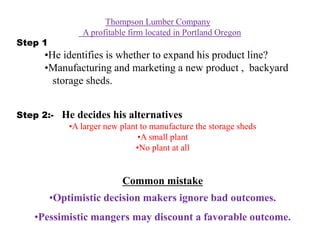
Thompson Lumber Company
A profitable firm located in Portland Oregon
Step 1
•He identifies is whether to expand his product line?
•Manufacturing and marketing a new product , backyard
storage sheds.
Step 2:- He decides his alternatives
•A larger new plant to manufacture the storage sheds
•A small plant
•No plant at all
Common mistake
•Optimistic decision makers ignore bad outcomes.
•Pessimistic mangers may discount a favorable outcome.
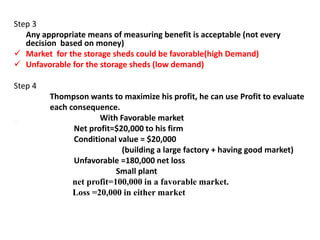
Step 3
Any appropriate means of measuring benefit is acceptable (not every
decision based on money)
 Market for the storage sheds could be favorable(high Demand)
 Unfavorable for the storage sheds (low demand)
Step 4
Thompson wants to maximize his profit, he can use Profit to evaluate
each consequence.
With Favorable market
Net profit=$20,000 to his firm
Conditional value = $20,000
(building a large factory + having good market)
Unfavorable =180,000 net loss
Small plant
net profit=100,000 in a favorable market.
Loss =20,000 in either market
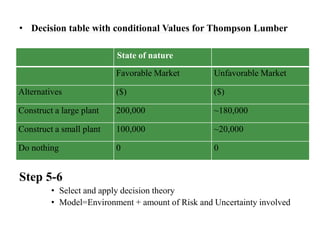
• Decision table with conditional Values for Thompson Lumber
Step 5-6
• Select and apply decision theory
• Model=Environment + amount of Risk and Uncertainty involved
State of nature
Favorable Market Unfavorable Market
Alternatives ($) ($)
Construct a large plant 200,000 ~180,000
Construct a small plant 100,000 ~20,000
Do nothing 0 0

Decision analysis

  • 1.
  • 2.
    Why and howto make decisions? What is involved in making good decisions? What makes difference between good and bad decisions?
  • 3.
    Decisions Makes Career •Decision theory • Analytic • Systematic Approach • Study of decision making
  • 4.
    Good Decision Logic Consider allavailable data Possible alternatives Applies the quantitative approach About to describe
  • 6.
    Bad Decision Does notuse all available information Not based on logic Does not employ appropriate quantitative techniques Does not consider all alternatives
  • 7.
    Bad decision • Luckilya favorable outcome occurs, even then Bad decisions yields • Bad Results in long run
  • 9.
    Steps in decisionmaking Clearly define the problem at hand List the possible alternatives Identify the possible outcomes List the payoff of each alternative Select one of the mathematical decision theory models
  • 10.
    Step 1: Clearlydefine the problem  Identification of the purpose of the decision.  The problem is thoroughly analyzed. Means one should ask when it comes to identifying the purpose of the decision.  What exactly is the problem?  Why the problem should be solved?  Who are the affected parties of the problem?  Does the problem have a deadline or a specific time-line?
  • 11.
    • Step 2:List the possible Alternatives  Information gathering.  A problem of an organization will have many stakeholders.  In addition, there can be dozens of factors involved and affected by the problem.  In the process of solving the problem, you will have to gather as much as information related to the factors and stakeholders involved in the problem.  For the process of information gathering, tools such as 'Check Sheets' can be effectively used.
  • 12.
    • Step 3:Possible outcomes and state of nature  Principles for judging the alternatives.  In this step, the baseline criteria for judging the alternatives should be set up.  When it comes to defining the criteria, organizational goals as well as the corporate culture should be taken into consideration.  As an example, profit is one of the main concerns in every decision making process.  Companies usually do not make decisions that reduce profits, unless it is an exceptional case.  Likewise, baseline principles should be identified related to the problem in hand. •
  • 13.
    Step 4: Identifythe pay off of each combination of alternatives  For this step, brainstorming to list down all the ideas is the best option.  For this, you can make use of Cause-and-Effect diagrams and Pareto Chart tool.  Cause-and-Effect diagram helps you to identify all possible causes of the problem .  Pareto chart helps you to prioritize and identify the causes with highest effect.  Then, you can move on generating all possible solutions (alternatives) for the problem in hand.
  • 14.
    • Step 5:Mathematical decision  Evaluation of alternatives by decision theory models.  Use your judgment principles and decision-making criteria to evaluate each alternative.  In this step, experience and effectiveness of the judgment principles come into play.  You need to compare each alternative for their positives and negatives.  Develop all in form of a system by the help of a mathematical model.
  • 15.
    After you gothrough from Step 1 to Step 5, last step is easy. In addition, the selection of the best alternative is an informed decision. since you have already followed a methodology to derive and select the best alternative. •
  • 16.
    • Step 6:Apply your model and make decisions  Execute the decision and Evaluate the results  Convert your decision into a plan or a sequence of activities. Execute your plan by yourself or with the help of subordinates.  Evaluate the outcome of your decision.  See whether there is anything you should learn and then correct in future decision making.  This is one of the best practices that will improve your decision-making skills.
  • 17.
    Thompson Lumber Company Aprofitable firm located in Portland Oregon Step 1 •He identifies is whether to expand his product line? •Manufacturing and marketing a new product , backyard storage sheds. Step 2:- He decides his alternatives •A larger new plant to manufacture the storage sheds •A small plant •No plant at all Common mistake •Optimistic decision makers ignore bad outcomes. •Pessimistic mangers may discount a favorable outcome.
  • 18.
    Step 3 Any appropriatemeans of measuring benefit is acceptable (not every decision based on money)  Market for the storage sheds could be favorable(high Demand)  Unfavorable for the storage sheds (low demand) Step 4 Thompson wants to maximize his profit, he can use Profit to evaluate each consequence. With Favorable market Net profit=$20,000 to his firm Conditional value = $20,000 (building a large factory + having good market) Unfavorable =180,000 net loss Small plant net profit=100,000 in a favorable market. Loss =20,000 in either market
  • 19.
    • Decision tablewith conditional Values for Thompson Lumber Step 5-6 • Select and apply decision theory • Model=Environment + amount of Risk and Uncertainty involved State of nature Favorable Market Unfavorable Market Alternatives ($) ($) Construct a large plant 200,000 ~180,000 Construct a small plant 100,000 ~20,000 Do nothing 0 0