Presented by  M. Mohamed Nalim  Raja Managerial Decision Making
Managerial Decision Making Decision making is not easy It must be done amid  ever-changing factors  unclear information  conflicting points of view Manager’s Challenge:  Tupperware
Decisions and Decision Making Decision  =  choice made from available alternatives Decision Making  =   process of identifying problems and opportunities and resolving them
Decisions and Decision Making Many decisions that managers deal with every day involve at least some degree of uncertainty and require nonprogrammed decision making May be difficult to make Made amid changing factors Information may be unclear May have to deal with conflicting points of view
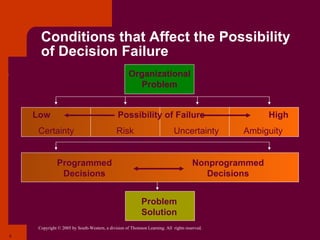
Conditions that Affect the Possibility of Decision Failure Organizational Problem Problem Solution Low High Possibility of Failure Certainty Risk Uncertainty Ambiguity Programmed Decisions Nonprogrammed Decisions
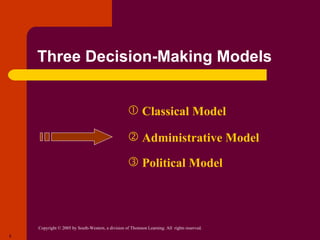
Three Decision-Making Models Classical Model Administrative Model Political Model
Classical Model Assumptions Decision maker operates to accomplish goals that are known and agreed upon Decision maker strives for condition of certainty – gathers complete information Criteria for evaluating alternatives are known Decision maker is rational and uses logic Normative =  describes how a manager should and provides guidelines for reaching an ideal decision Logical decision in the organization’s best economic interests
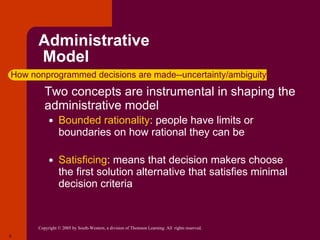
Administrative  Model Two concepts are instrumental in shaping the administrative model Bounded rationality : people have limits or boundaries on how rational they can be Satisficing : means that decision makers choose the first solution alternative that satisfies minimal decision criteria How nonprogrammed decisions are made--uncertainty/ambiguity
Administrative Model Managers actually make decisions in difficult situations characterized by non-programmed decisions, uncertainty, and ambiguity Decision goals often are vague, conflicting and lack consensus among managers;  Rational procedures are not always used Managers’ searches for alternatives are limited Managers settle for a satisficing rather than a maximizing solution intuition, looks to past experience Descriptive =  how managers actually make decisions--not how they should How nonprogrammed decisions are made--uncertainty/ambiguity
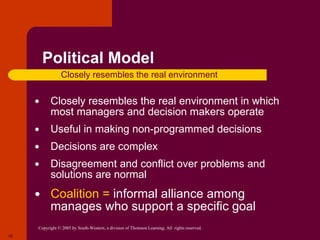
Political Model Closely resembles the real environment in which most managers and decision makers operate Useful in making non-programmed decisions Decisions are complex Disagreement and conflict over problems and solutions are normal Coalition =  informal alliance among manages who support a specific goal Closely resembles the real environment
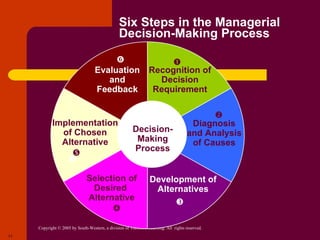
Six Steps in the Managerial Decision-Making Process Evaluation and Feedback Diagnosis and Analysis of Causes Recognition of Decision Requirement Development of Alternatives Selection of Desired  Alternative Implementation of Chosen Alternative Decision-Making Process        
Decision  Styles Differences among people with respect to how they perceive problems and make decisions Not all managers make decisions the same  Directive style Analytical style Conceptual style Behavioral style
Directive Style People who prefer simple, clear-cut solutions to problems Make decisions quickly May consider only one or two alternatives Efficient and rational Prefer rules or procedures
Analytical Style Complex solutions based on as much data as they can gather Carefully consider alternatives Base decision on objective, rational data from management control systems and other sources Search for best possible decision based on information available
Conceptual Style Consider a broad amount of information More socially oriented than analytical style Like to talk to others about the problem and possible solutions Consider many broad alternatives Relay on information from people and systems Solve problems creatively
Behavioral Style Have a deep concern for others as individuals Like to talk to people one-on-one Understand their feelings about the problem and the  effect of a given decision upon them Concerned with the personal development of others May make decisions to help others achieve their goals Experiential Exercise:  What’s Your Personal Decision Style?
Management decision making seminor

Management decision making seminor

  • 1.
    Presented by M. Mohamed Nalim Raja Managerial Decision Making
  • 2.
    Managerial Decision MakingDecision making is not easy It must be done amid ever-changing factors unclear information conflicting points of view Manager’s Challenge: Tupperware
  • 3.
    Decisions and DecisionMaking Decision = choice made from available alternatives Decision Making = process of identifying problems and opportunities and resolving them
  • 4.
    Decisions and DecisionMaking Many decisions that managers deal with every day involve at least some degree of uncertainty and require nonprogrammed decision making May be difficult to make Made amid changing factors Information may be unclear May have to deal with conflicting points of view
  • 5.
    Conditions that Affectthe Possibility of Decision Failure Organizational Problem Problem Solution Low High Possibility of Failure Certainty Risk Uncertainty Ambiguity Programmed Decisions Nonprogrammed Decisions
  • 6.
    Three Decision-Making ModelsClassical Model Administrative Model Political Model
  • 7.
    Classical Model AssumptionsDecision maker operates to accomplish goals that are known and agreed upon Decision maker strives for condition of certainty – gathers complete information Criteria for evaluating alternatives are known Decision maker is rational and uses logic Normative = describes how a manager should and provides guidelines for reaching an ideal decision Logical decision in the organization’s best economic interests
  • 8.
    Administrative ModelTwo concepts are instrumental in shaping the administrative model Bounded rationality : people have limits or boundaries on how rational they can be Satisficing : means that decision makers choose the first solution alternative that satisfies minimal decision criteria How nonprogrammed decisions are made--uncertainty/ambiguity
  • 9.
    Administrative Model Managersactually make decisions in difficult situations characterized by non-programmed decisions, uncertainty, and ambiguity Decision goals often are vague, conflicting and lack consensus among managers; Rational procedures are not always used Managers’ searches for alternatives are limited Managers settle for a satisficing rather than a maximizing solution intuition, looks to past experience Descriptive = how managers actually make decisions--not how they should How nonprogrammed decisions are made--uncertainty/ambiguity
  • 10.
    Political Model Closelyresembles the real environment in which most managers and decision makers operate Useful in making non-programmed decisions Decisions are complex Disagreement and conflict over problems and solutions are normal Coalition = informal alliance among manages who support a specific goal Closely resembles the real environment
  • 11.
    Six Steps inthe Managerial Decision-Making Process Evaluation and Feedback Diagnosis and Analysis of Causes Recognition of Decision Requirement Development of Alternatives Selection of Desired Alternative Implementation of Chosen Alternative Decision-Making Process        
  • 12.
    Decision StylesDifferences among people with respect to how they perceive problems and make decisions Not all managers make decisions the same Directive style Analytical style Conceptual style Behavioral style
  • 13.
    Directive Style Peoplewho prefer simple, clear-cut solutions to problems Make decisions quickly May consider only one or two alternatives Efficient and rational Prefer rules or procedures
  • 14.
    Analytical Style Complexsolutions based on as much data as they can gather Carefully consider alternatives Base decision on objective, rational data from management control systems and other sources Search for best possible decision based on information available
  • 15.
    Conceptual Style Considera broad amount of information More socially oriented than analytical style Like to talk to others about the problem and possible solutions Consider many broad alternatives Relay on information from people and systems Solve problems creatively
  • 16.
    Behavioral Style Havea deep concern for others as individuals Like to talk to people one-on-one Understand their feelings about the problem and the effect of a given decision upon them Concerned with the personal development of others May make decisions to help others achieve their goals Experiential Exercise: What’s Your Personal Decision Style?