Source: Management by Stephen Robbins and Mary
Coulter, 10th Edition
The Decision Making Process
 Decision making is the essence of management.
Mangers, when they plan, organize, lead, and control,
make decisions.
 Decisions- a choice from two or more alternatives
 To make a decision, a manager must follow a process to
be more effective and efficient.
8 Steps of Decision Making Process
1. Identification of a Problem
 Problem- an obstacle that makes achieving a desired
goal or purpose difficult
 Gathering of information
 Root cause analysis- separating the symptoms from
the “real problem”
8 Steps of Decision Making Process
2. Indentifying Decision Criteria- identifying possible
resolution to the problem. Must consider the pros
and cons of each criteria based on what is needed.
8 Steps of Decision Making Process
3. Allocating Weights to the Criteria- each possible
solution must have features or cons and pros. A
manager should score the criteria according to the
need of the situation.
8 Steps of Decision Making Process
5. Developing Alternatives- as manager it is advised you
select a viable alternative that could also resolve the
problem. At this point we are just listing not
evaluating the alternatives.
8 Steps of Decision Making Process
6. Analyzing Alternatives- each alternative is evaluated
by using the criteria created in step 2.
8 Steps of Decision Making Process
7. Selecting an Alternative-choosing the best
alternative or the one that scored the highest total in
step 5.
8 Steps of Decision Making Process
7. Implementing the Alternative- putting the decision
into action by conveying into those affected and
getting their commitment to it.
8 Steps of Decision Making Process
8. Evaluating Decision Effectiveness- evaluating the
outcome or result of the decision to see of the
problem was resolved. If the problem still persists,
the managers should re-assess the problem and start
over again.
Making Decisions
 Rational Decision Making – a type of decision making
in which choices are logical and consistent and
maximizes value. Mangers have to be objective as well.
 Assumption of Rationality- the decision is made to the
best interest of the organization. These decisions are
not realistic.
Making Decisions
 Bounded Rationality-decisions making that’s rational
but limited (bounded) by an individuals ability to
process information.
 Satisfice- accept solution that is good enough.
 Escalation of Commitment- an increase in
commitment to the previous decision despite of high
probability of failure or mistake.
Making Decisions
 The Role of Intuition- managers use their intuition in
making decisions. Most of this managers have long
managerial experiences already.
 Intuitive Decision Making- making decision on the
basis of experience, feelings, and accumulated
judgment.
 Values/Ethics based -Experience Based
 Affect initiated (Emotions) -Cognitive Based
 Subconscious mental processing
Types of Decisions
 Structured Problems and Programmed decisions- a
straightforward, familiar, and easily defined problem
that can be solved by a repetitive decision that can be
handled by a routine approach
 Procedure-a series of sequential steps used to respond
to a well-structured problem.
 Rule-an explicit statement that tells managers what
can or can’t be done.
 Policy-a guideline for making decisions.
Types of Decisions
 Unstructured Problems and Non-Programmed
decisions-a problem that is new or unusual and for
which information is ambiguous or incomplete usually
resolved by a unique and non recurring decision that
requires customer made solution.
Decision Making Conditions
 Certainty- a situation in which a decision maker can
make accurate decision because all outcomes are
known.
 Risk-a situation in which the decision maker is able to
estimate the likelihood of a certain outcome.
 Uncertainty-a situation in which a decision maker has
neither certainty nor reasonable probability estimates
available
Uncertainty
 Maximax- used by optimistic managers. Maximizing
of maximum payoff
 Maximin-somehow a pessimist manager. Maximizing
the minimum payoff.
 Minimax- minimize the maximum regret.
Decision Making Styles
 Linear Thinking Style- a decision characterized by a
person’s reference for using external data and facts and
processing this information through rational and
logical thinking.
 Non-Linear Thinking Style- a decision style
characterized by a person’s preference for the internal
sources of information and processing this
information with internal insights, feeling, and
hunches.
Biases and Errors
 Overconfidence Bias-too much confidence on oneself
or knowledge and resources.
 Immediate gratification-the want of immediate
rewards
 Anchoring Effect-fixate their decision on an initial
information as a starting point.
 Selective Perception Bias-selective organization and
perception of events
 Confirmation Bias-reaffirms their past choices and
discount information that contradicts past judgment
Biases and Errors
 Framing Bias- selecting and highlighting certain aspects of
a situation while excluding others.
 Availability bias-tend to remember events that are most
recent and vivid in memory. Distorts ability to be objective.
 Representation Bias-similarity to previous events
 Randomness Bias-creation meaning out of random events.
 Sunk Costs Errors-forgetting current choices can’t correct
the past.
 Self Serve Bias-credit self for success and blame others for
failure
 Hindsight Bias-false belief that they could have predicted
the outcome
Quantitative Decision Making Aids
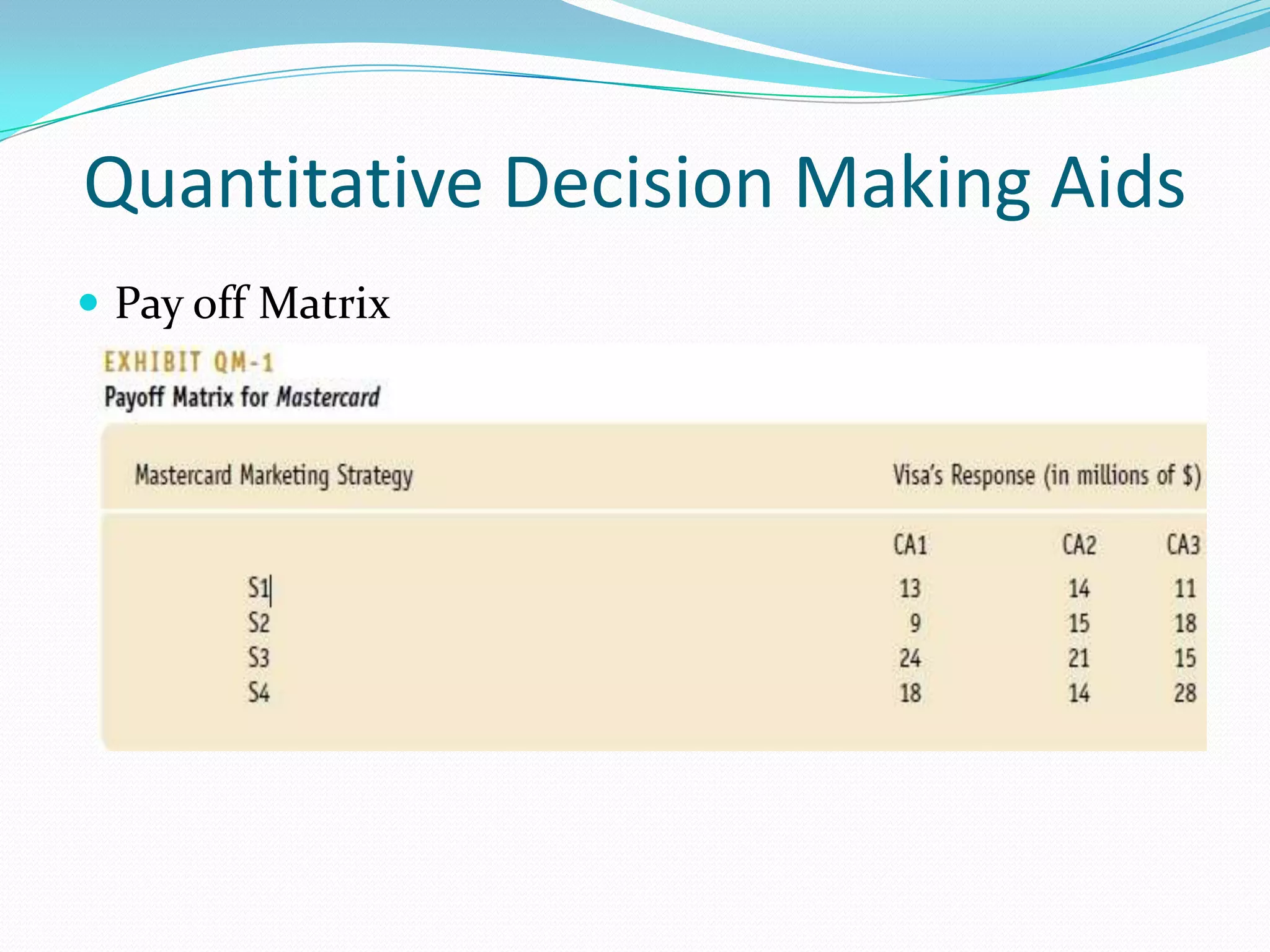
 Pay off Matrix
Quantitative Decision Making Aids
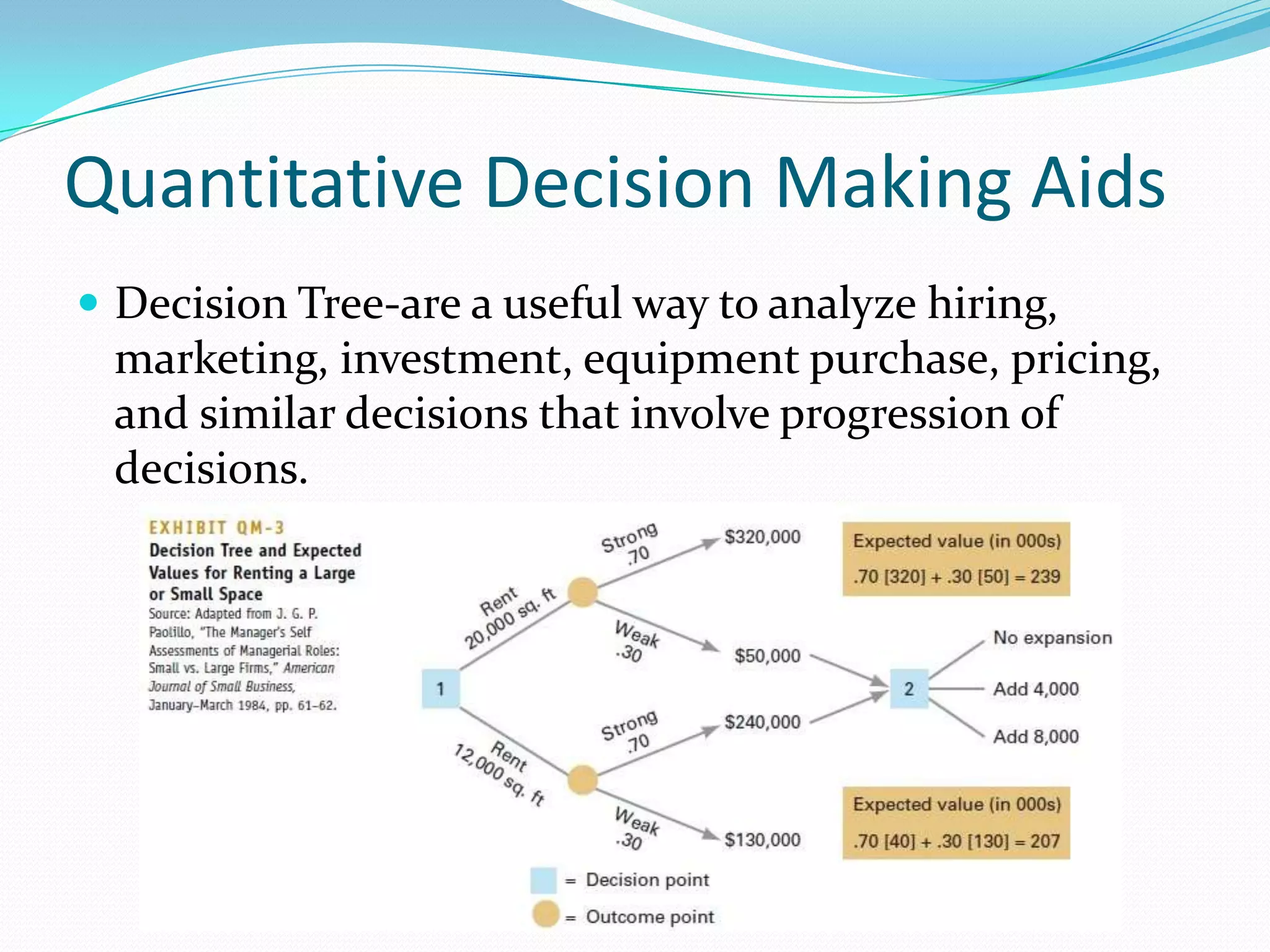
 Decision Tree-are a useful way to analyze hiring,
marketing, investment, equipment purchase, pricing,
and similar decisions that involve progression of
decisions.
Quantitative Decision Making Aids
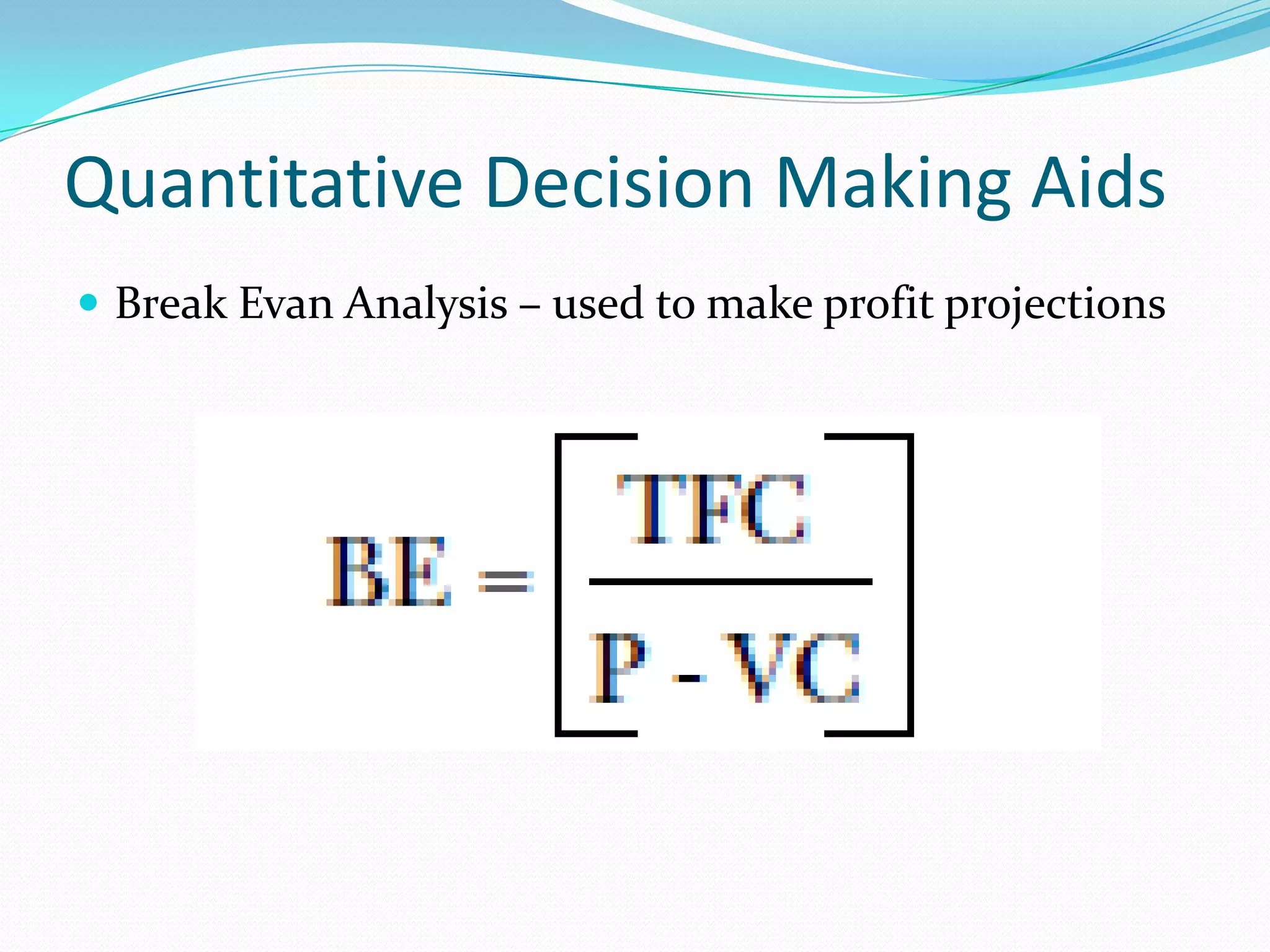
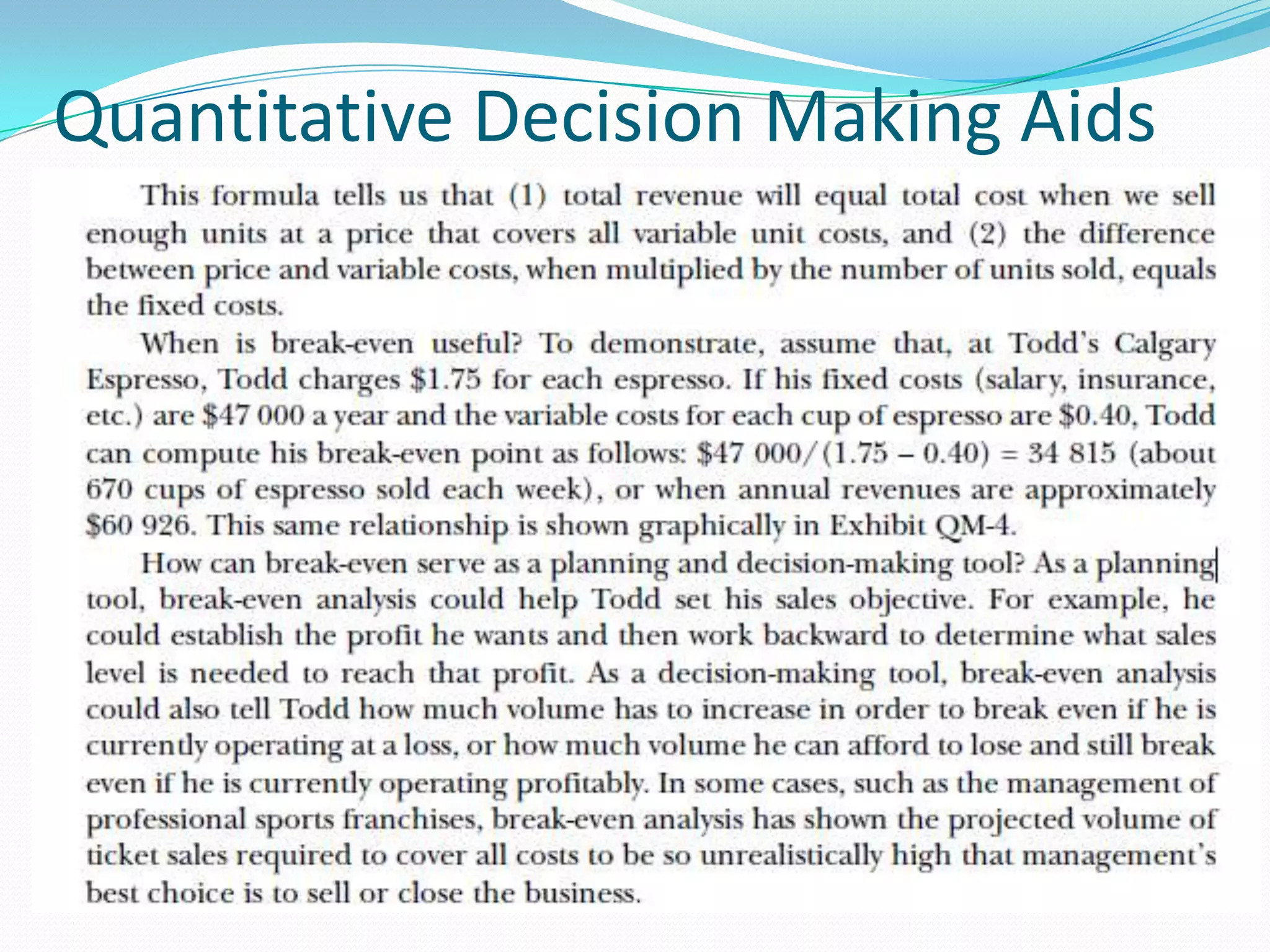
 Break Evan Analysis – used to make profit projections
Quantitative Decision Making Aids
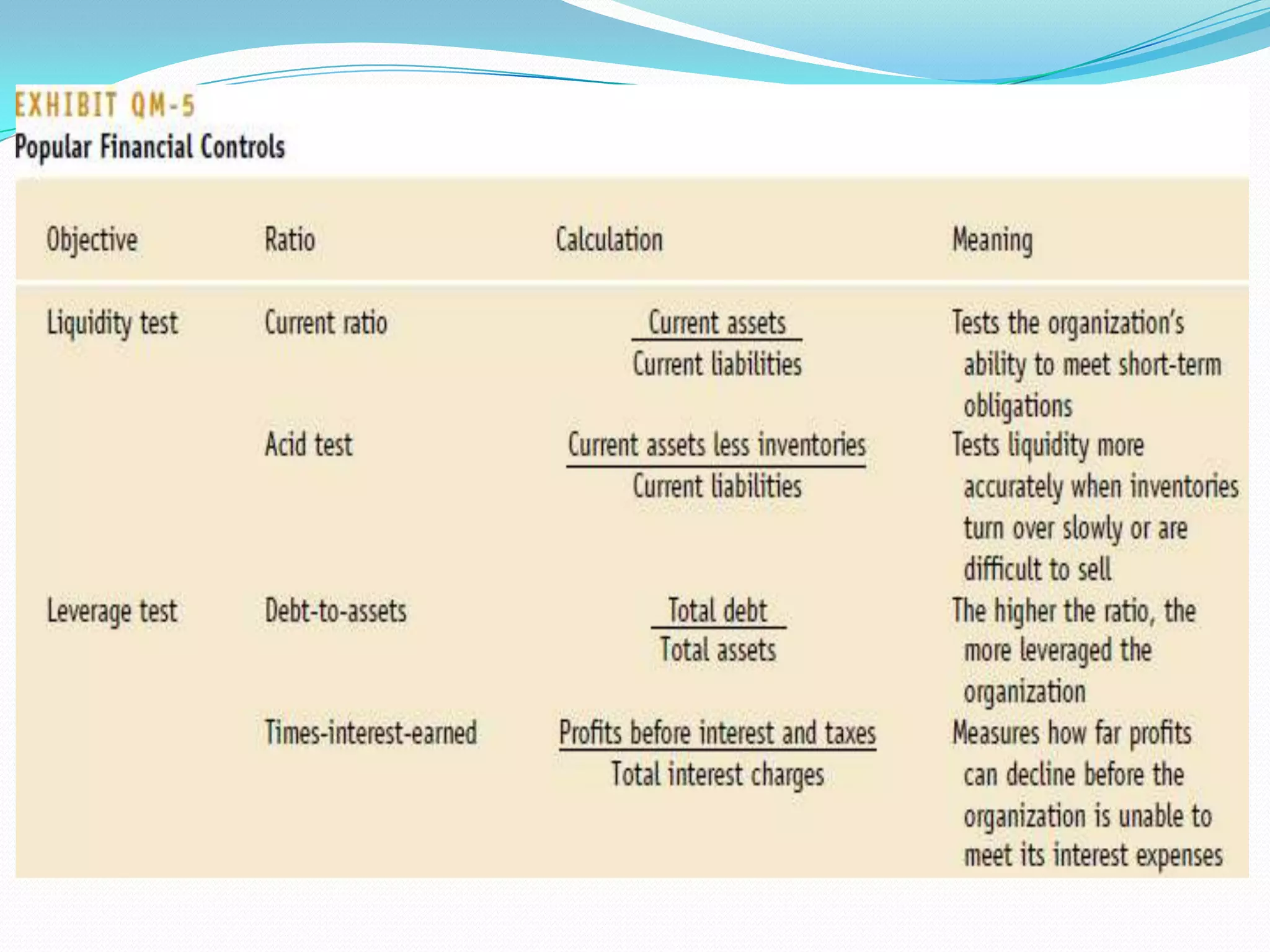
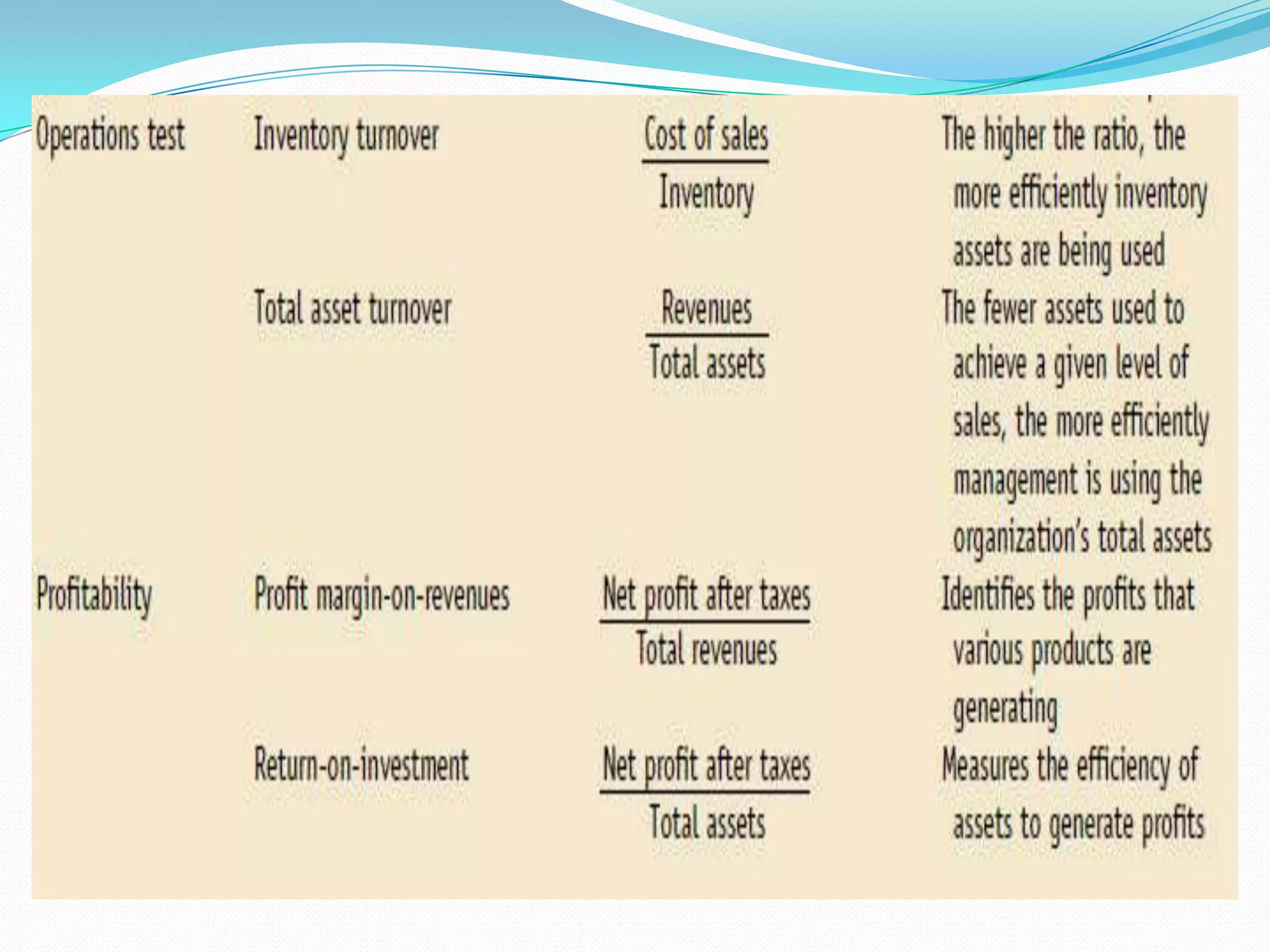
 Ratio Analysis
 Current Ratio- company’s current asset vs current
liabilities. The answer should be =>2:1
 Acid-Test Ration- same as current only that the
inventory is reduced based on the dollar value. Ratio
should be 1:1
Quantitative Decision Making Aids
 Linear Programming- a mathematical technique used
to resolve allocation problems. Maybe used in
transportation, advertising budget, staffing, etc.
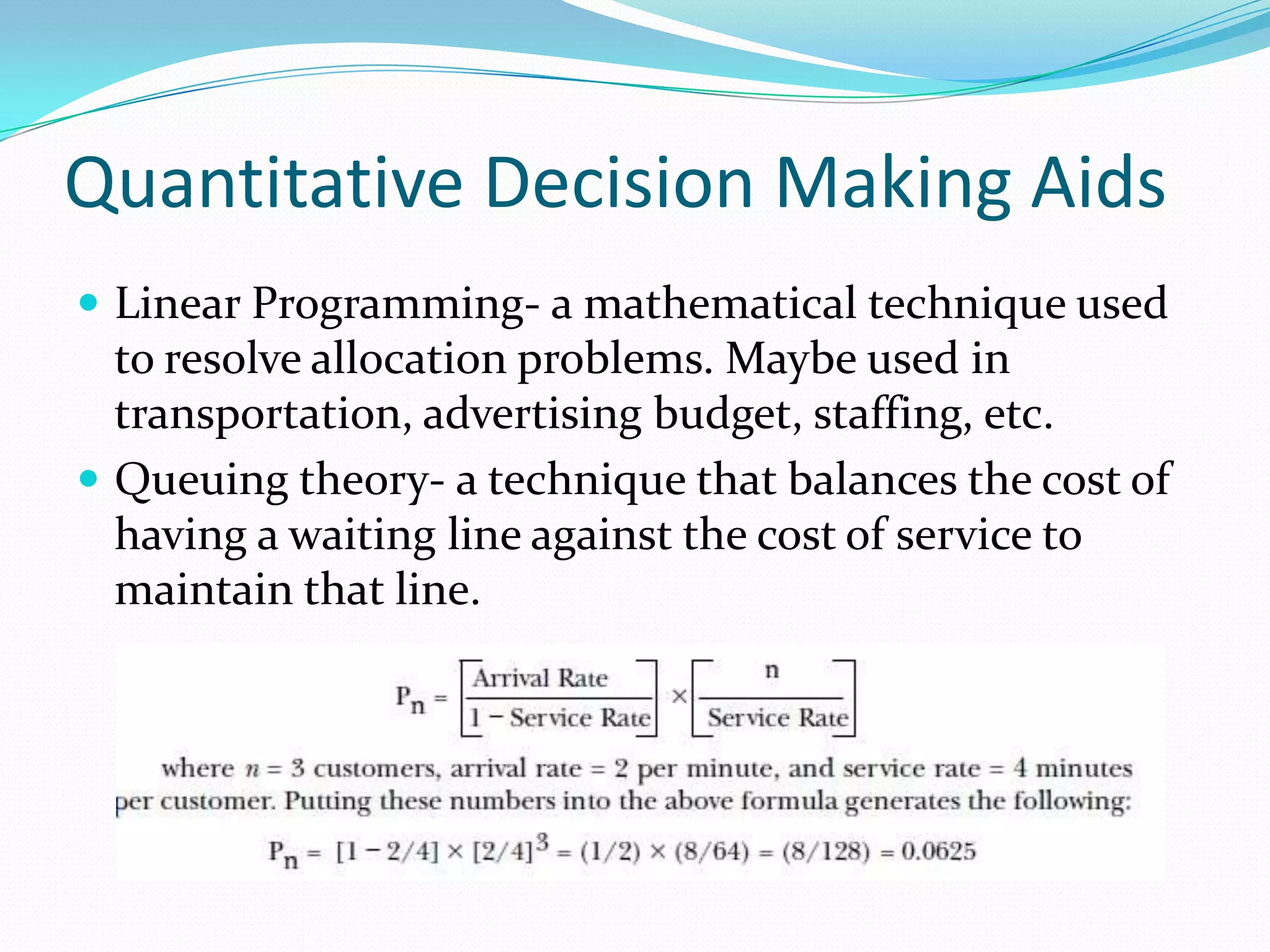
 Queuing theory- a technique that balances the cost of
having a waiting line against the cost of service to
maintain that line.
Quantitative Decision Making Aids
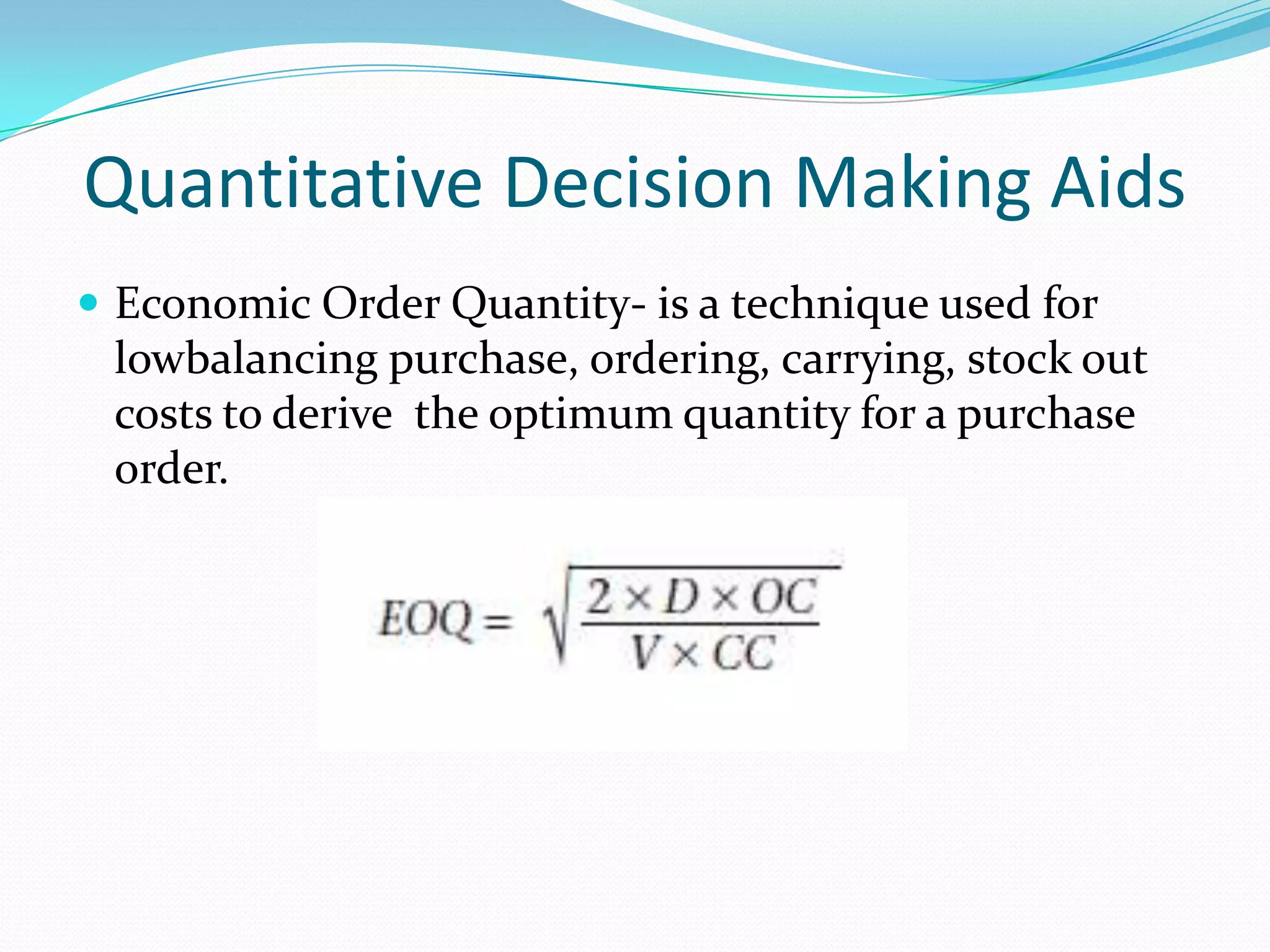
 Economic Order Quantity- is a technique used for
lowbalancing purchase, ordering, carrying, stock out
costs to derive the optimum quantity for a purchase
order.

Decision making

  • 1.
    Source: Management byStephen Robbins and Mary Coulter, 10th Edition
  • 2.
    The Decision MakingProcess  Decision making is the essence of management. Mangers, when they plan, organize, lead, and control, make decisions.  Decisions- a choice from two or more alternatives  To make a decision, a manager must follow a process to be more effective and efficient.
  • 3.
    8 Steps ofDecision Making Process 1. Identification of a Problem  Problem- an obstacle that makes achieving a desired goal or purpose difficult  Gathering of information  Root cause analysis- separating the symptoms from the “real problem”
  • 4.
    8 Steps ofDecision Making Process 2. Indentifying Decision Criteria- identifying possible resolution to the problem. Must consider the pros and cons of each criteria based on what is needed.
  • 5.
    8 Steps ofDecision Making Process 3. Allocating Weights to the Criteria- each possible solution must have features or cons and pros. A manager should score the criteria according to the need of the situation.
  • 6.
    8 Steps ofDecision Making Process 5. Developing Alternatives- as manager it is advised you select a viable alternative that could also resolve the problem. At this point we are just listing not evaluating the alternatives.
  • 7.
    8 Steps ofDecision Making Process 6. Analyzing Alternatives- each alternative is evaluated by using the criteria created in step 2.
  • 8.
    8 Steps ofDecision Making Process 7. Selecting an Alternative-choosing the best alternative or the one that scored the highest total in step 5.
  • 9.
    8 Steps ofDecision Making Process 7. Implementing the Alternative- putting the decision into action by conveying into those affected and getting their commitment to it.
  • 10.
    8 Steps ofDecision Making Process 8. Evaluating Decision Effectiveness- evaluating the outcome or result of the decision to see of the problem was resolved. If the problem still persists, the managers should re-assess the problem and start over again.
  • 11.
    Making Decisions  RationalDecision Making – a type of decision making in which choices are logical and consistent and maximizes value. Mangers have to be objective as well.  Assumption of Rationality- the decision is made to the best interest of the organization. These decisions are not realistic.
  • 12.
    Making Decisions  BoundedRationality-decisions making that’s rational but limited (bounded) by an individuals ability to process information.  Satisfice- accept solution that is good enough.  Escalation of Commitment- an increase in commitment to the previous decision despite of high probability of failure or mistake.
  • 13.
    Making Decisions  TheRole of Intuition- managers use their intuition in making decisions. Most of this managers have long managerial experiences already.  Intuitive Decision Making- making decision on the basis of experience, feelings, and accumulated judgment.  Values/Ethics based -Experience Based  Affect initiated (Emotions) -Cognitive Based  Subconscious mental processing
  • 14.
    Types of Decisions Structured Problems and Programmed decisions- a straightforward, familiar, and easily defined problem that can be solved by a repetitive decision that can be handled by a routine approach  Procedure-a series of sequential steps used to respond to a well-structured problem.  Rule-an explicit statement that tells managers what can or can’t be done.  Policy-a guideline for making decisions.
  • 15.
    Types of Decisions Unstructured Problems and Non-Programmed decisions-a problem that is new or unusual and for which information is ambiguous or incomplete usually resolved by a unique and non recurring decision that requires customer made solution.
  • 16.
    Decision Making Conditions Certainty- a situation in which a decision maker can make accurate decision because all outcomes are known.  Risk-a situation in which the decision maker is able to estimate the likelihood of a certain outcome.  Uncertainty-a situation in which a decision maker has neither certainty nor reasonable probability estimates available
  • 17.
    Uncertainty  Maximax- usedby optimistic managers. Maximizing of maximum payoff  Maximin-somehow a pessimist manager. Maximizing the minimum payoff.  Minimax- minimize the maximum regret.
  • 18.
    Decision Making Styles Linear Thinking Style- a decision characterized by a person’s reference for using external data and facts and processing this information through rational and logical thinking.  Non-Linear Thinking Style- a decision style characterized by a person’s preference for the internal sources of information and processing this information with internal insights, feeling, and hunches.
  • 19.
    Biases and Errors Overconfidence Bias-too much confidence on oneself or knowledge and resources.  Immediate gratification-the want of immediate rewards  Anchoring Effect-fixate their decision on an initial information as a starting point.  Selective Perception Bias-selective organization and perception of events  Confirmation Bias-reaffirms their past choices and discount information that contradicts past judgment
  • 20.
    Biases and Errors Framing Bias- selecting and highlighting certain aspects of a situation while excluding others.  Availability bias-tend to remember events that are most recent and vivid in memory. Distorts ability to be objective.  Representation Bias-similarity to previous events  Randomness Bias-creation meaning out of random events.  Sunk Costs Errors-forgetting current choices can’t correct the past.  Self Serve Bias-credit self for success and blame others for failure  Hindsight Bias-false belief that they could have predicted the outcome
  • 21.
    Quantitative Decision MakingAids  Pay off Matrix
  • 22.
    Quantitative Decision MakingAids  Decision Tree-are a useful way to analyze hiring, marketing, investment, equipment purchase, pricing, and similar decisions that involve progression of decisions.
  • 23.
    Quantitative Decision MakingAids  Break Evan Analysis – used to make profit projections
  • 24.
  • 25.
    Quantitative Decision MakingAids  Ratio Analysis  Current Ratio- company’s current asset vs current liabilities. The answer should be =>2:1  Acid-Test Ration- same as current only that the inventory is reduced based on the dollar value. Ratio should be 1:1
  • 28.
    Quantitative Decision MakingAids  Linear Programming- a mathematical technique used to resolve allocation problems. Maybe used in transportation, advertising budget, staffing, etc.  Queuing theory- a technique that balances the cost of having a waiting line against the cost of service to maintain that line.
  • 29.
    Quantitative Decision MakingAids  Economic Order Quantity- is a technique used for lowbalancing purchase, ordering, carrying, stock out costs to derive the optimum quantity for a purchase order.