The job of a manager
Decision Making
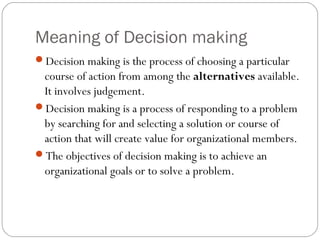
Meaning of Decision making
Decision making is the process of choosing a particular
course of action from among the alternatives available.
It involves judgement.
Decision making is a process of responding to a problem
by searching for and selecting a solution or course of
action that will create value for organizational members.
The objectives of decision making is to achieve an
organizational goals or to solve a problem.
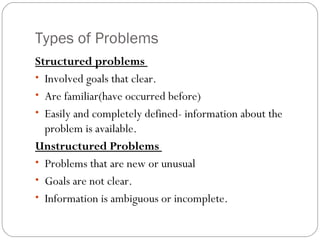
Types of Problems
Structured problems
• Involved goals that clear.
• Are familiar(have occurred before)
• Easily and completely defined- information about the
problem is available.
Unstructured Problems
• Problems that are new or unusual
• Goals are not clear.
• Information is ambiguous or incomplete.
Types of Decisions
There are basically two kinds of decision that managers
called upon to make:
Programmed and
 Non-programmed Decision
Programmed decision
• Programmed decision is a repetitive decision the can be
handled by a routine approach.
• They are relatively structured and information are
available and complete. Here a manager makes a
decision once and he uses that decision again and again.
• Examples:
Non-programmed decisions
Non programmed decisions are used for non- routine
matters of an organization.
They are unique in nature and every situation requires
special attention.
Non- programmed decisions are those decisions that are
relatively unstructured and occurs much less often than a
programmed decisions.
Examples:
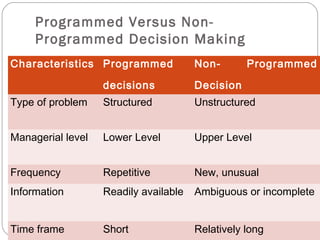
Programmed Versus Non-
Programmed Decision Making
Characteristics Programmed
decisions
Non- Programmed
Decision
Type of problem Structured Unstructured
Managerial level Lower Level Upper Level
Frequency Repetitive New, unusual
Information Readily available Ambiguous or incomplete
Time frame Short Relatively long
The Decision making process
Step 1: Identify the problem: Decision making
process starts with identification of the problem.
Problem is the differences between the actual and
desired situation.
Step 2: Develop alternative solutions: In this step
managers developed alternative solutions of the
problem.
The Decision making process
They can develop alternative solution in the following
ways-
Brain storming
Talk to the staff members
Talk to major customers
Study hard
Allow subordinates to participate in a decision making
process
The Decision making process
Step 3:Evaluate alternative solutions: Once
managers have developed a set of alternatives, they must
evaluate each one on the basis of three questions-
Is this alternative feasible?
Is the alternative provide a satisfactory solution?
What are the possible consequences for the rest of the
organization?
The Decision making process
Step 4 :Make a choice: Making a choice is not a easy
task, it is the most complex task. It is one of the most
difficult part of the decision making process. Managers
can use following factors as a guideline in making a
decision-
Concentrate on differences
Identify must and should
No compromise with must
Relate resource requirement to resource available
Consider time as a great factors
Characteristics of Effective
decision making
It is logical and consistent.
It requires only as much information and analysis as is
necessary to resolve a particular dilemma.
It is straightforward,
Reliable,
Easy to use and understand
Flexible.
 
Risk involved in decision
making
Decision making is undoubtedly a risky job on the part of
a manager. But all decisions are not equally risky. From
the point of involvement of risk, decision making may be
of following types:
Decision making under conditions of certainty:
In a situation involving certainty, people are reasonably
sure about what will happen when they make decision.
Here the risk of the manager is minimum.
A manager is making decisions under conditions of
certainty when the following conditions are fulfilled:
Risk involved in decision
making
1. Information available to make a decision are sufficient.
2. Outcome of a decision may be predicted with a fair
amount of certainty.
 Decision making under conditions of Risk:
In risk situation, a factual information may exist, but it may
be incomplete.
Here risk of the manager is moderate. A manager is making
decision under conditions of risk when the following
conditions are fulfilled:
1. Information available is not sufficient
2. Outcome of the decision may only be guessed
Risk involved in decision
making
Decision making under Uncertainty: In a
situation of uncertainty, people have only information,
but they do not know whether or not the data are
reliable and they are very unsure about whether or not
the situation may change.
Here the risk of the manager is the highest. A manager is
mainly making decision under conditions of uncertainty
when the following conditions are fulfilled:
1. Very little of no information are available
2. Outcome is unpredictable.

2.decision making

  • 1.
    The job ofa manager Decision Making
  • 2.
    Meaning of Decisionmaking Decision making is the process of choosing a particular course of action from among the alternatives available. It involves judgement. Decision making is a process of responding to a problem by searching for and selecting a solution or course of action that will create value for organizational members. The objectives of decision making is to achieve an organizational goals or to solve a problem.
  • 3.
    Types of Problems Structuredproblems • Involved goals that clear. • Are familiar(have occurred before) • Easily and completely defined- information about the problem is available. Unstructured Problems • Problems that are new or unusual • Goals are not clear. • Information is ambiguous or incomplete.
  • 4.
    Types of Decisions Thereare basically two kinds of decision that managers called upon to make: Programmed and  Non-programmed Decision
  • 5.
    Programmed decision • Programmeddecision is a repetitive decision the can be handled by a routine approach. • They are relatively structured and information are available and complete. Here a manager makes a decision once and he uses that decision again and again. • Examples:
  • 6.
    Non-programmed decisions Non programmeddecisions are used for non- routine matters of an organization. They are unique in nature and every situation requires special attention. Non- programmed decisions are those decisions that are relatively unstructured and occurs much less often than a programmed decisions. Examples:
  • 7.
    Programmed Versus Non- ProgrammedDecision Making Characteristics Programmed decisions Non- Programmed Decision Type of problem Structured Unstructured Managerial level Lower Level Upper Level Frequency Repetitive New, unusual Information Readily available Ambiguous or incomplete Time frame Short Relatively long
  • 8.
    The Decision makingprocess Step 1: Identify the problem: Decision making process starts with identification of the problem. Problem is the differences between the actual and desired situation. Step 2: Develop alternative solutions: In this step managers developed alternative solutions of the problem.
  • 9.
    The Decision makingprocess They can develop alternative solution in the following ways- Brain storming Talk to the staff members Talk to major customers Study hard Allow subordinates to participate in a decision making process
  • 10.
    The Decision makingprocess Step 3:Evaluate alternative solutions: Once managers have developed a set of alternatives, they must evaluate each one on the basis of three questions- Is this alternative feasible? Is the alternative provide a satisfactory solution? What are the possible consequences for the rest of the organization?
  • 11.
    The Decision makingprocess Step 4 :Make a choice: Making a choice is not a easy task, it is the most complex task. It is one of the most difficult part of the decision making process. Managers can use following factors as a guideline in making a decision- Concentrate on differences Identify must and should No compromise with must Relate resource requirement to resource available Consider time as a great factors
  • 12.
    Characteristics of Effective decisionmaking It is logical and consistent. It requires only as much information and analysis as is necessary to resolve a particular dilemma. It is straightforward, Reliable, Easy to use and understand Flexible.  
  • 13.
    Risk involved indecision making Decision making is undoubtedly a risky job on the part of a manager. But all decisions are not equally risky. From the point of involvement of risk, decision making may be of following types: Decision making under conditions of certainty: In a situation involving certainty, people are reasonably sure about what will happen when they make decision. Here the risk of the manager is minimum. A manager is making decisions under conditions of certainty when the following conditions are fulfilled:
  • 14.
    Risk involved indecision making 1. Information available to make a decision are sufficient. 2. Outcome of a decision may be predicted with a fair amount of certainty.  Decision making under conditions of Risk: In risk situation, a factual information may exist, but it may be incomplete. Here risk of the manager is moderate. A manager is making decision under conditions of risk when the following conditions are fulfilled: 1. Information available is not sufficient 2. Outcome of the decision may only be guessed
  • 15.
    Risk involved indecision making Decision making under Uncertainty: In a situation of uncertainty, people have only information, but they do not know whether or not the data are reliable and they are very unsure about whether or not the situation may change. Here the risk of the manager is the highest. A manager is mainly making decision under conditions of uncertainty when the following conditions are fulfilled: 1. Very little of no information are available 2. Outcome is unpredictable.