Decision Making Process
By
Ponmuthu S
&
Daniel R
What is a Decision?
Choice between two or more
alternatives
If you only have one
alternative, you do not have a
decision.
Decision Making
“Decision-making involves the
selection of a course of action from
among two or more possible
alternatives in order to arrive at a
solution for a given problem”.
Decision making process is a
consultative affair done by a comity of
professionals to drive better
functioning of any organization
Decision Making Process
The step by step method for taking
decisions
A decision maker should follow these
steps before taking decisions
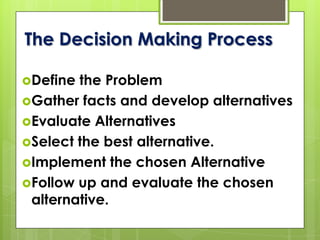
Define the Problem
Gather facts and develop alternatives
Evaluate Alternatives
Select the best alternative.
Implement the chosen Alternative
Follow up and evaluate the chosen
alternative.
The Decision Making Process
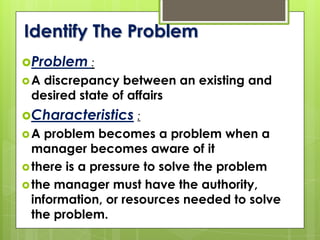
Identify The Problem
Problem :
A discrepancy between an existing and
desired state of affairs
Characteristics :
A problem becomes a problem when a
manager becomes aware of it
there is a pressure to solve the problem
the manager must have the authority,
information, or resources needed to solve
the problem.
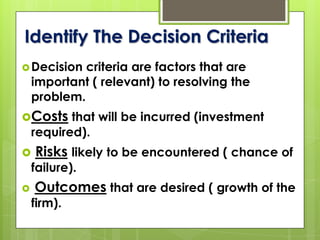
Decision criteria are factors that are
important ( relevant) to resolving the
problem.
Costs that will be incurred (investment
required).
 Risks likely to be encountered ( chance of
failure).
 Outcomes that are desired ( growth of the
firm).
Identify The Decision Criteria
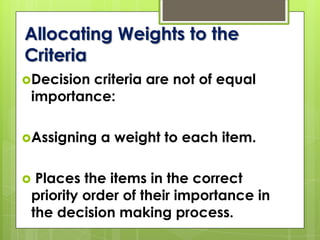
Decision criteria are not of equal
importance:
Assigning a weight to each item.
 Places the items in the correct
priority order of their importance in
the decision making process.
Allocating Weights to the
Criteria
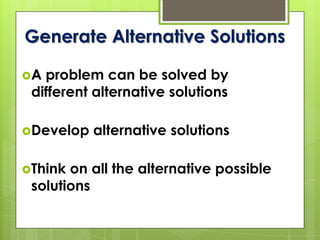
Generate Alternative Solutions
A problem can be solved by
different alternative solutions
Develop alternative solutions
Think on all the alternative possible
solutions
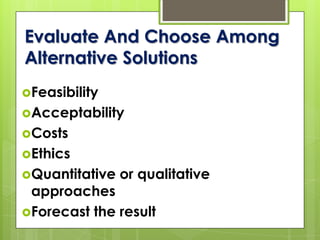
Evaluate And Choose Among
Alternative Solutions
Feasibility
Acceptability
Costs
Ethics
Quantitative or qualitative
approaches
Forecast the result
Choosing the best alternative
 The alternative with the highest total
weight is chosen.
The best alternative is the one that
produces the most advantages and
the fewest serious disadvantages.
Sometimes, the optimal solution is a
combination of several alternatives.
Selecting The Alternative
Implement And Monitor The
Chosen Solution
Reveals its effectiveness and significance
in achieving the desired goals
Depends on careful planning and
sensitivity
To ensure that the alternative put into
action is moving towards the objectives
Confirms that the organization goals
have been achieved.
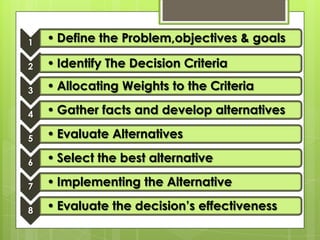
1 • Define the Problem,objectives & goals
2 • Identify The Decision Criteria
3 • Allocating Weights to the Criteria
4 • Gather facts and develop alternatives
5 • Evaluate Alternatives
6 • Select the best alternative
7 • Implementing the Alternative
8 • Evaluate the decision’s effectiveness
Decision Making Process
Always continuous & dynamics
It is not only a process and also a
practice
A good decision maker will be the good
manager
Be a best decision maker.., Be a best
manager
Thank You
????

Decision making process

  • 2.
  • 3.
    What is aDecision? Choice between two or more alternatives If you only have one alternative, you do not have a decision.
  • 5.
    Decision Making “Decision-making involvesthe selection of a course of action from among two or more possible alternatives in order to arrive at a solution for a given problem”. Decision making process is a consultative affair done by a comity of professionals to drive better functioning of any organization
  • 6.
  • 7.
    Decision Making Process Thestep by step method for taking decisions A decision maker should follow these steps before taking decisions
  • 8.
    Define the Problem Gatherfacts and develop alternatives Evaluate Alternatives Select the best alternative. Implement the chosen Alternative Follow up and evaluate the chosen alternative. The Decision Making Process
  • 9.
    Identify The Problem Problem: A discrepancy between an existing and desired state of affairs Characteristics : A problem becomes a problem when a manager becomes aware of it there is a pressure to solve the problem the manager must have the authority, information, or resources needed to solve the problem.
  • 11.
    Decision criteria arefactors that are important ( relevant) to resolving the problem. Costs that will be incurred (investment required).  Risks likely to be encountered ( chance of failure).  Outcomes that are desired ( growth of the firm). Identify The Decision Criteria
  • 12.
    Decision criteria arenot of equal importance: Assigning a weight to each item.  Places the items in the correct priority order of their importance in the decision making process. Allocating Weights to the Criteria
  • 13.
    Generate Alternative Solutions Aproblem can be solved by different alternative solutions Develop alternative solutions Think on all the alternative possible solutions
  • 14.
    Evaluate And ChooseAmong Alternative Solutions Feasibility Acceptability Costs Ethics Quantitative or qualitative approaches Forecast the result
  • 15.
    Choosing the bestalternative  The alternative with the highest total weight is chosen. The best alternative is the one that produces the most advantages and the fewest serious disadvantages. Sometimes, the optimal solution is a combination of several alternatives. Selecting The Alternative
  • 16.
    Implement And MonitorThe Chosen Solution Reveals its effectiveness and significance in achieving the desired goals Depends on careful planning and sensitivity To ensure that the alternative put into action is moving towards the objectives Confirms that the organization goals have been achieved.
  • 17.
    1 • Definethe Problem,objectives & goals 2 • Identify The Decision Criteria 3 • Allocating Weights to the Criteria 4 • Gather facts and develop alternatives 5 • Evaluate Alternatives 6 • Select the best alternative 7 • Implementing the Alternative 8 • Evaluate the decision’s effectiveness
  • 18.
    Decision Making Process Alwayscontinuous & dynamics It is not only a process and also a practice A good decision maker will be the good manager Be a best decision maker.., Be a best manager
  • 19.
  • 20.