DECISION MAKING   A Presentation by Deepti Sharma   Parul Dahiya Prashant Arora   Ravish Nagpal Vishal Chawla
DECISION MAKING What is Decision Making? The Phases in decision making process. Our Route Map Decision making in organizations Decision making techniques. Factors Influencing decision making Some Models of Decision making. How do intuition, judgment, and creativity affect decision  making? Types of Decisions Managing Decision Making Process-undestanding the reasons  for failure
DECISION MAKING Define the Phases in decision making process. Objectives of the session Discuss the Creative process . Understanding decision making techniques. Identify some Models of Decision making .
Defining Decision Making Chester Barnard  gave a comprehensive analytical treatment of decision making. A process of narrowing choice. Decision making is universally defined as choosing between alternatives. A Classical Thought :   Fayol  &  Urwick  (Stressed Delegation) Taylor  alluded scientific methods only as ideal approach. DECISION MAKING
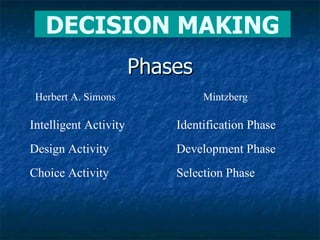
Phases Herbert A. Simons Mintzberg Intelligent Activity Design Activity Choice Activity Selection Phase Development Phase Identification Phase DECISION MAKING
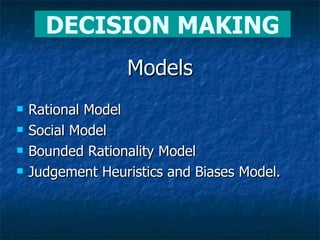
Models Rational Model  Social Model  Bounded Rationality Model Judgement Heuristics and Biases Model. DECISION MAKING
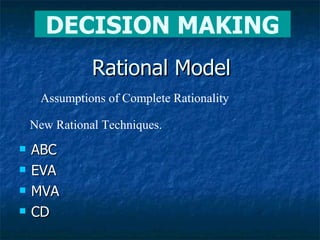
Rational Model ABC EVA MVA CD DECISION MAKING Assumptions of Complete Rationality New Rational Techniques.
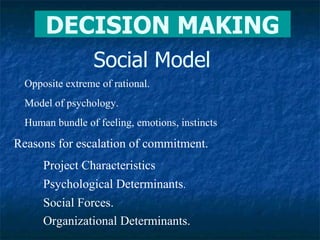
Social Model Opposite extreme of rational. Model of psychology. Human bundle of feeling, emotions, instincts DECISION MAKING Reasons for escalation of commitment. Project Characteristics Psychological Determinants . Social Forces. Organizational Determinants.
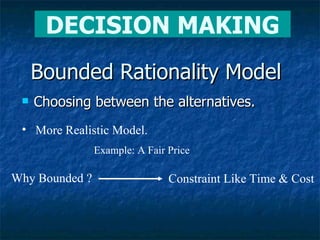
Bounded Rationality Model Choosing between the alternatives. DECISION MAKING More Realistic Model. Example: A Fair Price Why Bounded ? Constraint Like Time & Cost
How do intuition, judgment, and creativity affect decision making? Intuition. The ability to know or recognize quickly and readily the possibilities of a given situation. A key element of decision making under risk and uncertainty. DECISION MAKING
Intuitive Decision Making An unconscious process of making decisions on the basis of experience and accumulated judgment.   Making decisions on the basis of gut feeling doesn't happen independently of rational analysis. The two complement each other.  Although intuitive decision making will not replace the rational decision-making process, it does play an important role in managerial decision making. Decision Making
How do judgment affect decision making? Judgmental heuristics. Simplifying strategies or “rules of thumb” used to make decisions. Makes it easier to to deal with uncertainty and limited information. Can lead to systematic errors that affect the quality and/or ethics of decisions. Decision Making
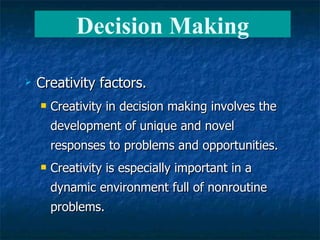
Creativity factors. Creativity in decision making involves the development of unique and novel responses to problems and opportunities. Creativity is especially important in a dynamic environment full of nonroutine problems. Decision Making
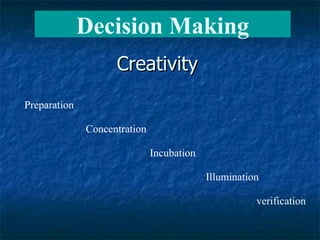
Creativity Preparation Concentration Incubation Illumination verification Decision Making
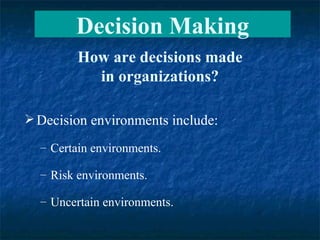
Decision environments include: Certain environments. Risk environments. Uncertain environments. How are decisions made in organizations? Decision Making
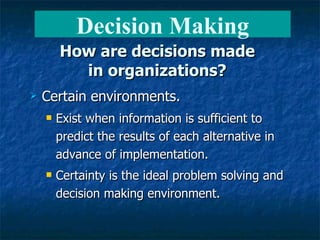
How are decisions made in organizations? Certain environments. Exist when information is sufficient to predict the results of each alternative in advance of implementation. Certainty is the ideal problem solving and decision making environment. Decision Making
How are decisions made in organizations? Risk environments. Exist when decision makers lack complete certainty regarding the outcomes of various courses of action, but they can assign probabilities of occurrence. Probabilities can be assigned through objective statistical procedures or personal intuition. Decision Making
How are decisions made in organizations? Uncertain environments. Exist when managers have so little information that they cannot even assign probabilities to various alternatives and possible outcomes. Uncertainty forces decision makers to rely on individual and group creativity to succeed in problem solving. Decision Making
Factors Influencing decision making Technology Culture Ethics Decision Making
How do technology, culture, and ethics influence decision making? Information technology and decision making. Artificial intelligence. The study of how computers can be programmed to think like human beings. Will allow computers to displace many decision makers. Expert systems that support decision making by following “either-or” rules to make deductions.
How do technology, culture, and ethics influence decision making? Cultural factors and decision making. Culture is “the way in which a group of people solves problems.” North American culture stresses decisiveness, speed, and the individual selection of alternatives. Other cultures place less emphasis on individual choice than on developing implementations that work. The most important impact of culture on decision making concerns which issues are elevated to the status of problems solvable with the firm.
How do technology, culture, and ethics influence decision making? Ethical issues and decision making. Ethical dilemma. A situation in which a person must decide whether or not to do something that, although personally or organizationally beneficial, may be considered unethical and perhaps illegal. Ethical dilemmas are often associated with: Risk and uncertainty. Nonroutine problem situations.
How do technology, culture, and ethics influence decision making? Suggestions for integrating ethical decision making into the firm. Develop a code of ethics and follow it. Establish procedures for reporting violations. Involve employees in identifying ethical issues. Monitor ethical performance. Reward ethical behavior. Publicize ethical efforts.
Types of Decisions Programmed Non - Programmed Programmed decisions. Involve routine problems that arise regularly and can be addressed through standard responses. Non programmed decisions. Involve nonroutine problems that require solutions specifically tailored to the situation at hand Decision Making
How can the decision-making process be managed? Reasons for decision making failure. Managers too often copy others’ choices and try to sell them to subordinates. Managers tend to emphasize problems and solutions rather than successful implementation. Managers use participation too infrequently. Time Management Decision Making
Thank you We are open for Questions if any

Decision making

  • 1.
    DECISION MAKING A Presentation by Deepti Sharma Parul Dahiya Prashant Arora Ravish Nagpal Vishal Chawla
  • 2.
    DECISION MAKING Whatis Decision Making? The Phases in decision making process. Our Route Map Decision making in organizations Decision making techniques. Factors Influencing decision making Some Models of Decision making. How do intuition, judgment, and creativity affect decision making? Types of Decisions Managing Decision Making Process-undestanding the reasons for failure
  • 3.
    DECISION MAKING Definethe Phases in decision making process. Objectives of the session Discuss the Creative process . Understanding decision making techniques. Identify some Models of Decision making .
  • 4.
    Defining Decision MakingChester Barnard gave a comprehensive analytical treatment of decision making. A process of narrowing choice. Decision making is universally defined as choosing between alternatives. A Classical Thought : Fayol & Urwick (Stressed Delegation) Taylor alluded scientific methods only as ideal approach. DECISION MAKING
  • 5.
    Phases Herbert A.Simons Mintzberg Intelligent Activity Design Activity Choice Activity Selection Phase Development Phase Identification Phase DECISION MAKING
  • 6.
    Models Rational Model Social Model Bounded Rationality Model Judgement Heuristics and Biases Model. DECISION MAKING
  • 7.
    Rational Model ABCEVA MVA CD DECISION MAKING Assumptions of Complete Rationality New Rational Techniques.
  • 8.
    Social Model Oppositeextreme of rational. Model of psychology. Human bundle of feeling, emotions, instincts DECISION MAKING Reasons for escalation of commitment. Project Characteristics Psychological Determinants . Social Forces. Organizational Determinants.
  • 9.
    Bounded Rationality ModelChoosing between the alternatives. DECISION MAKING More Realistic Model. Example: A Fair Price Why Bounded ? Constraint Like Time & Cost
  • 10.
    How do intuition,judgment, and creativity affect decision making? Intuition. The ability to know or recognize quickly and readily the possibilities of a given situation. A key element of decision making under risk and uncertainty. DECISION MAKING
  • 11.
    Intuitive Decision MakingAn unconscious process of making decisions on the basis of experience and accumulated judgment. Making decisions on the basis of gut feeling doesn't happen independently of rational analysis. The two complement each other. Although intuitive decision making will not replace the rational decision-making process, it does play an important role in managerial decision making. Decision Making
  • 12.
    How do judgmentaffect decision making? Judgmental heuristics. Simplifying strategies or “rules of thumb” used to make decisions. Makes it easier to to deal with uncertainty and limited information. Can lead to systematic errors that affect the quality and/or ethics of decisions. Decision Making
  • 13.
    Creativity factors. Creativityin decision making involves the development of unique and novel responses to problems and opportunities. Creativity is especially important in a dynamic environment full of nonroutine problems. Decision Making
  • 14.
    Creativity Preparation ConcentrationIncubation Illumination verification Decision Making
  • 15.
    Decision environments include:Certain environments. Risk environments. Uncertain environments. How are decisions made in organizations? Decision Making
  • 16.
    How are decisionsmade in organizations? Certain environments. Exist when information is sufficient to predict the results of each alternative in advance of implementation. Certainty is the ideal problem solving and decision making environment. Decision Making
  • 17.
    How are decisionsmade in organizations? Risk environments. Exist when decision makers lack complete certainty regarding the outcomes of various courses of action, but they can assign probabilities of occurrence. Probabilities can be assigned through objective statistical procedures or personal intuition. Decision Making
  • 18.
    How are decisionsmade in organizations? Uncertain environments. Exist when managers have so little information that they cannot even assign probabilities to various alternatives and possible outcomes. Uncertainty forces decision makers to rely on individual and group creativity to succeed in problem solving. Decision Making
  • 19.
    Factors Influencing decisionmaking Technology Culture Ethics Decision Making
  • 20.
    How do technology,culture, and ethics influence decision making? Information technology and decision making. Artificial intelligence. The study of how computers can be programmed to think like human beings. Will allow computers to displace many decision makers. Expert systems that support decision making by following “either-or” rules to make deductions.
  • 21.
    How do technology,culture, and ethics influence decision making? Cultural factors and decision making. Culture is “the way in which a group of people solves problems.” North American culture stresses decisiveness, speed, and the individual selection of alternatives. Other cultures place less emphasis on individual choice than on developing implementations that work. The most important impact of culture on decision making concerns which issues are elevated to the status of problems solvable with the firm.
  • 22.
    How do technology,culture, and ethics influence decision making? Ethical issues and decision making. Ethical dilemma. A situation in which a person must decide whether or not to do something that, although personally or organizationally beneficial, may be considered unethical and perhaps illegal. Ethical dilemmas are often associated with: Risk and uncertainty. Nonroutine problem situations.
  • 23.
    How do technology,culture, and ethics influence decision making? Suggestions for integrating ethical decision making into the firm. Develop a code of ethics and follow it. Establish procedures for reporting violations. Involve employees in identifying ethical issues. Monitor ethical performance. Reward ethical behavior. Publicize ethical efforts.
  • 24.
    Types of DecisionsProgrammed Non - Programmed Programmed decisions. Involve routine problems that arise regularly and can be addressed through standard responses. Non programmed decisions. Involve nonroutine problems that require solutions specifically tailored to the situation at hand Decision Making
  • 25.
    How can thedecision-making process be managed? Reasons for decision making failure. Managers too often copy others’ choices and try to sell them to subordinates. Managers tend to emphasize problems and solutions rather than successful implementation. Managers use participation too infrequently. Time Management Decision Making
  • 26.
    Thank you Weare open for Questions if any