DECISION MAKING
Defined
• “It is a process of selection from a set of alternative courses of action
which is thought to fulfil the objectives of the decision problem more
satisfactorily than other.”
• It is course of action which is consciously chosen for achieving a desired
result.
• It is a process of establishing goals, defining tasks, searching for
alternatives and developing plans in order to find the best answer to the
decision problem.
• It is the core of managerial activity
Interlinkage between Decision Making and
Planning
• Decision – Making and planning are deeply interlinked. the
determination of objectives, policies , programmes , strategies
etc. involves Decision making
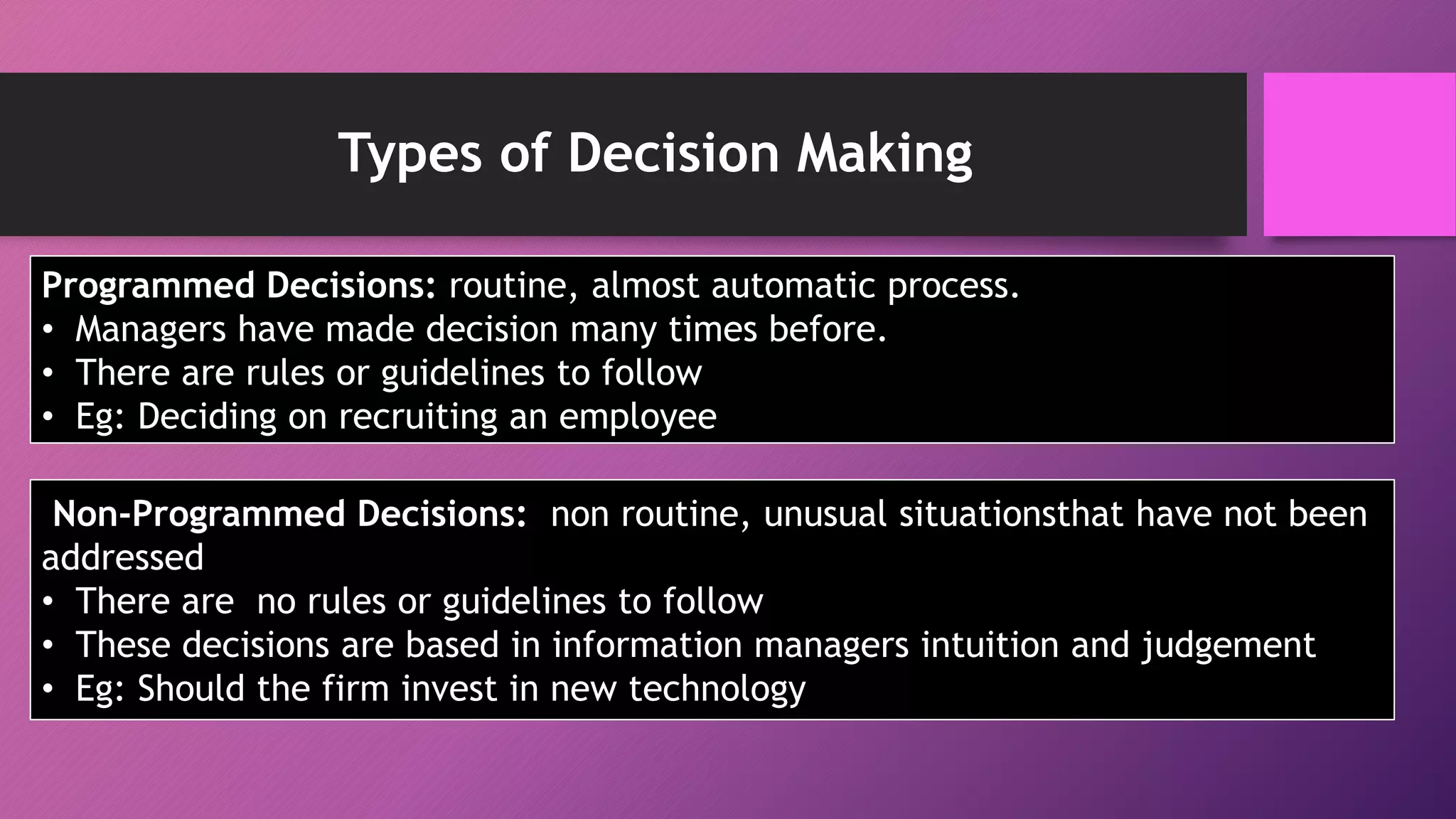
Types of Decision Making
Programmed Decisions: routine, almost automatic process.
• Managers have made decision many times before.
• There are rules or guidelines to follow
• Eg: Deciding on recruiting an employee
Non-Programmed Decisions: non routine, unusual situationsthat have not been
addressed
• There are no rules or guidelines to follow
• These decisions are based in information managers intuition and judgement
• Eg: Should the firm invest in new technology
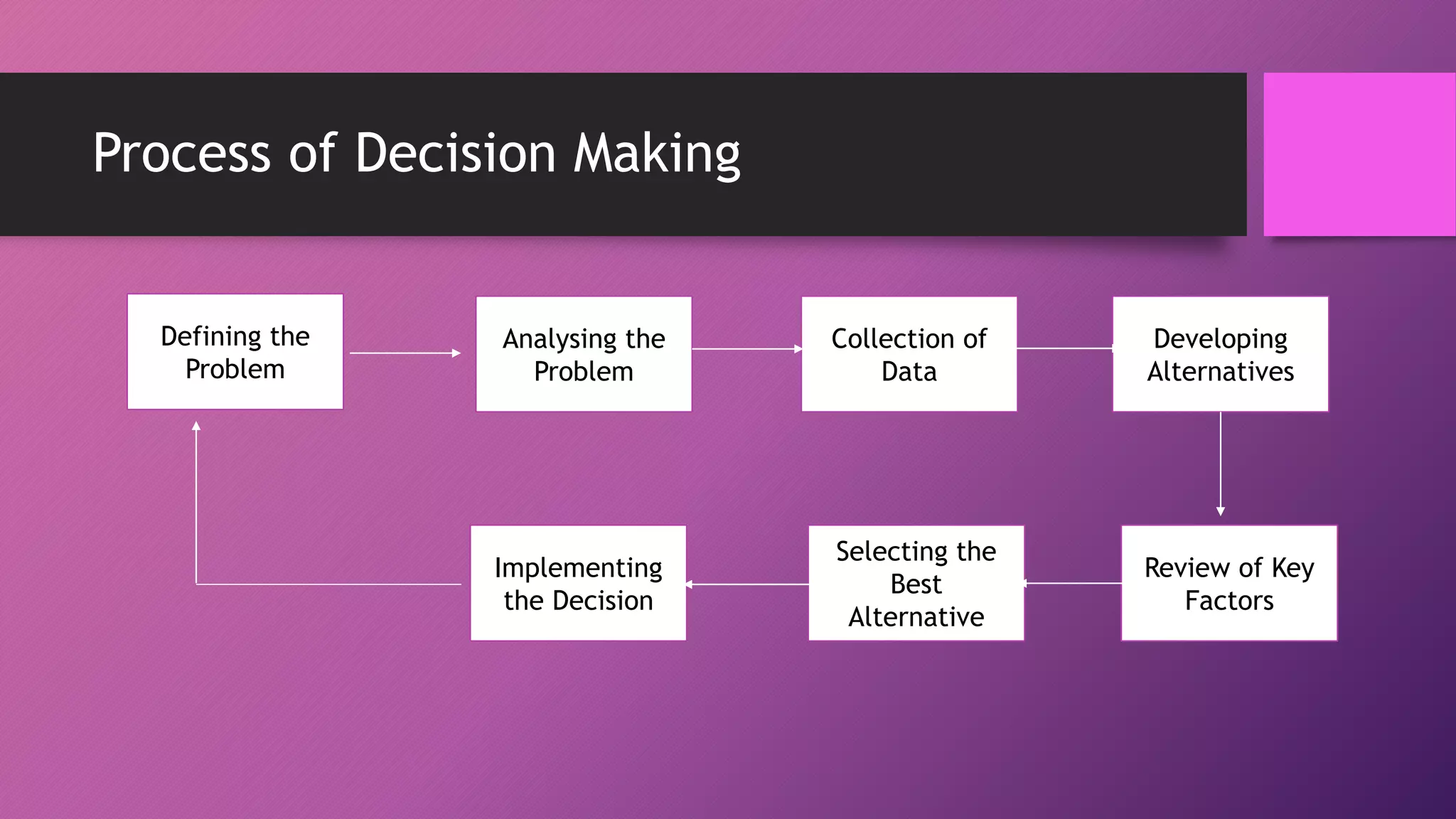
Process of Decision Making
Defining the
Problem
Selecting the
Best
Alternative
Review of Key
Factors
Developing
Alternatives
Collection of
Data
Analysing the
Problem
Implementing
the Decision
Techniques of Decision Making
• Marginal Cost Analysis
• Cost- Benefit Analysis
• Operations Research
• Linear Programming
• Network Analysis
Classical Model of Decision Making
• It is a prescriptive model that tells how the decisions should be
made.
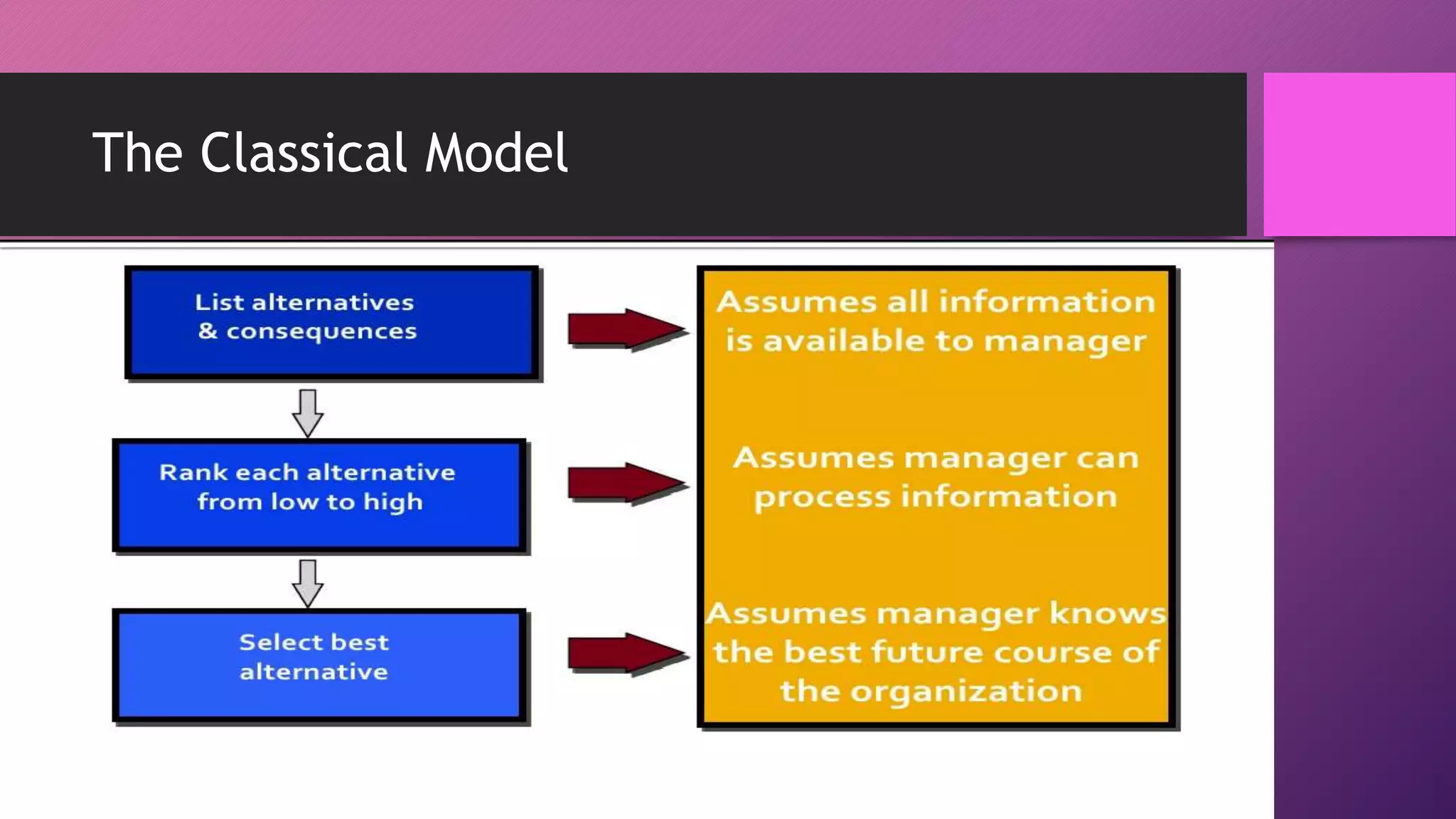
• This model assumes manager have access to all the information
needed to reach a decision.
• Managers can then make the optimum decision easily ranking their
own preferences among alternatives
• Unfortunately , managers often do not have sufficient Information
The Classical Model
Principle of Bounded Rationality
• Managers makes decision which involve different combination of
intuition and Rational thinking.
• A Manager who depends upon intuition is more subjective and a
person who depends upon Logical thinking is more objective.
• Simon emphasized that a person makes decision not only on
absolutely logical analysis of facts but also on his Intitution , value
system and way of thinking, which are subjective in nature.
Concept
• The Administrative man seeks satisfying(not optimal) decisions
which are satisfactorily for his practical purposes.
• He makes decisions which are good enough and do not make
undue demand on his time, efforts and money.
Causes of Bounded Rationality
• The Individual does not study and analyse the problem fully
because of personal bias , indifferent attitude etc.
• The Individual does not have full knowledge of alternatives and/
or their consequences.
• The Individual interprets the organizational goals in his own way.
He may adopt a course of action which according to him will meet
the goals effectively.
• The Individual does not search for best solution, but for “good
enough solutions". In other words, he aims at “satisfactory” rather
than optimum decision.
• The effectiveness of a decision is dependet upon environmental
factors which are beyond the control of decision makers.

DECISION MAKING.pptx

  • 1.
  • 2.
    Defined • “It isa process of selection from a set of alternative courses of action which is thought to fulfil the objectives of the decision problem more satisfactorily than other.” • It is course of action which is consciously chosen for achieving a desired result. • It is a process of establishing goals, defining tasks, searching for alternatives and developing plans in order to find the best answer to the decision problem. • It is the core of managerial activity
  • 3.
    Interlinkage between DecisionMaking and Planning • Decision – Making and planning are deeply interlinked. the determination of objectives, policies , programmes , strategies etc. involves Decision making
  • 4.
    Types of DecisionMaking Programmed Decisions: routine, almost automatic process. • Managers have made decision many times before. • There are rules or guidelines to follow • Eg: Deciding on recruiting an employee Non-Programmed Decisions: non routine, unusual situationsthat have not been addressed • There are no rules or guidelines to follow • These decisions are based in information managers intuition and judgement • Eg: Should the firm invest in new technology
  • 5.
    Process of DecisionMaking Defining the Problem Selecting the Best Alternative Review of Key Factors Developing Alternatives Collection of Data Analysing the Problem Implementing the Decision
  • 6.
    Techniques of DecisionMaking • Marginal Cost Analysis • Cost- Benefit Analysis • Operations Research • Linear Programming • Network Analysis
  • 7.
    Classical Model ofDecision Making • It is a prescriptive model that tells how the decisions should be made. • This model assumes manager have access to all the information needed to reach a decision. • Managers can then make the optimum decision easily ranking their own preferences among alternatives • Unfortunately , managers often do not have sufficient Information
  • 8.
  • 9.
    Principle of BoundedRationality • Managers makes decision which involve different combination of intuition and Rational thinking. • A Manager who depends upon intuition is more subjective and a person who depends upon Logical thinking is more objective. • Simon emphasized that a person makes decision not only on absolutely logical analysis of facts but also on his Intitution , value system and way of thinking, which are subjective in nature.
  • 10.
    Concept • The Administrativeman seeks satisfying(not optimal) decisions which are satisfactorily for his practical purposes. • He makes decisions which are good enough and do not make undue demand on his time, efforts and money.
  • 11.
    Causes of BoundedRationality • The Individual does not study and analyse the problem fully because of personal bias , indifferent attitude etc. • The Individual does not have full knowledge of alternatives and/ or their consequences. • The Individual interprets the organizational goals in his own way. He may adopt a course of action which according to him will meet the goals effectively. • The Individual does not search for best solution, but for “good enough solutions". In other words, he aims at “satisfactory” rather than optimum decision. • The effectiveness of a decision is dependet upon environmental factors which are beyond the control of decision makers.