THE KAIZEN FORUM DECISION MAKING
DECISION MAKING “ A manager by profession is a decision maker; Uncertainty is his opponent, overcoming it is his mission.” “ A decision is a judgement.  It is a choice between alternatives.  It is rarely a choice between right and wrong.  It is at best a choice between  “almost  right” and “probably wrong”. “ DRUCKER”
CONCEPTS TO BE COVERED “ When making decisions don’t get paralysis through analysis”. Limitations of rational decision  making model Models of decision making. Individual vs Group decision making.. Your individual decision making style? Why decision fails? Guidelines for decision making.
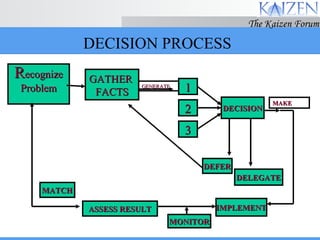
DECISION PROCESS R ecognize Problem GATHER  FACTS 1 2 3 GENERATE DECISION MONITOR DEFER DELEGATE IMPLEMENT MAKE ASSESS RESULT MATCH
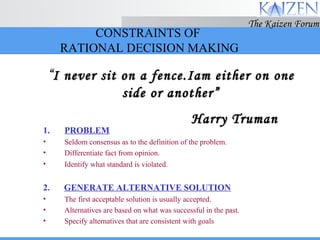
CONSTRAINTS OF  RATIONAL DECISION MAKING PROBLEM Seldom consensus as to the definition of the problem. Differentiate fact from opinion. Identify what standard is   violated. 2.   GENERATE ALTERNATIVE SOLUTION The first acceptable solution is usually accepted. Alternatives are based on what was successful in the past. Specify alternatives that are consistent with goals “ I never sit on a fence.Iam either on one side or another” Harry Truman
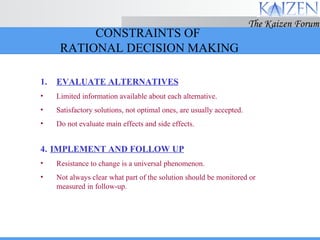
EVALUATE ALTERNATIVES Limited information available about each alternative.  Satisfactory solutions, not optimal ones, are usually accepted. Do not evaluate main effects and side effects. CONSTRAINTS OF  RATIONAL DECISION MAKING 4.   IMPLEMENT AND FOLLOW UP Resistance to change is a universal phenomenon. Not always clear what part of the solution should be monitored or measured in follow-up.
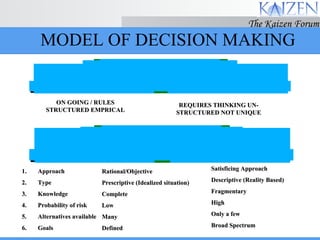
ON GOING / RULES STRUCTURED EMPRICAL REQUIRES THINKING UN-STRUCTURED NOT UNIQUE MODEL OF DECISION MAKING Approach Type Knowledge Probability of risk Alternatives available Goals Rational/Objective Prescriptive (Idealized situation) Complete Low Many Defined Satisficing Approach Descriptive (Reality Based) Fragmentary High Only a few Broad Spectrum
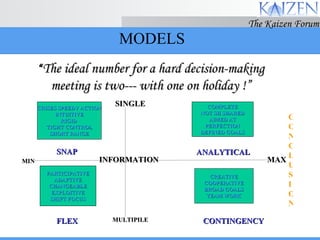
MODELS CRISES SPEEDY ACTION INTUITIVE  RIGID  TIGHT CONTROL SHORT RANGE SINGLE COMPLETE NOT SH SHARED AIMED AT PERFECTION DEFINED GOALS ANALYTICAL SNAP MIN MAX PARTICIPATIVE ADAPTIVE CHANGEABLE EXPLOITIVE SHIFT FOCUS FLEX MULTIPILE CONTINGENCY CREATIVE COOPERATIVE BROAD GOALS TEAM WORK “ The ideal number for a hard decision-making meeting is two--- with one on holiday !” INFORMATION CONCLUSION
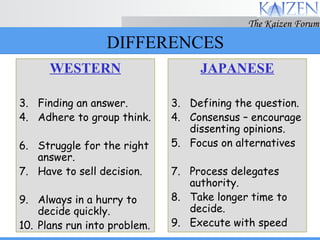
DIFFERENCES WESTERN Finding an answer. Adhere to group think. Struggle for the right answer. Have to sell decision. Always in a hurry to decide quickly. Plans run into problem. JAPANESE Defining the question. Consensus – encourage dissenting opinions. Focus on alternatives Process delegates authority. Take longer time to decide. Execute with speed
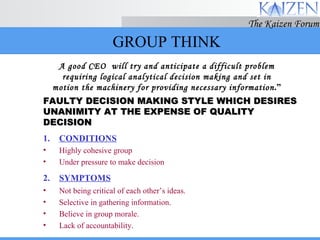
GROUP THINK A good CEO  will try and anticipate a difficult problem requiring logical analytical decision making and set in motion the machinery for providing necessary information .” CONDITIONS Highly cohesive group Under pressure to make decision 2. SYMPTOMS Not being critical of each other’s ideas. Selective in gathering information. Believe in group morale. Lack of accountability. FAULTY DECISION MAKING STYLE WHICH DESIRES UNANIMITY AT THE EXPENSE OF QUALITY  DECISION
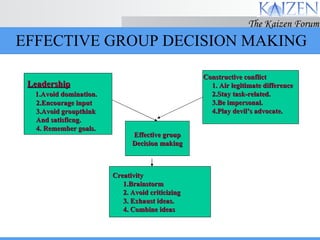
EFFECTIVE GROUP DECISION MAKING Leadership 1.Avoid domination. 2.Encourage input 3.Avoid groupthink  And satisficng. 4. Remember goals. Constructive conflict 1. Air legitimate difference 2.Stay task-related. 3.Be impersonal. 4.Play devil’s advocate. Effective group Decision making Creativity 1.Brainstorm 2. Avoid criticizing 3. Exhaust ideas. 4. Combine ideas
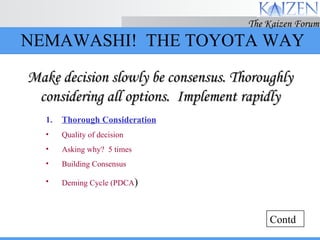
NEMAWASHI!  THE TOYOTA WAY Make decision slowly be consensus. Thoroughly considering all options.  Implement rapidly Thorough Consideration Quality of decision Asking why?  5 times Building Consensus Deming Cycle (PDCA ) Contd
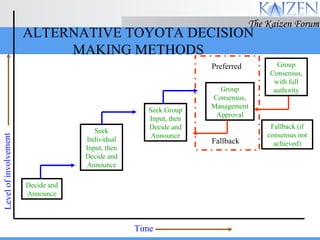
Decide and Announce Seek Individual Input, then Decide and Announce Seek Group Input, then Decide and Announce Group Consensus, Management Approval Group Consensus, with full authority Time Level of involvement Preferred Fallback Fallback (if consensus not achieved) ALTERNATIVE TOYOTA DECISION MAKING METHODS
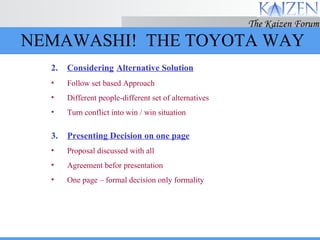
2. Considering   Alternative Solution Follow set based Approach Different people-different set of alternatives Turn conflict into win / win situation 3. Presenting Decision on one page Proposal discussed with all Agreement befor presentation One page – formal decision only formality NEMAWASHI!  THE TOYOTA WAY
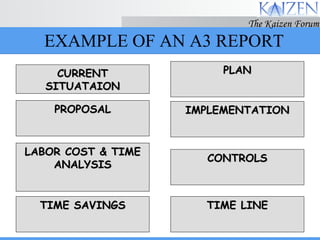
EXAMPLE OF AN A3 REPORT CURRENT SITUATAION PROPOSAL LABOR COST & TIME ANALYSIS TIME SAVINGS PLAN IMPLEMENTATION CONTROLS TIME LINE
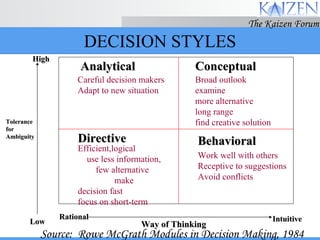
DECISION STYLES High Low Tolerance  for  Ambiguity Rational Intuitive Way of Thinking Careful decision makers Adapt to new situation Efficient,logical  use less information,  few alternative    make decision fast  focus on short-term Broad outlook examine  more alternative  long range  find creative solution Work well with others Receptive to suggestions Avoid conflicts Source:  Rowe McGrath Modules in Decision Making, 1984 Behavioral Conceptual Directive Analytical
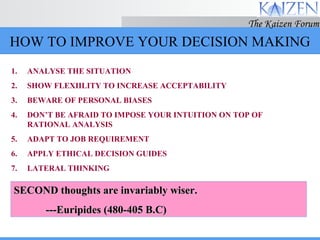
HOW TO IMPROVE YOUR DECISION MAKING ANALYSE THE SITUATION SHOW FLEXIILITY TO INCREASE ACCEPTABILITY BEWARE OF PERSONAL BIASES DON’T BE AFRAID TO IMPOSE YOUR INTUITION ON TOP OF RATIONAL ANALYSIS ADAPT TO JOB REQUIREMENT APPLY ETHICAL DECISION GUIDES LATERAL THINKING SECOND thoughts are invariably wiser. ---Euripides (480-405 B.C)
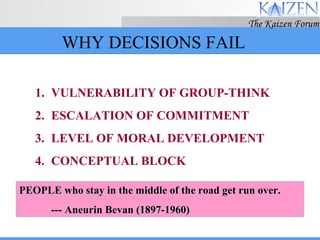
WHY DECISIONS FAIL VULNERABILITY OF GROUP-THINK ESCALATION OF COMMITMENT LEVEL OF MORAL DEVELOPMENT CONCEPTUAL BLOCK PEOPLE who stay in the middle of the road get run over. --- Aneurin Bevan (1897-1960)
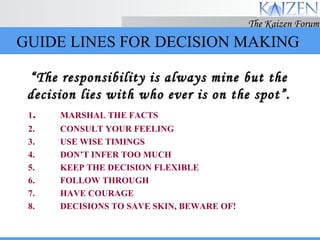
GUIDE LINES FOR DECISION MAKING 1 . MARSHAL THE FACTS 2. CONSULT YOUR FEELING 3. USE WISE TIMINGS 4. DON’T INFER TOO MUCH 5. KEEP THE DECISION FLEXIBLE 6. FOLLOW THROUGH 7. HAVE COURAGE 8. DECISIONS TO SAVE SKIN, BEWARE OF! “ The responsibility is always mine but the decision lies with who ever is on the spot”.

Decision Making

  • 1.
    THE KAIZEN FORUMDECISION MAKING
  • 2.
    DECISION MAKING “A manager by profession is a decision maker; Uncertainty is his opponent, overcoming it is his mission.” “ A decision is a judgement. It is a choice between alternatives. It is rarely a choice between right and wrong. It is at best a choice between “almost right” and “probably wrong”. “ DRUCKER”
  • 3.
    CONCEPTS TO BECOVERED “ When making decisions don’t get paralysis through analysis”. Limitations of rational decision making model Models of decision making. Individual vs Group decision making.. Your individual decision making style? Why decision fails? Guidelines for decision making.
  • 4.
    DECISION PROCESS Recognize Problem GATHER FACTS 1 2 3 GENERATE DECISION MONITOR DEFER DELEGATE IMPLEMENT MAKE ASSESS RESULT MATCH
  • 5.
    CONSTRAINTS OF RATIONAL DECISION MAKING PROBLEM Seldom consensus as to the definition of the problem. Differentiate fact from opinion. Identify what standard is violated. 2. GENERATE ALTERNATIVE SOLUTION The first acceptable solution is usually accepted. Alternatives are based on what was successful in the past. Specify alternatives that are consistent with goals “ I never sit on a fence.Iam either on one side or another” Harry Truman
  • 6.
    EVALUATE ALTERNATIVES Limitedinformation available about each alternative. Satisfactory solutions, not optimal ones, are usually accepted. Do not evaluate main effects and side effects. CONSTRAINTS OF RATIONAL DECISION MAKING 4. IMPLEMENT AND FOLLOW UP Resistance to change is a universal phenomenon. Not always clear what part of the solution should be monitored or measured in follow-up.
  • 7.
    ON GOING /RULES STRUCTURED EMPRICAL REQUIRES THINKING UN-STRUCTURED NOT UNIQUE MODEL OF DECISION MAKING Approach Type Knowledge Probability of risk Alternatives available Goals Rational/Objective Prescriptive (Idealized situation) Complete Low Many Defined Satisficing Approach Descriptive (Reality Based) Fragmentary High Only a few Broad Spectrum
  • 8.
    MODELS CRISES SPEEDYACTION INTUITIVE RIGID TIGHT CONTROL SHORT RANGE SINGLE COMPLETE NOT SH SHARED AIMED AT PERFECTION DEFINED GOALS ANALYTICAL SNAP MIN MAX PARTICIPATIVE ADAPTIVE CHANGEABLE EXPLOITIVE SHIFT FOCUS FLEX MULTIPILE CONTINGENCY CREATIVE COOPERATIVE BROAD GOALS TEAM WORK “ The ideal number for a hard decision-making meeting is two--- with one on holiday !” INFORMATION CONCLUSION
  • 9.
    DIFFERENCES WESTERN Findingan answer. Adhere to group think. Struggle for the right answer. Have to sell decision. Always in a hurry to decide quickly. Plans run into problem. JAPANESE Defining the question. Consensus – encourage dissenting opinions. Focus on alternatives Process delegates authority. Take longer time to decide. Execute with speed
  • 10.
    GROUP THINK Agood CEO will try and anticipate a difficult problem requiring logical analytical decision making and set in motion the machinery for providing necessary information .” CONDITIONS Highly cohesive group Under pressure to make decision 2. SYMPTOMS Not being critical of each other’s ideas. Selective in gathering information. Believe in group morale. Lack of accountability. FAULTY DECISION MAKING STYLE WHICH DESIRES UNANIMITY AT THE EXPENSE OF QUALITY DECISION
  • 11.
    EFFECTIVE GROUP DECISIONMAKING Leadership 1.Avoid domination. 2.Encourage input 3.Avoid groupthink And satisficng. 4. Remember goals. Constructive conflict 1. Air legitimate difference 2.Stay task-related. 3.Be impersonal. 4.Play devil’s advocate. Effective group Decision making Creativity 1.Brainstorm 2. Avoid criticizing 3. Exhaust ideas. 4. Combine ideas
  • 12.
    NEMAWASHI! THETOYOTA WAY Make decision slowly be consensus. Thoroughly considering all options. Implement rapidly Thorough Consideration Quality of decision Asking why? 5 times Building Consensus Deming Cycle (PDCA ) Contd
  • 13.
    Decide and AnnounceSeek Individual Input, then Decide and Announce Seek Group Input, then Decide and Announce Group Consensus, Management Approval Group Consensus, with full authority Time Level of involvement Preferred Fallback Fallback (if consensus not achieved) ALTERNATIVE TOYOTA DECISION MAKING METHODS
  • 14.
    2. Considering Alternative Solution Follow set based Approach Different people-different set of alternatives Turn conflict into win / win situation 3. Presenting Decision on one page Proposal discussed with all Agreement befor presentation One page – formal decision only formality NEMAWASHI! THE TOYOTA WAY
  • 15.
    EXAMPLE OF ANA3 REPORT CURRENT SITUATAION PROPOSAL LABOR COST & TIME ANALYSIS TIME SAVINGS PLAN IMPLEMENTATION CONTROLS TIME LINE
  • 16.
    DECISION STYLES HighLow Tolerance for Ambiguity Rational Intuitive Way of Thinking Careful decision makers Adapt to new situation Efficient,logical use less information, few alternative make decision fast focus on short-term Broad outlook examine more alternative long range find creative solution Work well with others Receptive to suggestions Avoid conflicts Source: Rowe McGrath Modules in Decision Making, 1984 Behavioral Conceptual Directive Analytical
  • 17.
    HOW TO IMPROVEYOUR DECISION MAKING ANALYSE THE SITUATION SHOW FLEXIILITY TO INCREASE ACCEPTABILITY BEWARE OF PERSONAL BIASES DON’T BE AFRAID TO IMPOSE YOUR INTUITION ON TOP OF RATIONAL ANALYSIS ADAPT TO JOB REQUIREMENT APPLY ETHICAL DECISION GUIDES LATERAL THINKING SECOND thoughts are invariably wiser. ---Euripides (480-405 B.C)
  • 18.
    WHY DECISIONS FAILVULNERABILITY OF GROUP-THINK ESCALATION OF COMMITMENT LEVEL OF MORAL DEVELOPMENT CONCEPTUAL BLOCK PEOPLE who stay in the middle of the road get run over. --- Aneurin Bevan (1897-1960)
  • 19.
    GUIDE LINES FORDECISION MAKING 1 . MARSHAL THE FACTS 2. CONSULT YOUR FEELING 3. USE WISE TIMINGS 4. DON’T INFER TOO MUCH 5. KEEP THE DECISION FLEXIBLE 6. FOLLOW THROUGH 7. HAVE COURAGE 8. DECISIONS TO SAVE SKIN, BEWARE OF! “ The responsibility is always mine but the decision lies with who ever is on the spot”.