DECISION MAKING CSH Pharma Group
What you think what is decision making?
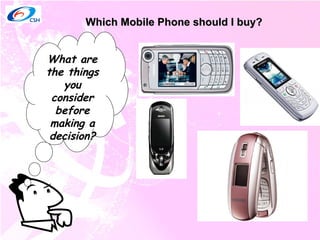
Which Mobile Phone should I buy? What are the things you consider before making a decision?
What are the things you consider before making a decision?
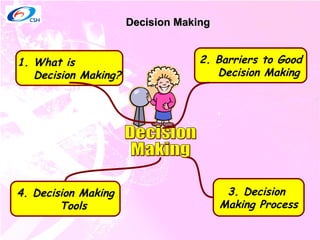
Decision Making Decision  Making What is  Decision Making? 2. Barriers to Good Decision Making 4. Decision Making Tools 3. Decision  Making Process
Decision Making The process of examining your possibilities options, comparing them, and choosing a course of action.   A choice from two or more alternative
Barriers to Good Decision Making  “ Successful leaders have the courage to take action while others hesitate.” -  John C. Maxwell
Hasty  -  Making quick decisions without having much thought. Narrow  -   Decision making is based on very limited information.  Scattered  -  Our thoughts in making decisions are disconnected or disorganized. Fuzzy -  Sometimes, the lack of clarity on important aspects of a decision causes us to overlook certain important considerations.
Making Effective Decisions Perception. Priority.  Acceptability. Risk.  Resources. Goals. Values.  Demands. Style.  Judgment.
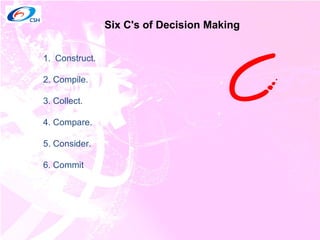
Six C's of Decision Making Construct. 2. Compile. 3. Collect.  4. Compare. 5. Consider. 6. Commit
Construct   a clear picture of  precisely what must be decided. Compile  a list of requirements that must be met . Collect  information on alternatives  that meet the requirements
Compare  alternatives that meet  the requirements.  Consider  the " what might go wrong " factor with each alternative. Commit  to a decision and follow through with it.
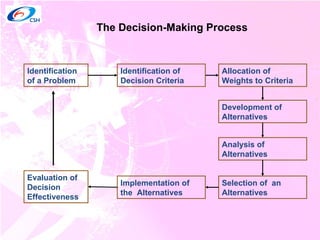
The Decision-Making Process Identification of a Problem Identification of Decision Criteria Allocation of Weights to Criteria Development of Alternatives Analysis of Alternatives Selection of  an Alternatives Implementation of the  Alternatives Evaluation of Decision Effectiveness
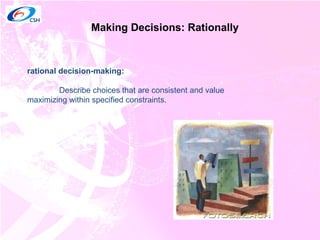
Making Decisions: Rationally rational decision-making: Describe choices that are consistent and value maximizing within specified constraints.
Making Decisions:  Bounded Rationality bounded rationality decision-making: Behavior that is rational within the parameters of a simplified decision-making process, which is limited (or bounded) by an individual’s ability to process information.
Intuition decision-making: Intuition decision-making: a subconscious process of making decision on the basis of experience and accumulated judgment .
Decision Making Styles
Directive Style A decision making style characterized by low tolerance for ambiguity and a rational way of thinking. They’re efficient and logical Directive types makes fast decisions and focus on  the short run
Analytical Style A decision making style characterized by a high tolerance a high tolerance ambiguity and a rational way of thinking. They want more information before making decision and consider more alternatives
Conceptual Style A decision making style characterized by a high tolerance for ambiguity and an intuitive way of thinking. Very broad in the their outlook and will look at  many alternatives They focus on the long run and very good at  finding creative solutions to problem
Behavioral Style A decision making style characterized by a high tolerance a low tolerance ambiguity and an intuitive way of thinking. They’re concerned about the achievements of subordinates and are receptive to suggestion from others
Decision Making Tools Tool to facilitate better decisions: SWOT ANALYSIS
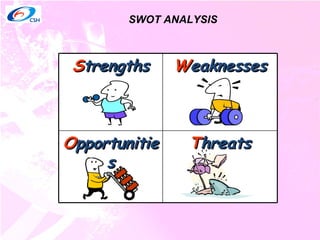
SWOT ANALYSIS T hreats O pportunities W eaknesses S trengths
SWOT  analysis is a great technique for identifying your  S trengths  and  W eaknesses  and study any  O pportunities  and  T hreats  you face. It is also a powerful  strategic planning tool  used to evaluate a project or in a business venture or in any other situation of an organization or individual requiring a decision in pursuit of an objective.  It involves monitoring the marketing environment  internal  and  external  to the organization or individual.

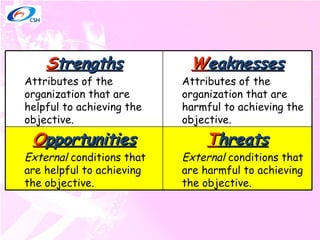
T hreats External  conditions that are harmful to achieving the objective. O pportunities External  conditions that are helpful to achieving the objective. W eaknesses Attributes of the organization that are harmful to achieving the objective. S trengths Attributes of the organization that are helpful to achieving the objective.
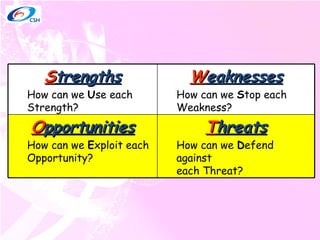
T hreats How can we  D efend against  each Threat? O pportunities How can we  E xploit each Opportunity? W eaknesses How can we  S top each Weakness? S trengths How can we  U se each Strength?
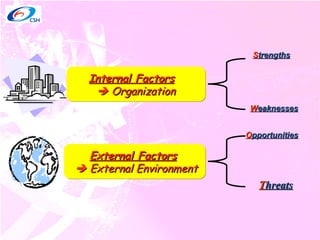
Internal Factors      Organization External Factors      External Environment S trengths W eaknesses O pportunities T hreats
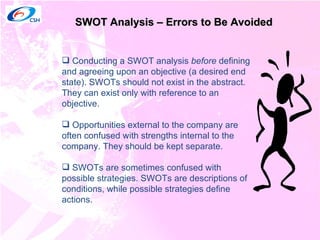
SWOT Analysis – Errors to Be Avoided Conducting a SWOT analysis  before  defining and agreeing upon an objective (a desired end state). SWOTs should not exist in the abstract. They can exist only with reference to an objective.  Opportunities external to the company are often confused with strengths internal to the company. They should be kept separate. SWOTs are sometimes confused with possible strategies. SWOTs are descriptions of conditions, while possible strategies define actions.
Group decision-making
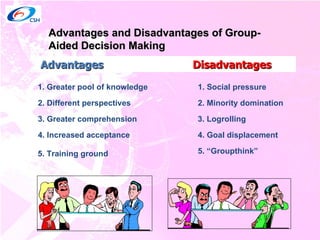
Advantages and Disadvantages of Group-Aided Decision Making Advantages   Disadvantages 1. Greater pool of knowledge 2. Different perspectives 3. Greater comprehension 4. Increased acceptance 5. Training ground 1. Social pressure 2. Minority domination 3. Logrolling 4. Goal displacement 5. “Groupthink”
Group Problem Solving Techniques Definition of consensus  – . . . reached when all members can say they either agree . . . Or have had their “day in court” and were unable to convince the others of their viewpoint.  In the final analysis, everyone agrees to support the outcome
Other approaches to a group decision Unanimity A minority or one decides
Brainstorming  - disciplined process Silent idea (optional) Ideas/opinions solicited and written on a  board, disallowing criticisms, allowing  piggy-backing on ideas, clarification Delphi technique  is another, more formal  form of brainstorming. Involves several  rounds of questionnaire, feedback, etc.  Useful in cases where participants are not in  the same place.
Nominal Group Technique  – used to narrow down options through voting. Computer-aided Decision Making Uses computers to manage brainstorming or Delphi questioning
Any Questions?


Decision Making

  • 1.
    DECISION MAKING CSHPharma Group
  • 2.
    What you thinkwhat is decision making?
  • 3.
    Which Mobile Phoneshould I buy? What are the things you consider before making a decision?
  • 4.
    What are thethings you consider before making a decision?
  • 5.
    Decision Making Decision Making What is Decision Making? 2. Barriers to Good Decision Making 4. Decision Making Tools 3. Decision Making Process
  • 6.
    Decision Making Theprocess of examining your possibilities options, comparing them, and choosing a course of action. A choice from two or more alternative
  • 7.
    Barriers to GoodDecision Making “ Successful leaders have the courage to take action while others hesitate.” - John C. Maxwell
  • 8.
    Hasty - Making quick decisions without having much thought. Narrow - Decision making is based on very limited information. Scattered - Our thoughts in making decisions are disconnected or disorganized. Fuzzy - Sometimes, the lack of clarity on important aspects of a decision causes us to overlook certain important considerations.
  • 9.
    Making Effective DecisionsPerception. Priority. Acceptability. Risk. Resources. Goals. Values. Demands. Style. Judgment.
  • 10.
    Six C's ofDecision Making Construct. 2. Compile. 3. Collect. 4. Compare. 5. Consider. 6. Commit
  • 11.
    Construct a clear picture of precisely what must be decided. Compile a list of requirements that must be met . Collect information on alternatives that meet the requirements
  • 12.
    Compare alternativesthat meet the requirements. Consider the " what might go wrong " factor with each alternative. Commit to a decision and follow through with it.
  • 13.
    The Decision-Making ProcessIdentification of a Problem Identification of Decision Criteria Allocation of Weights to Criteria Development of Alternatives Analysis of Alternatives Selection of an Alternatives Implementation of the Alternatives Evaluation of Decision Effectiveness
  • 14.
    Making Decisions: Rationallyrational decision-making: Describe choices that are consistent and value maximizing within specified constraints.
  • 15.
    Making Decisions: Bounded Rationality bounded rationality decision-making: Behavior that is rational within the parameters of a simplified decision-making process, which is limited (or bounded) by an individual’s ability to process information.
  • 16.
    Intuition decision-making: Intuitiondecision-making: a subconscious process of making decision on the basis of experience and accumulated judgment .
  • 17.
  • 18.
    Directive Style Adecision making style characterized by low tolerance for ambiguity and a rational way of thinking. They’re efficient and logical Directive types makes fast decisions and focus on the short run
  • 19.
    Analytical Style Adecision making style characterized by a high tolerance a high tolerance ambiguity and a rational way of thinking. They want more information before making decision and consider more alternatives
  • 20.
    Conceptual Style Adecision making style characterized by a high tolerance for ambiguity and an intuitive way of thinking. Very broad in the their outlook and will look at many alternatives They focus on the long run and very good at finding creative solutions to problem
  • 21.
    Behavioral Style Adecision making style characterized by a high tolerance a low tolerance ambiguity and an intuitive way of thinking. They’re concerned about the achievements of subordinates and are receptive to suggestion from others
  • 22.
    Decision Making ToolsTool to facilitate better decisions: SWOT ANALYSIS
  • 23.
    SWOT ANALYSIS Threats O pportunities W eaknesses S trengths
  • 24.
    SWOT analysisis a great technique for identifying your S trengths and W eaknesses and study any O pportunities and T hreats you face. It is also a powerful strategic planning tool used to evaluate a project or in a business venture or in any other situation of an organization or individual requiring a decision in pursuit of an objective. It involves monitoring the marketing environment internal and external to the organization or individual.

  • 25.

    T hreats External conditions that are harmful to achieving the objective. O pportunities External conditions that are helpful to achieving the objective. W eaknesses Attributes of the organization that are harmful to achieving the objective. S trengths Attributes of the organization that are helpful to achieving the objective.
  • 26.
    T hreats Howcan we D efend against each Threat? O pportunities How can we E xploit each Opportunity? W eaknesses How can we S top each Weakness? S trengths How can we U se each Strength?
  • 27.
    Internal Factors  Organization External Factors  External Environment S trengths W eaknesses O pportunities T hreats
  • 28.
    SWOT Analysis –Errors to Be Avoided Conducting a SWOT analysis before defining and agreeing upon an objective (a desired end state). SWOTs should not exist in the abstract. They can exist only with reference to an objective. Opportunities external to the company are often confused with strengths internal to the company. They should be kept separate. SWOTs are sometimes confused with possible strategies. SWOTs are descriptions of conditions, while possible strategies define actions.
  • 29.
  • 30.
    Advantages and Disadvantagesof Group-Aided Decision Making Advantages Disadvantages 1. Greater pool of knowledge 2. Different perspectives 3. Greater comprehension 4. Increased acceptance 5. Training ground 1. Social pressure 2. Minority domination 3. Logrolling 4. Goal displacement 5. “Groupthink”
  • 31.
    Group Problem SolvingTechniques Definition of consensus – . . . reached when all members can say they either agree . . . Or have had their “day in court” and were unable to convince the others of their viewpoint. In the final analysis, everyone agrees to support the outcome
  • 32.
    Other approaches toa group decision Unanimity A minority or one decides
  • 33.
    Brainstorming -disciplined process Silent idea (optional) Ideas/opinions solicited and written on a board, disallowing criticisms, allowing piggy-backing on ideas, clarification Delphi technique is another, more formal form of brainstorming. Involves several rounds of questionnaire, feedback, etc. Useful in cases where participants are not in the same place.
  • 34.
    Nominal Group Technique – used to narrow down options through voting. Computer-aided Decision Making Uses computers to manage brainstorming or Delphi questioning
  • 35.
  • 36.
  • 37.
  • 38.
  • 39.
  • 40.
  • 41.
  • 42.
  • 43.
  • 44.
  • 45.
  • 46.
  • 47.