DECISION MAKING IN MANAGEMENT
Managerial Decision MakingDecision making:the process by which managers respond to opportunities and threats by analyzing options, and making decisions about goals and courses of action.Decisions in response to opportunities:managers respond to ways to improve organizational performance.Decisions in response to threats:occurs when managers are impacted by adverse events to the organization.
Types of Decision MakingProgrammed Decisions:routine, almost automatic process.Managers have made decision many times before.There are rules or guidelines to follow.Example: Deciding to reorder office supplies.Non-programmed Decisions:unusual situations that have not been often addressed.No rules to follow since the decision is new.These decisions are made based on information, and a manger’s intuition, and judgment.Example: Should the firm invest in a new technology?
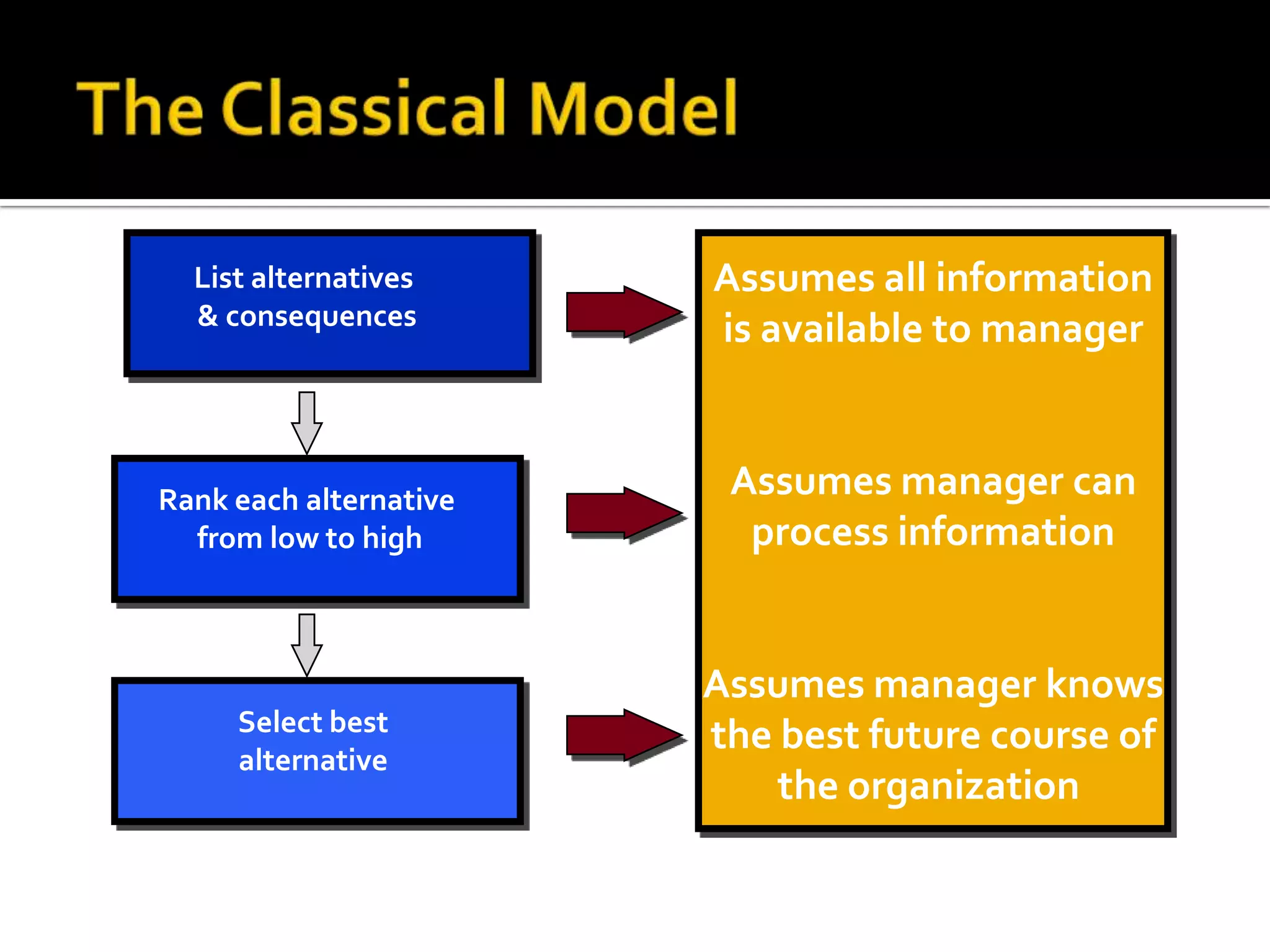
The Classical ModelClassical model of decision making:a prescriptive model that tells how the decision should be made.Assumes managers have access to all the information needed to reach a decision.Managers can then make the optimum decision by easily ranking their own preferences among alternatives.Unfortunately, mangers often do not have all (or even most) required information.
The Classical ModelAssumes all informationis available to managerAssumes manager canprocess informationAssumes manager knowsthe best future course ofthe organization List alternatives & consequencesRank each alternative from low to highSelect bestalternative
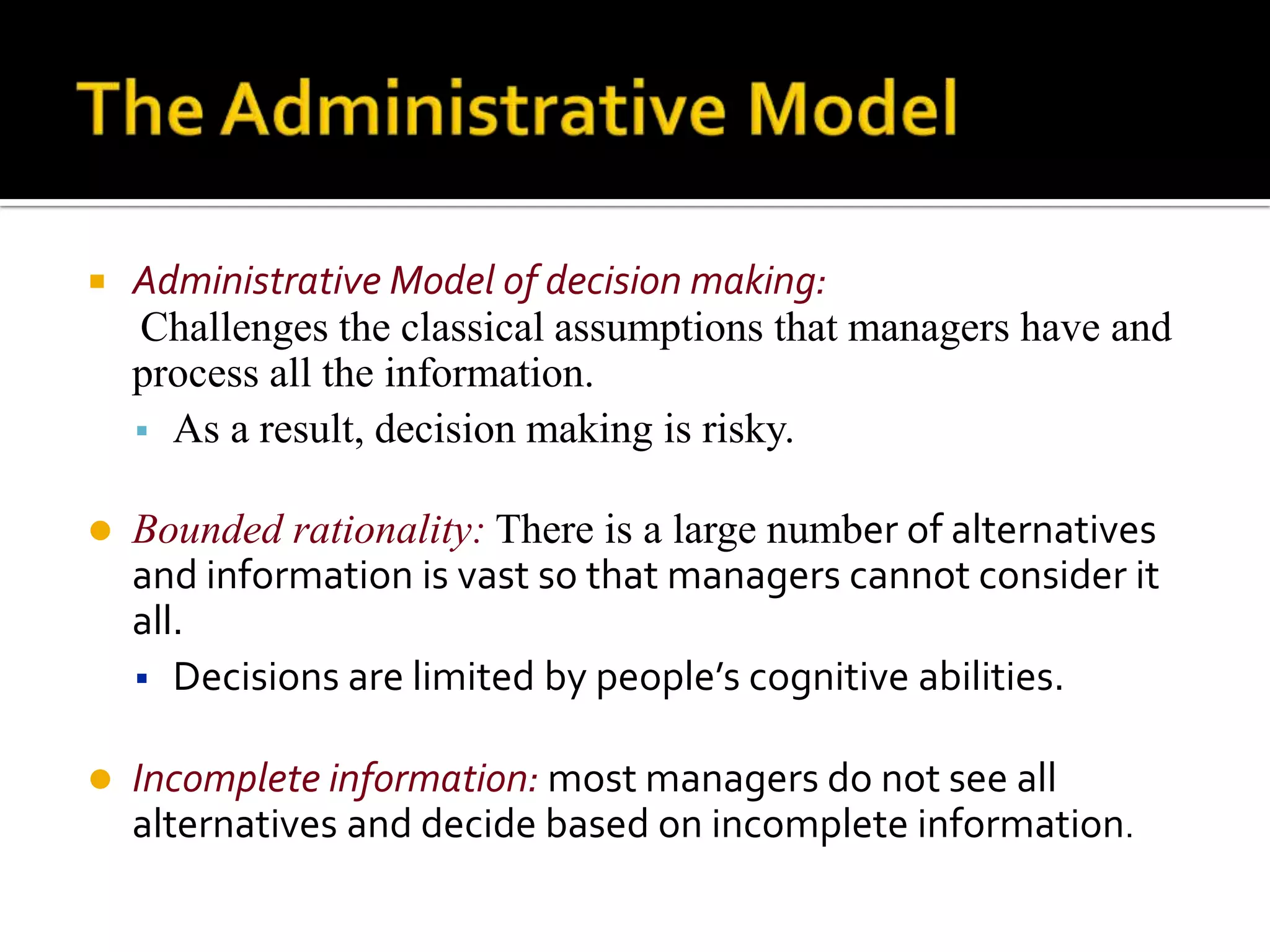
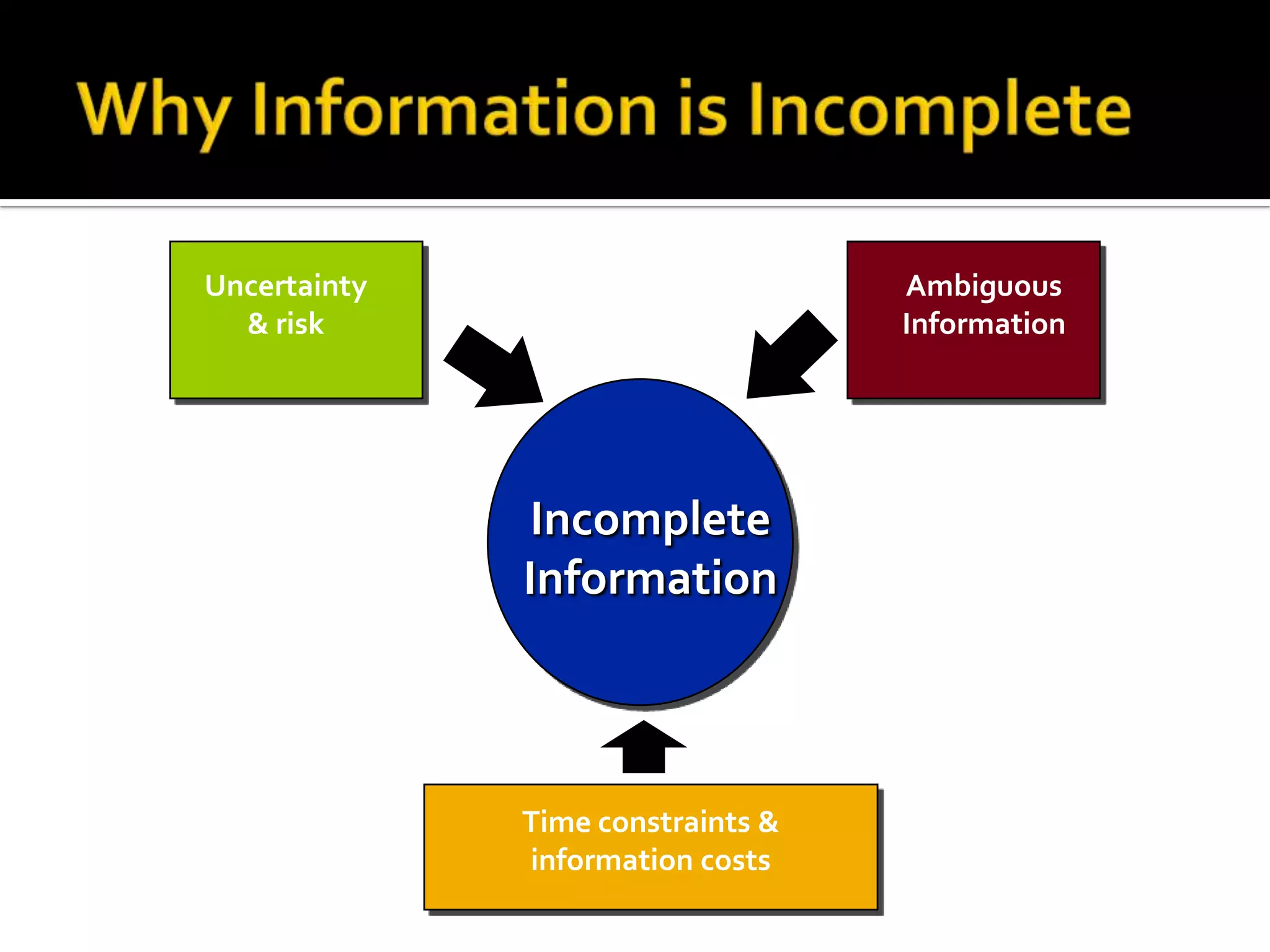
The Administrative ModelAdministrative Model of decision making:Challenges the classical assumptions that managers have and process all the information.As a result, decision making is risky.Bounded rationality:There is a large number of alternatives and information is vast so that managers cannot consider it all.Decisions are limited by people’s cognitive abilities.Incomplete information:most managers do not see all alternatives and decide based on incomplete information.Why Information is IncompleteUncertainty& riskAmbiguousInformationIncompleteInformationTime constraints &information costs
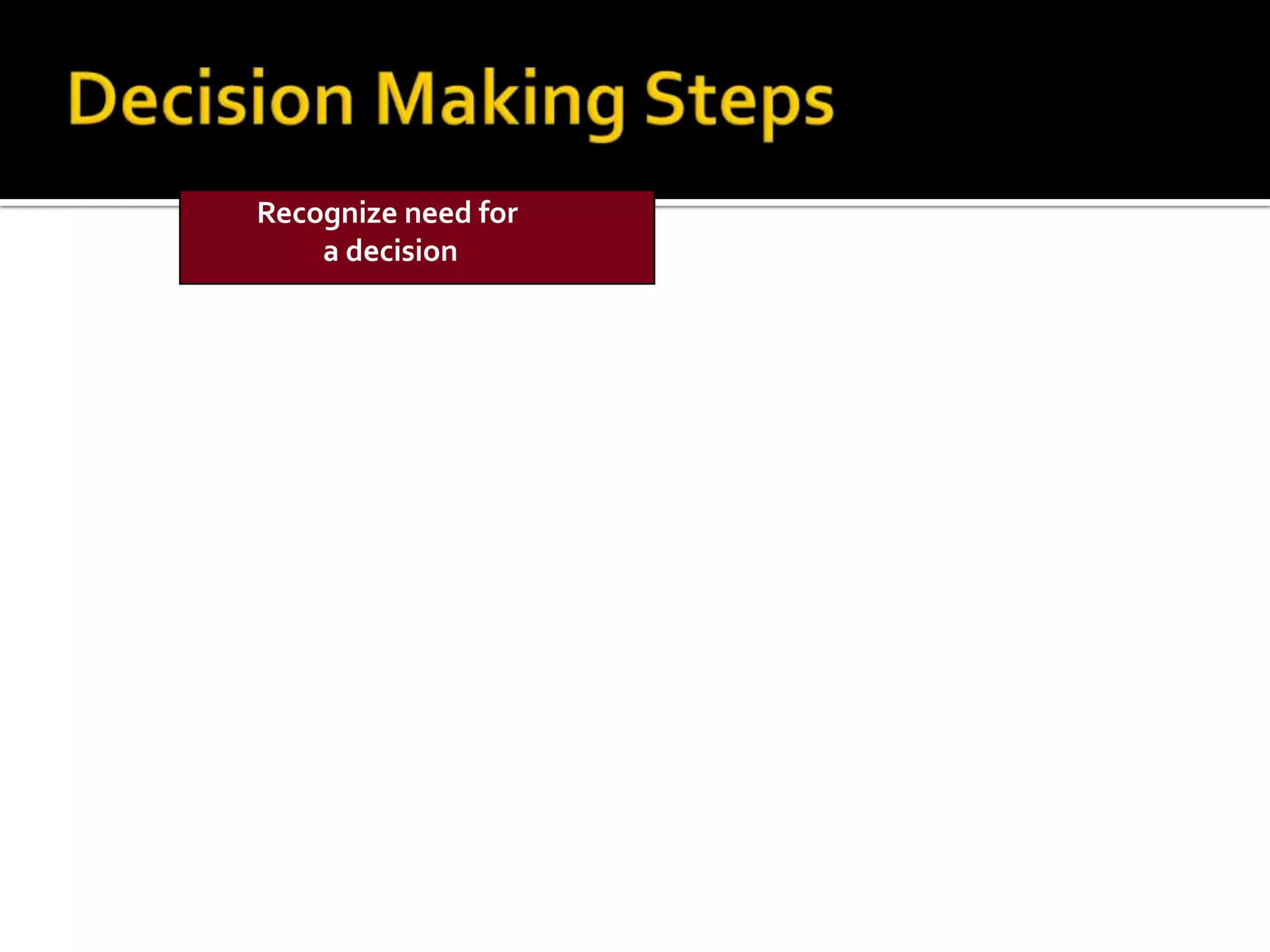
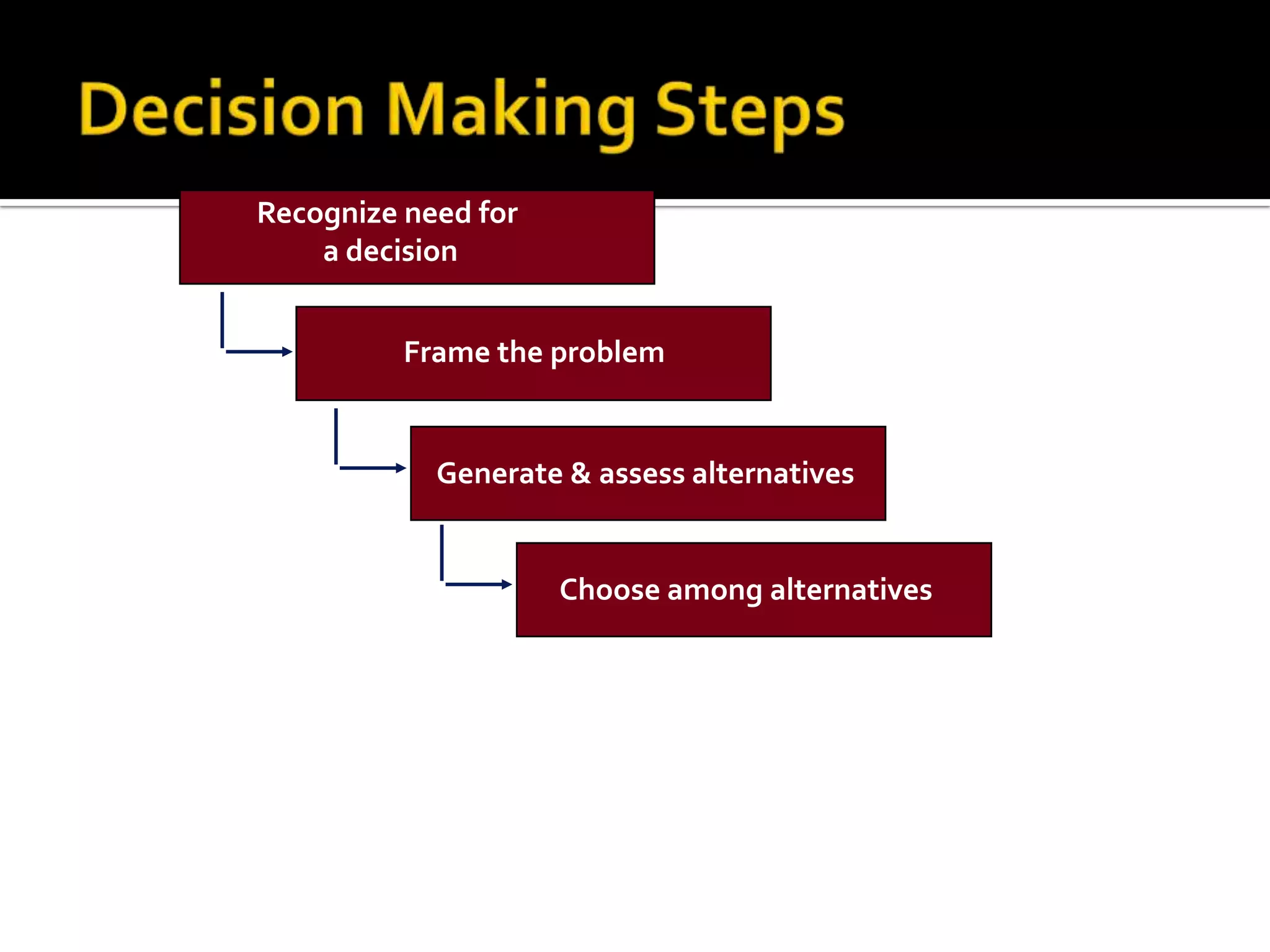
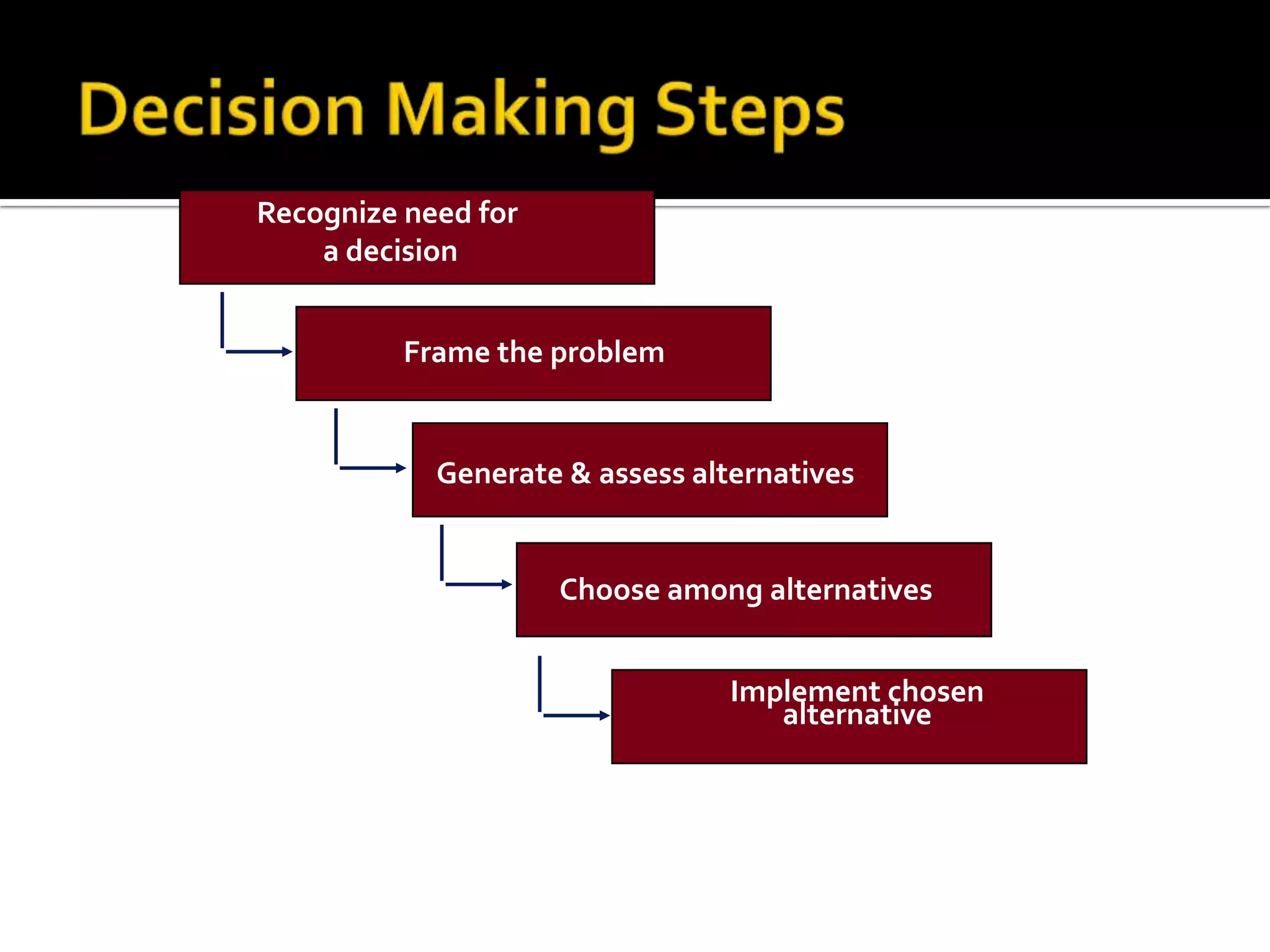
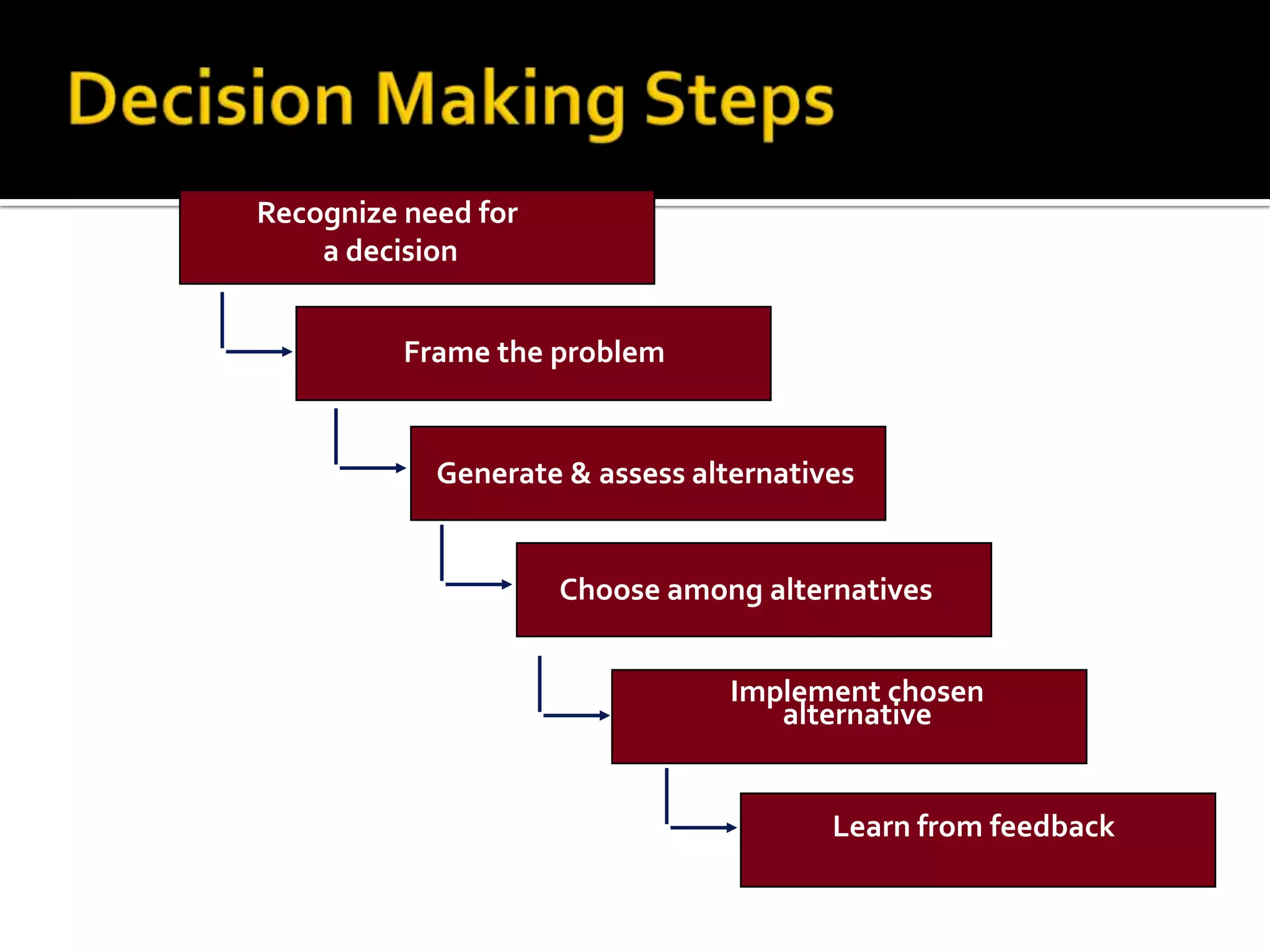
Decision Making StepsRecognize need for a decisionFrame the problemGenerate & assess alternativesChoose among alternativesImplement chosenalternativeLearn from feedback
Decision Making StepsRecognize need for a decision: Managers must first realize the need for which a decision must be made.
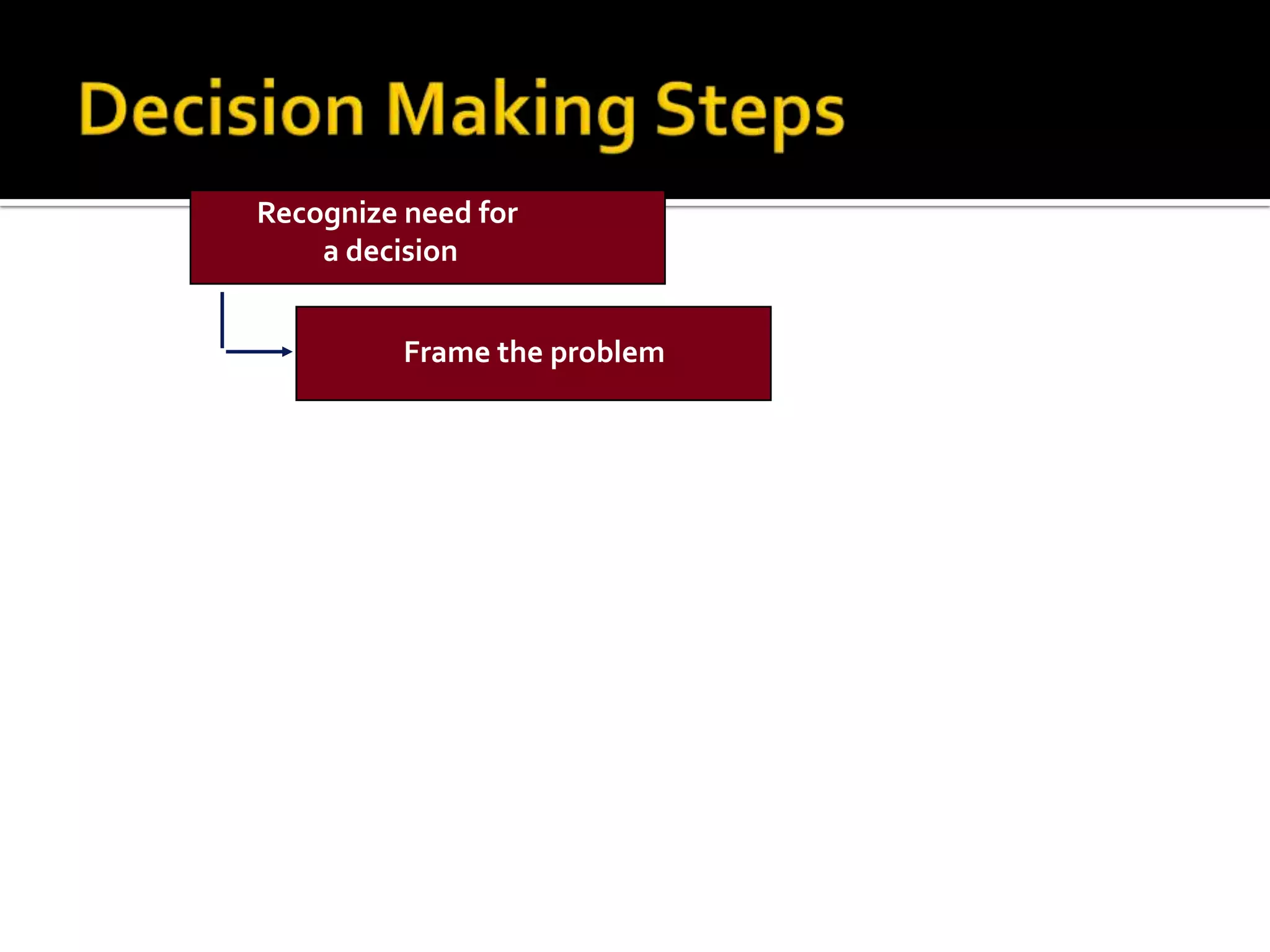
Recognize need for a decisionFrame the problemGenerate & assess alternativesChoose among alternativesImplement chosenalternativeLearn from feedbackDecision Making Steps
2. Frame the problem: managers must  frame problem for which decision is to be made.Decision Making Steps
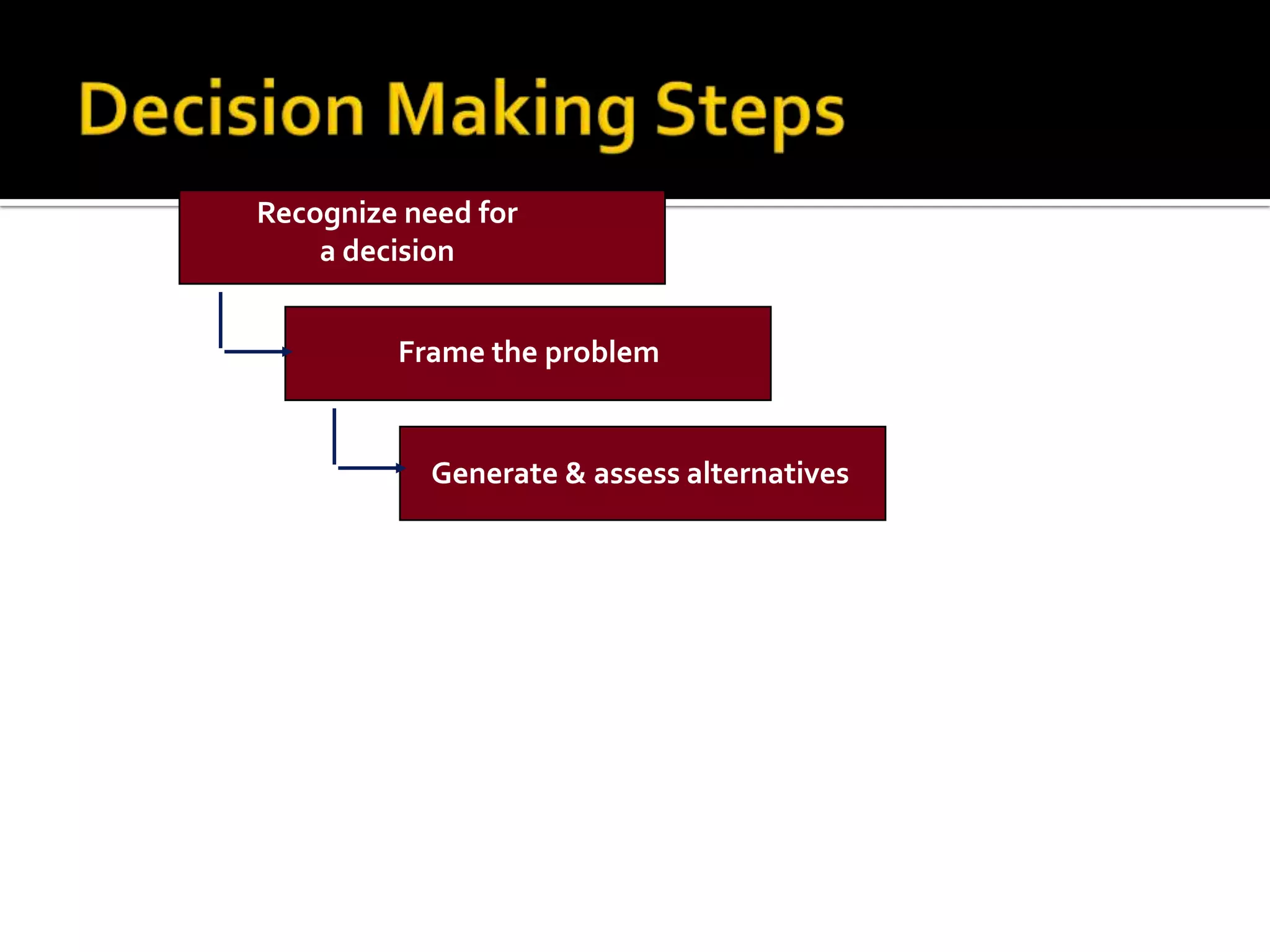
Recognize need for a decisionFrame the problemGenerate & assess alternativesChoose among alternativesImplement chosenalternativeLearn from feedbackDecision Making Steps
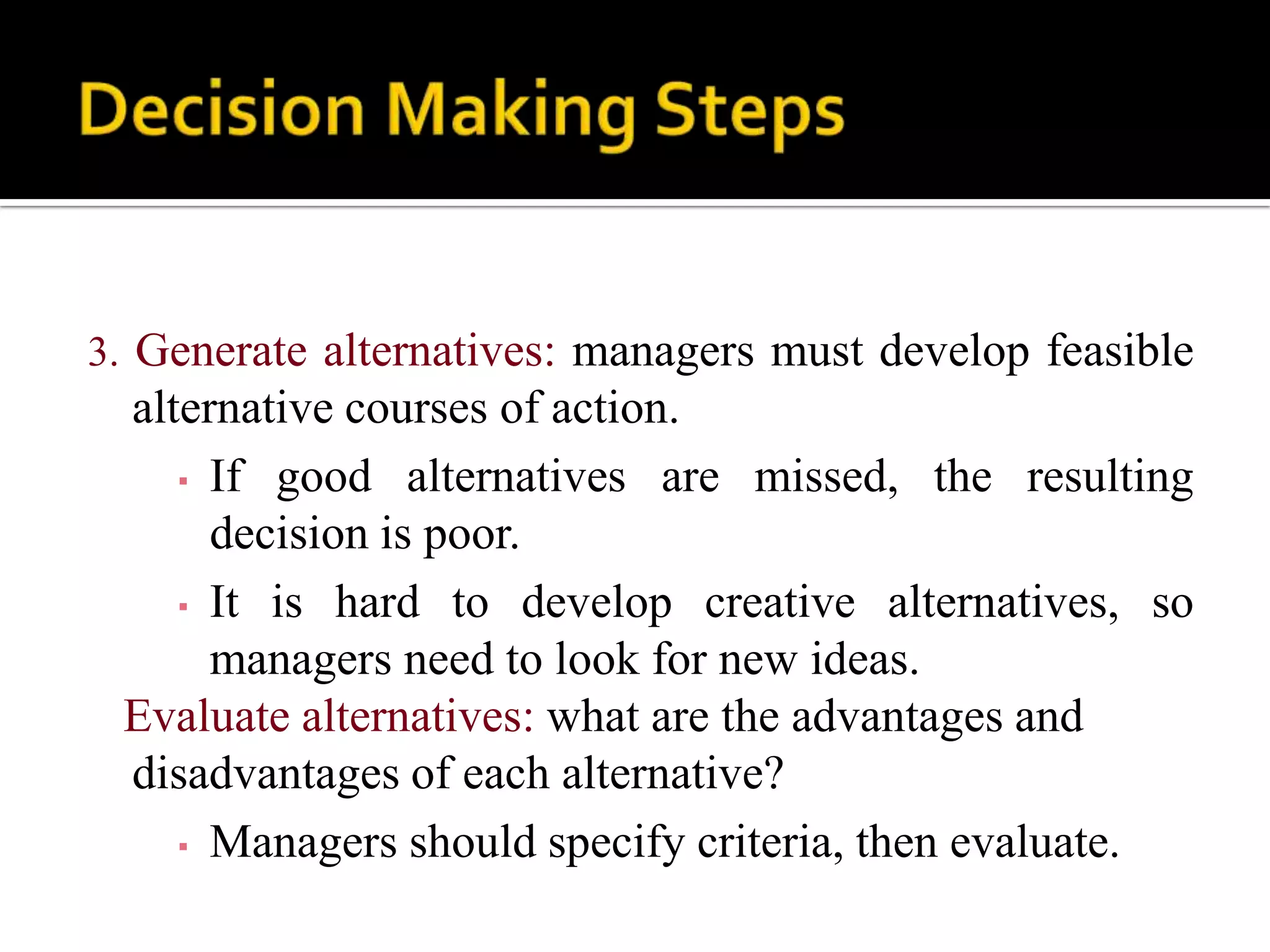
3. Generate alternatives: managers must develop feasible alternative courses of action.If good alternatives are missed, the resulting decision is poor.It is hard to develop creative alternatives, so managers need to look for new ideas.   Evaluate alternatives: what are the advantages and disadvantages of each alternative?Managers should specify criteria, then evaluate.Decision Making Steps
Recognize need for a decisionFrame the problemGenerate & assess alternativesChoose among alternativesImplement chosenalternativeLearn from feedbackDecision Making Steps
Decision Making Steps4. Choose among alternatives:managers rank alternatives and decide.While ranking, all information needs to be considered.
Recognize need for a decisionFrame the problemGenerate & assess alternativesChoose among alternativesImplement chosenalternativeLearn from feedbackDecision Making Steps
5. Implement choose alternative:managers must now carry out the alternative.Often a decision is made and not implemented.Decision Making Steps
Decision Making StepsRecognize need for a decisionFrame the problemGenerate & assess alternativesChoose among alternativesImplement chosenalternativeLearn from feedback
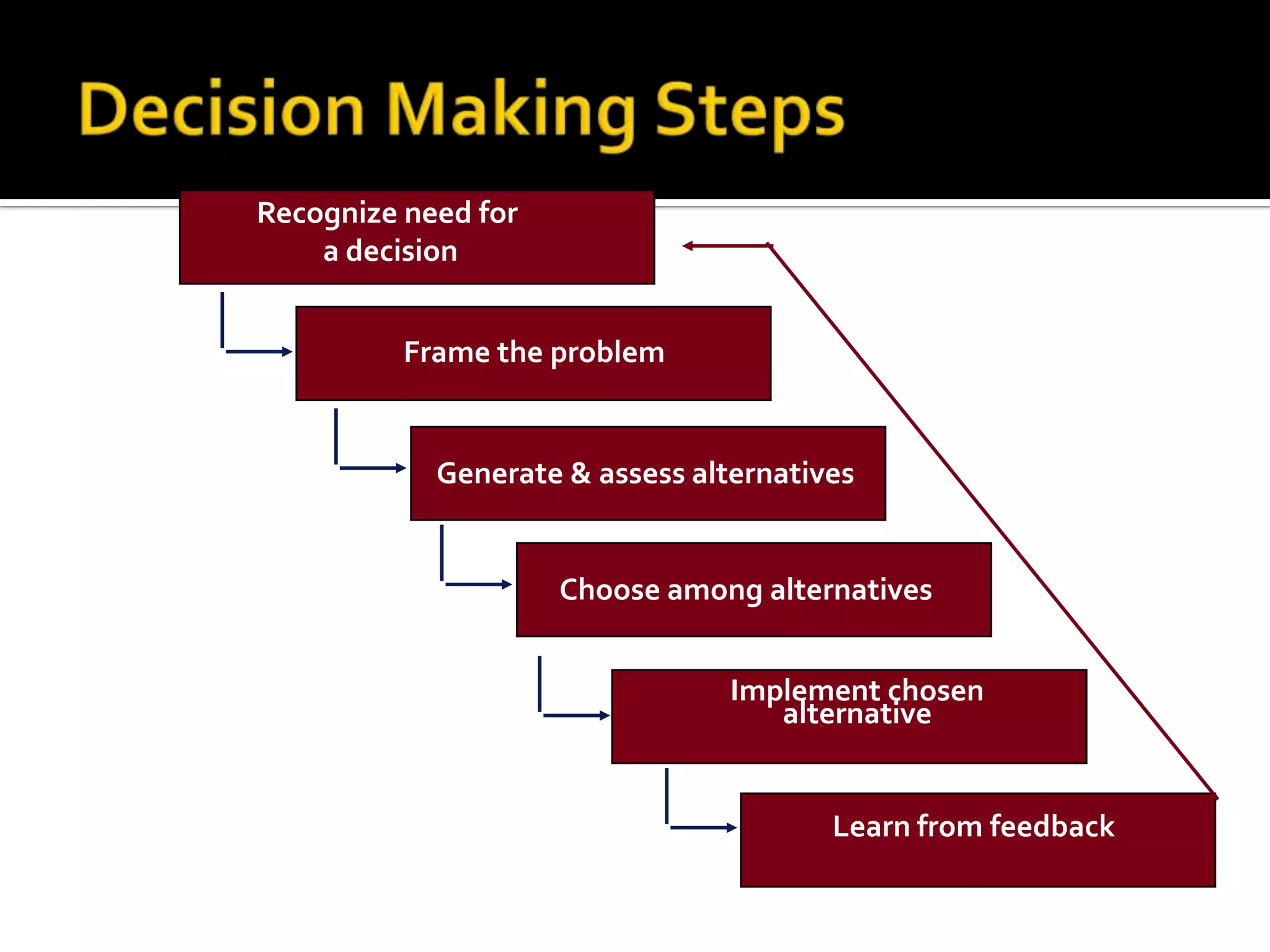
6. Learn from feedback:managers should consider what went right and wrong with the decision and learn for the future.Without feedback, managers never learn from experience and might repeat the same mistake.Decision Making Steps
Recognize need for a decisionFrame the problemGenerate & assess alternativesChoose among alternativesImplement chosenalternativeLearn from feedbackDecision Making Steps
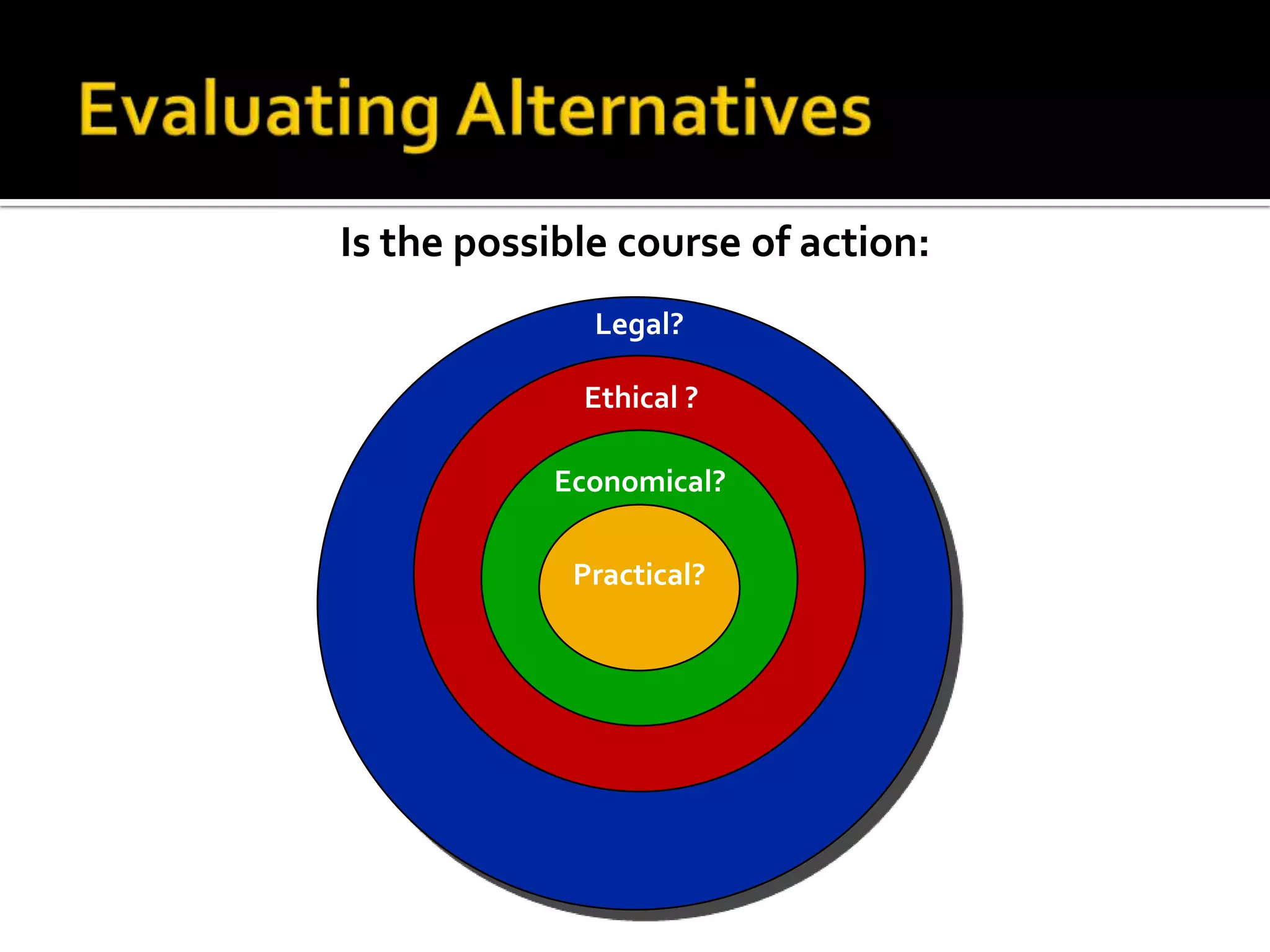
Evaluating AlternativesIs the possible course of action:Legal?Ethical ?Economical?Practical?
Evaluating AlternativesIs it legal?Managers must first be sure that an alternative is legal both in this country and abroad for exports.Is it ethical?The alternative must be ethical and not hurt stakeholders unnecessarily.Is it economically feasible?Can our organization’s performance goals sustain this alternative?Is it practical?Does the management have the capabilities and resources to do it?
Cognitive BiasesSuggests decision makers use heuristics to deal with bounded rationality.A heuristic is a rule of thumb to deal with complex situations.If the heuristic is wrong, however, then poor decisions result from its use.Systematic errorscan result from use of an incorrect heuristic.These errors will appear over and over since the rule used to make decision is flawed.
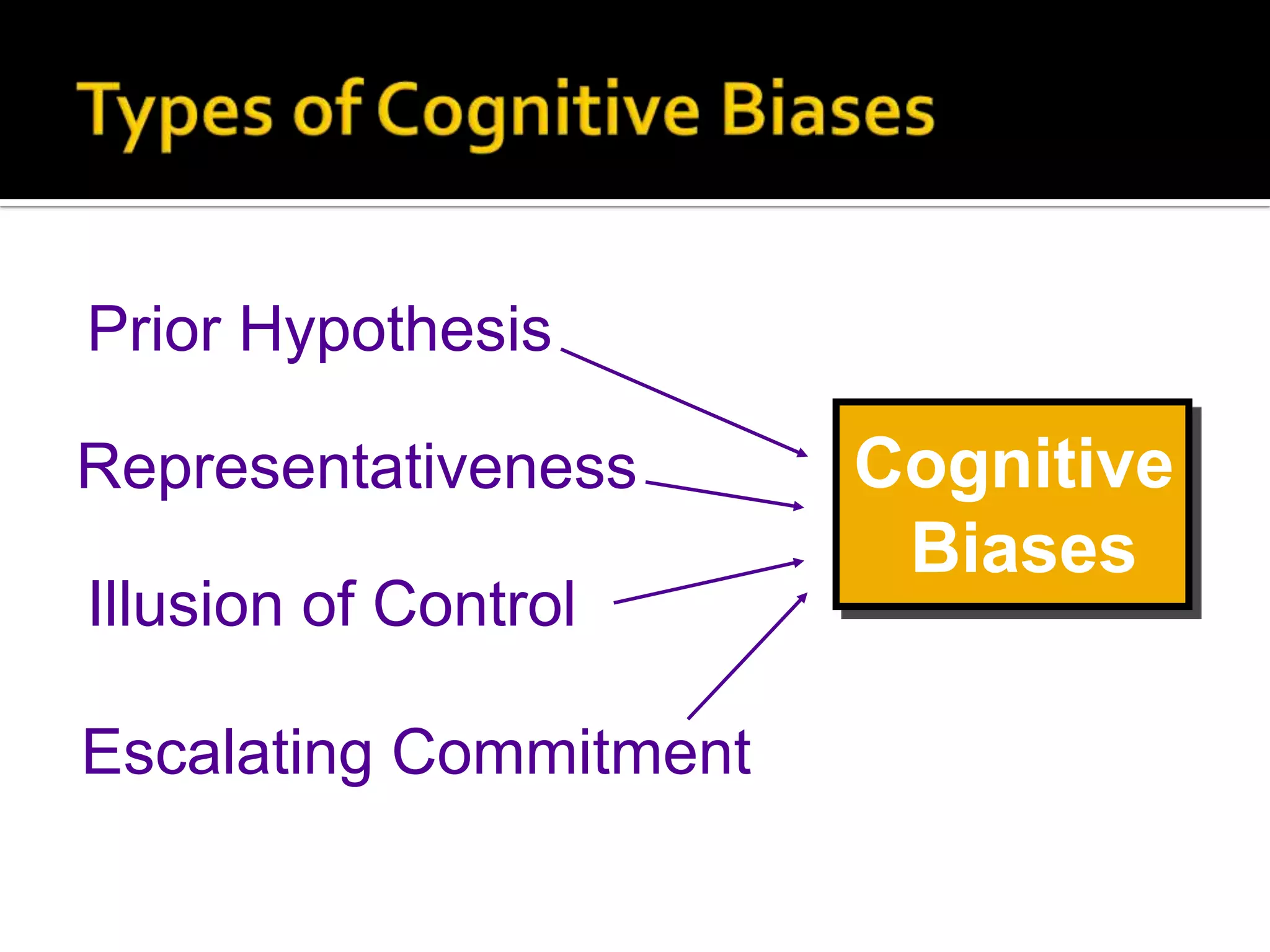
Types of Cognitive BiasesPrior HypothesisCognitive BiasesRepresentativenessIllusion of ControlEscalating Commitment
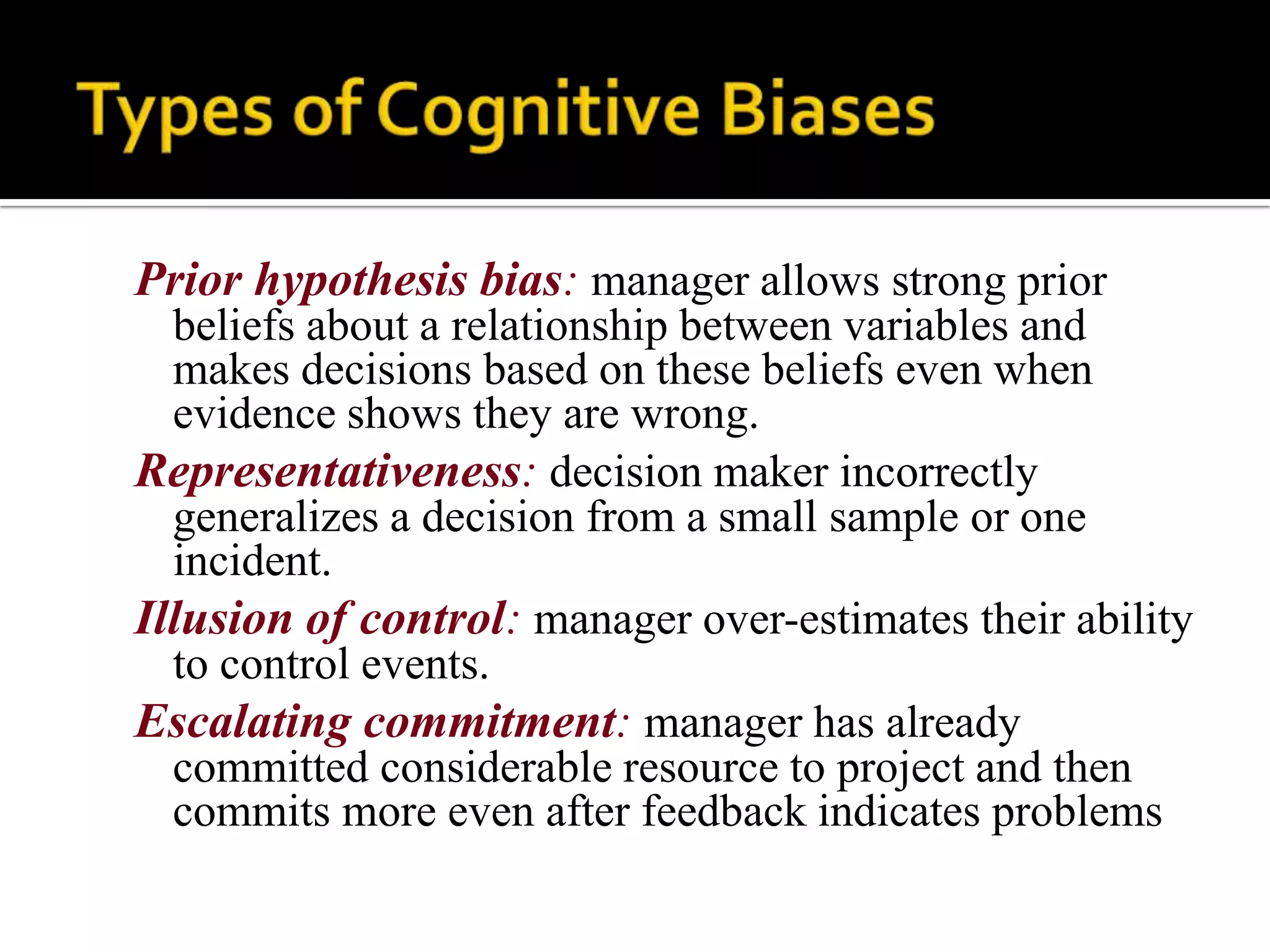
Types of Cognitive BiasesPrior hypothesis bias: manager allows strong prior beliefs about a relationship between variables and makes decisions based on these beliefs even when evidence shows they are wrong.Representativeness: decision maker incorrectly generalizes a decision from a small sample or one incident.Illusion of control: manager over-estimates their ability to control events.Escalating commitment: manager has already committed considerable resource to project and then commits more even after feedback indicates problems
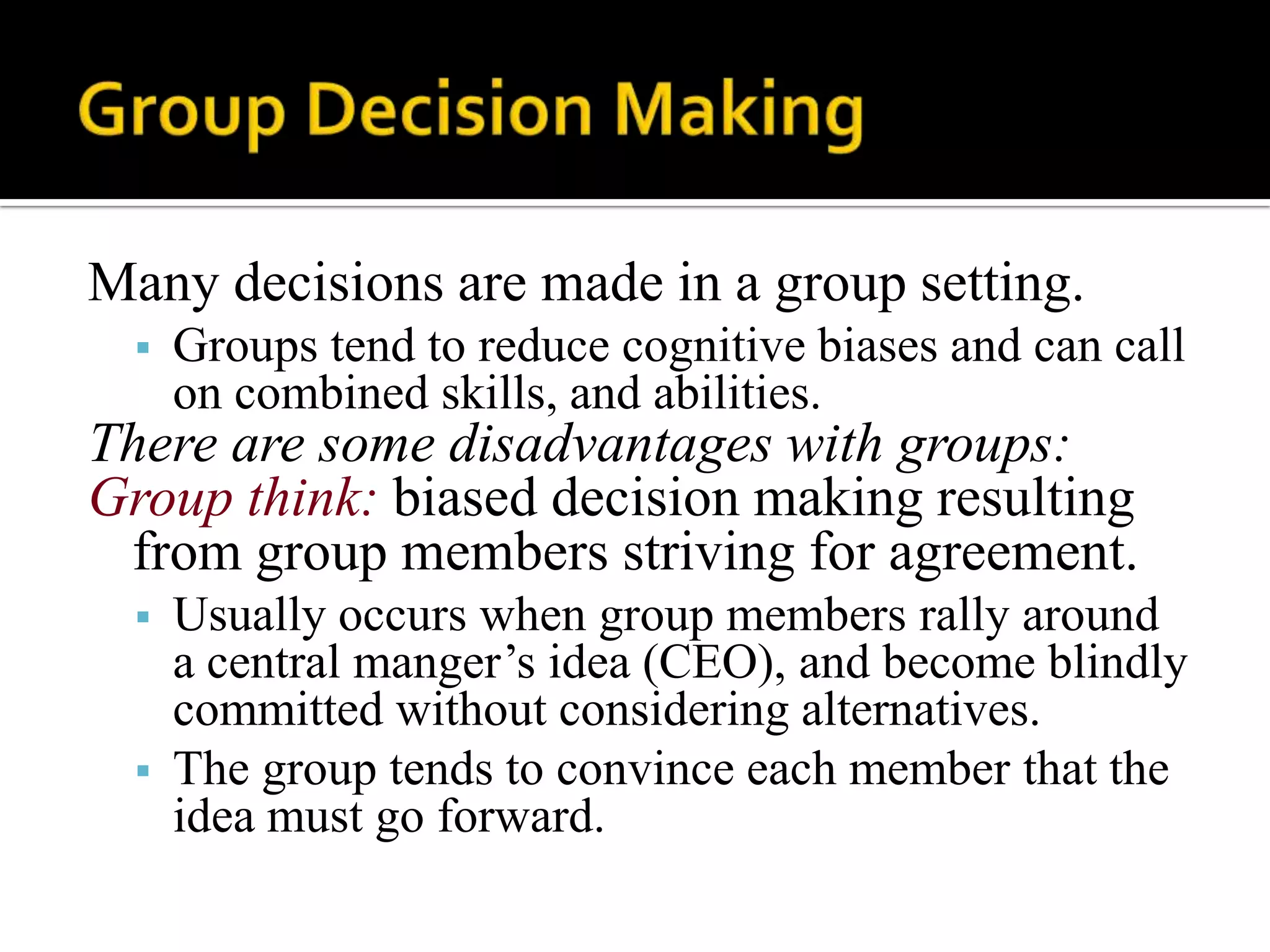
Group Decision MakingMany decisions are made in a group setting.Groups tend to reduce cognitive biases and can call on combined skills, and abilities.There are some disadvantages with groups:Group think:biased decision making resulting from group members striving for agreement.Usually occurs when group members rally around a central manger’s idea (CEO), and become blindly committed without considering alternatives.The group tends to convince each member that the idea must go forward.
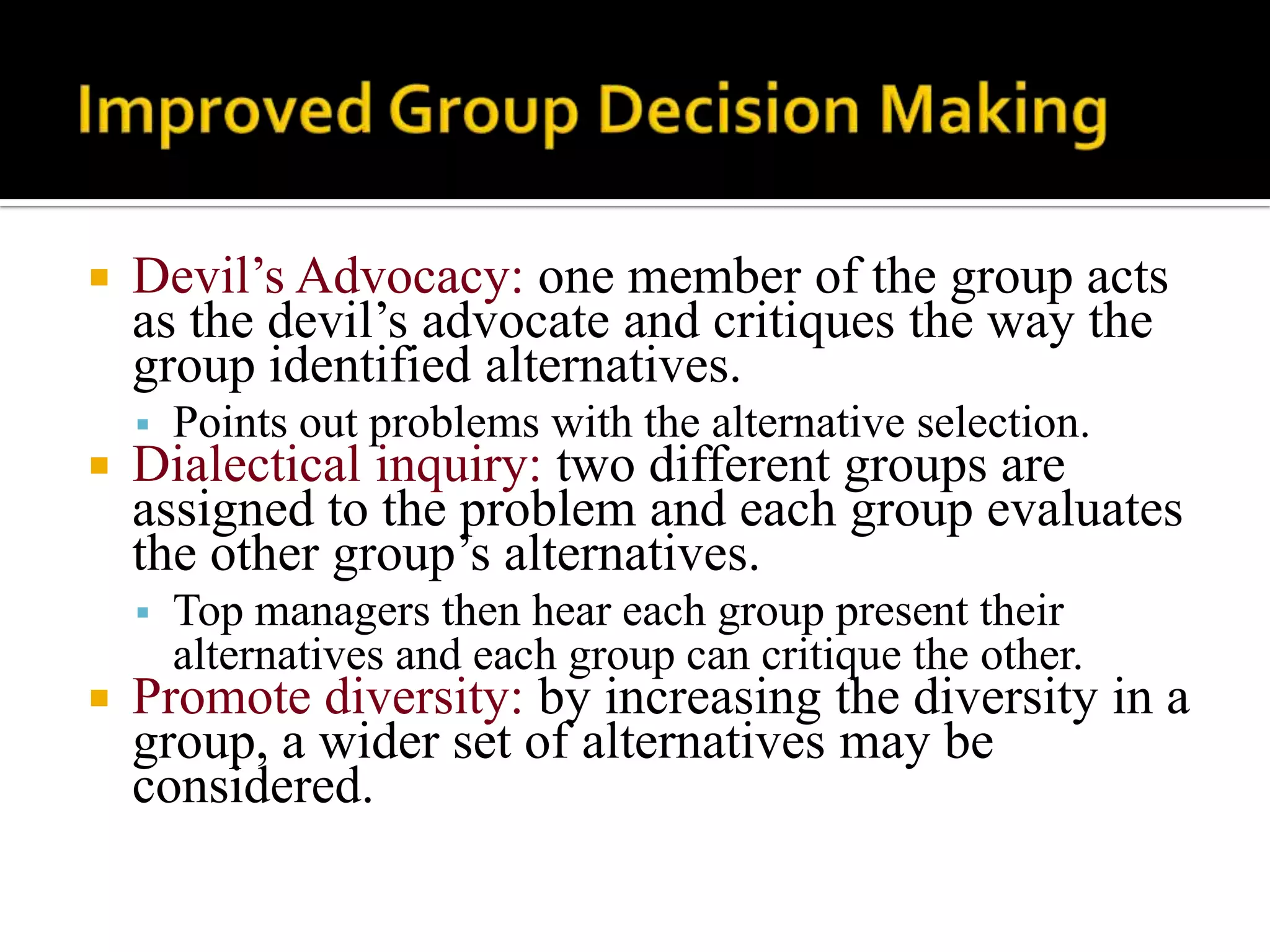
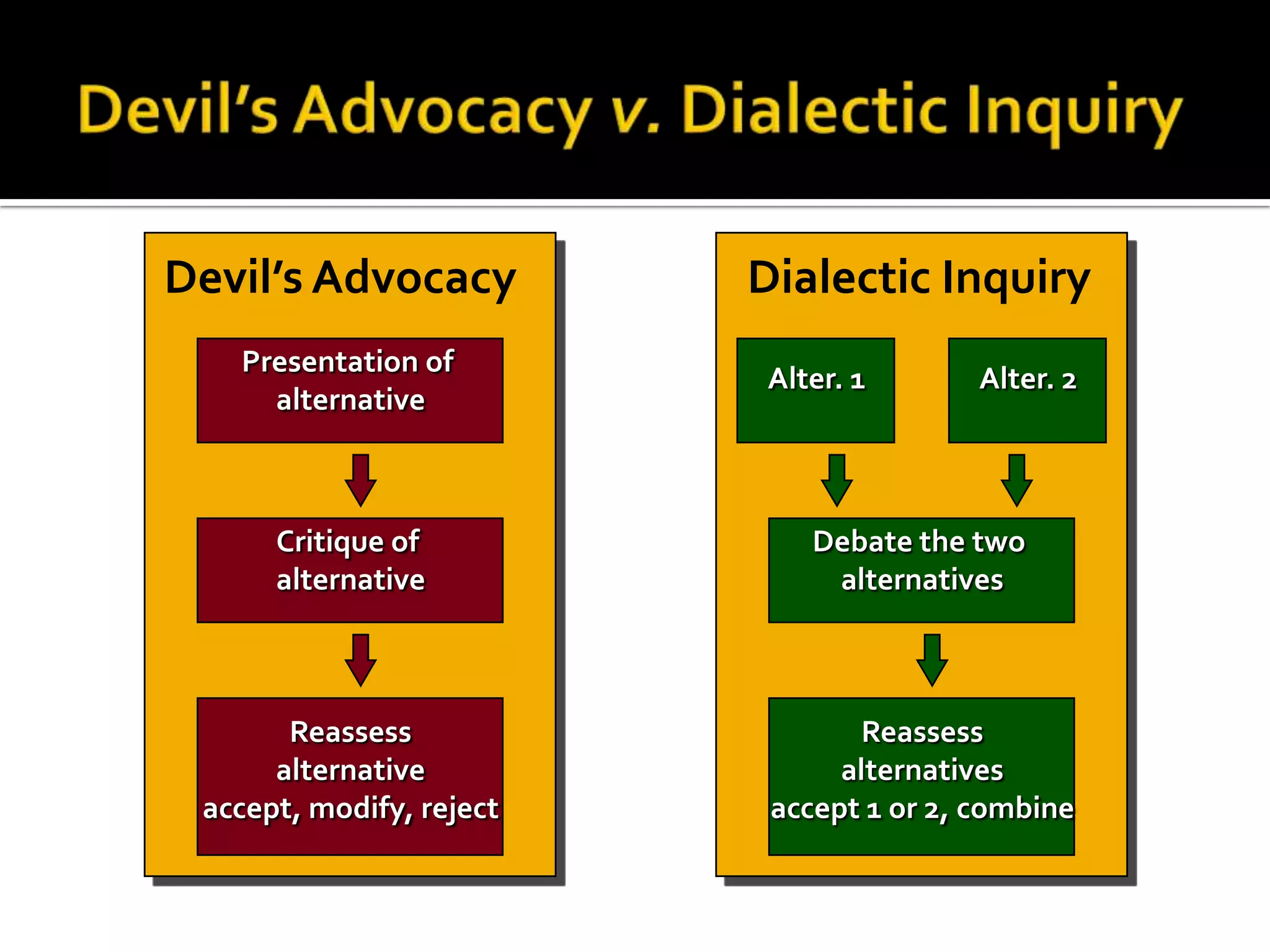
Improved Group Decision MakingDevil’s Advocacy: one member of the group acts as the devil’s advocate and critiques the way the group identified alternatives.Points out problems with the alternative selection.Dialectical inquiry: two different groups are assigned to the problem and each group evaluates the other group’s alternatives. Top managers then hear each group present their alternatives and each group can critique the other.Promote diversity: by increasing the diversity in a group, a wider set of alternatives may be considered.
Devil’s Advocacy v. Dialectic InquiryDevil’s AdvocacyDialectic InquiryAlter. 1Alter. 2Presentation of alternativeCritique of alternativeDebate the two alternativesReassessalternativeaccept, modify, rejectReassessalternativesaccept 1 or 2, combine
Organizational Learning & CreativityOrganizational Learning: Managers seek to improve member’s ability to understand the organization and environment so as to raise effectiveness.The learning organization: managers try to improve the people’s ability to behave creatively to maximize organizational learning .Creativity: is the ability of the decision maker to discover novel ideas leading to a feasible course of action.A creative management staff and employees are the key to the learning organization.
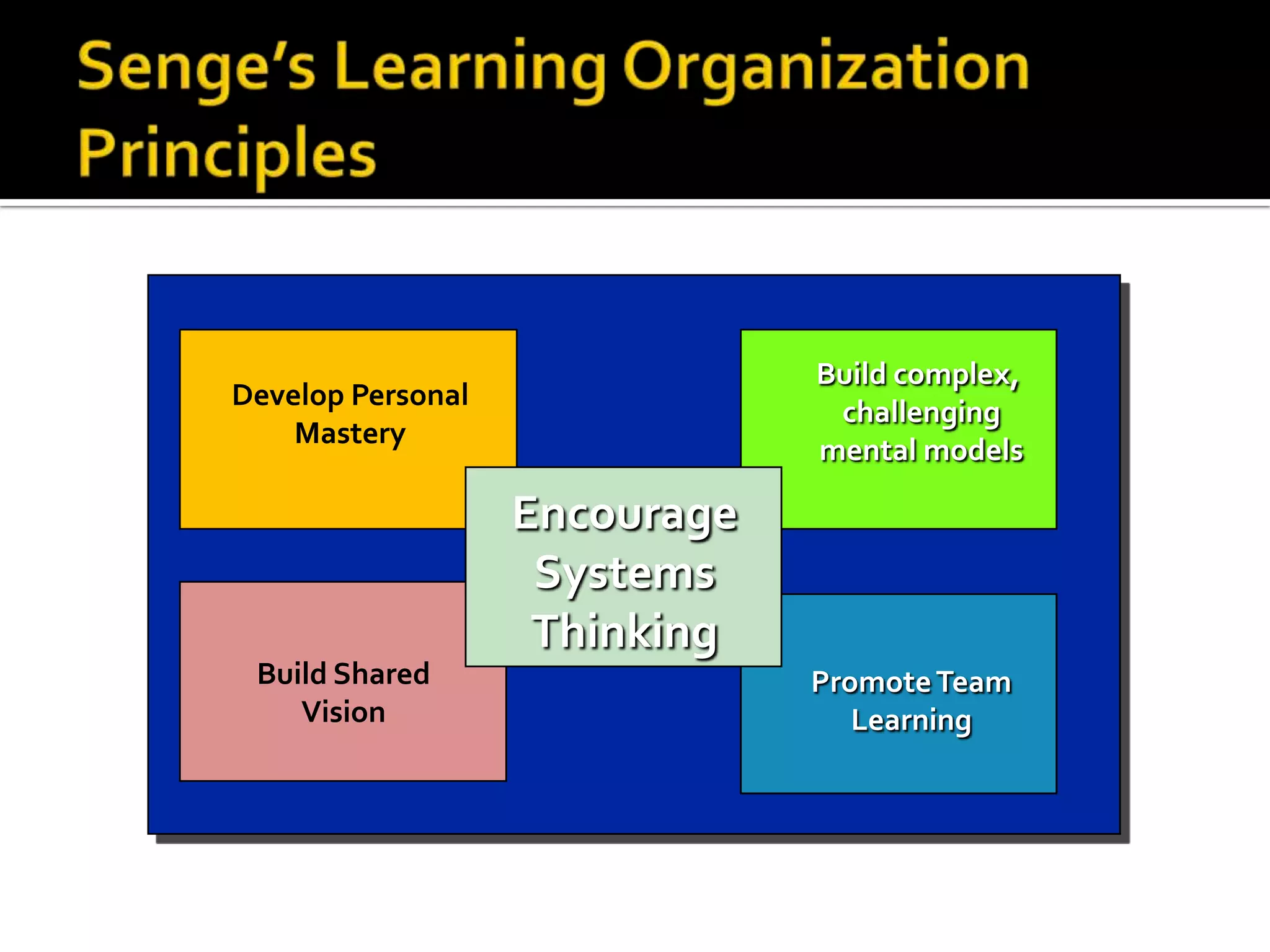
Senge’s Learning Organization PrinciplesBuild complex, challengingmental modelsDevelop PersonalMasteryEncourageSystems ThinkingBuild SharedVisionPromote TeamLearning
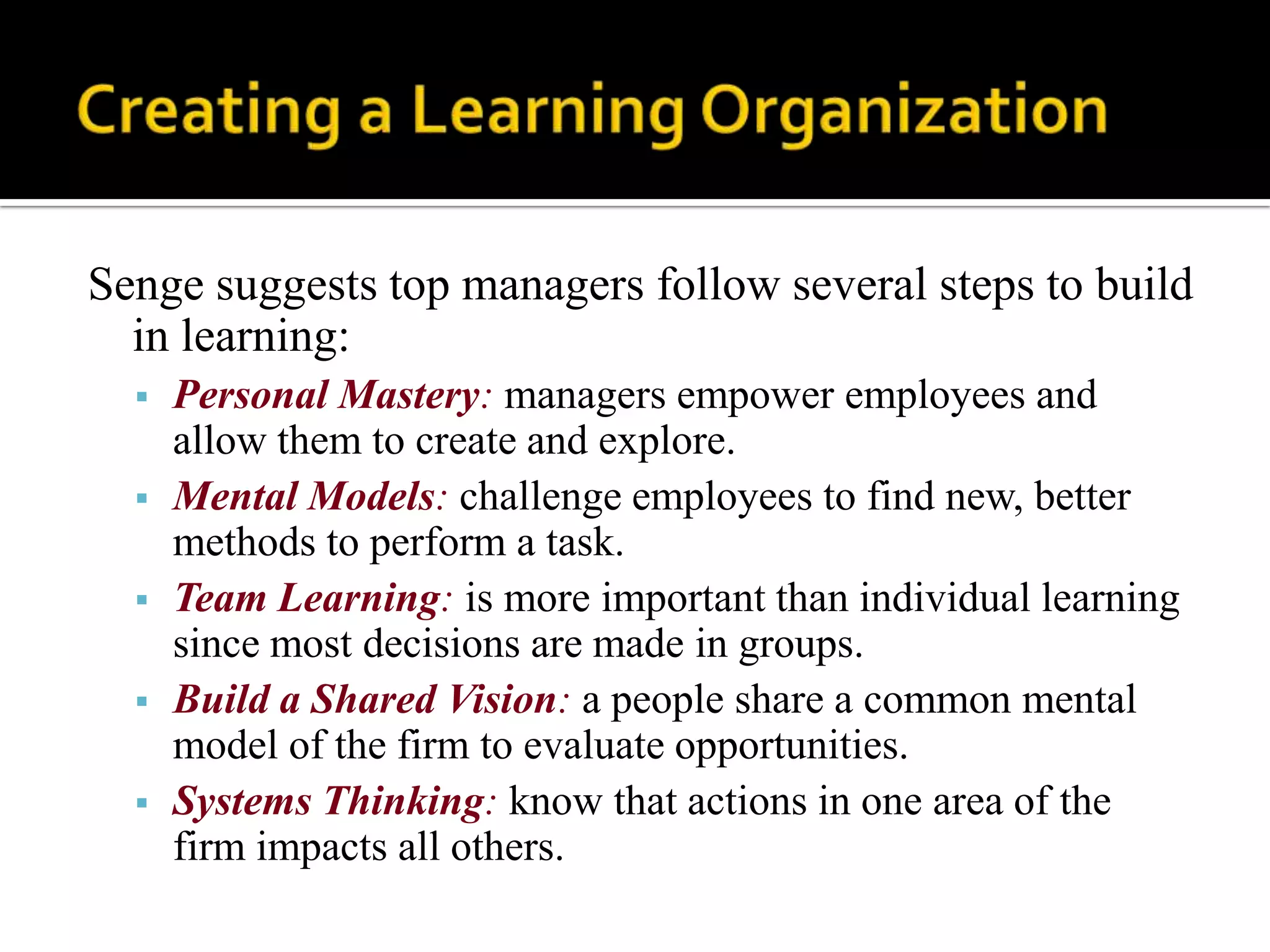
Creating a Learning OrganizationSenge suggests top managers follow several steps to build  in learning:Personal Mastery:managers empower employees and allow them to create and explore.Mental Models:challenge employees to find new, better methods to perform a task.Team Learning:is more important than individual learning since most decisions are made in groups.Build a Shared Vision:a people share a common mental model of the firm to evaluate opportunities.Systems Thinking:know that actions in one area of the firm impacts all others.
Individual CreativityOrganizations can build an environment supportive of creativity.Many of these issues are the same as for the learning organization.Managers must provide employees with the ability to take risks.If people take risks, they will occasionally fail. Thus, to build creativity, periodic failures must be rewarded.This idea is hard to accept for some managers.
Building Group CreativityBrainstorming: managers meet face-to-face to generate and debate many alternatives. Group members are not allowed to evaluate alternatives until all alternatives are listed.Be creative and radical in stating alternatives.When all are listed, then the pros and cons of each are discussed and a short list created.Production blocking is a potential problem with brainstorming.Members cannot absorb all information being presented during the session and can forget their own alternatives.
Building Group CreativityNominal Group Technique: Provides a more structured way to generate alternatives in writing. Avoids the production blocking problem.	Similar to brainstorming except that each member is given time to first write down all alternatives he or she would suggest.Alternatives are then read aloud without discussion until all have been listed.Then discussion occurs and alternatives are ranked.
Building Group CreativityDelphi Technique:provides for a written format without having all managers meet face-to-face.Problem is distributed in written form to managers who then generate written alternatives.Responses are received and summarized by top managers.These results are sent back to participants for feedback, and ranking.The process continues until consensus is reached.Delphi allows distant managers to participate.
Thank You !!
Decision Making In Management

Decision Making In Management

  • 1.
  • 2.
    Managerial Decision MakingDecisionmaking:the process by which managers respond to opportunities and threats by analyzing options, and making decisions about goals and courses of action.Decisions in response to opportunities:managers respond to ways to improve organizational performance.Decisions in response to threats:occurs when managers are impacted by adverse events to the organization.
  • 3.
    Types of DecisionMakingProgrammed Decisions:routine, almost automatic process.Managers have made decision many times before.There are rules or guidelines to follow.Example: Deciding to reorder office supplies.Non-programmed Decisions:unusual situations that have not been often addressed.No rules to follow since the decision is new.These decisions are made based on information, and a manger’s intuition, and judgment.Example: Should the firm invest in a new technology?
  • 4.
    The Classical ModelClassicalmodel of decision making:a prescriptive model that tells how the decision should be made.Assumes managers have access to all the information needed to reach a decision.Managers can then make the optimum decision by easily ranking their own preferences among alternatives.Unfortunately, mangers often do not have all (or even most) required information.
  • 5.
    The Classical ModelAssumesall informationis available to managerAssumes manager canprocess informationAssumes manager knowsthe best future course ofthe organization List alternatives & consequencesRank each alternative from low to highSelect bestalternative
  • 6.
    The Administrative ModelAdministrativeModel of decision making:Challenges the classical assumptions that managers have and process all the information.As a result, decision making is risky.Bounded rationality:There is a large number of alternatives and information is vast so that managers cannot consider it all.Decisions are limited by people’s cognitive abilities.Incomplete information:most managers do not see all alternatives and decide based on incomplete information.Why Information is IncompleteUncertainty& riskAmbiguousInformationIncompleteInformationTime constraints &information costs
  • 7.
    Decision Making StepsRecognizeneed for a decisionFrame the problemGenerate & assess alternativesChoose among alternativesImplement chosenalternativeLearn from feedback
  • 8.
    Decision Making StepsRecognizeneed for a decision: Managers must first realize the need for which a decision must be made.
  • 9.
    Recognize need fora decisionFrame the problemGenerate & assess alternativesChoose among alternativesImplement chosenalternativeLearn from feedbackDecision Making Steps
  • 10.
    2. Frame theproblem: managers must frame problem for which decision is to be made.Decision Making Steps
  • 11.
    Recognize need fora decisionFrame the problemGenerate & assess alternativesChoose among alternativesImplement chosenalternativeLearn from feedbackDecision Making Steps
  • 12.
    3. Generate alternatives:managers must develop feasible alternative courses of action.If good alternatives are missed, the resulting decision is poor.It is hard to develop creative alternatives, so managers need to look for new ideas. Evaluate alternatives: what are the advantages and disadvantages of each alternative?Managers should specify criteria, then evaluate.Decision Making Steps
  • 13.
    Recognize need fora decisionFrame the problemGenerate & assess alternativesChoose among alternativesImplement chosenalternativeLearn from feedbackDecision Making Steps
  • 14.
    Decision Making Steps4.Choose among alternatives:managers rank alternatives and decide.While ranking, all information needs to be considered.
  • 15.
    Recognize need fora decisionFrame the problemGenerate & assess alternativesChoose among alternativesImplement chosenalternativeLearn from feedbackDecision Making Steps
  • 16.
    5. Implement choosealternative:managers must now carry out the alternative.Often a decision is made and not implemented.Decision Making Steps
  • 17.
    Decision Making StepsRecognizeneed for a decisionFrame the problemGenerate & assess alternativesChoose among alternativesImplement chosenalternativeLearn from feedback
  • 18.
    6. Learn fromfeedback:managers should consider what went right and wrong with the decision and learn for the future.Without feedback, managers never learn from experience and might repeat the same mistake.Decision Making Steps
  • 19.
    Recognize need fora decisionFrame the problemGenerate & assess alternativesChoose among alternativesImplement chosenalternativeLearn from feedbackDecision Making Steps
  • 20.
    Evaluating AlternativesIs thepossible course of action:Legal?Ethical ?Economical?Practical?
  • 21.
    Evaluating AlternativesIs itlegal?Managers must first be sure that an alternative is legal both in this country and abroad for exports.Is it ethical?The alternative must be ethical and not hurt stakeholders unnecessarily.Is it economically feasible?Can our organization’s performance goals sustain this alternative?Is it practical?Does the management have the capabilities and resources to do it?
  • 22.
    Cognitive BiasesSuggests decisionmakers use heuristics to deal with bounded rationality.A heuristic is a rule of thumb to deal with complex situations.If the heuristic is wrong, however, then poor decisions result from its use.Systematic errorscan result from use of an incorrect heuristic.These errors will appear over and over since the rule used to make decision is flawed.
  • 23.
    Types of CognitiveBiasesPrior HypothesisCognitive BiasesRepresentativenessIllusion of ControlEscalating Commitment
  • 24.
    Types of CognitiveBiasesPrior hypothesis bias: manager allows strong prior beliefs about a relationship between variables and makes decisions based on these beliefs even when evidence shows they are wrong.Representativeness: decision maker incorrectly generalizes a decision from a small sample or one incident.Illusion of control: manager over-estimates their ability to control events.Escalating commitment: manager has already committed considerable resource to project and then commits more even after feedback indicates problems
  • 25.
    Group Decision MakingManydecisions are made in a group setting.Groups tend to reduce cognitive biases and can call on combined skills, and abilities.There are some disadvantages with groups:Group think:biased decision making resulting from group members striving for agreement.Usually occurs when group members rally around a central manger’s idea (CEO), and become blindly committed without considering alternatives.The group tends to convince each member that the idea must go forward.
  • 26.
    Improved Group DecisionMakingDevil’s Advocacy: one member of the group acts as the devil’s advocate and critiques the way the group identified alternatives.Points out problems with the alternative selection.Dialectical inquiry: two different groups are assigned to the problem and each group evaluates the other group’s alternatives. Top managers then hear each group present their alternatives and each group can critique the other.Promote diversity: by increasing the diversity in a group, a wider set of alternatives may be considered.
  • 27.
    Devil’s Advocacy v.Dialectic InquiryDevil’s AdvocacyDialectic InquiryAlter. 1Alter. 2Presentation of alternativeCritique of alternativeDebate the two alternativesReassessalternativeaccept, modify, rejectReassessalternativesaccept 1 or 2, combine
  • 28.
    Organizational Learning &CreativityOrganizational Learning: Managers seek to improve member’s ability to understand the organization and environment so as to raise effectiveness.The learning organization: managers try to improve the people’s ability to behave creatively to maximize organizational learning .Creativity: is the ability of the decision maker to discover novel ideas leading to a feasible course of action.A creative management staff and employees are the key to the learning organization.
  • 29.
    Senge’s Learning OrganizationPrinciplesBuild complex, challengingmental modelsDevelop PersonalMasteryEncourageSystems ThinkingBuild SharedVisionPromote TeamLearning
  • 30.
    Creating a LearningOrganizationSenge suggests top managers follow several steps to build in learning:Personal Mastery:managers empower employees and allow them to create and explore.Mental Models:challenge employees to find new, better methods to perform a task.Team Learning:is more important than individual learning since most decisions are made in groups.Build a Shared Vision:a people share a common mental model of the firm to evaluate opportunities.Systems Thinking:know that actions in one area of the firm impacts all others.
  • 31.
    Individual CreativityOrganizations canbuild an environment supportive of creativity.Many of these issues are the same as for the learning organization.Managers must provide employees with the ability to take risks.If people take risks, they will occasionally fail. Thus, to build creativity, periodic failures must be rewarded.This idea is hard to accept for some managers.
  • 32.
    Building Group CreativityBrainstorming:managers meet face-to-face to generate and debate many alternatives. Group members are not allowed to evaluate alternatives until all alternatives are listed.Be creative and radical in stating alternatives.When all are listed, then the pros and cons of each are discussed and a short list created.Production blocking is a potential problem with brainstorming.Members cannot absorb all information being presented during the session and can forget their own alternatives.
  • 33.
    Building Group CreativityNominalGroup Technique: Provides a more structured way to generate alternatives in writing. Avoids the production blocking problem. Similar to brainstorming except that each member is given time to first write down all alternatives he or she would suggest.Alternatives are then read aloud without discussion until all have been listed.Then discussion occurs and alternatives are ranked.
  • 34.
    Building Group CreativityDelphiTechnique:provides for a written format without having all managers meet face-to-face.Problem is distributed in written form to managers who then generate written alternatives.Responses are received and summarized by top managers.These results are sent back to participants for feedback, and ranking.The process continues until consensus is reached.Delphi allows distant managers to participate.
  • 35.