



Decision Making
-Prof. Nishikant C. Warbhuwan
Research Scholar, S.R.T.M. University Nanded,
Asst. Professor, School of Management Sciences,
S.R.T.M. University, Sub centre, Latur, India.
Email: nishikant.warbhuwan@srtmun.ac.in
nishikant.warbhuwan@srtmun.ac.in
Decision Making
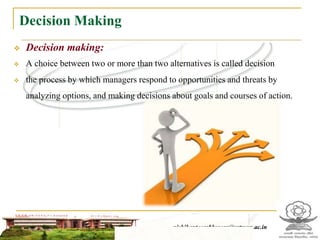
 Decision making:
 A choice between two or more than two alternatives is called decision
 the process by which managers respond to opportunities and threats by
analyzing options, and making decisions about goals and courses of action.
nishikant.warbhuwan@srtmun.ac.innishikant.warbhuwan@srtmun.ac.in
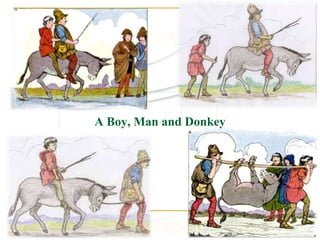
A Boy, Man and Donkey
nishikant.warbhuwan@srtmun.ac.in
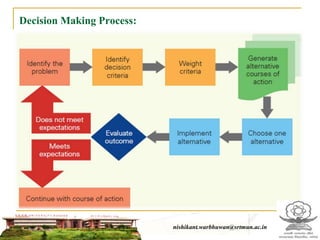
Decision Making Process:
nishikant.warbhuwan@srtmun.ac.innishikant.warbhuwan@srtmun.ac.in
Decision Making steps”
 Identify the Problem:
When making a decision a person
first needs to identify and define
the problem or conflict.
nishikant.warbhuwan@srtmun.ac.in
Decision Making steps:
 Identify Decision Criteria:
When a problem identified,
the decision criteria important
to resolving the problem must
be identified. That is, managers
must determine what is
relevant in making decision.
nishikant.warbhuwan@srtmun.ac.in
Decision Making steps:
 Allocation of Weights to criteria:
If the relevant criteria are not
equally important, the decision
maker must weight the items
in order to give them the
correct priority in the
decision.
nishikant.warbhuwan@srtmun.ac.in
Decision Making steps:
 Development of Alternatives:
The fourth step in decision making
process requires the decision
maker to list viable alternative
that could resolve. The problem
this is the step where a decision
maker needs to be creative.
nishikant.warbhuwan@srtmun.ac.in
Decision Making steps:
 Choose One alternative:
After making all the alternatives,
the next step in planning or in
decision making is to evaluate
these alternatives. Evaluation is
required in order to select the
best alternative for implementation.
nishikant.warbhuwan@srtmun.ac.in
Decision Making steps:
 Implementation of the Alternative:
After choosing best alternative
decision in to action by conveying
it to those effected and getting their
commitment to it.
nishikant.warbhuwan@srtmun.ac.in
Decision Making steps:
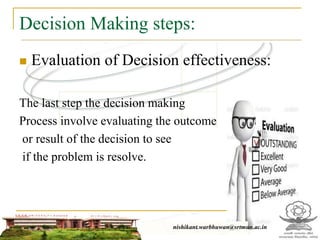
 Evaluation of Decision effectiveness:
The last step the decision making
Process involve evaluating the outcome
or result of the decision to see
if the problem is resolve.
nishikant.warbhuwan@srtmun.ac.in
Types of Decision Making:
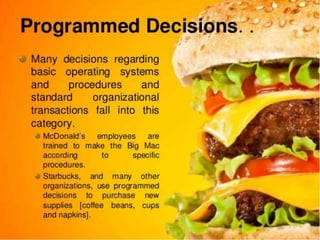
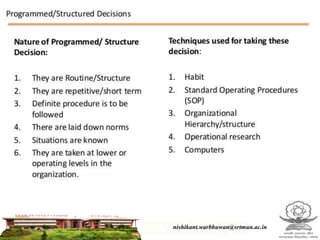
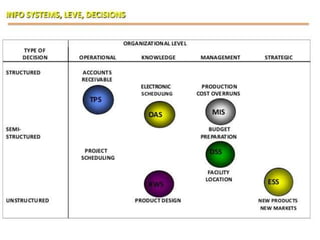
 Programmed Decisions: routine, almost automatic process.
 Managers have made decision many times before.
 There are rules or guidelines to follow.
 Routine situations
 Decision rules can be developed and applied
 Managers formulate decision rules so subordinates can make decisions
 Example: Deciding to reorder office supplies.
nishikant.warbhuwan@srtmun.ac.innishikant.warbhuwan@srtmun.ac.in
nishikant.warbhuwan@srtmun.ac.in
Types of Decision Making:
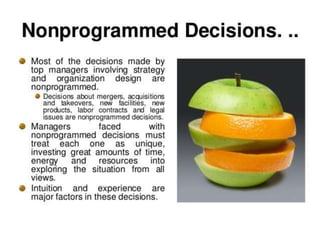
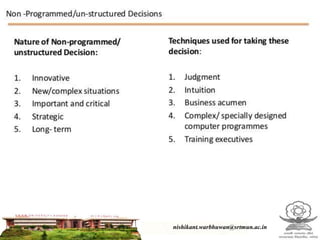
 Non-programmed Decisions: unusual situations that have not been
often addressed.
 No rules to follow since the decision is new.
 These decisions are made based on information, and a manger’s intuition, and
judgment.
 Poorly defined situations
 Decisions are complex
 Routine decision rules do not apply
 Trend is toward subordinates making more nonprogrammed decisions
 Example: Should the firm invest in a new technology?
nishikant.warbhuwan@srtmun.ac.innishikant.warbhuwan@srtmun.ac.in
nishikant.warbhuwan@srtmun.ac.in
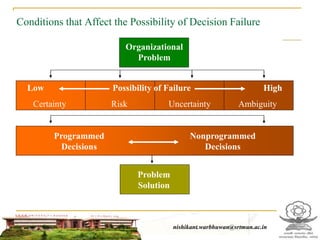
Conditions that Affect the Possibility of Decision Failure
Organizational
Problem
Problem
Solution
Low HighPossibility of Failure
Certainty Risk Uncertainty Ambiguity
Programmed
Decisions
Nonprogrammed
Decisions
nishikant.warbhuwan@srtmun.ac.in
Decision Making Models:
 1. Classical Model Or The Rational-Economic Model
 2. Administrative Model Or Behavioral
 3. Herbert Simon’s Model
nishikant.warbhuwan@srtmun.ac.innishikant.warbhuwan@srtmun.ac.in
Glossary
 Rationality:
A type of decision making in which choices are logical consistent and
maximize value.
 Bounded Rationality:
Decision making that's rational but limited(bounded) by an individuals
ability to process information.
 Intuition:
Making decision on the basis of experience, and accumulated judgment.
nishikant.warbhuwan@srtmun.ac.innishikant.warbhuwan@srtmun.ac.in
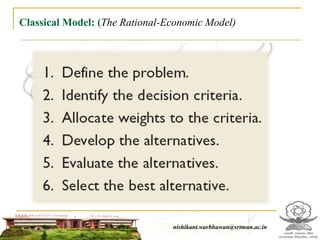
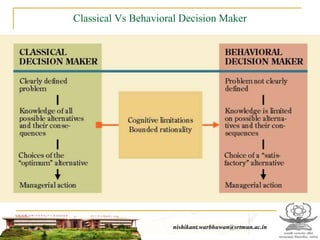
Classical Model: (The Rational-Economic Model)
Classical decision theory assumes the manager faces a clearly defined problem,
knows all possible action alternatives and their consequences, and then chooses the
optimum solution
Administrative Model (Behavioral)
` Behavioral decision theory accepts the notion of bounded rationality. It assumes
the manager acts only in terms of what is perceived about a given situation, and
then chooses a satisfying solution.
nishikant.warbhuwan@srtmun.ac.innishikant.warbhuwan@srtmun.ac.in
Decision Making Models:
Classical Model: (The Rational-Economic Model)
Assumptions
 Decision maker operates to accomplish goals that are known and agreed upon
 Decision maker strives for condition of certainty – gathers complete information
 Criteria for evaluating alternatives are known
 Decision maker is rational and uses logic
 The decision maker selects the optimum or best choice.
Facts:
 1. Goals are known and agreed upon. Problems are precisely defined
 2. All alternatives and outcomes are calculated
 3. Criteria evaluated and decision made maximizing return (expected value)
 4. Uses rationality and logic.
nishikant.warbhuwan@srtmun.ac.innishikant.warbhuwan@srtmun.ac.in
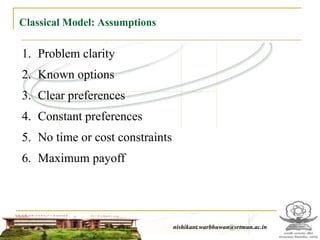
Classical Model: Assumptions
nishikant.warbhuwan@srtmun.ac.innishikant.warbhuwan@srtmun.ac.in
1. Problem clarity
2. Known options
3. Clear preferences
4. Constant preferences
5. No time or cost constraints
6. Maximum payoff
Classical Model: (The Rational-Economic Model)
nishikant.warbhuwan@srtmun.ac.innishikant.warbhuwan@srtmun.ac.in
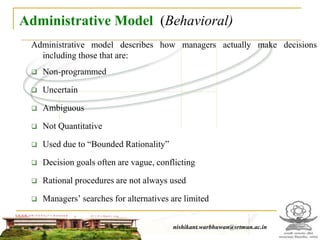
Administrative Model (Behavioral)
Administrative model describes how managers actually make decisions
including those that are:
 Non-programmed
 Uncertain
 Ambiguous
 Not Quantitative
 Used due to “Bounded Rationality”
 Decision goals often are vague, conflicting
 Rational procedures are not always used
 Managers’ searches for alternatives are limited
nishikant.warbhuwan@srtmun.ac.in
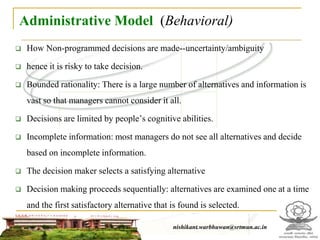
Administrative Model (Behavioral)
 How Non-programmed decisions are made--uncertainty/ambiguity
 hence it is risky to take decision.
 Bounded rationality: There is a large number of alternatives and information is
vast so that managers cannot consider it all.
 Decisions are limited by people’s cognitive abilities.
 Incomplete information: most managers do not see all alternatives and decide
based on incomplete information.
 The decision maker selects a satisfying alternative
 Decision making proceeds sequentially: alternatives are examined one at a time
and the first satisfactory alternative that is found is selected.
nishikant.warbhuwan@srtmun.ac.in
Classical Vs Behavioral Decision Maker
nishikant.warbhuwan@srtmun.ac.in
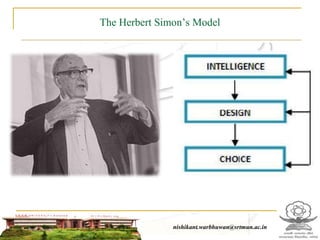
The Herbert Simon’s Model
nishikant.warbhuwan@srtmun.ac.in
The Herbert Simon’s Model
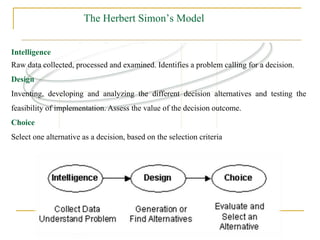
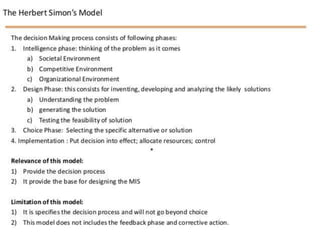
Intelligence
Raw data collected, processed and examined. Identifies a problem calling for a decision.
Design
Inventing, developing and analyzing the different decision alternatives and testing the
feasibility of implementation. Assess the value of the decision outcome.
Choice
Select one alternative as a decision, based on the selection criteria
Classical Vs Behavioral Decision Maker
nishikant.warbhuwan@srtmun.ac.in
nishikant.warbhuwan@srtmun.ac.innishikant.warbhuwan@srtmun.ac.in

itmis decision making models

  • 1.
    Decision Making -Prof. NishikantC. Warbhuwan Research Scholar, S.R.T.M. University Nanded, Asst. Professor, School of Management Sciences, S.R.T.M. University, Sub centre, Latur, India. Email: nishikant.warbhuwan@srtmun.ac.in
  • 2.
  • 3.
    Decision Making  Decisionmaking:  A choice between two or more than two alternatives is called decision  the process by which managers respond to opportunities and threats by analyzing options, and making decisions about goals and courses of action. nishikant.warbhuwan@srtmun.ac.innishikant.warbhuwan@srtmun.ac.in
  • 4.
    A Boy, Manand Donkey
  • 5.
  • 6.
  • 7.
  • 8.
    Decision Making steps” Identify the Problem: When making a decision a person first needs to identify and define the problem or conflict. nishikant.warbhuwan@srtmun.ac.in
  • 9.
    Decision Making steps: Identify Decision Criteria: When a problem identified, the decision criteria important to resolving the problem must be identified. That is, managers must determine what is relevant in making decision. nishikant.warbhuwan@srtmun.ac.in
  • 10.
    Decision Making steps: Allocation of Weights to criteria: If the relevant criteria are not equally important, the decision maker must weight the items in order to give them the correct priority in the decision. nishikant.warbhuwan@srtmun.ac.in
  • 11.
    Decision Making steps: Development of Alternatives: The fourth step in decision making process requires the decision maker to list viable alternative that could resolve. The problem this is the step where a decision maker needs to be creative. nishikant.warbhuwan@srtmun.ac.in
  • 12.
    Decision Making steps: Choose One alternative: After making all the alternatives, the next step in planning or in decision making is to evaluate these alternatives. Evaluation is required in order to select the best alternative for implementation. nishikant.warbhuwan@srtmun.ac.in
  • 13.
    Decision Making steps: Implementation of the Alternative: After choosing best alternative decision in to action by conveying it to those effected and getting their commitment to it. nishikant.warbhuwan@srtmun.ac.in
  • 14.
    Decision Making steps: Evaluation of Decision effectiveness: The last step the decision making Process involve evaluating the outcome or result of the decision to see if the problem is resolve. nishikant.warbhuwan@srtmun.ac.in
  • 15.
    Types of DecisionMaking:  Programmed Decisions: routine, almost automatic process.  Managers have made decision many times before.  There are rules or guidelines to follow.  Routine situations  Decision rules can be developed and applied  Managers formulate decision rules so subordinates can make decisions  Example: Deciding to reorder office supplies. nishikant.warbhuwan@srtmun.ac.innishikant.warbhuwan@srtmun.ac.in
  • 16.
  • 17.
  • 18.
    Types of DecisionMaking:  Non-programmed Decisions: unusual situations that have not been often addressed.  No rules to follow since the decision is new.  These decisions are made based on information, and a manger’s intuition, and judgment.  Poorly defined situations  Decisions are complex  Routine decision rules do not apply  Trend is toward subordinates making more nonprogrammed decisions  Example: Should the firm invest in a new technology? nishikant.warbhuwan@srtmun.ac.innishikant.warbhuwan@srtmun.ac.in
  • 19.
  • 20.
  • 21.
  • 22.
    Conditions that Affectthe Possibility of Decision Failure Organizational Problem Problem Solution Low HighPossibility of Failure Certainty Risk Uncertainty Ambiguity Programmed Decisions Nonprogrammed Decisions nishikant.warbhuwan@srtmun.ac.in
  • 23.
    Decision Making Models: 1. Classical Model Or The Rational-Economic Model  2. Administrative Model Or Behavioral  3. Herbert Simon’s Model nishikant.warbhuwan@srtmun.ac.innishikant.warbhuwan@srtmun.ac.in
  • 24.
    Glossary  Rationality: A typeof decision making in which choices are logical consistent and maximize value.  Bounded Rationality: Decision making that's rational but limited(bounded) by an individuals ability to process information.  Intuition: Making decision on the basis of experience, and accumulated judgment. nishikant.warbhuwan@srtmun.ac.innishikant.warbhuwan@srtmun.ac.in
  • 25.
    Classical Model: (TheRational-Economic Model) Classical decision theory assumes the manager faces a clearly defined problem, knows all possible action alternatives and their consequences, and then chooses the optimum solution Administrative Model (Behavioral) ` Behavioral decision theory accepts the notion of bounded rationality. It assumes the manager acts only in terms of what is perceived about a given situation, and then chooses a satisfying solution. nishikant.warbhuwan@srtmun.ac.innishikant.warbhuwan@srtmun.ac.in Decision Making Models:
  • 26.
    Classical Model: (TheRational-Economic Model) Assumptions  Decision maker operates to accomplish goals that are known and agreed upon  Decision maker strives for condition of certainty – gathers complete information  Criteria for evaluating alternatives are known  Decision maker is rational and uses logic  The decision maker selects the optimum or best choice. Facts:  1. Goals are known and agreed upon. Problems are precisely defined  2. All alternatives and outcomes are calculated  3. Criteria evaluated and decision made maximizing return (expected value)  4. Uses rationality and logic. nishikant.warbhuwan@srtmun.ac.innishikant.warbhuwan@srtmun.ac.in
  • 27.
    Classical Model: Assumptions nishikant.warbhuwan@srtmun.ac.innishikant.warbhuwan@srtmun.ac.in 1.Problem clarity 2. Known options 3. Clear preferences 4. Constant preferences 5. No time or cost constraints 6. Maximum payoff
  • 28.
    Classical Model: (TheRational-Economic Model) nishikant.warbhuwan@srtmun.ac.innishikant.warbhuwan@srtmun.ac.in
  • 29.
    Administrative Model (Behavioral) Administrativemodel describes how managers actually make decisions including those that are:  Non-programmed  Uncertain  Ambiguous  Not Quantitative  Used due to “Bounded Rationality”  Decision goals often are vague, conflicting  Rational procedures are not always used  Managers’ searches for alternatives are limited nishikant.warbhuwan@srtmun.ac.in nishikant.warbhuwan@srtmun.ac.in
  • 30.
    Administrative Model (Behavioral) How Non-programmed decisions are made--uncertainty/ambiguity  hence it is risky to take decision.  Bounded rationality: There is a large number of alternatives and information is vast so that managers cannot consider it all.  Decisions are limited by people’s cognitive abilities.  Incomplete information: most managers do not see all alternatives and decide based on incomplete information.  The decision maker selects a satisfying alternative  Decision making proceeds sequentially: alternatives are examined one at a time and the first satisfactory alternative that is found is selected. nishikant.warbhuwan@srtmun.ac.in nishikant.warbhuwan@srtmun.ac.in
  • 31.
    Classical Vs BehavioralDecision Maker nishikant.warbhuwan@srtmun.ac.in nishikant.warbhuwan@srtmun.ac.in
  • 32.
    The Herbert Simon’sModel nishikant.warbhuwan@srtmun.ac.in
  • 33.
    The Herbert Simon’sModel Intelligence Raw data collected, processed and examined. Identifies a problem calling for a decision. Design Inventing, developing and analyzing the different decision alternatives and testing the feasibility of implementation. Assess the value of the decision outcome. Choice Select one alternative as a decision, based on the selection criteria
  • 34.
    Classical Vs BehavioralDecision Maker nishikant.warbhuwan@srtmun.ac.in
  • 35.
  • 36.